Disclosure: As an Amazon Associate, dailyhomedecorating.com earns from qualifying purchases. Links to Amazon on this page are affiliate links; they cost you nothing extra. Prices and availability change often, so check the current Amazon listing before you buy.
The best mattresses for overweight sleepers solve a quieter version of the load problem: not extreme weight, but above-average weight — the broad territory where standard mattresses technically work yet wear out their welcome early. An overweight sleeper on an average mattress typically gets a good first year, a declining second, and a trough by the third, because comfort foams compact in proportion to the load they carry and standard cores are not specified with much margin. The fix is not a specialty product; it is buying one notch up the durability ladder — denser foam, thicker profiles, firmer support than the showroom consensus suggests, and honest attention to edges and foundations. This guide applies that logic to the verified pool at mostly mainstream prices, because the overweight sleeper’s need is usually not exotic engineering but margin: a mattress built with enough of it that year three feels like year one.
Everything here is comfort and durability framing. The guide’s promise is narrow and keepable: these picks will hold their support under above-average load better than the standard mattresses they replace, and the reviews state each one’s margin honestly.
Where to Buy
All six picks are sold on Amazon — verify current price, size, and trial terms on the listing before buying. Start with the Zinus 12 Inch Green Tea Memory Foam Mattress, whose high-density support foam is the pool’s value-margin champion; confirm it via this Check on Amazon link. The remaining picks: GhostBed Classic 11 Inch Memory Foam Mattress — Check on Amazon; Novilla Bliss Queen Size Mattress — Check on Amazon; Tuft & Needle Original Legacy Mattress — Check on Amazon; Signature Design by Ashley Chime 12 Inch Hybrid Mattress — Check on Amazon; Sealy Dreamlife 12″ Hybrid Mattress-in-a-Box — Check on Amazon.
In this guide
Quick Picks
| Pick | Badge | Why it earns its place |
|---|---|---|
| Zinus 12 Inch Green Tea Memory Foam Mattress | Best Overall | High-density support foam in a full twelve inches, at the tier where durability-per-dollar peaks. |
| GhostBed Classic 11 Inch Memory Foam Mattress | Best Dense Core | A high-density core explicitly built for spinal alignment, with a springy, cool surface. |
| Novilla Bliss Queen Size Mattress | Best Plush-Top Margin | A pillow top over individually wrapped coils — comfort that a coil core keeps honest under load. |
| Tuft & Needle Original Legacy Mattress | Best Adaptive Support | Foam that firms as you settle deeper — support that scales itself to your weight. |
| Signature Design by Ashley Chime 12 Inch Hybrid Mattress | Best Coil Discipline | 13-gauge pocketed coils and a lumbar layer, for sleepers who want margin in steel (full size). |
| Sealy Dreamlife 12″ Hybrid Mattress-in-a-Box | Best Long-Term Structure | Encased coils with a legacy brand’s build — the pick when the horizon is a decade. |
Key Takeaways
- Buy margin, not miracles: density, depth, and firmness one notch above the showroom consensus.
- High-density foam and coils are the two honest durability technologies at mainstream prices.
- Firmness feels softer under more weight — choose a step firmer than reviews written by lighter sleepers suggest.
- Edges and foundations decide whether the margin you bought actually reaches your sleep.
- Rotation is the cheapest durability upgrade in existence, and overweight sleepers benefit most from it.
- Heavier loads than this guide’s center? Best Mattresses For Obese works the same specification at full engineering strength.
How These Picks Were Chosen
We screened the verified pool for margin at mainstream prices: high-density support foams named in listings, profiles of ten inches and up, coil systems where the budget allowed, and firmness that reads supportive rather than plush. Thin mattresses and soft-first builds were excluded. The set intentionally spans the durability ladder — value foam with density, adaptive foam that scales support to load, and two coil builds for sleepers who want the longest horizon — because overweight shoppers arrive with different budgets for the same physics.
One pool note: the Ashley Chime appears in a full size only; it is included for its unmatched coil gauge at its tier and flagged wherever it appears. Queen shoppers wanting its discipline should take the Sealy as the scaled equivalent.
The 6 Best Mattresses for Overweight Sleepers — Reviewed

Zinus 12 Inch Green Tea Memory Foam Mattress
Our badge: Best Overall
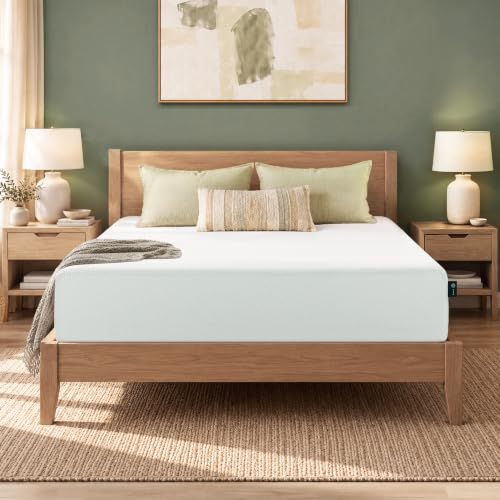
The Zinus 12 Inch Green Tea Memory Foam Mattress leads on the strength of one specification repeated through this guide: high-density support foam, here layered in a full twelve inches — pressure-relieving memory foam over airflow-enhancing comfort foam over a dense base that the brand describes in firm-support terms. Density is what separates foam that compacts in two years from foam that holds five, and the Zinus spends its budget there rather than on branding. Green tea and charcoal infusions manage freshness in a bed that works harder, and the CertiPUR-US certification verifies the foam file.
Strengths
- Density-first construction at the pool’s best durability-per-dollar position
- Twelve inches of travel absorbs above-average load without bottoming
- Medium-firm support suits the back and side positions most sleepers rotate through
Trade-offs
- Foam edges are adequate, not armored — heavy edge-sitters should look to the hybrids
- Slow foam response when turning
- At the top of the overweight range, coils carry more margin
| Color | White |
| Size | Queen |
| Dimensions | 80 x 60 x 12 inches |
| Weight | 62.3 pounds |
The Zinus ownership experience under above-average load is about the second year: the year standard value mattresses begin their visible decline. Its dense base slows that clock materially — not forever, because foam physics is foam physics, but long enough that the purchase amortizes the way a mattress should. Its medium-firm feel also corrects properly for load: what an average tester calls medium-firm, an overweight sleeper experiences as a supportive medium, which is the zone most positions want.
Pair it with a solid foundation and quarterly rotation, and it is the guide’s default recommendation: the most margin available before the price ladder’s next rung, from the pool’s most proven value brand.
Best for: overweight sleepers wanting maximum foam durability per dollar / Not suited for: the highest loads or committed edge-sitters
Choose it for dense value; skip it if you want steel’s horizon. Check on Amazon

GhostBed Classic 11 Inch Memory Foam Mattress
Our badge: Best Dense Core
The GhostBed Classic 11 Inch Queen Memory Foam Mattress builds its identity on a high-density core for spinal alignment, in a balanced medium-firm feel the brand aims at every position — and for an overweight sleeper, that combination is the foam category’s most load-literate mainstream design. Above the core, gel memory foam and an aerated latex layer keep the surface cool and springy, which matters doubly under load: a heavier body generates more heat and pays more effort to turn, and this surface discounts both. CertiPUR-US certified, made in the USA and Canada, at just fifty pounds.
Strengths
- High-density core: the foam specification that predicts support life
- Lively surface cuts the turning effort heavier bodies pay in slow foam
- Cooling layers sized for a warmer body’s output
Trade-offs
- Contains a latex layer — excluded for latex-sensitive shoppers
- Eleven inches is adequate travel; the deepest loads prefer twelve-plus
- Uniform support without zoning
| Color | White |
| Size | Queen |
| Dimensions | 80 x 60 x 11 inches |
| Weight | 50 pounds |
The GhostBed is the foam pick for the overweight sleeper who moves: combination sleepers, restless sleepers, anyone whose night involves frequent repositioning. Its density holds the support line while its latex-bounce surface keeps movement cheap, and the combination ages gracefully because the core — the part that determines year-three feel — is the part the brand spent on. Its light weight is a maintenance dividend: rotation, the durability habit this guide preaches, is a one-person job here.
Against the Zinus it trades an inch of depth for a livelier, cooler surface and an American-made file; against the coils it trades ultimate horizon for silence and stillness. For the center of the overweight range, it is a genuinely complete answer.
Best for: active, combination overweight sleepers wanting dense foam with an easy surface / Not suited for: latex-sensitive shoppers
Choose it for dense, lively foam; skip it if you want maximum depth. Check on Amazon

Novilla Bliss Queen Size Mattress
Our badge: Best Plush-Top Margin
The Novilla Bliss Queen Size Mattress is the guide’s comfort diplomat: a plush pillow top over individually wrapped coils, in a twelve-inch hybrid build. Its inclusion in a load guide is deliberate — many overweight sleepers have been told to choose between comfort and durability, and the Novilla’s structure declines the choice: the pillow top cushions the contact surface while the coil core underneath carries the load with steel’s longevity. The wrapped coils also isolate a partner’s motion, and the brand positions the medium feel across back, side, and stomach positions.
Strengths
- Coil core carries the load; pillow top carries the comfort — each material doing its honest job
- Wrapped coils localize support and damp partner motion
- Twelve-inch profile gives the comfort layers travel to work in
Trade-offs
- The plush top will compact faster than the core beneath it — rotation matters doubly
- Newer brand against legacy quality records
- Heavier sleepers near the range’s top should take the firmer coil picks
| Color | Grey |
| Size | Queen |
| Dimensions | 80 x 60 x 12 inches |
| Weight | 61.5 pounds |
The Novilla serves the overweight sleeper whose previous “durable” mattress felt like sleeping on a parking structure: support need not be punitive, and a coil core with a genuine comfort layer proves it nightly. Its medium feel under load reads supportive rather than soft — the load correction this guide describes — and the pillow top spares shoulders and hips the break-in period firmer picks impose.
Its discipline requirement is rotation: pillow tops wear where bodies lie, and quarterly turns keep the comfort layer’s clock honest. Sleepers willing to keep that appointment get the guide’s most comfortable margin per dollar.
Best for: overweight sleepers wanting real comfort over a load-bearing coil core / Not suited for: the top of the load range or rotation-averse owners
Choose it for comfort with a steel spine; skip it if you want maximum firmness discipline. Check on Amazon

Tuft & Needle Original Legacy Mattress
Our badge: Best Adaptive Support
The Tuft & Needle Original Legacy Medium Firm Gel Foam Queen Mattress offers the overweight sleeper a clever piece of physics: T&N Flex foam that firms as you settle deeper, so support scales automatically with the sleeper’s weight — a heavier body presses deeper and meets a firmer answer, exactly the correction this guide otherwise tells shoppers to apply manually. T&N Adaptive foam contours on top, cooling gel and graphite manage heat, a ventilated layer relieves pressure, and the certifications (CertiPUR-US, GREENGUARD Gold) are the pool’s strongest air-quality file.
Strengths
- Load-scaling support: the mattress firms its answer in proportion to your weight
- Responsive surface keeps turning cheap for a heavier body
- Cooling and certification stacks are best-in-class at its tier
Trade-offs
- Ten inches is the guide’s slimmest travel — the top of the range should look deeper
- Two-week break-in before judgment
- Foam horizon remains shorter than coils under sustained load
| Color | White |
| Size | Queen |
| Dimensions | 80 x 60 x 10 inches |
| Weight | 72 pounds |
The Tuft & Needle suits the lower-to-middle overweight range best, where its ten inches of adaptive foam have travel to spare and its self-scaling firmness feels like a custom fit. Its hundred-night trial and ten-year warranty are fairly framed, and its easy movement makes it the foam pick for combination sleepers whose positions — and therefore load maps — change nightly.
Heavier sleepers approaching this guide’s upper boundary should read its trade-off honestly and step to the twelve-inch picks. Within its range, it is the most intelligent foam behavior available at a mainstream price.
Best for: light-to-mid overweight combination sleepers wanting self-scaling support / Not suited for: the top of the load range needing depth
Choose it for adaptive intelligence; skip it if you need maximum travel. Check on Amazon

Signature Design by Ashley Chime 12 Inch Hybrid Mattress
Our badge: Best Coil Discipline
The Signature Design by Ashley Chime 12 Inch Hybrid Full Size Mattress in a Box brings steel discipline at a value tier: 13-gauge pocketed coils — the thickest wire in the pool — with reinforced perimeter rows and a high-density gel lumbar layer, across a twelve-inch full-size build with a 180-night trial. For an overweight single sleeper in a full frame, it is margin in its purest form: coils that fatigue slowest, edges that hold, and a lumbar zone that spends extra density where a body’s mass centers. Flagged as always: full size only in this listing.
Strengths
- Firm-gauge coils deliver the longest support horizon per dollar here
- Reinforced edges keep the full width and the morning stand-up honest
- 180-night trial covers the seasons where support fade announces itself
Trade-offs
- Full size only — queen shoppers should take the Sealy
- Firm, no-nonsense feel; comfort-first shoppers look to the Novilla
- Less motion isolation than the foam picks
| Color | White |
| Size | Full |
| Dimensions | 74.4 x 53.3 x 12 inches |
| Weight | 62 pounds |
The Chime’s firmness deserves the load correction stated plainly: under an overweight body, its assertive support reads as correct rather than harsh, because the body compresses it into the comfort zone an average tester reaches on a softer bed. That is why it recurs across this lot’s load guides — it is the rare value product whose headline specification is the one durability actually runs on.
On a rated full-size foundation, rotated quarterly, it will out-support mattresses costing considerably more. For its size class, it is the guide’s easiest recommendation.
Best for: single overweight sleepers in full frames wanting maximum coil margin / Not suited for: couples or queen rooms
Choose it for gauge; skip it for width. Check on Amazon

Sealy Dreamlife 12″ Hybrid Mattress-in-a-Box
Our badge: Best Long-Term Structure
The Sealy Dreamlife 12″ Hybrid Mattress-in-a-Box closes the guide as the decade-horizon pick: seven inches of individually encased coils under gel memory foam and a high-density transition layer, from a legacy brand whose quality control is itself a durability feature. Encased coils localize an overweight sleeper’s load to its own coil neighborhood, hold their response for years beyond foam’s clock, and ventilate the bed passively. Surface-Guard antimicrobial technology and CertiPUR-US foams complete a build with no weak file.
Strengths
- The longest support horizon in the guide — coils plus legacy manufacturing
- Localized support resists the center-wear pattern of above-average loads
- Airflow and gel manage the warmer sleep heavier bodies experience
Trade-offs
- Positioned above the value foam picks in the range
- Motion isolation trails all-foam options
- Just over eighty pounds at setup
| Color | Dreamlife |
| Size | Queen |
| Dimensions | 80 x 60 x 12 inches |
| Weight | 80.6 pounds |
The Sealy is the answer to the overweight sleeper’s most expensive habit: replacing declining mattresses. Its structure declines slowest, so its cost per supported year undercuts the value picks it outprices at the register — the arithmetic this whole guide is built on. Its comfort layer keeps the structure from feeling industrial, and its coil perimeter keeps the edges working.
Buy it on a rated foundation, rotate it quarterly, and expect the support you calibrated to in month one to be substantially the support you keep. For a one-and-done purchase at this load, it is the guide’s structural recommendation.
Best for: overweight sleepers wanting the longest support horizon in a queen / Not suited for: strict budgets or motion-isolation purists
Choose it for the decade; skip it if the Zinus’s value math wins your spreadsheet. Check on Amazon
Comparison Table
| Pick | Durability Technology | Feel Under Load | Profile | Check price on Amazon |
|---|---|---|---|---|
| Zinus 12″ Green Tea | High-density support foam | Supportive medium-firm | 12 inch | Check price on Amazon |
| GhostBed Classic 11″ | High-density core + latex | Medium-firm, springy | 11 inch | Check price on Amazon |
| Novilla Bliss | Wrapped coils + pillow top | Medium, cushioned | 12 inch | Check price on Amazon |
| Tuft & Needle Original | Load-firming adaptive foam | Medium, responsive | 10 inch | Check price on Amazon |
| Ashley Chime 12″ | 13-gauge pocketed coils | Medium-firm, disciplined | 12 inch (Full) | Check price on Amazon |
| Sealy Dreamlife 12″ | Encased coils | Supportive hybrid | 12 inch | Check price on Amazon |
How to Choose the Best Mattress for an Overweight Sleeper
Apply the One-Notch Rule
Whatever the consensus recommends for your position — firmness, softness, price tier — buy one notch more durable: firmer, denser, deeper. The rule works because every consensus number was calibrated on average bodies, and your load spends a mattress’s margin faster. One notch is the correction; two notches is a parking lot. The trial verifies the calibration — log mornings for a month before judging.
Read Density and Gauge, Not Adjectives
“Supportive,” “orthopedic,” and “luxury firm” are not specifications. Density language in foam cores, coil gauge and construction in hybrids, and profile depth are. This guide’s picks all publish at least one real specification; demand the same of any outside candidate, and treat a listing that offers only adjectives as a listing whose numbers would not help it.
Protect the Margin You Bought
A rated foundation, quarterly rotation, and a protector: the unglamorous trio that decides whether margin survives contact with reality. Overweight sleepers get more durability per rotation than anyone, because their load map is deeper — redistribute it before it engraves. The Best Mattresses For Heavy Couples guide covers the two-body version of the same maintenance math.
Budget by Cost Per Supported Year
A value mattress replaced in three years costs more per year than a mid-tier mattress replaced in seven — and the declining years are slept on declining support. When two picks both fit, divide price by honest expected support life under your load. This guide’s ordering quietly follows that arithmetic; your spreadsheet should too.
Edges and Exits Count Double
Above-average weight loads the perimeter harder at every sit and stand, and weak edges shrink the usable bed nightly. Sit on the edge during the trial’s first week — if it slides or collapses, the mattress’s margin does not extend to its borders, and your mornings will know before your back does. Our Best Throw Pillows For Bedrooms Under $200 live guide is unrelated to load — but the pillows you prop against for reading in a firmer bed are a comfort worth having once the support is right.
How Do You Make a Mattress Last Longer Under Load?
Rotate head-to-foot quarterly — put it on the calendar, because memory fails and load does not. Keep the foundation honest: check center supports and slats annually, since bases sag quietly under sustained weight and take mattresses down with them. Use a protector from night one; moisture accelerates foam aging, and warranties exclude fluid damage. Let the mattress air on sheet-change mornings. Avoid sitting on the same edge spot for long daily sessions — vary the reading chair position if the bed doubles as your lounge — and keep jump-based bed use (kids, pets at play) in perspective: dynamic loads multiply static ones. None of this is heroic; all of it compounds, and under above-average load the compounding is the product.
Problem: a body impression is forming in year two — rotate now and check the foundation; early impressions redistribute, permanent ones are warranty conversations with measurement photos.
Problem: the bed feels softer than the trial promised — verify the foundation has not sagged (the most common culprit), then judge the mattress; bases fail silently and first.
Problem: edges are going soft while the center holds — your sit-load is concentrated; vary sitting spots, and grade named edge systems first in the next purchase.
Problem: you sleep hotter than you used to — compacted foam traps more heat each year; a cooling-focused replacement or breathable bedding refresh are the honest levers.
Problem: your partner’s side feels different from yours — mismatched loads wear a shared mattress unevenly; rotation equalizes some of it, and local-response designs (coils, adaptive foam) prevent most of it next time.
The Second-Year Problem: Why This Keyword Exists
Ask overweight sleepers about mattresses and a pattern emerges: the first year is fine almost everywhere, and the complaints cluster in year two and three — the trough, the softened middle, the morning stiffness that crept back. That clustering is the physics of margin: standard mattresses carry enough for average loads indefinitely and enough for above-average loads temporarily. This guide exists to move the purchase one notch up the margin ladder so the second year resembles the first. If you take one idea from this page, take the calendar test: do not ask how a mattress feels tonight — ask what in its construction (density, gauge, depth) is still working in year three. Every pick here can answer that question in specifications.
Overweight vs Obese vs Heavy Couples: Which Guide Is Yours?
The lot’s three load guides divide the spectrum by engineering need. This guide serves the individual above-average sleeper whose loads mainstream products can carry with margin. Best Mattresses For Obese serves higher individual loads where maximum mainstream engineering — deepest profiles, strongest edge systems, flagship warranties — is the correct spend. Best Mattresses For Heavy Couples serves two-body loads, where the combined map and the center trough dominate. Shoppers between categories should read up one guide: the cost of margin you do not need is small, and the cost of margin you do need is a mattress replaced early.
Weight Changes and the Mattress: Buying for the Body You Have
Bodies change — through training, illness, medication, pregnancy, and the ordinary decades — and the overweight sleeper’s mattress decision sits inside that trajectory whether the shopper names it or not. The practical rule is to buy for the body you have tonight, with margin, rather than for a body you hope to have by summer: a mattress specified for an aspirational weight will under-serve every night of the journey, and the journey’s sleep quality is itself one of the strongest predictors of whether health goals survive contact with exhaustion. The margin this guide keeps prescribing is precisely what makes a mattress tolerant of change in both directions — a support system bought one notch up carries a body that gains a little without complaint and a body that loses a lot without feeling like a board, because density and depth forgive in both directions. Flippable and zoned designs forgive most of all, which is why they recur across this lot’s load guides.
The honest exception is a planned, major, clinician-supervised change — bariatric surgery being the clearest case — where the body’s load may shift by an amount that genuinely re-specifies the mattress within a year or two. There, the staged strategy wins: a sound mid-tier mattress now, bought without flagship commitment, and the flagship purchase deferred until the new equilibrium, when it can be specified correctly and enjoyed for its full life. Between those poles, the everyday shopper’s answer is this guide’s: margin, density, rotation, and a trial long enough for the body you have to render its verdict. Readers at either boundary of this guide’s range will find the neighboring specifications in Best Mattresses For Obese above and the lot’s position guides below — and the guest-room corollary, a bed that welcomes visiting family of every size without comment, in Best Mattresses For Sleeper Sofas.
The Overweight Sleeper’s Trial: Grading Support the Way Load Experiences It
A trial graded by average-body habits misleads an overweight sleeper, because the failure modes of load arrive on a different schedule. First impressions flatter every mattress — the question load asks is not how the surface feels on night three but how the support behaves at week six, when the comfort layers have taken their initial set and the core’s true character emerges. Grade accordingly: reserve judgment through the first fortnight, then run the load-specific audits. The center test: lie in your usual position for ten minutes at the mattress’s center and at its edge zone, and compare the level your body finds — a growing difference between the two is the trough announcing itself early. The partner test, for couples: roll toward each other deliberately and note whether the surface shepherds you — shared platforms under mismatched loads declare themselves here before they declare themselves at 3 a.m. The morning-after test remains the master metric, logged as this lot’s guides prescribe, but weighted toward stiffness patterns: load-related support failure presents as lumbar stiffness that was absent in the trial’s first weeks and grows across them, a trend line no single morning can show.
Keep the audits honest by keeping the foundation out of the suspect list — verify it once, at setup, with the straightedge check this guide’s how-to describes, so that every later observation is about the mattress alone. An overweight sleeper who trials this way converts the return window from a formality into the most informative month of the purchase, and either keeps a mattress the evidence endorses or returns one the evidence convicted while returning is still free. That is the entire advantage of buying under load with a method: the body files its report either way — the log simply makes sure somebody reads it.
Exercise, Recovery, and the Overweight Sleeper’s Night Shift
The overweight sleeper is statistically likely to be doing the thing every clinician recommends — exercising more than they used to — and the mattress’s role in that project is underappreciated: adaptation happens at night. Muscles trained by day repair during deep sleep; joints loaded by a new walking habit unload across the same hours; and the motivation for tomorrow’s session is substantially decided by how rested the morning feels. A support system that is quietly failing taxes all three — fragmenting the deep sleep with discomfort-driven position changes, leaving the trained tissue braced instead of recovering, and greeting the exerciser with the stiffness that argues for skipping today. This is the virtuous circle of the load guides stated from the other side: the mattress is not a reward for the fitness project but part of its equipment, as load-bearing in its way as the shoes.
Practical corollaries follow. The trial of a new mattress should span training days and rest days alike, because recovery nights grade a surface differently than sedentary ones. Soreness from a new program should be logged as what it is — training soreness, with its own 48-hour rhythm — rather than billed to the mattress in week one. And the exerciser whose weight is genuinely changing should revisit this guide’s margin logic at each plateau: the specification follows the body, and a body in motion deserves a support system re-checked against its current load, not its starting one.
Partners of Different Sizes: The Middle-Load Diplomacy
Many readers of this guide share the bed with someone whose load differs from theirs by enough to matter — and the mismatch, not the absolute weight, is often the real specification. A uniform mattress mediates the difference by averaging, and averaging serves the heavier partner a surface slightly too soft and the lighter partner one slightly too firm, with a gentle slope toward the heavier side as the years compact it. The designs that resist averaging are the recurring heroes of this lot’s load coverage: encased coils that carry each zone independently, adaptive foams that firm under the deeper-pressing body, and grids that flex by point rather than by platform. Couples in the overweight band’s diplomacy should also use the cheapest asymmetry available — bedding. The lighter partner who runs cold takes the heavier duvet; the heavier partner who runs warm takes the sheet alone; and the shared surface, freed of the temperature negotiation, can be chosen on support alone.
Grade the trial as a couple or not at all: two logs, an agreed rule that the worse-served sleeper’s trend decides, and a rotation rota that survives both partners’ work schedules. A mattress that passes a two-body audit at this load will rarely surprise either sleeper later — the surprises were all scheduled, witnessed, and logged in the first month, where they belong.
Reading Owner Reviews as an Overweight Shopper
Review sections are written disproportionately by average-weight sleepers, and the overweight reader needs a translation layer this guide can provide. First, filter by the reviewers who disclose a comparable build — their firmness reports are your data; everyone else’s are weather from another climate. A mattress that average reviewers call “too firm” is frequently the overweight sleeper’s correct medium-firm, and the reverse translation applies to every “perfectly soft” rave. Second, mine the longevity reports by the same filter: a support complaint at month eighteen from a comparable body predicts your experience more reliably than a hundred first-week impressions from lighter ones. Third, treat the absence of comparable reviewers as information in itself — a mattress with no heavier owners reporting may be one heavier owners returned early, and the trial terms then matter more than the testimonials.
The brands in this guide were chosen partly because their review bases are deep enough to sustain this filtering — thousands of owners, among whom the comparable bodies can actually be found. That depth is a product feature no specification sheet lists, and at this load it is worth real money. Read like an auditor, buy like an engineer, and let the comparable strangers in the review section do what they unknowingly volunteered for: testing your mattress before you had to.
The Middle Path, Stated Plainly
This guide’s whole argument fits in a paragraph, and it deserves one before the mistakes section. The overweight sleeper does not need a specialty product, a medical device, or a flagship — they need the mainstream mattress they would have bought anyway, specified one notch more honestly: denser where foam is concerned, deeper where profile is concerned, firmer where the showroom’s calibration is concerned, and maintained like the load-bearing equipment it is. Every pick here is that paragraph made physical, at prices that respect the household’s other obligations. The market will try to sell this reader both less (the plush bargain that troughs by spring) and more (the flagship whose margins address loads twice theirs). The middle path — margin, density, rotation, evidence — is where the value lives, and it has been this guide’s only recommendation from its first line.
Aging Into the Specification: The Overweight Sleeper at Sixty
The load guides in this lot are usually read as weight documents, but they are equally age documents, and the overweight sleeper’s later decades deserve their own paragraph. As tissue thins over the contact points and circulation forgives less, the same load that a forty-year-old’s body distributed without comment begins to file pressure complaints — which means the margin this guide prescribes buys its second dividend in the sleeper’s sixties, when the surface’s kindness matters as much as its support. Mobility joins the specification in those decades as well: the responsive surfaces and honest edges weighted throughout this guide become the difference between a bed that assists its owner’s independence and one that taxes it daily. Buy the margin now, while it reads as prudence, and it will read as foresight later — the same purchase, appreciated by two different decades of the same body.
Postscript: The Reader This Guide Was Written For
This guide was written for a specific reader: the one who has replaced a mattress a year or two early, more than once, and quietly suspected the pattern had a cause. It does — the margin was never bought, because nobody told this reader it was for sale, or that it cost one notch rather than one flagship. Now the pattern has a name and the fix has a specification. Buy the notch, keep the rotation, file the paperwork, and let the next replacement be scheduled by evidence in a year of your choosing rather than by a trough in a month of its own. That is the entire promise, and the picks above are how it is kept.
One Sentence to Carry Into the Purchase
Here is the guide in a sentence, for the moment the listings start to blur: buy one notch more mattress than the average-body consensus recommends — denser, deeper, firmer — put it on a foundation rated for the truth, rotate it like you mean it, and let a month of logged mornings, not a night of first impressions, decide whether it stays. Every review above is that sentence wearing a brand name. Every mistake below is that sentence ignored. The notch is small, the decade it buys is not, and the reader who has replaced one mattress too early already knows exactly what the sentence is worth.
Common Buying Mistakes
Buying the Average-Body Consensus Pick
Best-of lists calibrated on average testers undersell your load by design. Apply the one-notch rule to any recommendation — including, honestly, this one’s firmness language.
Chasing Plush Comfort
Plush layers under above-average load compact first and fastest, converting a comfort feature into the trough’s first draft. Comfort for load is depth and zoning wearing a decent top layer — the Novilla pattern — not softness itself.
Forgetting the Foundation’s Share
Half of “mattress sag” at this load is base sag. Rate the foundation, inspect it annually, and never let a bargain base invoice your flagship.
Skipping Rotation Because Nothing Looks Wrong
Rotation works before impressions are visible; after they are visible, it merely slows them. Calendar the turns while the surface still looks new.
Replacing on the Calendar Instead of the Evidence
Load varies; so does wear. Replace when support measurably declines — trough, morning stiffness returning, edges gone — not when an anniversary arrives. Your body keeps the real records.
Final Recommendation
The Zinus 12 Inch Green Tea Memory Foam Mattress is our top pick for overweight sleepers: high-density support in a full twelve inches at the tier where durability-per-dollar peaks. Sleepers wanting the longest horizon should take the Sealy’s encased coils — Check on Amazon — active combination sleepers the GhostBed’s dense, lively core, and comfort seekers the Novilla’s coil-backed pillow top. Whatever you choose: one notch up, a rated foundation, quarterly rotation. Margin is the whole strategy — buy it once and sleep on it for years.
Frequently Asked Questions
What firmness is best for overweight sleepers?
One step firmer than the average recommendation for your position — typically medium-firm to firm with real architecture beneath it. Your load compresses the mattress further, so a medium-firm here experiences like the supportive medium your position wants.
Is memory foam durable enough for overweight sleepers?
High-density memory foam builds — the Zinus and GhostBed pattern — hold support respectably for years under above-average load. Low-density budget foam does not. The specification that decides it is density in the support core, not the material’s name.
How thick should the mattress be?
Ten inches is a floor, twelve is the comfortable standard, and more is margin. Depth is compression travel: above-average loads spend it faster, and bottoming out against the core is what early troughs are made of.
Hybrid or foam for an overweight sleeper?
Hybrids hold support longest and breathe better; dense foam isolates motion and costs less per inch of depth. At the center of the overweight range both work — choose by budget horizon: foam for value now, coils for cost-per-year over a decade.
How can I make my mattress last longer?
Quarterly rotation, a rated foundation inspected annually, a protector from night one, and airing on sheet-change mornings. Under above-average load these habits are worth years — they are the cheapest durability in this entire category.
When should I read the obese or heavy-couples guides instead?
When your individual load is at the higher ranges — where flagship engineering and stated capacities matter — or when two sleepers share the load. Reading up one guide costs nothing; underbuying margin costs a mattress.


