Disclosure: As an Amazon Associate, dailyhomedecorating.com earns from qualifying purchases. Links to Amazon on this page are affiliate links; they cost you nothing extra. Prices and availability change often, so check the current Amazon listing before you buy.
The best desk chairs for medical students are built for a sitting load most workers never meet: anatomy decks at midnight, question banks on weekends, lecture videos at double speed, and study blocks that stretch from breakfast to the small hours in exam season. Medical students do not sit like office workers — they sit like endurance athletes whose sport is stillness, in small rooms, on student budgets, often at desks that double as dining tables. This guide ranks six chairs from a verified product pool for that exact life: support that survives twelve-hour days, dimensions that fit student rooms, constructions that survive house shares and moves, and prices left to the listings — check them, because student tiers move fast. If your study has become a home office in all but name, Best Ergonomic Desk Chairs For Home Office ranks this pool on adjustment depth for working adults.
Every specification below comes from verified listing data — dimensions, weights, stated features and capacities exactly as listed, nothing estimated or invented. Read the Quick Picks for the short answer, the reviews for the study reasoning, and the rhythm sections for the sitting-and-break patterns that examiners never teach and every senior student wishes someone had.
Where to Buy
All six picks are sold on Amazon. Check the current listing for the latest price, colour options, delivery timing and availability before you buy, because all of these change often — and student budgets feel every change.
- Hbada P5 Ergonomic Office Chair — our first choice for long study days. Check on Amazon
- Herman Miller Classic Aeron Chair-Aluminum — Check on Amazon
- Respawn 110 Pro Ergonomic Gaming Chair with Footrest and Recline — Check on Amazon
- Secretlab Titan Evo Black Gaming Chair – Regular — Check on Amazon
- Homall Gaming Chair — Check on Amazon
- Karl home Mid-Century Lounge Accent Chair — Check on Amazon
In this guide
Quick Picks
| Pick | Badge | Why it earns its place |
|---|---|---|
| Hbada P5 Ergonomic Office Chair | Best Overall | Adjustable everything, breathable mesh, modest footprint — the study-day all-rounder. |
| Herman Miller Classic Aeron Chair-Aluminum | Best Premium | Suspended support that cannot flatten across a degree’s worth of sitting. |
| Respawn 110 Pro Ergonomic Gaming Chair with Footrest and Recline | Best for Recline Breaks | 155-degree recline plus footrest: the power-nap and review chair in one. |
| Secretlab Titan Evo Black Gaming Chair – Regular | Best for Fine-Tuning | 4D arms and moulded foam for students who study and game at one desk. |
| Homall Gaming Chair | Best Budget | Headrest, lumbar pillow, recline and footrest at a student-tier price. |
| Karl home Mid-Century Lounge Accent Chair | Best Reading Corner | The textbook chair: lumbar pillow, linen, and a posture change from the desk. |
Key Takeaways
- Start with the Hbada P5: it adjusts to you, breathes in warm rooms, and fits student footprints.
- Study posture is three postures — drill, read, review — and the best chairs serve all three, recline included.
- Mesh beats foam in un-air-conditioned student rooms by hour six of a summer revision day.
- Buy for the whole degree if you can; a chair bought in first year should still support you in finals.
- Every pick is specified from verified data only; check the Amazon listing for current price and availability.
- On the tightest budgets, compare Best Home Office Chairs Under $100 for the tier below this guide’s budget pick.
How These Picks Were Chosen
The pool for this guide was fixed before writing began: chairs with Amazon listings whose titles, brands and specifications could be verified. Shortlisting for medical students applied study-specific filters. Endurance of support across extreme daily hours — constructions that do not flatten. Adjustment reachable from the seat, because a student mid-question-bank will not fetch a tool. Thermal comfort for small, warm rooms. Footprint and weight for rooms that are also bedrooms and for the moves student life guarantees. And a budget spread honest about student finances, from an entry pick to a buy-once-for-the-degree premium, with prices left to the listings where they belong.
The method is stated plainly, as throughout this series: verified manufacturer and listing data assessed against the known demands of long study. No hands-on testing is claimed, and no medical claims are made — fittingly, for this audience: a chair supports study; it does not treat anything. No prices are printed because they change; no popularity figures appear because they would be stale. Where numbers appear — break intervals, recline angles — they are widely used study-rhythm benchmarks, offered for adaptation, not prescription.
Badges follow the ranking: Best Overall for the study all-rounder, then premium endurance, recline breaks, fine-tuning, budget, and a reading-corner chair whose inclusion is argued in its review — textbook and paper reading is a third of a medical student’s sitting, and it happens badly in a desk chair or not at all. Students whose study is shading into research years and paid work should also weigh Best Chairs For Working Long Hours, where the same endurance logic is ranked for employees.
The 6 Best Desk Chairs for Medical Students — Reviewed

Hbada P5 Ergonomic Office Chair
Our badge: Best Overall
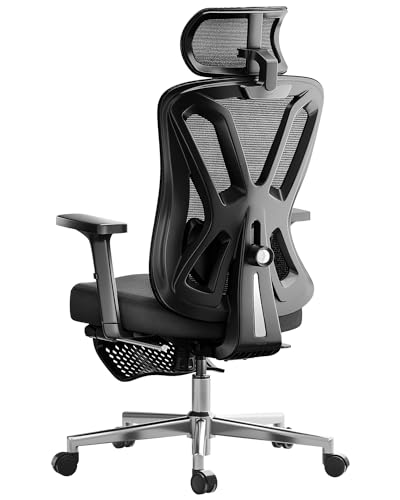
The Hbada P5 Ergonomic Office Chair fits student life point by point: adjustable lumbar support that travels to your waist, armrests that raise and lower, a 2D headrest, a 135-degree recline for review sessions, a 3.35-inch seat-height range for desks of every provenance, and an S-shaped mesh back that breathes through summer revision in rooms without air conditioning. The listing notes SGS certification and BIFMA testing, and at 44 pounds the chair survives the annual room move without a removal company.
Strengths
- Adjustable lumbar support moves up and down to meet your back
- 2D headrest adjusts in height and angle for neck support
- Mesh back breathes through long, warm study sessions
Trade-offs
- Mesh feel is firmer and less plush than foam chairs
- Sized best for users roughly five feet to five-nine in height
- Footrest configuration adds bulk some small rooms cannot spare
| Color | Black |
| Size | 27.56 x 27.56 x 49.41 inches |
| Dimensions | 10.85039368972 x 10.85039368972 x 19.45275588567 inches |
| Weight | 44 pounds |
| Product Group | Furniture |
The study-specific virtues compound. Every adjustment is reachable from the seat — no tools, no standing — so the mid-session re-tune actually happens. Mesh shrugs off the coffee-and-midnight reality of student rooms and vacuums clean in seconds. The black design disappears into a small room’s background and reads professional on the video calls that now include patient-communication practice and remote tutorials. And the mid-tier positioning, which you should verify on the listing, is the sweet spot of the student budget: real ergonomics without the premium that belongs in a textbook fund.
The size guidance is the standing check — users roughly five feet to five-nine are the stated band, so taller students should read the Titan review before ordering. Within band, for the median medical student in the median small room, this is the guide’s confident first answer.
Best for: Most medical students, for most study, in most student rooms / Not suited for: Very tall students, or anyone wanting a plush foam seat
Choose it for the complete study brief; skip it if your height outruns its band. Check on Amazon
Herman Miller Classic Aeron Chair-Aluminum
Our badge: Best Premium
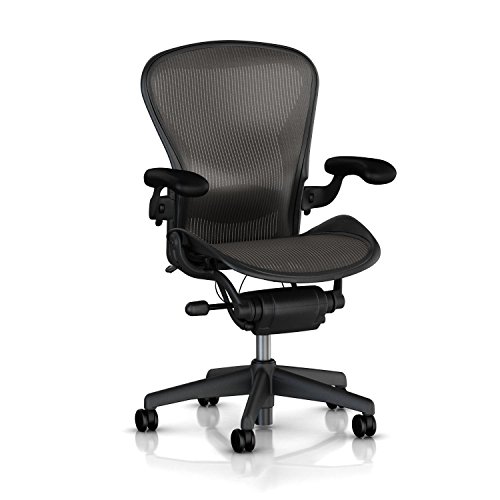
The Herman Miller Classic Aeron Chair-Aluminum is the buy-once answer: a suspended seat and back that cannot flatten across four or more years of extreme sitting, with tension control, tilt lock, forward tilt and lumbar support. For a student whose family wants to make one durable investment in the degree — or a graduate student tired of replacing chairs — the endurance arithmetic is genuinely different here. This listing is Size B, the medium, in aluminum at 50 pounds, with hardwood-floor casters that landlords’ floors will appreciate.
Strengths
- Tension control, tilt lock and forward tilt give precise movement control
- Lumbar support and breathable suspension keep long days comfortable
- Hardwood-floor casters are specified for finished floors
Trade-offs
- Size B medium will not fit very tall or very small users correctly
- Controls take a weekend to learn and set properly
- No headrest for the lean-back review session
| Color | Black |
| Size | Size B (Medium) |
| Dimensions | 16 x 27 x 41 inches |
| Weight | 50 pounds |
| Product Group | Furniture |
| Binding | Kitchen |
Forward tilt earns a student’s attention specifically: annotating, writing and tablet work all pull the body into a lean, and this chair supports the lean instead of abandoning you to a perch. The suspended surface also solves the student-room heat problem as completely as mesh does, with no foam anywhere in the system to age, absorb spills or harbour the archaeology of shared houses. Resale value, which students rightly care about, is historically the strongest of any chair in this pool — a degree-long asset rather than a consumable.
The disciplines are size and configuration: Size B must fit your seated measurements, and the exact options should be confirmed on the listing, whose pool data is concise. Students in the band, with the horizon, get the benchmark. Students outside it get an expensive lesson in why this guide measures first.
Best for: Long-horizon students sized for Size B, and resellers-in-waiting / Not suited for: Students outside the medium band, or headrest devotees
Choose it on measurements and horizon; skip it on either mismatch. Check on Amazon

Respawn 110 Pro Ergonomic Gaming Chair with Footrest and Recline
Our badge: Best for Recline Breaks
The Respawn 110 Pro Ergonomic Gaming Chair with Footrest and Recline is built around the study rhythm this guide preaches: dual-density foam, lumbar support and a cushioned headrest for the upright blocks; then a 155-degree recline with infinite angle lock and a reinforced retractable footrest for the breaks — including the twenty-minute power nap that exam season runs on, taken without the catastrophe of lying down on a bed. Its gray fabric keeps a small room calm and stays cooler than PU leather.
Strengths
- 155-degree recline with infinite angle lock is the deepest here
- Retractable footrest is reinforced with multi-point brackets
- Dual-density foam and fabric upholstery stay cooler than PU leather
Trade-offs
- Supports up to 275 lb, less headroom than rivals for larger users
- Fabric needs prompt attention after study-snack incidents
- Reclined footprint is long for the smallest rooms
| Color | Gray Fabric |
| Size | 28.50″ D x 26.75″ W x 51.50″ H |
| Dimensions | 28 x 26.4 x 51.2 inches |
| Weight | 46.3 pounds |
| Product Group | Furniture |
| Binding | Kitchen |
The nap point deserves expansion, because it is a real study technology: a reclined rest in the chair, alarm set, lights on, is recoverable in a way a bed nap at 4pm is not — grogginess, lost hours, inverted sleep. The Respawn’s recline-plus-footrest is the only setup in the pool that honestly serves it. Between naps, the same recline serves video lectures at the angle lectures deserve, and the swivel covers the reach to shelf, printer and kettle-adjacent surfaces of a student desk.
Measure the room for the recline arc before ordering, and respect the 275-pound stated capacity. For the student whose room is also the library, the cinema and the nap facility — most students — it is the most complete single-chair answer after the Hbada, and the first choice of anyone whose study style is block-and-recover.
Best for: Block-and-recover studiers and power-nappers / Not suited for: Users over the stated capacity, or rooms without recline clearance
Choose it for the rhythm; skip it if the room cannot fit the recline. Check on Amazon

Secretlab Titan Evo Black Gaming Chair – Regular
Our badge: Best for Fine-Tuning
The Secretlab Titan Evo Black Gaming Chair – Regular serves the student whose desk is also the gaming station, the streaming seat and the reading chair — and who wants one precise fit for all of it. Cold-cure foam holds its moulded shape across years of double-duty; 4D armrests place elbows exactly for keyboard, controller or textbook; the magnetic memory-foam head pillow slides to your head; built-in lumbar support covers the curve. Rated to 285 pounds in the Regular size.
Strengths
- Cold-cure foam holds its shape and support for years
- Magnetic memory-foam head pillow adjusts over a wide range
- 4D armrests and built-in lumbar support dial in a precise fit
Trade-offs
- At 76 pounds, house moves become a two-person negotiation
- Premium positioning means you must check the listing carefully against a student budget
- Regular size will feel snug for very tall or broad users
| Color | Black |
| Size | Regular |
| Dimensions | 19.291338563 x 22.047244072 x 53.937007819 inches |
| Weight | 76.05948039 pounds |
| Product Group | Furniture |
| Binding | Home |
The student-specific calculus is consolidation: one chair bought well can replace the cycle of cheap chairs that die each academic year, and the Titan’s construction is the pool’s strongest argument that the cycle can end. The leatherette wipes clean after the incidents student rooms specialise in, and the black finish keeps the chair employable on camera for telemedicine practice and interviews. Its weight is the lifestyle cost — this chair moves house when you do, with help, and otherwise stays.
Verify size guidance on the listing if you are at the extremes of the Regular’s intent. For the study-and-play student with a multi-year horizon at one address, it is the premium pick that earns its tier in daily, double-shift use.
Best for: Study-and-gaming consolidation over a multi-year horizon / Not suited for: Frequent movers, or frames beyond the Regular size
Choose it to end the replacement cycle; skip it if you move every term. Check on Amazon

Homall Gaming Chair
Our badge: Best Budget
The Homall Gaming Chair is the student-budget complete kit: headrest, massage lumbar pillow, 135-degree recline, slide-out footrest, high-density foam, and a BIFMA-certified metal base rated to 300 pounds — with stated dimensions (seat 19.7 wide, 18.5 deep, back 33.1 high, in inches) that let a careful student fit-check it against body and room before spending. That transparency is itself a student-friendly feature.
Strengths
- Slide-out footrest and 135-degree recline support real breaks
- Massage lumbar pillow and headrest included in the box
- High-density foam and BIFMA-certified metal base feel solid
Trade-offs
- White PU leather shows student-room life and warms in summer
- Armrests lack multi-direction adjustment
- Foam will age faster than the premium constructions here
| Color | White |
| Size | 19.7 inches x 18.5 inches x 50.4 inches |
| Dimensions | 18.5 x 20.9 x 50.4 inches |
| Weight | 39.7 pounds |
| Product Group | Furniture |
| Binding | Kitchen |
The tall back is the budget surprise: 33.1 inches supports the shoulder blades of most students, a specification many dearer chairs fail to publish. The footrest extends to a stated 29.6 inches, serving the reclined review session; the massage pillow is a comfort prompt to shift and settle, not a therapy device, and should be anchored so it stays at the waist. Assembly is by numbered parts — a fresher’s-evening job — and at under 40 pounds the chair handles the annual move gracefully.
Buy it with the right horizon: a degree stage, honestly served, rather than a decade promised. Students whose budgets stretch further and whose rooms are stable should take the Hbada’s adjustability; students for whom this tier is the ceiling get more real ergonomics here than the price suggests, provided the current listing price — check it — stays in the tier this guide assumes.
Best for: Budget-limited students needing the full kit now / Not suited for: Decade horizons, or pristine-white-room aesthetics
Choose it for value with published dimensions; skip it if you can fund the Hbada’s tuning. Check on Amazon

Karl home Mid-Century Lounge Accent Chair
Our badge: Best Reading Corner
The Karl home Mid-Century Lounge Accent Chair is the third posture of medical study: the textbook chair. A solid wood frame rated to 330 pounds, breathable linen, wide curved arms at reading height, and an included lumbar pillow — arranged in a reclined lounge angle that rests every muscle the desk chair loads. Papers, pharmacology tomes and anatomy atlases are read here, away from the screen’s posture, ideally by the room’s best light.
Strengths
- Included lumbar pillow supports the lower back curve directly
- Solid wood frame rated to 330 lb feels genuinely sturdy
- Breathable linen suits warm rooms better than leather or velvet
Trade-offs
- Needs floor space a small room may not have beside the desk
- Linen shows spills — textbooks yes, tomato soup no
- Green colourway will not suit every scheme
| Color | Green |
| Size | 28.3 inches L x 31.5 inches W x 29.5 inches H |
| Dimensions | 39.5 x 36.3 x 37.5 inches |
| Weight | 33.3 pounds |
| Product Group | Furniture |
| Binding | Kitchen |
The pedagogic case is posture variety: material read in a different chair, at a different angle, is encoded differently and remembered in a different context — students discover this accidentally in libraries and should engineer it at home. The Karl also serves the pre-clinical years’ social reality: it is the chair a visitor can sit in, in a room that otherwise contains one desk chair and a bed. The pool lists two dimension sets for this model; plan the corner against the smaller size figures and confirm on the listing.
It is a companion purchase, sequenced after the desk chair, and small rooms may honestly lack the floor for it — in which case the Respawn’s recline covers the reading posture within one footprint. Where the corner exists, this chair fills it with the most supportive reading seat in the pool.
Best for: Textbook and paper reading, and rooms with a corner to spare / Not suited for: Desk work, or rooms without the floor space
Choose it as the second study seat; skip it if one chair must do everything. Check on Amazon
Comparison Table
| Pick | Dimensions | Weight | Colour | Check price on Amazon |
|---|---|---|---|---|
| Hbada P5 Ergonomic Office Chair | 10.85039368972 x 10.85039368972 x 19.45275588567 inches | 44 pounds | Black | Check price on Amazon |
| Herman Miller Classic Aeron Chair-Aluminum | 16 x 27 x 41 inches | 50 pounds | Black | Check price on Amazon |
| Respawn 110 Pro Ergonomic Gaming Chair with Footrest and Recline | 28 x 26.4 x 51.2 inches | 46.3 pounds | Gray Fabric | Check price on Amazon |
| Secretlab Titan Evo Black Gaming Chair – Regular | 19.291338563 x 22.047244072 x 53.937007819 inches | 76.05948039 pounds | Black | Check price on Amazon |
| Homall Gaming Chair | 18.5 x 20.9 x 50.4 inches | 39.7 pounds | White | Check price on Amazon |
| Karl home Mid-Century Lounge Accent Chair | 39.5 x 36.3 x 37.5 inches | 33.3 pounds | Green | Check price on Amazon |
Read the table as a room plan and a moving plan combined: weights predict both daily life and moving day. Prices are deliberately not printed — check the current Amazon listing for each finalist.
How to Choose the Best Desk Chairs for Medical Students
Match the Chair to the Three Study Postures
Medical study is not one posture. Drilling — question banks, flashcards, notes — is upright and screen-close. Reviewing — lectures, marked work — is reclined and screen-far. Reading — textbooks and papers — is best away from the desk entirely. Audit any candidate against all three: an upright-only chair abandons two-thirds of your study life, which is why recline range and, where space allows, a second chair dominate this guide’s thinking. The Respawn exists in this ranking almost entirely on posture two; the Karl entirely on posture three.
Endurance of Support Beats First-Week Comfort
Your sitting load is closer to a professional athlete’s training load than to an office worker’s, and it compounds across years. Constructions that hold shape — suspension, moulded cold-cure foam, spring bases, dense foams honestly rated — are worth prioritising over initial plushness, which is foam’s way of spending its support early. If the budget forces a choice, choose the chair whose support will resemble itself in your final year, and let accessories handle the rest.
Heat, Noise and Small Rooms
Student rooms run warm and shared walls run thin. Mesh and linen breathe through summer revision; PU leather warms and can stick; fabric sits between. Noise matters too — a chair that creaks at 2am is a housemate-relations problem, so test adjustments and recline for sound in the first week and tighten anything that talks. Footprint is the third roommate: measure the desk bay and the recline arc against the room’s real layout, bed and door included, using the verified dimensions in each review. The room-planning discipline in Best Desk Chairs For Home applies here with the volume turned up.
Budget Across the Degree, Not the Term
Run the arithmetic honestly: a cheap chair replaced yearly versus a mid or premium chair kept for the degree. Include the hidden costs of replacement — delivery, assembly evenings, the weeks of bad sitting while a dying chair is tolerated. Students with stable housing and multi-year horizons usually find the middle of this guide’s ranking the true economy; students moving each term should weight portability and the budget pick’s honesty more heavily. Either way, check current prices on the listings — tiers in this market move, and the ranking’s logic follows construction, not a fixed figure.
Protect the Sleep System
The chair’s last job is negative: it must not become a sleep substitute that wrecks the night. Recline naps are a tool with rules — short, alarmed, in daylight — and a bed is for sleeping. Students who protect that boundary study better in every chair; students who blur it find no chair comfortable by finals. Choose the recline that serves the nap rule, and let the bed keep its job. Wellbeing framing only, here as everywhere in this guide: the chair supports the student, and the student — not the furniture — remains responsible for the system.
How Should Medical Students Structure Study Sitting?
In blocks, with the chair’s postures as the punctuation. A workable pattern used by many senior students: fifty-minute upright blocks for drilling, separated by standing breaks; a reclined block for lecture review; a reading block in the second chair or the same chair fully reclined; and a hard stop that protects sleep. The exact numbers matter less than the alternation — tissues, eyes and attention all fatigue on different clocks, and posture change is the one intervention that serves all three. Set timers in exam season, when the will to move is weakest and the need is greatest.
Build the room to make the pattern frictionless: the recline lever reachable, the reading chair placed, water at the desk so breaks are for movement rather than errands. And keep one rule sacred — the chair is re-tuned at the start of each term, because bodies, desks and workloads all change between rotations, and last term’s perfect setup is this term’s approximation.
Problem: You reach midnight having sat for six unbroken hours — The block system failed at the timer level, not the chair level. Put breaks in the study plan itself — between decks, between lectures — and let the recline or the corridor be the reward the plan pays out.
Problem: Your neck aches from tablet and textbook work — Raise the work, not your tolerance: a stand or stack that brings reading material toward eye level, and a headrest correctly placed for reclined review. Looking down is a geometry problem before it is a chair problem.
Problem: The chair creaks and the house is asleep — Tighten every fixing, lubricate only where the manufacturer allows, and place the chair on a rug to damp transmission. Night revision is a social contract; keep your side of it.
Problem: Exam-season sitting has wrecked your routine entirely — Shrink the blocks rather than abandoning them: twenty-five minutes upright, five standing, repeated, is a rhythm even finals week can hold — and it outperforms the heroic unbroken cram by every measure students can feel.
How Do You Keep a Study Chair Comfortable in a Small Dorm or Flat?
Defend the setup’s geometry in miniature. The desk bay gets measured, the recline arc gets respected — even if it means the chair lives at an angle — and the floor gets its system: a mat or rug that defines the workstation and protects a landlord’s floor from caster archaeology. Keep the chair’s territory free of the room’s other lives — laundry, bags, the instrument case — because a workstation that must be excavated before use will be avoided, and study will migrate to the bed, where posture goes to die. Small rooms reward ruthless tidiness at exactly one square metre: the one the chair occupies.
Maintenance in miniature is equally simple: weekly caster check (hair is the enemy in shared houses), monthly fixing check, surfaces cleaned by material. Ten minutes a month keeps a student chair feeling new across a degree — and a chair that feels new is a chair that gets sat in properly, which is the whole game.
Study Postures: Desk, Recline and Reading Corner
The three-posture model deserves its deeper pass, because it reorganises how a student should spend. Most chair advice assumes the desk posture is the study posture; in medicine it is barely half. Lecture-heavy terms are recline terms. Anatomy and pharmacology, with their atlases and tomes, are reading-corner subjects. Clinical-years revision, question-bank driven, returns to the desk. A chair strategy that follows the curriculum — upright support first, recline second, reading seat third — will beat a single expensive chair bought against the desk posture alone, which is why this guide spends two of its six picks off the desk entirely or deep in recline.
There is a memory argument too, and senior students swear by it anecdotally: material learned in varied postures and places is recalled in varied contexts — including, crucially, the examination hall’s. Vary the chair, vary the encoding. It costs nothing beyond the furniture logic already in this guide, and it converts an ergonomic recommendation into a study technique, which is the only kind of recommendation medical students reliably follow.
Shared Houses and Night Study
The shared house audits a chair socially. It will be borrowed, spun in, occasionally slept in by a guest, and judged by housemates whose own chairs are worse. Durability and cleanability — mesh that vacuums, leatherette that wipes, fabric that forgives — are therefore not fussy preferences but house-share survival traits, and the picks here were filtered for them. Agree the borrowing rules early if your chair is the house’s best seat; resentment is a poor study aid.
Night study adds the acoustic and circadian dimensions: a quiet chair, a lamp that lights the desk without flooding the corridor, and the discipline of the hard stop. The student who protects housemates’ sleep and their own will out-study the one who treats 3am as a personality. Choose the chair that helps you keep those contracts — silent mechanisms, a recline that rests without seducing you into the bed-nap trap — and the house, the degree and the back all benefit from the same purchase. Students furnishing for patients’ families or shared professional housing later will find the same social logic in Best Sofas For Homes With Kids, where durability under other people’s children is the entire brief.
Clinical placements change the sitting equation in the degree’s second half, and the chair strategy should change with them. Placement days are standing days; the chair’s job shrinks to evenings of notes, reflections and exam revision — shorter, denser blocks where the recline and the reading corner earn more than the upright drilling posture. Students entering placement years often find the Respawn or the Karl suddenly outranking the desk-first picks in daily value, not because the chairs changed but because the curriculum did. Plan for the pivot when you buy: a chair system that covers all three postures from the start absorbs the transition without a second purchase, which is the deepest reason this guide ranks a six-chair system rather than a single winner. Graduates furnishing a first professional flat will meet the same posture logic at household scale in Best Sofas For Airbnb, where durable, guest-ready seating carries the argument.
A last word on money, since students must think in loans and terms. The chair is one of the few purchases in a medical degree whose value is consumed entirely by the buyer, daily, for years — unlike textbooks, it does not halve in value when a new edition lands, and unlike electronics it does not obsolete. That does not license extravagance; it licenses arithmetic. Divide any candidate’s current listing price by the study days you will actually sit in it, and the premium chairs in this guide routinely cost less per day than the coffee that fuels the sitting. Run that division before you apologise for the purchase, and again before you apologise for the cheap chair that needs replacing in the year of finals — the arithmetic, like the anatomy, rewards those who actually do it.
The residency horizon deserves a closing paragraph, because the chair bought for the pre-clinical years will be asked to serve the clinical ones too — and clinical years change the sitting problem rather than ending it. Days split between wards, libraries and home study reward a chair that is light enough to move between rooms, simple enough to re-tune in thirty seconds after a housemate has borrowed the desk, and durable enough that its second owner — the student you will sell or gift it to at graduation — inherits support rather than a dip. The picks in this guide were ranked with that whole arc in view: buy for the degree, maintain for the decade, and let the settings card taped under the desk carry your fit through every room the training moves you to. Medicine will ask enough of your back in the years ahead; the chair at home should not be one of the things asking.
Common Buying Mistakes
Buying for the First Term Only
First-term sitting is the lightest of the degree. Buy for the final-year load — hours, weight of use, and your own grown expertise in what your back needs — or expect to buy twice.
Studying From the Bed Because the Chair Is Bad
The bed is where posture, alertness and sleep hygiene go to be traded for an hour’s false comfort. A decent chair is a study intervention, not furniture indulgence; fund it before the second textbook.
Ignoring the Room’s Heat
A leatherette chair in an unventilated summer room will be abandoned by July, whatever its ergonomics. Match surface to climate — mesh and fabric exist in this guide for your room, specifically.
Skipping the Recline Arc Measurement
A reclining chair that hits the bed or the wall reclines to exactly the angle of frustration. Measure the arc; if the room forbids it, buy the upright chair and a separate reading seat instead.
Letting the Chair Replace the System
Blocks, breaks, sleep and movement do what no chair can. The students who thrive treat the chair as one component — the one this guide can help with — and run the rest themselves.
One more consideration for the finalists’ week: test the chair on your worst study day, not your best. A chair auditioned on a light afternoon will pass exams it should fail; the same chair across a twelve-hour question-bank marathon, a hot room and a midnight finish will tell you the truth about foam, heat and lumbar placement in a single sitting. Schedule the trial accordingly — delivery before a heavy week, return window noted — and let the marathon vote. Students are trained to trust evidence over impression in every other domain of the degree; the chair deserves the same epistemology, and rewards it with four years of unnoticed, faithful support.
Final Recommendation
For most readers searching for the best desk chairs for medical students, the answer is the Hbada P5 Ergonomic Office Chair: adjustable, breathable, room-friendly support for the whole study day, at a tier a student budget can defend. For the block-and-recover studier, the runner-up is the Respawn 110 Pro — Check on Amazon — whose recline serves review blocks and disciplined naps alike. Everyone should confirm the current price, colour and availability on the Amazon listing, since those details change often and are deliberately not printed here. Buy for the degree, set the chair up before the first deck of flashcards, and protect the sleep the studying is for.
Keep the receipt, the measurements and the settings card together in one envelope or note — the student’s paper trail. If the chair disappoints, the trail makes the return painless; if it delights, the trail makes its eventual replacement a five-minute decision in a busier life, when a foundation doctor furnishing a first flat will be grateful that a medical student once measured a torso properly and wrote it down. Good systems compound; this one starts with a chair.
Finally, a word about the guilt that study culture attaches to comfort, as if a supportive chair were a softness unbefitting the profession. It is worth discarding early. The students who sustain long study careers are the ones who treat their working conditions as part of the training rather than as a distraction from it — sleep, light, movement and a chair that fits are study infrastructure, no different in kind from the question bank. Buy the infrastructure without apology, maintain it without ceremony, and spend the saved discomfort on the material itself. The degree is long enough without the furniture adding its own curriculum of aches, distractions and quietly shortened study sessions across four demanding years.
Frequently Asked Questions
How many hours a day do medical students really sit?
Commonly eight to twelve in term, and more in exam blocks — which is why this guide treats study sitting as an endurance load rather than an office load. The exact figure matters less than the pattern: the hours are survivable in any of these chairs with the block-and-break rhythm, and punishing in all of them without it.
Is a footrest useful for studying?
Two kinds are. A desk footrest corrects geometry when the chair must sit high for the desk. A built-in reclining footrest — on the Respawn and Homall here — serves the review posture and the disciplined nap. For standard upright drilling with feet flat, neither is necessary; buy the chair first and add the rest only if your geometry asks for it.
Mesh or foam for a warm student room?
Mesh, and it is not close: by hour six of a summer revision day, a mesh or suspended back is degrees cooler against the body, and heat-driven fidgeting is posture’s silent enemy. Foam partisans in hot rooms should choose fabric over PU leather, keep a fan in the system, and accept the compromise knowingly.
Can I use the same chair for gaming and study?
Yes — two picks here are gaming chairs by design and study chairs by mechanics. The consolidation argument is strong for students: one precise fit, one footprint, one purchase amortised over every seated hour you have. Just keep the study setup saved in your habits — same settings card discipline as a shared chair — so play does not quietly de-tune your work posture.
What should I prioritise on a student budget?
In order: a back tall enough for your shoulder blades, a lumbar answer you will actually use, a seat construction that will not flatten within the year, and only then features. The Homall covers that order at the entry tier; the Hbada adds adjustability, which is the first upgrade worth funding when the budget breathes.
What is the best first choice for best desk chairs for medical students?
The Hbada P5 Ergonomic Office Chair is the first choice in this guide, because its adjustability, breathability and footprint meet the demands of medical study with the fewest compromises. Check its full review above for the strengths and trade-offs behind that ranking, and confirm current price and availability on Amazon before buying.


