Disclosure: As an Amazon Associate, dailyhomedecorating.com earns from qualifying purchases. Links to Amazon on this page are affiliate links; they cost you nothing extra. Prices and availability change often, so check the current Amazon listing before you buy.
If you are shopping for the best chairs for studying, the honest starting point is that most listings are written to sell a photograph, while what you actually need is a chair that fits your body, your room and the way you really sit. This guide narrows the verified pool to six picks that earn their place for this exact search, ranks them with a clear first choice, and states the trade-offs plainly — including where a pick is a close alternative rather than a perfect match, because that honesty is what makes a shortlist useful.
Studying asks for a particular balance: alert enough that the mind stays on the page, comfortable enough that the body stops interrupting, and supportive across sessions that stretch from twenty minutes to a whole revision day. A chair that is too lounge-like invites drifting; a chair that is too hard makes every hour a negotiation. This guide weighs upright support, seat comfort over long reads, how each chair pairs with a desk or a dining table, and the value of a second, softer seat for reading away from the desk — a two-chair rhythm many students find works better than any single perfect chair.
Read the Quick Picks first if you are in a hurry, then the full review of the two or three chairs that match your situation. Related reading is woven through the guide where it genuinely helps — start with Best Office Chairs For Neck Pain if your search is still widening — and the buying guide and how-to sections after the reviews are where the expensive mistakes get avoided: wrong seat height, wrong depth, wrong material for the room. By the end you should know which of these six chairs belongs in your home, and just as clearly, which ones to skip.
Where to Buy
Every linked pick in this guide is sold on Amazon, which is where you should check the current price, availability, color options and delivery details before buying, since all of those change often. The first pick carries a direct name link as well as a Check on Amazon link; every other pick carries a Check on Amazon link, so you can open the live listings side by side and compare them properly.
- Hbada P5 Ergonomic Office Chair — Check on Amazon
- Homall Gaming Chair — Check on Amazon
- Respawn 110 Pro Ergonomic Gaming Chair with Footrest and Recline | Ergonomic office chair — Check on Amazon
- Karl home Mid-Century Lounge Accent Chair — Check on Amazon
- LSSPAID Modern Accent Chairs — Check on Amazon
- Yaheetech Dining Chairs Set of 4 Upholstered Kitchen Chair Fabric Dark Gray | Fabric High — Check on Amazon
In this guide
Quick Picks
| Pick | Badge | Why it earns its place |
|---|---|---|
| Hbada P5 Ergonomic Office Chair | Best Overall | The most complete answer to this search in the pool, balancing support, fit and everyday practicality. |
| Homall Gaming Chair | Best Budget | A strong second direction for readers whose priorities differ slightly from the lead pick’s. |
| Respawn 110 Pro Ergonomic Gaming Chair with Footrest and Recline | Ergonomic office chair | Best for Reading Breaks | Earns its place with one standout strength that a specific group of readers will value most. |
| Karl home Mid-Century Lounge Accent Chair | Best Reading Corner | A practical, honest option whose best feature is how easily it fits real rooms and routines. |
| LSSPAID Modern Accent Chairs | Best Comfortable Lounge Study | The pick for readers who want this guide’s problem solved in a different style of chair. |
| Yaheetech Dining Chairs Set of 4 Upholstered Kitchen Chair Fabric Dark Gray | Fabric High | Best at a Dining Table | A specialist choice that will be exactly right for a narrower group — and clearly wrong for others. |
Key Takeaways
- For most readers searching for the best chairs for studying, the first pick in this guide is the safest place to start: it answers the core need with the fewest compromises.
- Fit beats features — seat height, seat depth and backrest reach decide comfort long before styling does.
- Every pick here comes from a verified pool, and every spec box uses only the specifications supplied for that product.
- Prices move constantly, so treat any budget in the keyword as a tier to check on the live listing, never as a printed promise.
- The runner-up pick is not a lesser chair; it is the better answer for readers whose body, room or budget differs from the lead pick’s ideal reader.
How These Picks Were Chosen
The pool for this guide is a fixed, verified set of products, and that constraint shaped the shortlist honestly. Each candidate was judged against the specific need inside the search for the best chairs for studying: how it supports the body, how it fits the rooms and routines involved, what its listing actually states about dimensions, weight and capacity, and where its design plainly falls short. Products that could not answer the search at all were left out, and picks that answer it only partly carry that fact in their trade-offs rather than hiding it.
Badges were assigned after the ranking, not before, so that each badge describes what a pick genuinely does best — overall balance, budget value, premium build, a specialist strength, compactness, or a fit for a particular household. Where two chairs are close, the deciding factor was the reader this keyword describes: their likely body, their likely room, and the mistake they are most likely to be trying not to repeat. Readers comparing across guides on this site, such as Best Sofas And Chairs For Small Room, will notice the same discipline: verified specifications only, no invented numbers, and no prices printed anywhere.
A note on method, because it matters for trust: this guide is built from verified listing data — dimensions, weights, stated capacities, materials and feature descriptions supplied for each product — assessed against well-established seating and ergonomics principles. It does not claim hands-on laboratory testing, and it never prints star ratings or review counts, because those change constantly and would mislead you within weeks. What it offers instead is a careful, honest reading of what each chair is, matched against what your search actually needs.
The 6 Best Chairs for Studying — Reviewed

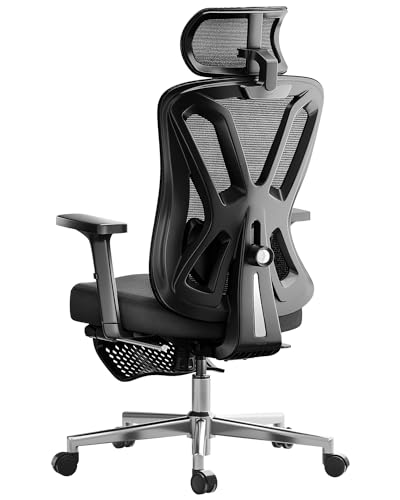
Hbada P5 Ergonomic Office Chair
Our badge: Best Overall
The Hbada P5 Ergonomic Office Chair is this guide’s best overall pick. The Hbada P5 is a mesh-backed ergonomic desk chair built around adjustability: an S-shaped backrest that follows the curve of the spine, a lumbar support that moves up and down, a 2D headrest that adjusts in height and angle, adjustable armrests, a tilt function that reclines to 135 degrees, and a slide-out footrest for breaks. Its height adjusts across a 3.35-inch range, and the maker positions it for people roughly five feet tall and up, which makes it one of the more tuneable chairs in this pool.
Strengths
- Adjustable lumbar support that moves up and down to meet the small of your back
- Height, headrest, armrests and tilt all adjust, so the chair can be fitted rather than endured
- Mesh-style comfort with a footrest for short recline breaks between tasks
Trade-offs
- The footrest is a break feature, not a substitute for standing and walking during the day
- At 44 pounds it is not a chair you will want to carry between rooms often
- The black finish and gaming-adjacent shape will not suit every traditional office
| Color | Black |
| Size | 27.56 x 27.56 x 49.41 inches |
| Dimensions | 10.85039368972 x 10.85039368972 x 19.45275588567 inches |
| Weight | 44 pounds |
| Product Group | Furniture |
For this particular search, the question to ask of Hbada P5 Ergonomic Office Chair is narrow: does it answer the problem described at the top of this guide, for the reader that problem describes? On the evidence of its design, the answer is its combination of support, fit and everyday practicality. The strengths listed above are the reasons it earned its badge; the trade-offs are the reasons a different reader should keep scrolling to the next pick instead of forcing this one to fit.
Long sessions expose the truth about any desk chair. Heat builds, foam settles, and the posture you start with is rarely the posture you finish with. A chair of this type earns its keep by making the good positions easy to return to: sit back, feel the backrest meet you, drop your shoulders onto the armrests, and get on with the work. Judge it by your last hour of the day, not your first five minutes, and by whether you stand up feeling ready to move rather than needing to unfold.
Best for: readers whose search for the best chairs for studying matches this pick’s strengths and whose room suits its size and style / Not suited for: readers who need a fundamentally different kind of chair, or whose measurements fall outside what its spec box describes
Choose this pick if its strengths line up with your problem and its trade-offs read like minor footnotes; skip it without regret if a trade-off touches the exact reason you are shopping. Check on Amazon

Homall Gaming Chair
Our badge: Best Budget
The Homall Gaming Chair is this guide’s best budget pick. The Homall gaming chair pairs a high back with a flexible headrest and a massage lumbar pillow, a slide-out footrest, a 135-degree recline and a 360-degree swivel, on a BIFMA-certified metal base with a Class 3 gas lift and a listed capacity of 300 pounds. The cushions, backrest and armrests are filled with high-density foam under a PU leather cover, which gives it a plusher first sit than the mesh chairs in this guide.
Strengths
- Massage lumbar pillow and headrest address the two spots desk workers rub first
- Slide-out footrest and 135-degree recline make break time genuinely restful
- Listed 300-pound capacity and a metal base give it a sturdy brief for its tier
Trade-offs
- PU leather needs gentle care and can feel warm in rooms without air conditioning
- The racing style is a strong look that not every home office wants
- Massage here means a vibrating pillow, not a deep-tissue substitute — set expectations accordingly
| Color | White |
| Size | 19.7 inches x 18.5 inches x 50.4 inches |
| Dimensions | 18.5 x 20.9 x 50.4 inches |
| Weight | 39.7 pounds |
| Product Group | Furniture |
Measured against what this keyword actually demands, Homall Gaming Chair makes its case on how directly its design addresses the core need without gimmicks. That will not be every reader’s priority — the picks in this guide deliberately spread their strengths so that different bodies and rooms can each find a first choice — but for the reader whose problem matches this chair’s strengths, it is a coherent, defensible buy rather than a compromise.
In daily desk use, what separates a chair like this from a merely adequate one is how it behaves when you stop thinking about it. The adjustments stop being features and become habits: a small lift change when you swap shoes, a lean back while you read, a footrest or recline that turns a two-minute pause into an actual rest. Readers who set a chair like this up carefully in the first week tend to forget it entirely by the second, which is the highest compliment a working chair can earn.
Durability in real homes is mostly about small habits. Wipe spills the day they happen rather than the week after, keep the chair out of punishing direct sun where you can, check the fasteners after the first month when everything has settled, and vacuum upholstery with a soft brush rather than letting grit work into the weave. None of this is glamorous, and all of it is the difference between a chair that ages gracefully and one that looks tired in its second year.
Best for: readers whose search for the best chairs for studying matches this pick’s strengths and whose room suits its size and style / Not suited for: readers who need a fundamentally different kind of chair, or whose measurements fall outside what its spec box describes
Choose this pick if its strengths line up with your problem and its trade-offs read like minor footnotes; skip it without regret if a trade-off touches the exact reason you are shopping. Check on Amazon

Respawn 110 Pro Ergonomic Gaming Chair with Footrest and Recline | Ergonomic office chair
Our badge: Best for Reading Breaks
The Respawn 110 Pro Ergonomic Gaming Chair with Footrest and Recline | Ergonomic office chair is this guide’s best for reading breaks pick. The Respawn 110 Pro blends gaming-chair looks with office-chair manners: dual-density foam, lumbar support, a cushioned headrest, tilt control, height adjustment and a backrest that reclines to 155 degrees with an infinite angle lock, plus a reinforced retractable footrest on multi-point brackets. It is listed as supporting up to 275 pounds, swivels a full 360 degrees, and comes in a gray fabric finish that sits more quietly in a work room than most racing chairs.
Strengths
- 155-degree recline with an angle lock is the deepest, most controllable recline in this pool
- Retractable footrest is reinforced rather than decorative, so feet-up breaks feel secure
- Fabric finish and gray color read as office furniture first, gaming gear second
Trade-offs
- Listed capacity of 275 pounds is lower than several rivals here
- At 46.3 pounds it is a two-person job to get up a narrow staircase comfortably
- Dual-density foam feels firm at first and takes a few days to stop surprising you
| Color | Gray Fabric |
| Size | 28.50″ D x 26.75″ W x 51.50″ H |
| Dimensions | 28 x 26.4 x 51.2 inches |
| Weight | 46.3 pounds |
| Product Group | Furniture |
For this particular search, the question to ask of Respawn 110 Pro Ergonomic Gaming Chair with Footrest and Recline | Ergonomic office chair is narrow: does it answer the problem described at the top of this guide, for the reader that problem describes? On the evidence of its design, the answer is the honesty of its spec sheet and the solidity of its construction. The strengths listed above are the reasons it earned its badge; the trade-offs are the reasons a different reader should keep scrolling to the next pick instead of forcing this one to fit.
Long sessions expose the truth about any desk chair. Heat builds, foam settles, and the posture you start with is rarely the posture you finish with. A chair of this type earns its keep by making the good positions easy to return to: sit back, feel the backrest meet you, drop your shoulders onto the armrests, and get on with the work. Judge it by your last hour of the day, not your first five minutes, and by whether you stand up feeling ready to move rather than needing to unfold.
Best for: readers whose search for the best chairs for studying matches this pick’s strengths and whose room suits its size and style / Not suited for: readers who need a fundamentally different kind of chair, or whose measurements fall outside what its spec box describes
Choose this pick if its strengths line up with your problem and its trade-offs read like minor footnotes; skip it without regret if a trade-off touches the exact reason you are shopping. Check on Amazon

Karl home Mid-Century Lounge Accent Chair
Our badge: Best Reading Corner
The Karl home Mid-Century Lounge Accent Chair is this guide’s best reading corner pick. The Karl home lounge chair is a mid-century accent chair in green linen with a solid wood frame, wide curved armrests, flared legs and — the detail that earns it a place in support-focused guides — a lumbar pillow included in the box. The listing states a capacity of up to 330 pounds, the backrest and armrests are angled for relaxation, and the seat is filled with high-density sponge under breathable linen.
Strengths
- Included lumbar pillow lets you place support exactly where your back wants it
- Solid wood frame with a stated 330-pound capacity feels planted and calm
- Wide curved armrests give your forearms a real resting place while reading
Trade-offs
- It is a lounge chair, not a desk chair — no wheels, no height adjustment, no swivel
- The pool dimensions are inconsistent between the size and dimension fields, so measure your space and check the listing
- Linen asks for a gentler cleaning routine than wipe-clean faux leather
| Color | Green |
| Size | 28.3 inches L x 31.5 inches W x 29.5 inches H |
| Dimensions | 39.5 x 36.3 x 37.5 inches |
| Weight | 33.3 pounds |
| Product Group | Furniture |
Measured against what this keyword actually demands, Karl home Mid-Century Lounge Accent Chair makes its case on its fit for the specific body and room this search describes. That will not be every reader’s priority — the picks in this guide deliberately spread their strengths so that different bodies and rooms can each find a first choice — but for the reader whose problem matches this chair’s strengths, it is a coherent, defensible buy rather than a compromise.
As a lounge or accent chair, this pick lives a different life from a desk chair: it is sat in for reading, conversation, television and the quiet ten minutes with a coffee that hold a day together. Its support is fixed rather than adjustable, so the honest test is whether its built-in shape matches your body — sit back fully, check where the backrest meets you, and notice whether your feet rest flat. When the shape fits, a chair like this can be the most comfortable seat in the house; when it does not, no amount of good looks will rescue it.
Best for: readers whose search for the best chairs for studying matches this pick’s strengths and whose room suits its size and style / Not suited for: readers who need a fundamentally different kind of chair, or whose measurements fall outside what its spec box describes
Choose this pick if its strengths line up with your problem and its trade-offs read like minor footnotes; skip it without regret if a trade-off touches the exact reason you are shopping. Check on Amazon

LSSPAID Modern Accent Chairs
Our badge: Best Comfortable Lounge Study
The LSSPAID Modern Accent Chairs is this guide’s best comfortable lounge study pick. The LSSPAID accent chair is a chenille armchair with a matching lumbar pillow, a notably thick 7-inch sponge cushion reinforced with a bottom spring, a 115-degree seating angle and a deep 24.8-inch seat. The solid wood frame is listed as withstanding up to 350 pounds, anti-slip foot pads protect the floor, and the hollow base design even lets a robot vacuum pass underneath, which owners of small rooms will appreciate more than they expect.
Strengths
- Matching lumbar pillow plus a 7-inch cushion is the plushest support pairing among the accent picks
- Listed 350-pound capacity on a solid wood frame is generous for an armchair
- Deep seat and 115-degree angle suit cross-legged and feet-up sitting styles
Trade-offs
- The deep, soft seat is a lounge posture, not an upright working posture
- Chenille shows crumbs and pet hair more honestly than smooth faux leather
- At 33 pounds it is light enough to move, but the wide frame still needs a clear doorway path
| Color | Charcoal |
| Size | Set of 1 |
| Dimensions | 30.5 x 29.5 x 31.5 inches |
| Weight | 33 pounds |
| Product Group | Furniture |
For this particular search, the question to ask of LSSPAID Modern Accent Chairs is narrow: does it answer the problem described at the top of this guide, for the reader that problem describes? On the evidence of its design, the answer is the way its best features line up with the way people actually sit. The strengths listed above are the reasons it earned its badge; the trade-offs are the reasons a different reader should keep scrolling to the next pick instead of forcing this one to fit.
Accent chairs are bought with the eyes and judged by the body, usually within the first week. Pay attention to the unglamorous details: how the seat feels at the forty-minute mark of a film, whether the arms are at a height your forearms actually use, and how easy the chair is to get out of when your hands are full of book and mug. A chair that passes those tests becomes furniture you keep for years; one that fails becomes an expensive place to put laundry.
Consider the room around the chair as part of the review. Light matters: a chair placed against a window gets used differently from one in a corner. Flooring matters: casters, legs and pads behave differently on wood, tile and carpet, and the spec box gives you the chair’s weight and footprint to plan with. The best chair in this guide placed in the wrong spot will lose to a lesser chair placed well, every single week of the year.
Best for: readers whose search for the best chairs for studying matches this pick’s strengths and whose room suits its size and style / Not suited for: readers who need a fundamentally different kind of chair, or whose measurements fall outside what its spec box describes
Choose this pick if its strengths line up with your problem and its trade-offs read like minor footnotes; skip it without regret if a trade-off touches the exact reason you are shopping. Check on Amazon

Yaheetech Dining Chairs Set of 4 Upholstered Kitchen Chair Fabric Dark Gray | Fabric High
Our badge: Best at a Dining Table
The Yaheetech Dining Chairs Set of 4 Upholstered Kitchen Chair Fabric Dark Gray | Fabric High is this guide’s best at a dining table pick. The Yaheetech dining set includes four armless upholstered parson chairs with high backs, polyester fabric over high-density foam, solid rubberwood legs, adjustable footpads and protective pads on every leg. Each chair measures 18 inches wide, 22.5 inches deep and 36.5 inches high, and the listing states each can hold up to 298 pounds. The armless, upright design is what makes dining chairs quietly useful far beyond the dining table.
Strengths
- Armless design leaves arms and shoulders completely free — a real advantage for some uses
- Protective foot pads and adjustable footpads guard floors and stop wobble
- High back gives more support than the typical side chair
Trade-offs
- Upright dining posture is designed for meals, not for leaning back for hours
- You are buying four chairs; storage for the spares is your problem to solve
- No swivel, wheels or height adjustment of any kind
| Color | Fabric- Dark Gray |
| Size | Set of 4 |
| Dimensions | 22.5 x 18 x 36.5 inches |
| Weight | 55.45 pounds |
| Product Group | Furniture |
Measured against what this keyword actually demands, Yaheetech Dining Chairs Set of 4 Upholstered Kitchen Chair Fabric Dark Gray | Fabric High makes its case on its combination of support, fit and everyday practicality. That will not be every reader’s priority — the picks in this guide deliberately spread their strengths so that different bodies and rooms can each find a first choice — but for the reader whose problem matches this chair’s strengths, it is a coherent, defensible buy rather than a compromise.
Dining chairs lead double lives: table seating by evening, and — because they are upright, armless or compact — task seating everywhere else. Their posture is honest and upright, their padding is modest, and their virtues are freedom of movement and a small footprint. Judge this pick on the length of your sessions: for meals, music, homework at the table and shorter desk stretches it can be exactly right; for all-day sitting, plan on it being one seat in a rotation rather than the only chair you own.
Durability in real homes is mostly about small habits. Wipe spills the day they happen rather than the week after, keep the chair out of punishing direct sun where you can, check the fasteners after the first month when everything has settled, and vacuum upholstery with a soft brush rather than letting grit work into the weave. None of this is glamorous, and all of it is the difference between a chair that ages gracefully and one that looks tired in its second year.
Best for: readers whose search for the best chairs for studying matches this pick’s strengths and whose room suits its size and style / Not suited for: readers who need a fundamentally different kind of chair, or whose measurements fall outside what its spec box describes
Choose this pick if its strengths line up with your problem and its trade-offs read like minor footnotes; skip it without regret if a trade-off touches the exact reason you are shopping. Check on Amazon
Comparison Table
The table below compares the six picks on the verified attributes that decide the most purchases — finish, footprint and weight — so you can eliminate the chairs that cannot fit your room before you fall for the ones that can.
| Pick | Color | Dimensions | Weight | Check price on Amazon |
|---|---|---|---|---|
| Hbada P5 Ergonomic Office Chair | Black | 10.85039368972 x 10.85039368972 x 19.45275588567 inches | 44 pounds | Check price on Amazon |
| Homall Gaming Chair | White | 18.5 x 20.9 x 50.4 inches | 39.7 pounds | Check price on Amazon |
| Respawn 110 Pro Ergonomic Gaming Chair with Footrest and Recline | Ergonomic office chair | Gray Fabric | 28 x 26.4 x 51.2 inches | 46.3 pounds | Check price on Amazon |
| Karl home Mid-Century Lounge Accent Chair | Green | 39.5 x 36.3 x 37.5 inches | 33.3 pounds | Check price on Amazon |
| LSSPAID Modern Accent Chairs | Charcoal | 30.5 x 29.5 x 31.5 inches | 33 pounds | Check price on Amazon |
| Yaheetech Dining Chairs Set of 4 Upholstered Kitchen Chair Fabric Dark Gray | Fabric High | Fabric- Dark Gray | 22.5 x 18 x 36.5 inches | 55.45 pounds | Check price on Amazon |
Read the dimensions column against your doorway, your desk or table, and the floor space the chair will actually occupy, including room to push back, recline or rock where the design allows it. Weight matters more than most buyers expect: it decides whether one person can place the chair, whether it can follow you between rooms, and how planted it will feel in daily use.
How to Choose the Best Chairs for Studying
Choosing well for this search is mostly a matter of asking the right questions in the right order: fit first, then support, then the practicalities of room, floor and budget. The five factors below are the ones that decide satisfaction with the best chairs for studying long after the delivery day, and working through them in order will usually shrink a shortlist of six to an obvious one or two. Keep a tape measure nearby — nearly every answer below is a number. Readers planning a whole seating corner rather than a single chair may also find Best Office Chairs For Tall People and Best Sofas For Older Adults useful companions to this section.
Backrest Shape and Lumbar Contact
Sit back in a chair and notice where it meets you. Support belongs at the belt line, in the small inward curve of the lower back, and it should feel like a gentle presence rather than a push. Adjustable lumbar support earns its keep because belt lines sit at different heights on different bodies. Fixed backs and pillows can work beautifully, but only when their shape happens to match yours — which is why return-friendly buying matters more for fixed chairs than for adjustable ones.
Seat Depth and Cushion Character
Seat depth is the silent cause of perching: too deep, and you slide forward to let your feet reach the floor, abandoning the backrest entirely. The cushion itself should be firm enough that you do not feel the frame through it at the end of a long sit, and shaped so weight spreads across the seat rather than concentrating in two points. Very soft seats feel wonderful for ten minutes and punishing by the second hour; very firm seats reverse that pattern, which is why long-session sitters should usually choose firmer than their first instinct.
Armrests: Height, Width and Getting Out of the Way
Armrests have two jobs that pull in opposite directions: support your forearms so your shoulders can relax, and never trap you, bump your desk, or block an activity that needs free arms. For desk work, the right height lets your elbows rest with your shoulders down, not shrugged. For chairs used to rise from, the arms must be solid enough to push on without flexing. Adjustable arms solve the desk problem elegantly; fixed arms solve the rising problem reliably; know which problem is yours before you choose.
Capacity, Frame and the Honesty of Numbers
Treat every stated capacity as a ceiling to stay comfortably under, not a target to test. What carries you is the frame, the base and the lift, and their materials are printed in listings for a reason: metal bases, solid wood frames and dense foam all age more gracefully under load than their budget equivalents. If you are anywhere near a chair’s stated limit, choose the next chair up in strength — the margin is not wasted money, it is the difference between a chair that feels planted in year three and one that creaks by Christmas.
Materials, Care and the Room It Lives In
Upholstery is a lifestyle decision disguised as a style one. Mesh breathes through summer workdays and shows little wear. PU and faux leathers wipe clean around children, coffee and pets, and ask for gentle products to stay supple. Natural-feeling fabrics — linen, chenille, boucle, velvet — look and feel wonderful and reward households willing to spot-clean and brush them. Match the material to the room’s real life, including its sun, its animals and its spill rate, and the chair will still please you when the novelty is long gone.
How to Structure Study Sessions and Breaks So Your Back Survives Revision Week
Setup is where good chairs are made or quietly ruined, so give this section the twenty minutes it asks for. Work in order: place the chair where it will live, set its height against your desk, table or floor position, then adjust the back, supports and arms, and only then judge how it feels. Changing everything at once teaches you nothing, because you cannot tell which change helped. Readers setting up a full room rather than a single seat will find the same order of operations in Best Office Chairs Under $100.
Once the basics feel right, live with them for several days before fine-tuning. Your body judges a new chair against the old one’s habits, and first impressions — especially about firmness and support position — regularly reverse themselves by day three. Keep the tools the chair shipped with, note the settings that work if the chair will be shared, and resist the urge to keep adjusting daily; stability is part of comfort, and a chair that is constantly being tuned never gets the chance to simply be sat in.
Build the break habit from the first day, too. However good the chair, set a rhythm of standing, walking and changing position across your sitting time, and use any recline, footrest or second seat the setup offers as part of that rhythm rather than as furniture decoration. The how-to advice in this guide and the chairs themselves both work best inside a day that moves.
Problem: The chair feels fine for ten minutes and uncomfortable by the second hour — the seat or your setup is asking one posture to last too long. Change one variable at a time: sit fully back so the backrest shares the load, adjust the lumbar contact to belt height, and set a timer to stand and move every half hour or so. If discomfort always arrives at the same spot, that spot is the diagnosis — pressure points point at edges, heights and depths, and those are adjustable or fixable with a cushion.
Problem: Your feet do not rest flat on the floor — the seat is too high for your legs, and dangling feet pull on the backs of the thighs and the lower back all day. Lower the chair if it adjusts; if it is already at its minimum, add a stable footrest or a low platform under the desk rather than perching on the seat edge. Never solve this by sliding forward — that trades foot comfort for an unsupported back.
Problem: The lumbar support digs in or feels like a lump — it is positioned wrong for your body, which is the most common and most fixable chair complaint there is. Move it down toward the belt line, reduce its depth if the chair allows, and give your back two or three days to judge the change before moving it again. If a fixed pillow is the culprit, try it lower, thinner-side forward, or behind the calves as a foot prop — pillows are tools, not commandments.
Problem: The chair squeaks, wobbles or slowly sinks — work through the boring checks in order: tighten every fastener a quarter turn, confirm the lift is fully seated in the base, check casters and feet for trapped grit or a cracked wheel, and test the lift by sitting and rising five times. Sinking that returns after these checks is a failing lift, and on most chairs it is a replaceable part rather than a reason to replace the whole chair.
Desk Chair Versus Reading Chair: The Two-Seat Study System
Guides usually stop at the product; this one keeps going, because the questions inside desk chair versus reading chair: the two-seat study system decide whether the winner of this ranking stays a winner in your home. Think about your own version of the problem behind the best chairs for studying: when it appears, where you are sitting when it does, and what you have already tried. The answers locate you inside this guide’s shortlist far more precisely than any badge can.
The practical move is to test your conclusion against your real routine for one ordinary week. Note when discomfort, fidgeting or avoidance shows up, and what changed just before it did. Patterns in that small diary — a time of day, a task, a particular seat — are worth more than another evening of reading reviews, because they describe your problem rather than the average shopper’s. Bring those notes back to the reviews above and the right pick usually identifies itself.
Small Rooms and Shared Spaces: Studying Where You Also Live
This is the part of the decision that listings almost never help with, because it concerns the reader behind the search for the best chairs for studying rather than any single product. Two people can buy the same chair from this guide and have opposite experiences, and the difference is rarely quality — it is the match between the chair and one person’s body, habits and room. That is why this section exists: to give you the thinking that turns a ranking into a personal decision, using small rooms and shared spaces: studying where you also live as the lens.
It also helps to decide in advance what would make you return a chair. Write the test down before the box arrives: the sitting sessions it must survive, the rise it must allow, the desk or table it must work with. Deciding the test in advance protects you from the two failure modes of chair buying — keeping a bad fit out of inertia, and returning a good fit over a first-day impression that a week of adjustment would have reversed.
Common Buying Mistakes
Most disappointing chair purchases follow one of a handful of patterns, and every pattern below is avoidable in about the time it takes to read about it. Readers who recognize their own plan in one of these mistakes — including the plan to browse Best Beach Chairs For Elderly next and repeat the same approach there — should pause and correct course before ordering, not after unboxing.
Chasing features and skipping fit
A long feature list cannot rescue a chair whose basic dimensions do not fit your body. Fit first — height, depth, back reach — then let features break ties between chairs that already fit. That order, reversed, is how most disappointing purchases happen.
Forgetting the floor, the desk and the doorway
Chairs live in systems: casters meet flooring, armrests meet desk undersides, boxes meet doorways and stairwells. Measure all three before ordering, especially for heavy or oversized picks, and the delivery day becomes boring in the best possible way.
Keeping a chair that hurts because returning feels like failure
A short, honest trial at home tells you more than a month of reviews. If a chair still feels wrong after a week of proper adjustment, that is information, not weakness — act on it while returns are still simple, and take the measurements you learned into the next choice.
Buying by photograph instead of by measurements
A chair that looks perfect can be two inches too deep for your legs, and you will feel those two inches every day. Measure your current best chair — seat height, depth and back height — and compare numbers, not pictures, before ordering.
Assuming one chair must do every job
Desk work, reading, dining and relaxing ask genuinely different things of a seat. Readers who accept a main chair plus a simple second seat usually end up more comfortable than readers who keep hunting for one chair that does everything and does most of it badly.
Final Recommendation
Start with the Hbada P5 Ergonomic Office Chair. For the typical reader behind the search for the best chairs for studying, it offers the most complete balance of support, fit and everyday practicality in this pool, and it is the pick least likely to need replacing within the year. If its trade-offs touch your situation directly — your measurements, your room, or the way you sit — the runner-up is the deliberate alternative rather than a consolation: Check on Amazon for the Homall Gaming Chair, whose strengths answer the same search from a different direction.
Whichever you choose, do the unglamorous things that make the choice succeed: measure before ordering, set the chair up slowly, give it a week of honest use, and keep the return option in mind while you judge it. A chair chosen that way stops being a gamble and becomes what it should have been all along — the seat your day quietly rests on. Readers still comparing directions can continue with Best Orthopedic Sofas before deciding.
Frequently Asked Questions
Can one chair really be right for two very different people?
Only if it adjusts, and even then only if both people actually re-adjust it. Shared chairs live or die on how fast their settings can be changed: height and armrests in seconds, lumbar in moments. Fixed chairs shared between different bodies are a compromise someone quietly loses every day, which is why households with two full-time sitters usually do better with two honest chairs than one expensive one.
How long should a good chair last with daily use?
A well-built chair used daily should give years of service, and the spread between chairs is mostly construction: frames, bases, lifts and foam quality. The practical signs of a chair nearing its end are a lift that sinks, foam that stays compressed, and fasteners that will not stay tight. Care habits — tightening hardware after the first month, keeping grit out of upholstery, and not using armrests as step stools — reliably add life to any chair in this guide.
Is a firmer or softer seat better for long sitting?
For long sessions, firmer usually wins, because support is what a seat owes you at hour three. Soft seats feel generous at first and then let you sink into positions your back has to work to hold. The exception is short, relaxed sitting — reading and television — where a softer lounge seat is often the honest preference. Match firmness to session length rather than to the showroom sit.
Do I need adjustable lumbar support, or is a pillow enough?
Both work when they fit. Adjustable support earns its place when several people share a chair, or when you have never found a fixed shape that suits you, because it can be moved to your belt line precisely. A pillow suits a single sitter in a lounge chair and can be repositioned in seconds. The failure mode is the same for both: support placed too high, pushing the mid-back instead of filling the lower curve.
How do I know whether a chair will fit me before it arrives?
Measure the chair you sit in most now — seat height from the floor, seat depth, and backrest height above the seat — and compare those three numbers with the dimensions in each spec box in this guide. Then check your desk height and the clearance under it. Three measurements and five minutes will predict fit more reliably than any amount of review reading, including this guide.
What is the single most common setup mistake with a new chair?
Leaving the factory settings untouched. Most chairs arrive set to an average that fits nobody in particular, and most owners never change them. Spend the first sitting adjusting height, then backrest or lumbar position, then armrests, in that order, and re-check after a week — your judgment on day seven is worth ten times your judgment on day one.


