Where to buy
Check the latest price, availability and delivery on Amazon. Orders are placed on Amazon. We may earn a commission from qualifying purchases.
- Most capable fixture in the tier (traditional form): Gama Sonic Imperial III Commercial Solar Post Light, 300 Lumens, Dual Color — Check on Amazon
- Lamp head for an existing post: Gama Sonic Aspen Solar Post Light with 3-Inch Fitter — Check on Amazon
- Best smart color coverage: Linkind Smart Solar Spot Lights SL5C, 8-Pack — Check on Amazon
- Best patio layer: Brightech Ambience Pro Solar String Lights, 48 ft — Check on Amazon
See 2 more Amazon options
- Gama Sonic Stainless Steel Bollard Solar Lamp — this guide’s top pick for a modern exterior; sold singly through the maker’s own Amazon offer (the listing showed no featured offer when we researched it, so check the current price on Amazon): Check on Amazon
- Ring Solar Pathlight — the single-light listing; the value move is the 4-pack + Bridge starter kit on the same product line, discussed in its review below: Check on Amazon
Read the full guide ↓
Disclosure: As an Amazon Associate, dailyhomedecorating.com earns from qualifying purchases. Links to Amazon on this page are affiliate links; they cost you nothing extra. Listing details such as price and availability change often, so check the current Amazon listing before you buy.
A modern house exposes a problem a traditional house never faces at this budget: the top of the solar market is dressed for the wrong architecture. We swept the premium end of the category for stocked, verifiable products under the $300 ceiling, and the band is close to empty — exactly one single fixture sits at the very top of it, a commercial-grade Gama Sonic post light, and it is a lantern: beveled glass panes, a finialed silhouette descended from gas lamps. The tier’s second-best fixture wears the same costume further down the band. Meanwhile the forms a modern exterior actually asks for — the low stainless bollard, the near-invisible app-controlled spot, light that matches to a single color temperature — live further down the range, and the most design-serious answer at this money is not solar at all. This guide does two jobs: it ranks the six defensible solar purchases at up to $300 by how they sit on a modern house, and it says plainly where the wired alternative beats them.
The ceiling facts first, because they shape everything. Below the flagship head at the top of the tier — which mounts on a 3-inch post you buy separately — the most capable path fixture we could verify is a single bollard positioned in the middle of the band, the priciest smart starter kit sits in the upper part of the band, and every path set, spotlight set and string light in the category sits lower still. So $300 at this tier is a choice among one traditional flagship head, a pair of architectural bollards, a smart coverage system, or a hybrid plan — wires for the main line, solar for the layers — and for a modern home, the ranking of those four options is almost the reverse of the price order.
Three honesty notes govern everything below. First, brightness and runtime figures are the makers’ own numbers, produced by no shared measurement standard: a path light advertised at 400 lumens and one advertised at 40 may differ far less in a yard than the numbers suggest, and an “up to 14 hours” runtime is the best mode on the best day, not a winter average. We say where a pick’s figure comes from, and we never rank two products on lumen claims alone. Second, every solar light here needs direct sun — six to eight hours of it for a full charge — and a fixture installed in shade will disappoint by November whatever it cost. Third, solar lights are consumables in a way wired lights are not: the battery pack inside even the best fixture here is rated for roughly three years of charge cycles, while the housing around it may last a decade. The picks are judged partly on whether that battery can be replaced when it fades.
Quick Picks
Short on time? Each row names a buyer type and the product that suits it; check the current price on Amazon for the exact configuration named.
| Buyer type | Pick | Why it stands out | Link |
|---|---|---|---|
| Best overall for modern homes | Gama Sonic Stainless Steel Bollard Solar Lamp | A cast stainless bollard at 100 maker-rated lumens — the only fixture in the tier whose daytime silhouette belongs on a modern facade; the pair is this tier’s real purchase. Check price on Amazon | Check on Amazon |
| Best smart color coverage | Linkind Smart Solar Spot Lights SL5C (8-Pack) | Eight app-controlled spotlights in one pack, with tunable white, so every accent in the yard can be locked to one color temperature. Check price on Amazon | Check on Amazon |
| Best smart security layer | Ring Solar Pathlight (4-Pack + Bridge Starter Kit) | Motion-activated 80 maker-rated lumens per light, app grouping and camera linking — the starter kit sits in the upper part of this tier and builds to eight lights. Check price on Amazon | Check on Amazon |
| Best patio layer | Brightech Ambience Pro Solar String Lights (48 ft) | Commercial-grade Edison strand positioned at the accessible end of the tier — the soft layer that finishes a modern patio, kept deliberately separate from the architectural line. Check price on Amazon | Check on Amazon |
| Best lamp head (transitional exteriors) | Gama Sonic Aspen Solar Post Light (3-inch fitter) | 120 maker-rated lumens of warm light with replaceable battery packs, positioned in the middle of the tier — superbly built, honestly traditional in form; the post is sold separately. Check price on Amazon | Check on Amazon |
| Most capable fixture — traditional form | Gama Sonic Imperial III Commercial Solar Post Light | The strongest solar fixture here: 300 maker-rated lumens, dual color temperature, commercial cast aluminum at the very top of this tier — in a lantern silhouette a strict modern exterior will read as costume. Check price on Amazon | Check on Amazon |
How These Picks Were Chosen
The first filter was the budget, applied to configurations rather than to headline listings. Solar lights are sold as singles, pairs, packs of four to twenty-four, and starter kits with hubs, and a listing can belong to any of them. Every pick in this guide is described by the configuration in its heading — one bollard, an eight-pack of spotlights, a four-pack with a bridge — and packs are judged as coverage purchases while singles are judged as fixtures, because this guide never lets a pack and a single pretend to be the same kind of purchase.
The second filter was verifiability, and it bit hard at this tier. A pick earns a direct Amazon link only where its listing and identity could be pinned from independent sources. Two of the six picks carry qualifications stated in the open: the Gama Sonic bollard’s Amazon listing showed no featured offer during research — the maker’s own Amazon account offers the single through the buying-options list — so it is linked as check-price; and the Ring link points to the verified single-light listing, with the starter kit described from Ring’s own store material, because the kit’s own listing could not be pinned to the same standard. Where a well-known product failed verification entirely — Gama Sonic’s classic Royal Bulb lamp post currently shows no featured offer on Amazon at all — it appears in prose, without a link, in the framing section below.
Specifications were taken from makers’ specification material, never from listing titles. Only three of the six picks below carry a verifiable IP figure — IP65 on the Imperial III, IP66 on the Ring pathlight, IP67 on the Linkind SL5C — and for the other three this guide prints no rating rather than repeat a title’s “waterproof” adjective. Every lumen figure is likewise the maker’s, labelled as such, because no common standard stands behind solar lumen claims.
The third filter is the one this guide adds for modern homes: form discipline. A modern exterior is a composition — flat planes, large glass, a restrained palette — and a fixture is judged twice, once for the light it throws at night and once for the object it is at noon. Lantern silhouettes, faux-gaslight detailing and mixed color temperatures break the composition regardless of the engineering underneath, so the reviews below score daytime silhouette and color-temperature discipline alongside output and battery design. The final filter was total system cost, not the box: the post a lamp head mounts on, the hub a smart light needs, and the battery pack due for replacement in about three years are all accounted for inside the reviews.
The $300 Question, Asked by a Modern House
Start with what $300 does not buy. It does not buy a complete premium lamp post. Gama Sonic — the one brand that builds residential solar fixtures like street furniture, in cast aluminum with replaceable batteries — sells its Aspen as a complete lamp post kit, with the pole and EZ-Anchor base included, through Home Depot: that complete kit sits over this budget before you have lit anything else. Its Imperial III lamp post, the full-pole version of this guide’s most capable head, sits well above this tier at a specialist lighting retailer. Nor does $300 buy a modern flagship, because the category does not make one: the premium solar market sells to traditional and transitional houses, and its best engineering arrives in lantern shapes. A buyer with a flat-roofed, black-framed, gravel-and-concrete house who sorts by price descending will be offered costume jewelry for a building that wears none.
It also does not buy brightness parity with wires — at this budget that comparison is the center of the decision. The honest benchmark is a low-voltage kit: VOLT’s Basics landscape kit — four brass spotlights and two brass path lights, a 100-watt transformer and 100 feet of cable — is sold at the maker’s store, and its specification table rates each spotlight at 350 lumens and each path light at 300. For a comparable position in the budget, wired money buys six fixtures each matching or beating the best solar fixture’s maker-rated output, all of them identical in color and brightness because they share one power supply, all of them on a transformer timer rather than at the mercy of yesterday’s weather. The cost is the installation solar never asks for: a trench, a buried cable run, an afternoon of work — in exchange, brass fixtures that are infrastructure, rated in decades, where every solar battery here is a three-year consumable. For a modern home, whose lighting is usually designed as one architectural line — driveway, front walk, facade — that uniformity is exactly what the architecture asks for. Our verdict for this lens: give the main line to wires, and spend solar money on the layers wires serve badly — beds that change, accents you may re-aim, the patio strand — where solar’s flexibility is a real advantage rather than a compromise.
The honest solar spends, then, are these. First, the architectural pair: two Gama Sonic bollards — also offered as the maker’s factory two-pack at a specialist retailer — flanking the front walk or the driveway entrance in an even rhythm, the one purchase in this tier that looks like it was specified rather than shopped. Second, the smart system: the Ring starter kit plus a second four-pack (eight motion lights and the Bridge, discussed in the Ring review), or two Linkind eight-packs plus the voice hub (sixteen color spotlights, discussed in the Linkind review) — coverage with app discipline, one temperature, one schedule. Third, the hybrid: the VOLT wired kit carrying the architectural line, plus the Brightech strand over the patio — the budget spent with each technology doing the job it is actually good at. Fourth, the allocation: the best verified set for the yard you have — an Aspen head and its anchor kit combined if your house is transitional enough to wear it — and the rest of the $300 kept, because the category’s stocked ceiling means most yards cannot absorb $300 of solar productively. For a single-zone job where one good set is the whole purchase, Best Solar Garden Lights Under $200 covers the sensible ceiling for most gardens.
Premium money, spent well, buys the fixture and the replaceable battery — and on a modern house it also buys restraint: fewer objects, evenly spaced, one color of light.
The 6 Best Solar Garden Lights Under $300 — For Modern Homes
The order below is this lens’s order: fixtures a modern exterior can wear come first; the two superbly engineered lanterns close the list, verdicts stated plainly.
1. Gama Sonic Stainless Steel Bollard Solar Lamp — Best Overall for Modern Homes
Who it suits: A modern homeowner lighting one short, important run — the front walk, the driveway entrance, the steps to a raised deck — who would rather have two fixtures that read as landscape architecture than twelve that read as lawn ornaments.
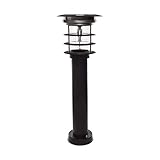
The bollard is the fixture landscape designers actually specify, and it is the only form in this tier native to modern architecture: a low stainless-steel column, black-finished, with a glass lens and no ornament anywhere on it. By day it is a quiet vertical line in the planting; by night it throws its light down and out at path level, which is where path light belongs. Gama Sonic’s EZ Anchor corkscrew base twists into the ground and can be repositioned without concrete. The maker rates it at 100 lumens of 2700K warm white from 11 LEDs, running eight to ten hours on a 1000 mAh lithium-ion pack — the runtime band the maker’s own specification sheet prints, and a realistic one for a fixture this size. The Amazon listing sells it singly and in a two-pack; during research the listing showed no featured offer, and the maker’s own Amazon account offered the single through the buying-options list. A factory two-pack is also offered at a specialist retailer. It is therefore presented as check-price on Amazon: check the current price on Amazon, and treat the pair as the purchase this tier is really about.
- Stainless steel and glass, positioned as a premium single fixture — the only path fixture in the category built to a landscape-trade standard, in the one silhouette a modern facade accepts
- Bollards compose: a flanking pair or an evenly spaced run turns a walk into a designed line
- 100 maker-rated lumens is honest output for a bollard: enough to define a walkway edge, claimed as nothing more
- The two-pack at a specialist retailer is the cleanest single purchase at this entire tier: two real fixtures, no accessories required
Honest limitation: As a premium single fixture, this is the least coverage per purchase in the guide, and no IP rating appears in the maker’s specification summary we could verify — for a fixture that lives at sprinkler height, confirm the listing’s current spec field before ordering. Two bollards also light two points; a long path still needs cheaper sets, or a wired run.
Choose it if the front walk is the project and the daytime look matters as much as the nighttime one. Skip it if you are counting lights per purchase — the Linkind and Ring systems below deliver eight lights where this delivers one.
2. Linkind Smart Solar Spot Lights SL5C, 8-Pack — Best Smart Color Coverage
Who it suits: The buyer with the actual $300-yard problem: trees to uplight, a facade to wash, beds to accent — many targets, one budget — and a modern house whose lighting has to behave as one system: one temperature, one schedule, controlled from one app.
The SL5C is a ground-stake spotlight with a separate-aim head, sold in an eight-pack on Amazon, with the same configuration offered at the maker’s own store — and that eight-light pack is what makes this the coverage pick. Check the current price on Amazon. Linkind rates each light at 150 lumens, a maker figure we report without endorsing, in RGBTW: full color plus tunable white, controlled from the AiDot app over Bluetooth, with group control for up to 32 lights across eight groups and dynamic scenes for the color you will use twice a year. The tunable white is the feature this lens cares about: it is the only system here that can hold every accent in the yard at the same white, matched to the bollards’ 2700K or set cooler against concrete and steel. The housing is rated IP67 in the maker’s specification material, the charging is the maker’s MPPT design, and the stated runtime reaches up to 14 hours in energy-saving mode — again, the best mode on the best day, and labelled as the maker’s claim.
- Eight aimable spotlights in one pack is the strongest coverage in this guide; two packs plus the voice hub put sixteen lights under app control inside the budget
- Tunable white is a discipline tool, not a toy: one temperature across facade, trees and beds is the difference between a lighting design and a collection of lights
- IP67 is a real, printed rating — the spotlights can sit in irrigated beds, which is where spotlights live
- App grouping up to 32 lights means the system scales by adding more pack lights, not by replacing a hub
Honest limitation: The ecosystem has a toll booth: app control over Bluetooth works out of the box, but voice control through Alexa or Google requires Linkind’s BLE Mesh Hub, sold separately — the eight-pack plus hub is the real starting configuration for the voice-controlled version, so check price on Amazon for both pieces. The listing does not present the battery as user-replaceable, so treat each light as a sealed unit with a finite life; given the pack’s coverage role that is a fair trade, but it is a trade. And the color scenes cut both ways on a modern house: the discipline is warm white fifty weeks a year, with color as an occasional event, not a permanent rainbow.
Choose it if your yard has many targets and you want them coordinated, matched in temperature and scheduled for the least compromise per light. Skip it if you dislike app-dependent hardware or your hub patience is already spent on other systems.

3. Ring Solar Pathlight — Best Smart Security Layer
Who it suits: A household already in, or entering, the Ring ecosystem, that wants its path lights to behave like security devices: motion-triggered, grouped in an app, and able to wake the cameras when something walks the path at 2 a.m.
Each Ring Solar Pathlight is rated by its maker at up to 80 adjustable lumens of 3500K white, with a motion sensor covering 120 degrees out to about 15 feet, in a 16.8-inch housing sealed to IP66 — a verifiable rating, and the right one for a fixture that lives in mulch. The housing is a plain low post with no ornament, which is why it survives this lens’s form filter where the lanterns do not: it reads as equipment, and modern houses tolerate equipment. The smart half is the system: the lights need a Ring Bridge (or Amazon Sidewalk coverage, which Ring’s store notes can substitute in covered areas) to reach the app, where brightness, schedules and motion sensitivity are set per light or group, and where a motion event can trigger linked Ring cameras and doorbells. The battery is a standard replaceable 18650 cell that also tops up by micro-USB — the only pick in this guide whose battery you can buy anywhere and charge indoors in a dark week. The link below is the verified single-light listing — check price on Amazon; the purchase to make is the starter kit — four pathlights plus the Bridge — positioned in the upper part of this tier and also sold through Ring’s own store.
- Motion activation is the correct behavior for path lights: full brightness when someone is actually on the path, not a dim all-night burn that empties the battery by 4 a.m.
- The ecosystem fits this budget properly: the starter kit plus a second four-pack of lights builds an eight-light system with the Bridge — a full system that stays within this tier when the components are bought as kits rather than as singles
- Replaceable 18650 cells with a USB top-up option remove solar’s worst failure mode — the sealed light that dies in December and cannot be helped
- One Bridge supports up to 50 Ring lights, so the hub cost is paid exactly once, however far the system grows
Honest limitation: Ring’s fixed 3500K is cooler than the 2700K of the Gama Sonic fixtures, and on a modern exterior the mismatch is visible: do not interleave Ring pathlights and warm bollards along the same sightline, or the discipline this lens exists to protect is gone. Without the Bridge or Sidewalk coverage these are also expensive dumb lights, and the app’s value depends on Ring’s platform continuing to support them — a platform risk no cast-aluminum fixture carries. Eighty maker-rated lumens is guidance light; the cameras it wakes are a further purchase this budget does not include. Kit pricing is also the most volatile here, so check the current price on Amazon and buy on a promotion, not on a deadline.
Choose it if your paths are also your perimeter and you value the motion-and-camera behavior over raw light — and your design can give Ring its own zone at its own temperature. Skip it if you want light without an account, an app and a hub.

4. Brightech Ambience Pro Solar String Lights, 48 ft — Best Patio Layer
Who it suits: Anyone whose $300 plan includes a patio, pergola or fence line that needs atmosphere rather than illumination.
The Ambience Pro is the category’s reference string light: 48 feet of commercial-grade cable carrying 15 shatterproof S14 Edison-style bulbs at 1 watt each in a 3000K soft white, fed by a solar panel that stakes where the sun is while the strand hangs where the people are. On a modern patio the Edison filament is a deliberate anachronism — the one warm, retro layer in a minimal scheme — and it works because it is kept separate: atmosphere over the seating, never a substitute for the architectural line. It sits at the accessible end of this tier — check price on Amazon — and its pricing is known to swing with promotions, so check the current price on Amazon before buying rather than chasing a promotion cycle.
- Commercial-grade cable and shatterproof bulbs: the strand is built to stay up year-round, which is the entire point of a string light
- The separate solar panel solves the patio problem honestly — shade for people, sun for the panel — instead of pretending a shaded pergola charges well
- Positioned at the accessible end of the tier, it is the finishing layer of a $300 yard: bollards plus strand, or the wired kit plus strand, with budget left over
- Soft-white 3000K Edison output is ambience by design and claims nothing more — no inflated lumen figure anywhere near it
Honest limitation: This is decoration, not lighting: fifteen 1-watt bulbs will not make a path safe or a grill usable, and pairing it with a real task or path light is the plan, not an upsell. Runtime is bounded by the panel’s day — a strand charged under a cloudy week will fade early — and like all solar strings, the battery lives in the panel housing as a consumable the listing does not offer as a service part.
Choose it if your plan has a patio layer and the current listing sits at the accessible end of its usual range. Skip it if the yard’s problem is darkness rather than atmosphere — spend the money on the systems above and add the strand later.

5. Gama Sonic Aspen Solar Post Light — Best Lamp Head for Transitional Exteriors
Who it suits: Anyone replacing a dead lamp head on an existing 3-inch post, or building one proper lamp post on a stated budget — provided the house can wear a lantern. Modern farmhouse, transitional and Scandinavian-leaning exteriors can; a strict minimalist facade cannot.
The Aspen is the Imperial III’s residential sibling: the same cast-aluminum, glass-lensed construction language at a size a garden can absorb, positioned in the middle of this tier — check price on Amazon, and note that a specialist retailer carries the same fitter fixture in the same part of the band. Gama Sonic rates it at 120 lumens of 2700K warm white — modest next to the flagship, honest next to the category — powered by two lithium-ion 1500 mAh battery packs the maker rates at about 1,000 charges, roughly three years of nights, after which the packs are replaceable rather than the fixture being landfill. A 3.2-watt monocrystalline panel and a high/low brightness setting support a maker-rated runtime of up to 18 hours on a full charge. Judged as engineering it may be the best-value object in this guide; judged as form, it is a small lantern on a post — and on the wrong house that is the whole story.
- Cast aluminum with real glass — the construction tier below it is plastic, and the difference is visible from the street
- Replaceable battery packs rated around 1,000 charges: the fixture is a ten-year object with a three-year battery, as it should be
- High/low output settings let you trade brightness for winter runtime instead of accepting whatever the panel harvested
- Positioned in the middle of the tier on Amazon — check the current price on Amazon — the rare premium solar fixture whose positioning needs no apology
Honest limitation: Like the flagship, this is a fitter head: the post is sold separately, and the complete Aspen lamp post kit — fixture, pole and anchor base — sits over this guide’s budget at Home Depot. On Amazon, Gama Sonic’s EZ-Anchor installation kit for its post lights is the add-on to budget for alongside the head — check price on Amazon for both pieces, because the complete lamp, not the head alone, is the figure to budget. And 120 maker-rated lumens is pathway light, not area light; expect a pool of warm light at the post, not a lit driveway.
Choose it if your exterior is transitional enough to carry a lantern and you want one handsome, serviceable lamp with the post honestly budgeted. Skip it if your facade is strictly modern — the bollard pair above gives you the same permanence in a form the house accepts.
6. Gama Sonic Imperial III Commercial Solar Post Light — Most Capable Fixture, Traditional Form
Who it suits: A homeowner with a driveway entrance, gate or front walk that needs one real lamp — not a marker — and who already has, or is willing to add, a standard 3-inch lamp post. This is a commercial fixture sold to homes, and it suits buyers who think of outdoor lighting as furniture. On a modern house, read this review’s verdict before the specification impresses you into a mistake.
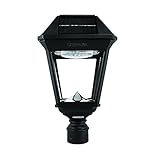
The Imperial III is what the top of the solar market actually looks like: a cast-aluminum post-top fixture, powder-coated black with beveled glass panes, rated by its maker at 300 lumens from 21 SMD LEDs behind a selectable color temperature — 2700K warm or 6000K daylight at the flip of an internal switch. That switch is, ironically, the most modern-friendly feature in either lantern: set it to 2700K once and it at least agrees in temperature with the rest of the yard. Its 8-watt monocrystalline panel and GS-series battery pack are sized for multi-night storage; Gama Sonic’s commercial catalog rates the Imperial III line at three to six nights of stored duration, and retailer specification tables credit it with up to 72 hours of runtime, figures we report as maker claims rather than measurements. It carries an IP65 rating in its specification material — the only fixture in this guide whose weatherproofing is a tested number rather than an adjective. At roughly 19.5 inches tall and 9.4 pounds, it has the physical presence the plastic sets far down the range are imitating.
- 300 maker-rated lumens with dual color temperature (2700K/6000K) — the strongest output claim here, and the only one aimed at genuinely lighting an area
- Commercial construction: cast aluminum, beveled glass, IP65 — built like the wired fixtures it competes with
- Multi-night battery storage by design, and — decisive at the top of the tier — a replaceable battery pack and replaceable LEDs, so the flagship fixture is serviceable rather than disposable
- An 8-watt monocrystalline panel, several times the panel area of a path-light set, which is what makes its runtime claims physically plausible
Honest limitation: At the top of this tier you are buying the head only — check the current price on Amazon. The Imperial III is a 3-inch fitter fixture — the pole is not in the box — and the complete lamp-post version of this same light sits well above this tier at a specialist retailer, so a buyer starting from bare ground should budget this as the top-tier component of a larger project, not a complete project on its own. Its runtime figures are also the maker’s: multi-night storage assumes the panel gets the full-sun days that charge it. And for this lens there is a second limitation the specification cannot fix: the silhouette. Beveled panes and a lantern crown are a historical quotation, and a modern facade will read it as one every single day, long after the impressive first night is forgotten.
Choose it if one entrance defines the property and your architecture — traditional, transitional, modern farmhouse — can carry a lantern honestly. Skip it if your house is genuinely modern: the same $300 buys the bollard pair, or the wired kit for the main line, and both will look like they belong.
Comparison Table
Positioned by the configuration named; output figures are the makers’ own claims throughout — compare within a brand cautiously, across brands barely at all.
| Product | Position in tier | Maker-rated output | Weather rating | Battery story | Link |
|---|---|---|---|---|---|
| Gama Sonic Bollard | Premium single in the middle of the tier; two-pack at a specialist retailer | 100 lumens, 2700K | Not published in maker spec summary | Li-ion pack, 8–10 h maker runtime | Check-price — see review above |
| Linkind SL5C Spot Lights (8-Pack) | Eight-pack coverage pick — check price on Amazon | 150 lumens per light, RGBTW | IP67 | Sealed per listing; hub for voice sold separately | Check on Amazon |
| Ring Solar Pathlight system | Starter kit in the upper part of the tier — check price on Amazon | 80 lumens, 3500K, motion-activated | IP66 | Replaceable 18650 cell, USB top-up | Check on Amazon |
| Brightech Ambience Pro String Lights | Accessible end of the tier (48 ft, 15 bulbs) — check price on Amazon | 1W soft-white bulbs; ambience, not task light | Commercial-grade strand; no IP figure verified | Panel battery is a consumable | See review above |
| Gama Sonic Aspen Post Light | Middle of the tier, head only — check price on Amazon | 120 lumens, 2700K | Not published in maker spec summary | Replaceable packs, ~1,000-charge rating | Check on Amazon |
| Gama Sonic Imperial III Post Light | Top of the tier, head only — check price on Amazon | 300 lumens, 2700K/6000K | IP65 | Replaceable pack; multi-night storage claim | Check on Amazon |
How to Choose Solar Garden Lights at This Budget — The Modern Discipline
- Decide what the $300 is — a fixture, a pair, a system, or a hybrid. The category’s stocked ceiling makes this the real first decision. One commercial lamp head, two landscape bollards, eight to sixteen smart lights, or a wired main line with solar layers are all legitimate $300 answers; a mythical mid-priced “set” in the upper part of the band is not on the shelf.
- Judge the fixture at noon, not just at night. On a modern house the object is part of the architecture for the sixteen hours it is not lit. Minimal silhouettes — bollards, low posts, stake spots that disappear into planting — pass this test; lantern crowns and faux-gaslight detailing fail it regardless of their engineering.
- Hold one color temperature across every fixture in a sightline. The Gama Sonic fixtures burn 2700K; Ring is fixed at a cooler 3500K; the Imperial III can be switched to match at installation; the Linkind spots can be tuned to whatever the rest of the yard is doing. Pick a temperature per zone, zone the systems that cannot match, and never interleave two temperatures along one walk.
- Compose in rhythm, not scatter. Modern landscaping reads in repetition: a bollard pair flanking a walk, an even run at even spacing, spots aimed in a consistent pattern. Fewer fixtures, deliberately placed, look designed; the same money scattered as twelve mixed markers looks like a sale aisle.
- Give the main line to wires if it is truly architectural. Driveway, front walk and facade wash reward the wired kit’s uniform output and timer discipline, and punish solar’s per-fixture variation. Solar earns its place on the secondary layers: beds, accents, the patio, anywhere a trench is disproportionate or the layout may change.
- Audit your sun before your cart. Every fixture here needs six to eight hours of direct sun for a full charge, and the panel’s location — not the light’s — is what matters. A spot sunny in June can sit in a fence’s shadow all December, when nights are longest and charge is shortest.
- Price the whole system, including the second purchase. Lamp head plus post, smart lights plus hub, fixture plus its replacement battery in year three. This guide accounts for those extras inside each review; a listing that hides them is not cheaper, just quieter.
- Buy the battery story, not just the fixture. At this tier the housing will outlast the battery everywhere. Replaceable packs (both Gama Sonic post lights) and standard cells (Ring’s 18650) turn a dead light into a simple maintenance swap; sealed units turn it into a replacement purchase. At $300, that difference is the decision.
- Check for a printed IP rating, and distrust the adjective. “Waterproof” in a title is free; IP65, IP66 and IP67 in a spec table are tested claims. Three picks here carry printed ratings; where a maker does not publish one, this guide says so — and a fixture with no published rating belongs in a sheltered spot.
- Match the plan to the plot. Grounds are not the only place this budget gets spent: compact modern plots and terraces will find the layout logic in Best Solar Garden Lights For Small Rooms Under $300, and anyone lighting a terrace off a sleeping space — where a motion light firing at 2 a.m. is a cost, not a feature — should weigh the dusk-to-dawn options in Best Solar Garden Lights For Bedrooms Under $300 before choosing motion activation.
Common Buying Mistakes
- Buying the flagship lantern for a glass-and-concrete house. Sorting by price puts the Imperial III first, and its specification is genuinely the best here — but a modern facade will read its lantern silhouette as costume every day. Form is a specification too; the bollard pair is this tier’s flagship for modern architecture.
- Mixing color temperatures along one sightline. Warm 2700K bollards interleaved with Ring’s 3500K pathlights looks like two unfinished projects, not one system. Zone them, tune them (Linkind), or switch them (the Imperial III’s internal selector).
- Buying a lamp head and budgeting as if it were a lamp post. The two Gama Sonic post lights are fitter heads. The post, anchor kit or complete-kit premium adds meaningfully to the total depending on the route — and the complete Aspen kit sits outside this budget entirely. Budget for the assembly, not the head.
- Believing a runtime hour figure in winter. “Up to 18 hours” and “up to 14 hours” are summer numbers at full charge. Short days, low sun angles and three cloudy days in a row are the actual test, and the fixtures that survive it are the ones with big panels, storage headroom and low modes — not the ones with the longest printed hours.
- Installing in the shade the light is meant to decorate. The most common solar failure is a panel under the tree it uplights. If the target spot has no sun, the honest options are a fixture with a remote or generous panel (the Brightech strand’s separate panel), a motion light that sips power (Ring), or wires.
- Comparing packs by box price. An eight-pack of spotlights and a single premium fixture are different products — coverage versus furniture — and judging each by its role in the yard is the only honest common ground.
- Forgetting the hub until setup night. Ring lights without a Bridge or Sidewalk coverage, and Linkind lights without the hub for voice, both work less than the box implies. The hub is part of the system cost; budget it from the start.
- Paying a spike price for a commodity strand. Commodity solar — strings, stake sets — swings with promotions, while flagship fixtures barely move. Check the current price on Amazon, spend patience on the former and money on the latter.
Final Recommendation
For a genuinely modern home, the answer at this tier is the bollard pair: two Gama Sonic bollards as the factory two-pack (singly, check-price on Amazon) flank the walk or the drive in the one silhouette the architecture accepts, with serviceable construction and honest output. Behind it, the Linkind eight-pack plus its hub — or two packs and the hub — covers beds, trees and facade accents at one tuned temperature, and the Ring system earns its own zone wherever paths double as a perimeter. If the main line matters most, take the hybrid seriously: the VOLT wired kit for the architectural line and the Brightech strand over the patio, with each technology doing its proper job. The Aspen and the Imperial III remain excellent fixtures — for houses that can wear a lantern. Hold the discipline: the budget is a ceiling, not a target; one temperature per sightline; rhythm over scatter. A yard lit well with part of the budget unspent beats one forced to absorb $300 of the wrong shape.
FAQ
Is there actually a solar garden light that costs $300?
One verifiable single fixture sits at the top of the tier: the Gama Sonic Imperial III commercial post light — and it is a lamp head for a 3-inch post, sold without the pole. Check the current price on Amazon. Complete premium lamp posts sit above this tier (the Aspen lamp post kit at Home Depot; the Imperial III lamp post at a specialist retailer), and no stocked garden set in the upper part of the band turned up in our research. Treat $300 as a coverage budget, a pair budget, or a hybrid budget, because the market does.
Why do the most expensive solar fixtures look traditional?
Because that is who buys them. Premium solar sells to established suburban homes, and its flagship engineering — cast aluminum, real glass, replaceable batteries — arrives in the lantern forms that market wants. Modern forms live at different positions in the range: the bollard as a premium single fixture, app-controlled spots as an affordable-per-light pack. A modern buyer at $300 is assembling a system from those parts, not buying a flagship — or stepping to wired fixtures, where architectural forms are the norm.
Solar or low-voltage wired at $300 — which suits a modern home?
For the main architectural line, wired. A low-voltage kit at this money (VOLT’s Basics kit: four brass spotlights and two path lights, transformer and cable included, at the maker’s store) rates every fixture at 300–350 lumens, feeds them all from one supply so color and brightness match exactly, and runs them on a timer. The best solar fixture here claims 300 maker-rated lumens for one head. Solar wins on installation — no trench, no cable, lights anywhere the sun reaches — and on flexibility, which is why it keeps the secondary layers in our recommendation: beds, accents, the patio strand. At $300 the trade is explicit, and modern architecture, which prizes uniformity, usually resolves it as a hybrid.
Can I keep one color temperature across the whole yard?
Yes, if you choose systems that let you. The Linkind SL5C’s tunable white can be set to match a 2700K bollard line or run cooler against concrete and steel, and the Imperial III has an internal 2700K/6000K selector. The constraint is Ring: its pathlight is fixed at 3500K, noticeably cooler than the Gama Sonic fixtures’ 2700K. Give Ring its own zone rather than interleaving it with warm fixtures along the same walk, and the yard reads as one design.
How long do premium solar lights actually last?
The fixture and the battery have different lives. Cast-aluminum housings like the Gama Sonic pair should serve a decade; their battery packs are rated around 1,000 charge cycles — roughly three years of nights — and are replaceable, which is what makes the fixture’s life real. Ring’s pathlight uses a standard 18650 cell you can replace or top up by USB. Sealed sets should be budgeted as three-to-five-year products whatever the housing is made of, because the battery is the product.
Do I need the hub for the smart picks?
For the features that make them smart, yes. Ring’s pathlights need a Ring Bridge or Amazon Sidewalk coverage to reach the app — the starter kit bundles the Bridge, which is why it is the recommended purchase. Linkind’s SL5C lights work with the app over Bluetooth without a hub, but voice control through Alexa or Google requires the BLE Mesh Hub, sold separately. Check price on Amazon for both systems and their hubs.