Where to buy
Check the latest price, availability and delivery on Amazon. Orders are placed on Amazon. We may earn a commission from qualifying purchases.
- Best overall: TP-Link Tapo L930-5 RGBWIC Smart Light Strip, 16.4ft — Check on Amazon
- Govee RGBIC Wi-Fi LED Strip Lights, 32.8ft (H618C) — Check on Amazon
- Govee LED Strip Light M1 with Matter, 16.4ft — Check on Amazon
- Philips Hue Solo Lightstrip, 10ft — Check on Amazon
See 2 more Amazon options
- PAUTIX RGB Smart IC COB LED Strip Light Kit, 20ft — Check price on Amazon (check-price pick: it belongs in this guide only if the live price is at or under $75)
- Nanoleaf Essentials Matter Lightstrip 80″ Smarter Kit — no link: we could not pin this kit’s US Amazon listing code to our two-source standard, so search Amazon by the exact product name or model NF080K03-2LS instead.
Read the full guide ↓
Disclosure: As an Amazon Associate, dailyhomedecorating.com earns from qualifying purchases. Links to Amazon on this page are affiliate links; they cost you nothing extra. Listing details such as price and availability change often, so check the current Amazon listing before you buy.
A small room changes the arithmetic of this entire category. In a lounge or a big bedroom, a light strip budget gets eaten by distance: the run is long, so the money goes on footage, and quality is whatever is left over. In a room of 100 square feet or so, the distances collapse. The bed is against one wall, the desk is against another, and the total length of strip you can honestly place is somewhere between ten and twenty feet. That means an under-$75 budget in a small room does not have to buy length at all — it can buy quality instead: a real white channel instead of a colored mix pretending to be white, a denser strip that does not show its dots at arm’s length, a routine that fades the light down at night without you reaching for your phone. This guide is the under-$75 smart strip tier re-sorted for short runs, close viewing distances and rooms where one strip has to do several jobs at once.
The honest shape of the tier survives the move to a smaller room, but the winners change places. At $75 you can still have only one of three things done properly: length and Wi-Fi color, real white light with genuine sleep routines and no hub, or premium light quality inside a serious ecosystem. What changes is which of those you should pick. The strip that wins big rooms on sheer footage — 32.8 feet of Govee RGBIC — becomes an awkward guest here, because a small room gives you nowhere honest to put the leftover half of the reel. Meanwhile the strips that look “too short” in other guides, a 10-foot Philips Hue Solo and an 80-inch Nanoleaf kit, are suddenly sized almost exactly for a headboard, a desk and a shelf. And the best overall pick, TP-Link’s Tapo L930-5 (check price on Amazon), stops being a compromise: its fixed 16.4-foot run is roughly the whole job in a small room. If your small room is a bedroom first, the companion guide to the Best Smart Light Strip For Bedrooms Under $75 works through the same six strips with sleep routines front and center, and the Best Smart Light Strip For Modern Homes Under $75 takes the whole-home ecosystem view.
Below: a quick picks table, detailed notes on all six strips, a comparison table, a buying checklist built around small-room routes and leftover footage, the mistakes shoppers make when a room is small, and a short FAQ. Every pick below is tied to a stated strip length, because length without context is meaningless in this category — and in a small room, length is the one thing you should refuse to overbuy.
Quick Picks
Short on time, or comparing several options at once? Each row below names a buyer type and the strip that suits it, with a link to the listing where we could pin one to our standard.
| Buyer type | Pick | Why it stands out | Link |
|---|---|---|---|
| Best overall | TP-Link Tapo L930-5 RGBWIC Smart Light Strip, 16.4ft | Real white LEDs plus addressable color, Wi-Fi and HomeKit, and a circadian mode — no hub, check price on Amazon, and 16.4ft is a whole small room’s worth | Check on Amazon |
| Best light quality | Govee LED Strip Light M1 with Matter, 16.4ft | Dense 60 LEDs per meter (maker figure) and a real warm-white channel; in a small room its 16.4ft is a full run — but only in budget when discounted | Check on Amazon |
| Best short premium run | Philips Hue Solo Lightstrip, 10ft | Ten feet is a headboard plus a desk in a small room; the best wake-up system in the guide — once you add the Bridge that costs extra | Check on Amazon |
| Smoothest glow at close range | PAUTIX RGB Smart IC COB LED Strip Light Kit, 20ft | COB construction gives one continuous, dotless line of light — which matters most when the strip is three feet from your eyes | Check price on Amazon |
| Best ceiling outline, if that is the plan | Govee RGBIC Wi-Fi LED Strip Lights, 32.8ft (H618C) | The only pick long enough to ring a small room — check price on Amazon — but surplus footage is a real problem if your plan is furniture, not a cove | Check on Amazon |
| Best single short run with real white | Nanoleaf Essentials Matter Lightstrip 80″ Smarter Kit | Bright, real-white RGBW strip with Matter over Thread — 80 inches is one headboard or one shelf, exactly, and no link (see the review) | Search Amazon by exact name |
How These Picks Were Chosen
The first filter was the budget, applied honestly and always against a stated length. Every linked product below is a real Amazon listing we could pin to our two-source standard for the configuration named — check the current price on Amazon before you buy. Two picks needed labels rather than silence. The Govee M1 sits above this tier at list price and only enters it on discount, so it is marked sale-dependent wherever it appears: buy it only when the live price sits inside the under-$75 budget. The PAUTIX COB kit’s US price could not be pinned to our two-source standard, so it is a check-price pick — no price is printed for it, and it belongs here if the live listing sits inside the budget. The Nanoleaf kit is well documented but its current US Amazon listing code could not be pinned to the same standard, so it is covered in prose with no link rather than given a button we could not verify.
The second filter was small-room fitness, and it re-weighted everything. First, placeable length: the runs a small room actually offers — two or three sides of a bed, a desk’s back edge, a shelf or two — total between ten and twenty feet of honest route in most rooms. A strip much longer than your route is not a bargain; it is a storage problem attached to a power supply, because a lit strip should not be left coiled and a cut strip cannot be rejoined. Second, glow quality at close range: you sit, sleep and work within a few feet of the strip, so visible diode dots and a cold, blue-leaning “white” are not minor flaws — they are the whole experience. Third, the dimming floor: a small room runs its strip at low brightness most of the time, so how gently it behaves at 5 or 10 percent matters more than its headline peak output, a maker’s figure with no shared standard behind it anyway. Fourth, control from where you sit: app, voice, a physical remote or an in-line controller you can reach without standing up, plus routines that run without your phone. Finally, a fact that shapes several reviews: no strip in this guide ships with a motion sensor in the box. The small-room substitute is a dim overnight schedule at a few percent brightness, which costs almost nothing to run and covers the walk to the door; a walk-up sensor is a separate purchase, flagged rather than hidden.
The 6 Best Smart Light Strips for Small Rooms Under $75
TP-Link Tapo L930-5 RGBWIC Smart Light Strip, 16.4ft
Who it suits: Small-room buyers who want one kit that covers the room and does every job — warm dim light at night, a gentler wake-up, real white for reading or working — without a hub, an ecosystem buy-in, or spending the whole budget.
Start with the number that disqualifies this strip in bigger rooms: 16.4 feet is the maximum run, and it cannot be extended. Now measure a small room. Three sides of a double bed come to roughly 17 feet; two sides plus the back edge of a desk come to about 15; a headboard wall, one shelf and a wardrobe top come to less. In other words, the Tapo’s ceiling is approximately a small room’s entire lighting plan, and the limitation simply evaporates. What you get for the length is the most complete strip in the tier. RGBWIC means addressable color segments — 50 zones of them — plus dedicated white diodes on the same tape. Those white LEDs are the point: they produce a true warm white at low brightness for crossing the room at night, and a clean neutral white for reading or desk work, while the color side still runs a slow gradient behind the headboard. TP-Link rates the white output at 1,000 lumens; treat that as a maker’s figure, as you should every brightness number in this category — and in a small room you will rarely run any strip near full output anyway. It connects over 2.4 GHz Wi-Fi with no hub, and works with Apple HomeKit as well as Alexa and Google Assistant, a combination rivals in this tier rarely match. Check the current price on Amazon: it sits comfortably inside the under-$75 budget, leaving headroom unspent. In a small room that headroom is not a failure to use the budget; it is the correct outcome, because there is no second run for the extra money to light.
The feature that seals it for a room you also sleep in is documented in TP-Link’s own support pages: Auto-Biorhythm Lighting adjusts brightness and color temperature through the day against your local sunrise and sunset, with gradual transitions between time points. Turn the strip on at night and it comes up dim and mellow rather than glaring — and in a small room, where the strip is never more than a few feet from your eyes, that softness is worth more than in a big one. You can build nodes that warm and dim it toward bedtime and brighten it toward morning; it is not a one-tap sunrise button, but it is a real, maker-documented circadian system at the accessible end of this tier, which nothing else here offers without extra hardware. TP-Link also exposes a Default State setting — what the light does when power returns after an outage — which decides whether a 4 a.m. power blink wakes the whole room. The strip is coated (TP-Link calls it a PU coating, rated IP44), trimmable at its marked points, and the cut-off piece cannot be reused; trim the route to the furniture and accept the offcut as the cost of a clean fit. Two honest gaps: TP-Link does not publish an LED density figure, so we will not invent one — the coating diffuses the diodes reasonably well, but a bare run facing the room will still show its segments more than the COB strip below — and the power brick and controller need a planned home, usually behind the bed or inside the desk run.
- RGBWIC design: 50 addressable color zones plus dedicated white diodes for real warm and neutral white.
- Auto-Biorhythm circadian mode and a configurable power-restore Default State, per TP-Link’s own documentation.
- Wi-Fi with HomeKit, Alexa and Google Assistant, no hub required; PU-coated and trimmable.
Honest limitation: The run cannot be extended past 16.4 feet — a non-issue in most small rooms, but measure your route before assuming. The white brightness figure is a maker’s number, and TP-Link publishes no LED density.
Choose it if you want one kit that does the whole small room properly, well inside the budget — check price on Amazon. Skip it if your route genuinely measures over 16.4 feet, or if a dotless glow at close range outranks white quality — that is the PAUTIX below.

Govee LED Strip Light M1 with Matter, 16.4ft
Who it suits: Small-room buyers who care most about how the light itself looks — dense, smooth, genuinely warm — and who are willing to wait for a discount to bring it inside the budget.
Start with the label, because this pick carries one: the M1’s list price sits over this guide’s ceiling. It earns its place because it repeatedly falls inside the budget in sales, and when it does it is the best-looking light here. Check the current price on Amazon: the rule is printed wherever the M1 appears in this guide — buy it only when the live price sits inside the under-$75 budget, and walk away at list. In a small room, two of the M1’s usual compromises disappear. Its 16.4 feet — one wall or one bed in a large room — is a full small-room route: around the bed, up behind the headboard, or along a desk-and-shelf run, in a single kit. And the extension Govee sells to double the run, a separate purchase that complicates the M1’s value elsewhere, is simply unnecessary here; there is nowhere for another 16 feet to go. What remains is the reason to buy it: density and white. Govee publishes 60 light beads per meter for the M1, roughly double the density of its basic RGBIC strips, and at small-room viewing distances that density is exactly the difference between a dotted line you can pick out from your pillow and an even wash of light. It is also an RGBIC strip with a real warm-white channel added, so unlike the longer Govee below it can make a warm glow that actually looks warm at the low brightnesses a small room runs at. It was Govee’s first Matter product: Matter over Wi-Fi, working with Alexa, Google Assistant, Apple Home and SmartThings, no hub required.
One honest qualification comes with the badge. Matter control of the M1 is single-color control — the multi-color effects, scenes and music modes live in the Govee Home app, so your smart-home platform gets a well-behaved dimmable strip and the app keeps the fireworks; plan automations around that split. The app’s scheduling and timers cover a fade-down at night, even if, like its cheaper sibling, it stops short of a dedicated sunrise program. If the listing is sitting at full list price when you shop, the correct move is to buy the Tapo and set a price alert, not to stretch — in a room this size the Tapo’s glow is closer to the M1’s than the gap between them suggests.
- Maker-published 60 LEDs per meter — the densest bead-style strip here, and at close range that density is the whole ballgame.
- RGBIC plus a real warm-white channel, so low warm light looks warm rather than blue.
- Matter over Wi-Fi for Alexa, Google, Apple Home and SmartThings, with the full effects library in Govee’s app.
Honest limitation: Sale-dependent: at list price it sits over budget — check the current price on Amazon. Matter control is single-color only, and the run cannot grow past 16.4 feet without a paid extension you probably do not need.
Choose it if you catch it on sale inside the budget and want the best light quality in the tier. Skip it if it is at list price when you shop — buy the Tapo and wait for the sale.
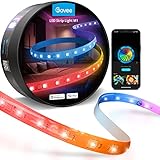
Philips Hue Solo Lightstrip, 10ft
Who it suits: Small-room buyers building toward a Hue setup — people who want a true gradual sunrise, a slow fade to dark and polite behavior after a power cut — and who accept that the full version of that costs more than this tier.
Ten feet is the length other guides apologize for. In a small room, do the sum instead: a headboard is five to six feet wide, a desk run is four to five, a floating shelf is three to four. Ten feet is a headboard plus one side of the bed, or a desk and the shelf above it, or the whole under-bed glow on the two sides that face the room. The Solo is the premium short strip: RGBWW diodes — red, green, blue plus warm-white and cool-white — so its whites are real, tunable from candle-warm to daylight, and convincing at the very low levels a small room lives at, where a mixed RGB white falls apart fastest. Signify markets the Solo line at up to 1,700 lumens; that is a maker’s headline figure, so treat it as “bright for a strip” rather than a measurement — and in a small room, brightness is the one thing you will never run short of. Check the current price on Amazon for the 10-foot kit: the strip itself sits — just — inside this budget. Out of the box it runs over Bluetooth in the Hue app: on, off, dim, color and scenes, no extra hardware. For a simple under-bed or behind-headboard glow, that is genuinely all a small room needs, and the strip-alone purchase makes more sense here than anywhere else in this guide, because ten feet actually finishes the job.
Now the catch, stated as plainly as the price, because it does not shrink with the room: everything that makes Hue the best sleep system in this guide lives behind the Hue Bridge. The Wake Up automation that fades the strip up like a sunrise over your chosen minutes, the Go to Sleep fade, schedules that run when your phone is off, out-of-home control and Matter support all require the Bridge — a separate purchase, so check its current price on Amazon. Strip plus Bridge together is not an under-$75 purchase in any honest accounting, and a smaller room does not make it one. What the Bridge money also buys is the most civilized power behavior here: Hue lets you set what a light does when power returns, so a midnight outage does not have to mean a small room lit like an operating theater at 4 a.m. Two more facts to plan around. The Solo shows one color at a time — it is not an addressable gradient strip like the Govees or the Tapo — which matters less in a small room, where a single calm wash suits the space better than a rainbow chasing itself around four short walls. And Hue’s own listing language on cutting is blunt: once you cut it, you cannot reconnect it, so measure the headboard run twice. Bought with open eyes — strip now, Bridge when the budget allows — it is the best long-term purchase in the guide. Bought expecting the sunrise routine out of the box, it will disappoint you.
- RGBWW diodes give real warm-to-daylight white, convincing at very low brightness.
- With the Bridge: the guide’s best gradual Wake Up sunrise, Go to Sleep fade, and a configurable power-on behavior.
- Bluetooth app control works out of the box with no extra hardware — and 10ft genuinely covers a small room’s main run.
Honest limitation: The sleep routines need the Bridge (a separate purchase — check price on Amazon), taking the real total over this budget. One color at a time, and a cut cannot be reconnected.
Choose it if you are starting a Hue room and will add the Bridge, or want premium real white from one short run now. Skip it if $75 is a hard ceiling for the whole project — the Tapo gives you routines with no second purchase.

PAUTIX RGB Smart IC COB LED Strip Light Kit, 20ft
Who it suits: Glow purists in small rooms. If the dotted look of bead-style strips bothers you in a big room, it will bother you twice as much three feet from your desk — and COB is the construction that removes the dots entirely.
COB — chip-on-board — packs the emitters so densely along the tape that the eye reads one continuous ribbon of light instead of a row of dots. Viewing distance is why this pick climbs the ranking in a small room: across a lounge, a bead strip’s dots blur into a line; across a small bedroom, from pillow to headboard or chair to shelf, they stay dots. The PAUTIX throws the smoothest, most even glow in this guide, smoother than the dense M1, because there are effectively no gaps to see — under a bed frame it reads as a soft pool of light on the floor with no visible source, and behind a monitor or a shelf as a clean line rather than a string of beads. The kit is a complete package: a 20-foot addressable strip (that is the configuration this guide covers), a 24-volt power supply, PAUTIX’s SP548E controller, and an RF remote. Twenty feet is more than most small-room routes need, but unlike the longer Govee below, the surplus here is modest — one long furniture run plus a desk, and the roll is mostly spent. The controller speaks Wi-Fi and Bluetooth through the BanlanX app and adds Alexa and Google Assistant voice control, and the RF remote deserves a small-room mention: unlike infrared remotes, RF works through bedding and furniture, so the remote in a drawer can kill the light without line of sight. The strip is UL-listed, runs on 24 volts (gentler voltage drop over a run than the 12-volt kits), and its addressable design divides the 20 feet into 61 segments of roughly four inches each, per the maker’s specification — coarse zones next to the Tapo’s 50 segments in 16 feet, which matters for effects and not much for a static warm glow.
Now the two labels this pick carries. First, price: we could not pin a US price for this kit from two independent sources, so no price is printed here and the pick is check-price — it belongs in an under-$75 guide only if the live Amazon listing is at or under $75 when you look. Second, white: for all its optical quality, this is an RGB strip with no white channel, so its “warm white” is the same red-green-blue mix as every other RGB strip — better hidden by the COB diffusion, but not warmer in spectrum, and in a small room that cold cast sits close to your eyes at reading distance. The BanlanX app is a generic platform app — functional timers and schedules, no circadian mode, no sunrise routine, a step below Govee’s or TP-Link’s software. Buy this strip for the quality of its light as a physical object. Do not buy it for software, and do not buy it as your only night light if true warm white matters to you.
- COB construction: one continuous, dotless line of light — the smoothest glow in the guide, and the gap is widest at small-room distances.
- Complete 20-foot kit with 24V supply, Wi-Fi/Bluetooth controller and an RF remote that works through furniture.
- UL-listed and addressable, with timers and schedules in the app plus Alexa and Google voice control.
Honest limitation: Check-price pick — no verified US price, so it counts only if the live listing is $75 or under. No white channel, and the generic app has no sunrise or circadian routine.
Choose it if an even, invisible-source glow is your top priority and the live price cooperates. Skip it if you want real warm white or a polished app — the Tapo and the M1 split those jobs between them.
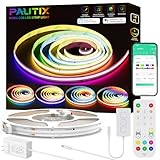
Nanoleaf Essentials Matter Lightstrip 80″ Smarter Kit
Who it suits: Owners of a Matter-and-Thread home whose small room needs exactly one short, bright, real-white run — a headboard width, a floating shelf, a desk hutch — rather than a whole room of light.
This is the guide’s prose-only pick, and the reason is procedural rather than a verdict on the product: the kit sits in the middle of this tier at list and is discounted often, but its current US Amazon listing code could not be pinned to the two-source standard we require before printing a buy link. So there is no button. Search Amazon by the exact name — Nanoleaf Essentials Matter Lightstrip 80″ Smarter Kit, model NF080K03-2LS — and check you have found the Matter generation, not the older HomeKit-only kit it replaced. In a small room, the kit’s famous shortness stops being a flaw and becomes a fit: 80 inches is 6.7 feet — one headboard, one shelf run, one side of a bed — precisely the single-feature runs that small rooms are made of. What you are fitting is an RGBW strip: color diodes plus a real white channel tunable from about 2700K warm to 6500K daylight, one of only three picks here that can do an honest warm night light. Nanoleaf’s brightness figures — a maker-rated peak of 2,200 lumens — are the highest headline numbers in the guide; as ever, they are maker numbers, but independent reviewers agree the strip is unusually bright for its size, and in a small room that brightness, bounced off a wall, is enough to read by and then some.
The constraints are infrastructure and shape. The strip shows one color at a time rather than addressable zones. Its smart control runs on Matter over Thread, which means full ecosystem control requires a Thread border router — a HomePod mini, a recent Apple TV, a current Echo or Nest hub. Many homes already own one without knowing it; if yours does not, that is another purchase standing between you and the features on the box, and this budget has no room for it. The fallback is real, though: the Nanoleaf app controls the strip over Bluetooth with no router at all, the app offers a circadian lighting mode that shifts color temperature through the day, and the kit includes a physical in-line controller — a small mercy at 3 a.m. that app-only strips cannot match, and in a small room that controller can live on the headboard within arm’s reach of the pillow. Cut points are marked roughly every 13 inches, and the cut piece, as everywhere here, is spent. Expansion packs cost extra and erode its value fast, so buy this kit for the one run it fits, not as the start of a longer one. In a Thread home with a short feature run to light, it is arguably the smartest buy in the middle of this tier; outside one, the Tapo does more with less fuss.
- RGBW strip with real tunable white (about 2700–6500K) and the brightest maker-rated output in the guide.
- Matter over Thread plus Bluetooth app control, a circadian mode, and a physical in-line controller.
- Mid-tier at list, and discounted often.
Honest limitation: Only 80 inches long, one color at a time, and Matter control needs a Thread border router you may not own. No Amazon link: we could not pin its US listing code to our standard, so buy by exact name and model.
Choose it if you already run a Thread home and need one short, bright, real-white run. Skip it if you need length, addressable effects, or do not own a border router — the Tapo covers all three with less fuss.
No link for this pick — see the note above and search Amazon by the exact product name.
Govee RGBIC Wi-Fi LED Strip Lights, 32.8ft (H618C)
Who it suits: Small-room buyers whose plan is genuinely a whole-room outline — a ceiling cove or a full wall perimeter in one continuous run — and who care more about color and coverage than about perfect white.
Every other pick in this guide is furniture-scale. This one is room-scale, and in a small room that cuts both ways, so let us do the arithmetic honestly. A 10-by-12-foot room has a 44-foot perimeter; 32.8 feet rings most of it, or runs a ceiling cove on all four walls of a smaller box room, in a single kit with a single power feed. If that is your plan, nothing else here can do it, and its positioning is remarkable: check the current price on Amazon — it sits at the accessible end of this tier, with more footage in budget than any other pick here. Control is Wi-Fi plus Bluetooth through the Govee Home app, with Alexa and Google Assistant voice control and no hub. Govee’s app is the most playful here — dozens of scenes, segmented DIY color, music sync — and for a teenager’s room or a gaming corner that energy is the point. But if your small-room plan is the usual one — under the bed, behind the headboard, along the desk — this reel gives you roughly twice the strip you can place, and surplus strip is not a spare. A lit strip should not be left coiled behind furniture, and cutting an addressable strip at its marks leaves the offcut dead. So the honest shape of this purchase is: either your route really is a room outline, or you are paying for fifteen feet of strip whose best fate is staying dark in a drawer.
The second caveat is about white, and it bites harder in a small room. The H618C is an RGBIC strip: every diode is a colored diode and there is no white channel at all. Set it to “warm white” and it mixes red, green and blue to approximate it; the result is a cold, slightly blue-leaning light that looks fine as a party accent and noticeably wrong as a bedside glow — and in a small room the strip is close to everything, including your eyes and the book in your hands, so the wrongness has nowhere to hide. Govee’s app gives you timers and schedules, but no dedicated gradual sunrise routine of the kind Hue and TP-Link build in — you can fake a wake-up with stepped scenes, but it is a workaround, not a feature. Its adhesive, like all budget adhesive backing, is effectively one-shot, and a 32.8-foot run is a lot of route to commit to in one pass. None of this makes it a bad strip. It makes it a room-outline color strip: if your design really is a glowing perimeter, it is the best value in the guide; if the strip itself has to be your night light and reading light, the Tapo does that job just as well with footage that fits.
- 32.8 feet in one kit — the only pick that can ring a small room; check price on Amazon.
- Wi-Fi and Bluetooth control with Alexa and Google Assistant; no hub needed.
- Segmented RGBIC color with Govee’s large scene library and music sync.
Honest limitation: Roughly double the footage most small-room routes can use, and the surplus cannot be coiled lit or cut and reused. No white channel, so all “white” is a cold RGB mix; no true sunrise routine; adhesive is one-shot.
Choose it if your design is a ceiling cove or full perimeter and color matters more than white. Skip it if your plan is bed-and-desk furniture runs — you will pay for footage you cannot place, and the Tapo or M1 will light the same room better.

Comparison Table
| Product | Length | Control | White light | Price basis | Link |
|---|---|---|---|---|---|
| TP-Link Tapo L930-5 | 16.4ft | Wi-Fi app, HomeKit, Alexa, Google; no hub | Real white channel (RGBWIC) | Check price on Amazon | Check on Amazon |
| Govee M1 with Matter | 16.4ft | Matter over Wi-Fi + Govee app; no hub | Real warm-white channel | Check price on Amazon — sale-dependent | Check on Amazon |
| Philips Hue Solo | 10ft | Bluetooth app; Bridge (extra) adds automations and Matter | Real warm + cool white (RGBWW) | Check price on Amazon; Bridge extra | Check on Amazon |
| PAUTIX RGB Smart IC COB Kit | 20ft | Wi-Fi + Bluetooth app, RF remote, Alexa, Google | RGB mix only — but dotless COB glow | Check price — buy only at $75 or under | Check price on Amazon |
| Govee RGBIC Wi-Fi H618C | 32.8ft | Wi-Fi + Bluetooth app, Alexa, Google; no hub | RGB mix only — cold | Check price on Amazon | Check on Amazon |
| Nanoleaf Essentials Matter Kit | 80 inches (6.7ft) | Matter over Thread (border router needed) + Bluetooth app | Real white channel (RGBW) | Mid-tier at list | Search Amazon by exact name |
How to Choose
Measure the furniture, not the room. The route a strip actually takes in a small room is a list of furniture runs, not a floor plan. Add yours up before you look at a single listing: two or three sides of a bed (roughly 11 to 17 feet depending on size and how many sides face the room), a desk’s back edge (4 to 5 feet), a shelf or wardrobe top (3 to 6 feet), a headboard (5 to 6 feet). Most small rooms total somewhere between ten and twenty feet of honest route — which is why this tier’s quality picks, at 10 to 20 feet each, fit it so well, and why a 32.8-foot reel is usually a solution looking for a problem. Buy the strip whose length is closest to your route from above, because a small surplus can be trimmed at a cut mark and a large one cannot be hidden.
Plan one strip that does three jobs. The small-room move that makes a single kit feel like a lighting system is routing: one continuous run that passes the places you actually live. A 16.4-foot strip can start behind the headboard, drop down one side of the bed as under-bed glow for the walk to the door, and end along the desk’s back edge as indirect task light — three jobs, one plug, one app tile. It works because in a small room those places are a few feet apart; the same trick in a large room would need three strips. Decide the route on paper first, check that the powered end lands near an outlet, and only then choose between the Tapo’s routines, the M1’s density and the PAUTIX’s seamless line — all three are the right length for the trick and differ in the light they make along it.
Decide what “white” you are actually buying. This is the single most consequential choice in the guide, and small rooms raise the stakes because the strip is always close to your eyes. If the strip will be your night light and reading light, it must have a white channel: RGBW, RGBWW or RGBWIC, like the Tapo, M1, Hue Solo and Nanoleaf here. If it will only ever be a colored glow behind furniture, a plain RGBIC strip is fine and stretches further per kit — but do not let a listing’s “16 million colors including warm white” phrasing talk you out of the distinction, because an RGB mix at its warmest is still a cool, blue-leaning light.
Judge the dimming floor, not the brightness ceiling. Strip brightness figures are maker numbers with no shared standard behind them, and in a small room they are doubly misleading: almost any strip here is bright enough at full power, and you will spend your evenings at a fraction of it. What decides whether the room feels calm is how the strip behaves at 5 to 20 percent — whether it dims smoothly, holds its color, and can sit at a barely-there overnight level. Density and diffusion help too: a dense or COB strip at low power reads as a soft wash, while a sparse bead strip reads as a row of dim dots. If $75 is itself a stretch, the Best Smart Light Strip For Small Rooms Under $40 guide keeps the same honesty rules on a tighter budget; if you are weighing what the next step up buys, the Best Smart Light Strip For Small Rooms Under $100 and the wider Best Smart Light Strip Under $100 guides show where the extra money goes — mostly into ecosystems and longer premium runs, which a small room rarely needs.
Plan the unglamorous parts. Smart strips are powered from one end by a brick that needs an outlet, and in a small room outlets are scarce and visible: pick the route whose powered end lands behind furniture, and give the controller a planned home rather than a dangling one. Adhesive backing on every strip here is effectively one-shot: wipe the surface, dry-fit the route with painter’s tape, then commit. Whatever you buy, spend the first evening setting the power-restore behavior where the system offers one — Tapo’s Default State, Hue’s power-on setting — because in a small room a strip that comes back at full brightness after a power blink lights the whole room, including your face. And since none of these kits includes a motion sensor, treat the overnight dim schedule as your night path.
Common Buying Mistakes
Buying footage you cannot place. The signature small-room mistake: a 50- or 100-foot reel bought because it looked like a bargain, in a room with eighteen feet of route. The surplus cannot be left coiled and lit, cannot be cut off and reused, and ends up dark in a drawer — so the “cheap” strip wastes more of its length than the quality pick ever would. Measure first; buy the closest length above your route.
Comparing prices without comparing lengths. A cheaper strip and a pricier strip are often the same strip economics at 16 feet and 33 feet. Always tie a listing’s price to its length; do the same check on any listing you find elsewhere, per placeable foot, before deciding something is a bargain.
Believing the lumen headline. Strip brightness figures are maker numbers with no shared standard behind them. In a small room you will run the strip dim anyway; density, diffusion and placement decide how the glow actually looks, and a dimmable strip bounced off a wall will always feel gentler than a brighter one aimed at the room.
Buying RGB for a white-light job. The most common regret in this category, amplified by small rooms: a strip bought to be a warm night light that can only make cold mixed white, glowing blue-ish a few feet from the pillow. If white is the job, the spec must show a white channel — RGBW, RGBWW or RGBWIC — full stop.
Assuming the ecosystem price is the strip price. Hue’s sunrise needs a Bridge; Nanoleaf’s Matter needs a Thread border router; the M1’s extension costs extra. The honest cost of a small-room system is the strip plus whatever unlocks the feature you actually bought it for, and several reviews above flag that extra purchase out loud.
Cutting first and measuring later. Every strip here cuts one-way. The offcut cannot be reconnected (Hue’s listing says so in so many words), and a strip cut two feet short is short forever. In a small room the temptation is to trim as you go around each piece of furniture — resist it, and cut once, at the end, if at all.
Sticking before thinking. Budget adhesive is weak and one-shot: it lets go of dusty or textured surfaces within weeks, and peeling a run up to re-route it usually ends the adhesive and sometimes the strip. Small rooms make this worse, because routes thread behind furniture you have to move to reach. Clean, dry-fit with tape, then stick.
Final Recommendation
For most small rooms, buy the TP-Link Tapo L930-5. It is the only pick that combines a real white channel, a documented circadian mode, HomeKit-grade control with no hub, and a power-restore setting — and in a small room its fixed 16.4-foot run, a limitation everywhere else, is roughly the whole route. Check its current price on Amazon — it leaves part of the budget unspent, which in a room with no second run to light is not under-buying; it is the right answer. If light quality is your religion and the Govee M1 is sitting inside the budget on the day you shop (check the current price on Amazon), take it — its density is the smoothest bead-style glow here, and a small room asks nothing of its length it cannot give. If it is at its full list price, take the Tapo and set a price alert instead. Choose the PAUTIX if a dotless, invisible-source line matters more than software and its live price lands in tier. Choose the Hue Solo only as the first piece of a Hue room you intend to finish with a Bridge. The Nanoleaf is the specialist for Thread homes with one short feature run. And the Govee H618C is the pick for exactly one small-room plan — a full ceiling cove or perimeter in color — bought with your eyes open about its cold mixed white and its surplus footage everywhere else. The small-room lesson of this tier in one line: at $75, the less footage you need, the more light quality your money can buy — so spend it on quality.
FAQ
How much strip does a small room actually need?
Less than the listings want you to buy. Add up the furniture runs: two or three sides of a bed (roughly 11 to 17 feet), a desk edge (4 to 5 feet), a shelf or headboard (3 to 6 feet). Most small rooms land between ten and twenty feet of route in total, which is why the 16.4-foot class dominates this guide and why very long reels usually leave you with surplus you cannot use.
What should I do with leftover strip length?
Ideally, not have any: buy the closest length above your measured route. If a small surplus remains, trim it at a marked cut point and accept that the offcut is dead — cutting is one-way on every strip here, and the trimmed piece cannot be reconnected. What not to do is leave the surplus coiled up and lit behind furniture; a coiled strip traps heat and looks like exactly what it is. Plan the route so the strip ends where the furniture does.
Can one strip really light a whole small room?
As the room’s evening and night light, yes — with the right route. A single run bounced off a wall or ceiling, or threaded from headboard to bed frame to desk, gives a small room a complete ambient layer: enough to move around, read in bed with a real-white strip, and wind down. What it does not replace is a focused task light at a desk for long work sessions, and no strip here should be bought as one. Think of the strip as the room’s background light, doing three jobs — ambient glow, indirect desk light, night path — at background brightness.
Why does my strip’s “warm white” look blue?
Because on a plain RGB or RGBIC strip, white is not a color the strip has — it is a mixture of red, green and blue diodes, and the mixture leans cool. In a small room you sit close to the strip, so the lean is obvious. The fix is a strip with a dedicated white channel (RGBW, RGBWW or RGBWIC). No app update, preset or “warm” slider changes the diodes on the tape.
Do I need a hub in a small room?
Usually not. The Tapo, both Govees and the PAUTIX all run hub-free over Wi-Fi. The exceptions are feature-shaped: Hue’s automations, sunrise routine and out-of-home control need the Hue Bridge (a separate purchase — check price on Amazon), and Nanoleaf’s Matter control needs a Thread border router, which many homes already own inside a smart speaker or streaming box. Bluetooth-only control, like the Hue Solo’s out of the box, works fine within a small room — range is the one thing a small room makes easy.
Is there a motion-sensor strip in this guide for night-time trips?
No — and that absence is worth knowing before you buy. None of the six kits includes a motion sensor. In a small room the practical substitute works unusually well: a dim warm schedule running overnight at a few percent brightness lights the whole short walk to the door, costs almost nothing to run, and never needs you to find a remote. A separate motion sensor from the same ecosystem can be added later at extra cost if you still want walk-up light.