Where to buy:
- TWODRAPES Pinch Pleated Linen Curtains, 108″ (Pair) — Check Price on Amazon
- MIULEE Pinch Pleated Linen Curtains, 90″ (Pair) — Check Price on Amazon
- NICETOWN Pinch Pleated Linen Curtains, 96″ (Pair) — Check Price on Amazon
- LAMIT Linen Semi Sheer Curtains, 52″ x 96″ (Pair) — Check Price on Amazon
- TWODRAPES Triple Pinch Pleat Linen Curtains, 84″ (Pair) — Check Price on Amazon
- jinchan Linen Curtains, 84″ Grommet (Pair) — Check Price on Amazon
- Wider windows: MIULEE Pinch Pleated Linen Curtains, 4-Panel Set, 90″ — Check Price on Amazon
- See more Amazon options for sheer curtains
Disclosure: dailyhomedecorating.com is reader-supported. When you buy through links on our site, we may earn an affiliate commission from Amazon at no extra cost to you. Prices and availability change constantly; the price on the Amazon product page at checkout is the one that counts.
A $100 budget for sheer curtains sounds generous until you start reading how this category is actually sold. The premium end of the sheer market prices per panel, not per pair, so a panel sold singly is really only half a pair, and the true cost for a window is double the single-panel figure. The word “linen” in a title usually means a linen-look polyester, and at least one widely sold “linen sheer” turns out, in its own specification table, to be 5% linen and 95% polyester. Panel widths shrink, too: the ready-made pinch pleat pairs that dominate this tier are built from 40-inch panels, not the standard 52-inch panels most buyers assume. This guide counts everything as a pair, states the real panel width of every pick, and reads the material specification fields instead of the titles.
Here is the honest headline first. Yes, the things buyers actually want at this tier exist on Amazon inside a $100 pair budget: ready-made pinch pleat pairs in 90, 96, and even 108-inch lengths, with hooks and rings in the box, sit comfortably inside the pair budget — check price on Amazon for the current figure for the size and color you need. What does not exist is a true 100% flax linen sheer pair under $100. The one verified real-flax sheer we found is sold per panel at a level that puts a pair well over this budget before options — and it is a made-to-order product, not a ready-made Amazon pair. Every “linen” pick below is a blend, and where a brand publishes its flax percentage we print it: the most transparent pick on this list is 20% linen and 80% polyester, and it says so in its own listing.
One more thing to settle before the picks, because no listing will tell you plainly: no sheer curtain gives you privacy at night. With your lights on and darkness outside, every product in this guide — sheer or semi-sheer, cheap or premium — shows silhouettes and movement to anyone outside. What you are buying at this tier is daytime softness: glare cut, a blurred view in, and a finished, tailored look at the window. Judge the picks on that basis and $100 goes a long way. Judge them as privacy curtains and no budget will save you; that job belongs to a lined drape or a blackout layer behind the sheer.
Quick Picks
| Product | Best For | Pair Price | Configuration Priced |
|---|---|---|---|
| TWODRAPES Pinch Pleated Linen Curtains, 108″ | Best overall — longest ready-made pinch pleat pair | Check price on Amazon | 2 panels, 40″W x 108″L each, Natural |
| MIULEE Pinch Pleated Linen Curtains, 90″ | Best value pinch pleat | Check price on Amazon | 2 panels, 40″W x 90″L each, Natural |
| NICETOWN Pinch Pleated Linen Curtains, 96″ | Best mid-price pinch pleat, richer colorways | Check price on Amazon | 2 panels, 40″W x 96″L each, Dark Sepia |
| LAMIT Linen Semi Sheer Curtains, 96″ | Best standard-width pair, published flax percentage | Check price on Amazon | 2 panels, 52″W x 96″L each, Natural |
| TWODRAPES Triple Pinch Pleat Linen Curtains, 84″ | Best standard-length pinch pleat | Check price on Amazon | 2 panels, 40″W x 84″L each, Natural |
| jinchan Linen Curtains, 84″ Grommet | Best budget grommet pair | Check price on Amazon | 2 panels, 50″W x 84″L each |
Every pick above is sold as a pair for the exact size and color named — check the current price on Amazon for that configuration. On these listings, price moves with color and length, sometimes noticeably between two colors of the same curtain, so check the exact configuration in the table rather than assuming a figure for the product line in general.
How These Picks Were Chosen
Sheer curtains are the easiest category in home textiles to shop badly, because almost every word on the listing page is doing marketing work. We chose these six by ignoring titles and working from specification fields, package contents, and verified pair pricing instead.
Pair pricing, converted openly. Our standard unit is a pair of two 52 x 84 inch panels. Any product sold per panel was converted to its true pair cost before it was allowed anywhere near this list, and products whose pair cost broke the budget were excluded no matter how good they looked — that rule alone removed most of the “premium sheer” market, including a made-to-order 100% European flax sheer sold per panel at a level that puts a pair well over budget and a heavily promoted “luxury linen sheer” also sold per panel at a level that puts a pair well over budget, whose own spec table lists the fabric as 5% linen and 95% polyester.
Material from the spec fields, never the title. For every pick we looked for the fiber breakdown in the specification table or the brand’s own technical copy. Where a percentage is published, we print it: LAMIT states 20% linen and 80% polyester, and the H.VERSAILTEX semi-sheer line — an also-ran here because we could not verify it to our standard — publishes 30% linen and 70% polyester. Where no percentage is published, as with jinchan’s “linen blend,” we say exactly that and treat the fabric as a linen-look blend of unknown flax content. The pinch pleat picks from TWODRAPES, MIULEE, and NICETOWN are sold as flax-blend fabrics; one TWODRAPES listing’s specification field reads “linen, cotton, polyester,” and none of the three publishes a flax percentage. Assume the flax share is a minority in all of them.
Density claims treated as marketing. Three of the pinch pleat picks are marketed with a “380 GSM” fabric weight. GSM figures for curtains have no shared measurement standard across brands, the number cannot be checked from the listing, and a genuinely sheer voile is normally a far lighter cloth — one made-to-order sheer line publishes about 90 GSM for its polyester sheer and 110 GSM for its real-flax sheer. Read “380 GSM” as “a dense, light-filtering semi-sheer,” not as a measured fact, and do not compare GSM numbers between brands.
Header style verified, hardware separated. A pinch pleat pick had to be a real sewn pinch pleat — not a rod pocket photographed in folds — and we checked what is in the package. The TWODRAPES and NICETOWN pairs include hooks and rings; the MIULEE pair includes hooks for its back tabs. No pick includes a rod or a track. Budget for the rod separately.
Light-filtering percentages ignored. Brands quote light-blocking or light-filtering percentages for sheers with no common test behind them. We describe each pick’s opacity the way Amazon’s own spec field does — sheer or semi-sheer, light-filtering — and we do not repeat percentage claims as facts anywhere in this guide.
Verification. Each pick’s identity and specifications were cross-checked from independent sources before it earned a link, against the same product’s listing details on Amazon’s international storefronts or the brand’s other retail channels. The jinchan pair is the one exception to flag openly: its sourcing during research was thinner than the other picks, with its identity confirmed from the listing itself, so check the current price on Amazon first before relying on its budget positioning. One popular product was left off entirely — NICETOWN’s classic white voile pair (54 x 96 inches) is the obvious true-voile benchmark, but we could not verify it to the same standard, so it appears in this guide as prose only, with no link.
Detailed Reviews
1. TWODRAPES Pinch Pleated Linen Curtains, 108″ — Best Overall

TWODRAPES Pinch Pleated Linen Curtains (108-inch pair) — check price on Amazon for a pair of two 40″W x 108″L panels in Natural.
Who it suits: Anyone with tall windows, a sliding door, or a floor-to-ceiling run who wants the tailored pinch pleat look without entering made-to-order pricing. A ready-made 108-inch pinch pleat pair inside this budget is the single hardest configuration to find in this category, and this is the pair that anchors the tier.
- Sold as a true pair: two panels, each 40 inches wide by 108 inches long — check price on Amazon, with no per-panel conversion needed
- Real sewn pinch pleats, heat-trained at the factory (the brand cites training at 248°F) so the folds arrive formed and are meant to keep their shape
- Package includes 16 adjustable hooks and 16 metal rings, so it can hang from a rod with rings or convert to a track with carriers
- Fabric specification on the listing reads linen, cotton, and polyester; opacity is rated semi-sheer and light-filtering — a dense weave that blurs daytime views rather than a gauzy voile
- Back tab option on the same header gives a second, softer hanging style without rings
Honest limitation: The panels are 40 inches wide, not the standard 52. Two panels give you about 80 inches of coverage, which dresses a window up to roughly 48–53 inches wide with proper fullness. On a wide picture window or a double sliding door you will need two pairs, and at that point the total will move well past the budget in this guide’s title. The brand’s “380 GSM” figure is a marketing number with no cross-brand standard behind it, and no flax percentage is published for the fabric, so buy it as a linen-look blend, not as linen.
Choose it if your windows are tall and not especially wide, and you want the most finished, drapery-like result this budget can produce. Skip it if your window is wider than about 54 inches (look at the LAMIT pair or two pairs instead), or if you want a true airy voile — this fabric is a dense semi-sheer and reads more like a light drape than a classic sheer.
2. MIULEE Pinch Pleated Linen Curtains, 90″ — Best Value Pinch Pleat
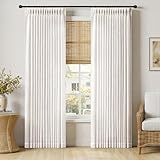
MIULEE Pinch Pleated Linen Curtains (90-inch pair) — check price on Amazon for a pair of two 40″W x 90″L panels in Natural.
Who it suits: Buyers who want the pinch pleat look at the value end of this guide, and anyone dressing several windows — positioned low in this tier, it makes covering two windows far more feasible than with the pricier pleat lines.
- Among the lowest-positioned pinch pleat pairs here: check price on Amazon for two 40 x 90 inch panels, sold by Miulee Home
- Memory-trained pinch pleats with a back tab header and hooks included, so the pair hangs from rings or a track without extra hardware beyond the rod
- A genuinely heavy fabric for the category — the pair’s listed weight is about 8.4 pounds — which is why it drapes in formed folds instead of floating like a voile
- Light-filtering semi-sheer opacity: softens glare and blurs daytime shapes while keeping the room bright
- Wide-window escape hatch exists in the same line: a 4-panel set of the same curtain — check price on Amazon — is positioned to stay inside this budget, for windows that need the extra width
Honest limitation: The value positioning belongs to the Natural colorway at 90 inches, and this line’s pricing is unusually color-sensitive — other colorways and lengths in the same line sit noticeably higher in the tier. If your room needs a specific color, check the current price on Amazon for that exact configuration before assuming the value positioning applies. As with every pinch pleat pick here, the panels are 40 inches wide, no flax percentage is published for the fabric, and the “380 GSM” in the title is a brand claim, not a measurement you can compare across brands.
Choose it if Natural works in your room and you want pleats on a budget, or if you are covering multiple windows. Skip it if you need a specific color at this exact positioning, or a true 52-inch-wide panel — the LAMIT pair below is the standard-width option.
3. NICETOWN Pinch Pleated Linen Curtains, 96″ — Best Mid-Price Pinch Pleat

NICETOWN Pinch Pleated Linen Curtains (96-inch pair) — check price on Amazon for a pair of two 40″W x 96″L panels in Dark Sepia.
Who it suits: Anyone who wants the 96-inch length — the right drop for 8-foot ceilings with a high-mounted rod — in a richer, deeper colorway than the pale naturals that dominate this category.
- Two 40 x 96 inch panels per pair — check price on Amazon — sold by NICETOWN, with rings and hooks included for the pinch pleat header
- Memory-trained pleats: the folds are set at the factory and are designed to spring back after handling
- Coarse-weave, textured fabric with a semi-sheer, light-filtering opacity — the weave is visibly more open and rustic than the MIULEE’s smoother cloth
- Color range runs deeper than most sheer lines, including the Dark Sepia featured here; the same line’s Cream version sells through Amazon’s other storefronts at a similar tier, so the line is established, not a one-off listing
Honest limitation: Ignore any strikethrough list-price framing attached to this listing; check the current price on Amazon, and treat discount framing as decoration. The pair weighs about 4.8 pounds — noticeably lighter than the MIULEE pair — so expect a slightly less sculpted drape. NICETOWN publishes a 30% natural linen figure for its related linen-blend sheer line, but no flax percentage is stated for this pinch pleat listing itself, so do not buy it assuming that number applies here.
Choose it if you want 96-inch pleats in a warm, deeper tone from a brand with a broad sheer catalog behind it. Skip it if you want the heaviest, most structured drape (the MIULEE pair is denser and positioned lower in the tier) or the longest drop (the TWODRAPES 108-inch pair).
4. LAMIT Linen Semi Sheer Curtains, 52″ x 96″ — Best Standard-Width Pair

LAMIT Linen Semi Sheer Curtains (52 x 96-inch pair) — check price on Amazon for a pair of two 52″W x 96″L panels in Natural.
Who it suits: Buyers with standard or wide windows who have been doing the width math on the pinch pleat picks and not liking the answer. This is the only pick that matches the standard 52-inch panel width, so one pair covers what one pair is supposed to cover — and it is the most honest label in the guide.
- Full standard width: two panels at 52 inches wide each (104 inches total) by 96 inches long — check price on Amazon for the pair, sold by LAMIT US
- The brand publishes its fiber content in its own listing text and spec fields: 20% linen, 80% polyester — a minority flax share, stated openly instead of hidden behind the word “linen”
- Dual header: rod pocket and back tabs on the same panel, so it can hang shirred on a rod for soft gathers or on tabs for flatter folds
- Semi-sheer, light-filtering weave with a visible slub texture; the shorter 84-inch version of this same line sits at the budget end of the line in roundups, so the line’s positioning is genuinely budget-tier
Honest limitation: There is no pinch pleat here — the tailored, formed-fold look of the first three picks is exactly what you give up for standard width at this tier. Shirred on a rod pocket, it gathers softly and casually; on back tabs it hangs flatter. And 20% linen means the fabric’s behavior — wrinkle resistance, easy washing, durability — is mostly polyester’s, whatever the title implies.
Choose it if your window is wide, your budget is firm, and you prefer a published fiber percentage over a pleat. Skip it if the crisp pinch pleat silhouette is the whole point of the purchase — go back to the MIULEE or TWODRAPES pairs and accept the narrower panels.
5. TWODRAPES Triple Pinch Pleat Linen Curtains, 84″ — Best Standard-Length Pinch Pleat

TWODRAPES Triple Pinch Pleat Linen Curtains (84-inch pair) — check price on Amazon for a pair of two 40″W x 84″L panels in Natural.
Who it suits: Standard-height rooms. Most windows in most homes want an 84-inch drop, and this pair delivers the most formal header in the guide — a triple pinch pleat — at exactly that length.
- Triple pinch pleats: three-finger folds that produce fuller, more traditional drapery waves than the double pleats on the other picks
- Two 40 x 84 inch panels per pair — check price on Amazon — sold by TWODRAPES, with hooks and rings included and a back tab alternative on the same header
- Same dense, light-filtering semi-sheer fabric family as the 108-inch TWODRAPES pair, in the Natural colorway
- The 84-inch length puddles nowhere and clears baseboards and radiators in typical rooms — the lowest-risk length to buy without a tape measure marathon
Honest limitation: You are paying a premium over the MIULEE pair for the pleat style and the standard length, in the same 40-inch panel width and the same unpublished-flax blend territory. One data caution: the tracking data for this listing carries an implausible 1-pound weight figure that contradicts the fabric’s description, a reminder that marketplace data fields are messy — the configuration was verified, but treat stray spec numbers on any of these listings with suspicion.
Choose it if your ceilings are standard height and you want the fullest, most classic pleat. Skip it if your windows need 90 inches or more of drop — that is what the MIULEE, NICETOWN, and 108-inch TWODRAPES pairs are for.
6. jinchan Linen Curtains, 84″ Grommet — Best Budget Grommet Pair

jinchan Linen Curtains (84-inch grommet pair) — check price on Amazon for a pair of two 50″W x 84″L panels.
Who it suits: Anyone who opens and closes their curtains daily. Grommets slide on a rod with one hand, need no rings, hooks, or track, and this is the budget-end pair in the guide at a near-standard width.
- Two 50 x 84 inch panels — close to the standard 52-inch width — check price on Amazon for the pair, positioned at the budget end here
- Grommet top fits rods up to 1.5 inches in diameter and glides open and closed more easily than any pleat or pocket header
- The brand’s own care text is refreshingly specific: machine wash cold with mild detergent, do not bleach, gentle cycle, tumble dry low, and steam-iron for five to ten minutes to clear packaging wrinkles
- Light-filtering semi-sheer weave; the brand itself describes the fabric as “light but not sheer,” which matches its denser-than-voile character
Honest limitation: jinchan’s specification field says only “linen blend” and publishes no flax percentage anywhere we could find — so despite the name, treat this as a linen-look fabric of unknown composition. Its pricing also carries this guide’s one sourcing caveat: it rested on a single source during research, so check the current price on Amazon before you rely on its budget positioning. Grommets also cap the formality: this is a clean, casual header, not a tailored one.
Choose it if budget and daily sliding matter more than a formal header. Skip it if you want published fiber content (LAMIT) or real pleats (any of the first three picks).
Comparison Table
| Product | Pair Price | Panel Size (each) | Header | Material (per spec fields) | Hooks/Rings Included |
|---|---|---|---|---|---|
| TWODRAPES Pinch Pleated, 108″ | Check price on Amazon | 40″ x 108″ | Pinch pleat / back tab | Linen, cotton, polyester (no % published) | Yes — 16 hooks, 16 rings |
| MIULEE Pinch Pleated, 90″ | Check price on Amazon | 40″ x 90″ | Pinch pleat, back tab | Flax blend (no % published) | Yes — hooks |
| NICETOWN Pinch Pleated, 96″ | Check price on Amazon | 40″ x 96″ | Pinch pleat / back tab | Linen blend (no % published) | Yes — rings and hooks |
| LAMIT Linen Semi Sheer, 96″ | Check price on Amazon | 52″ x 96″ | Rod pocket / back tab | 20% linen, 80% polyester (published) | No — hangs on a rod |
| TWODRAPES Triple Pinch Pleat, 84″ | Check price on Amazon | 40″ x 84″ | Triple pinch pleat / back tab | Flax blend (no % published) | Yes — hooks and rings |
| jinchan Linen Curtains, 84″ | Check price on Amazon | 50″ x 84″ | Grommet | “Linen blend” (no % published) | No — grommets built in |
How to Choose Sheer Curtains Under $100
- Convert every price to a pair price before comparing. This category mixes pair pricing and per-panel pricing in the same search results. A panel sold singly needs to be bought twice for a window, so the pair cost is double the single-panel figure. If a listing does not say “2 panels” or “pair” in the size field, assume it is one panel until proven otherwise.
- Do the width math with the real panel width. For soft, full folds you want total panel width of about 1.5 to 2 times the window width. A standard pair (two 52-inch panels, 104 inches total) suits a window up to roughly 52–69 inches wide. The pinch pleat pairs in this guide are 40-inch panels — about 80 inches total — which suits windows up to roughly 40–53 inches. Wider window? Buy the LAMIT pair, jinchan pair, or a 4-panel set, and re-check the total against your $100 ceiling.
- Read the fiber line, not the title. “Linen” in a curtain title means linen texture until a specification field proves otherwise. A published percentage — 20% linen, 30% linen — is a minority flax share stated honestly. No percentage at all means the flax content is unknown and probably small. A genuinely 100% flax sheer exists, but it is sold per panel made-to-order at a level that puts a pair well over this budget, which is why it is not in this guide’s picks.
- Decide what “sheer” means for your room. True voile is gauzy and floaty and gives the weakest daytime privacy — shapes stay readable through it. The dense linen-blend semi-sheers that fill this guide blur shapes and cut glare much better, but read visually as light drapes. Neither gives any privacy at night with the lights on; for a street-facing bedroom, plan a second, opaque layer or a blind behind the sheer.
- Pick the header for how the curtain will live. Pinch pleats look tailored and need rings, hooks, and a rod or track; they suit curtains that mostly stay dressed. Grommets slide best for daily opening and closing. Rod pockets are the cheapest and most casual, and they bunch the most fabric at the top. The header is a bigger daily-life decision than the fabric.
- Budget the rod separately — always. Not one pick in this guide includes a rod or track. The pinch pleat pairs include their hooks and rings, which helps, but the rod itself is a separate purchase, and a ceiling track for a floor-to-ceiling run costs more than a simple rod. Price the hardware before you commit the whole $100 to fabric.
- Match care to the header, and check the label. Pleated headers hold their shape best with steaming and gentle handling, and standard care guidance treats stiffened, pleated drapery as a steam-or-dry-clean category rather than a machine-wash one. Flat panels like the jinchan pair carry straightforward brand care text — cold, gentle, mild detergent, no bleach, low tumble. Whatever you buy, the sewn-in label outranks any listing copy, and any panel containing real flax can shrink if it meets hot water or a hot dryer.
- Plan the layer, not just the sheer. In most well-dressed windows the sheer is one of two layers: it lives on its own rod or track, with an opaque drape, a roller blind, or a blackout panel doing the privacy and darkness work behind or in front of it. A double rod or a dual track costs more than a single rod, so decide the layering plan before you buy hardware — and remember that a sheer bought for a layered window can be chosen purely for texture and light, which is exactly where the dense semi-sheer picks in this guide are strongest.
- Ignore light-filtering percentages and GSM shootouts. Neither number has a shared standard behind it in this category. Compare opacity classes (sheer vs. semi-sheer), panel dimensions, and fiber content — the things that are actually stated consistently — and treat every percentage as advertising.
Do Branded Sheer Lines Fit a $100 Pair Budget? The Honest Answer
Partly — and the dividing line is width and fiber, not quality. The ready-made pinch pleat lines from TWODRAPES, MIULEE, and NICETOWN are real branded sheer programs with trained pleats, included hardware, and lengths up to 108 inches, and their pairs sit inside this budget — check price on Amazon for the current figure for your size and color. If the look you want is the tailored sheer wall from design photos, $100 buys it — provided your window is narrow enough for 40-inch panels, or you accept a 4-panel set like MIULEE’s pack in the same line as your “pair.”
What $100 does not buy is fiber honesty at the top end. The verified 100% European flax sheer we found is a made-to-order panel sold singly at a premium level, so a pair starts well over budget before you choose a header or a lining — over budget on its own, before the rod. Designer Belgian linen panels sit at a designer ceiling, many times this pair budget per panel. And the per-panel trap is everywhere in between: the most heavily marketed “luxury linen sheer” we checked is sold per panel at a level that puts a pair at roughly double this budget, for a fabric its own specification table lists as 5% linen and 95% polyester. The word “linen” is doing all the work in that listing, and it is doing it at twice this guide’s budget.
Run the panel math on the three reference points and the tier explains itself. A made-to-order polyester sheer sold per panel can land a pair near the top of this budget — technically inside, for a fabric with no flax in it at all, plus a production wait. The real-flax version of that same program starts at a higher per-panel level, putting a pair well over budget, and climbs with every option. The designer Belgian linen panel, bought as two panels, is a pair at many times this budget. Against those reference points, a value-positioned ready-made pinch pleat pair is not a compromised product; it is what the honest end of this market actually costs. The compromise is only in the fiber, and it is a compromise the good listings disclose.
So the tier’s real conclusion is this: under $100 a pair, you can have the pleats, the length, and the hardware — or a published, honest fiber percentage at standard width — but the market will not sell you a majority-flax sheer at any width, and it will happily charge you double this budget for a polyester panel wearing a linen name. Buy the configuration, read the spec field, and let the title say whatever it wants.
Lengths and Drops: Why This Tier Runs 84 to 108 Inches
Sheer curtains fail more often on length than on fabric, so it is worth understanding why this guide’s picks cluster where they do. The 84-inch drop — the jinchan pair and the TWODRAPES triple pleat — is the standard apartment length: it suits a rod mounted a few inches above a standard window on an 8-foot ceiling and lands at or just below the sill-to-floor midpoint of most rooms. The 90-inch MIULEE pair exists for the common in-between case, where 84 kisses the baseboard and 96 pools. The 96-inch NICETOWN and LAMIT pairs are the floor-length answer for 8-foot ceilings with the rod mounted high, close to the crown, which is the mounting style that makes a room look taller. And the 108-inch TWODRAPES pair serves 9-foot ceilings, tall sliding doors, and the deliberate slight-break look where the fabric just touches the floor.
Two measuring rules prevent most returns. First, measure from where the rod will actually sit, not from the top of the window frame — a pinch pleat pair hung on rings drops an extra inch or two below the rod from the ring and hook, while a rod-pocket pair like the LAMIT loses a little length to the fabric gathered above the pocket. Second, decide the floor relationship before ordering: sheers look best either kissing the floor (within half an inch) or breaking slightly on it; the awkward outcome is the accidental two-inch hover, which reads as a measuring error no matter how good the fabric is. If your measurement lands between two of these lengths, buy the longer one — a 96-inch pair can be hemmed cheaply, while an 84-inch pair cannot be lengthened at all.
What Happened to True Voile?
Readers who came here picturing a classic gauzy voile — the floaty, nearly transparent white curtain — will notice that all six picks are denser semi-sheers instead. That is a deliberate result of the verification process, and it is worth explaining. The canonical voile pair in this market, NICETOWN’s white rod-pocket voile in 54 x 96 inches, is a real and widely sold product, but we could not verify it from two independent sources to this guide’s standard, so under this guide’s rules it earns no link. The rest of the true-voile field is a commodity tier of near-identical listings whose prices move too fast and whose specifications are too thin to verify to the standard the other picks met.
There is also a functional reason the semi-sheers won. Voile is the most transparent fabric class in the category: in daylight it softens light beautifully but leaves shapes, movement, and even broad details readable from outside, and at night it is effectively clear with the lights on. The dense linen-blend semi-sheers in this guide blur the daytime view to silhouettes, which is what most buyers actually want from a living-room or bedroom sheer. If your window faces a garden, a courtyard, or open sky — anywhere privacy is a minor concern — a voile pair is a legitimate, usually cheaper choice; just buy it knowing its price and specifications are the least stable in the category, and check the listing’s size field twice, because voile is where per-panel selling is most aggressive.
Common Buying Mistakes
- Ordering one unit of a per-panel listing. The most common sheer mistake in this price range. Check the size field for “pack of 2” before ordering; if it says “pack of 1,” your window needs two units and your budget needs doubling.
- Assuming 52-inch panels. Pinch pleat pairs at this tier are usually 40-inch panels. Measure your window, multiply by 1.5–2 for fullness, and compare against the pair’s true total width — 80 inches, not the 104 you may be picturing.
- Trusting the title’s “linen.” Fiber content lives in the specification table. If no percentage is published, you are buying a linen look, and at least one popular “linen sheer” is 95% polyester by its own spec sheet.
- Expecting nighttime privacy. Every sheer and semi-sheer in this guide shows silhouettes after dark with interior lights on. Street-facing and bedroom windows need an opaque second layer; no sheer at any price changes that.
- Comparing GSM and light-filter percentages across brands. There is no shared standard for either number in curtains. A “380 GSM” claim and a “70% light filtering” claim are both marketing until a brand publishes its test method, which none of these do.
- Forgetting the rod. Hooks and rings may be in the box; the rod or track never is. A floor-to-ceiling track run can cost as much as the jinchan pair itself.
- Ironing memory-trained pleats flat. The folds on the pinch pleat picks are heat-set at the factory. Steam them; do not press them, and do not wash a pleated header on a hot cycle unless the sewn-in label explicitly allows it.
Final Recommendation
- Best overall: TWODRAPES Pinch Pleated Linen Curtains, 108″ — check price on Amazon for the pair. The longest ready-made pinch pleat pair we could verify, with hooks and rings in the box.
- Best value: MIULEE Pinch Pleated Linen Curtains, 90″ — check price on Amazon for the pair in Natural, with a four-panel set in the same line — also check price on Amazon — for wide windows that is positioned to still fit this budget.
- Best standard width: LAMIT Linen Semi Sheer Curtains, 52″ x 96″ — check price on Amazon for the pair, and the only pick that publishes its fiber content: 20% linen, 80% polyester.
- Best budget: jinchan Linen Curtains, 84″ Grommet — check price on Amazon for the pair at near-standard width, with the easiest daily slide and the clearest care instructions (check its current price first; it carries this guide’s one single-source caveat).
If your window is a standard single window and you want the finished look, buy the MIULEE pair and spend the savings on a decent rod. If your window is wide, buy the LAMIT pair and accept gathers instead of pleats. And if what you truly want is real flax linen, save past this tier: the honest starting point for a 100% linen sheer pair is well past this tier, made-to-order, and anything in this tier wearing the word “linen” is a blend — the good ones, like the picks above, are worth buying as exactly that.
Frequently Asked Questions
Do sheer curtains provide privacy at night?
No. This is the most important fact in this guide. With interior lights on after dark, every sheer and semi-sheer curtain — including all six picks here — reveals silhouettes and movement to viewers outside. Sheers manage daytime glare and soften the daytime view in. For nighttime privacy, add a lined drape, a blackout layer, or a blind behind the sheer.
Are any sheers under $100 a pair actually made of linen?
Not majority-linen, and none that are 100% flax. The verified blends in this guide run from a published 20% linen (LAMIT) to unpublished minority blends sold under “linen” titles. The one verified 100% European flax sheer we found is made-to-order per panel at a level that puts a pair well over this budget, which is why no true-linen product appears in the picks. If a listing will not state a flax percentage in its specifications, assume the linen content is small.
Why are the pinch pleat pairs only 40 inches wide per panel?
Because that is how the ready-made pinch pleat market is built: narrower panels keep the pair price down and suit the narrow-to-medium windows most buyers dress. Two 40-inch panels give about 80 inches of coverage, right for windows up to roughly 40–53 inches wide at normal fullness. For wider glass, use a standard-width pair like the LAMIT, or a four-panel set — MIULEE’s, check price on Amazon, is positioned to stay inside this budget.
What does “memory trained” mean on these curtains?
It means the pleats were heat-set at the factory — one brand cites training at 248°F — so the folds arrive formed and are designed to return to shape after hanging and handling, instead of needing to be dressed by hand after every wash. It is a real construction feature, but it also means care matters: steam the pleats to refresh them rather than ironing them flat.
Is a rod included with any of these curtains?
No. No pick in this guide includes a rod or a ceiling track. The pinch pleat pairs from TWODRAPES and NICETOWN include hooks and rings, and the MIULEE pair includes hooks, which covers the small hardware — but the rod itself is always a separate purchase, so budget for it alongside the fabric.
Can I machine wash these curtains?
It depends on the header more than the fabric. The flat panels are the easy cases: jinchan’s own care text for its grommet pair specifies a cold machine wash with mild detergent, no bleach, a gentle cycle, and a low tumble dry. For the pinch pleat pairs, treat the pleats as the delicate part — standard care guidance puts stiffened, pleated drapery in the steam-or-dry-clean category, because a hot or rough wash can break the heat-set folds the brands call memory training. Whatever the listing claims, the sewn-in care label on the panel you receive is the authority; check it before the first wash, and keep any panel with real flax content away from hot water, which is what shrinks it.
Sheer or semi-sheer — which should I choose?
Choose true sheer (voile) when you want maximum light and a floaty, gauzy look and daytime privacy barely matters — a high window, a layered look over blinds, a bright sunroom. Choose semi-sheer, like every pick in this guide, when you want glare cut and a blurred daytime view with a more substantial, drape-like presence. All six picks here are semi-sheer light-filtering fabrics, because at this budget that is where the verified quality sits.