Where to buy
Check the latest price, availability and delivery on Amazon. Orders are placed on Amazon. We may earn a commission from qualifying purchases.
- Best overall: HMCITY 120 LED Solar Wall Light, 2-Pack (Back Button, Daylight White) — Check on Amazon
- Aootek 120 LED Solar Motion Sensor Light, 2-Pack (Black, Daylight White) — Check on Amazon
- CLAONER 452 LED Solar Motion Sensor Light, 2-Pack — Check on Amazon
- GlowGarden Solar Up-and-Down Wall Sconce, 2-Pack — Check on Amazon
See 2 more Amazon options
- Aootek 120 LED Solar Motion Sensor Light, 4-Pack (Black, Daylight White)
- LIT-PaTH Outdoor LED Wall Lantern, 1-Pack (LT-WL01350K)
Read the full guide ↓
Disclosure: As an Amazon Associate, dailyhomedecorating.com earns from qualifying purchases. Links to Amazon on this page are affiliate links; they cost you nothing extra. Listing details such as price and availability change often, so check the current Amazon listing before you buy.
Fifteen dollars is an awkward amount of money to spend on an outdoor wall light, and this guide will not pretend otherwise. It is enough — just — for a pair of solar motion lights that genuinely work: small plastic fixtures that charge from a panel on their own face, watch for movement with a PIR sensor, and throw a useful burst of light over a door, a gate or a garage apron at a very low cost per light. It is not enough for the thing most people picture when they type the search: a hardwired lantern wired into a junction box beside the front door. We looked hard for one. Every hardwired fixture we could verify sits well above this budget — the closest example, an aluminum-and-glass integrated-LED lantern from LIT-PaTH, sits well above this tier; check the current price on Amazon to see the gap for yourself — and several classic budget lantern listings showed no featured offer at all when we checked. So the honest headline of this tier is: under $15, outdoor wall lighting means solar, and solar means a set of physical limits — sun exposure, battery size, plastic housings — that this guide states pick by pick instead of smoothing over.
Here is the shape of the six picks. The HMCITY 2-pack is the best overall buy — check the current price on Amazon, as it is the proven design this tier is known for. The Aootek 2-pack adds a reflector design and a front-mounted button, and its fit for this budget is deal-dependent — it moves in and out of this tier, so check the current price on Amazon before counting on it — and it is labeled as such. Two picks are included as clearly labeled check-price options, because we could verify their listings and specifications but could not pin a current price from a source we trusted: the CLAONER 452 LED 2-pack, the newest high-diode-count design, and the GlowGarden up-and-down sconce, the only pick that looks like a decorative fixture rather than a security light — and the only one with no motion sensor at all. One pick is a deliberate, labeled near-miss: the Aootek 4-pack, which sits just over this budget and still offers the lowest cost per light in this guide when you divide its pack price by four — check the current price on Amazon to run that math live. And the LIT-PaTH lantern closes the list as the hardwired reality check, included so you can check the current price on Amazon and see what the wired version of this purchase actually costs relative to this budget.
Two warnings govern everything below. We print no lumen figure as fact anywhere in this guide; where one is mentioned it is labeled a maker figure, and the picks are ranked on architecture, sensor behavior and pack economics instead. If you are lighting a specific kind of home, start with the version of this guide written for it: Best Outdoor Wall Light For Apartments Under $15, Best Outdoor Wall Light For Modern Homes Under $15 or Best Outdoor Wall Light For Small Rooms Under $15. And if your budget can stretch, Best Outdoor Wall Light Under $30 is where hardwired fixtures and metal housings begin.
Quick Picks
Short on time, or comparing several options at once? Each row below names a buyer type and the product that suits it, with a link to the listing.
| Buyer type | Pick | Why it stands out | Link |
|---|---|---|---|
| Best overall | HMCITY 120 LED Solar Wall Light, 2-Pack (Back Button, Daylight White) | The proven budget solar motion light — a low per-light cost in a 2-pack; check price on Amazon | Check on Amazon |
| Best wide-angle design | Aootek 120 LED Solar Motion Sensor Light, 2-Pack (Black, Daylight White) | Reflector housing spreads light sideways, front-mounted mode button — fits this budget at deal moments, so check the current price on Amazon | Check on Amazon |
| Most LEDs (check price) | CLAONER 452 LED Solar Motion Sensor Light, 2-Pack | The newest high-diode-count design with three modes — we could not pin a trustworthy price, so check the live listing; buy only at $15 or less | Check on Amazon |
| Best-looking (check price) | GlowGarden Solar Up-and-Down Wall Sconce, 2-Pack | The only decorative sconce shape here — up-and-down beams, dusk-to-dawn, no motion sensor; listing showed no featured offer when we checked, so check the live price | Check on Amazon |
| Best per-light value (near-miss) | Aootek 120 LED Solar Motion Sensor Light, 4-Pack (Black, Daylight White) | Sits just over this budget, stated plainly — but the lowest per-light cost in this guide when you divide by four; check price on Amazon | Check on Amazon |
| The hardwired reality check | LIT-PaTH Outdoor LED Wall Lantern, 1-Pack (LT-WL01350K) | Aluminum and glass, hardwired, integrated LED — sits well above this budget, which is what a real wired lantern actually costs; check the current price on Amazon to see the gap | Check on Amazon |
How These Picks Were Chosen
The first filter was the product category itself, defined plainly: an outdoor wall light, for this guide, is a fixture that mounts on an exterior wall — beside a door, on a garage, over a patio, along a fence line — and lights the space in front of that wall. A hardwired fixture draws from a junction box, needs no sun, and produces steady light all night — and, as the LIT-PaTH pick documents, sits well above this budget. A solar fixture is a self-contained board, panel and battery in a plastic shell, which is why it can sit at the very bottom of the price ladder — and why its light is a burst on motion rather than a porch lamp’s steady glow. Under $15 the choice is made for you, and this guide’s job is to make sure you choose well inside it.
The second filter was verification. Two picks — the CLAONER 452 LED and the GlowGarden sconce — are included as clearly labeled check-price options: we could verify their listings and specifications, but not a current price we trusted (the GlowGarden’s Amazon page showed no featured offer during our research), so we print no price rather than repeat a stale one, and each review states the live price at which the pick earns its place. One pick, the Aootek 4-pack, is labeled a near-miss in the same breath as its name: it sits just over this guide’s budget, and it is included because its per-light cost, when you check the current price on Amazon and divide by four, can beat in-budget options — hiding it would make the guide tidier and worse.
We did not install these lights ourselves. We read the maker listings, manuals and specification pages and compared the numbers that actually separate products in this tier: power architecture, sensor mechanism (a PIR motion sensor and a photocell dusk-to-dawn switch are different devices doing different jobs, and listings blur them deliberately), the number and placement of lighting modes and the button that selects them, housing material, pack configuration, and the maker’s weather claims — read critically, because an IP65 code is a dust-and-water-jet test result, not a wet-location certification, and no solar pick here carries a UL or ETL location listing we could verify. What we favored, in order: a sensor and mode set matched to the doorway it will serve; a panel and battery sized honestly for the LEDs they feed; a mode control you can reach after the light is mounted; and a maker with enough of a track record that the listing, and its replacement, will exist next year.
The 6 Best Outdoor Wall Lights Under $15
HMCITY 120 LED Solar Wall Light, 2-Pack (Back Button, Daylight White)
Who it suits: Homeowners who want the proven, default answer — a pair of motion lights for the front door and the side gate, bought at the price this category is famous for, with no wiring and no electrician.
The HMCITY is the reference product of the budget solar shelf: 120 LEDs behind a frosted cover, a PIR motion sensor, a solar panel across the top face, and an ABS plastic housing, sold here as a 2-pack in the back-button, daylight-white configuration. Mode one is security mode: dark until the sensor sees movement, then full brightness for a short burst — the battery-sipping setting that makes a small panel viable. Mode two holds a constant medium brightness all night, the porch-light impersonation, at the cost of the shortest runtime. Mode three is the sensible compromise: a dim marker glow all night that jumps to full brightness when motion triggers it. On price, this is the friendliest pick in this guide: it sits at the low end of this tier, with a low cost per light in this 2-pack configuration — check the current price on Amazon before you buy, and confirm it still fits this budget at the moment you order.
The limitations deserve the same specificity. Start with the name of this configuration: back button. The mode selector sits on the rear face of the housing, against the wall, so changing modes after installation means unmounting the light or reaching behind it — a small annoyance that becomes a real one at the top of a ladder, and the reason the front-button Aootek below exists as a pick. Brightness is the category’s standing caveat in its purest form — listings in this product family variously claim 800, 960, 1,200 and 2,200 lumens for what is substantially the same hardware, so we print none of them; expect a useful pool of light over a doorway, not a lit yard. The housing is ABS plastic, which keeps the price and the weight down and will chalk and yellow over years of sun in a way metal would not. Within those limits, this is the light the rest of the tier is measured against — check price on Amazon for its current position in this tier.
- Three genuinely distinct modes — motion-only, constant medium, and dim-with-motion-boost — covering security and marker-light duty in one fixture.
- Positioned at the low end of this budget tier as a 2-pack, for a low cost per light — check price on Amazon.
Honest limitation: The mode button is on the back of the housing, so changing modes means unmounting the light; output is a motion-triggered burst rather than steady porch light, the family’s lumen claims contradict each other (800–2,200 for similar hardware) so none is printed, and performance collapses on shaded walls.
Choose it if you want the default budget answer for a door and a gate — check the current price on Amazon first. Skip it if you will change modes often (the front-button Aootek below), need light all evening rather than on motion, or your mounting wall gets little direct sun — no solar pick fixes that.
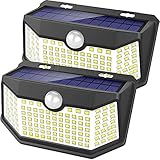
Aootek 120 LED Solar Motion Sensor Light, 2-Pack (Black, Daylight White)
Who it suits: Buyers lighting a wider area than a single doorway — a garage apron, a driveway edge, a broad patio wall — who want the light thrown sideways as well as down, and a mode button they can actually reach.
The first is the button: Aootek puts the mode selector on the front face, so switching between its three modes — security (motion-triggered full brightness), permanent-on, and smart brightness control (dim all night, full power on motion) — is a fingertip job on the mounted light, not an unmounting job. The second is the spread: a reflector built into the housing throws the 120 LEDs’ output across a claimed 270° illumination pattern, against the maker-rated PIR detection of up to 26 feet at a 120° angle — both maker figures, printed here as claims rather than measurements, but the reflector is a physical feature you can see in the housing, and side-throw is the real difference between lighting a doorstep and lighting the approach to it. A warm-white version of the same 2-pack exists on its own listing for buyers who find daylight white harsh at a front door. Pricing needs its label read carefully: this 2-pack’s fit for this guide is deal-dependent — at deal moments it falls inside this budget, and at other moments it sits above it as a near-miss — so check the current price on Amazon before you buy, and judge it by the live price you actually see rather than by the headline.
The limitations are the class limitations, plus the pricing one just stated. The permanent-on mode asks the most of the smallest component in the box — the battery — and on short winter days or a partially shaded wall it is the first mode to fade before dawn. Detection range and illumination angle are maker figures with no shared test standard behind them; treat 26 feet as the optimistic edge of the sensor’s reach, not a guarantee at your mounting height — the maker’s own materials recommend installing around 5.6–6.6 feet up, and mounting higher shrinks the effective detection zone beneath the light. Judged when it falls inside this budget, it is the better-engineered of the two proven designs; judged when it sits above the budget, it is the guide’s second near-miss, and the 4-pack below is the smarter way to buy this hardware anyway.
- Front-mounted mode button — the fix for the back-button problem, and reason enough to pick this design if you switch modes seasonally.
- Deal-dependent fit for this budget — inside the tier at deal moments, above it at others — so check the current price on Amazon before buying.
Honest limitation: Its fit for this budget is deal-dependent: it is not always inside this tier, so check the current price on Amazon and treat it as a near-miss whenever the live price sits above this budget. ABS plastic housing; detection and angle figures are maker claims; permanent-on mode fades first in winter.
Choose it if you check the current price on Amazon and find it inside this budget, want side-throw coverage, or will use the mode button more than once. Skip it if the live price sits above this budget and you need two lights — check the HMCITY above instead — or if you need four, where the 4-pack below is the smarter way to buy this hardware.

CLAONER 452 LED Solar Motion Sensor Light, 2-Pack
Who it suits: Shoppers drawn to the newest, highest-diode-count version of the solar motion light — and willing to check a live price before buying, because this is one of the two picks whose price we could not pin.
CLAONER is one of the volume names of this category, and this 2-pack is its current flagship pitch: 452 LEDs — the count is the headline — with a PIR motion sensor, three lighting modes of the now-standard kind (motion-triggered full brightness, a constant setting, and a dim-with-boost setting), an upgraded solar panel the maker promotes for faster charging, and an IP65-rated housing. What we could not do, during our research, is pin this specific listing’s price from two sources we trusted — and the brand’s wider range explains why we refuse to guess: CLAONER’s established 126 LED 4-pack, a larger multipack from the same maker, sits at and above this budget line rather than comfortably below it. In other words, this maker’s lights tend to live around this tier’s upper edge. So the buying rule for this pick is printed instead of a price: check the current price on Amazon, and it earns its place in this guide only if the live listing fits this $15 budget for the 2-pack; above that, it belongs to the next guide up, and the HMCITY and Aootek picks above deliver the same architecture — check their current prices on Amazon as well.
The deeper limitation is the headline number itself. Four hundred fifty-two LEDs sounds like four times the light of the 120-LED picks, and it is not, for a reason rooted in the box’s smallest components: every diode in this fixture is fed by one small solar panel and one small battery, and total light output is capped by the energy those two parts harvest and store, not by how many diodes share it. It cannot repeal the arithmetic that a day’s sun on a playing-card-sized panel yields a few watt-hours, to be spent as a bright burst on motion or a thin glow all night. The listing is also the newest in this guide, which cuts both ways — the design is current, and the owner record behind it is the thinnest here, with none of the years-deep review history the HMCITY and Aootek carry. None of that makes it a bad light.
- The densest diode field in this guide — 452 LEDs across the 2-pack’s fixtures — for the most even spread of light this architecture offers.
- The standard, proven three-mode PIR architecture with an upgraded panel, from one of the category’s volume makers.
- Included with a printed buying rule instead of an invented price: worth considering only if it fits this budget live — the brand’s larger 4-pack sits around this tier’s upper edge, so check price on Amazon before assuming.
Honest limitation: We could not pin a trustworthy current price, so none is printed — and the brand’s wider range suggests it may sit above this budget. The 452 count is a diode count, not a brightness figure: output is capped by the same small panel and battery as every pick here. Newest listing in the guide, thinnest owner record.
Choose it if the live price is at or under $15 and you value the denser, more even light field. Skip it if the live price is above this budget — the HMCITY delivers the same architecture, so check its current price on Amazon — or if a deep owner record matters more to you than the newest design.

GlowGarden Solar Up-and-Down Wall Sconce, 2-Pack
Who it suits: Homeowners who want their outdoor wall light to look like a light fixture — a decorative sconce that washes the wall above and below itself — and who understand they are buying accent, not illumination.
Every other pick in this guide is a security light wearing a wall light’s name. This one is the opposite: a small sconce (maker model Swl-3030-6, sold under the GlowGarden name) whose six LEDs are split three-up and three-down, so the fixture paints two fans of warm-white light on the wall itself — the up-and-down wash that makes a plain façade look designed at night. There is no motion sensor. The mechanism is a photocell: the light charges by day, switches itself on at dusk, and runs until its battery fades or dawn switches it off, with a maker-claimed runtime of up to 12 hours that, like all such claims, assumes a full day of strong sun behind it. It is also this guide’s second check-price pick, for a stated reason: during our research, Amazon’s page for this listing showed no featured offer, and we could not pin a current price from a source we trusted, so we print none. The buying rule follows the budget: at $15 or less for the 2-pack it is a fair fit for the look; materially above that, decorative solar sconces wait in the next guides up.
The limitations are the mirror image of its charm. Six LEDs, however arranged, produce accent light: enough to read the wall’s texture and mark the fixture’s position, nowhere near enough to find a keyhole, read a house number, or light a step — if the doorway needs working light, this sconce is a companion to a motion light, never a substitute for one. We could not verify a specific IP rating for this listing, let alone a wet-location certification — the maker markets it for outdoor fence and wall use, and the prudent reading of that silence is to mount it where the wall offers some shelter, under an eave or a porch roof, rather than on the most rain-exposed face of the house.
- The only true sconce shape in this guide: three LEDs up, three down, washing the wall in warm white — decoration the security lights cannot imitate.
- Photocell dusk-to-dawn operation with no modes, buttons or sensors to manage: it simply comes on at night.
- Sold as a 2-pack, so a doorway or a pair of fence posts gets the matched, symmetrical look the style depends on.
Honest limitation: We could not verify a current price — the listing showed no featured offer — so none is printed; buy only at $15 or less live. Accent output only (six LEDs), no motion sensor, the battery is spent every night regardless of need, and no specific IP rating could be verified, so mount it somewhere sheltered.
Choose it if the wall already has working light and what it lacks is looks. Skip it if it would be the doorway’s only light, if your winters are dark (the battery will not last the night), or if the live price has climbed past $15.
Aootek 120 LED Solar Motion Sensor Light, 4-Pack (Black, Daylight White)
Who it suits: Anyone whose house actually needs four lights — front door, back door, garage and side gate — and who would rather step just over a headline budget than buy two separate 2-packs at a worse per-light rate.
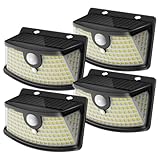
This pick sits just over this guide’s budget, and the guide includes it anyway, with that near-miss status in the open. The arithmetic that justifies its place is per-light math: check the current price on Amazon and divide by four, and the resulting cost per light can undercut smaller packs — including the HMCITY 2-pack — because you are buying four fixtures in a single pack rather than two. The hardware is the same AK06-family design as the 2-pack reviewed above: 120 LEDs per fixture, the reflector housing, the front-mounted mode button, the three modes (security, permanent-on, smart brightness control), the maker-rated PIR reach of up to 26 feet, and the IP65 ABS construction. The wider family adds context: a larger 6-pack from the same family exists for houses that need six, sitting higher as a total purchase while spreading the cost across more lights. The pattern is the tier’s real shape: solar motion lights are a per-light product with a low per-light floor, and pack size, not brand, is how you approach that floor — always by checking the current price on Amazon and dividing by the number of lights in the pack.
The honest limitation is the obvious one, stated without decoration: this pick is not under $15, and if your budget is a hard line rather than a guideline, the HMCITY 2-pack above is your pick and this one is a temptation to resist. Beyond the price, the class limitations apply at scale — four plastic housings chalking in the sun rather than two, four panels that each need their own patch of direct sun (the shaded side of the house will underperform no matter how good the deal was), and four sets of maker-figure specifications. None of that dents the value case. If the project is a whole house rather than a single doorway, this is the smartest money in the guide, and the small step over the budget line is stated openly rather than hidden.
- The lowest potential unit cost in this guide when you check the current price on Amazon and divide the 4-pack price by four.
- Identical AK06-family hardware to the 2-pack pick: reflector housing, front button, three modes, IP65 — just four of them.
- This pack lives just above this budget line as a near-miss, which is itself useful information about the tier — check price on Amazon to confirm its current position.
Honest limitation: It sits just over this guide’s budget as a labeled near-miss, rather than inside the under-$15 tier. One color temperature across four mounting points, four panels each needing direct sun, and the class’s plastic construction throughout.
Choose it if you need three or four lights and can treat $15 as a guideline. Skip it if the budget is a hard line (buy the HMCITY 2-pack), or if you need only one or two lights — per-light value you never install is not value.
LIT-PaTH Outdoor LED Wall Lantern, 1-Pack (LT-WL01350K)
Who it suits: Readers who came to this guide wanting a real porch lantern — wired, metal, permanent — and who deserve the actual price of that thing rather than a page of solar substitutes pretending to be it.
This is the hardwired reality check, included so the tier’s central fact is stated plainly. The LIT-PaTH LT-WL01350K is a proper exterior wall lantern: a painted aluminum housing with a glass shade — metal and glass, in a guide otherwise made of ABS plastic — hardwired to a junction box, with an integrated LED board rated by the maker at 9.5 watts and 800 lumens (a maker figure, like every brightness number in this category, though hardwired figures at least describe a device with unlimited power behind them). The light is 5000K daylight only, switched by your wall switch, on for exactly as long as you leave it on, indifferent to clouds, seasons and the direction your wall faces. This single pack sits well above this guide’s budget — check the current price on Amazon to see its live position — and a larger pack configuration exists for buyers who need more than one, though even bought that way a wired lantern remains a step up from this solar tier. When we checked its Amazon page during this research it showed no featured offer, so check the current price on Amazon before planning around it; the conclusion survives any small movement, because no hardwired fixture we could verify comes close to this budget.
Its limitations are the honest costs of the real thing. Installation is electrical work: it needs an existing junction box where you want the light, or an electrician to put one there, which can cost more than every pick in this guide combined — the fixture price is the small part of a hardwired project that starts from bare wall. The LED board is integrated and non-removable, so when it eventually fails there is no bulb to change; the fixture is replaced whole, which is the trade behind its sealed, weather-resistant build. The 5000K-only output is a cool daylight that flatters a garage more than a front door, and there is no warm option in this model. If that is what you actually want, this pick is your honest starting point — check the current price on Amazon — and the step-up ladder below shows the whole climb.
- Aluminum housing and glass shade — the only metal-and-glass construction in this guide, built as a permanent fixture.
- Hardwired and switch-controlled: full light all night, every night, with no sun, battery or sensor in the chain.
- The hardwired category’s entry point, sitting well above this solar budget — check the current price on Amazon to see the gap.
Honest limitation: It sits well above this budget, and the listing showed no featured offer when we checked — check the current price on Amazon. It needs a junction box (an electrician if none exists), the integrated LED is not replaceable, and 5000K is the only color temperature.
Choose it if you have a junction box, want permanent light, and can spend what hardwired actually costs. Skip it if the $15 budget is real — that is what the five solar picks above are for — or if there is no wiring at the mounting point.

Comparison Table
| Product | Type | Best use | Link |
|---|---|---|---|
| HMCITY 120 LED Solar Wall Light, 2-Pack — check price on Amazon | Solar PIR motion light, 3 modes, IP65 ABS | The default pick for a front door and a side gate | Check on Amazon |
| Aootek 120 LED Solar Motion Sensor Light, 2-Pack — check the current price on Amazon | Solar PIR motion light, reflector housing, front button | Wide walls, garage aprons, anywhere side-throw matters | Check on Amazon |
| CLAONER 452 LED Solar Motion Sensor Light, 2-Pack — check live price | Solar PIR motion light, 452 LEDs, 3 modes | The densest light field — buy only at $15 or less live | Check on Amazon |
| GlowGarden Solar Up-and-Down Wall Sconce, 2-Pack — check live price | Solar dusk-to-dawn accent sconce, no motion sensor | Decorative wall wash where working light already exists | Check on Amazon |
| Aootek 120 LED Solar Motion Sensor Light, 4-Pack — near-miss, just over this budget; check price on Amazon | Solar PIR motion light, reflector housing, 4-pack | Whole-house coverage with a low per-light cost — divide the live pack price by four | Check on Amazon |
| LIT-PaTH Outdoor LED Wall Lantern, 1-Pack — well above this budget; check price on Amazon | Hardwired integrated-LED lantern, aluminum and glass | Permanent porch light where a junction box already exists | Check on Amazon |
How to Choose
Decide the power architecture before the brand. Everything in this category flows from one fork. Hardwired fixtures draw from a junction box: steady, switch-controlled light, all night, in any weather, in metal housings built to stay up for a decade — sitting well above this budget for a single fixture, plus installation if no box exists where you want the light. Solar fixtures are self-contained panel-battery-board appliances that sit at a low cost per light because there is no wiring, no metalwork and no certification in the box — and whose light is therefore a rationed resource, spent as motion-triggered bursts or a thin all-night glow. Under $15, the fork is not a choice: solar is what the budget buys, and the picks above are ranked inside that reality.
Audit your sun before you audit the listings. A solar wall light is a bet on its own mounting point. Makers recommend six to eight hours of direct sun, and mounting heights around 5.6–6.6 feet for the sensor geometry to work as rated. If the spot fails the sun test and the light matters, that is the genuine case for the hardwired rung — not a more expensive solar light with a bigger number on the box.
Match the sensor mechanism to the job. Listings blur two different devices into the phrase “auto on/off,” and they are not interchangeable. A PIR motion sensor watches for moving heat: the light stays dark until someone approaches, then fires at full brightness — the right mechanism for doors, gates, garages and security duty, and the reason the battery survives, because darkness is free. A photocell — dusk-to-dawn — simply reads ambient light: the fixture switches on at nightfall and burns until the battery or the dawn gives out, which is the right mechanism for a decorative sconce or a marker glow and the wrong one for a doorway you want lit on arrival. Modes refine the PIR side: motion-only maximizes battery life, a constant mode impersonates a porch light at the cost of runtime, and dim-with-boost splits the difference.
Read the weather claim for what it actually is. IP65, the rating on every solar pick here, is a laboratory code: dust-tight, and proof against water jets from any direction. What it is not is a wet-location listing: it is not a UL or ETL certification, it says nothing about years of UV, freeze-thaw cycles or the seal around a battery door in year three, and we could not verify a location certification for any solar pick in this guide. The practical translation: mount solar lights where the architecture offers any shelter going — under an eave, on the porch wall rather than the exposed gable — not because IP65 fears rain, but because every seal and every plastic ages slower out of the worst of the weather. For a hardwired fixture the standard is different and stricter: a fixture in direct rain needs a genuine wet-location rating, one under a porch roof a damp-location rating, and that rating — printed by a certifier, not implied by an IP code — is part of what stepping up beyond this budget is buying.
Ignore lumens; interrogate the energy budget instead. Brightness is the specification this category lies about most fluently, because it can: there is no shared measurement standard behind the numbers, and the same 120-LED product family is listed in different places at 800, 960, 1,200 and 2,200 lumens. LED counts are the same trick in a different unit — 452 diodes share the same small battery as 120, and total light is set by stored energy, not diode census. The questions that actually predict performance are physical: how big is the panel, how big is the battery (where the maker states it), and how is the energy spent — a motion-burst light concentrates a day’s harvest into seconds of strong light, while an all-night light spreads it into a glow.
Do the per-light math, and buy the pack the house needs. Every price in this category is a price for a configuration — pack size, shell color, color temperature, button style are separate listings at separate prices, and listings exploit the confusion by headlining the biggest pack at the smallest pack’s price. The discipline is division: check the current price on Amazon for each candidate, divide that live price by the number of lights in the pack, and compare the per-light results — a larger pack such as the Aootek 4-pack will often undercut a 2-pack such as the HMCITY per light, a still larger family pack spreads the cost further, and the hardwired LIT-PaTH stands apart as a single permanent fixture well above this tier.
What $15 Actually Buys in Outdoor Wall Lighting
It is worth understanding why the solar lights are so cheap, because the same math explains everything this tier cannot do. A solar motion light is a circuit board, a stamp-sized panel, a small rechargeable cell and a bank of LEDs in a molded plastic shell. That low per-light cost is not a pricing miracle; it is what a light costs when everything a fixture used to be is deleted and only the light source and its own tiny power station remain.
What $15 buys, then, is a specific and genuinely useful tool: motion-triggered light at the points a house is passed through, installed in ten minutes with two screws, at a per-light cost lower than the bulb in a porch lantern. What it does not buy, anywhere we could verify: a hardwired fixture (that category sits well above this budget, in single or multipack form); a metal housing or a glass shade at any pack size; a wet-location certification we could verify; steady all-evening light for a porch people sit on; or performance on a wall the sun does not reach. It also does not buy honesty in the listings themselves — lumen figures contradict each other four ways inside a single product family, LED counts are marketed as brightness, and “waterproof” is printed where a laboratory code belongs — which is why this guide labels its near-misses, directs you to check the current price on Amazon for every pick, and leaves two picks as check-price options rather than fill in numbers it could not stand behind.
The Step-Up Ladder: What Each Extra Rung Buys
At the entry rung, the HMCITY 2-pack buys the proven design — the in-budget default; check the current price on Amazon to confirm it still fits. The next rung, the Aootek 2-pack, buys the refinements: reflector spread and a front button, when its live price falls inside this budget. Just above this guide’s line, stated on the rung where it belongs, the Aootek 4-pack buys unit economics: a lower cost per light for whole-house coverage when you divide its live pack price by four. Higher still, the family’s larger 6-pack takes the same per-light math further for houses that need six lights. CLAONER’s 126 LED 4-pack is that brand’s multipack option, for buyers comparing across makers — positioned around and above this tier rather than at its entry point. And at the top rung here, the LIT-PaTH buys out of the solar economy entirely: aluminum, glass, a junction box and light that does not ask the weather for permission — with the unpriced caveat that if no junction box exists where you want it, an electrician’s visit is the real step-up cost. The next territory, where hardwired fixtures multiply and wet-location ratings become standard equipment, is mapped in Best Outdoor Wall Light Under $40.
Common Buying Mistakes
Mounting a solar light where the sun never reaches. The most common failure in this category is not electrical — it is geographical. A panel on a north wall, under a porch roof or in an eave’s shadow harvests a fraction of its rating, and the light fades early and triggers weakly while its listing gets blamed.
Believing the lumen figure — or the LED count. Brightness claims here are maker numbers with no shared standard: one product family is listed at 800, 960, 1,200 and 2,200 lumens in different places. Diode counts are the same marketing in another unit, because output is capped by the panel and battery, not by how many LEDs share them. Architecture, sensor and pack math are the specifications that differ for real.
Reading IP65 as a wet-location rating. IP65 is a dust-and-water-jet laboratory code, not a UL or ETL location certification — and no solar pick in this guide carries a certification we could verify. Give the light whatever shelter the wall offers, and for hardwired fixtures in direct rain, insist on a genuine wet-location rating.
Buying a decorative sconce to do a security light’s job. The GlowGarden’s six LEDs paint a wall beautifully and light a doorstep barely at all.
Comparing pack prices without dividing. A larger pack can work out cheaper than a smaller pack in the only unit that matters — the cost per light once you check the current price on Amazon and divide by the pack size. Listings headline the largest pack at the smallest pack’s price precisely because shoppers skip the division. Count your mounting points, then divide every candidate by its pack size before comparing anything.
Choosing a mode you cannot change. A back-button light’s mode is set once, on the day it is mounted, effectively forever — because nobody unmounts a working light to press a button. If your use will change with the seasons, buy the front-button design; if you buy the back-button one, choose the dim-with-boost mode before it goes up, since it is the setting that serves both security and marker duty.
Final Recommendation
For most readers, the answer is the HMCITY 120 LED 2-Pack: the proven design of this category — check the current price on Amazon — with three modes that cover security and marker duty in one fixture. Mount the pair where the sun actually reaches, set the dim-with-boost mode before they go up — the button is on the back — and a front door and a side gate are lit for about the price of a porch bulb. If your walls are wide or your modes will change with the seasons, the Aootek 2-Pack buys the reflector spread and the front button when you check the current price on Amazon and find it inside this budget; if its live price sits above this budget, skip the pair and consider the 4-pack instead. And if what you actually want is a porch lantern — metal, glass, on at the switch until you say otherwise — let this guide’s last pick save you a search: check its current price on Amazon — it sits well above this budget, plus a junction box, and no amount of LED-count arithmetic at $15 was ever going to change that. Fifteen dollars buys excellent motion light for the places you pass through.
FAQ
Can you really buy a hardwired outdoor wall light for under $15?
No — not one we could verify. The cheapest hardwired fixture we could verify in our research, the LIT-PaTH integrated-LED lantern, sits well above this budget in single-pack form and remains a step up even in a larger pack configuration — check the current price on Amazon to see its live position — and several classic budget lantern listings showed no featured offer at all. Under $15, outdoor wall lighting is solar; this guide states that gap plainly rather than letting the headline imply otherwise.
Are solar wall lights bright enough for a front door?
For the doorway’s actual jobs, yes: finding the lock, seeing a visitor’s face at conversational distance, and marking the step. A PIR motion light concentrates a day’s solar harvest into a strong short burst, which suits doors and gates well. What solar does not do at this price is light a yard, a driveway’s full length, or a porch for an evening of sitting — those need either a much larger solar system or the hardwired rung well above this budget.
What does IP65 actually mean — is it a wet-location rating?
IP65 is a laboratory code: the housing is dust-tight and resists water jets from any direction, which covers rain on a wall comfortably. It is not a wet-location listing — that is a separate UL or ETL certification, and we could not verify one for any solar pick in this guide.
How much sun do these lights need, and where should I mount them?
Makers recommend six to eight hours of direct sun on the panel and a mounting height around 5.6–6.6 feet for the sensor’s rated geometry.
What is the difference between motion-sensor and dusk-to-dawn lights?
A PIR motion sensor keeps the light dark until it detects moving heat, then fires at full brightness — maximum effect per charge, ideal for security and doors. A photocell dusk-to-dawn light, like the GlowGarden sconce, switches on at nightfall and burns until dawn or until the battery fades — ideal for decoration, wasteful for security. Listings blur the two mechanisms into “auto on/off”; the reviews above separate them pick by pick.
How long do the batteries last, and can they be replaced?
The battery is the wear part of every solar pick here: expect strong performance in the first seasons and a gradual shortening of runtime as the cell ages, fastest in lights run in constant-on modes and in cold climates. Most fixtures in this class are sealed or use cells that are replaceable only with tools and some confidence; at this tier’s low cost per light, the category’s economics treat the fixture as the consumable.
Will solar wall lights work in winter?
They work within winter’s arithmetic: shorter days charge less, cold reduces battery capacity, and low sun angles can leave a wall-mounted panel in shadow it never sees in June. Motion-only mode is the winter setting — it spends nothing until someone is actually there — while constant-on modes are the first to fade before dawn.