Where to buy
Check the latest price, availability and delivery on Amazon. Orders are placed on Amazon. We may earn a commission from qualifying purchases.
- Best for a covered small entry: BesLowe Outdoor Wall Light Fixtures, 2-Pack, E26 Socket, Glass Shades, Matte Black — Check on Amazon
- Aootek Solar Motion Sensor Lights, 120 LED, IP65, 4-Pack — Check on Amazon
- Tuffenough Solar Outdoor Lights, 2500LM, 210 LED, 3 Heads, Remote, 2-Pack — Check on Amazon
- URPOWER Solar Spot Lights Outdoor, 2-in-1 Wall Light / Landscape Spotlight, 2-Pack — Check on Amazon
See 2 more Amazon options
- HMCITY 120 LED Solar Wall Lights, Motion Sensor, 3 Modes, 2-Pack — Check on Amazon
- SOLPEX Solar Deck Lights Outdoor, 16-Pack, Warm White — Check on Amazon
Read the full guide ↓
Disclosure: As an Amazon Associate, dailyhomedecorating.com earns from qualifying purchases. Links to Amazon on this page are affiliate links; they cost you nothing extra. Listing details such as price and availability change often, so check the current Amazon listing before you buy.
A small outdoor space changes the lighting problem completely, and most buying guides never notice. When the “yard” is a five-foot balcony, a patio the size of a parking space, or an entryway barely wider than its own door, three constraints take over that barely matter on a big suburban wall. The first is footprint: wall space is the scarcest resource you own, and every fixture competes for it with the door swing, the railing, the chair you actually sit in. A lantern that projects eight inches from the wall is furniture in a space this size; a wedge the size of a paperback is not. The second constraint is sun. Small outdoor spaces are usually small because something bigger is next to them — the balcony above yours, the neighboring house three feet away, the fence that gives you privacy and takes your afternoon light with it. A solar panel in a space like that does not get a slightly worse version of the sun; on many days it gets none, and a solar light that never charges is not a dim light, it is a dead one. The third constraint is distance. In a small space you do not walk past your wall light — you sit next to it, three feet away, for hours. A motion flood that is bracing at the end of a driveway is a genuine annoyance at arm’s length, and a gentle two-lumen marker that would be invisible across a lawn becomes exactly the right amount of light on a balcony rail.
So this guide re-sorts the under-$40 outdoor wall light market through those three filters. Every pick below is measured against the wall it has to share, the sun it can actually reach, and the person sitting beside it. The six products are the same six we would shortlist for any wall at this price — one hardwired lantern pair and five solar designs — but the ranking logic is small-space logic: footprint before brightness, chargeability before features, and many small points of light before one big one. Readers working with a full-size wall and none of these constraints should start from our general guide to the Best Outdoor Wall Light Under $40; this one assumes the wall is small and works out from there.
Two honesty notes before the picks, because they shape everything below. First, brightness: there is no shared measuring standard behind the lumen figures in this category, so a maker’s 2,500 lumens and another maker’s 200 are not numbers on the same scale. This guide prints lumen figures as maker claims and sorts them into classes — accent glow, doorway burst, area flood — and it treats LED counts as what they are, a description of a circuit board rather than of light. The biggest claim in the guide, the Tuffenough flood’s 2,500 lumens, has not been independently measured by any source we found, and it is flagged that way every time it appears. Second, the budget’s hard edge: under $40, hardwired and automatic do not meet. Verified hardwired two-packs with a motion sensor or photocell sit above this budget, so at this price you choose between a wired fixture you switch yourself and a solar light that switches itself. In a small space that choice has a wrinkle — the wired fixture is also the only pick completely immune to the sun problem — and the reviews below keep both sides of it visible.
Quick Picks
Short on time, or comparing several options at once? Each row below names a small-space situation and the light that suits it, with a link to the listing.
| Small-space situation | Pick | Why it stands out here | Link |
|---|---|---|---|
| Best for a covered small entry | BesLowe Outdoor Wall Light Fixtures, 2-Pack | The only hardwired pick — two real glass-and-metal E26 lanterns — check price on Amazon — and the only pick that does not care whether your entry ever sees the sun | Check on Amazon |
| Best tiny-footprint coverage | Aootek Solar Motion Sensor Lights, 4-Pack | Four palm-size wedges (about 4.1 × 3.7 in each) with three modes and an IP65 claim — check the current price on Amazon, and buy only when the live price still fits this budget | Check on Amazon |
| Best for a small space with one wide job | Tuffenough Solar Outdoor Lights, 2-Pack | Three aimable heads and a remote per unit, 2,500 lumens claimed by the maker and unmeasured — check price on Amazon; an 11.4-inch-wide unit, so reserve it for the one wall that needs width | Check on Amazon |
| Best for sun-starved walls | URPOWER Solar Spot Lights, 2-Pack | The panel tilts independently of the head, so it can face the sky while the beam faces the wall — dusk-to-dawn accent light; check the current price on Amazon | Check on Amazon |
| Best wedge for posts and narrow strips | HMCITY 120 LED Solar Wall Lights, 2-Pack | A 4.1-inch wedge with the tier’s most useful mode set, including a dim all-night level for sitting spaces — a check-price pick: check the current price on Amazon for the exact 2-pack, and buy only when the live price fits the under-$40 budget | Check on Amazon |
| Best many-small-points pick | SOLPEX Solar Deck Lights, 16-Pack | Sixteen tiny warm-white markers — check price on Amazon — the natural small-space pattern: outline the rail, the steps and the deck edge instead of flooding any of them | Check on Amazon |
How These Picks Were Chosen
The budget filter came first, applied at the exact configuration each review recommends. That discipline matters more in this category than in most, because a single listing family routinely sells a single light, a 2-pack, a 4-pack and a 12-pack at four prices, in two shell colors and two light colors, and the headline price belongs to whichever variant the page happened to open on. Check the live price on Amazon for the exact pack size and variant named in each review, because a listing family’s headline can belong to a different configuration. Confirm the configuration you want still fits the under-$40 budget before you buy.
On top of the budget, three small-space filters decided the ranking. The first was footprint — the fixture’s claim on a wall that has very little wall to give. We recorded physical size wherever the maker or coverage states it: the Aootek and HMCITY wedges are roughly four inches across, small enough for a fence post, a gate pillar or the strip of wall between a door and a corner; the SOLPEX markers are smaller still, closer to a matchbox than a fixture; the BesLowe lanterns are real lanterns, with the projection and presence that implies; and the Tuffenough, at about 11.4 inches wide with three splayed heads, is the one pick whose footprint has to be argued for rather than assumed. The second filter was the sun audit. A solar light’s panel position relative to its beam decides whether it can work in a shaded small space at all: fixed-panel wedges must live where the sun lands, full stop, while the URPOWER’s independently tilting panel can harvest sky from a wall whose lower half never sees direct light. We weighted that geometry heavily, because in balconies stacked under balconies and alleys between houses it is the difference between a light and an ornament.
The power divide runs underneath all three filters, because it decides what ownership means. The BesLowe pair is hardwired: it needs an existing junction box and a wall switch, it has no battery to fade and no panel to shade, and its light source is a replaceable E26 bulb — when the bulb dies, the fixture stays, and the bulb’s rated output is printed under a real standard on the bulb’s box.
Weather honesty was the last filter. What decides whether a light belongs on a rain-exposed wall is a location rating — wet-location for walls that take direct rain, damp-location for covered porches — or, on solar units, an IP code the maker is willing to stand behind. Small spaces cut both ways here: a balcony under the balcony above is effectively a covered location even on an outside wall, while a narrow side alley can funnel driven rain onto a wall that looks sheltered.
Two absences belong in this section because they mark the tier’s ceiling. The first is the automatic hardwired light: sensor-equipped hardwired two-packs we verified during research — BesLowe’s own upgraded motion-sensor pair and a VIANIS motion-sensor two-pack among them — sit over this budget, in the upper part of the wider market, so no pick below is a wired light that switches itself; buyers who need that combination should budget for the under-$75 tier. The second is the smart sconce: app- and voice-controlled outdoor wall lights exist, but nothing credible in this under-$40 tier does, so no pick here pretends to be smart. What $40 buys in a small space instead is distribution — several modest points of light placed where a small room outdoors actually needs them — and readers whose small space comes with a lease should also see our Best Outdoor Wall Light For Apartments Under $40 guide, where every pick is a no-permission install.
We did not test these lights on our own walls.
The 6 Best Outdoor Wall Lights Under $40 for Small Spaces
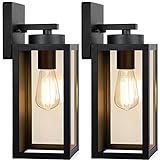
BesLowe Outdoor Wall Light Fixtures, 2-Pack — E26 Sockets, Glass Shades, Matte Black
Who it suits: Owners of a small covered entry — a stoop, a porch just deep enough for a chair, a condo doorway under an overhang — who already have a junction box by the door and want one proper fixture pair instead of a constellation of gadgets.
Start with the reason a hardwired lantern leads a small-space guide at all: it is the only pick that does not negotiate with the sun. A small entry tucked under a porch roof or a balcony slab may never receive a direct ray, and every solar pick below will quietly fail there no matter how good its panel is. The BesLowe pair wires into the box your door already has and simply works — full brightness at midnight in December, exactly as in June. Each fixture is a matte-black lantern with clear glass panels around an exposed E26 socket the listing rates to a 100-watt maximum; the maker suggests ST58 or ST64 Edison-style bulbs for the filament look, but the socket’s real gift is choice. The light in a small entry is light you stand inside of, inches from the source while you work a key, so the bulb decision is the comfort decision: a 2700K warm bulb makes a tiny porch feel like a room, a 5000K daylight bulb makes it feel like a loading bay, and a photocell or smart bulb adds the automation the fixture itself lacks for the price of the bulb. Check the current price on Amazon for the pair before you compare it with the solar picks below. On footprint, be clear-eyed: these are lanterns, not wedges.
The compromises are the ones the headline leaves out. Bulbs are not included: the cost of two LED bulbs sits on top of the fixture price, at or near the top of this budget once both are counted, and any honest comparison with the solar picks — whose light sources are built in — starts from that full working cost. There is no sensor of any kind, no photocell and no motion detector; the light is on when your switch is on, and automation arrives via a timer, a smart switch or a photocell bulb bought separately.
- The sun-proof pick: hardwired light that runs at full brightness all night regardless of how shaded the space is — the decisive advantage in entries and balconies that never see direct sun.
- A real fixture pair: metal lanterns, clear glass, standard E26 sockets — bulb, color temperature and any future smart or photocell bulb are your choice — check price on Amazon for the pair.
- A real fixture from an established listing: metal, glass and standard sockets, rather than a sealed gadget with a built-in expiry date.
Honest limitation: Bulbs are not included, there is no built-in sensor or timer, the lanterns take real wall space, and the waterproof claim comes without a wet-location rating we could verify — budget for two bulbs, bring your own automation, and mount under cover.
Choose it if your small entry has a junction box and little or no sun — it is the only pick whose performance does not depend on either the weather or the season. Skip it if you rent, or the wall is a balcony rail or fence with no wiring — the solar picks below install with two screws and leave with you.
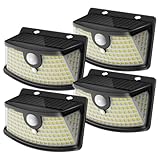
Aootek Solar Motion Sensor Lights, 120 LED, 4-Pack
Who it suits: Small-space owners whose outdoors is a scatter of tiny zones — a gate, a bin corner, two balcony ends, a short flight of steps — and who want a motion light on each one without spending fixture money or wall space on any of them.
The Aootek wedge is the reference design of its class, and its dimensions are the point: roughly 4.1 by 3.7 inches, small enough to disappear onto a fence post or the narrow pier of wall beside a door where no lantern would fit. Behind the reflector sit 120 LEDs and a PIR motion sensor; the maker’s figures, printed as maker figures, claim a 270-degree lighting angle, detection out to 26 feet across 120 degrees, and an IP65 waterproof rating. The panel is a PET-laminated monocrystalline cell the maker rates at up to 20.5 percent conversion — the spec that decides whether a short winter day still buys a working night. Three modes cover the three ways these lights get used: motion-only at full brightness, a constant medium light with the sensor off, and the hybrid — a dim all-night level that brightens when the sensor fires. In a small space the hybrid is not a preference, it is the setting, for a reason the driveway guides never face: a motion sensor in a nine-foot patio sees the whole patio, including you, sitting still-ish in a chair, all evening. Motion-only mode turns your own balcony light into a strobe that fires every time you shift; the dim level gives the space a steady glow to sit in and reserves the burst for the gate and the steps, where bursts belong. Check the current price on Amazon for the four-pack before you buy, because this model’s pricing moves often enough that the live listing, not any earlier figure, decides whether it belongs in this tier.
The compromises start with that same pricing volatility: this four-pack has at times moved above this entire budget, so check the current price on Amazon and treat a live price that no longer fits the tier as the wrong week rather than the wrong product. The architecture’s limits follow. The LED is integrated and the battery sealed, so the unit’s life is the battery’s life — a few years of nightly cycles, then the whole wedge is replaced; at this tier’s per-unit level the arithmetic is forgivable, but it should be understood before buying, not after the first failure. Output is a burst product: sized to flood a doorway for the seconds you are in it, not to work by, and the output claims in coverage of this model (500 lumens in some) are claims, not measurements — in the constant modes this is a guide light.
- Four complete motion lights in one pack — check price on Amazon — a low-cost way in this guide to put a light on four separate small zones.
- A footprint of about 4.1 × 3.7 inches per unit: fits posts, pillars and wall strips where no lantern or flood physically goes.
- Three modes including the dim-plus-motion hybrid a sitting space needs, an IP65 claim, and a sensor the maker rates to 26 feet.
Honest limitation: The battery and LED are sealed and finite, the output is a motion burst rather than a working light, and the price is volatile — it has moved above this entire budget at times, so check the current price on Amazon and buy only when the live price fits this budget.
Choose it if your small outdoors is several small zones and at least some of them get real sun. Skip it if every candidate wall is shaded — a starved wedge helps no one — or if the one zone is a seating nook that needs steady light, where the URPOWER and SOLPEX below behave better.
Tuffenough Solar Outdoor Lights, 2500LM, 210 LED, 3 Heads, 2-Pack
Who it suits: Owners whose small space includes one genuinely wide job — a one-car driveway apron, a tight side yard that doubles as the bin run and the bike store, a garage front on a narrow lot — where coverage width matters more than delicacy.
Every other pick in this guide is small. This one is included precisely because some small spaces contain one big task, and it is honest about what it is: a lighting rig, not a lamp. Each unit carries a solar panel on top, three adjustable LED heads that splay across a claimed 270-degree field, and a motion sensor in the center, in a housing about 11.4 inches wide. The maker’s headline figure is 2,500 lumens from 210 LEDs at a 6,500K daylight color, off a 2,000mAh battery per unit — and this guide attaches its strongest caveat to that number, because no independent source we found has measured it, and a battery this size cannot sustain anything like 2,500 true lumens for more than a short burst. Read the claim as a class label — the brightest class of solar flood in this tier, in bursts — and the real distinction survives the discounting: three heads aimed left, center and right genuinely do blanket a driveway apron or a side yard in a way a single wedge cannot. The remote control is the second real feature, and in a small-space context it matters more than usual: units like this get mounted high, over a garage door or at the top of a side wall, and modes that can only be changed at the unit mean a ladder every time the season changes. The three modes run from motion-only through dim-with-boost to a steady strong light. On price, check the current price on Amazon for the two-pack before you decide, because this tier’s larger solar floods move between the middle and the top of the budget depending on the week.
Now the small-space case against it, which this lens obliges us to make plainly. Eleven and a half inches of triple-headed hardware is a lot of object on a small wall: mounted over a balcony door it will crowd the door, loom over the chair beneath it, and look like security infrastructure — because it is. The 6,500K output compounds the problem at close range. Blue-white burst light is effective over concrete at twenty feet; at the six-to-ten feet of a patio it is glare, flattening everything and everyone it hits, and there is no warm variant of this configuration to soften it. If the wall in question is outside a bedroom window, that blast is a household negotiation waiting to happen — see our Best Outdoor Wall Light For Bedrooms Under $40 guide before mounting any motion flood where people sleep on the other side of the glass.
- The widest coverage in this guide: three aimable heads per unit and two units in the box — check the current price on Amazon.
- A remote that changes modes from the ground — the feature that makes a high-mounted unit livable across seasons.
- A 2,000mAh battery per unit, an IP65 claim, and a dim-standby-with-boost mode that keeps the big flood civilized on ordinary nights.
Honest limitation: The 2,500-lumen figure is a maker claim no independent source we found has measured, the unit is physically large for a small wall, and the light is 6,500K blue-white only — a burst over a wide area, not company for a seating corner.
Choose it if your small property has exactly one wide, workmanlike job — the drive apron, the side yard, the garage front — and a sunny wall to feed it. Skip it if the wall overlooks where anyone sits or sleeps; everything else in this guide is kinder at close range.

URPOWER Solar Spot Lights Outdoor, 2-in-1 Wall Light / Landscape Spotlight, 2-Pack
Who it suits: Owners of shaded small spaces — the north-facing balcony, the patio in the lee of the house, the entry under a deep overhang — who need a light that stays on all evening and whose walls refuse to cooperate with fixed-panel solar.
The URPOWER’s decisive feature is a hinge. On every wedge in this guide the solar panel is laminated to the housing, so the light must live where the sun lands; on this spotlight the head tilts 90 degrees and the panel tilts 180 degrees independently, in the maker’s specification, which breaks the trap that kills small-space solar. Mounted on a wall, the panel can lie back toward the sky — harvesting the bright open sky above a narrow alley or a stacked balcony — while the beam points down the wall, across a house number, or up into the one plant that makes the patio feel like a garden. No other pick here can separate charging geometry from lighting geometry, and in a sun-starved space that separation is worth more than any lumen figure. The design has been on sale since 2015, and its longevity is itself evidence: a photocell dark sensor switches it on at dusk and off at dawn with no motion involved, two brightness modes trade output against runtime — the maker’s figures put the low mode at up to ten hours and the high at about six — and the same unit works as a ground stake in a bed if the wall plan changes. Output is a claimed 200 lumens from four LEDs off a 2,200mAh battery: modest numbers, honestly sized for accent work. Check the current price on Amazon for the two-pack, in the middle of this tier’s range when it is priced as this guide found it.
The compromises are output, age and aim. Output first: 200 claimed lumens is accent light, full stop. It will wash a wall and glow on a plaque; it will not light a step edge for safety or a doorway for keys, and buyers who need either should take a wedge and accept the motion mechanism. Age second: a 2015 design carries an older panel and battery generation than the newest wedges, and while the 2,200mAh capacity is respectable, winter runtime on the high mode will fall well short of the maker’s six hours — the low mode is the winter setting, and even it shortens in December. Aim third, and this one is specific to small spaces: a spotlight lights what it points at, which on a small wall means a bright pool with dark edges a few feet away. One unit alone can look like a searchlight mounted by accident; two units crossed at shallow angles look like a decision.
- The sun-trap workaround: an independently tilting panel that can face the sky while the beam faces the wall — the only pick that charges and lights in different directions.
- True dusk-to-dawn operation: on at dark, off at dawn, no motion required and no burst to startle anyone sitting beside it.
- A decade-old, still-selling design with a 2,200mAh battery, an IP65 figure cited by third-party teardowns, and a stake-or-wall 2-in-1 mount — check price on Amazon for the two-pack.
Honest limitation: Two hundred claimed lumens is accent light only, the panel and battery are a generation old, and even a tilting panel cannot invent sun that never reaches the space — a fully roofed balcony still belongs to the BesLowe or the markers below.
Choose it if your small space gets sky but not sun — open shade, a bright alley, a balcony under a balcony — and you want an all-evening wash rather than a security burst. Skip it if the job is task or safety light; bursts and brightness live in the wedges above.

HMCITY 120 LED Solar Wall Lights, Motion Sensor, 3 Modes, 2-Pack
Who it suits: Buyers threading light into the leftover geometry of a small property — a gate post, a fence pillar, the four inches of wall between a door frame and a corner — who want the category’s most proven budget wedge and are willing to buy it in the right week.
The HMCITY is, by years of bestseller lists, the default solar wall light of this price class, and its small-space credential is its size: a wedge about 4.1 inches wide carrying 120 LEDs, a PIR motion sensor and a monocrystalline panel, with a claimed 960 lumens and an IP65 rating — both maker figures, printed with the same skepticism applied everywhere in this guide. What earns it a separate review from the near-identical Aootek is the mode set, which is the clearest expression of the category’s choices: full brightness on motion only; a constant medium light with the sensor off; and a dim all-night level that boosts to full when the sensor fires. For a small space, that third mode is the whole argument. A wedge on the wall of a patio you actually sit in cannot be a motion-only light — it would fire as you reach for your drink — and it cannot be a full-brightness constant light on a small battery. Dim-until-needed is the pattern that behaves like a porch light and a security light in the same night, at a scale a four-inch wedge can sustain. An 18-month maker warranty stands behind the listing, longer than most of this tier offers. On price, this is a check-price pick in the fullest sense: this listing family is sold in 2-, 4-, 6-, 8-, 10- and 12-packs across two shell colors and two light colors, and the price belongs to whichever configuration the page opens on. The two-pack linked here is the configuration to check — check the current price on Amazon, and buy it only when the live price for that exact pack fits the under-$40 budget, ideally toward the lower half of the tier.
The compromises are price chaos, sameness and the usual solar physics — in that order. Price chaos is this pick’s defining trait: the same brand page can present one pack size as a deal one month and push a different configuration to the front the next, and a buyer who clicks the wrong variant can pay far more for the same wedges in a different count. Check the pack size in the cart title before the price convinces you of anything. Sameness second: this is a generic-class product sold under many names, and its real-world brightness is the class standard — a strong local burst for a doorway or a gate, not area lighting — whatever the 960-lumen claim implies. Physics third, and in small spaces it bites harder than usual: the panel is small and fixed flat to the housing, so the wedge must live where the sun does, and the narrow walls and post tops where this light physically fits are often exactly the spots a fence or an upper balcony shades.
- The category’s best-selling wedge family in a 4.1-inch housing that fits posts, pillars and narrow wall strips where lanterns cannot go.
- The most useful mode set in this guide for a sitting space — including the dim-all-night-plus-motion-boost pattern — backed by an 18-month maker warranty.
- A large-pack format that can bring the per-light cost down toward the bottom of this tier — check the current price on Amazon for the exact pack before you compare it with the other wedges.
Honest limitation: This is a check-price pick — the listing family’s prices swing by pack and week, the 960-lumen figure is a maker claim, and the fixed panel makes it the pick most likely to starve on a shaded small wall.
Choose it if you find the linked two-pack (or a larger pack of the same model) at a live price that fits this budget, toward its lower half, and the mounting spot passes a midday sun check. Skip it if the live price has drifted to the top of this budget — at that point the BesLowe pair is the better object — or if the only available spots are shaded, where the URPOWER’s tilting panel is the smarter solar bet.

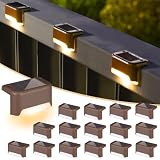
SOLPEX Solar Deck Lights Outdoor, 16-Pack, Warm White
Who it suits: Anyone whose small outdoors has edges — deck boards, stair risers, a balcony rail, a low retaining wall, a fence line ten feet long — and who suspects, correctly, that the space needs a pattern of gentle light rather than any single brighter one.
This is the pick the small-space lens was invented for. Sixteen small solar markers in one box, each a low-profile warm-white light that charges by day and switches itself on at dark, screwed onto stair risers, deck rails, fence boards and low walls. Check the current price on Amazon for the sixteen-pack, and buy toward the lower end of this tier when the live price gives you the choice. Now the honesty that makes the pick work: a tester who measured this class of light put each unit at roughly two lumens, a candle’s worth. On a lawn, two lumens is nothing. On a five-foot balcony it is a different product entirely — the rail reads as a line, the step edge announces itself, the deck perimeter becomes a shape you can navigate by, and none of it glares at the person sitting three feet away, because the light is warm white rather than security blue and candle-class rather than flood-class.
The compromises are durability and brightness, and the owner record states both plainly. Amazon’s own review summary for this listing is unusually candid: alongside praise for appearance and value sit consistent reports of units stopping after a hard winter, of brightness that disappoints anyone expecting more than a glow, and of individual lights failing early. With sixteen in the box, most owners treat a couple of early failures as the cost of the format — a fair frame, as long as it is chosen in advance rather than discovered. The listing says waterproof without an IP code we could verify, so these belong on vertical faces and under rail caps — covered positions — rather than face-up where water pools; in a small space that usually means the riser, not the tread, and the inside face of the rail, not its top.
- Sixteen dusk-to-dawn markers in one box — check price on Amazon — the only way in this guide to outline a whole small deck, rail or stair in a single purchase.
- Warm white at candle-class output: the gentlest light in the guide, and the only one designed for the distance — about three feet — at which small-space light is actually experienced.
- An established listing since 2019; the failure pattern is documented, is the format’s, and is priced into the format’s low per-light position in this tier.
Honest limitation: Each light is a roughly two-lumen marker by tester measurement, the listing publishes no IP code we could verify, and owner reports include units dying over a winter — outline lighting for covered positions, bought with spares built into the pack count.
Choose it if the project is edges — steps, a rail, a deck perimeter, a short fence — and the goal is a warm, even pattern at close range. Skip it if any single spot needs real brightness; one Aootek wedge out-lights a handful of these exactly where it matters.
Comparison Table
| Pick | Price | Power | Sensor / control | Weather claim | Light source | Best small-space use |
|---|---|---|---|---|---|---|
| BesLowe 2-Pack | Check price on Amazon | Hardwired | None — wall switch | “Waterproof” per listing; no verified wet-location/IP figure | E26 socket, bulb not included | Covered small entry with no sun |
| Aootek 4-Pack | Check the current price on Amazon | Solar | PIR motion, 3 modes incl. dim + boost | IP65 (maker claim) | Integrated LED, sealed | Tiny-footprint coverage of several zones |
| Tuffenough 2-Pack | Check price on Amazon | Solar | PIR motion, 3 modes, remote | IP65 (maker claim) | Integrated LED, 3 heads | One wide job: drive apron, side yard |
| URPOWER 2-Pack | Check the current price on Amazon | Solar | Photocell dusk-to-dawn, 2 brightness modes | Waterproof; IP65 per third-party teardowns | Integrated LED, 200 lm claimed | Sun-starved walls, all-evening accent |
| HMCITY 2-Pack | Check price on Amazon — confirm the exact pack size | Solar | PIR motion, 3 modes incl. dim + boost | IP65 (maker claim) | Integrated LED, sealed | Posts, pillars and narrow wall strips |
| SOLPEX 16-Pack | Check price on Amazon | Solar | Photocell dusk-to-dawn, always-on at night | “Waterproof” per listing; no verified IP code | Integrated LED, ~2 lm per tester measurement | Edges: rails, steps, deck perimeter |
How to Choose an Outdoor Wall Light for a Small Space Under $40
Measure the wall before the wattage. Small-space lighting fails on geometry more often than on brightness. Walk the space with a tape: how wide is the pier of wall beside the door, how far does a fixture project before it crowds a chair or a door swing, how much of the wall does the railing already own? The answers sort this guide by themselves.
Run a sun audit at three times of day. This is the step small-space buyers skip and regret. A solar panel fixed to a light’s housing charges only where the light is mounted, and small spaces are shade machines: the balcony above is a roof, the privacy fence is a wall to the sun, the neighboring house takes the afternoon. Stand in the space at 10 a.m., 1 p.m. and 4 p.m. and note which walls hold direct sun and for how long. A spot with four or more hours of direct sun runs any solar pick here.
Decide what the light does to the person sitting next to it. In a big yard, a wall light is scenery. In a small space it is a roommate. Motion-only floods at close range fire every time someone shifts in a chair; 6,500K daylight color at three feet reads as interrogation, not ambience. Match the mechanism to the furniture: seating zones want dusk-to-dawn steadiness (the URPOWER), dim hybrid modes (the Aootek and HMCITY in their dim-plus-boost settings) or candle-class warmth (the SOLPEX). Transit zones — gates, steps, the bin corner, the path to the door — are where motion bursts earn their keep, because nobody lingers in them. Most small spaces end up with one of each: a steady light where people sit, a burst light where people pass. Shoppers furnishing a small modern outdoor room, where the fixture is also a visible design object, should weigh the silhouettes in our Best Outdoor Wall Light For Modern Homes Under $40 guide alongside these mechanics.
Prefer several small points over one big source. A single bright light in a small space creates a bright pool, hard shadows and glare in the sightline of anyone facing it — and leaves the corners it cannot reach looking darker by contrast. Distributed light does the opposite: four wedges from one pack, or sixteen markers from one box, wrap a small space in even, low-level light that reads as designed rather than installed. This is also the budget’s natural shape — under $40, distribution is what the money is good at.
Match the weather claim to the micro-exposure, not the map. Small spaces create their own weather. A balcony under another balcony is a damp location even on an outside wall; a narrow alley between houses can funnel driven rain onto a wall that faces away from the storm.
Count the whole cost, in money and in years. The hardwired pair needs two bulbs and possibly an electrician; the solar packs need nothing at install and carry a replacement horizon of a few years per unit as their sealed batteries fade; the check-price pack needs a minute of variant-checking to avoid paying for the wrong pack size. Think in cost per point of light — a fixture for the entry, a wedge for each zone, a marker for each edge — and check the current price on Amazon for each architecture before you decide which one fits this budget for the points you actually need. And if the budget itself is the binding constraint, our Best Outdoor Wall Light For Small Rooms Under $30 guide covers the same small-space logic one tier down, where the solar multipacks get cheaper per light and the hardwired option disappears.
Common Buying Mistakes
Mounting the solar light where the light is needed instead of where the sun is. The single most common failure in small-space solar, because the two places are so often different: the dark corner by the door is dark precisely because nothing reaches it, sun included.
Judging a balcony’s light by its midday brightness. Open shade feels bright to a person standing in it at noon — bright enough to read by — and buyers reasonably assume a panel there is charging.
Putting a burst light over the chairs. A motion flood mounted above a seating nook fires for every gesture, every refill, every shift of weight — and at 6,500K and a few feet, each firing is a small event the whole group feels.
Buying a four-pack for a two-point space. Multipack pricing makes extra units feel free, and in a big yard they are — there is always another gate.
Aiming the sensor at the neighbor’s life. A PIR sensor rated to 26 feet does not know where your property ends.
Final Recommendation
For most small spaces, start with distribution. The SOLPEX sixteen-pack — check price on Amazon — is the small-space pick in its purest form — sixteen warm points that turn a rail, a stair and a deck edge into a navigable, good-looking room outdoors, at a per-light position in this tier that makes the format’s known fragility a fair trade. Where the zones are points rather than edges — a gate, a door, a bin corner — the Aootek four-pack — check the current price on Amazon — covers four of them in housings too small to argue with, provided at least some of those walls see real sun and you buy it only when the live price fits this budget. If the space’s defining fact is shade, skip the solar negotiation entirely where you can: the BesLowe pair — check price on Amazon — plus two bulbs of your choosing is the only purchase here that behaves like part of the house, and where wiring is impossible the URPOWER spots tilt their panels at whatever sky the space has left. The Tuffenough pair earns its place for the one wide job a small property still contains — and only that job. What $40 will not buy has been said plainly throughout: an automatic hardwired fixture, a smart sconce, a lumen figure you can take to court.
FAQ
Why does a small outdoor space need different lights from a big yard?
Because three variables invert. Wall footprint becomes scarce, so fixture size competes with doors, rails and chairs.
My balcony gets no direct sun at all. Is any solar light worth buying?
Only with the right expectations. A fixed-panel wedge on a sunless wall will undercharge daily and fade early — that is physics, not a defective unit. Two partial answers exist: the URPOWER, whose panel tilts independently and can harvest bright open sky from a wall in open shade, and the SOLPEX markers, whose tiny output asks so little of their batteries that even a weak charge buys an evening’s glow. If the space is roofed or north-facing under a slab, neither is a real answer — the hardwired BesLowe pair, where a junction box exists, is the pick that does not care.
One brighter light or several dim ones — which works better in a small space?
Several dim ones, in almost every small-space case. A single bright source in a confined area creates a hot pool, hard shadow and glare at sitting distance, and makes the unlit corners look darker by contrast.
Will a motion light drive me crazy on my own small patio?
In motion-only mode, plausibly yes: a sensor rated to 26 feet sees the entire patio, including you in a chair, and fires for ordinary movement all evening. The fixes are in the picks. Run the Aootek or the HMCITY in their dim-all-night-with-motion-boost mode, so the space holds a steady glow and the burst is a brightening rather than a switch from dark; aim the sensor across the entry path rather than across the seating; and keep pure motion-only lights for gates and steps, where nobody lingers.
Can I get a hardwired outdoor wall light with a motion sensor or photocell for under $40?
Not as a verified pair from an established brand, on this guide’s research. The hardwired two-pack under $40 — the BesLowe — is a plain switch-run fixture with no sensor; sensor-equipped hardwired two-packs we verified sit above this budget, in the upper part of the wider market. Two workarounds keep the budget: put a photocell or smart E26 bulb in the plain fixture, moving the sensor into a replaceable bulb, or use a solar motion light and accept the battery format.
Why does one pick in this guide have no printed price?
Because listing prices change often and this guide does not print a static figure that will go stale. The HMCITY listing family is the clearest case: it sells the same wedge in six pack sizes and four color combinations, so a single printed figure would belong to one configuration and mislead buyers of another. For every pick, check the current price on Amazon for the exact pack and variant named in its review.