Where to buy
Check the latest price, availability and delivery on Amazon. Orders are placed on Amazon. We may earn a commission from qualifying purchases.
- Best overall for small rooms: Shiftshade 4-Pack Acrylic Mirror Tiles, 12 x 12 Inch, 2 mm Thick — Check on Amazon
- Delma Glass Full Length Wall Mirror Tiles, 14 x 12 Inch, 4PCS (near-miss, just over budget — the only real glass here) — Check on Amazon
- UNBREAKABL MIRO 4-Pack Acrylic Mirror Tiles, 12 x 12 Inch, 0.12 Inch Thick (check price — the flattest acrylic here) — Check on Amazon
- SAFEE MRROR 4-Pack Acrylic Mirror Tiles, 10 x 10 Inch — Check on Amazon
See 2 more Amazon options
- JEOYOO 4-Pack Acrylic Mirror Tiles, 8 x 8 Inch (cheapest verified — but its 32-inch ceiling fails twice in a small room; read the warning) — Check on Amazon
- NC Unbreakable Acrylic Mirror, 12 x 12 Inch, 4 Pcs (over-budget reality check) — Check on Amazon
Read the full guide ↓
Disclosure: As an Amazon Associate, dailyhomedecorating.com earns from qualifying purchases. Links to Amazon on this page are affiliate links; they cost you nothing extra. Listing details such as price and availability change often, so check the current Amazon listing before you buy.
A small room changes the mirror question completely, and it changes this guide’s answers with it. In a big bedroom, a full length mirror is furniture: it leans, it stands, it takes its square feet of floor and earns them back in looks. So the small-room mirror has one non-negotiable requirement before all others: it must cost zero floor space. It has to live on a wall or on the back of a door, flat as paint. A column of tiles on the inside of a closet door or the back of a bedroom door gives you a full-height reflection and takes nothing from the room at all.
Now the honesty, because this category needs more of it than most. At $15 there is no one-piece full length mirror on Amazon — none. When we researched this guide, the cheapest one-piece over-the-door glass mirror we could verify sat well above this budget, and standing or leaning mirrors start higher still. Everything at $15 is a kit of four flat tiles you stick up in a column. A small room adds one more twist that the general guides miss. In a big room, a slightly short mirror can be forgiven because you step back and the geometry relaxes. This guide does that arithmetic for all six sets, ranks them by how they behave at small-room distances on small-room surfaces, and labels every near-miss and over-budget pick clearly.
What follows is a quick picks table, the reasoning behind the list, a section on the small-room math of distance and placement, detailed notes on all six products re-ranked for tight spaces, a comparison table, a buying checklist, an honest account of what $15 cannot buy, the mistakes small-room shoppers make at this price, and answers to the questions that come up again and again. Check the current price on Amazon for each pick, as listing prices change often; where a price could not be verified, the guide says so instead of guessing. Readers furnishing a rental should also see our companion guide to the Best Full Length Mirror For Apartments Under $15, where adhesive removal and deposit risk get their own treatment; the general ranking lives in Best Full Length Mirror Under $15.
Quick Picks
Short on time, or comparing several options at once? Each row below names a buyer type and the product that suits it, with a link to the listing. Read the labels carefully: only three picks are fully verified inside the $15 budget, and one of them — the cheapest — cannot build a full-length column for an adult in any room, small or otherwise. The rest are a check-price pick, a near-miss in real glass, and one deliberate over-budget reality check, included because a small room punishes a wrong purchase more than a big one does: there is no spare wall to move a mistake to.
| Buyer type | Pick | Why it stands out | Link |
|---|---|---|---|
| Best overall for small rooms (in budget) | Shiftshade 4-Pack Acrylic Mirror Tiles, 12 x 12 in, 2 mm | Four 12-inch tiles stack to a true 48-inch column that lives on a door and costs zero floor space — — check price on Amazon | Check on Amazon |
| Best real glass (near-miss, just over budget) | Delma Glass Full Length Wall Mirror Tiles, 14 x 12 in, 4PCS | Actual float glass stacking to 56 inches — the tallest column here — for just over budget | Check on Amazon |
| Flattest acrylic (check price) | UNBREAKABL MIRO 4-Pack Acrylic Mirror Tiles, 12 x 12 in, 0.12 in thick | 3 mm-class acrylic — the stiffest tile format here, which matters most at the close distances a small room forces; check the current price on Amazon | Check on Amazon |
| Best for kids and tight budgets (in budget) | SAFEE MRROR 4-Pack Acrylic Mirror Tiles, 10 x 10 in | A 40-inch column at the lower end of this budget tier — honestly sized for children and shorter adults, shatterproof by design | Check on Amazon |
| Cheapest verified (in budget, with a warning) | JEOYOO 4-Pack Acrylic Mirror Tiles, 8 x 8 in | The lowest-priced verified option in this tier — but four 8-inch tiles top out at 32 inches, and a small room gives you no distance to make up the difference | Check on Amazon |
| The same format at its honest price (over budget) | NC Unbreakable Acrylic Mirror, 12 x 12 in, 4 Pcs | A 48-inch acrylic column with a live US listing — check price on Amazon — included to show what the format really costs | Check on Amazon |
How These Picks Were Chosen
We researched this guide on Amazon in November 2026, looking for anything a shopper could plausibly buy as a full length mirror for $15 or less, then re-ranked the survivors through a small-room lens. The height check eliminated more products than any other, because the under-$15 “full length” category is dominated by four-packs of small acrylic tiles marketed with the same language as a 48-inch door mirror while delivering half to two-thirds of the height. We did the stacking arithmetic for every set and printed it, because a mirror that cannot reach from your shoes to your head is not a full length mirror at any price — and in a small room, as the next section explains, the shortfall cannot be walked away from.
Price positioning deserves its own paragraph, because it shaped this list. Three picks sit inside the budget in this tier: the Shiftshade 12 x 12 four-pack, the SAFEE MRROR 10 x 10 four-pack and the JEOYOO 8 x 8 four-pack. The Delma glass set sits just over the line either way, and is labeled a near-miss accordingly. The NC set sits clearly above the budget. Prices in this category move constantly, so check the current price on Amazon on the listing before you buy.
Two small-room filters then re-ordered the list. The first is mounting reality: every pick here is adhesive-mounted, which in a small room is a feature, not a limitation — no pick hangs from hooks that need door clearance, and none stands on legs that need floor. But adhesive needs a flat, smooth surface, and small rooms offer fewer candidate surfaces, so each review names the surfaces its tiles will actually hold on and look right on. The second filter is distance behavior. A small room holds you between roughly two and six feet from your mirror, so we weighted how each material behaves at exactly that range: acrylic’s makers themselves concede the reflection is best within about half a meter and warps beyond it, while glass stays true at any distance — a difference that matters less at three feet than at fifteen, and more than usual across a tile’s seams, which sit closer to your eyes in a small room. One more rule governed everything: every price is attached to the exact size it buys, and because every pick is frameless, the listed size is the mirror size — the frame-versus-glass shell game that plagues framed mirrors does not apply to tiles. What you measure is what reflects. For the dressing-corner angle on the same budget, see the Best Full Length Mirror For Bedrooms Under $15; for a clean frameless look, the Best Full Length Mirror For Modern Homes Under $15.
The Small-Room Math: Distance, Height and the Door You Already Own
Three pieces of geometry decide whether a tile column works in a small room, and none of them appear in any listing. The first is the half-height rule. That is why the standard door mirror is 48 inches tall, and why a 48-inch column of tiles is the practical floor for most adults. The rule itself does not change with distance, but your margin for error does. In a large room you can shuffle back, crouch slightly, tilt your head — the reflection cooperates across a range of positions. In a small room your standing spot is fixed by the furniture: the strip of floor between the bed and the wall, the patch in front of the closet. If the column is six inches too short or hung six inches too low, there is no other spot to stand in. Measure your height, halve it, add placement care — or simply buy the tallest column the budget allows and hang it precisely.
The second piece is distance, and it cuts in acrylic’s favor more than the general guides admit. Acrylic’s weakness is flex: a thin plastic sheet follows the wall’s bumps and ripples, and the warp grows as you back away. Its makers say the quiet part in their own guidance — the reflection is best within about half a meter. That is a real limitation for anyone who dresses carefully, and it is the honest reason the tallest column matters — a 48- or 56-inch column at the right height lets a short room show you head to toe in one look, where a 32-inch column shows you a torso and asks you to trust the rest.
The third piece is the door. A framed mirror needs width, clearance and a stud; a tile column needs twelve flat inches and a level. The trade is seams — three horizontal joints cross a four-tile column, and at small-room distance they are close to your eyes. Everything in the ranking below was judged against this math.
The 6 Best Full Length Mirror Options for Small Rooms Around $15
Shiftshade 4-Pack Acrylic Mirror Tiles, 12 x 12 Inch, 2 mm Thick
Who it suits: Small-room dwellers who want the cheapest verified route to a genuinely full-length reflection — on the back of a bedroom door, inside a closet door, or on the one narrow wall strip the room can spare — and who understand they are buying acrylic tiles, not a glass mirror.
This set leads the guide because it is the only in-budget kit whose arithmetic survives a small room. That column asks for nothing from the room — twelve inches of flat door or wall, zero floor, zero clearance — which in a small room is the whole ballgame. At 2 mm, the acrylic sits in the middle class of the format — twice the 1 mm films that ripple like foil, short of the 3 mm class below — and check the current price on Amazon for the four-pack. Total reflective area is 576 square inches, exactly four square feet. The whole set weighs roughly two pounds by physical estimate — the listings do not publish a verified weight — so any sound adhesive pad set holds it, even on a hollow-core door, and it cannot shatter if the door gets slammed.
The limitations are the format’s, seen from closer than usual. Four tiles means three seams, and in a small room those seams are two to four feet from your eyes, not across a bedroom: alignment care matters more here, not less. The adhesive is a commitment in both directions — strong on smooth, clean, painted drywall, tile and flat doors; capable of pulling paint on removal and weakening in steamy bathrooms. None of this dethrones it. Judged as what a small room actually needs — a true 48 inches, mounted on nothing, for under $15 — it is the pick of this guide.
- Four 12 x 12 inch tiles stack to a true 48 x 12 inch column — the minimum real full length — using zero floor space; check price on Amazon.
- 2 mm acrylic: stiffer and flatter than the 1 mm film class, shatterproof on doors that slam, and light enough for hollow-core doors.
- Rearranges into a 24 x 24 inch grid when the room needs a wide dressing mirror instead of a column.
Honest limitation: It is acrylic, not glass: three seams cross the reflection at close range, edges can ripple, and the adhesive can mark painted walls on removal.
Choose it if you want a true full-length view for under $15 and your door or wall is flat. Skip it if you need an undistorted, seam-free reflection — that requires one piece of glass, which starts far above this budget.

Delma Glass Full Length Wall Mirror Tiles, 14 x 12 Inch, 4PCS
Who it suits: Small-room buyers who can stretch just past the cap and want the one thing acrylic cannot give them: a reflection that stays optically true, in the room where they will stand closest to it and look hardest.
Everything about this set starts with its material. Total reflective area is 672 square inches, the most here. In a small room that extra height is not a luxury: remember that your standing position is fixed by the furniture, so surplus column is surplus margin — more freedom in where the column hangs and how tall its user can be. The price position is the near-miss this guide exists to label clearly: it sits just over the $15 line. If it dips to $15 or below on a coupon, it becomes the best pick in this guide outright. Expect roughly five pounds across the four glass tiles — a physical estimate, as the listing publishes no verified weight — and treat the mounting surface accordingly: every pad provided, a properly prepared flat surface, full curing time.
The limitations are glass’s own, and a small room sharpens two of them. The frosted edges soften the three seams but do not erase them. None of this outweighs the material advantage for the right room. It means the Delma is the pick for small-room buyers whose space is calm, whose surface is flat, and who can accept being just over budget for the only true reflection on this page.
- Real float glass — the only glass in the guide — for a flat, calm, scratch-resistant reflection at the close distances small rooms enforce.
- Tallest column here at 56 x 12 inches (or 48 x 14), with 672 square inches of reflective area and frosted edges.
Honest limitation: Just over budget, and it is breakable, comparatively heavy glass — wrong for slamming doors, toddlers and high-traffic small rooms.
Choose it if your small room is a calm adult space with a flat wall or a gently closing door, and you can stretch just past the cap — or catch it on a dip to $15. Skip it if the mirror must survive children, pets or a hard-used door — that is acrylic’s job.
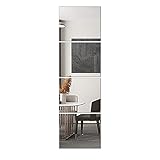
UNBREAKABL MIRO 4-Pack Acrylic Mirror Tiles, 12 x 12 Inch, 0.12 Inch Thick
Who it suits: Small-room buyers who have decided on acrylic — for a slamming door, a child’s corner, a home-gym wall — and want the version of the format that holds its plane best at the two-to-four-foot distances a small room imposes, provided the live price cooperates.
This set earns its place on one number: 0.12 inch. In a small room that stiffness is worth more than anywhere else, because you view the mirror from close range, where the difference between a calm tile and a rippling one is the difference between checking an outfit and checking a funhouse. On specifications alone, this is the best acrylic tile set in the guide.
So why is it third, labeled “check price,” instead of first? The surrounding evidence is not encouraging for the budget: the same brand’s larger tile sets and comparable extra-thick sets from other sellers generally sit above this budget tier. The 3 mm class, in other words, usually costs more than $15. We include the set because it defines the top of the format and because prices and featured offers change — if you open the listing and find it at $15 or under, it jumps to the top of this guide’s acrylic ranking on thickness alone. If it sits well above budget, it belongs to the under-$30 conversation, not this one. Do not buy it at an unverified price on our say-so; the “check price” label is the recommendation.
- 0.12 inch (about 3 mm) acrylic — the thickest tiles here, and thickness is what keeps an acrylic mirror flat and calm at close range.
- Full 48 x 12 inch column from four tiles; 576 square inches, same coverage and same zero floor cost as the top pick.
- Sold for the exact small spaces where acrylic beats glass: dorm corners, gym walls, kids’ rooms, doors that slam.
Honest limitation: No verified US price — the listing showed no featured offer during research, and comparable 3 mm sets generally sit above this tier, so it may simply not be a $15 product.
Choose it if the live listing price is $15 or less when you check — then it is the best acrylic here. Skip it if it sits above budget; the 2 mm Shiftshade delivers the same size inside this budget — check price on Amazon.

SAFEE MRROR 4-Pack Acrylic Mirror Tiles, 10 x 10 Inch
Who it suits: Parents first — anyone building a safe, shatterproof mirror at child height in a small nursery or shared kids’ room — plus shorter adults who want an outfit-check column on a door and can live without the last few inches at the top.
The SAFEE MRROR set is the value pick of this guide, and its dimensions deserve the same honest treatment as its price. Check the current price on Amazon — this set sits at the lower end of this budget tier, among the most affordable verified entries here. Small rooms are where this set’s compromises shrink and its virtues grow. A child’s small bedroom is exactly the room where a mirror must not be breakable, must not stand on the floor, and must fit a short stretch of wall or the lower half of a door — and 40 inches, honestly labeled, serves that room completely.
For an adult of average height, though, the arithmetic is the arithmetic: 40 inches is a three-quarter mirror. It shows an outfit from roughly the knees up when you stand close, and more if you step back — and stepping back is precisely what a small room rations. The remaining limitations are the category’s own. Ten inches is also a narrow column: you see yourself in a vertical slice, and two people cannot check outfits side by side. The adhesive mounting carries the usual warnings — smooth clean surfaces only, paint risk on removal, weakness in steamy bathrooms. None of that makes this a bad product; at this tier it is a fairly priced kids’ mirror and a workable budget column for smaller adults. It only becomes a bad purchase when a shopper believes the “full length” title over the 40-inch arithmetic, which is why this guide prints the arithmetic in the headline row of the table.
- Four 10 x 10 inch tiles — a 40 x 10 inch column, mounted with zero floor cost — check price on Amazon.
- Shatterproof acrylic marketed honestly for children: no sharp edges, feather-light, safe if it falls — the right material for a small kids’ room.
- Enough height for children and shorter adults; mounts on doors and walls with adhesive.
Honest limitation: Forty inches is not full length for most adults — it is a three-quarter mirror — and a small room gives you no distance to disguise the shortfall.
Choose it if the mirror is for a child’s room, a play space, or a shorter adult’s outfit checks on a door. Skip it if you are tall or need true head-to-toe: the Shiftshade’s 48-inch column sits slightly higher in this same budget tier.

JEOYOO 4-Pack Acrylic Mirror Tiles, 8 x 8 Inch
Who it suits: Shoppers who want to test the tile format for the least possible money, parents of small children, and anyone dressing a narrow spot — a vanity column, a locker door, a desk-side wall sliver — where 32 inches of mirror is actually the requirement.
We include this set because it is the cheapest verified “full length mirror” result in the category — and because in a small room, reviewing it honestly matters more than anywhere else. The facts: four acrylic tiles, each 8 x 8 inches, — check the current price on Amazon; it sits at the very bottom of this budget tier. Now the arithmetic the title omits. Four 8-inch tiles stack to a column 32 inches tall and 8 inches wide, or fold into a 16 x 16 inch grid. In a large room, a determined user can sometimes cheat a short mirror: step back, shift position, piece the view together across two glances. A small room removes the cheat. Your standing spot is fixed by the bed and the dresser, the column is what it is, and 32 inches of it shows a torso. Total reflective area is 256 square inches, less than half of what the Shiftshade set provides. That trade — much less mirror for a modest saving within the same tier — is the real decision here, and in a small room it is a worse trade than it looks, because the room offers no workaround.
The product itself is unremarkable in the category’s usual ways: acrylic with the standard distance ripple, a thickness the listing does not clearly state, adhesive mounting with the standard paint-and-humidity caveats. An 8-inch-wide column also fits slivers of wall — beside a door frame, on a closet door’s flat panel — where even a 12-inch column will not go, and as a vanity or hair-and-makeup column over a small desk it is honestly sized. Spend a little more within the tier on the Shiftshade column and get the mirror you actually searched for.
- Cheapest verified pick in this tier — the lowest-cost way to try tile mirrors; check price on Amazon.
- Light, shatterproof acrylic in the narrowest column here: fits wall slivers and door panels a 12-inch column cannot.
- Works as a vanity or desk column, a kids’ mirror, or a locker-door mirror.
Honest limitation: Four 8-inch tiles reach only 32 inches — a half-length mirror for adults, full stop — and a small room gives you no distance to compensate for the missing height.
Choose it if you want a cheap format test, a child’s mirror, or a narrow half-length column. Skip it if you need to see an adult head to toe — no arrangement of these four tiles can do that, in a room of any size.

NC Unbreakable Acrylic Mirror, 12 x 12 Inch, 4 Pcs
Who it suits: No one shopping strictly under $15 — and that is the point. This set is in the guide as a measuring stick: the same format as our top pick, from a listing whose US price we could read directly, showing what that format honestly costs.
The product itself is respectable. Check the current price on Amazon — it sits clearly above the Shiftshade set in price, a noticeable premium for a comparable column. Is the extra thickness worth it? If the live Shiftshade listing still sits inside this budget, the honest answer for most buyers is no; the difference is better spent checking the UNBREAKABL MIRO listing or stretching to the Delma. But markets move: if the Shiftshade price climbs or its listing vanishes, this set is the fallback that proves the format’s going rate, and it still sits well below every one-piece glass door mirror we found — while still costing a small room nothing in floor space.
We label it plainly as an over-budget reality check, well past the $15 cap, because guides that quietly pad a “best under $15” list with clearly over-budget products teach shoppers to distrust every price on the page. Its presence here also marks the boundary of the whole category: just above the $15 tier you are still buying acrylic tiles, just thicker or better-finished ones; real one-piece glass starts in a much higher tier. If your budget is truly fixed at $15, buy the Shiftshade or the SAFEE set and ignore this row. If you find yourself tempted by this set’s thickness, check the UNBREAKABL MIRO listing first — the same 3 mm class sometimes appears there closer to budget — and if both sit well above budget, weigh the step up to the range covered in Best Full Length Mirror For Small Rooms Under $30, where the same zero-floor-space logic starts buying one-piece glass, rather than paying glass-adjacent money for plastic.
- Same 48 x 12 inch column and 576 square inches as the top pick, with rounded corners for child safety.
- Listing sits clearly above this budget — check price on Amazon — an anchor for the format’s real cost.
- Thicker, bend-tested plexiglass positioning for gyms and kids’ rooms.
Honest limitation: It is well over the budget in a guide about $15 — included as a reality check, not a recommendation for strict-budget shoppers.
Choose it if the in-budget listings have moved or vanished and you need the format at its verified going rate. Skip it if your cap is really $15 — the Shiftshade set delivers the same size inside the budget.

Comparison Table
The table below puts the six picks side by side on the specifications that decide a tile mirror in a small room: material, the size each tile actually is, the tallest column the set can build, total reflective area, thickness where a listing states it, and the price position — including the labels on the two picks whose prices break or escape the budget. Read the “tallest column” column first; in a room with no room to step back, it is the honest version of every “full length” claim on this page.
| Product | Material | Tile size | Tallest column | Total area | Thickness | Mounting | Price position | Link |
|---|---|---|---|---|---|---|---|---|
| Shiftshade 4-Pack Acrylic Mirror Tiles | Acrylic | 12 x 12 in | 48 x 12 in | 576 sq in | 2 mm | Adhesive, wall or door | In budget — check price on Amazon | Check on Amazon |
| Delma Glass Full Length Wall Mirror Tiles, 4PCS | Real float glass | 14 x 12 in | 56 x 12 in | 672 sq in | Thin float glass, frosted edges | Adhesive, flat wall or door | Near-miss, just over budget — check price on Amazon | Check on Amazon |
| UNBREAKABL MIRO 4-Pack Acrylic Mirror Tiles | Acrylic | 12 x 12 in | 48 x 12 in | 576 sq in | 0.12 in (about 3 mm) | Adhesive, wall or door | Check price on Amazon | Check on Amazon |
| SAFEE MRROR 4-Pack Acrylic Mirror Tiles | Acrylic | 10 x 10 in | 40 x 10 in | 400 sq in | Not clearly stated | Adhesive, wall or door | In budget, lower end of tier — check price on Amazon | Check on Amazon |
| JEOYOO 4-Pack Acrylic Mirror Tiles | Acrylic | 8 x 8 in | 32 x 8 in | 256 sq in | Not clearly stated | Adhesive, wall or door | In budget, lowest in tier — check price on Amazon | Check on Amazon |
| NC Unbreakable Acrylic Mirror, 4 Pcs | Acrylic | 12 x 12 in | 48 x 12 in | 576 sq in | “Super thick” plexiglass (listing language) | Adhesive, wall or door | Over budget — check price on Amazon | Check on Amazon |
How to Choose a Full Length Mirror for a Small Room at This Price
Buying a tile mirror well for a small room is mostly a matter of measuring three things listings never mention: your floor, your standing spot, and your door. The checklist below is ordered by importance for tight spaces — footprint first, because it is the constraint that defines the room; then height and placement, which a small room makes unforgiving; then material and thickness, which decide how the reflection behaves at close range.
- Start with the zero-floor rule. In a small room, eliminate any mirror that stands, leans or needs clearance in front of it before you compare anything else. Every pick in this guide mounts flat with adhesive, and that is not a budget quirk — it is the format the room demands. Measure the flat field, not the door: molded panels, trim and hinges all subtract from it.
- Do the height math before anything else. Multiply the tile size by the tile count. Four tiles of 12 inches make a 48-inch column; four of 10 inches make 40; four of 8 inches make 32. Ignore any “assembled size” that assumes an arrangement you will not use.
- Plan the placement, not just the product. Stand where you will actually stand — the strip between bed and wall, the patch before the closet — and check the sightline: can that spot see the whole column without the dresser edge or the door swing crossing it? Hang the column so its top edge sits midway between your eye line and the top of your head, and place the seams at mid-thigh and shoulder height rather than at eye level, because at two to four feet away you will meet those seams every morning.
- Decide glass versus acrylic on purpose. Glass gives a flat, true reflection at any distance and shrugs off scratches and cleaning; it also breaks, weighs several times more, and at this budget exists only as the Delma tile set, just over the line. Acrylic cannot shatter, weighs ounces per tile, and is safe on doors and around children; it also flexes, ripples as distance grows, scratches, and attracts dust. Buying one material while expecting the other is the most common disappointment in this category.
- If you choose acrylic, shop by thickness. Acrylic mirror comes in three practical classes: 1 mm films (avoid — they wrinkle and wave), 2 mm tiles (the workable budget class, our top pick), and 3 mm or 1/8-inch plates (the stiff class, our check-price pick). Thickness is rarely in the title; look for it in the specifications, and treat a listing that hides it as a 1–2 mm product. At small-room distances, every fraction of a millimeter reduces the funhouse effect more than any coating claim.
- Interrogate the mounting. Adhesive wants a surface that is flat, smooth, clean and dry — painted drywall in good condition, tile, a flat hollow-core door. It struggles on textured paint, brick, wallpaper and in steamy bathrooms, and removal can pull paint, which matters in rentals. The maker’s own warning on the glass set says it plainly: an uneven surface means a distorted reflection and a weak bond. Small rooms often mean small, humid bathrooms nearby — if the mirror must live in the steam, expect a shorter bond life and check the pads monthly.
- Weight is a safety spec, not a footnote. Listings in this category rarely publish a verified weight, so treat the figures as physical estimates: an acrylic four-pack totals roughly one to three pounds depending on thickness — any sound adhesive pad set holds it, even on a hollow-core door. The glass set runs about five pounds across four tiles, each tile individually heavier than a whole acrylic pack; use every pad provided, on a properly prepared surface, and never mount glass tiles where a falling tile lands on a child or a bare foot — a real consideration in a room where the bed is two steps from the door.
Acrylic vs Glass in a Small Room: Why the Usual Verdict Shifts
Five of the six products in this guide are acrylic, and the listings for all five use the word “mirror” exactly as the glass set does — which is legal, accurate and quietly misleading, because the two materials behave like different products that happen to share a shape. Glass is rigid at any practical thickness, so its reflective coating sits on a plane that does not move; the reflection is the same at one foot and at fifteen. Makers of acrylic tiles admit this in their own fine print — one advises that the reflection is best within about half a meter and distorts beyond it.
A small room rewrites what that admission means. The standard advice — acrylic for the gym, glass for the dressing mirror — assumes you can stand across a bedroom from your reflection, deep in acrylic’s warp zone. A small room never lets you. The mature way to shop is to pick your material first — safety and weight, or fidelity — and only then compare products within it. This guide’s structure does exactly that: the Shiftshade is the best verified acrylic value, the UNBREAKABL MIRO the best acrylic specification, and the Delma the glass benchmark, just over the line, against which both are measured.
What $15 Cannot Buy
A buying guide earns its keep as much by its exclusions as its picks, so here is the exclusion list in plain terms. At $15, you cannot buy a one-piece full length mirror of any kind on Amazon: the cheapest one-piece over-the-door glass mirror in our research, a 47 x 14 inch model, sat well above this budget, and name-brand door mirrors sat higher still. You cannot buy an arched, rounded or otherwise decorative full length mirror, the shapes that dominate social media, which start several times higher. You cannot buy a distortion-free acrylic reflection at room distance at any thickness — 3 mm narrows the gap, it does not close it. And you cannot buy a tile set that is both real glass and verifiably under $15: the glass set in this guide missed the budget by a small margin. What $15 can buy, bought knowingly, is a safe, light, genuinely full-height acrylic column that costs your small room nothing — no floor, no clearance, no furniture moved — for an outfit check, a child’s first mirror, a gym corner or a closet door. That is a real product serving the exact rooms that need it most. The disappointment in this category never comes from the tiles; it comes from expecting a much higher-tier product at the $15 price, which is why this guide prints the gap instead of hiding it.
Common Buying Mistakes
- Believing the words “full length” in a title. The phrase is unregulated. Four 8-inch tiles wear it as confidently as a 60-inch door mirror. Always multiply tile size by count and compare the result with half your height — 48 inches of column is the adult standard, and anything under 40 is a partial mirror for grown-ups, with no room to step back and pretend otherwise.
- Buying a leaning or standing mirror for a room that cannot feed it. The mirror’s footprint is the least of it: add the lean clearance and the walk-around zone and a “slim” floor mirror can claim four square feet. In a small room that is a dresser’s worth of floor. If the mirror does not mount flat, it does not belong in the room.
- Assuming a mirror is glass. Most under-$15 mirrors are acrylic, and listings rarely volunteer the material in the title. If the words acrylic, plexiglass, shatterproof or unbreakable appear anywhere, it is plastic — with plastic’s ripple and scratch behavior. Shoppers who wanted glass and bought acrylic write most of this category’s one-star reviews.
- Judging by the grid photo instead of your arrangement. Listing photos show tiles in wide grids that look like big mirrors; your full-length column uses the same tiles in a narrow stack with three seams, viewed from three feet away. Picture the column, not the grid, and place the seams where they cross your reflection least — mid-thigh and shoulder height bother most people less than a seam at eye level.
- Mounting on the wrong surface. Orange-peel texture, matte paint, wallpaper and bathroom humidity are the four horsemen of fallen tiles. Glass tiles on a bumpy wall distort even though glass is rigid, because thin tiles pressed over bumps telegraph them. Prep with alcohol, use a level, press the full pad area, and respect curing time — and in a small room, check that the door’s molded panels leave a flat field big enough for the column before you order.
- Buying the cheapest set twice. The 8-inch set looks like the bargain until you realize you needed the 12-inch set — at which point you have paid twice and spent more than stepping up to the Delma glass in the first place. Decide your required height first and buy once; a small room punishes the double purchase with a second set of adhesive marks, too.
- Putting glass tiles where they can fall or be struck. Glass tile sets are the best mirrors here and the only hazardous ones. Not at toddler height, not on slamming doors, not above a bed or a bathtub — placements a small room tempts you into because wall choice is scarce. Acrylic exists precisely for those places.
Final Recommendation
Our recommendation follows the guide’s own logic: buy the tallest verified column your real budget reaches, and mount it on the door. If the budget is exactly $15 and the user is an adult, buy the Shiftshade 12 x 12 inch acrylic four-pack — check the current price on Amazon; it is the only pick that reaches a true 48 inches inside the budget, in the workable 2 mm class, and it costs a small room literally nothing: no floor, no clearance, no furniture rearranged. If the mirror is for a child, or the adult is shorter and the door is the spot, the SAFEE MRROR set is the honest value in this tier. And if you can find a little flexibility — or catch a price dip — the Delma glass tile set, just over budget, is the best mirror in this guide by material and by height, the one purchase here that nobody upgrades from soon, provided your small room is a calm one. Check the UNBREAKABL MIRO listing before ordering any acrylic: if its 3 mm tiles are sitting at $15 or under that day, they preempt the Shiftshade. What we would not do is buy the 8-inch set expecting a full length mirror in a room with no distance to fake it, or pay the NC set’s over-budget price while the Shiftshade still sits inside this budget. Bought with the arithmetic in front of you, a $15 tile column is the rare budget product that fits a small room better than the expensive one does. Bought on a title’s promise, it is a torso mirror and a lesson.
FAQ
Can you really buy a full length mirror for under $15? You can buy a full-height mirror for under $15, with one honest asterisk: it will be a column of four adhesive acrylic tiles, not a one-piece mirror. The Shiftshade four-pack builds a 48 x 12 inch column inside this budget — check the current price on Amazon. A one-piece glass door mirror starts in a much higher tier, and real glass in tile form starts just over the line.
Where should a full length mirror go in a small room? On the back of the bedroom door or the inside of a closet door, in most cases — flat, vertical, already where dressing happens, and costing zero floor space. A wall strip beside the wardrobe is the second choice. What matters is the sightline from your one fixed standing spot: stand there before you mount anything and confirm the whole column is visible without furniture crossing it.
How tall does a mirror need to be to count as full length? Optics says a flat mirror shows your whole body if it spans at least half your height, perfectly placed. In practice, the standard door mirror is 48 inches tall, and we treat 48 inches as the adult floor: a 40-inch column works for shorter adults and children, and a 32-inch column is a half-length mirror for any adult, whatever its listing claims. In a small room this matters more, not less, because you cannot step back to compensate for a short column.
Will a mirror actually make my small room look bigger? A wide mirror opposite a window can; a 12-inch column mostly will not — it is too narrow to read as extra space, and its job is dressing, not illusion. If the room-expanding effect is the goal, the same four tiles arranged as a 24 x 24 inch grid over a dresser bounce more light and read wider, at the cost of full-length duty. Choose which job the room needs more; one set of tiles cannot do both at once.
Are acrylic mirror tiles as good as glass? For safety, weight and price, better; for the reflection itself, no — with a small-room caveat. Acrylic is shatterproof and feather-light, but thin acrylic flexes, so the image ripples as you step back; one maker’s own guidance rates its reflection best within about half a meter. A small room keeps you near that honest range, which is why acrylic performs better in tight spaces than its reputation suggests. Glass stays flat and true at any distance and resists scratches. Pick acrylic for kids, gyms and slamming doors; pick glass for a dressing mirror you will judge outfits in.
Why does my tile mirror look wavy or distorted? Almost always the surface behind it. The fixes are a flatter wall or door, thicker tiles (3 mm class), full and even adhesive contact, and standing closer — acrylic is honest at arm’s length. If the waviness persists on a verified-flat surface, the tiles themselves are the thin film class and no mounting will save them.
Can I put mirror tiles on a door? Yes — a flat interior door is one of the best surfaces for them, and in a small room it is usually the right one. Use acrylic on any door that gets slammed or sits in a child’s room; reserve glass tiles for doors that close gently, and never mount glass where a falling tile could land on someone. Check that the column clears the door’s panels and trim, since raised paneling breaks the flat contact adhesive needs.
Will adhesive mirror tiles damage my walls or door? They can. Heat and a slow peel reduce the damage; nothing guarantees zero trace. If the deposit matters more than the mirror, this format is the wrong one.