Where to buy
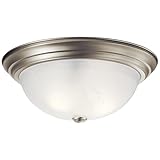
Best overall for apartments: Kichler 8110NI 15.25″ Flush Mount, Brushed Nickel — Check on Amazon
Best rental living-room look: Globe Electric Kyle 60998 Matte Brass with White Linen Shade
Best for open-plan apartments: VONLUCE 18″ Drum Semi-Flush Mount
Best smart for renters: Govee Ceiling Light Pro 15″
Best cheap leave-behind: TALOYA 12″ LED Flush Mount
Best dimming without rewiring: KIWIVIC 16″ Dimmable Ceiling Light with Remote
Best Flush Mount Ceiling Light for Apartments Under $200: The Renter’s Permission-First Guide
Disclosure: As an Amazon Associate, dailyhomedecorating.com earns from qualifying purchases made through links on this page. That never changes what we recommend or what a fixture’s specs are: the lumen figures below are the manufacturers’ own published numbers, and every limitation we found — including the legal one in the next paragraph — is stated in the open.
Before a single fixture: a hardwired ceiling light is not furniture. It is part of the building’s electrical system, and in a rented apartment it belongs to your landlord. Most leases prohibit tenants from altering electrical fixtures at all, and even leases that stay silent on the subject rarely grant you the right to swap one. So this guide starts with the sentence most lighting guides skip: do not change a ceiling fixture in a rental without your landlord’s written permission — an email or a signed note in the lease file, not a hallway “yeah, sure.” An unauthorized swap can cost you part of your deposit, a restoration charge at move-out, or worse if anything ever goes wrong electrically in that unit.
That settled, this guide serves two real audiences. The first is renters who have asked and received that written yes — a surprisingly common outcome, because landlords know the builder-grade dome in your living room is ugly, and many will happily let a tenant upgrade it at the tenant’s expense, especially if you offer in writing to reinstall the original before you leave. The second audience is owners of small apartments and condos, who face the same rooms, the same low ceilings, and the same thin lighting budgets as renters, with no permission step at all. Everything below is written for both, and where the advice splits — what to take with you, what to leave behind, what never to touch — it splits along exactly that line.
The $200 budget interacts with apartment life in a specific way. At the lowest end of this budget, ceiling lights are mostly thin LED discs: inexpensive, light, and honestly disposable — the kind of fixture you install with permission and leave behind without a second thought when the lease ends. Higher up in the same under-$200 budget, the tier also contains fixtures from established brands like Kichler and Globe Electric, built from glass, steel, and linen around standard replaceable bulbs. Those are different objects. A glass-and-steel Kichler is worth unscrewing, wrapping, and taking to your next home; an inexpensive plastic disc is not worth the bubble wrap. This guide sorts all six picks by that logic — take it, maybe take it, or leave it — alongside the usual questions of size, brightness, and dimming.
Two honesty rules apply to every number in this guide. First, lumen figures on LED fixtures are manufacturer claims with no common measurement standard behind them; a disc claiming 4,300 lumens and one claiming 2,000 were not necessarily tested the same way, so treat the figures as rough size classes. Second, the three bulb-based fixtures below do not include bulbs — you will need to add decent LED A19 bulbs as a separate purchase, and those bulbs also determine your brightness, color temperature, and color rendering, which is an extra step and a freedom at the same time. Prices are not printed in this guide at all: for every pick, check the current price on Amazon before you buy, and buy only if the live listing sits within this guide’s under-$200 budget. The picks below are positioned qualitatively within that budget — lowest end, lower part, or upper part — so you can judge the trade-offs without relying on a printed number that could go stale.
Quick Picks
| Buyer type | Pick | Why it wins for apartment life | Check |
|---|---|---|---|
| Best overall for apartments | Kichler 8110NI 15.25″ Flush Mount (B0014HCHO0) | Real glass dome and steel body from a real brand, three replaceable E26 sockets, only about 3.8 lb — the fixture in this guide most worth uninstalling and taking with you. Check the current price on Amazon; buy only if it sits within the under-$200 budget | Check on Amazon |
| Best rental living-room look | Globe Electric Kyle 60998, Matte Brass (B09SVKFF1H) | A white linen shade over matte brass that sits low in this budget band — it erases the “rental white box” feel of a room for a small share of the budget; two E26 sockets, bulbs separate. Check the current price on Amazon | Check on Amazon |
| Best for open-plan apartments | VONLUCE 18″ Drum Semi-Flush Mount (B075XP4BNR) | The biggest shade here, sitting in the lower-middle of this budget band; the semi-flush drop spreads light sideways across a combined living/dining space; three E26 sockets behind a diffuser. Check the current price on Amazon | Check on Amazon |
| Best smart for renters | Govee Ceiling Light Pro 15″ (B0F1N5HPVH) | App and voice dimming, schedules, and 2700K–6500K tuning at the upper end of this budget band — the dimmer control your lease won’t let you wire into the wall, delivered by software instead. Check the current price on Amazon | Check on Amazon |
| Best cheap leave-behind | TALOYA 12″ LED Flush Mount (B07PZT7RJS) | At the lowest end of this budget and 0.94 inches thin — made for low rental ceilings, inexpensive enough to leave installed when you move without a flicker of regret; plastic, and not dimmable. Check the current price on Amazon | Check on Amazon |
| Best dimming without rewiring | KIWIVIC 16″ Dimmable Ceiling Light (B0FQ59XD6K) | Brightness and 3000K–6500K color adjustment from a handheld remote — real dimming in a unit where you may not touch the switch wiring. Check the current price on Amazon; buy only if it sits within the under-$200 budget | Check on Amazon |
How These Picks Were Chosen
Every fixture here was checked against its manufacturer’s specifications or its live Amazon listing during research for this series — diameter, depth, socket count or LED wattage, dimming method, and materials — and then re-judged through the apartment filter. That filter has four questions the general guide does not ask. Does the fixture mount to a standard ceiling junction box with no new holes, no new box, and no ceiling cutting? (All six do; anything requiring more was excluded, because no landlord’s permission slip covers construction.) How deep is it, honestly, against the 8-foot — sometimes 7.5-foot — ceilings of real apartments? What happens at move-out: is it worth uninstalling, and does it reinstall without leaving evidence? And what does it ask of the wiring beyond the fixture itself — because a renter who gets permission to swap a fixture has not usually been given permission to rewire the switch, add a dimmer, or move the box.
The dimming question deserved that emphasis, because it is where apartment lighting advice usually goes wrong. There are three distinct ways a ceiling light dims — through a wall dimmer, through a handheld remote, and through an app — and they are not interchangeable. A wall dimmer is electrical work in the wall, which most permissions do not include. So this guide deliberately includes one remote-dimming disc and one app-dimming smart light: both give a renter genuine dimming while the wall switch stays exactly as the landlord left it. Conversely, one pick (the TALOYA) does not dim at all and says so on its listing, and the three bulb fixtures dim only the traditional way, with dimmable bulbs on a compatible dimmer — which matters if your apartment already has a dimmer installed and matters not at all if it does not.
How to read the pricing in this guide, stated once and plainly. No static prices are printed for any pick, because a printed price goes stale quickly and can mislead you at checkout. For every linked pick, check the current price on Amazon and hold it to one rule: at or under this guide’s $200 budget it belongs here; over it, it does not. Qualitatively, the Globe Electric Kyle and the TALOYA sit at the low end of this budget band, the VONLUCE drum sits in the lower-middle, and the Govee sits toward the upper end; the Kichler 8110NI and the KIWIVIC are value-tier fixtures positioned well within the budget — confirm that on the live listing before ordering. Finally, two instructive absences. Kichler’s Ceiling Space LED, a 17.25-inch integrated fixture, sits above this budget, so it appears only as a labeled over-budget reference. And Progress Lighting’s Avra, a 15-inch three-light glass dome offered at Target, had no verifiable live Amazon offer, so it is a benchmark mentioned in prose, never a linked pick: a guide that links to a listing it cannot verify is not doing its job.
The Apartment Fork: Integrated LED or Replaceable Bulbs?
Three of the six picks are sealed LED fixtures and three take ordinary screw-in bulbs, and for apartment dwellers this split carries a second meaning beyond the usual one. The usual meaning first. An integrated LED disc — the Govee, TALOYA, and KIWIVIC below — is thin, efficient, and often adds selectable color temperature or smart features. Its weakness is structural: the LED board and its driver are one appliance, and when the driver fails (in budget discs the driver, not the diode, is what fails) there is no bulb to change; the whole fixture is replaced. A bulb-based fixture — the Kichler, Globe, and VONLUCE — is deeper, costs a little more once bulbs are added, and offers no built-in color tricks, but every wear part is a replaceable LED bulb, you choose brightness and color yourself, and the fixture remains serviceable for fifteen years.
The apartment meaning is about moving day. A sealed disc is a one-address product in practice: it is light, cheap to replace, and — for the inexpensive ones — not worth the twenty minutes it takes to remove, wrap, and reinstall elsewhere. A glass-and-steel bulb fixture is a possession. The Kichler below weighs about 3.8 pounds, unscrews from a standard box in minutes, takes any bulb you own, and will serve in the next apartment’s bedroom exactly as it served in this one’s living room. So the honest recommendation splits by horizon: if this apartment is a one- or two-year stop, buy discs and leave them; if you are furnishing a condo you own, or you are the kind of renter who moves their furniture across three leases, buy sockets and take them. The master guide to this budget, the Best Flush Mount Ceiling Light Under $200, works through the same split room by room without the moving-day lens.
1. Best Overall for Apartments: Kichler 8110NI 15.25″ Flush Mount, Brushed Nickel (B0014HCHO0)
Who it suits: Renters with written permission — and condo owners — who want one fixture good enough to be worth taking when they go: a real brand, real glass, and sockets that will never be orphaned by a dead LED driver. This is the default recommendation of the guide.
The 8110NI is Kichler’s long-running value flush mount: a 15.25-inch steel fixture, 6 inches deep, in brushed nickel, with a satin etched glass dome in an alabaster-style swirl over three standard E26 sockets rated to 60 watts each. Three sockets is the detail that matters. Fit three decent LED A19 bulbs and every quality of the light is your choice — about 800 lumens each for a bedroom, brighter for a living room, 2700K for warmth or 3000K for a cleaner look, 90+ CRI bulbs if you care how colors render. No integrated fixture in this guide hands you that control, and when a bulb dies in year six you twist in a new one instead of shopping for a fixture and booking another permission conversation with a landlord.
For apartment life specifically, three traits elevate it. It is light — about 3.8 pounds — so one person can hold it against the ceiling with one hand while connecting wires with the other, and it puts no meaningful strain on an older ceiling box of unknown history, which describes most rental ceiling boxes. At 6 inches deep it is a true flush mount that behaves on an 8-foot ceiling: mounted over a living room or bed it reads as a designed fixture, not a pancake, and it stays clear of headroom in a way the 7.4-inch shade below cannot quite promise. And it is dimmable per Kichler’s own spec sheet — which, in a bulb fixture, means dimmable bulbs on a compatible LED-rated dimmer; if your apartment already has a dimmer on that switch, this fixture uses it properly, and if it does not, the fixture loses nothing. It is rated for dry locations, so it belongs in living rooms, bedrooms, and dining areas rather than directly over a shower, and it carries a one-year limited warranty — standard for the class, not generous.
On price, this guide’s check-price rule applies in full: no static price is printed here. It is a value-line fixture positioned well within this guide’s under-$200 budget; check the current price on Amazon, and buy only if the price you see sits within that budget — if it ever shows above the cap, something about the listing has changed and the pick no longer makes sense.
Pros: Real glass dome and steel body from an established brand; three replaceable E26 sockets make brightness, color temperature, and CRI your permanent choice; only ~3.8 lb, gentle on old ceiling boxes and easy to install or remove solo; dimmable per the manufacturer’s spec sheet; 15.25-inch size suits the medium and large rooms apartments actually have.
The honest limitation: Bulbs are not included, so budget for three good LED bulbs as an extra purchase on top of the fixture. The swirled glass dome is traditional in style — “classic” or “dated” depending on your taste — and it will not give a modern room the crisp look the linen-shade picks below deliver. And its price must be checked on Amazon before you buy, per the check-price framing above.
Choose it if you want the fixture you install once, service with bulbs, and unscrew and take with you when the lease ends. Skip it if your ceiling is under 8 feet and the fixture hangs over a walkway (look at the discs), you want app control, or the traditional dome clashes with your room.
2. Best Rental Living-Room Look: Globe Electric Kyle 60998, Matte Brass with White Linen Shade (B09SVKFF1H)
Who it suits: Anyone whose real problem is that the apartment looks like a rental — white walls, white ceiling, beige everything — and who wants the single change that most alters how the main room feels at 7 p.m.
The Kyle pairs a 15.9-inch white linen drum shade with a matte brass frame and hides two E26 sockets (60 watts maximum each, bulbs sold separately) behind the fabric. Fabric does real optical work: it diffuses the bulbs into a soft, even glow with no visible hot spots and no bare-bulb glare when you look up from a sofa, which is why drum shades dominate hotel and designer lighting at far higher tiers. Matte brass is the current-decade metal — warmer than the chrome and brushed nickel of builder fixtures — and against white linen it reads as a decision, not a compromise. The Kyle sits low in this budget band — check the current price on Amazon before you buy: it delivers the designer look of this tier for a small share of the budget, and its position at the low end changes the take-it-or-leave-it math. Leaving it behind for the next tenant (with the landlord’s agreement, in writing) is a defensible choice, and taking it is a ten-minute job.
Globe Electric rates the fixture as fully dimmable with a compatible dimmer and dimmable bulbs, so if the apartment’s living room switch is already a dimmer, the Kyle turns it into an evening room properly. Two sockets is the right count behind a shade this size: two 800-lumen LED bulbs give roughly 1,600 lumens of soft light, comfortable for a living room or bedroom, and because the bulbs are standard E26 you can choose 2700K for maximum coziness. That softness is exactly why the Best Flush Mount Ceiling Light For Bedrooms Under $200 keeps returning to this fixture for sleep spaces.
The apartment-specific caution is depth. At 7.4 inches, the Kyle is close to semi-flush territory — the deepest profile in this guide. On an 8-foot ceiling it leaves about 7 feet 5 inches of clearance: fine over a sofa, a bed, or a dining table, but too low over a walkway, and it does not belong in a room with ceilings under 8 feet at all. Older apartment buildings with 7.5-foot ceilings should skip it entirely and take a disc.
Pros: The softest, most flattering light in the guide, and the fastest cure for the rental-white-box look; sits low in this budget band — check price on Amazon; dimmable with the right bulbs and an existing dimmer; standard E26 sockets keep it serviceable forever; inexpensive enough that leaving it behind is painless.
The honest limitation: At 7.4 inches deep it needs 8-foot ceilings and a no-walk position; fabric asks for occasional dusting and is a dry-room material, not a steamy-bathroom one; and, like all the bulb fixtures here, it does not include bulbs.
Choose it if looks and light quality tie for first place, your ceilings are 8 feet or higher, and the fixture hangs over furniture rather than a path. Skip it if your ceilings are low, you need a damp-rated fixture, or maximum raw brightness is the goal.

3. Best for Open-Plan Apartments: VONLUCE 18″ Drum Semi-Flush Mount (B075XP4BNR)
Who it suits: Larger apartment living spaces — the open-plan living/dining rooms of newer buildings, and primary bedrooms over 150 square feet — where a 12- or 15-inch fixture looks lost in the middle of a wide ceiling.
A semi-flush mount is the convertible of ceiling lights: the shade hangs a short stem’s length below the ceiling instead of hugging it, and that small gap changes the light. The bulbs sit lower and further from the ceiling plane, so light escapes sideways through the shade and washes the upper walls instead of pooling in a circle directly beneath. In an open-plan apartment, where one ceiling fixture is often asked to serve a sofa zone and a dining zone at once, that sideways spread is the difference between a lit room and a lit circle. The VONLUCE applies the idea at the largest scale in this guide: an 18-inch linen drum on a metal frame — this listing is the white shade with black finish version — with three E26 sockets at up to 60 watts each behind a bottom diffuser that hides the bulbs from anyone standing under it. Three sockets in an 18-inch drum is proper hardware: three 1,100-lumen bulbs make family-room brightness, three 800-lumen bulbs make a calmer room, all replaceable forever with bulbs you choose.
It sits in the lower-middle of this budget band — check the current price on Amazon — which is a great deal of fixture for its position in the tier; comparable 18-inch drums from legacy brands generally sit higher in the market. It dims the traditional way, with dimmable bulbs on a compatible dimmer. For the black-and-white neutrality of modern apartment interiors it is also the most architecturally quiet pick here; the Best Flush Mount Ceiling Light For Modern Homes Under $200 leans on it for exactly that reason.
The rental cautions are real. The semi-flush drop means the fixture occupies roughly 8 inches of headroom once mounted, so on the 8-foot ceilings common in apartments it belongs only over a table, bed, or seating — never over open floor, a doorway swing, or stairs — and on ceilings under 8 feet it does not belong at all. VONLUCE is a value brand rather than a legacy name, so fit and finish and long-term parts support sit a step below Kichler or Globe, and dimension data for this model has appeared in inconsistent forms in listings; confirm the exact height on the live listing if your clearance is tight.
Pros: The largest shade in the guide at 18 inches, scaled for open-plan rooms; semi-flush drop spreads light wider than any true flush mount here; three replaceable E26 sockets; diffuser hides bulbs from below; sits in the lower-middle of this budget band — check price on Amazon.
The honest limitation: The drop eats headroom — 8.5-foot ceilings or a strictly over-furniture position are the safe uses, which rules out many apartments; an 18-inch drum overwhelms a small room; value-brand support horizon; bulbs cost extra, as with every socketed pick.
Choose it if the room is large, the ceiling is high enough, and you want wide, soft, bulb-based light from one central fixture. Skip it if ceilings are at or under 8 feet over open floor, the room is small, or you want a sealed smart fixture.

4. Best Smart for Renters: Govee Ceiling Light Pro 15″ (B0F1N5HPVH)
Who it suits: Smart-home renters — Alexa, Google, or Matter households — who want one ceiling light to be a bright work light at noon, a warm lamp at dinner, and a dim glow at midnight, and who cannot solve that with a wall dimmer because the wall is not theirs to rewire.
The Govee Ceiling Light Pro is a 15-inch low-profile disc with two lighting systems inside: a main white light claiming 4,300 lumens (a manufacturer figure — read it as “bright enough for a medium-large room,” not a lab measurement) adjustable from 2700K warm to 6500K daylight, and an RGBIC ambient ring that glows in colors and animated scenes independently of the main light. It connects over Wi-Fi, works with Matter as well as Alexa and Google Assistant, and supports schedules, timers, and music-sync effects through the Govee app. It sits at the upper end of this budget band — check the current price on Amazon — making it the highest-positioned pick in this guide, and the only one whose light is fully programmable.
For a renter, the headline is not the colors; it is the dimming route. The Govee dims beautifully — through its app, by voice, and on schedules — and that matters because adding a wall dimmer is electrical work most landlord permissions do not cover. This fixture delivers dimmer-grade control while the wall switch stays a plain switch. But the same fact has a hard edge that listings blur: the Govee is not designed for a standard wall dimmer. Like most smart fixtures it wants full, constant power from a plain switch, and feeding it through a TRIAC dimmer can cause flicker or damage. If your apartment’s light already runs on a wall dimmer you rely on, this is the wrong fixture; if the switch is a plain switch and your household runs lights by voice and routine, it is the right one. Two more apartment notes: it needs decent Wi-Fi at the ceiling, and as a sealed integrated fixture it is replaced whole when its electronics eventually fail — the standard smart-light trade, and, as the highest-positioned pick here, the one whose move-out math is genuinely debatable. Our take: it is light and quick to remove, so take it if you will use the features in the next place; do not leave a premium smart fixture behind as a gift unless the landlord has agreed in writing to compensate or you simply prefer not to patch your schedule around an uninstall.
Pros: Tunable white 2700K–6500K plus RGBIC color scenes — the most capable light in the guide; Matter support avoids ecosystem lock-in; app and voice dimming replaces the wall dimmer a renter cannot install; schedules suit bedrooms and living rooms; low-profile disc suits 8-foot ceilings.
The honest limitation: No wall-dimmer compatibility — plain switch only; no replaceable bulbs; plastic-bodied disc looks, so you are paying for capability, not materials; no headline high-CRI figure, so for color-critical corners the bulb fixtures with 90+ CRI bulbs are safer. Check the current price on Amazon before ordering.
Choose it if scenes, schedules, and voice control are how your home already works and the switch is a plain one. Skip it if you rely on a wall dimmer, dislike app-controlled essentials, or want a fixture repairable with a bulb.

5. Best Cheap Leave-Behind: TALOYA 12″ LED Flush Mount (B07PZT7RJS)
Who it suits: Low ceilings, hallways, kitchens, laundry corners, second bedrooms — and any renter with permission who wants a visibly better light than the builder dome for about the cost of a pizza, with zero intention of ever removing it.
The TALOYA is 12 inches across and just 0.94 inches thick, which answers the most common apartment ceiling problem: an 8-foot ceiling, or the 7-foot ceiling of a basement or older building, where a 6-inch glass dome eats headroom and looks oppressive. Inside is a 20-watt integrated LED claiming 2,000 lumens — again a manufacturer figure, best read as “plenty for a hallway, kitchen, or small bedroom” — with a feature that punches above its position at the lowest end of this budget: a switch on the fixture selects among five color temperatures (3000K, 3500K, 4000K, 5000K, 6500K) at installation, so one SKU can match the warm light of a bedroom or the cooler light of a laundry room. The listing rates it at CRI 80 — honest, ordinary color rendering, fine for utility spaces, not ideal over a vanity.
Now the compromises, unsoftened, because at this end of the budget they are the product. The housing and diffuser are plastic — polycarbonate, not glass or metal — and up close it looks like what it costs. The listing states plainly that this model is not dimmable: pair it with a standard switch only, because a non-dimmable LED on a dimmer circuit flickers, buzzes, and dies early. And as a sealed unit, its life is its driver’s life. None of that prevents it from being the right answer in the right room — it prevents it from being the right answer in a showcase living room. Check the current price on Amazon before you buy rather than trusting any printed number.
The rental framing is what earns it a pick slot. This is the fixture you install with permission in the dim hallway or the kitchen, enjoy for the whole lease, and leave installed when you go — restoring the landlord’s original dome over an inexpensive hallway fixture would cost you more in time than the TALOYA is worth, and most landlords, asked in writing, are glad to keep the upgrade. Agree that in advance, in the same email thread as the permission, and move-out day gets simpler for everyone.
Pros: Under an inch thick — the low-ceiling solution in this guide; five selectable color temperatures at installation; claimed 2,000 lumens from 20 watts is efficient; its position at the lowest end of the budget makes multi-room installs painless; the definitive leave-behind pick.
The honest limitation: Not dimmable, plastic construction, CRI 80, and a sealed design replaced whole when it fails. It is a utility light, and in a formal living room it will look like one.
Choose it if headroom or budget is the binding constraint, or the room is a hallway, kitchen, or spare room. Skip it if you need dimming (the KIWIVIC below adds a remote), the room is a showcase space, or you want a fixture that lasts decades.

6. Best Dimming Without Rewiring: KIWIVIC 16″ Dimmable Ceiling Light with Remote (B0FQ59XD6K)
Who it suits: Bedrooms and living rooms on a plain switch with no dimmer — the standard rental situation — where you want to dim the overhead light from the bed or sofa without an electrician, without a smart-home setup, and without touching a single wire beyond the fixture itself.
The KIWIVIC solves the exact problem this guide keeps circling: dimming without a dimmer. Its 16-inch ultra-thin disc packs a 36-watt integrated LED claiming 3,600 lumens (manufacturer figure; read it as large-room bright), and the included handheld remote adjusts both brightness and color temperature continuously across 3000K–6500K. In a bedroom that combination is genuinely useful — full, cooler brightness for getting dressed; warm and low for winding down — and it asks nothing of your wiring. The fixture installs on the existing junction box, the wall switch stays a plain switch, and the remote does everything else. The 16-inch diameter is also a step up from the usual 12-inch budget discs, spreading light more evenly across rooms up to roughly 200 square feet, and the thin profile behaves on the 8-foot ceilings where the shade picks cannot go. Small-space readers will find it treated as the low-ceiling default in the Best Flush Mount Ceiling Light For Small Rooms Under $200 as well.
The trade-offs mirror the other discs, plus one of its own. It is a sealed integrated fixture, so failure means replacement. Remote dimming is not wall dimming: lose the remote or let its battery die at the wrong moment and you are back to full-brightness on/off at the switch until a replacement arrives — households that want everything on wall controls should take a bulb fixture and an existing dimmer instead. And per this guide’s check-price rule, no static price is printed for this model: check the current price on Amazon, and buy only if it sits within this guide’s under-$200 budget — as a value-tier fixture, it is positioned well within that budget.
Pros: Real dimming and color adjustment with zero rewiring and zero switch work; 16-inch size suits medium and large rooms; claimed 3,600 lumens is strong output for a thin disc; remote control is ideal for bedrooms; low profile suits 8-foot ceilings; light enough to leave behind or take, your call.
The honest limitation: Sealed LED appliance with a budget-brand support horizon; all control depends on keeping the remote alive and findable; check the current price on Amazon before you buy.
Choose it if you want dimmable ceiling light in a room that has no dimmer and cannot get one. Skip it if you want wall-dimmer control, smart-home integration (the Govee is the pick), or a serviceable bulb-based fixture.

Comparison Table
| Product | Size & light source | Color temperature | Dimming | Move-out verdict | Check |
|---|---|---|---|---|---|
| Kichler 8110NI | 15.25″ Ø × 6″H; glass dome, 3 × E26 bulbs (not included) | Your choice of bulbs | Yes — with dimmable bulbs + LED-rated dimmer (per Kichler spec sheet) | Take it — glass, steel, ~3.8 lb | Check on Amazon |
| Globe Electric Kyle 60998 | 15.9″ Ø × 7.4″H; linen shade, 2 × E26 bulbs (separate) | Your choice of bulbs | Yes — with dimmable bulbs + compatible dimmer | Either — low in this budget band | Check on Amazon |
| VONLUCE 18″ Drum Semi-Flush | 18″ Ø; linen drum + diffuser, 3 × E26 bulbs (separate) | Your choice of bulbs | Yes — with dimmable bulbs + compatible dimmer | Take it if ceilings allowed it | Check on Amazon |
| Govee Ceiling Light Pro | 15″ Ø disc; integrated LED, 4,300 lumens claimed | 2700K–6500K adjustable + RGBIC color | App / voice only — not for wall dimmers | Take it — premium smart electronics | Check on Amazon |
| TALOYA 12″ Flush Mount | 12″ Ø × 0.94″H; integrated 20W LED, 2,000 lumens claimed, CRI 80 | 5 selectable: 3000/3500/4000/5000/6500K | No — plain switch only | Leave it — lowest end of the budget, agree it in writing | Check on Amazon |
| KIWIVIC 16″ with Remote | 16″ Ø thin disc; integrated 36W LED, 3,600 lumens claimed | 3000K–6500K via remote | Remote only — no wall dimmer needed | Either — value-tier disc | Check on Amazon |
How to Choose a Flush Mount Ceiling Light for an Apartment
- Get the permission first, in writing, before you order anything. An email from the landlord saying yes — ideally naming the room and your commitment to restore the original fixture or leave the upgrade by agreement — is the entire foundation of this project. Verbal permission has a way of evaporating at deposit time.
- Decide take-it or leave-it before you buy. At the lowest end of the budget, plan to leave the fixture (and get that agreed in the same email). Higher up in the budget, prefer glass, steel, and sockets — fixtures built to be uninstalled and reinstalled, like the Kichler and the VONLUCE.
- Measure your ceiling before your room. Apartment ceilings run 8 feet, and older buildings run lower. Keep total fixture depth at or under about 8 inches anywhere people walk; on an 8-foot ceiling the 7.4-inch Kyle belongs only over furniture, the semi-flush VONLUCE only over furniture on 8.5-foot ceilings, and under 8 feet the answer is a disc.
- Match the dimming route to what you are allowed to change. Existing wall dimmer → bulb fixture with dimmable LED bulbs. Plain switch, no wiring changes allowed → remote disc (KIWIVIC) or smart disc (Govee). Never put a non-dimmable LED like the TALOYA on a dimmer circuit, and never run a smart fixture through a wall dimmer.
- Settle the light-source question with your horizon in mind. Replaceable E26 bulbs (Kichler, Globe, VONLUCE) mean the fixture outlives its bulbs and moves house with you. Integrated LED (Govee, TALOYA, KIWIVIC) means thinner profiles and features, with the fixture replaced whole when its driver dies.
- Size the diameter to the room. Roughly: 12–13 inches for rooms under 100 sq ft, 15–16 inches for 100–200 sq ft, 18 inches beyond that. An undersized fixture in a big open-plan room looks like a mistake no bulb can fix.
- Treat lumen numbers as size classes, not scores. There is no shared measurement standard behind them. As a sanity check, aim for roughly 20 lumens per square foot of claimed output for living spaces, more for kitchens — then judge the room with the return window still open.
- Pick a color temperature strategy. Bulb fixtures: 2700K for bedrooms and living rooms, 3000K as the all-purpose compromise, 4000K+ only for work areas. Discs: prefer selectable-CCT models — all three here are — so a wrong guess is a switch flip, not a return. Note the TALOYA’s warmest setting is 3000K.
- Check CRI where color matters. Budget discs publish CRI 80 or nothing. Over a vanity, art wall, or dining table, choose a bulb fixture and fit 90+ CRI bulbs; the shade material matters less than the light’s color quality.
- Budget the whole install, including the exit. Bulbs are an extra purchase on top of socketed fixtures. Your time at move-out is a cost too: plan the uninstall-and-restore (or the written leave-behind agreement) when you install, not during the final week of the lease.
The Swap Itself: Doing It Without Losing Your Deposit
The physical swap is the easy half — every fixture in this guide mounts to a standard ceiling junction box with the same two or three wires — but apartment swaps carry a paper trail that homeowner swaps do not. Work through it in order. First, the permission email, saved, naming the room. Second, before anything comes down, photograph the existing fixture, then switch off the breaker for that circuit (not just the wall switch) and test that the light is dead. Third, as the old fixture comes down, photograph the wire connections exactly as you found them — which wire to which wire — before disconnecting anything; phone photos are the cheapest insurance in this entire project. Fourth, put the landlord’s original fixture, its mounting hardware, and its screws into a labeled box and store it somewhere it will survive the lease; a fixture thrown away in month one becomes a deduction in month thirteen. Fifth, install the new fixture per its instructions, restore power, and test every function — including, for the discs, the remote or app pairing — while the ladder is still out. Finally, keep the new fixture’s box and instructions with the old fixture’s box, so move-out day is a reversal of a documented process rather than an archaeology dig. If anything about the existing wiring looks damaged, ancient, or improvised when you open it up, stop: that is no longer a fixture swap, it is your landlord’s electrician’s job, and your permission email almost certainly does not cover it.
Common Buying Mistakes
- Swapping a fixture on verbal permission. The single most expensive mistake in this guide. If it is not in writing, it did not happen, and the deposit settlement will proceed accordingly.
- Throwing away the landlord’s original fixture. Restoring a unit to its original condition is the default lease obligation. A discarded builder dome turns an inexpensive upgrade into a replacement charge plus labor.
- Forgetting the bulbs in the price. A fabric-shade fixture plus quality dimmable LED bulbs costs more than the fixture alone — check the current price on Amazon for the fixture and factor in the bulbs — still excellent value at the low end of this budget, but compare it honestly against a smart disc whose light is built in.
- Hanging a deep fixture on a low ceiling. A 7.4-inch shade on a 7.5-foot ceiling leaves under 7 feet of clearance — head-strike territory. Measure the drop, not just the diameter.
- Putting a non-dimmable LED on a dimmer. The TALOYA’s listing says “not dimmable” for a reason: dimmer circuits make such fixtures flicker, buzz, and die early. If the room has a dimmer, choose a dimmable pick.
- Assuming a smart light works with your wall dimmer. It is the reverse — smart fixtures like the Govee want a plain switch at full power. Running one through a TRIAC dimmer is the most common cause of “defective” smart-light returns.
- Leaving a premium fixture behind by default. Expensive picks travel. If you would rather not uninstall, negotiate the leave-behind in writing — some landlords will credit a genuinely better fixture; none will if you never ask.
- Comparing fixtures by claimed lumens. A 4,300-lumen claim and a 2,000-lumen claim from different makers were not measured the same way. Shortlist by diameter, wattage class, and room size; judge brightness in place, inside the return window.
- Buying the designer name at this budget. The famous designer fixtures mostly sit well above this guide’s budget — Kichler’s Ceiling Space LED is one over-budget example. Within an under-$200 budget, a value-line fixture with real materials beats a famous name’s thinnest entry-level offering.
Final Recommendation
For most apartments and most people, buy the Kichler 8110NI: a real glass dome from a real brand, three sockets that make brightness and color your permanent choice, light enough to install solo and worth unscrewing when you leave — just add three good LED bulbs to the cart and check the current price on Amazon first, buying only if it sits within the under-$200 budget per this guide’s check-price rule. If the room’s look matters as much as its light and your ceilings allow the depth, the Globe Electric Kyle — low in this budget band, so check the current price on Amazon — is the best-looking value in the guide. Choose the Govee if your home runs on scenes and voice and the switch is a plain one; the KIWIVIC if you need dimming and may not touch the switch wiring; the VONLUCE for a big open-plan room on a high-enough ceiling; and the TALOYA wherever headroom or budget is the real constraint — the hallway, the kitchen, the low-ceilinged spare room. And if your heart is set on the designer tier, know that it sits above this guide’s budget — which is the band the Best Flush Mount Ceiling Light For Apartments Under $300 takes up next.
FAQ
Can I legally change a ceiling light in a rented apartment?
Only with your landlord’s permission, and you should get it in writing. A hardwired fixture is part of the building’s electrical system, most leases prohibit unapproved alterations, and an unauthorized swap can be charged against your deposit as a restoration cost. Many landlords say yes when asked properly — in an email, with an offer to restore the original fixture at move-out or to leave the upgrade by agreement. Owners of their own apartment or condo need no permission, though building rules and local electrical codes still apply.
My landlord said yes in person. Is that enough?
Treat it as a no until it exists in writing. People forget, property managers change, and deposit disputes are settled with documents. A two-line follow-up email — “confirming our chat: I have your OK to replace the living-room ceiling light at my expense and reinstall the original before I move out” — converts a conversation into protection, and a landlord acting in good faith will not object to it.
Which of these fixtures is easiest to take with me when I move?
The Kichler 8110NI, and it is not close: about 3.8 pounds, standard mounting, no electronics to pair or reset, and glass and steel that survive being wrapped and boxed. The Govee is the runner-up — light and quick to remove, though you will re-pair it at the next address. The TALOYA is the opposite case: at the lowest end of this budget, uninstalling it costs more in time than the fixture is worth, which is why this guide frames it as a leave-behind from the start.
My apartment has no dimmer and I am not allowed to install one. Can I still dim the ceiling light?
Yes — change the fixture, not the switch. The KIWIVIC dims and adjusts color temperature from a handheld remote with the wall switch untouched, and the Govee dims through its app and voice control on the same condition. What you cannot do is pair the wrong technologies: the TALOYA does not dim at all, and the Govee must not be fed through a wall dimmer even if one exists.
My ceilings are only 8 feet. Which picks are safe?
The three discs — TALOYA at 0.94 inches, and the low-profile Govee and KIWIVIC — are safe anywhere. The Kichler at 6 inches is fine over living areas and beds. The Kyle at 7.4 inches and the semi-flush VONLUCE belong only over furniture at 8 feet, and under 8 feet neither belongs at all; in low rooms, spend on diameter and light quality instead of depth.
How many lumens does an apartment living room actually need?
As a planning figure, about 20 lumens per square foot from all light sources combined — roughly 3,000 lumens for a 150 sq ft room — with kitchens wanting more. Treat fixture lumen claims as approximate, since makers do not measure to a shared standard, and remember a ceiling light is rarely a room’s only source: lamps you already own count toward the total.
Do I need an electrician for a fixture swap?
A like-for-like swap on an existing junction box — same wires, same box, no new circuits — is a common DIY job for a competent adult working with the breaker off, and every fixture here is that kind of swap. Stop and hand it to a licensed electrician (yours if you own, your landlord’s if you rent) if the box is loose or damaged, the wiring is cloth-insulated or crumbling, there is no proper junction box, or anything looks improvised. In a rental, that discovery is also a message to your landlord, not a problem to hide.