Where to buy
Check the latest price, availability and delivery on Amazon. Orders are placed on Amazon. We may earn a commission from qualifying purchases.
- Best overall: NICETOWN Blackout Curtains, 52″W x 63″L, 2 Panels, Grommet Top — Check on Amazon
- NICETOWN Thermal Insulated Grommet Blackout Curtains, Black, 42″W x 63″L, 2 Panels — Check on Amazon
- Amazon Basics Portable Room Darkening Blackout Curtain Shade with Suction Cups, 50″W x 78″L, 1 Panel — Check on Amazon
- BGment Rod Pocket and Back Tab Blackout Curtains, Navy Blue, 42″W x 63″L, 2 Panels — Check on Amazon
See 2 more Amazon options
- MIULEE Black Blackout Curtains, 40″W x 63″L, 2 Panels, Grommet Top — Check on Amazon
- NICETOWN 100% Blackout Curtains with Black Liner, Grey, 52″W x 63″L, 2 Panels — Check on Amazon
Read the full guide ↓
Disclosure: As an Amazon Associate, dailyhomedecorating.com earns from qualifying purchases. Links to Amazon on this page are affiliate links; they cost you nothing extra. Listing details such as price and availability change often, so check the current Amazon listing before you buy.
The best blackout curtains for small rooms under $30 work because of a piece of geometry that works against almost every other budget in this category: small rooms have small windows. The sizes this price tier actually sells — pairs of 40, 42 and 52 inch panels in the short 63 inch drop — are a compromise in a big bedroom with a tall window, where they leave a foot of bare glass at the bottom. On the window of a small bedroom, a box room, a nursery or a study, those same sizes are not the compromise at all. They are the correct, intended fit, at the lowest prices in the category, and a small room’s single window means the whole thirty dollars lands on one opening instead of being spread thin across three. Every pick below is a real product selected for this under $30 tier in the exact size named — check price on Amazon for the current price of each — and the one pick that sits above the tier, a lined pair positioned just over this budget, is labeled as over budget wherever it appears rather than quietly rounded down.
Two honest warnings before the picks, because this category needs them at every price. First, the percentages printed on curtain listings — 85%, 95%, 99%, “100% blackout” — are maker claims with no standard test behind them. The unlined triple-weave fabrics that dominate this budget genuinely block most light that hits the cloth itself, roughly 85 to 95 percent in dark colors by independent roundup estimates, but only a curtain with a separate opaque liner blocks all of it, and liners mostly live above this budget. Second, in a small room you live closer to your window than anywhere else in the house — the bed, the desk or the crib is often directly beneath it — so the light that leaks around a curtain’s edges matters more, not less, and fit earns as much of this guide’s attention as fabric. For most small rooms we would start with the NICETOWN 52 x 63 pair, the full standard width in the short drop a small window actually needs. If your window is narrow, the 42 inch pair below it is the proven buy. And if your small room has no wall beside the window for a rod at all, skip to the suction-cup shade. Below: a quick picks table, detailed notes on all six products, a comparison table, a buying checklist written for small windows, the size math that makes this budget work, the truth about blackout percentages, the mistakes small-room shoppers make, and answers to the questions that come up again and again.
Quick Picks
Short on time, or comparing several options at once? Each row below names a buyer type and the product that suits it, with the size and a link to the listing. Check price on Amazon for the size named in that row.
| Buyer type | Pick | Why it stands out | Link |
|---|---|---|---|
| Best overall for small rooms | NICETOWN Blackout Curtains, 52″W x 63″L, 2 Panels, Grommet Top | Full standard width in the short drop a small window needs — check price on Amazon | Check on Amazon |
| Best for narrow windows | NICETOWN Grommet Blackout Curtains, Black, 42″W x 63″L, 2 Panels | The proven budget pair, sized for the narrow windows small rooms actually have — check price on Amazon | Check on Amazon |
| Best when there is no room for a rod | Amazon Basics Portable Blackout Curtain Shade, Suction Cups, 50″W x 78″L, 1 Panel | Sticks to the glass itself — no rod, no brackets, no wall space needed — check price on Amazon | Check on Amazon |
| Best tight seal and tailored look | BGment Rod Pocket and Back Tab Blackout Curtains, Navy Blue, 42″W x 63″L, 2 Panels | Back tabs hold the fabric close to the wall and hide the rod — check price on Amazon | Check on Amazon |
| Best for the smallest windows | MIULEE Black Blackout Curtains, 40″W x 63″L, 2 Panels, Grommet Top | Slim 40-inch panels for bathroom and box-room windows, often promoted on limited-time deals — check price on Amazon | Check on Amazon |
| Best true blackout — over budget, labeled | NICETOWN 100% Blackout Curtains with Black Liner, Grey, 52″W x 63″L, 2 Panels | A real sewn-in black liner — the only total-darkness build here, positioned just above this budget — check price on Amazon | Check on Amazon |
How These Picks Were Chosen
The first filter was the budget, applied to a named size and panel count, because a curtain price means nothing until both are pinned down. Every product below is a real Amazon listing selected for this under $30 tier in the exact configuration this guide recommends — check the current price on Amazon for each, as listings change — with one deliberate exception. The lined NICETOWN pair in the final review sits just above this budget, and it is included as a labeled near-miss because it is the only true-blackout construction anywhere near this budget. It is flagged in its table row, its review and its honest limitation; nothing else in the guide needed the favor. Two picks, the MIULEE and the Amazon Basics shade, are frequently promoted through deals and discounts, so their reviews note that positioning plainly.
We did not hang these curtains ourselves. We read the maker listings and specification pages, compared construction — unlined triple weave against a sewn-in black liner, grommet against rod pocket and back tab headers, a suction-cup shade against all of them — and cross-checked listing details against retailer roundups. Where a brand sells the same design in a dozen sizes, we focused on the short configurations a small room actually uses: the 63 inch drop, and panel widths of 40, 42 and 52 inches. Headline light-blocking percentages are maker figures with no standard test behind them, so we weighted construction, color and coverage math at least as heavily as any number in a listing title — and the section on blackout percentages below explains how far those numbers can be trusted.
The small-room lens decided the borderline cases. A small room usually has one window, and that window is usually small: 24 to 48 inches wide, with a sill roughly five feet below the rod. That single fact promotes the short, narrow pairs that other guides treat as the budget compromise, and it demotes raw width — a pair of 84 inch panels that puddles on the floor and stacks a foot deep on each side of a small window is not an upgrade here, it is clutter with a receipt. It also raises the value of the two non-standard picks: a shade that mounts to the glass when there is no wall for a rod, and a back-tab header that holds fabric close to the wall when the bed sits right under the window and every leak lands on the pillow. Readers furnishing a small room that doubles as a full-time bedroom should also see Best Blackout Curtains For Bedrooms Under $30, where the same budget is ranked purely for sleep.
The 6 Best Blackout Curtains for Small Rooms Under $30
NICETOWN Blackout Curtains, 52″W x 63″L, 2 Panels, Grommet Top
Who it suits: Most small rooms — the box bedroom, the nursery, the home office — with a window in the 30 to 48 inch range and a sill about five feet below the rod.
This is the configuration this whole guide is built around: two panels of the full standard 52 inch width, in the short 63 inch drop. In a large room that pairing reads as the cheap option, because the window it belongs on is tall. In a small room it is simply the right curtain — 104 inches of fabric gives a 36 to 48 inch window the one-and-a-half to two times fullness that gathered folds and real edge overlap require, and the 63 inch length lands at or just below the sill instead of pooling onto the floor space a small room cannot spare. The construction is NICETOWN’s unlined triple weave, a black yarn core woven between two polyester faces, with metal grommets on a 1.6 inch inner diameter that fit standard rods. Check the current price on Amazon for the 52 x 63 pair — colorway prices on this listing move independently, so check the price for the color you actually want.
Color is a performance decision on this curtain, not just a decorative one, and the review would be dishonest without pressing the point: an unlined triple weave blocks light with density and dye, and NICETOWN’s own published range for the construction is 85 to 99 percent, with dark colors at the top and pale colors at the bottom. The listing this guide links carries an OEKO-TEX Standard 100 certification, a genuine point in its favor for nurseries and children’s rooms. Choose navy, black or charcoal and the fabric performs at the top of its class; choose a pale pink or beige and the same curtain becomes a dimmer that glows against a bright morning. The grommet header slides freely, which suits a small room’s curtain that gets opened every day, and the pair is light enough — about two and a half pounds in its packaging — that a modest rod or even a well-chosen tension rod carries it without drama. What it cannot do is seal a room: the liner that makes darkness total is the over-budget pick at the end of this guide, and the gap between this pair and that one is exactly the last few percent of light.
- Full 52-inch width in the short 63-inch drop — the small-room configuration, not a cut-down compromise.
- OEKO-TEX Standard 100 certified fabric on this listing, unusual in this budget tier.
- Grommets slide daily without a fight, and the light pair hangs happily on a modest rod.
Honest limitation: Unlined triple weave blocks roughly 85–99% through the fabric depending on color — dark colorways darken superbly, pale ones glow — and check the current price on Amazon for the color you actually want.
Choose it if your small room’s window is 30 to 48 inches wide and you want the standard curtain, correctly sized, in this budget tier. Skip it if the window is narrow — the 42 inch pair below covers it for less.

NICETOWN Thermal Insulated Grommet Blackout Curtains, Black, 42″W x 63″L, 2 Panels
Who it suits: Small rooms with narrow windows — a 24 to 40 inch window in a box room, a spare room or a child’s bedroom — and anyone who wants the most documented pair in the category.
If the pick above is this guide’s best overall, this is its best value, and the difference is ten inches of width. Two 42 inch panels give 84 inches of fabric, which dresses a window up to about 50 inches wide with proper fullness and is generously more than a narrow small-room window needs — and in exchange it sits much lower in this budget tier. The black 42 x 63 pair sits at the low end of this tier — check price on Amazon — which makes it one of the most affordable credible blackout pairs in this category. The construction is the same NICETOWN triple weave as its wider sibling, black yarn woven through the core, and the color linked here is black, the strongest-blocking colorway of the fabric: independent roundups of this curtain family put dark triple weave at the top of its 85 to 95 percent through-the-cloth range. Six grommets per panel slide on any standard rod, and the pair has been Amazon’s default budget answer for the better part of a decade, with the review history to prove it.
The small-room case for this pair goes beyond price. On a narrow window, a wider pair does not buy darkness — it buys stack: the bunched fabric at each side of the window when the curtains are open, which on a small wall reads as bulk and eats the wall space a shelf or a picture wanted. Eighty-four inches of fabric stacks slim, hangs in tidy folds, and leaves the little wall it hangs on mostly alone. The cautions are the family’s usual ones. Its budget positioning belongs to the 42 x 63 size — the same curtain in 52 x 84 sits higher in the range — and the fabric, however good, is unlined: it will darken a small room thoroughly and it will not make it a cave. Light-colored colorways of this listing block noticeably less than the black linked here, so if the room’s palette demands beige, understand you are buying a dimmer and judge it accordingly. For the window it fits, though, nothing in this guide has a longer track record for its tier.
- The proven pair of the category, in the narrow width small windows actually have — check price on Amazon.
- Black is the strongest-blocking colorway of the triple weave, and it is the one linked.
- Slim stack when open: 84 inches of fabric leaves a small wall mostly alone.
Honest limitation: Its budget positioning belongs to the 42 x 63 size; the floor-length version sits higher in the range, and pale colorways of the same listing block far less light than the black.
Choose it if your window is 24 to 40 inches wide and you want the safest buy in the guide. Skip it if your window is wider than about 50 inches — the coverage math stops working and the 52 inch pair above is the honest buy.
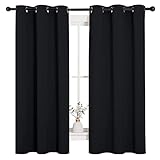
Amazon Basics Portable Room Darkening Blackout Curtain Shade with Suction Cups, 50″W x 78″L, 1 Panel
Who it suits: Small rooms where a curtain cannot go — the window with furniture hard against both sides, the wall-to-wall window with nowhere for a rod, the rental where drilling is banned — and nurseries that need darkness on demand.
Every other pick in this guide assumes a rod, and a rod assumes wall: brackets beyond the frame, space for the panels to stack, a landlord or a wall that tolerates screws. The smallest rooms are exactly where those assumptions fail — the box room whose window spans the whole wall, the nursery where the crib and the wardrobe already own the corners. This Amazon Basics shade removes the assumption. It is a single sheet of polyester, 50 inches wide by 78 inches long, that sticks directly to the window glass with suction cups; hook-and-loop tabs let you fold the sheet down to fit a smaller window or roll it partway up, and it packs into a travel bag when it comes down. It sits in the middle of this budget tier and is often promoted — check the current price on Amazon. The version linked carries a moon-and-stars print aimed at children’s rooms; plainer versions exist on the same listing family.
Now the honesty this pick demands, because it asks for more than most. Amazon’s own listing calls this product “room darkening,” and that is the correct description: the sheet covers the glass, not the wall around it, so light enters at the edges in a way a properly overlapped curtain prevents, and through the fabric it dims rather than seals. Suction cups need smooth, clean glass and they let go eventually — heat, dust and time all work on them — so a shade that was perfect in October may greet you from the floor one morning in February; re-seating the cups is part of owning it. What it buys in exchange is a kind of darkness no curtain in this guide can offer a difficult room: total coverage of an awkward window, installed in five minutes, removed without a trace, for less than a rod and a pair of panels would cost together. In a small room where the alternative is no blackout at all, that trade is not a compromise — it is the whole solution, and renters solving the same problem across a whole unit will find the fuller treatment in Best Blackout Curtains For Apartments Under $30.
- Mounts to the glass itself: no rod, no brackets, no drilling, no wall space consumed.
- Folds down with hook-and-loop tabs to fit smaller windows, and travels in its own bag.
- Mid-tier positioning in this budget — check the current price on Amazon.
Honest limitation: Amazon itself labels it room darkening, not blackout: it covers glass rather than wall, leaks at the edges, and its suction cups need smooth glass and periodic re-seating.
Choose it if your small room cannot take a rod, or you rent and cannot drill. Skip it if you need genuine total darkness for daytime sleep — that is the lined pair at the end of this guide.

BGment Rod Pocket and Back Tab Blackout Curtains, Navy Blue, 42″W x 63″L, 2 Panels
Who it suits: Small rooms where the bed or desk sits directly under the window — and anyone who cares how the top of the curtain looks on a wall they face all day.
In a small room, the top of the curtain is not a detail. The window is a large share of the wall, the wall is never more than a few feet away, and a grommet header’s row of scalloped gaps — each fold letting a scallop of light over the top — sits close enough to see. This BGment pair answers with its header: one panel offers a rod pocket, back tabs, or clip rings if you add them, three ways to hang from a single product, for the navy 42 x 63 pair — check price on Amazon. The back-tab hang is the one this guide recommends for small rooms. The rod disappears behind the fabric, the folds fall in even, tailored columns, and — the functional point — the fabric sits closer to the wall than a grommet curtain riding below its rings, which trims the top halo that lands on a bed pushed under the window. Navy is a strong-blocking color in the triple-weave fabric, deep enough to perform through the cloth while still reading as a chosen color rather than a blackout compromise.
The costs of that tidy top are friction and a fine-print distinction. Pocket and tab headers draw slowly — the panel bunches and shuffles rather than slides — so this pair suits a curtain that stays closed for long stretches, a nursery or a sleep-first small bedroom, better than one opened and closed twice a day. And BGment sells a separate double-layer line with a sewn black liner that blocks more light than this triple-weave pair; the names are similar enough to confuse, and this pick is the unlined one, with the maker advertising 90 to 99 percent blocking for it — a claim to file under the category optimism examined below, since no standard test stands behind it. What is here is a well-made triple-weave pair whose tailored hang and close fit are worth real darkness at the edges, the edges being where small rooms feel leaks most. Buyers furnishing a small modern room, where the hidden rod and flat folds suit the aesthetic, will find this same construction assessed for that style in Best Blackout Curtains For Modern Homes Under $30.
- Three hanging methods in one header — rod pocket, back tabs or clip rings.
- Back tabs hide the rod and hold the fabric close to the wall, trimming the top light halo.
- Navy triple weave: a strong-blocking color that still reads as a design choice — check price on Amazon.
Honest limitation: Both built-in headers are friction hangs that draw slowly, and this is BGment’s triple-weave line, not its better-blocking lined line, which sits higher in the range.
Choose it if the bed sits under the window and the top seal matters, or the curtain’s look is part of the room. Skip it if you open and close your curtains constantly — a grommet pair slides instead of shuffling.
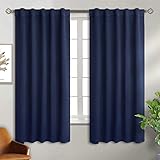
MIULEE Black Blackout Curtains, 40″W x 63″L, 2 Panels, Grommet Top
Who it suits: The smallest windows in the house — the box-room window, the bathroom window, the narrow window over a desk or a crib — and deal-watchers happy to buy when promotions run.
Read the width first, because it is the entire product: each panel is 40 inches wide, so the pair totals 80 inches of fabric. On the small windows it is made for, that is not a shortfall — a 28 to 40 inch window gets proper gathered fullness and a clean, slim stack from 80 inches, where a standard pair would bunch into heavy folds that crowd a small wall. MIULEE is one of the largest curtain sellers on Amazon, the fabric is the familiar triple weave with a grommet top, and the color linked is black, the strongest blocker in the weave. Its positioning is the headline and the caution in one: the black 40 x 63 set sits at the low end of this tier and is often promoted on limited-time deals — check price on Amazon. For a bathroom that needs privacy and darkness, or the little window of a child’s small bedroom, this is the pair scaled to both the glass and the budget.
Two cautions, both about honesty rather than quality. First, the positioning: it is often promoted on limited-time deals, and between deals it sits higher in this tier — it belongs in an under-$30 guide, but its lowest positioning is a deal-day story, and the live listing price on Amazon is the one that counts. Second, the width math is a one-way door: 80 inches of fabric is right for small windows and wrong for anything else. Stretch it across a 50 inch window and the panels hang nearly flat, leaking at the sides and looking starved while they do it. This is a specialist, and within its specialty it is arguably the best-matched pick in the guide — but measure before you fall for the deal, because the window it fits is the window it fits.
- Among the lowest-positioned grommet pairs in the guide when its deal is live — check price on Amazon.
- 40-inch panels are the correct scale for bathroom, box-room and over-desk windows.
- Black triple-weave fabric from a major curtain brand, with an easy-sliding grommet top.
Honest limitation: Its lowest positioning comes on limited-time deals — check the current price on Amazon — and 80 total inches of fabric is too little for standard or wide windows.
Choose it if your window is genuinely small and the deal is showing. Skip it if your window is wider than about 44 inches — step up to a 42 or 52 inch pair above.
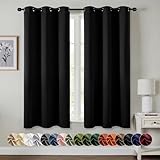
NICETOWN 100% Blackout Curtains with Black Liner, Grey, 52″W x 63″L, 2 Panels
Who it suits: The small room that must go truly dark — a day sleeper’s box room, a light-sensitive child’s nursery, a migraine sufferer’s retreat — and whose owner would rather stretch just above this budget than live with a glow.
This pick carries its warning in its table row and repeats it here: positioned just above this guide’s budget — check price on Amazon — this pair is over this guide’s budget, and it is included because it is the only curtain near this tier that does the thing the others approximate. The construction explains why. Each panel is two layers of woven polyester with a black liner built in — 460 GSM in total, against a plain triple weave’s single fabric — and a dedicated opaque layer blocks light completely, in any face color, where a weave can only block most of it in dark ones. The weight that comes with two layers even helps here, hanging the panels flatter against the wall and trimming edge leaks. Its positioning argues for patience as much as for purchase: it can move closer to this guide’s line when promotions run, so check the current price on Amazon before deciding.
The honest costs are care and weight. The lined build is hand wash or dry clean only on the maker’s instructions — no machine cycle, where the triple-weave picks above wash without ceremony — and a liner mistreated with heat can crack or separate, after which the curtain is an expensive room darkener. The pair is also heavy for its size, and wants a rod anchored into studs or proper wall anchors rather than a tension rod’s optimism; in a small room with one small window that is a five-minute job, but it is a job. Judge it as what it is: the correct tool for total darkness, priced just above the tier that otherwise cannot provide it. If the budget is truly immovable, the unlined picks above will darken a small room well for less. If darkness is the requirement and stretching just above this budget is possible, this is the pair — and Best Blackout Curtains Under $40 is where its standard-size siblings live when the window turns out taller than a small room’s.
- A sewn-in black liner: the only construction in this guide that blocks light completely, in any color.
- Heavy 460 GSM build hangs flat against the wall, trimming the edge leaks small rooms feel most.
- It can move closer to this tier when promotions run — check price on Amazon.
Honest limitation: It sits just above this budget — check price on Amazon — and is labeled as such; it is hand wash or dry clean only, and its weight needs a properly anchored rod.
Choose it if total darkness is the requirement and a little flexibility above this budget exists. Skip it if the budget is hard or the household machine-washes everything — the triple-weave picks above forgive that; this one does not.

Comparison Table
| Product | Size & panels | Best use | Link |
|---|---|---|---|
| NICETOWN Blackout Curtains, Grommet | 52 x 63 in, 2 panels, grommet | The standard curtain in the small-room size | Check on Amazon |
| NICETOWN Grommet Blackout Curtains, Black | 42 x 63 in, 2 panels, grommet | Narrow windows, in this budget tier | Check on Amazon |
| Amazon Basics Portable Blackout Shade | 50 x 78 in, 1 panel, suction cups | Windows with no wall or permission for a rod | Check on Amazon |
| BGment Rod Pocket and Back Tab Curtains, Navy Blue | 42 x 63 in, 2 panels, pocket/tab | The tightest top seal and the tailored look | Check on Amazon |
| MIULEE Black Blackout Curtains | 40 x 63 in, 2 panels, grommet | The smallest windows, often promoted on deals — check price on Amazon | Check on Amazon |
| NICETOWN 100% Blackout Curtains with Black Liner, Grey | 52 x 63 in, 2 panels, grommet, lined | Total darkness — just above this budget; check price on Amazon | Check on Amazon |
How to Choose Blackout Curtains for a Small Room Under $30
- Measure the window before you look at prices. Width across the frame, and the drop from where the rod will sit to the sill. In a small room the size decides the product: most small windows want a 63 inch drop and 40 to 52 inch panels, and buying the standard 84 inch length anyway just purchases puddle.
- Do the fullness math at small scale. Curtains need 1.5 to 2 times the window’s width in fabric to fold properly and overlap the frame. A 36 inch window is honestly served by a 42 inch pair — 84 inches of fabric — and over-served by anything wider.
- Count the stack, not just the coverage. Open curtains bunch at both sides of the window. On a small wall, a wide pair’s stack can eat a foot of wall on each side; a narrower pair stacks slim and leaves the wall for the room. If there is no wall beside the window at all, that is the suction-cup shade’s case.
- Spend the whole budget on the one window. A small room’s advantage is concentration: one pair, plus the small extra effort of edge sealing — a rod mounted wide and close, an overlap at the center — that turn a darkening fabric into a dark room. Best Blackout Curtains For Small Rooms Under $40 shows what the next tier adds when a second window or a taller one enters the picture.
- Buy the darkest color you can live with. In unlined triple weave, color is performance: black blocks the most through the cloth, navy and charcoal follow, pale colors glow. In a small room the curtain is a large share of the wall, so if a pale color is non-negotiable, the honest route is the lined construction, not a pale weave and hope.
- Match the header to the room’s geometry. Grommets slide and suit daily opening. Back tabs and rod pockets hold fabric closer to the wall and trim the top halo — worth real darkness when the bed sits under the window — but they draw slowly.
- Check whether the price is a pair price. Five of the six picks here are two-panel sets; the shade is a single sheet, and says so. This category also sells single panels at pair-like prices. Confirm the panel count on the listing before comparing anything.
- Treat deal prices as deal prices. The MIULEE and the shade are often promoted on deals. Check the current price on Amazon for each; if a live price has drifted, the NICETOWN pairs are the stable buys in this guide.
- Budget the rod into the $30. No curtain pick here includes one. A basic rod is an extra cost on top of the pair — in a small room with one window, the pair plus the rod is the true project cost, and it still fits where a larger room’s three windows would not.
- Keep the packaging until the first night is slept. Judge blackout curtains after dark, in the room, from the bed or desk where you will actually sit. Every pick here is easier to return boxed.
Why $30 Is Honestly Enough in a Small Room: The Size Math
Here is the arithmetic this category hopes you will not do, run in the small room’s favor for once. The curtain in the advertisements — a floor-length pair of 52 x 84 inch panels from a known brand — sits higher in the market unlined, and higher still with a liner. Its glass is typically 24 to 48 inches wide, its sill sits about five feet below the rod, and the sizes that fit it — 63 inch drops in 40, 42 and 52 inch widths — are the lowest-positioned configurations every brand sells, because they use the least fabric. The under-$30 tier is not selling a defective version of the real curtain.
The concentration effect compounds the advantage. A small room has one window, so the entire $30 lands on a single opening: the best pair in the tier, in the darkest color, hung on a rod mounted wide and high with the edges sealed — a specification a bigger budget spread thin rarely achieves. A small room with a tall window — a narrow Victorian bedroom, a converted attic with a deep drop — is not served by the 63 inch sizes and should not pretend otherwise; its answer is the 84 inch pair in the next tier. And a small room whose window is wide but short, the basement and over-the-counter case, wants width without length, which in this guide means the 52 inch pair and in the wider market means checking the 52 x 54 configurations before the standard ones.
The Truth About Blackout Percentages
Somewhere in almost every curtain listing in this guide sits a number — 85%, 90%, 95%, 99%, occasionally a flat “100% blackout” — and here is what that number is: a maker’s claim, produced by no standard test, under no regulator, measured, if measured at all, through the fabric alone under conditions the maker chose. The honest version, supported by independent roundups that have put light meters behind these fabrics, is that standard triple-weave blackout cloth blocks somewhere around 85 to 95 percent of the light that strikes it, with dark colors at the top of the range and light colors well below it. True 100 percent blockage through the fabric requires an opaque layer — the sewn-in black liner of the final pick in this guide — and that construction starts, as that pick demonstrates, just above this budget.
The good news is that the fabric was never most of the problem, and in a small room this is truer than anywhere. The light that wakes you comes predominantly around the curtain, not through it: the halo above the rod, the seams at the sides, the gap where two panels meet. A lower-cost pair hung wide, high and close to the wall will darken a small room better than a higher-cost pair hung exactly to the frame. Buy the darkest color you can stand, buy enough width to overlap the frame, mount the rod so the fabric kisses the wall, overlap the panels where they meet, and the triple weave in any pick here will do the rest. Save the percentage anxiety for the one case where it is real: if you sleep in daylight for a living, no weave at any color is the tool, and the lined pick — over budget and all — is the honest recommendation.
Will These Curtains Fit a Small Room’s Window?
For the standard small-room case — a window between about 24 and 48 inches wide, rod mounted above the frame, sill roughly five feet below it — the picks divide cleanly by width. The MIULEE’s 80 inches of fabric serves windows up to about 40 inches; the 42 inch pairs from NICETOWN and BGment, at 84 inches, serve up to about 50; the 52 inch pairs, at 104 inches, serve up to about 65 and suit the small room whose window is its whole wall. Length is simpler: a 63 inch panel on a rod mounted four to six inches above the frame lands at or below a typical small-room sill, which is where a small room wants it — clearing the radiator, the desk or the crib that stands beneath, and never pooling onto floor space that does not exist.
Three small-room situations deserve direct answers. First, the window with no wall beside it — frame running to the corner, furniture against both sides: no rod-based pick stacks there, and the Amazon Basics shade, which mounts to the glass and folds away, is the pick built for it. Second, the window above the bed: the sleeper’s head is a foot from the glass, edge leaks land on the pillow, and the fixes are mounting, not fabric — rod close to the wall, back tabs if you can, panels overlapping at the center; Best Blackout Curtains For Bedrooms Under $30 works through the sleep-specific version of this problem in full. Third, the small room that is also a modern room, all pale walls and one statement window: a lined curtain is what makes a pale color honest there, and the over-budget pick in this guide — or the fuller range in Best Blackout Curtains For Modern Homes Under $30 — is where that conversation belongs.
Common Buying Mistakes
- Buying the standard 84 inch length out of habit, then living with a foot of curtain pooled on the floor of a room that had no floor to spare.
- Believing the headline price without checking which size it belongs to — then receiving 42 x 45 inch panels fit for a kitchen window.
- Comparing a single panel’s price against a pair’s price and thinking you have found a bargain.
- Buying the widest pair “for more darkness” and discovering the open stack eats the small wall on both sides of the window.
- Choosing the pale color for the look and the blackout claim for the sleep, and getting neither: light colors of triple-weave fabric glow.
- Trusting the percentage in the title. There is no standard test behind “99% blackout,” and edges leak more light than fabric ever does.
- Hanging the rod exactly to the frame, so the panels cover glass and nothing else, then blaming the curtains for the halo — in a small room, where you sleep a foot from the leak.
- Forgetting the rod entirely — no curtain pick in this guide includes one, and at this budget the rod adds meaningfully to the project cost.
- Machine-washing the lined pair that said hand wash, and cracking the liner that made it a blackout curtain.
- Judging the darkness at noon from the doorway instead of at dawn from the bed, where the curtain will actually be judged every day.
Final Recommendation
- Most small rooms: NICETOWN Blackout Curtains, 52″W x 63″L, 2 Panels, Grommet Top.
- Narrow windows, hardest budget: NICETOWN Grommet Blackout Curtains, Black, 42″W x 63″L, 2 Panels.
- No wall or permission for a rod: Amazon Basics Portable Blackout Curtain Shade with Suction Cups.
- The tightest seal and the tailored look: BGment Rod Pocket and Back Tab Blackout Curtains, Navy Blue.
- The smallest windows, often on deal — check price on Amazon: MIULEE Black Blackout Curtains, 40″W x 63″L, 2 Panels.
- Total darkness, budget knowingly stretched: NICETOWN 100% Blackout Curtains with Black Liner, Grey, 52″W x 63″L, 2 Panels — just above this budget; check price on Amazon.
Our top two are the NICETOWN 52 x 63 pair for most small rooms — it is the standard curtain in the size a small window actually needs, certified fabric and all — check price on Amazon — and the NICETOWN 42 x 63 pair in black for narrow windows and hard budgets, because a whole small window darkened at the low end of this tier is the best pure value in the guide. Between those poles, choose by the room’s geometry, not by brand: the shade where no rod can go, the BGment where the bed sits under the window and the top seal decides the morning, the MIULEE where the window is genuinely tiny and the deal is live. And the lined pair stands apart as the guide’s honest exception: if the small room must go truly dark — a day sleeper, a light-sensitive child — it is worth stretching just above this budget for, and worth waiting for a promotion that brings it closer to this tier if the budget cannot bend. Measure the glass, confirm the size and panel count on the listing, check the live price — curtain prices move with promotions and colorways weekly — and order the pair that matches the window you actually have.
Frequently Asked Questions
What size blackout curtains should I buy for a small room?
Start from the window, not the room. Most small-room windows are 24 to 48 inches wide with a sill about five feet below the rod, and for them the short configurations in this guide are the correct fit: a pair of 42 inch panels for windows up to about 50 inches wide, a pair of 52 inch panels for wider ones, and a 63 inch drop that lands at the sill.
Can you really black out a small room for under $30?
You can darken one thoroughly, and — because a small room usually has a single, small window — you can do it with better value than in any other room in the house. What this budget does not quite buy is total, liner-grade darkness: the only lined pair near the tier sits just above this budget — check price on Amazon — and this guide labels it over budget rather than pretend otherwise.
Do these curtains really block 99% of light?
No unlined curtain blocks a measured 99% of a room’s light, whatever the title says. Triple-weave fabrics block roughly 85 to 95 percent of light through the cloth itself in dark colors — less in pale ones — and the darkness you experience depends mostly on fit: width overlap, a rod mounted close to the wall, panels that meet in the middle. True 100 percent blockage through the fabric needs the lined construction of the final pick in this guide.
Which color blocks the most light?
Black, then the deep colors — navy, charcoal, dark grey — then mid-tones, with white and beige last by a wide margin. This matters doubly in a small room, where the curtain is a large share of the wall and the temptation to go pale is strongest: if a light color is non-negotiable, buy a lined curtain whose backing does the work, and accept that it lives at or just above this budget.
My small room has no space for a curtain rod. What then?
That is the case the Amazon Basics portable shade in this guide exists for: it mounts to the glass with suction cups, needs no wall, no brackets and no drilling, and folds down to fit smaller windows. Amazon itself rates it room darkening rather than blackout — it covers glass, not wall, and leaks at the edges — but in a room where the alternative is bare glass, it is the difference between a bright room and a dim one — check price on Amazon for the shade. Renters facing the same constraint across several rooms will find the dedicated treatment in Best Blackout Curtains For Apartments Under $30.
Grommets or back tabs — which is better for a small room?
It depends on where the furniture sits. Grommets slide freely and suit a curtain opened and closed daily, but the fabric rides below the rings and leaves a scalloped halo at the top. Back tabs hide the rod and hold the fabric closer to the wall, which trims that halo — worth real sleep when the bed is pushed under the window, as it so often is in a small room — but they draw with friction and suit curtains that stay closed. The BGment pair in this guide offers both headers on one panel if you want to experiment.
- Best Blackout Curtains Under $40
- Best Blackout Curtains For Small Rooms Under $40
- Best Blackout Curtains For Bedrooms Under $30
- Best Blackout Curtains For Apartments Under $30
- Best Blackout Curtains For Modern Homes Under $30