Where to buy
Check the latest price, availability and delivery on Amazon. Orders are placed on Amazon. We may earn a commission from qualifying purchases.
- Best overall: JALL Wake Up Light Sunrise Alarm Clock — Full-Screen Sunrise and Sunset Simulation, 25 Soothing Sounds, Bluetooth Speaker, Dual Alarms, FM Radio — Check on Amazon
- Dekala Sunrise Alarm Clock with Pulse Wake — 400-Lumen Sunrise, 4 Alarms, Sunset Sound Machine, No App — Check on Amazon
- Odokee Sunrise Alarm Clock White Noise Machine (H03) — 5–60 Minute Sunrise, 25 Sleep Sounds, Fully Dimmable Display — Check on Amazon
- Philips SmartSleep Wake-Up Light HF3500/60 — Sunrise Simulation, 10 Brightness Levels, Tap to Snooze — Check on Amazon
See 2 more Amazon options
- REACHER Wood Grain Sunrise Alarm Clock and Sound Machine (R7W) — 26 Sleep Sounds, 0–100% Dimmable Clock — Check on Amazon
- Govee RGBIC Smart Table Lamp 2 — 500 Lumens, 2700K–6500K, Matter and Alexa, Wake-Up Routines — Check on Amazon
Read the full guide ↓
Disclosure: As an Amazon Associate, dailyhomedecorating.com earns from qualifying purchases. Links to Amazon on this page are affiliate links; they cost you nothing extra. Listing details such as price and availability change often, so check the current Amazon listing before you buy.
The best bedside lamp for a bedroom under $75 is no longer really a lamp in the old sense — it is a sleep tool that happens to give light. The plain shaded lamps in Best Bedside Lamp Under $40 dim warmly and charge your phone, and they do it well, but none of them can do the one thing bedroom readers ask for most: change the light on a schedule, so the room darkens gradually as you wind down and brightens gradually before you have to wake. That is what this tier buys. Within this budget, Amazon sells a mature class of wake-up lights — full-screen sunrise clocks that ramp from near-black to full brightness over 5 to 60 minutes, play sleep sounds through the night, and let you set everything with buttons on the device rather than an app on the phone you are trying to keep out of the bedroom. This guide is written sleep-first: warm light, dimming that goes genuinely low, controls that work half-asleep, and a sunrise wake-up wherever the budget allows it.
So the six picks below are the honest families that sell under $75: a full-screen sunrise clock that does everything at the lower end of this tier, a heavy-sleeper model with a pulsing 95 dB alarm behind its gentle dawn, a sound-machine-first clock whose display dims from 0 to 100 percent, the last simple Philips wake-up light (with a discontinuation caveat we will not hide), a wood-grain clock that looks like furniture instead of electronics, and one true smart lamp for readers who do want schedules run by an app. For most bedrooms we would begin with the JALL: it is the complete sleep routine — sunrise, sunset, 25 sounds, a display that goes fully dark — at the accessible end of this tier — check price on Amazon. If you sleep through gentle alarms, skip to the Dekala. And if your bedroom is one half of a shared flat or a small room where the nightstand is also the desk, compare the picks here against Best Bedside Lamp For Apartments Under $75, where the same budget is weighed for rental life. Below you will find a quick picks table, detailed notes on all six products, a comparison table, a buying checklist, an honest account of what the evidence does and does not say about sunrise waking, the mistakes shoppers make at this price, and answers to the questions that come up again and again.
Quick Picks
Short on time, or comparing several options at once? Each row below names a sleeper type and the lamp that suits it, with a link to the listing.
| Buyer type | Pick | Why it stands out | Link |
|---|---|---|---|
| Best overall | JALL Wake Up Light Sunrise Alarm Clock (K8) | Full-screen sunrise and sunset, 25 sounds and a display that goes fully dark — check price on Amazon | Check on Amazon |
| Best for heavy sleepers | Dekala Sunrise Alarm Clock with Pulse Wake | A gentle 400-lumen dawn backed by a 95 dB Pulse Wake and four alarms | Check on Amazon |
| Best sound machine combo | Odokee Sunrise Alarm Clock (H03) | 25 sleep sounds and a 0–100% dimmable display, all on physical controls | Check on Amazon |
| Best simple name brand | Philips SmartSleep Wake-Up Light HF3500/60 | The original wake-up light formula — 10 levels, tap snooze, no app, no account | Check on Amazon |
| Best looking | REACHER Wood Grain Sunrise Alarm Clock (R7W) | A wood-grain glow that reads as furniture, with 26 sleep sounds behind it | Check on Amazon |
| Best smart lamp | Govee RGBIC Smart Table Lamp 2 | Scheduled wake-up routines and 2700K warm light, if you accept app control | Check on Amazon |
How These Picks Were Chosen
The first filter was the budget, applied the way this site always applies it: a real Amazon listing, in the configuration recommended, at or under $75 in the United States. Five of the six sit comfortably under the line. The sixth, the Govee lamp, needs its caveat up front rather than buried: its list positioning sits above this guide’s budget, and it is included because it is often available within this budget — check the current price on Amazon. If you land on the listing at a price above this guide’s budget, it does not belong to this guide, and its review says so again.
The second filter was the angle of this guide: the bedroom, judged at 2 a.m. and at 6 a.m. rather than in a showroom. We weighted, in order: a sunrise wake-up that ramps gradually (every pick has one, with ramps from 5 to 60 minutes); light that goes warm and genuinely dim at night, ideally to a night-light level rather than a dimmed reading light; a clock display that can dim to darkness, because a glowing display is the most common way these devices sabotage the sleep they promise; and controls on the device itself — buttons, a dial, a tap — because a lamp that needs a phone app to set its alarm has reintroduced the phone to the bedroom. Five of the six picks need no app, no account and no subscription. The Govee is the deliberate exception, included for smart-home readers and labeled as such everywhere it appears.
We did not use these devices ourselves. We read the maker listings, user manuals and specification tables. Two famous names were checked and excluded on price alone: the Hatch Restore 3, the category’s polished flagship, sits well above this budget with an optional subscription on top, and the Philips HF3520/60 — the colored-sunrise Philips most reviews recommend — also sits well above this budget. Both are fine products answering a different search. The Lumie range was checked and left out for a US guide: its entry Sunrise Alarm is sold mainly in the UK, and its US Bodyclock models sit above this budget. And one boundary of the category deserves stating before the reviews: none of these is a light-therapy box. A 10,000-lux therapy lamp is a medical-adjacent device you sit in front of at breakfast; a bedside wake-up light peaks at a few hundred lux and is a gentler, different tool. The honest-evidence section below covers what that distinction means.
The 6 Best Bedside Lamps for Bedrooms Under $75
JALL Wake Up Light Sunrise Alarm Clock — Full-Screen Sunrise and Sunset, 25 Sounds, Dual Alarms
Who it suits: Most bedroom buyers — anyone who wants the complete wind-down and wake-up routine, set once with buttons, at the accessible end of this tier — check price on Amazon.
Start with the device that defines this tier the way the Fenmzee defined the $40 tier. The JALL K8 is a half-dome whose entire front face is the light: instead of a bulb behind a shade, the whole screen glows, building from near-black through red and amber to full brightness over a ramp you can set between 10 and 60 minutes. The same ramp runs in reverse at night as a sunset simulation. Around that light engine sits a full sleep toolkit: 25 built-in soothing sounds (white noise, rain, campfire, birds and more) with a sleep timer, 17 night-light colors for a low evening glow, dual alarms with weekday and weekend settings, an FM radio, and a 5W Bluetooth speaker if you would rather fall asleep to your own audio. The detail that matters most at 3 a.m. is the display: the dot-matrix clock dims through five levels and can go fully dark during sleep hours, so the device that manages your light does not leak any of its own. Check the current price on Amazon for the white K8 — it sits at the lower end of this tier, offering the complete routine at a level comparable to a plain lamp in Best Bedside Lamp For Bedrooms Under $40.
The honest cautions are about build and sound rather than concept. This is a marketplace brand: the shell is plastic (the fabric-look front is a woven panel over that shell), support is an Amazon message, and the 5W speaker handles white noise and podcasts happily but is a bedside speaker, not a hi-fi — bass-heavy listeners will hear the budget. Reviewers of the model line note the FM radio is fiddly to tune and some nature loops repeat sooner than all-night listeners would like. The light itself, though, is the point, and on the light the K8 is not a compromise: a full-screen panel spreads the dawn across the room instead of pointing a bulb at the ceiling, the ramp length is yours to set, and every function — alarms, sounds, sunset — is set on the device with physical controls. No app, no account, no subscription, and nothing glowing at you overnight. That is the whole brief for a bedroom, answered within this budget tier.
- Full-screen sunrise and sunset simulation with ramps adjustable from 10 to 60 minutes.
- 25 built-in sleep sounds, 17 night-light colors, dual weekday/weekend alarms and FM radio.
- Clock display dims through five levels to fully dark — no light leak beside the bed.
Honest limitation: A plastic, marketplace-brand build with a modest 5W speaker; the nature-sound loops can repeat noticeably over a full night, and FM tuning is fiddly.
Choose it if you want the full sleep routine — dawn, dusk, sounds, dark display — for the least money. Skip it if you sleep through gentle alarms (that is the Dekala below) or you want a lamp-shaped object rather than a glowing dome (see the REACHER).

Dekala Sunrise Alarm Clock with Pulse Wake — 400-Lumen Sunrise, 4 Alarms, Sunset Sound Machine
Who it suits: Heavy sleepers — people who have already slept through a gentle sunrise clock and need the dawn to come with reinforcements.
Every sunrise clock has the same failure mode: the sleeper it cannot wake. The Dekala is built around that failure. Its wake-up starts like the others — a three-channel sunrise peaking at a maker-rated 400 lumens — but behind the light sits Pulse Wake, a four-phase escalation of light and sound pulses that tops out at a claimed 95 dB, for sleepers a glow alone will never rouse. The alarm system around it is the most serious in this guide: four independent alarms, each with its own wake mode — Standard for gentle wakers, Snooze for chronic snoozers, Heavy for the deepest sleepers — and each programmable across a 7-day week, so a partner’s 6:30 Heavy alarm and your 7:00 Standard alarm coexist. Light-only alarms are available too, for waking one side of the bed in silence. The evening side is not neglected: a sunset that runs from 5 to 120 minutes with 10 non-looping sleep sounds (a real distinction — loops are what wake light sleepers at 4 a.m.), an all-night sound option, and a guided Breathing Light mode that paces its glow to slow breathing. Setup is deliberately phone-free: two buttons, one dial and on-screen prompts on the 2.8-inch IPS display. Check price on Amazon — it sits in the middle of this tier.
Two honesty notes belong to this pick specifically. First, Dekala’s own store does not document this model or explain Pulse Wake; everything known about the feature comes from the Amazon listing itself, and at least one careful reviewer could not confirm what the pulses physically are beyond light and sound — there is no evidence of a vibrating bed-shaker component, so if you need physical shaking to wake, a dedicated bed-shaker alarm is still the sure tool. Second, the listing is vague about battery backup, so assume a power cut is a risk to a critical alarm until the listing says otherwise, and keep a phone alarm as backup for mornings that matter — advice, frankly, that applies to every clock in this guide. Neither note dents the central fact: this is the only pick that treats “the sunrise didn’t wake me” as the problem to solve, and solves it with escalation rather than adjectives.
- Pulse Wake escalation to a claimed 95 dB behind a 400-lumen sunrise — the heavy-sleeper answer.
- Four alarms × three wake modes, each programmable across a 7-day week; light-only silent alarms included.
- Sunset from 5 to 120 minutes with 10 non-looping sounds, plus a guided Breathing Light mode.
Honest limitation: Pulse Wake is documented only by the Amazon listing — Dekala’s own store doesn’t describe the model — and battery backup is unspecified, so keep a backup alarm for critical mornings.
Choose it if gentle sunrise clocks have failed you, or two sleepers need very different alarms from one device. Skip it if light alone wakes you easily — the JALL gives you the same routine at a lower point in this tier, with a better-documented feature set.

Odokee Sunrise Alarm Clock White Noise Machine (H03) — 5–60 Minute Sunrise, 25 Sleep Sounds, Fully Dimmable Display
Who it suits: Sound-first sleepers — anyone whose real problem is noise (a snoring partner, a street outside, a thin apartment wall) and who wants the wake-up light as part of the same device.
Where the JALL leads with its light panel, the Odokee H03 leads with its sound library and its darkness. The sunrise is fully specified — a ramp you can set anywhere from 5 to 60 minutes before the alarm — but the deeper spec sheet is the evening one: 25 calming sounds spanning white, pink, brown and blue noise as well as rain and waves, played through a Bluetooth-capable speaker, with light-only and sound-only modes so the two halves of the device can work independently. The feature this guide cares about most is the dimming range: both the clock display and the night light adjust from 0 to 100 percent, which means the display can go truly dark and the night light can sit at a level that guides a bathroom trip without waking a partner. Everything is set with physical controls on the device — no app, no account, no phone in the bedroom. The Putty finish, sold by Odokee and shipped by Amazon, sits toward the upper part of this tier — check the current price on Amazon.
The trade-offs are the mirror of its strengths. The H03’s light is a clock-face panel rather than a room-filling screen, so its dawn is gentler in spread than the JALL’s full-screen glow — for most sleepers that is plenty, and for the deepest sleepers the Dekala’s 400 lumens and Pulse Wake exist. Odokee is also a younger brand than Philips, without the decades-long support record, and the listing does not promise the kind of multi-alarm, per-day programming the Dekala offers; couples on different schedules should read the alarm section of the listing carefully before ordering. What the H03 gets right is the hierarchy of a real bedroom: darkness first, sound second, light third — and it is the only pick under $75 whose display dimming is specified as a full 0–100% range rather than a few steps. Readers squeezing this class of device onto a small nightstand should also weigh it against Best Bedside Lamp For Small Rooms Under $75, where footprint leads the brief.
- 25 sleep sounds across white, pink, brown and blue noise plus nature sounds, with Bluetooth audio.
- Display and night light both dim across a full 0–100% range — a genuinely dark bedroom.
- Sunrise ramp adjustable from 5 to 60 minutes; light-only and sound-only modes; no app or account.
Honest limitation: The light panel is smaller than the JALL’s full screen, the brand is young, and per-day multi-alarm programming is limited — read the listing’s alarm details if two schedules share the device.
Choose it if noise is your sleep problem and display darkness is non-negotiable. Skip it if you need the brightest possible dawn — the Dekala peaks higher and escalates harder.

Philips SmartSleep Wake-Up Light HF3500/60 — Sunrise Simulation, 10 Brightness Levels, Tap to Snooze
Who it suits: Brand-loyal minimalists — anyone who wants the original, simplest wake-up light from the company that created the category, and nothing else on the nightstand.
The HF3500/60 is the entry model of the Philips Wake-Up Light line, and its spec sheet is a study in doing one thing plainly. The sunrise runs for 30 minutes, brightening through a yellow color flow — note, yellow only: unlike its bigger siblings there is no red-to-orange dawn sequence — to a maximum of 200 lux at the level you choose from 10 brightness settings. At the alarm time a single gentle beep sounds, and you snooze it for nine minutes by tapping the top of the lamp, a gesture designed for a hand that cannot yet find buttons. The clock display dims through four brightness levels. There is no app, no radio, no sound library, no USB port and no subscription — the lamp is also its own bedside light at any of the 10 levels. Check price on Amazon for the current listing.
Now the caveat this pick cannot be sold without: Philips lists the HF3500/60 as discontinued on its own US website. The Amazon offers that remain are third-party sellers, which means seller quality, warranty handling and stock vary in a way they do not for the other picks — check who is actually selling the unit before you buy, and understand that you are buying the last of a line rather than a current product. Two functional limits compound it: there is no battery backup, so an overnight power flicker wipes the alarm — a serious flaw in an alarm clock, and the reason a backup alarm is mandatory with this pick — and the sunrise-only spec means no sunset wind-down and no weekday/weekend alarm split. What remains is still real: the most proven dawn curve in the business in its simplest Philips form, in a device a grandparent could set up. Buy it with open eyes, as a simple tool at the end of its production life, and it earns its place here. Readers who want the supported, current Philips should know that the HF3520/60 sits well above this budget — outside this guide entirely.
- The original wake-up light formula: 30-minute sunrise, 10 brightness levels up to 200 lux, tap-to-snooze.
- No app, no account, no radio, no library — the simplest setup in this guide.
- Display dims through four levels; doubles as a plain bedside lamp.
Honest limitation: Discontinued by Philips — Amazon stock is third-party, so check the seller — with no battery backup, a single beep alarm sound, a yellow-only sunrise and no sunset mode.
Choose it if you want the trusted name and the simplest possible device, and you accept end-of-line stock. Skip it if a power cut must never cost you an alarm, or you want sleep sounds and a sunset — the JALL and Odokee cover both at lower points in this tier.
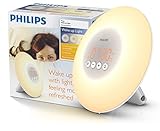
REACHER Wood Grain Sunrise Alarm Clock and Sound Machine (R7W) — 26 Sleep Sounds, Fully Dimmable Clock
Who it suits: Anyone whose bedroom is a room first and a gadget shelf second — the buyer who wants the sleep routine hidden inside something that looks like a wooden bedside object.
The REACHER R7W is the design pick of this guide, and unusually, the design is not a tax on function. The wood-grain dome runs a proper sunrise simulation, brightening from 1 percent to 100 percent over a ramp you can set between 5 and 60 minutes, and pairs it with eight wake sounds rather than a bare beep. The evening side carries 26 sleep sounds — white noise, ocean, rain, wind — with an auto-off timer adjustable from 15 to 120 minutes, and the night light and clock display dim manually or automatically across a full 0 to 100 percent range, so the wood glow can fade to nothing by lights-out. All of it is run from physical controls on the device; there is no app and no account. Check price on Amazon — it sits at the lower end of this tier, comparable to the JALL, with the emphasis spent on looks instead of a Bluetooth speaker.
The honest notes are specific. The R7W offers one sunrise alarm, not the dual or quadruple alarms of the JALL and Dekala, so two different wake times mean two devices or a compromise. It is plug-in only, and while its settings survive a power cut, its functions stop during one — the same backup-alarm advice applies. And there is no sunset simulation as such: the evening routine is the night light plus timed sleep sounds, which many sleepers will find equivalent in practice, but if a true fading-sunset ramp is the feature you came for, the JALL, Dekala and Odokee all offer the real thing. What the REACHER proves is that the lower end of this category no longer requires a plastic dome that announces itself as electronics — a point that matters in bedrooms styled as calm spaces, and one readers with a modern interior should cross-check against Best Bedside Lamp For Modern Homes Under $75.
- Wood-grain finish that reads as furniture — the best-looking device in this guide.
- Sunrise from 1% to 100% over 5–60 minutes, 8 wake sounds and 26 sleep sounds with a 15–120 minute auto-off.
- Display and night light dim across a full 0–100% range, manually or automatically.
Honest limitation: A single alarm only, plug-in power with no function during an outage, and no true sunset ramp — the evening side is night light plus timed sounds.
Choose it if looks matter and one alarm is all your household needs. Skip it if two schedules share the nightstand or a fading sunset is the point — go back to the JALL.

Govee RGBIC Smart Table Lamp 2 — 500 Lumens, 2700K–6500K, Matter, App Wake-Up Routines
Who it suits: Smart-home readers — the one buyer in six who actively wants schedules, scenes and voice control, and accepts that the phone runs the routine.
Every other pick in this guide is a clock that glows. The Govee is a lamp that schedules. It is a compact cylinder — 4.3 inches across, 8.8 inches tall — with an integrated RGBICWW LED array rated at 500 lumens, white light adjustable from 2700K warm to 6500K daylight, and 64 preset scene modes. For sleep, the relevant machinery lives in the Govee app: wake-up and sleep routines that brighten or dim the lamp gradually on a schedule, timers, and integration with Alexa, Google and Matter-compatible platforms for voice control. The lamp’s top is touch-sensitive, and a Pat-to-Wake feature turns it on with a pat — though, in a detail that captures this pick’s whole trade, that feature must first be enabled in the app. Pricing needs the honesty flagged in the selection notes: its list positioning is over this guide’s ceiling, but it is often available within this budget — check the current price on Amazon. When the current price falls within this budget it belongs here; at full list positioning it does not.
The limitations are structural, not incidental. This is not an alarm clock: there is no display, no speaker and no standalone alarm, so the wake-up routine is light only, and it depends on the app, your Wi-Fi and Govee’s servers continuing to cooperate — the opposite philosophy from the five button-driven picks above. The LED is integrated and sealed, so when it eventually fades the whole lamp is replaced, not a bulb; there is no replaceable-bulb future here of the kind Best Bedside Lamp Under $40 could take for granted. And the 2700K floor, while genuinely warm, is a shade cooler than the amber glow a dedicated sunset clock produces at its lowest. None of this makes the Govee a bad product — as a smart lamp it is the most capable object in the guide, and its scheduled dimming is a real wind-down tool. It makes it a different answer: the right one if your bedroom already runs on routines and voice, the wrong one if the point of the purchase was to get the phone out of the bedroom.
- Scheduled wake-up and sleep routines with gradual brightening and dimming, plus voice control via Alexa, Google and Matter.
- 500 lumens with white light from 2700K warm to 6500K daylight and 64 scene modes.
- Compact 4.3-inch footprint with touch controls on the lamp itself for basic use.
Honest limitation: Its list positioning is over this guide’s budget — it belongs here only when the current price on Amazon falls within this budget — and it is an app-dependent lamp with no alarm, no display and a sealed, non-replaceable LED.
Choose it if your home already runs on smart routines and you want the lamp inside that system. Skip it if you want a self-contained alarm clock that works with the Wi-Fi down — that is every other pick in this guide.

Comparison Table
| Product | Type | Best use | Link |
|---|---|---|---|
| JALL Wake Up Light (K8) | Full-screen sunrise clock with 25 sounds | The complete sleep routine at the accessible end of this tier | Check on Amazon |
| Dekala Sunrise Alarm Clock with Pulse Wake | Sunrise clock with 95 dB pulse escalation | Waking heavy sleepers a gentle dawn leaves behind | Check on Amazon |
| Odokee Sunrise Alarm Clock (H03) | Sound-machine sunrise clock, 0–100% dimming | Noise problems and a truly dark display | Check on Amazon |
| Philips SmartSleep HF3500/60 | Name-brand wake-up light, sunrise only | The simplest proven dawn, from end-of-line stock | Check on Amazon |
| REACHER Wood Grain Sunrise Clock (R7W) | Wood-grain sunrise clock and sound machine | A sleep routine that looks like furniture | Check on Amazon |
| Govee RGBIC Smart Table Lamp 2 | App-controlled smart lamp with routines | Scheduled light inside a smart home | Check on Amazon |
How to Choose a Bedside Lamp for a Bedroom Under $75
- Decide what wakes you before you shop. Light alone wakes most people eventually, but “eventually” is doing work in that sentence. If a gentle dawn has ever left you asleep, you need escalation — the Dekala’s Pulse Wake and louder alarms — not a prettier sunrise. If light wakes you reliably, every pick here works and the choice moves to the evening features.
- Set the ramp, not just the alarm. Sunrise ramps in this guide run from 5 to 60 minutes. Thirty minutes is the classic default (and the Philips’ fixed setting); light sleepers often prefer 10–20, deep sleepers 40–60. A clock with an adjustable ramp — five of these six — lets you tune the one variable that decides whether dawn simulation works for you.
- Demand a display that goes dark. A clock display at fixed brightness undoes the point of a dark bedroom. The JALL’s display dims to fully off, the Odokee and REACHER dim across 0–100%, and the Philips offers four levels. If a listing does not say how dark its display goes, assume it glows and budget for disappointment.
- Score the evening as hard as the morning. A sunset ramp (JALL, Dekala, Odokee) or timed sleep sounds (all six, in some form) is half the product. Check whether sleep sounds can play all night or only on a timer, and whether the timer’s maximum — 120 minutes on the REACHER — covers your night if you wake at 4 a.m.
- Count alarms the way your household actually sleeps. One alarm (REACHER), dual weekday/weekend alarms (JALL), or four per-day programmable alarms (Dekala) are very different products wearing similar domes. Couples with different schedules should buy the alarm system first and the light second.
- Keep the phone out unless you choose otherwise. Five picks set everything on the device. The Govee’s routines, scenes and pat-to-wake all begin in an app. Neither is wrong, but they are opposite purchases: decide whether the bedroom is a phone-free zone before you decide which lamp it gets.
- Ask what happens when the power blinks. Battery backup is the least glamorous and most consequential spec in this category. The Philips has none, the Dekala’s is unspecified, and the REACHER’s functions stop during an outage even though its settings survive. Whatever you buy, keep a phone alarm as backup for the mornings that cannot be missed.
- Separate wake-up lights from therapy lights. These devices peak at a few hundred lux to ease waking. A 10,000-lux light-therapy box is a different product for a different purpose, used at a desk or breakfast table. Do not buy a sunrise clock expecting therapy, or a therapy box expecting a gentle dawn.
- Keep the packaging for a week. Whether a dawn wakes you is knowable only in your room, with your sleep depth and your blackout curtains. Every pick here is easier to return boxed than to resent at 6 a.m.
What $75 Buys That $40 Doesn’t
The step from $40 to $75 in bedside lighting is not about brightness or prettier shades — the lamps in Best Bedside Lamp Under $40 are already warm, dimmable and pleasant. What the extra money buys is time behavior: light that changes itself on a schedule. Under $40, a lamp waits for your hand. Under $75, the device runs a routine — dimming through a sunset while you read, holding a night-light level until the sleep timer ends, then rebuilding a dawn before the alarm so waking starts before sound does. It also buys the supporting cast that routine needs: built-in sleep sounds instead of a second device, displays engineered to disappear, and alarm systems — dual, quadruple, per-day — that a lamp never needed.
It is equally honest to say who should not step up. If you fall asleep easily, wake to your alarm without drama and simply want a warm light for the last chapter of a book, the $40 tier does that completely, and the money you save buys several books. This tier earns its money in specific frictions: the phone alarm that ruins the first minute of the day, the partner woken by your 6 a.m. start (a light-only alarm on the Dekala or JALL wakes one side of the bed), the street noise that needs masking all night, the winter morning that begins in full darkness. Recognize your friction in that list and the step up is rational. Do not recognize it, and the honest recommendation is to stay at $40 — or even at the simpler tier in Best Bedside Lamp Under $40 — and keep the change.
What a Sunrise Can and Cannot Promise: The Honest Evidence
Dawn-simulation marketing leans on circadian language, so here is the measured version. Sleep researchers who review this category — the Sleep Foundation’s buying guidance is representative — describe gradual light as something that can make waking feel gentler for many people, while noting that evidence for broader improvements to sleep or health is limited. Philips itself, on its own product pages, cautions that sensitivity to light differs a great deal from person to person. No bedside clock in this guide — peaking at 200 lux (Philips) or a maker-rated 400 lumens (Dekala) — is a treatment for seasonal affective disorder or any sleep disorder; clinical light therapy uses roughly 10,000 lux at close range, which is a different device category entirely, and anyone treating a diagnosed condition should take equipment advice from a clinician, not a buying guide.
What a sunrise clock plausibly does, and what owners consistently report, is narrower and still valuable: it starts the waking process before the alarm sound, so the sound arrives as a confirmation rather than an ambush; it removes the phone from the nightstand for people whose alarm was their last screen of the night and first of the morning; and a sunset routine gives the evening a fixed, dimming endpoint. Buy it for those three things and it will likely satisfy you. Buy it as a medical intervention and it will not, at any price — the flagship in this category, well above this budget, makes the same light as the JALL at the lower end of this tier, wrapped in better industrial design and a larger sound library.
Will These Fit Your Nightstand?
These devices are clocks, not lamps, and their geometry differs from the shaded lamps elsewhere on this site. The domes run roughly seven inches across — the JALL’s half-dome is about 7.2 inches wide — which is a larger footprint than the 3.8-inch bases of the $40 touch lamps, but they replace two or three objects at once: lamp, alarm clock and sound machine. The Govee is the exception, at 4.3 inches across, because it replaces only the lamp. Before ordering, clear the nightstand mentally: if the clock, a book, a water glass and a phone all live there now, the sunrise clock evicts the old alarm clock and the separate white-noise machine, which is usually a net win in space.
Two placement rules matter more than size. First, the light panel should face the bed, not the wall — a dawn aimed at drywall is a rumor of a dawn. Second, these are all corded devices that must stay powered to keep their alarms, so the cord run to an always-on outlet is part of the purchase; do not plug an alarm clock into a wall-switched outlet and then blame it for the morning it missed. In children’s rooms, the calculus flips toward the sound machines: the Odokee’s noise library and the JALL’s night-light colors do nursery duty well, and a sunrise alarm is a kinder first alarm clock than a phone for a school-age child. In guest rooms, choose the device a stranger can operate at midnight — physical buttons and a tap, which is to say any pick here except the app-led Govee.
Common Buying Mistakes
- Buying a sunrise clock as a light-therapy device — a few hundred lux at the pillow is a wake-up aid, not a 10,000-lux treatment.
- Choosing the gentlest clock when you are a proven heavy sleeper, then concluding the whole category fails; escalation exists (Pulse Wake) for exactly this case.
- Ignoring the display. A clock whose screen cannot dim to dark will light the room it was bought to darken.
- Counting one alarm when your household runs two schedules — single-alarm clocks are the most common return in this category.
- Plugging an alarm clock into a wall-switched outlet, or any outlet on a timer, and losing the alarm when the power cuts.
- Assuming battery backup. Several picks here have none or do not specify it; a phone backup alarm for critical mornings is not paranoia, it is the system working.
- Paying flagship money for the sunrise itself. The dawn from a flagship model well above this budget is not brighter in kind than the dawn from a pick at the lower end of this tier; the extra money buys design, sounds and app polish.
- Buying the app-controlled lamp to escape your phone. If the routine lives in an app, the phone moved into the bedroom with it.
- Judging the light by its midday maximum. The settings you will live with are the lowest night-light level and the first five minutes of the ramp — check both in reviews of the exact model.
Final Recommendation
- Most bedrooms: JALL Wake Up Light Sunrise Alarm Clock (K8).
- Heavy sleepers: Dekala Sunrise Alarm Clock with Pulse Wake.
- Noise is the problem: Odokee Sunrise Alarm Clock (H03).
- Simplest name brand: Philips SmartSleep Wake-Up Light HF3500/60 — bought knowingly, from end-of-line stock.
- Looks first, one alarm: REACHER Wood Grain Sunrise Alarm Clock (R7W).
- Smart-home bedrooms: Govee RGBIC Smart Table Lamp 2 — when its current price falls within this budget, not at full list positioning.
Our top two are the JALL for most bedrooms — nothing else at the lower end of this tier combines a full-screen adjustable sunrise, a true sunset, 25 sounds and a display that goes fully dark, all without an app — check price on Amazon — and the Dekala for the sleepers the JALL cannot wake, because Pulse Wake is the only feature in this guide aimed at the category’s real failure mode. Between those poles, pick by your friction: the Odokee if noise and display glow are the enemy, the REACHER if the device must disappear into a calm room, the Philips if you want the proven original and accept its end-of-line status, and the Govee only if your bedroom already runs on an app and you catch it under $75. Whichever you choose, do the three unglamorous things: face the light panel at the bed, plug it into an always-on outlet, and keep a backup alarm for the morning that matters most. Then give the dawn a week before you judge it — waking is a habit, and habits, unlike lamps, cannot be unboxed in a day.
Frequently Asked Questions
Do sunrise alarm clocks actually work?
For many people, yes — as a gentler way to wake, not as a medical treatment. The gradual light starts the waking process before any sound, and sleep guidance such as the Sleep Foundation’s describes that as capable of making waking feel easier, while noting the evidence for wider health benefits is limited. Sensitivity varies a lot by person (Philips says so itself), heavy sleepers may need sound escalation like the Dekala’s Pulse Wake, and no bedside clock substitutes for a 10,000-lux therapy lamp or a clinician’s advice for a diagnosed condition.
How long should the sunrise ramp be?
Thirty minutes is the classic default — it is the Philips’ fixed ramp and a good starting point. Light sleepers often do better with 10 to 20 minutes, and deep sleepers with 40 to 60. Five of the six picks here let you adjust the ramp (the JALL, Dekala and Odokee span 5 to 60 minutes), which matters more than the peak brightness: the right ramp length is the difference between waking during the light and waking at the beep.
Will a sunrise clock wake my partner too?
Light fills a room, so a partner will usually stir — but two features reduce it. Light-only alarms (offered by the Dekala, and the light-first design of all these clocks) wake the near side of the bed more than the far side, and facing the panel toward your side helps. If your schedules differ by hours rather than minutes, the honest solution is per-person devices or a vibrating wearable alarm; no lamp fully solves a two-hour gap.
What happens to the alarm if the power goes out?
It depends on the model, and the differences matter. The Philips HF3500/60 has no battery backup, so an outage can cost you the alarm entirely. The REACHER keeps its settings but stops functioning during the outage. The Dekala’s listing does not specify backup clearly. Whatever you buy, keep a phone alarm set for mornings that cannot be missed — treat the sunrise clock as your primary wake and the phone as the safety net, not the other way round.
Do any of these need an app or a subscription?
Five of the six — JALL, Dekala, Odokee, Philips and REACHER — need neither: every setting is made on the device, and there is nothing to subscribe to. The Govee lamp is the exception; its routines and scenes live in the Govee app (free, but phone-based), though basic touch control works on the lamp itself. For contrast, the over-budget Hatch Restore 3 layers an optional paid subscription on top of its hardware cost, which is one reason it sits outside this guide.
Is a wake-up light the same as a light-therapy lamp?
No. A wake-up light peaks at a few hundred lux to ease the transition out of sleep. A light-therapy box delivers around 10,000 lux, is used at close range for a set period after waking, and is the device category aimed at seasonal mood symptoms. They are bought for different jobs, used at different distances and times, and neither does the other’s work — if you need therapy light, buy the box; if you need a kinder alarm, buy one of the clocks above.
- Best Bedside Lamp Under $40
- Best Bedside Lamp For Bedrooms Under $40
- Best Bedside Lamp For Apartments Under $75
- Best Bedside Lamp For Small Rooms Under $75
- Best Bedside Lamp For Modern Homes Under $75