Where to buy
Check the latest price, availability and delivery on Amazon. Orders are placed on Amazon. We may earn a commission from qualifying purchases.
- Best overall for bedrooms: BenQ WiT e-Reading Lamp, Matte Silver — Check on Amazon
- Zafferano Poldina Pro Cordless Table Lamp, White — Check on Amazon
- Adesso Martin Table Lamp, Walnut and Antique Brass — Check on Amazon
- Philips Hue Iris Smart Table Lamp, White — Check on Amazon
See 2 more Amazon options
- Philips Hue Go Portable Smart Table Lamp, White — Check on Amazon
- Brightech Maxwell Bedside Lamp with USB Port, Black — Check on Amazon
Read the full guide ↓
Disclosure: As an Amazon Associate, dailyhomedecorating.com earns from qualifying purchases. Links to Amazon on this page are affiliate links; they cost you nothing extra. Listing details such as price and availability change often, so check the current Amazon listing before you buy.
The best bedside lamp for a bedroom under $300 is not the brightest lamp or the prettiest lamp — it is the lamp that respects the person sleeping next to you. That is the lens this whole guide is written through. A bedroom lamp has to do two opposite jobs without disturbing anyone: put a clean, focused pool of light on your page at 11 p.m., and sink to a glow so low at 2 a.m. that it finds you the bathroom without waking the room. When we researched this guide, we also found the same surprise reported in our main Best Bedside Lamp Under $300 roundup: you do not need to spend the full budget to get a genuinely good bedroom lamp. At the top of this tier sits the BenQ WiT, a reading lamp with an ambient light sensor that lowers itself as your room darkens — check price on Amazon. Below it in the tier: the cordless Zafferano Poldina Pro for nightstands with no spare outlet, a walnut-and-brass Adesso Martin, two Philips Hue lamps — the wall-washing Iris and the portable Go — that turn the last hour of the evening into a slow fade, and the Brightech Maxwell, the most accessible pick here, that quietly includes the USB port the expensive picks forgot.
Every pick below was judged first on sleep manners. Does the light stay where it is aimed, or does it spill across the pillow? Does the dimmer slide smoothly down to a night-light, or does it jump in steps that feel like a flashlight in a dark room? Can you run it half-asleep, by touch or by voice, without picking up a phone and blasting your eyes with a screen? Only after a lamp passed those tests did we ask what it was made of and what it cost. The famous designer names you might expect in this tier — Artemide’s Tolomeo Mini, the full-size Anglepoise 1227 — sit above this budget, and we explain why they sit outside it in the honest-ceiling section below rather than smuggling them in. What follows is a quick picks table, detailed notes on all six lamps written from the bed’s point of view, a comparison table, a buying checklist for shared bedrooms, and answers to the questions couples and light sleepers ask most.
Quick Picks
Short on time, or comparing several options at once? Each row below names a bedroom situation and the lamp that suits it, with a link to the listing.
| Bedroom situation | Pick | Why it stands out | Link |
|---|---|---|---|
| Best overall for bedrooms | BenQ WiT e-Reading Lamp, Matte Silver | Aimed reading light that dims itself and stays off your partner’s pillow | Check on Amazon |
| Best cordless, no outlet needed | Zafferano Poldina Pro Cordless Table Lamp, White | No cord at all, candle-warm 2200K setting, tiny footprint | Check on Amazon |
| Best warm traditional glow | Adesso Martin Table Lamp, Walnut and Antique Brass | Fabric shade softens light for the whole bed; takes any E26 bulb you choose | Check on Amazon |
| Best for shared sleep routines | Philips Hue Iris Smart Table Lamp, White | Light bounces off the wall, so nothing shines in either sleeper’s eyes | Check on Amazon |
| Best night-wanderer | Philips Hue Go Portable Smart Table Lamp, White | Pick it up and carry a low glow to the bathroom or a child’s room | Check on Amazon |
| Best value pair-buy | Brightech Maxwell Bedside Lamp with USB Port, Black | Lantern-soft light plus a phone charger, at the accessible end of this tier | Check on Amazon |
How These Picks Were Chosen
The budget filter came first. Every lamp below is a real Amazon US listing whose ASIN we confirmed against maker or retailer specification records, and which sits within this guide’s under $300 budget — check the current price on Amazon before you buy, since listing prices change often. Two celebrated designer lamps sit above this budget and were moved to the honest-ceiling section instead of being quietly included over budget; a third, the Anglepoise Original 1227 Mini Desk Lamp, could not be verified on Amazon within this budget, so it is named as a near-miss rather than a pick. A bedroom guide that fudges its own ceiling in paragraph one has nothing honest to tell you in paragraph ten.
The second filter was the bedroom itself, and it is stricter than the one we used for the general guide. We read maker listings, specification sheets and dimensions looking for four sleep-specific qualities: light control (a beam or shade that keeps light on your side of the bed), dimming depth (a smooth slide to a true night-light level, not three fixed steps), dark-friendly operation (touch, a physical button, or voice — anything except a bright phone screen at midnight), and cord logic (a lamp that works where your outlets actually are, including nightstands that have none to spare). We did not use these lamps ourselves, and headline figures such as lumens and battery hours are maker figures; where we repeat one, we say whose it is.
Fit decided the borderline cases, because bedroom geometry is unforgiving. A shade’s height against your mattress decides whether you see a warm glow or a bare bulb at eye level. A cordless lamp’s footprint decides whether it can share a small nightstand with a water glass and a paperback. A wall-wash lamp needs a hand’s width of air behind it or its halo collapses. Where a listing was vague about a dimension or a control, we say so in the review instead of guessing, and the checklist below tells you what to measure on your own side of the bed before you order.
The 6 Best Bedside Lamps for Bedrooms Under $300
BenQ WiT e-Reading Lamp, Matte Silver
Who it suits: The partner who reads for an hour after the other has gone to sleep — and wants to do it without lighting up the whole bed.
Every shared bedroom has the same negotiation: one person is mid-chapter, the other is mid-dream. The BenQ WiT is the closest thing this budget offers to a peace treaty. It was born as a desk lamp, but its curved head throws a wide, even, aimed beam — across your open book or e-reader, and nowhere else. There is no bare bulb glaring sideways, no shade leaking light across the duvet; the light lands on the page and stops. The feature that earns the price in a bedroom specifically is the ambient light sensor. Switch it to auto and the lamp reads the room and sets its own brightness, easing down as the room darkens — so at 9 p.m. it gives you full reading light, and at midnight it has quietly stepped itself down to a level that won’t push through your partner’s eyelids. Two smart modes tune the light for paper or for screens, softening contrast for tablet readers, and you can set color temperature manually from a sleep-friendly warm 2700K upward when you take over.
The controls matter at this hour, and they are all on the lamp: a touch-sensitive ring on the head adjusts brightness without a phone, an app, or a screen anywhere in the transaction. The arm moves on smooth, firm joints and stays where you leave it, the base is weighted so a sleepy knock won’t topple it, and the matte silver body is metal rather than painted plastic. Positioned at the top of this tier, it is the premium pick in this guide — check the current price on Amazon before you buy, since its listing price can move. The honest shape of this tier is that the best bedroom reading light here sits near the top of the budget rather than at its very ceiling. Measure your nightstand depth before ordering — the arm needs room to reach over a book — and if reading in bed is your nightly ritual, this is the lamp that lets you keep it without keeping anyone else awake.
- Aimed, even beam lights your page instead of the whole bed — no glare in a sleeping partner’s eyes.
- Ambient light sensor dims the lamp automatically as the room darkens; paper and screen modes.
- On-lamp touch controls and adjustable color temperature from 2700K — no phone needed at midnight.
Honest limitation: It looks and occupies space like equipment, not decor, and needs a deep nightstand; its listing price can fluctuate, so check the current price on Amazon and confirm it still sits within this budget before you buy.
Choose it if you read in bed nightly and share that bed. Skip it if your bedside light is purely for winding down — the Hue and Poldina picks below are gentler and prettier for that job.

Zafferano Poldina Pro Cordless Table Lamp, White
Who it suits: Bedrooms where the nightstand has no free outlet — an older house, a guest room, a bed floated away from the wall — and anyone who wants the bedside to feel like a boutique hotel.
The Poldina Pro solves the most old-fashioned bedroom problem there is: the outlet is behind the headboard, already feeding a phone charger and an alarm clock, and there is nowhere left to plug in a lamp. This lamp needs no outlet at all. It is the cordless Italian lamp the restaurant world adopted — a slim die-cast aluminum stem and shade, powder-coated white here, on a small round base — and it lives on your nightstand untethered, recharging on a contact base you can keep in a drawer or a hallway: you simply set the lamp down on it, no plug to fumble for in the dark. For sleep, its party trick is color. The touch control on top of the shade offers three temperatures — 2200K, 2700K and 3000K — and 2200K dimmed low is close to candlelight, the kind of light that asks nothing of your circadian system in the last half hour of the day. Tap to switch, hold to dim smoothly; there is no app and no screen between you and darkness.
By the maker’s figures it runs up to about 12 hours per charge at lower settings, which covers an evening’s wind-down and a night-light with room to spare, and it is rated IP65 if it ever holidays outdoors. Now the honest framing, which matters more in a bedroom than anywhere: at roughly 200 lumens from a 2.2W LED, this is a glow, not a reading light. A few pages of a novel, yes; an hour with a dense hardback, no — that is the BenQ’s job, and forcing the Poldina to do it just means eye strain at a prettier lamp. What you are paying for here is design, materials and freedom from the cord, and on those terms it earns its place: at 14.9 inches tall on a 4.3-inch base it also fits the genuinely small nightstands we cover in Best Bedside Lamp For Small Rooms Under $300, where a conventional lamp crowds out the water glass. Like every battery product its battery will age over years, so treat it as a long-lived lamp rather than a lifetime one — but for a bedroom where the light is for atmosphere, a chapter, and a calm last hour, it is the most civilized object in this guide.
- Completely cordless — the bedside lamp for nightstands with no spare outlet.
- Touch dimmer with 2200K candle-warm setting for a genuinely sleep-friendly wind-down.
- Contact charging base (no plug to find in the dark) and up to about 12 hours per charge at low settings.
Honest limitation: About 200 lumens is ambient light, not reading light, and what you pay for is design and cordlessness rather than brightness; the battery will age over the years.
Choose it if your nightstand has no outlet to spare and your evenings end with atmosphere, not chapters. Skip it if you read for an hour a night — aim the BenQ at the page instead.

Adesso Martin Table Lamp, Walnut and Antique Brass
Who it suits: Couples furnishing a “real” bedroom — wood furniture, linen bedding, a fabric shade — who want one warm lamp whose light the whole bed can share comfortably.
Where the BenQ is a solo instrument, the Martin is the lamp for two people winding down together. Adesso, a lighting maker with decades in the business, built it the old way: natural oak and walnut-finished poplar wood, antique brass accents, and a white textured fabric shade, standing 25.5 inches tall on a compact 5-inch base. That height is the classic bedside proportion, and in a bedroom it is not a styling detail — it puts the bottom of the shade near chin level when you are propped up on pillows, so the light falls downward onto books and laps instead of shining sideways into either sleeper’s eyes. The fabric shade does the rest of the sleep work: it diffuses. Instead of a point of glare, the whole shade glows, which is why a shaded lamp at full brightness feels calmer in a bedroom than a brighter exposed-bulb design, and why this is the lamp to read beside while a partner dozes — the light is present but soft-edged everywhere it lands.
Its second bedroom virtue is that it takes a standard E26 bulb, which puts the light’s character entirely in your hands, forever. Fit a warm 2700K dimmable LED and the Martin becomes a warm, dimmable lamp; fit a smart bulb and it joins your evening routines with no hub and no new lamp; when a bulb dies in eight years you change a bulb, not a fixture. It is UL listed, and it sits in the middle of this tier — check the current price on Amazon before you buy. What the Martin does not have, be clear about: no built-in dimmer, no USB port, no sensor, no app. Dimming is whatever your chosen bulb and switch arrangement provides, and if you want a lamp that fades itself out at 11 p.m., the Hue picks below are your lamps. Buy the Martin for a shared, warm, repairable glow — the lamp in this guide most likely to still be on your nightstand in twenty years.
- Fabric shade diffuses light across the bed without a glare point — comfortable for two people winding down.
- 25.5-inch height puts the shade at the textbook level for reading in bed; compact 5-inch base.
- Standard E26 socket: your choice of warmth, dimming and smart bulb, replaceable forever; UL listed.
Honest limitation: No dimmer, USB or smart features of its own — those depend on the bulb you fit — so check the current price on Amazon before you buy.
Choose it if you want one handsome lamp whose soft light serves the whole bed. Skip it if you want the lamp itself to run routines, fades or charging.

Philips Hue Iris Smart Table Lamp, White
Who it suits: Light sleepers and smart-home bedrooms — anyone who wants the last hour of the evening to be a dimming ritual rather than a switch.
The Iris understands something about bedrooms that most lamps miss: the kindest light at night is light you never look at directly. This small Philips Hue lamp throws its light backward, washing the wall behind your nightstand with up to 570 lumens of white or color, so the room glows and nobody’s eyes — yours or your partner’s — ever meet a bulb. Turned down, it is a night-light with manners; turned warm and low, it makes a small bedroom feel calmer and larger at once. The bedroom case, though, is the routines. The Iris fades: set a go-to-sleep routine and the light sinks gradually over the time you choose, the way dusk does, instead of dropping you from full brightness to black at a switch. In the morning the same trick runs in reverse as a gentle wake-up. It works over Bluetooth with the Hue app straight out of the box, speaks to Alexa, Google Assistant and Apple HomeKit — so “bedroom to ten percent” from under the duvet, without touching a glowing phone, is a real nightly feature — and, positioned accessibly within this tier, it is one of the more approachable ways into this guide’s smart-lamp picks — check the current price on Amazon.
The caveats are the Hue caveats, stated plainly. The Iris is an accent lamp: 570 lumens bounced off a wall will not support serious reading, so in a reader’s bedroom it is the second lamp, not the only one. The best routines — the fades, wake-up schedules, out-of-home control — need a Hue Bridge, sold separately; Bluetooth alone gives you in-room app control, which for one bedroom may honestly be enough, but buy knowing which you are getting. It also needs a little air: leave a hand’s width between the lamp and the wall or the halo collapses into a stripe. And it looks like what it is, a smooth white piece of tech; in a bedroom built on wood and linen, the Martin will blend where the Iris announces itself. None of that changes what it does to a room at 10 p.m. For a couple trying to make the bedroom feel like the day is ending — lights low, warm, and sinking — no conventional lamp at any price in this guide imitates it. Renters building the same ritual in a first place will find the portable version of this idea in Best Bedside Lamp For Apartments Under $300; the Iris is the settled-home edition.
- Indirect wall-wash light up to 570 lumens — zero glare for either sleeper.
- Sleep and wake routines fade the light down or up gradually instead of switching it.
- Voice control via Alexa, Google Assistant and HomeKit; Bluetooth app control out of the box.
Honest limitation: Ambient light only — not a reading lamp — and the full routine features require a Hue Bridge sold separately; the techy look will not suit every bedroom.
Choose it if your bedroom runs on routines and the evening wind-down is a ritual you share. Skip it if it would be your only lamp and you read in bed — pair it with the BenQ or choose the Martin.
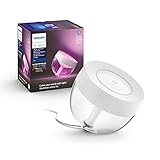
Philips Hue Go Portable Smart Table Lamp, White
Who it suits: Anyone whose night doesn’t stay in bed — parents checking on children, restless sleepers, anyone making the 3 a.m. trip to the bathroom down a dark hallway.
The Hue Go is a bowl of light, about 6 inches across, with the lamp inside the bowl and a rechargeable battery underneath, and its bedroom talent is that it moves. It lives on its charging base on your nightstand; when you get up in the night, you pick it up and take a low, warm glow with you — to the bathroom without flipping a hallway switch that floods your eyes and ends your sleepiness, to a child’s room for a midnight check without turning on their ceiling light, to the kitchen for water and back. A button on the lamp itself cycles preset scenes and brightness levels, which means it works with sleepy hands and no phone. Over Bluetooth, or with a Hue Bridge, it does everything the Iris does — the full range of whites and colors, wake and sleep routines — and for the bedside itself its signature trick is the fade-out: set a go-to-sleep routine and the Go dims itself away over half an hour, the single most sleep-friendly feature any lamp in this guide offers. Check the current price on Amazon, and note that the current US model has a silicone grip base made for being picked up daily.
Honesty, as always with battery light. The battery is rated for up to about 6 hours, so the truthful picture is a lamp that lives on its charger and goes walkabout for minutes at a time — plan on that, not on a full evening at full brightness away from the base. The bowl is plastic, and beside the Poldina’s aluminum or the Martin’s walnut it does not look like a premium-priced object; you are paying for Hue electronics and portability, not materials. And its light is diffuse and ambient — a glow to move through a dark house by, not a light to read a novel under. In a bedroom with children in the house, or an older home where the bathroom is a journey, those trade-offs are worth it: the Go is the only pick here that understands the night continues past the edge of the bed. If you love the idea but want it dressed for a styled room, the Poldina above is the prettier cordless lamp; if you want light that follows the person, this is the one.
- Rechargeable and carryable — a low glow for bathroom trips and midnight child checks, no ceiling lights needed.
- On-lamp button cycles scenes half-asleep; no phone, no bright screen.
- Go-to-sleep fade dims itself out over about thirty minutes — the most sleep-friendly trick in this guide.
Honest limitation: Battery life is up to about 6 hours, so it lives on its charger; the plastic bowl looks ordinary for the price, and the light is ambient, not readable.
Choose it if your nights involve moving around a dark house. Skip it if you want a permanent, handsome fixture that never leaves the nightstand.

Brightech Maxwell Bedside Lamp with USB Port, Black
Who it suits: Practical couples furnishing two nightstands, guest bedrooms, and anyone who suspects — correctly — that a warm glow and a charged phone cover most of what a bedside lamp is for.
Every premium guide needs one pick that embarrasses the tier, and in a bedroom the Maxwell’s embarrassment is specific: it has the USB charging port that the premium picks above somehow lack, right where your phone spends the night. Brightech’s design is a low, open wood frame — Japanese-inspired, finished here in black — with linen-look fabric panels, so it glows like a lantern rather than beaming like a lamp. For sleep, that lantern quality is the point: the light arrives softened from every side, with no glare point and no beam, at exactly the level of presence you want from a lamp in the last hour of the evening and the first minutes of the morning. An LED bulb is included, the footprint is compact enough for genuinely small nightstands, and it sits at the accessible end of this tier — check the current price on Amazon. For two nightstands, a matched pair of Maxwells leaves far more of this budget for bedding than a single premium lamp and one dark corner.
Here is what the extra money elsewhere buys, fairly stated. The Maxwell’s frame is wood-finished rather than solid walnut, its panels are fabric rather than aluminum and glass, and its glow is ambient — pleasant for winding down, marginal for long reading, with no dimmer beyond the bulb you fit. The USB port is a convenience-speed charger, not a fast charger; a phone in a hurry still wants its own brick. And it is a small lamp that can look lost on a wide nightstand beside a tall king bed, where the Martin’s 25.5 inches hold the space. None of that dents the value case for most bedrooms. If your current nightstand situation is a phone charger cable and the hallway light, the Maxwell is not a compromise pick — it is the sensible default, and the premium lamps above are the ones that have to justify themselves against it. For tighter budgets still, our Best Bedside Lamp For Bedrooms Under $40 guide covers the same two-nightstand logic at the next tier down.
- Built-in USB charging port — the feature the premium picks in this guide lack.
- Lantern-style frame glows softly in every direction, with no glare point to disturb a sleeper.
- LED bulb included — an accessible pick for furnishing a matched pair across two nightstands; check price on Amazon.
Honest limitation: Ambient light without a real dimmer, a modest-speed USB port, and materials a clear step below the wood, brass and aluminum above it.
Choose it if you are furnishing two nightstands or a guest room and want warmth plus charging at the accessible end of this tier. Skip it if you read for hours in bed or want a lamp that anchors the room’s design.

Comparison Table
| Product | Type | Best bedroom use | Link |
|---|---|---|---|
| BenQ WiT e-Reading Lamp | Sensor reading lamp | Reading in bed without waking your partner | Check on Amazon |
| Zafferano Poldina Pro | Cordless designer lamp | A candle-warm glow where there is no spare outlet | Check on Amazon |
| Adesso Martin Table Lamp | Wood and brass table lamp | One soft, shared glow from a fabric shade | Check on Amazon |
| Philips Hue Iris | Smart ambient lamp | Wall-wash light and fading sleep routines | Check on Amazon |
| Philips Hue Go | Portable smart lamp | A carryable glow for the night’s small journeys | Check on Amazon |
| Brightech Maxwell | USB bedside lamp | Warm light plus phone charging, one per nightstand | Check on Amazon |
How to Choose a Bedside Lamp for a Bedroom Under $300
- Start with the other sleeper. If anyone shares your bed, light direction outranks brightness: an aimed beam (BenQ), a diffusing shade (Martin) or a wall bounce (Iris) will be loved; an exposed bulb at eye level will be negotiated about at midnight.
- Demand a dimmer that goes truly low. In a bedroom the dimmer is the product. You want a smooth slide to night-light level — sensor, stepless touch, or app fade. Three fixed steps is a basic feature; at the upper end of this budget, walk away from it.
- Check the color temperature at the low end. Warm is sleep: 2700K or below for the last hour, and the Poldina’s 2200K is close to candlelight. A lamp that only does cool daylight temperatures is a desk lamp wearing a bedside price.
- Count outlets before you fall in love. If the nightstand outlet already feeds a charger and a clock, go cordless (Poldina, Hue Go) or choose a lamp that gives a port back (Maxwell). Cord Tetris is a nightly annoyance, not a one-time setup issue.
- Measure shade height against your mattress. Propped up in bed, the bottom of a shade should sit near chin level — for typical nightstands and mattresses that means a lamp around 24 to 28 inches tall, like the Martin. Glow lamps are deliberately shorter; judge them as candles, not readers.
- Decide how you will operate it half-asleep. Touch tops, physical buttons and voice control all work in the dark. Anything that requires opening an app on a bright phone screen will cost you sleepiness every single night.
- Be realistic about battery figures. Cordless hours are quoted at gentle settings — roughly 12 hours for the Poldina, roughly 6 for the Hue Go. If a lamp will burn brightly all evening, plan on it living beside its charger.
- Think in pairs honestly. Two nightstands usually want two lamps. One premium lamp and one bare nightstand works worse, and looks worse, than a matched pair at the more accessible end of this tier.
- Check the live listing, not your memory of a price. For every pick here — the BenQ, the Martin, the Maxwell and the rest — check the current price on Amazon before you buy, and confirm it still sits within this budget. Listing prices change often, so a figure you saw elsewhere may no longer apply.
Light That Shares a Bed: Glare, Spill and the Sleeping Partner
Most lamp advice is written for one person in a lit room. A bedroom at night is two people in a dark one, and the physics change completely. In darkness, your partner’s eyes are fully dark-adapted, which is why a lamp that seems modest at 9 p.m. feels aggressive at 1 a.m. — and why the direction of light matters more than its quantity. Light that travels sideways at pillow height is the enemy: it crosses the bed at exactly eye level. Light that travels down onto a page, or up and back onto a wall, can be several times brighter and disturb no one. That is the entire design logic behind this guide’s top three shapes — the BenQ’s aimed head, the Martin’s downward-diffusing shade, the Iris’s wall bounce — and it is the first question to ask of any lamp you consider outside this list: where does the light go when it leaves the lamp, and is any of it aimed at a sleeping face?
Spill has a second, quieter form: the control glow. A lamp that is “off” but wears a bright standby LED, or a smart lamp whose only midnight interface is a phone at full brightness, leaks wakefulness into the room even when its main light behaves. Prefer lamps you can run by touch or voice in the dark, and if a standby light bothers you, a lamp with a replaceable bulb and a plain switch — the Martin pattern — has no electronics awake at all. The goal is a bedroom where the darkest state is truly dark and every step up from it is gradual. Sleep is mostly the absence of interruptions; a good bedside lamp is one that never becomes one.
The Honest Ceiling: Why Nothing in This Guide Costs $300
This guide’s research found the same thing the general guide did: the famous designer bedside lamps mostly do not fit under $300. Artemide’s Tolomeo Mini sits above this budget at US retailers. The full-size Anglepoise Original 1227 also sits above this budget. The smaller Tolomeo Micro sits above it as well at US retail. All three are over budget, and a guide titled “under $300” that quietly included them would be lying in its headline — so they belong in the under-$500 tier, and the honest move, if one of them is the lamp you truly want, is to step up to that higher tier rather than buy a substitute you will keep apologizing for. The Anglepoise Original 1227 Mini Desk Lamp deserves its own sentence: it sits within this budget at some US design retailers, but we could not verify a live Amazon US listing within this budget, so it is a named near-miss, not a pick. We only recommend lamps you can check on Amazon within this guide’s budget.
What that leaves is the landscape this guide reports: a premium top pick, excellent lamps clustered in the middle and accessible parts of the tier, and a budget that turns out to be more generous than the bedroom-lamp market needs. If you arrived ready to spend the full budget on each nightstand, the pleasant surprise is that you probably do not have to — and what you save buys blackout curtains, better pillows, or the second lamp that makes the room symmetric. Readers styling a design-led room rather than a sleep-led one will find the same six lamps weighed on looks first in Best Bedside Lamp For Modern Homes Under $300; here, sleep wins ties.
Common Buying Mistakes
- Buying for the daytime showroom look and forgetting the 1 a.m. test: glare at pillow height, a bright standby light, or a dimmer whose lowest step is still a flashlight.
- Skipping the live price check on a premium lamp. Listing prices for lamps like the Martin and the BenQ change often, so check the current price on Amazon and confirm it still sits within this budget before you buy.
- Buying an ambient lamp to read by. The Iris, Hue Go and Poldina are beautiful glows and poor reading lights; an hour of squinting is how that mistake announces itself.
- Assuming the famous designer names fit the budget. The Tolomeo Mini and the Anglepoise 1227 sit above the under $300 budget however the search headlines are written — check the current listing before you assume.
- Forgetting the second nightstand. One premium lamp and one dark corner looks and works worse than a matched pair at the accessible end of the tier.
- Buying a smart lamp without counting the hub. Hue’s best sleep and wake routines need a Bridge; buy it knowingly, or choose the Bluetooth-only features on purpose.
- Trusting battery hours at face value. Cordless figures are measured gently; a Hue Go at full brightness is a few-hours lamp, not an all-evening one.
- Judging scale from product photos. The Poldina is 14.9 inches tall and the Hue Go is a 6-inch bowl; on a king-size nightstand both can look like doll furniture. Measure against your own furniture.
- Cramming a wall-wash lamp against the wall. The Iris needs space behind it for its halo; pushed flat, it becomes an expensive stripe.
Final Recommendation
- You read, they sleep: BenQ WiT e-Reading Lamp — check price on Amazon.
- No spare outlet, styled nightstand: Zafferano Poldina Pro Cordless Table Lamp.
- One warm lamp for the whole bed: Adesso Martin Table Lamp — check price on Amazon.
- Routines, fades and voice control: Philips Hue Iris.
- Nights that wander the house: Philips Hue Go.
- Two nightstands, sane budget: Brightech Maxwell — one per side, at the accessible end of this tier.
Our top two for bedrooms are the BenQ WiT and the Philips Hue Iris, because between them they cover the two ways a premium lamp earns its place beside a bed: light engineered to fall on a page and nowhere else, and light that never touches an eye at all while it fades the room down to sleep. If your bedroom is shared and nobody reads in it, start with the Iris; if one of you reads nightly, start with the BenQ and add the Iris later. The Poldina Pro is the pick when the outlet situation or the styling decides, the Martin is the pick you will still own in twenty years, and the Maxwell is the honest answer when accessible warm light and a phone charger is what the nightstand actually needs. Measure your nightstand, count your outlets, check the current price on Amazon, and choose for the nights — and the sleeper beside you — that you actually have.
Frequently Asked Questions
What is the best bedside lamp if my partner goes to sleep before me?
An aimed reading lamp — in this guide, the BenQ WiT. Its beam lands on your page rather than spreading across the bed, its ambient sensor lowers the brightness as the room darkens, and its controls are on the lamp, so there is no bright phone screen involved. The general rule: light directed down at a book or bounced off a wall disturbs a sleeper far less than a bare bulb or an unshaded lamp at pillow height, whatever the lumen count says.
How dim should a bedside lamp go for sleep?
Dim enough to read a clock and find the floor, not to read print — think candlelight. In practice that means a lamp with smooth, deep dimming rather than fixed steps, and a warm color temperature at the low end: 2700K or below, with the Poldina Pro’s 2200K setting the closest thing here to a candle. Smart lamps add a trick no switch can: a fade that lowers the light gradually over twenty or thirty minutes, which many people find easier to fall asleep to than an abrupt off.
Can I use a bedside lamp if my nightstand has no free outlet?
Yes — that is exactly the cordless case. The Zafferano Poldina Pro runs up to about 12 hours per charge at lower settings and recharges on a contact base you can keep anywhere in the house; the Philips Hue Go offers up to about 6 hours and doubles as a carry-around night light. The third option is a lamp that gives an outlet back: the Brightech Maxwell’s built-in USB port frees the charger brick from your one free socket. What not to do is run a permanent lamp off a dangling extension lead across the bed.
Why aren’t the Tolomeo and Anglepoise lamps in the picks?
Because they sit above this guide’s budget: the Artemide Tolomeo Mini, the full-size Anglepoise Original 1227 and the Tolomeo Micro all sit above the under $300 budget at US retailers. The smaller Anglepoise 1227 Mini sits within this budget at some design stores, but we could not verify an Amazon US listing within this budget, so it is a near-miss rather than a pick. You will find the icons covered in the under-$500 guide.
Is one expensive lamp better than two cheaper ones?
For a shared bedroom, usually not. Symmetry matters at night: two matched lamps mean both sleepers get the same light, the same controls and the same wind-down, and the room looks finished. Two Hue Iris lamps, or two Maxwells at the accessible end of this tier, will make most couples happier than one premium reading lamp and one bare nightstand. The exception is the serious solo reader, whose one BenQ WiT genuinely outperforms any pair of glow lamps at the job it is for.
Are smart lamps a good idea in the bedroom?
For the fade alone, often yes — a lamp that dims itself out over thirty minutes, or fades up like a sunrise, changes how a bedroom feels at both ends of the night, and voice control means no bright phone screen at midnight. The honest costs are the ecosystem (Hue’s full routines need a Bridge, sold separately) and longevity, since smart electronics age faster than a plain socket. If you want routines, buy Hue knowingly; if you want a twenty-year lamp, buy the Martin and put a smart bulb in it.