Where to buy
Check the latest price, availability and delivery on Amazon. Orders are placed on Amazon. We may earn a commission from qualifying purchases.
- Best overall: SAFAVIEH Abstract Collection ABT143Y Area Rug, 8′ x 10′, Green & Sage, Handmade Wool — Check on Amazon
- SAFAVIEH Natura Collection NAT318F Area Rug, 8′ x 10′, Grey, Handmade Wool & Viscose — Check on Amazon
- SAFAVIEH Natura Collection NAT852B Area Rug, 8′ x 10′, Ivory, Handmade Wool — Check on Amazon
- Loloi II Layla Collection LAY-03 Area Rug, 7’6″ x 9’6″, Olive/Charcoal — Check on Amazon
See 2 more Amazon options
- SAFAVIEH Marquee Collection MRQ110D Area Rug, 8′ x 10′, Blue & Ivory, Handmade Wool — Check on Amazon
- SAFAVIEH Adirondack Collection ADR113W Area Rug, 8′ x 10′, Champagne & Cream — Check on Amazon
Read the full guide ↓
Disclosure: As an Amazon Associate, dailyhomedecorating.com earns from qualifying purchases. Links to Amazon on this page are affiliate links; they cost you nothing extra. Listing details such as price and availability change often, so check the current Amazon listing before you buy.
The best area rugs under $500 are where the rug market stops apologizing. At $100, in the 5×7 ft size class, you are choosing between printed patterns and thin washable mats, and choosing well still means compromising. At $500, priced honestly on the size most living rooms actually need — the 8×10 ft class, including the 7’6″ x 9’6″ and 7’10” x 10′ cuts rug makers sell as their 8×10 — the compromise changes character completely. Real wool enters the room, and not as a marketing word on a synthetic listing: four of the six rugs in this guide have a handmade wool pile you can verify in the maker’s own specifications, hand-tufted in India, with the weight, resilience and slight initial shedding that only actual wool brings. Hand-tufted construction, which barely exists in the lower tiers in this size, becomes the normal way a rug here is made. And the budget is wide enough that a 9×12 ft stops being a fantasy for the synthetic end of the list, even though — and this guide will be plain about it — a hand-knotted wool 8×10 does not live under $500 at all, and anyone who implies otherwise is quoting you a smaller size.
So this guide fixes its measuring stick before it names a single pick, the same discipline the rest of this series uses. Every pick below was checked on an 8×10-class size on Amazon.com in the United States, and every pick genuinely fits inside the $500 budget in that size — check the current price on Amazon before you buy. Within that rule, the honest headline is one most $500 roundups will not print: you do not need to spend right up to the ceiling to get the best rugs in this size. The wool rugs worth buying here sit comfortably inside the budget — check price on Amazon for the current figure on each — the best power-loomed synthetics sit at the lower end of the tier, and pushing toward the very top of the budget buys you surprisingly little extra rug — it is mostly the foothills of the hand-knotted market, where true prices start well above this guide’s ceiling. For most people we would start with the SAFAVIEH Abstract ABT143Y, a handmade wool 8×10 with a modern green-and-sage design positioned in the middle of this tier — check the current price on Amazon — because it spends the budget exactly where this tier is supposed to spend it: on fiber and construction, in the full living-room size. If your room wants softness and sheen above all, the Natura NAT318F blends wool with viscose at the upper end of this guide. And if your household’s honest priority is a rug that shrugs off dogs, kids and dinner parties, the two power-loomed picks at the lower end of the tier will outlast your patience with wool’s shedding phase. Below you will find a quick picks table, detailed notes on all six rugs, a comparison table, a sizing and buying checklist, an honest account of what $500 does and does not buy in wool, the mistakes shoppers make at this price, and answers to the questions that come up again and again.
Quick Picks
Short on time, or comparing several options at once? Each row below names a buyer type and the rug that suits it, with a link to the listing. All picks were checked on the 8×10 ft size class — check price on Amazon for the current figure.
| Buyer type | Pick | Why it stands out | Link |
|---|---|---|---|
| Best overall | SAFAVIEH Abstract Collection ABT143Y, Green & Sage, 8′ x 10′ | Handmade wool in a modern abstract design at a mid-tier positioning — check price on Amazon | Check on Amazon |
| Best premium pick | SAFAVIEH Natura Collection NAT318F, Grey, 8′ x 10′ | Wool and viscose with a Moroccan fringe — the softest, richest surface here | Check on Amazon |
| Best boho wool value | SAFAVIEH Natura Collection NAT852B, Ivory, 8′ x 10′ | Handmade wool with fringe detail at the most accessible wool positioning in this guide | Check on Amazon |
| Best designer look for the money | Loloi II Layla Collection LAY-03, Olive/Charcoal, 7’6″ x 9’6″ | The famous vintage print in the full 8×10 class for a fraction of the budget | Check on Amazon |
| Best traditional wool | SAFAVIEH Marquee Collection MRQ110D, Blue & Ivory, 8′ x 10′ | Handmade wool mandala medallion for formal, traditional rooms | Check on Amazon |
| Best easy-care power-loomed | SAFAVIEH Adirondack Collection ADR113W, Champagne & Cream, 8′ x 10′ | Non-shedding synthetic pile that handles traffic, pets and dining chairs | Check on Amazon |
How These Picks Were Chosen
The first filter was the budget, applied to one fixed size so the comparison means something. Rug prices are meaningless without a size attached — the same design can cost far less in a 5×7 ft than in an 8×10 ft — so every pick below was checked in the 8×10 ft class: a true 8′ x 10′ where the maker cuts one, or the nearest equivalent cut (7’6″ x 9’6″ for the Loloi Layla) where it does not. Every pick fits inside the $500 budget in that size — check price on Amazon for the current figure on your exact size and colorway, because at this tier prices move and the live listing is the only figure that counts. Where a maker’s larger 9×12 ft size breaks the budget — which, for the wool picks, it reliably does — we say so in the review rather than let an 8×10 price pose as a whole-range price.
The second filter was fiber, verified rather than advertised. This tier is where listings start using the word “wool” loosely — wool-look, wool-feel, wool-blend with the blend doing heavy lifting — so we read the material fields in the maker specifications, not the headline adjectives. The result is a guide that is honest about its own composition: four picks are handmade wool or wool-and-viscose rugs (the two Natura designs, the Abstract, and the Marquee), and two picks are synthetics included deliberately, not accidentally — the Layla, whose printed polyester surface is the trade-off behind its designer pattern at the lower end of this tier, and the Adirondack, whose power-loomed polypropylene pile is the most practical surface in the guide for hard-use rooms. If a listing in your own searching claims wool at a suspiciously synthetic price, check the specifications tab before you believe it; in this research, that one habit separated real wool from wool-flavored marketing more reliably than any brand name.
We did not test these rugs in our own homes. We read the maker listings and specification pages, compared fibers, constructions, pile heights and backings, cross-checked listings against retailer offers, and favored rugs where the money buys something you can point at: a natural fiber instead of a printed imitation of one, a hand-tufted pile instead of a power-loomed one, a design from a collection with a long sales history instead of a label invented last season. Headline claims in this category — “luxury,” “heirloom quality,” “stain-proof” — are maker language, so we weighted construction facts (fiber, weave type, pile height, backing) at least as heavily as adjectives, and each review names the trade-off the listing photos do not show. One trade-off runs through the whole guide and deserves naming here: wool sheds when it is new. Every handmade wool pick below will release loose fiber for its first weeks of vacuuming. That is a property of the material, not a defect in these particular rugs, and the reviews treat it that way — as a cost to plan around, not a surprise to discover.
The 6 Best Area Rugs Under $500
SAFAVIEH Abstract Collection Area Rug, ABT143Y Green & Sage, 8′ x 10′
Who it suits: Living-room and bedroom decorators who want a genuinely modern pattern in real wool — the buyer this whole price tier exists for, upgrading from a synthetic 5×7 to a natural-fiber 8×10 that anchors a full seating group.
Start with the rug that spends $500-tier money the way $500-tier money is supposed to be spent. The ABT143Y is a SAFAVIEH Abstract Collection rug, handmade in wool, in a green and sage abstract design that reads contemporary without dating itself to a single season’s trend — soft, painterly blocks of color that sit comfortably under the grey sofas, warm woods and mixed metals of actual modern rooms. This exact listing (ASIN B086KZB32K) sits in the middle of this tier — check price on Amazon for the current figure. Rug pricing moves by colorway and season, and the honest summary is that this 8×10 wool rug is positioned as a mid-tier pick inside the budget, which is exactly the kind of positioning you want in a best-overall pick.
What the wool buys you, concretely, is behavior no printed synthetic in the cheaper guides can imitate. Wool pile has natural crimp, so it springs back after a coffee table or a sofa leg is moved instead of holding the dent as a permanent souvenir. Its fibers carry natural lanolin, which makes everyday spills bead briefly on the surface rather than soaking straight through — briefly is the honest word; wool gives you minutes to blot, not immunity. And an abstract pattern in mottled greens is close to a perfect camouflage strategy for a living-room floor: crumbs, pet hair and the pale dust of a week between vacuums all disappear into the design instead of announcing themselves. This is also the natural starting point for readers building a coordinated modern scheme — the same palette logic runs through Best Area Rug For Modern Homes Under $500, where the picks are ranked purely on contemporary styling.
The costs are wool’s costs, and this guide will keep naming them until they stop surprising people. A handmade wool rug sheds loose fiber in its first weeks — expect the vacuum canister to fill with greenish fluff and expect it to taper, not to vanish overnight. Wool wants a suction-only or beater-bar-off vacuum setting, it dislikes harsh chemical cleaners, and a serious red-wine event is a blot-and-professional-cleaner conversation, not a machine wash. There is no non-slip backing, so budget for a rug pad: on hardwood it stops the rug creeping, protects the floor’s finish from the rug’s backing, and adds the underfoot cushion that makes an 8×10 feel like the room’s foundation rather than its tablecloth. Pad included, this remains a mid-tier purchase that leaves real headroom inside the $500 budget — headroom the final section suggests spending on the pad and on nothing else.
- Handmade wool pile in a modern green-and-sage abstract design — real natural fiber, verified in the maker specifications.
- Mid-tier positioning for the full 8′ x 10′, comfortably inside the budget — check price on Amazon.
- Wool’s natural resilience: pile springs back after furniture moves, and spills bead briefly for blotting.
Honest limitation: It sheds when new, as all handmade wool does, it is spot-clean only, and it needs a rug pad on hard floors — budget separately for a quality 8×10 pad.
Choose it if you want the tier’s core promise — real wool, modern design, full 8×10 size — at the guide’s most sensible tier positioning. Skip it if your household needs machine washability or zero-maintenance care; no wool rug offers that, and the Adirondack below is your pick instead.

SAFAVIEH Natura Collection Area Rug, NAT318F Grey, 8′ x 10′
Who it suits: Buyers furnishing a calm, textured living room or primary bedroom who want the richest surface in this budget — and who are willing to choose the guide’s premium positioning for wool blended with viscose sheen and a handmade fringe.
The NAT318F is the premium pick, and its premium is a material, not a logo. The Natura Collection rug is handmade from wool and viscose: the wool provides the body, resilience and matte warmth, and the viscose — a plant-derived fiber spun to imitate silk’s light play — threads a soft sheen through the grey Moroccan-inspired design, finished with the boho fringe that gives the collection its name. In a room, that blend does something pure wool does not: the pattern shifts subtly as the light moves across the day, reading flat grey in the morning and faintly luminous by lamplight. This exact listing (ASIN B07F8LQ9P8) sits at the upper end of this guide — check the current price on Amazon before you commit. That positioning deserves an honest sentence: this is the one pick whose live price can move the most by colorway and season, so if you open the listing and find it positioned above this budget, that is the market’s weather, not a different rug, and the NAT852B below is the same collection’s idea at a steadier, lower positioning in the tier.
Underfoot, the wool-viscose blend is the softest surface in this guide, and the one that most rewards bare feet in a bedroom — which is why readers furnishing a sleep space should cross-check it against Best Area Rug For Bedrooms Under $500, where softness and morning comfort decide the ranking. The trade that buys that softness is delicacy. Viscose is weaker than wool when wet, so spills on this rug want blotting, never rubbing, and never a soaking — a flooded viscose patch can dry stiff and darker than the field around it. The fringe, beautiful as it is, is a maintenance item: it tangles in vacuum brushes, collects the room’s dust at the rug’s edge, and wants combing straight with fingers rather than machine attention. Place this rug where its virtues are the job — a primary bedroom, a low-traffic sitting room, under a coffee table rather than a dining table — and it is the most genuinely luxurious object in this guide. Place it under a high chair and you have bought the wrong Natura.
- Handmade wool and viscose: wool’s body with a silk-like sheen that shifts in changing light.
- Moroccan-inspired grey design with handmade fringe — the most decorative surface here.
- Premium positioning for the 8′ x 10′ in this guide — check the current price on Amazon.
Honest limitation: The viscose component is delicate when wet — blot, never soak or rub — the fringe needs hand care, and this listing’s price can move above this budget at times, so confirm the live figure before you commit.
Choose it if softness, sheen and a calm statement pattern are the point, in a bedroom or low-traffic living room. Skip it if the rug faces dining spills, toddlers or heavy traffic — the Abstract above or the Adirondack below will forgive far more.

SAFAVIEH Natura Collection Area Rug, NAT852B Ivory, 8′ x 10′
Who it suits: Boho, Scandinavian and light-and-airy decorators who want handmade wool and fringe in a pale ivory field — at the most accessible wool positioning in this guide.
If the NAT318F is the Natura idea in its premium form, the NAT852B is the same idea in its more accessible form. It is a Natura Collection rug in ivory, handmade in wool, with the collection’s Moroccan boho design and fringe detail, in the same full 8′ x 10′. The fiber story is simpler and, for many rooms, better: where the Grey NAT318F blends in viscose for sheen, the Ivory NAT852B’s listing specifies handmade wool, which trades a little luminosity for a little toughness — an ivory rug has enough to worry about without a delicate fiber in the blend. On positioning, this exact listing (ASIN B07VCVF5Q4) sits at the lower end of the wool picks in this guide — check price on Amazon for the current figure — which makes it the most accessible route here to a handmade wool 8×10. That is a remarkable sentence to be able to write about an 80-square-foot natural-fiber rug, and it is the reason this pick, not a synthetic, holds the value slot among the wool rugs.
Now the ivory conversation, because it must be had. A pale rug is a commitment device: it brightens a room like nothing else in this guide, it makes a small living room read larger, and it documents everything. Wool helps more than shoppers expect — its fibers hide dry soil within the pile rather than wearing it on the surface, and its natural oils resist everyday grime — but an ivory field under a muddy dog is an ivory field with a story on it, and no fiber chemistry changes that. The honest placement for this rug is the rooms where pale works: a bedroom, where shoes come off and traffic is two people; a sitting room or home office; or a living room in a shoes-off household. In those rooms it is close to unbeatable value. The fringe care notes from the NAT318F apply identically here — vacuum the field with suction, shake the fringe straight by hand — and a pad underneath is, as with every wool pick in this guide, part of the real purchase.
- Handmade wool in an ivory Moroccan boho design with fringe — the Natura look without the viscose premium.
- Most accessible wool positioning here, for the full 8′ x 10′ — check price on Amazon.
- Pale field brightens and visually enlarges a room more than any other pick.
Honest limitation: Ivory shows what ivory shows. Wool’s soil-hiding helps with dry dirt, not with mud or wine, and the fringe wants hand care — this is a rug for calm rooms, not for an entry path.
Choose it if your room is low-traffic or shoes-off and you want handmade wool at the guide’s friendliest positioning. Skip it if the rug will live with pets, small children or a front door’s weather — the Abstract’s mottled greens forgive what ivory cannot.

Loloi II Layla Collection Area Rug, LAY-03 Olive/Charcoal, 7’6″ x 9’6″
Who it suits: Anyone who loved the Layla in the under-$100 guide but whose room honestly needs the big size — decorators who want the most famous vintage-look pattern in the business, in the full living-room footprint, with most of the budget still in their pocket.
The Layla’s presence in a $500 guide needs one honest paragraph before anything else, because it is not a $500 rug and does not pretend to be. The Layla is a printed polyester rug — the pattern is printed onto the surface rather than woven or tufted in, the pile is 0.13 inches, and the backing is canvas. In the 7’6″ x 9’6″ size linked here (ASIN B07K1K72Z5), which is Loloi’s cut of the 8×10 class, it sits at the very lower end of this guide’s budget for the full living-room size — check price on Amazon for the current figure. It earns its place for two reasons. First, the pattern itself: the Olive/Charcoal colorway’s faded oriental design is, by a distance, the most imitated living-room look of the last decade, and at 8×10 scale it does the decorative work of far more premium rugs in this tier. Second, honesty about the tier: a $500 budget does not oblige you to spend $500, and for a renter, a first home, or a room that will be redecorated in three years, the correct under-$500 rug may be this lower-tier one plus a good pad, with the remaining budget spent on the curtains the new rug suddenly makes necessary. Readers furnishing rentals in particular should pair this pick with Best Area Rug For Apartments Under $500, where low commitment is a feature, not a flaw.
What living with it is like, the under-$100 guide already established at 5×7 scale, and the physics do not change with size: it is thin, so furniture sits on it beautifully, doors swing over it, robot vacuums climb it without drama, and bare feet feel the floor through it unless a pad goes underneath — at this size, budget for the pad as a certainty, not an option, because an 80-square-foot thin rug without one creeps, wrinkles at the traffic lanes and feels cheaper than it looks. It does not shed, it blots clean from its surface, and it is spot-clean only. The size note that matters most: because the Layla is accessibly positioned at every size, it is the one pick here whose 9×12-class sibling — the 9′ x 12′ Ocean/Rust colorway — still lives inside a $500 budget; check price on Amazon for that size. If your room is genuinely large, the Layla is how you cover it in this tier without apology; the wool picks’ 9x12s, as their reviews note, have left the budget behind.
- The benchmark vintage pattern, in the full 7’6″ x 9’6″ 8×10-class size, at the lower end of the budget — check price on Amazon.
- 0.13-inch printed low pile: non-shedding, furniture-friendly, door- and robot-vacuum-friendly.
- The only pick whose 9×12-class sizes also fit under $500, for genuinely large rooms.
Honest limitation: It is a print, and thin: no wool warmth, no pile resilience, and at this size a rug pad is effectively mandatory for it to sit and feel right.
Choose it if pattern impact for the spend is the priority, or your room needs 9×12 coverage inside this budget. Skip it if you came to this tier specifically for natural fiber and substance underfoot — that desire is exactly what the three wool picks above exist to serve.
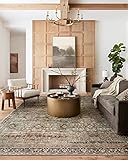
SAFAVIEH Marquee Collection Area Rug, MRQ110D Blue & Ivory, 8′ x 10′
Who it suits: Traditional, formal and transitional rooms — dining rooms and classic living rooms where a mandala medallion in blue and ivory is the correct, timeless answer and a modern abstract would look like a guest who dressed wrong.
Every other wool pick in this guide leans modern or boho. The Marquee is here for the other half of the housing stock. The MRQ110D is a SAFAVIEH Marquee Collection rug, handmade in wool, built around a mandala medallion design in blue and ivory — the kind of centered, bordered, formal pattern that has anchored dining rooms for a century because it solves the dining room’s actual problem: it gives a table and six chairs a visual field to sit on, with a medallion that lands under the table’s center and a border that frames the chairs. This exact listing (ASIN B07HB9JPQ4) sits in the upper-middle of this tier for the 8′ x 10′ — check price on Amazon for the current figure — squarely inside this budget, and notably steadier in positioning than the Natura NAT318F. One transparency note, in this guide’s spirit: offers for this listing can come from third-party sellers rather than Amazon directly, so confirm the seller and the live price on the listing itself; the rug and the size are verified, the storefront rotates.
Wool under a dining table is a more considered choice than it first appears, and the Marquee makes the case well. Wool’s resilience matters exactly where chair legs drag and a heavy table stands for years: the pile compresses under load and recovers when the furniture moves for cleaning, where a synthetic pile can take a permanent set. Its fibers also release dry crumbs to a vacuum more willingly than sticky synthetics do — dining debris is mostly dry, and dry is wool’s easy case. The wet case remains wool’s limit: gravy and wine are blot-immediately events, and a household whose dining room sees weekly red sauce may honestly belong with the Adirondack below. The medallion pattern, busy and mid-toned, is the traditionalist’s version of the Abstract’s camouflage — it hides the evidence of a lived-in formal room between cleanings. Add the standard wool notes — initial shedding, suction-leaning vacuuming, a pad underneath — and this is the pick that will still look correct in fifteen years, which is the entire point of a traditional room.
- Handmade wool with a blue-and-ivory mandala medallion — the formal, traditional design of the guide.
- Steady upper-middle positioning in this tier, for the full 8′ x 10′ — check price on Amazon.
- Wool pile recovers from dining-table and chair-leg compression better than synthetic piles.
Honest limitation: Spot-clean wool under a dining table is a discipline, recent offers were third-party sellers rather than Amazon-direct, and it sheds in its first weeks like every handmade wool rug here.
Choose it if your room is traditional or formal and you want wool’s longevity in a timeless pattern. Skip it if your dining style is spill-heavy and stress-free matters more than substance — the Adirondack below was made for that table.

SAFAVIEH Adirondack Collection Area Rug, ADR113W Champagne & Cream, 8′ x 10′
Who it suits: High-traffic households — dogs, kids, dining chairs, entry-adjacent living rooms — that want an 8×10 with a soft modern ombre look and a care routine that consists of vacuuming it and not thinking about it.
The Adirondack is this guide’s designated realist. It is a power-loomed synthetic rug — a polypropylene-family pile with a jute backing, in SAFAVIEH’s long-running Adirondack Collection — in a Champagne & Cream modern ombre design that fades softly across the field and flatters the light, neutral rooms most hard-use households actually live in. The collection’s 8x10s sit at the lower end of this tier in retailer offers for the line, which places the ADR113W’s 8′ x 10′ (ASIN B01N2TRFYP) in that same lower-tier band — well inside the budget, and positioned well below the wool picks, for the same 80 square feet of coverage. Check the current price on Amazon and confirm the live figure on the listing, because SAFAVIEH prices move by colorway; the Champagne & Cream’s siblings say clearly what shelf this rug sits on.
What that money buys is freedom from every wool caveat in this guide. The synthetic pile does not shed — not in week one, not ever. It does not fear water, so spills are a cloth and a mild cleaner, mud is a vacuum once it dries, and the rug can serve under a dining table, in front of a sofa that hosts two Labradors, or across the traffic lane between a front door and a kitchen without a single anxious thought. Its low pile lets dining chairs slide, doors clear and robot vacuums work, and the non-shedding surface is the friendliest in the guide to allergy-sensitive households. The honest costs are feel and lifespan character: a synthetic pile is less warm and less rich underfoot than wool, it can take a permanent flattening in the heaviest traffic lanes over years where wool would have recovered, and an ombre field — pale and low-contrast — shows dark soil sooner than the Abstract’s mottled greens or the Marquee’s busy medallion. It also wants a rug pad on hard floors, since the jute back has no grip of its own. None of that makes it a lesser rug; it makes it the correctly specified rug for the rooms the wool picks should not be asked to serve. If your 8×10’s job description includes a hallway’s worth of traffic, extend the same thinking down the corridor with Best Runner Rug Under $500.
- Power-loomed synthetic pile: zero shedding, water-tolerant, and unbothered by pets, kids and dining chairs.
- Champagne & Cream ombre design; the collection’s 8x10s sit at the lower end of this tier — check price on Amazon.
- Low pile that chairs, doors and robot vacuums all handle easily.
Honest limitation: Synthetic feel and synthetic aging: less warmth underfoot than wool, traffic lanes can flatten permanently over years, the pale ombre shows dark soil, and the jute back needs a pad on hard floors.
Choose it if your 8×10 faces real household traffic and you want to vacuum it and forget it. Skip it if barefoot richness and a natural fiber are the point of the purchase — that is the wool trio at the top of this guide.
Comparison Table
| Product | Type | Best use | Link |
|---|---|---|---|
| SAFAVIEH Abstract ABT143Y, 8′ x 10′ | Handmade wool | Modern living rooms; the tier’s core promise | Check on Amazon |
| SAFAVIEH Natura NAT318F, 8′ x 10′ | Handmade wool & viscose, fringe | Softness and sheen for bedrooms and calm rooms | Check on Amazon |
| SAFAVIEH Natura NAT852B, 8′ x 10′ | Handmade wool, fringe | Boho ivory value in low-traffic rooms | Check on Amazon |
| Loloi II Layla LAY-03, 7’6″ x 9’6″ | Printed polyester, 0.13″ pile | Designer vintage look; 9×12 coverage on budget | Check on Amazon |
| SAFAVIEH Marquee MRQ110D, 8′ x 10′ | Handmade wool medallion | Formal and traditional dining and living rooms | Check on Amazon |
| SAFAVIEH Adirondack ADR113W, 8′ x 10′ | Power-loomed synthetic, jute back | Traffic, pets and dining duty without anxiety | Check on Amazon |
How to Choose an Area Rug Under $500
- Fix your size first, then check prices. At this tier the standard is 8×10 ft: front legs of the sofa and both chairs on the rug, 12–18 inches of bare floor at the room’s edges. Price every candidate in that size. A $500 budget stretched over a 9×12 is a different, harder brief — only the synthetic end of this guide survives it.
- Verify the fiber in the specifications, not the headline. “Wool-look” and “wool-feel” are not wool. The material field in the maker’s specs is the truth: four picks here are verified wool or wool-viscose, two are honestly synthetic. At this tier, you are entitled to the real fiber — check that you are getting it.
- Understand hand-tufted, because it is this tier’s construction. Hand-tufted wool is yarn punched through a backing and held with latex and a secondary cloth back. It delivers real wool pile at a far more accessible positioning than hand-knotted, lasts a decade or more with care, and sheds early on. Hand-knotted is the superior construction — and in 8×10 wool it starts above this budget, which is a fact, not a failure of your searching.
- Budget the pad as part of the rug. Every pick here wants one on hard floors: grip, floor protection, and the cushion that separates “rug” from “floor covering.” A quality 8×10 felt or felt-and-rubber pad is a separate purchase to budget for. A well-chosen rug on a good pad feels richer than a more premium rug on bare wood.
- Match the fiber to the room’s spill profile. Wool for living rooms and bedrooms where spills are occasional and blotted fast. Wool-viscose only where spills are rare. Synthetic for dining rooms, entry paths and pet headquarters. The fiber decision is a household decision, not a taste decision.
- Plan for the shedding season. Any handmade wool rug releases loose fiber for its first weeks. Vacuum gently and often, expect the fluff, and judge the rug in month two. If that settling-in period genuinely bothers you, buy the synthetic with a clear conscience.
- Measure with painter’s tape before ordering. Tape the 8×10 outline, live with it for a day, and check the dining rule (24 inches of rug beyond the table on every side) and the door rule (pile plus pad must clear every swinging door) against your actual room.
- Check the live price, not a remembered one. Rug prices swing by colorway and season. Check the current price on Amazon on your exact size and color before you decide, and compare like-for-like sizes when you weigh one pick against another.
- Keep the packaging until the rug settles. An 8×10 is a serious object to return. Colors read differently under your light, wool needs weeks to finish shedding, and every judgment in the first 48 hours is provisional.
What $500 Buys — and What It Still Doesn’t
The step from $100 to $500 is the largest quality jump in this whole series, larger than the step from $500 to $1,000 will ever be. At $100, in the sizes that fit the budget, you are buying surfaces: printed patterns, thin washable mats, one honest woven synthetic. At $500, priced at 8×10, you are buying substance: natural fiber with real pile depth, hand construction, 80 square feet of it, from collections with decade-long sales histories. The wool in this guide will out-resile, out-warm and out-age anything in the cheaper tiers, and it does so at positioning that mostly sits comfortably inside this budget — the market’s honest center for a handmade wool 8×10, whatever the list prices claim. Readers stepping up from the smaller tier should feel the difference is real, because it is: this is the tier where a rug stops being décor you rotate and becomes furniture you keep.
It is equally honest to mark the ceiling, because $500 has one and shoppers deserve to see it drawn. Hand-knotted wool — the construction where every knot is tied by hand, the rugs that last generations — does not live here: market-wide, a hand-knotted wool 8×10 sits well above this budget, with in-stock options starting above this tier. Silk and silk-blend piles, high knot densities, and genuine antique or one-of-one pieces live further above still. And the 9×12 ft size in wool is this budget’s other hard wall: the wool picks’ larger sizes exit under-$500 as reliably as their 8x10s enter it, which is why the guide’s 9×12 answer is a synthetic print and why Best Area Rug Under $300 remains the smarter guide for anyone whose room is smaller than they feared and whose 8×10 turns out to be a 5×7 or 6×9 on tape-measure day. Spend $500 where it is strong — handmade wool, 8×10, in the room you live in most — and it is one of the best-value budgets in home furnishing. Spend it chasing the tier above’s construction at this tier’s price, and you will be disappointed by listings that were never what they claimed.
Will an 8×10 Actually Fit Your Room?
In a living room, an 8×10 is the size the furniture math was designed around: a full-size sofa up to about 96 inches, two chairs, and a coffee table, with every front leg on the rug and the rug extending at least a few inches beyond the seating group on each side. Lay the tape outline and check the two failure modes — a rug that ends mid-chair looks cut off, and a rug pushed against a wall on one side and floating on the other looks lost; 12 to 18 inches of bare floor around the rug is the frame that makes it read as intentional. In a bedroom, an 8×10 placed horizontally under a king or queen bed, extending on both sides and at the foot, is the full luxury layout — the wool picks, and especially the Natura pair, are at their best here, giving bare feet a warm landing on every side of the bed at once. Under a dining table, the 24-inch rule governs: an 8×10 honestly serves a table up to about 5.5 by 7.5 feet, which covers most six-seat setups; measure yours before assuming.
Two practical questions finish the fitting. First, weight and handling: a handmade wool 8×10 is a heavy object — the Blossom-family wool rugs in this size class run past 50 pounds — that arrives rolled, needs two people to place under furniture, and is a professional-cleaning conversation rather than a laundromat one. None of that is a reason not to buy it; all of it is a reason to place it once, correctly, on a pad, the first time. Second, doors and vacuums: wool pile plus a pad can catch a low-swinging door, so measure the gap; and every wool pick wants a vacuum with the beater bar off or on its gentlest setting, while the two synthetics take whatever vacuum you own. Five minutes with a tape measure and a strip of painter’s tape settles every one of these questions, and at this tier it is the cheapest insurance in the whole purchase.
Common Buying Mistakes
- Believing a “wool” headline without reading the specifications — and receiving a wool-look synthetic at a real-wool price.
- Chasing a hand-knotted 8×10 under $500, a product that essentially does not exist, and ending up with a mislabeled rug from a listing that knew it.
- Quoting the 5×7 price of a wool design to yourself while ordering the 8×10 — the size jump in wool is routinely substantial.
- Returning a wool rug in week one for shedding, the normal settling behavior of every handmade wool rug ever made.
- Putting a wool-viscose blend under a dining table, then soaking a spill and learning what viscose does when wet.
- Skipping the pad to save a little on a premium rug, then living with creep, curl and a thin feel the rug itself never caused.
- Vacuuming wool on a aggressive beater-bar setting and slowly pulling the pile apart, or scrubbing a spill in circles and felting it into the field.
- Buying an ivory rug for a muddy-paw household because it photographed like a Scandinavian magazine.
- Assuming the 9×12 costs “a bit more” than the 8×10 in wool — in this tier it costs the whole budget and then some.
- Judging any large rug’s color on a phone screen at full brightness, in a room lit by warm bulbs, and being surprised.
Final Recommendation
- Most buyers, living room first: SAFAVIEH Abstract Collection ABT143Y, Green & Sage, 8′ x 10′.
- Softness and sheen, calm rooms: SAFAVIEH Natura Collection NAT318F, Grey, 8′ x 10′.
- Handmade wool at the friendliest positioning: SAFAVIEH Natura Collection NAT852B, Ivory, 8′ x 10′.
- Pattern impact, minimum spend: Loloi II Layla Collection LAY-03, Olive/Charcoal, 7’6″ x 9’6″.
- Traditional rooms and dining formality: SAFAVIEH Marquee Collection MRQ110D, Blue & Ivory, 8′ x 10′.
- Traffic, pets and zero anxiety: SAFAVIEH Adirondack Collection ADR113W, Champagne & Cream, 8′ x 10′.
Our top two are the Abstract ABT143Y for anyone whose brief is the tier’s core promise — verified handmade wool, a modern design that hides a lived-in week, the full 8×10, at a mid-tier positioning that leaves room in the budget for the pad it deserves — check price on Amazon — and the Natura NAT852B for anyone whose rooms are calm enough for ivory, because a handmade wool 8×10 at the most accessible wool positioning in this guide is the single best fiber-for-the-spend option here. Between those poles, choose by room and by honesty about your household: the NAT318F where bare feet and lamplight matter most, the Marquee where the room is formal and the pattern should be timeless, the Layla where the budget has other plans or the room needs 9×12 coverage, and the Adirondack wherever life is genuinely hard on floors. And if you finished the sizing section realizing your room honestly needs a wool 9×12, believe yourself: that is the next budget tier’s product, not this one’s, and no amount of hopeful squinting at an 8×10 changes the tape measure. Tape the outline, verify the fiber in the specifications, check the live price on your exact size and color, and order the rug that matches the room and the household you actually have.
Frequently Asked Questions
Is $500 enough for a real wool rug in 8×10?
Yes — for hand-tufted wool, which is this tier’s honest center. The wool 8x10s in this guide sit comfortably inside this budget: handmade SAFAVIEH wool in the Abstract, Natura and Marquee collections — check price on Amazon for the current figure on each. What $500 does not buy is hand-knotted wool in this size; market-wide, hand-knotted 8x10s sit well above this budget. If a listing offers a hand-knotted wool 8×10 well under $500, read its specifications with great care.
Why does my new wool rug shed so much?
Because it is wool, and handmade. Hand-tufted wool rugs carry loose fiber from the shearing and tufting process, and the first weeks of vacuuming release it — sometimes alarmingly. It tapers steadily and is a property of the material, not a defect in your rug. Vacuum gently and frequently (beater bar off), and judge the rug in its second month. If shedding is heavy and undiminished after several months of regular use, that is a quality conversation to have with the seller.
Hand-tufted or power-loomed — which should I buy?
Hand-tufted wool (the Abstract, Natura and Marquee picks) gives you natural fiber: warmer, more resilient, better at recovering from furniture dents, and better at hiding dry soil — at the price of shedding early on and spot-clean-only care. Power-loomed synthetic (the Adirondack) gives you zero shedding, water tolerance and total indifference to pets and dining chairs — at the price of a less rich feel and traffic lanes that can flatten over years. Match the construction to your household’s spill and traffic profile, not to which sounds fancier.
Can I get a 9×12 rug under $500?
In synthetic, yes: the Loloi Layla’s 9×12-class sizes sit inside this budget — check price on Amazon for that size — and power-loomed collections offer 9x12s at the lower end of this tier. In wool, realistically no — the wool picks in this guide are 8×10 rugs, and their 9×12 siblings sit above $500 as a rule. If your room needs a wool 9×12, the honest move is the next budget tier; if it needs 9×12 coverage at this budget, a quality synthetic print is a respectable answer, not a failure.
Do I need a rug pad under a heavy wool 8×10?
Yes, even though the rug’s own weight stops most movement. A pad protects your floor’s finish from the rug’s backing over years of micro-shifting, adds the cushion that makes wool feel luxurious rather than merely thick, prevents edge curl, and extends the rug’s life by absorbing friction. Budget separately for a felt or felt-and-rubber 8×10 pad; it is the highest-value accessory in this entire guide.
How long will a hand-tufted wool rug last?
With normal care — gentle regular vacuuming, fast blotting, a pad underneath, professional cleaning every year or two in traffic — a hand-tufted wool 8×10 should serve a decade or more, and wool’s resilience means it typically looks better in year three, once fully settled, than in week one. It will not match a hand-knotted rug’s generational lifespan, which is precisely the difference the tier difference buys.