Disclosure: As an Amazon Associate, dailyhomedecorating.com earns from qualifying purchases. Links on this page are affiliate links; they cost you nothing extra. Prices and availability change often, so check the current Amazon listing before you buy.
So, is a spice rack worth it? The short answer is yes — for a household whose spice collection has outgrown a single shelf row and whose kitchen can offer the rack a dark home in a drawer or cabinet. It is not worth it for a small, stable collection that a tray already handles, and it is actively not worth it in the one configuration the advertisements love: a countertop rack beside the stove, where heat, light and steam degrade the very spices the rack was bought to organise. Worth is a function of collection size, available dark volume and placement — this article prices each factor in the currencies that actually matter: time, space, upkeep and flavour.

Key Takeaways
- Worth it if: you own duplicates you did not know about, hunt for jars mid-recipe, or have a drawer/cabinet to spare.
- Not worth it if: your collection fits one tray, or the only available spot is beside the hob or in sun.
- The hidden dividend is flavour: dark, cool storage keeps spices at their best measurably longer.
- The hidden costs are volume, refill ritual and upkeep — all payable in effort, not money.
- Start with a riser or tray to test the habit before committing to a full system.
Worth it if… your jars hide behind each other, you have bought a spice you already owned, and a drawer or cabinet section can be given over in a cool, dark part of the kitchen. Not worth it if… your collection is small enough to see all at once, or your kitchen offers only warm, bright counter space. And the deciding question is never the rack’s price — it is whether the organisation and preservation gains exceed the volume and upkeep costs in your specific kitchen, which the rest of this article works through honestly.
In this guide
Is a Spice Rack Worth It? What You Actually Get
Strip away the marketing and a spice rack buys you four concrete things. First, retrieval speed with certainty: not just faster finding, but the end of finding-as-searching — the collection presents itself, complete, in one glance, and the mid-recipe excavation ritual disappears from your cooking. Second, inventory truth: you can see what you own, what is nearly empty and what you have somehow bought three times, which changes shopping behaviour within a month. Third, order that maintains itself, because a definite place per jar makes correct refilling the path of least resistance for every member of the household. Fourth — only in drawer and cabinet formats, but there it is significant — better storage conditions: dark, cool, dry and stable, the conditions under which ground spices hold their character longest. Those four are the whole value proposition. Everything else a listing promises is decoration on one of them.
Everything in this guide starts with one uncomfortable fact about spice storage: the enemies of flavour are heat, light, moisture and air, and the typical kitchen rack is placed within reach of all four. Ground spices and dried herbs do not spoil in a way that makes them dangerous in normal home use; they fade. The volatile aromatic compounds that make cumin smell like cumin and paprika taste like paprika evaporate and oxidise, and warmth speeds that process up considerably. A jar sitting beside a hob lives through daily cycles of rising steam and cooking heat, and a jar on a sunny countertop spends its days in direct light. Neither jar is being stored badly in the sense of being dirty or disorganised — both are being stored in the worst possible microclimate in the room, purely because that spot is convenient.
Notice what the value list does not include: the rack does not make you a better cook, does not improve a single spice, and does not create space — it reallocates space and attention. That honesty matters for the worth calculation, because the gains are real but specific. Households that buy expecting a transformed kitchen are disappointed; households that buy expecting to never again hold a pan in one hand and excavate with the other get exactly what they paid for, every day, for years. Frequency is the multiplier in this calculation: a daily cook collects the retrieval dividend hundreds of times a year, and even a few saved seconds and one avoided frustration per meal compound into the strongest argument the category has.
The Real Costs Beyond Money
The first real cost is volume, and it is paid in the kitchen’s hardest currencies. A drawer conversion costs a drawer — in many kitchens, the drawer. A cabinet system costs a shelf block that tins or glasses were using. A door rack costs swing clearance and asks the hinges to carry glass. A countertop rack costs worktop, priced by the square inch in a small kitchen and never truly spare. Before any worth calculation, name the volume and name what it currently does; a rack whose home is genuinely dead space — the door’s inside face, the air above a shelf row — is nearly free, while a rack that evicts something useful starts its life in debt.
The second cost is ritual. Rigid and matched systems impose a refill ceremony — decant, funnel, label, date — every time a spice enters the house, and ceremonies decay: the jar that arrives in a busy week gets parked ‘temporarily’, and temporary parking is how parallel clutter is born. Open formats charge almost no ritual but levy a small tidiness tax on every use instead. The third cost is upkeep: powder settles, racks need their quarterly empty-and-wash, labels need maintaining. The fourth is the learning curve, genuinely small but real — a household needs a few weeks to internalise a new system’s logic, and reorganising during that window, a common mistake, restarts the clock. None of these costs is large. Together they are the difference between a system that is still working in year two and a handsome artefact of a forgotten intention.
Who It Pays Off For
The daily cook with a real collection
This household collects every dividend at maximum frequency: retrieval hundreds of times a year, inventory truth at every shop, preservation across a large and valuable collection. If your spice count runs to dozens of jars and cooking is a daily event, the worth question is barely a question — the only real decision is format, and our spice rack buying guide exists to make it. Choose drawer or cabinet, size with headroom, and the system pays for its volume within the first season.
The household that keeps buying duplicates
Duplicate buying is the market’s clearest signal that storage has failed: you cannot see what you own, so you buy it again. For this household a rack is not an organiser but a correction — the visible inventory ends the duplicates, and the empty-slot effect turns restocking into a glance. The payoff here is partly financial in a way the category rarely claims: the third jar of ground coriander you did not buy is a real, if humble, return. A simple riser often captures most of this value; the format matters less than the visibility.
The flavour-serious cook
If you buy spices with any care — small batches, good sources, whole spices ground as needed — then storage conditions are where your money is protected or wasted. A drawer or cabinet rack is, for this cook, less an organiser than a preservation device that also organises. The worth calculation is dominated by a single comparison: the same spice kept dark and cool versus kept beside the hob. Everything else — access, order — is a bonus on a purchase already justified by the storage science alone.
Who Should Skip It
The small, stable collection
Five to ten jars that all fit in one visible row or a small tray in a cabinet: your problem is solved, and a rack would spend volume and upkeep to re-solve it. The honest worth answer here is no. Revisit if the collection grows past the point where jars hide — the signal is duplicates or hunting, not a number in an article — and until then, put the effort into dating the jars you have, which delivers the preservation benefit free.
The kitchen with only warm, bright space
If every candidate spot is beside the cooker, over the radiator’s wall or in a shaft of afternoon sun, then the formats available to you are the ones whose storage conditions argue against them, and a countertop rack there is worse than the dark shelf you already have. Skip the rack; spend nothing; keep the collection in the least-bad cabinet and rotate stock briskly. Kitchens change — a cleared drawer, a moved microwave — and the purchase can be revisited when a dark home exists. Buying the rack first and hoping for the home later inverts the only order that works.
The household that will not maintain any system
Some households know, honestly, that labels will not be written, dates will not be added and the quarterly wash will not happen. For them the elaborate systems are not worth it, because an unmaintained system decays into clutter with better hardware. A minimal intervention still can be: a single riser, no decanting, no ceremony, jars as they come. If even that sounds like a commitment, the truthful answer is that your current shelf, imperfect and free, is your optimum — and recognising that is worth more than any rack.
Strengths and Trade-Offs of Owning One
Strengths of ownership
- Retrieval becomes glancing, not searching — the daily dividend, collected at every meal.
- Inventory becomes visible truth: duplicates end, gaps announce themselves.
- Order maintains itself when every jar has an address.
- In drawer and cabinet formats, flavour preservation runs quietly around the clock.
- Dead volume — door faces, shelf air, shallow drawers — becomes working storage.
Trade-offs of ownership
- Volume is spent permanently, in whichever currency your kitchen can least spare.
- Rigid formats impose a refill ritual that must survive busy weeks to stay worth it.
- Capacity ceilings guarantee an overflow decision eventually.
- Upkeep is quarterly and real: powder settles, and racks that resist washing get washed less.
- The placement temptation never fully goes away — convenience always argues for the hob-side spot.
Alternatives to Consider
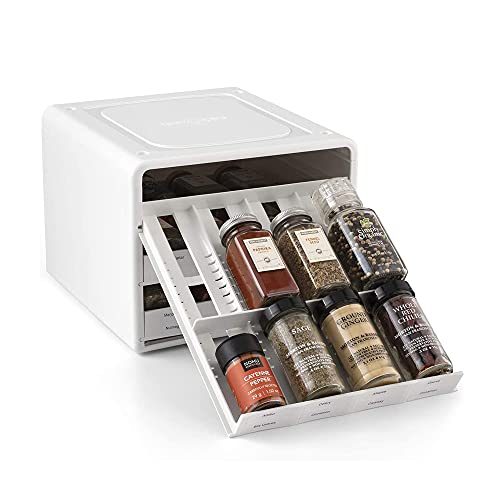
The tray-in-a-drawer is the strongest alternative and the one this article recommends as the honest halfway house: a simple tray or shallow box corrals jars in the dark, delivers most of the access and all of the storage climate, and asks for almost nothing. Its deficits — no per-jar order, slower scanning — are exactly the deficits a rack fixes, so living with the tray for a month tells you, from experience, whether the rack’s extra value is real for you. The plain riser is the second alternative: stadium steps on the existing shelf, the cheapest test of the visibility dividend. The third alternative is behavioural rather than hardware: shrink the collection to a working set you rotate briskly, store it in the darkest cabinet, and let freshness come from turnover instead of storage. Small collections honestly run this way can outperform large collections stored beautifully and used slowly. Format-level comparisons live in our spice rack reviews, and the balanced ledger in spice rack pros and cons.
How to Get the Most Value If You Buy
Value is maximised at setup and defended by three cheap habits. At setup: place for storage conditions first — drawer or cabinet, away from the oven wall — and let convenience be satisfied by putting the daily handful at the system’s front, wherever the system lives. Load with deliberate gaps. Label the surface the eye meets, and date every jar as it goes in. The habits: a one-in-one-out rule for the working set, so growth is a decision rather than a creep; a quarterly empty-wipe-wash that takes minutes because the rack was chosen to lift out whole; and a standing refusal to let ‘temporary’ jars park on the counter — a new jar joins the system the day it arrives, decanted or not, or it waits in the shopping bag as a visible prompt. Households that run these habits report the same thing in different words: the system disappears, and only the benefits remain visible.
Once the rack is in, choose an organising logic and stick to it for at least a month before judging it. Alphabetical order is the easiest to search and the easiest for other household members to maintain, because there is exactly one right place for everything. Grouping by cuisine — the curry spices together, the baking spices together — matches how recipes are actually cooked and keeps a whole flavour family in one grab. Grouping by frequency puts the daily handful at the front and the once-a-year jars at the back, which is efficient but drifts as habits change. Most households end up with a hybrid: frequency at the front, alphabetical within groups. The rack does not care; your future self, mid-recipe with wet hands, cares a great deal.
Whatever rack you choose, add one habit that costs nothing: write the month and year you opened each spice on the underside of the jar or on a small label. Ground spices give their best for a matter of months rather than years once opened, and whole spices keep their character considerably longer, but without a date you are guessing from memory, and memory is optimistic. A rack makes this easier, not harder — when every jar faces you in a row or a tier, a quick scan of dates during a tidy-up tells you which jars to use up first and which ones have quietly become coloured dust that will disappoint the next sauce you stir them into.
The Decision Checklist
Answer honestly; the rule follows the list.
- Have you bought a duplicate of a spice you already owned in the past year?
- Do you move jars aside to find other jars at least once a week?
- Is your collection larger than a single visible row — roughly, can you no longer see everything at once?
- Can you name a drawer, cabinet section or door that could host a rack away from heat and sun?
- Would at least one person in the household maintain labels and a quarterly wipe-down?
- Do you cook with spices most days, rather than occasionally?
- Is there a format whose volume cost you would not resent in a month?
The rule: four or more yes answers, including the dark-home question, means a spice rack is worth it for your kitchen — buy the format the space dictates, with headroom. Yes answers without the dark home means wait: solve placement first, because a rack in a warm bright spot is the one configuration this article calls actively not worth it. Two or fewer yes answers means your current storage is already near your optimum; spend the effort on dating jars and rotating stock, and let the collection’s growth, if it comes, reopen the question. The step-by-step buying method, once the checklist says yes, is how to choose a spice rack.
A Year of Ownership, Priced in Friction
Worth calculations fail when they are done in the abstract, so run this one concretely. Picture the year without the rack: every meal that wants a back-row spice costs a small excavation; every shop risks a duplicate; the collection’s true state is a guess; and the jars beside the hob fade on schedule. None of those costs is dramatic — that is precisely why they are underestimated — but they are collected daily, in the room where the household’s patience is thinnest, at the hour when it is most depleted. Now the year with the rack, in a drawer or cabinet: the excavations are gone, the duplicates mostly stop within a month, the inventory is a glance, and the flavour dividend accrues invisibly. Against that, the rack’s own costs — the volume, the quarterly wash, the refill ritual if you chose a rigid format — are collected rarely and at chosen moments. Worth, in kitchens, is mostly about when costs fall: daily and unchosen, or rarely and scheduled. The rack moves spice storage’s costs from the first column to the second, and that move is the whole case.
The honest counterweight is that the same arithmetic condemns the rack in the small-collection kitchen, where the unchosen daily costs barely exist — there is no excavation in a row of six jars — and the rack’s scheduled costs would be pure addition. It also condemns the hob-side carousel at any collection size, because that configuration keeps the worst daily cost of all, the fading, and adds its own. The arithmetic is not pro-rack or anti-rack; it is pro-honesty about which costs your kitchen actually pays today.
The Worth of the Halfway Options, Revisited
Because the tray and the riser keep appearing in this article as the recommended experiments, their worth deserves a direct verdict rather than a supporting role. The riser’s worth is the easiest case in the category: it converts an invisible collection into a visible one for the least effort a product can ask, and its only real cost is the admission that the shelf needed help. Households that stop there have not failed to buy a system; they have bought exactly the fraction of the benefit they needed. The tray’s worth is subtler — it buys darkness and corralling without order, which suits collections in transition: the household mid-way through standardising jars, the renter mid-way through a tenancy, the cook mid-way through deciding whether spices deserve a drawer. Both halfway options share a virtue the full systems cannot match: they are honest teachers. A month with either one tells you your household’s true maintenance appetite, and that knowledge is worth more than the hardware, because it prices every future system correctly.
What Owners Say a Year Later — the Patterns
Without inventing a single quotation, the patterns in long-term owner reports are consistent enough to summarise. The happiest owners describe the system least: it has disappeared into the kitchen’s furniture of habits, mentioned only when a visitor opens the drawer and reacts. The dissatisfied owners describe specifics — a tier too high, a slot too narrow, a ritual abandoned — and the specifics are always traceable to a skipped step at choosing time: an unmeasured drawer, an unmade jar decision, a placement chosen by the photograph. Almost nobody reports the hardware failing. Almost everybody who moved the rack out of the hob’s weather reports the move as the single best adjustment they made. And the owners who sold or gave away a matched carousel set form the survey’s saddest and most instructive group: they bought the category’s best-looking answer to a question their kitchen had not asked, and the worth arithmetic, done late, was unforgiving.
One more pattern is worth money to a reader still deciding: owners consistently under-report, at purchase time, how much they will value the inventory effect, and over-report how much they will value the look. A year in, the ranking has reversed for nearly everyone. Let that reversal guide the budget: spend on the format that maximises visibility and storage conditions, let appearance be the tiebreaker it deserves to be, and be suspicious of any purchase — at any tier — whose main argument is how it will look in the photograph of a kitchen that is not yours.
The Flavour Argument, Priced Properly
Return to the dividend this article keeps calling hidden, and price it as concretely as words allow. A household that cooks with spices daily holds, at any moment, a small inventory of ground spices and blends whose quality is decaying at a rate set by their storage. Beside the hob, that decay runs at the fastest rate the kitchen offers; in a dark drawer, at the slowest. The difference is not tasted in any single meal — it is tasted across a season, as the drawer household’s Tuesday curry lands with the top notes intact and the hob household’s tastes progressively flatter, in a way cooks tend to blame on their technique or the recipe. Reframed that way, the drawer or cabinet rack is not competing with other organisers; it is competing with the ongoing, invisible waste of ingredients bought at full quality and stored at half. For the household that buys spices with any care at all, that waste is the largest single figure in the worth calculation, and it points one way. For the household whose spices are an afterthought, the figure shrinks — but so does every other figure in the case, and the checklist at the end of this article exists to tell those two households apart.
The Counterfactual Kitchens
Worth questions are answered by counterfactuals, so consider three kitchens identical in cooks and collections, differing only in storage. The first keeps the shelf row: its costs are the excavations, the duplicates, the occasional jar discovered fossilised behind the vinegars. The second buys the carousel for the hob-side counter: its costs are the counter space and the fastest flavour fade of the three, offset by genuinely delightful access — this kitchen has paid money to make one cost smaller and the largest cost larger, and its worth verdict is the worst of the three despite owning the most product. The third converts a drawer with liner strips: its costs are the drawer and a quarterly rinse, and every other line in its ledger improves. The comparison isolates the article’s thesis in its purest form — the worth was never in the rack. It was in the relocation: from bright to dark, from hidden to visible, from searched to seen. Any purchase that achieves the relocation is worth it; any purchase that achieves only the organisation is worth much less; and one popular purchase achieves the organisation while reversing the relocation, which is why this article keeps returning, stubbornly, to the spot beside the stove.
A fourth kitchen deserves a sentence, because it is the one the halfway options serve: the kitchen that does the relocation without the rack — jars in a tray, in the dark drawer, labels up, dated. Its ledger is nearly the third kitchen’s, missing mainly the per-jar order and some scan speed. If that kitchen is yours and it works, this article’s verdict on your upgrading is a respectful shrug: the worth was in the move, you have already banked it, and the rack would be buying polish. Spend the difference on the spices themselves.
Regret, and How It Distributes
Purchases can also be judged by their regret profile — not whether buyers regret them, but how the regret is shaped when it comes. Spice rack regret, when it comes, is almost never ‘the product was bad’. It is locational (‘we never had the drawer to spare, really’), or ritual (‘the decanting lasted a month’), or photographic (‘it looked better in the listing’s kitchen’). All three regrets were knowable before purchase, and all three are addressed by a section of this article — which is either reassuring or damning depending on whether the sections get read before or after the fact. The regret that barely exists is the drawer-and-cabinet regret: households that placed for storage conditions and sized for their counted collections do not, in any pattern this article can find, wish the system away. They wish, at most, that they had done it sooner and measured once more. A purchase whose worst realistic regret is ‘sooner, with a tape measure’ is a purchase whose worth case has about as strong a shape as household goods ever get.
The Worth Question, Asked Backwards
Try the question inverted, as a final test: what would have to be true for a spice rack not to be worth it in a kitchen with a real collection and a dark home for it? The retrieval dividend would have to be worthless — but it is collected daily, by tired people, at the exact moment friction costs most. The inventory effect would have to be imaginary — but the duplicates in the cupboard testify otherwise. The flavour preservation would have to be a myth — but the storage science is the least contested thing in this article. And the costs would have to be larger than they are — a drawer, a quarterly rinse, a decision made once. The inverted question cannot be sustained, which is the strongest form the worth case can take: not that the rack is wonderful, but that its denial requires denying several ordinary facts at once. Where the denial does hold — the small collection, the bright-only kitchen, the household that will not maintain — this article has said so plainly and early. Everywhere else, the answer to the title’s question is yes, and it is yes for reasons that survive being argued with.
That is the note to end on: worth, in a kitchen, is rarely about objects. It is about whether the room’s daily frictions shrink or grow, and whether the ingredients you bought arrive in the pan at the quality you paid for. A spice rack, rightly placed, does both of those unglamorous things every day without being thought about — and being thought about less and less, year after year, is what worth it actually looks like from inside a working kitchen.
Two Households, One Rack, Opposite Verdicts
Make the article’s argument flesh with two households who bought the same mid-tier in-cabinet organiser in the same month. The first household cooks daily, counts its spices in dozens, and installed the organiser in a cabinet on an interior wall after a proper sort. Their year with it is the brochure’s, except quieter: no drama, no story, just a kitchen in which one small daily friction has been permanently deleted and a collection that tastes as it should. Asked its worth, they struggle to answer, because the system’s success has made it invisible — the surest sign of worth this article knows. The second household cooks twice a week, counts its spices in single figures plus a gift set, and installed the organiser because the cabinet had a gap that looked empty. Their year is a slow irritation: the refill ceremony for jars that barely empty, the slots that mock the collection’s smallness, the volume missed by the glasses that used to live there. Asked its worth, they answer instantly and negatively. Same product, same build quality, same price tier — opposite verdicts, both correct. The variable was never the rack. It was the fit between a system’s costs and a household’s life, and that fit is precisely what the checklist exists to test before the purchase rather than after it.
Hold those two households in mind against every worth-it article you ever read, this one included. Products do not have worth in the abstract; arrangements do — of object, kitchen, collection and habit. The most this page can do is hand you the arrangement’s variables in their true order of importance: collection size, dark volume, placement, maintenance honesty. Run your own household through them and the verdict you reach will be the right one, whether or not it matches the headline — and if it does not match, trust your run of the numbers over any article’s, because you are the only reviewer who has ever cooked in your kitchen.
The Small Print: What Worth It Does Not Mean
Worth-it verdicts attract misreading, so the small print, plainly. Worth it does not mean the rack will transform your cooking; it removes a friction and protects an ingredient, and transformation was never on the menu. Worth it does not mean the most complete system is the most worth buying; in this category worth peaks early, at the format that achieves visibility and dark storage, and the tiers above that buy finish and ceremony whose worth is a separate, more personal question. Worth it does not mean worth it forever without attention; the quarterly wash and the one-in-one-out rule are part of the arrangement, and a household unwilling to sign them is buying a depreciating asset. And worth it most emphatically does not transfer between kitchens: the verdict in this article is indexed to collection size, dark volume and cooking frequency, and importing another household’s yes — or another article’s — without re-running your own numbers is how the second household in the story above ended up irritated by a perfectly good product. Read the verdict as a method with an example answer attached, and it will serve you in this category and, frankly, in most of the ones this site covers.
With the small print filed, the headline can stand as written. For the daily-cooking household with a collection that hides from itself and a drawer or cabinet to offer, a spice rack is worth it — in flavour protected, duplicates un-bought, and a small daily friction deleted so completely that within a season nobody remembers it was ever there. That forgetfulness is the final measure. The purchases a kitchen truly values are the ones it stops noticing, and a rack in the dark, doing its double job in silence, is as close to invisible value as storage gets.
The Answer, Given to Four Callers
Worth-it questions arrive from recognisable callers, and the article can close by answering each in their own terms. To the cook who seasons by instinct and cooks by memory: yes, worth it, because your memory deserves a visible inventory to improvise from, and the drawer format will feel less like storage than like a well-laid mise en place that never needs laying. To the household manager counting every cubic inch twice: yes, if the volume is dead — door face, shelf air, shallow drawer — and no, politely, if the volume is alive, because no organiser outearns a working drawer doing its first job. To the flavour perfectionist: yes, and you already know why; the rack is the cheapest preservation equipment in your kitchen, and the carousel by the hob is the most expensive sabotage. To the sceptic who has read this far in genuine doubt: your doubt is the correct instrument — run the checklist, count the jars, stand in your kitchen at cooking hour and look at where the light and steam actually go. The article asks for no faith. It asks for a count, a look, and an honest month with a tray in a drawer, after which the worth question tends to answer itself in the only voice that was ever going to convince you: your own kitchen’s.
The Verdict in the Form of a Shopping Instruction
If the checklist said yes, the instruction is short enough to fit on the list itself. Convert the darkest drawer you can spare, or organise the darkest cabinet section, with the simplest format that fits your jars as they are; size it to the counted collection with room to grow; label what the eye meets; date what you open; and put the daily handful at the front without apologising to the alphabet. Then cook for a season and notice, somewhere around the twentieth meal, that you have stopped thinking about spice storage entirely. That noticing — or rather, that long preceding absence of noticing — is the sound of worth it, arriving exactly as this article promised: not as a revelation, but as a friction that never comes back.
One More Counterfactual: The Kitchen That Waited
There is a fifth kitchen in the counterfactual set, and it deserves its paragraph before the verdict rests: the kitchen that did everything in the wrong order on purpose — bought nothing for a year, but ran the article’s habits anyway. Its jars moved to the darkest cabinet the day the article was read; dates went on in marker; the collection was counted, sorted and shopped against a list. A year later its owner reports the strangest result in this article’s collection: most of the worth arrived without the purchase. The relocation and the habits — the two things this article has insisted carry the value — turned out to be portable, and the rack, when it finally came, bought only the remainder: the per-jar order, the glance-speed, the small daily ceremony of a drawer that presents its contents like a well-run shop. That remainder was still worth buying, the owner says, and says it without hesitation. But the kitchen that waited teaches the article’s deepest lesson in its purest form: the rack is the last ten percent of a system whose first ninety percent is decisions. Make the decisions and the purchase becomes easy; skip them and no purchase, at any tier, in any format, will make them for you.
So the article ends where it began, with the answer unchanged but, it hopes, better owned: worth it, for the kitchens the checklist names, in the places the storage science blesses, at the scale the collection justifies — and the reader who can now say why, in their own kitchen’s terms, no longer needs the article at all. That is the only testimonial worth collecting.
File the verdict, then, under the small group of household purchases whose value is proved by disappearance: the ones nobody discusses, nobody photographs twice, and nobody would willingly hand back. A spice rack in the dark belongs to that group whenever the checklist’s conditions are met — and membership in that group, quietly held for years, is the most durable meaning the words worth it have ever had.
The dead-volume principle behind the worth case is not kitchen-specific, and readers auditing other rooms will find the same arithmetic waiting: the space under a bed, the air inside a wardrobe, the inside face of every door in the house. Our survey of storage baskets covers the corralling half of that principle for the rooms beyond the kitchen, and it rewards the same habit this article has preached throughout — count what you own, then house it where the conditions suit it.
Earning Its Keep: The Long View on Owning a Spice Rack
Whether a spice rack is worth it is rarely settled on the day it arrives, so this section judges value across ordinary weeks of ownership: how often it is used, what it replaces, what it costs in space and upkeep, and the point at which it has quietly paid for its place in the home.
Start With Your Space and Your Routine
Compare how each option handles the in-between moments, such as being half full, partly open, moved aside or used in a hurry, because daily life happens mostly in those moments. If the spice rack needs assembly, read the instruction preview if one is offered, count the steps honestly against the time you have, and check whether a second pair of hands is recommended. If the listing offers accessories for the spice rack, decide which ones solve a problem you already have, and set aside the ones that only solve problems the listing itself invented. Measure the space where the spice rack will live, including the clearance needed to use it, move around it and clean behind or beneath it, and keep those numbers beside you while you compare options.
A spice rack earns its place when it removes a recurring irritation, and the clearest sign of value is noticing, a month later, that a small daily frustration has simply stopped happening. Decide in advance which single feature you would refuse to compromise on, and let that one priority settle ties between otherwise similar spice rack choices. Set the assembled spice rack up fully before deciding it is wrong for the space, since partly built or badly positioned pieces often look worse than they will once finished and levelled. A slight wobble, a stiff action or a small misalignment on day one rarely improves on its own, so address it during setup while adjustments are still easy to make.
When Small Problems Appear
Where the spice rack has a surface you will set things on, lean on, or load, consider the heaviest realistic load in your household rather than the lightest display load in the photos. If two options look nearly identical, compare the parts you will touch every day, since those contact points decide whether a spice rack feels solid or flimsy after the novelty wears off. Plan where the packaging and any old item being replaced will go on delivery day, a small step that prevents a rushed, careless first setup of the new spice rack. Take a photograph of the space before you order and mark the intended position of the spice rack on it, then revisit that photo whenever a listing tempts you toward a larger or different style.
The worth question changes with the household, so revisit it whenever your space, routine or family changes rather than treating today’s verdict on the spice rack as permanent. Keep the fittings, spare parts and instructions that come with the spice rack together in one labelled place, because the part you need in a year is always the one that was put somewhere safe.
A Short Decision Checklist
- Who will use the spice rack most, and any limits they have
- Where the spice rack and its accessories will be stored when not in use
- The one feature you will not compromise on
- Assembly needs, tools required and whether help is needed
- What your current arrangement does badly that the spice rack must fix
- The measured space, including clearance to use and clean around the spice rack
- Packaging kept until the spice rack has passed its first trial in place
- What your current arrangement does well that the spice rack must not lose
Taken together, these checks take only a little time, yet they answer the questions that decide whether the spice rack suits your home, your household and your routine, and they do so before money changes hands rather than after.
Frequently Asked Questions
Is a spice rack worth it for a small kitchen?
It can be the most worth it there — if the format spends hidden volume rather than worktop. A liner in a narrow drawer, a riser doubling a shelf, or a properly fitted door rack all add real storage to a kitchen that has none to spare. The countertop carousel inverts the logic, spending the scarcest surface a small kitchen owns. Judge by which volume the format consumes: hidden and vertical, yes; the worktop you chop on, no.
Does a spice rack actually keep spices fresher?
The rack itself does nothing; the storage conditions it creates do everything. Drawer and cabinet racks hold jars dark, cool and dry, and under those conditions ground spices keep their best character for months and fade slowly rather than fast. A countertop rack beside the hob creates the opposite conditions and fades spices faster than a plain shelf in a dark cabinet would. So the freshness answer is entirely a placement answer — which is why this article treats placement as the purchase.
What is the cheapest way to get most of the benefit?
A simple tiered riser on your existing cabinet shelf, or a tray in a drawer. Both deliver the visibility dividend — the end of back-row hunting and duplicate buying — at the lowest tier of effort and commitment, with no decanting and no installation. Live with either for a month. If the remaining annoyances are scan speed and per-jar order, a full system will earn its volume; if the annoyances have vanished, you have your answer and it cost almost nothing to learn.
Is a countertop spice rack ever worth it?
Yes, in one specific home: a cool, shaded stretch of counter away from the cooker — a pantry counter or a north-facing worktop the sun never reaches. There, the carousel’s genuine pro, the fastest one-handed access in the category, can be enjoyed without the storage penalty. The worth question collapses the moment the proposed spot is beside the hob or in sunlight, because then you are paying counter space to fade your own ingredients faster.
How long before a spice rack pays for itself?
In effort terms, quickly for daily cooks: the retrieval and inventory dividends are collected at every meal and every shop, and most households feel the system has justified its volume within the first season. In flavour terms, the drawer and cabinet formats pay continuously by slowing loss across the whole collection. The honest caveat is that ‘paying’ here is measured in friction removed and duplicates un-bought rather than in a sum — but friction, removed daily, is the currency kitchens actually run on.
When is a spice rack definitely not worth it?
Three cases. A small, stable collection that one tray already shows you completely. A kitchen whose only available spot is warm or bright, where the rack would store worse than your current shelf. And a household that knows it will not maintain labels, gaps or the quarterly wipe — for whom the system would decay into expensive clutter. In all three cases the right purchase is no purchase, and the right effort is dating jars and rotating stock in the dark cabinet you already own.
Related Reading
If the checklist said yes, continue to the spice rack buying guide; for dead-volume storage elsewhere, see under-bed storage and storage ottomans.