Disclosure: As an Amazon Associate, dailyhomedecorating.com earns from qualifying purchases. Links on this page are affiliate links; they cost you nothing extra. Prices and availability change often, so check the current Amazon listing before you buy.
Weighing up shoe cabinet pros and cons sounds simple until you notice that most lists cheat: the pros are written by sellers and the cons by people who bought the wrong format. This article does the weighing honestly. A shoe cabinet is neither a miracle nor a mistake — it is a trade, in which you exchange floor depth, some airflow and one careful evening of assembly for a calm, organised entryway. Whether that trade profits you depends on your hallway, your shoe collection and your household, so alongside the full pros and cons this guide maps the trade-offs onto real household profiles, sets the cabinet against its main alternatives, and closes with the buying and care moves that shrink the cons list in practice — including the safety step, wall anchoring, that no honest account of this furniture can skip.
Quick Verdict and Key Takeaways
Quick verdict: a shoe cabinet suits households whose entryway floor has become default storage, whose shoes are mostly low and mid-height, and who will anchor the unit and store shoes dry. It does not suit boot-dominated, wet-work households or anyone unable to fix a tall cabinet to a wall. Key takeaways: the biggest pro is visual and behavioural — order at the point where shoes come off, maintained by the furniture itself. The biggest cons are structural — optimistic capacity, format lock-in on tall footwear, and a closed interior that traps moisture if fed wet shoes. Every con on the list is either avoidable by choosing the right format or manageable with simple habits, which is exactly what separates a balanced verdict from a sales pitch.
In this guide
Shoe Cabinet Pros and Cons: The Pros
A calmer entryway, immediately
The first pro is the one owners mention most: the hallway stops looking like storage. Shoes carry visual chaos out of proportion to their size — odd angles, mixed colours, dirt — and a closed front removes all of it in one move. The room feels larger, cleaning it gets faster, and guests meet your home rather than your footwear. This is not superficial. The entryway sets the emotional temperature of arriving home, and a calm one is a daily, compounding benefit that no open rack fully delivers.
Order that maintains itself
A cabinet gives every pair an address, and addresses are what make tidiness survive busy weeks. Compartments, shelves and cubbies turn putting shoes away into a one-step habit performed where shoes come off, rather than a chore involving a distant closet. Households report the system working even on children, which is the strongest evidence available in domestic science. Floor storage, by contrast, requires fresh willpower daily — and willpower is the resource entryways run out of first.
Protection from dust, light and pets
Closed storage keeps dust off shoes worn weekly rather than daily, keeps sunlight from fading leathers, and removes footwear from the attention of dogs who regard shoes as premium chew stock and cats who regard them as beds. Shoes stored clean also keep the rest of the home cleaner: grit that would migrate from an open pile across your floors stays inside the cabinet, where a monthly wipe removes it.
Space efficiency you can measure
A cabinet stores vertically what a floor pile stores horizontally. The slim flip-drawer format is the extreme case, holding a household’s daily rotation in a footprint a console would envy, but even a shelf cabinet converts wall height into storage no rack matches for tidiness per square foot. In small homes this is not a marginal gain — it can be the difference between a hallway that functions and one that is merely a corridor with obstacles.
A defined home for the whole routine
Cabinets with a drawer or a usable top quietly absorb the rest of the leaving-the-house routine — keys, gloves, post, the lead for the dog. That consolidation is a genuine pro: the entryway becomes a station rather than a scatter. Even without drawers, a cabinet top at console height gives the routine a landing strip, provided you discipline it with a small tray instead of letting it become the new pile, now at waist height.
Shoe Cabinet Pros and Cons: The Cons
Capacity is always less than the promise
Treat every capacity claim on a shoe cabinet listing as optimistic. Makers count pairs using slim shoes in small sizes, perfectly nested, in every compartment including the ones real households reserve for boots or cleaning supplies. A cabinet advertised with a generous pair count may hold noticeably fewer once your household’s actual mix goes in: men’s sizes take more room than women’s flats, trainers are bulkier than sandals, and one pair of winter boots can consume a compartment a listing counted for several pairs. Flip drawers shrink usable capacity further because their tilted trays reject tall footwear entirely. The honest way to shop is to count your own shoes first — the pairs that genuinely need to live by the door, not the whole collection — and then assume any cabinet delivers somewhat less than its headline number for your mix. Leave headroom, too: a cabinet filled to one hundred percent is a cabinet nobody wants to open, and the overflow pair on the floor beside it is how entryway clutter restarts. Buying slightly more cabinet than your current count, in a format your bulkiest everyday shoes actually fit, beats buying the biggest number on the page.
Tall footwear is excluded or awkward
Boots are the footwear that breaks shoe cabinet plans. Flip drawers reject them outright — the tilted tray is built for low shoes — and even shelf cabinets often space their shelves for trainers, leaving tall boots to slouch, fold, or live elsewhere. Plan boot storage explicitly rather than discovering the problem in November. Some cabinets include one taller compartment or a removable shelf that creates a boot bay; that single flexible space is worth more than several extra slim compartments. If no cabinet in your depth budget offers a boot bay, pair the cabinet with a simple boot tray beside it for the wet season, and accept the hybrid openly instead of crushing boot shafts into spaces that damage them. Storing boots folded or crushed ruins their shape over a season, so the honest solution is always a space that lets them stand. Work boots and wellies bring mud as well as height: a washable tray under them, inside or beside the cabinet, keeps grit and meltwater off the cabinet floor and your hallway boards. Households in wet climates should weight this section heavily — the cabinet that handles your boots handles your hardest storage problem, and everything else is easy by comparison.
A closed box traps moisture and odour
Ventilation is the honest trade-off at the heart of every closed shoe cabinet. Doors hide the mess and keep dust off, but a sealed box also traps whatever your shoes bring home: warmth, residual sweat, damp from a rainy commute, and the odour that follows. Leather and fabric uppers need to dry between wears, and a cabinet that never breathes can keep shoes faintly musty and, in humid homes, invite mildew on linings and glues. The practical habits are simple. Never store wet or just-worn shoes straight into a closed cabinet — let them air in the open for a few hours first, ideally overnight after a wet day. Leave doors ajar occasionally on a dry day, choose designs with slatted, louvred or vented backs where you can, and drop a simple moisture absorber or odour sachet in the bottom compartment if your hallway runs humid. Rotate pairs so the same shoes are not sealed away day after day. None of this makes a closed cabinet a bad choice — it makes it a managed one. If your household generates a lot of damp trainers and work boots, an open rack may honestly serve you better, and this guide says so where it applies rather than pretending doors suit everyone.
Mechanisms and doors are moving parts
Most slim shoe cabinets use tipping drawers, also called flip drawers: the front panel and a shallow tray tilt forward together, and shoes sit heel-down in the tilted compartment. The design is clever space engineering — it stores shoes in a fraction of the depth a shelf needs — but it behaves differently from a normal drawer and deserves honest description. The compartment is shallow, so chunky trainers, high-tops and most boots simply do not fit, whatever the listing photograph suggests. Shoes rest at an angle, which suits flat and low-heeled styles best. The pivot mechanism is the moving part that wears: treat it gently, do not force an overfilled drawer shut, and expect a budget hinge to feel looser after a year of daily family use than it did on day one. Mind pinch points, too — the tilting front can nip fingers, and small children find the motion irresistible, which is one more reason the cabinet behind the drawer must be anchored to the wall. Used within its limits, a flip drawer is fast, tidy and satisfying. Loaded with the wrong shoes, it becomes the drawer that never quite closes, and the shoes migrate back to the floor in front of it.
Doors bring their own maintenance: hinges loosen, alignment drifts, and a door that will not sit flush advertises itself daily. None of this is fatal, and a twice-yearly tighten prevents most of it, but it is a real con against the open rack’s beautiful absence of anything to adjust, loosen or break.
Assembly, anchoring and the safety obligation
Before anything else, the safety rule that shapes every tall shoe cabinet decision: a tall, narrow cabinet must be anchored to the wall. This is not optional fine print. A slim cabinet is deepest at its base only in the loosest sense — load the top shelves with heavy boots, let a child pull on an open flip drawer or climb a shelf to reach a hat, and the centre of gravity walks forward until the whole unit tips. Tip-over accidents with lightweight bedroom and hallway furniture are a well-documented household hazard, and entryway cabinets are exactly the tall, shallow, top-loaded shape that tips most easily. Every cabinet discussed in this guide should be fixed to a stud or a proper wall anchor with the anti-tip strap or bracket the maker supplies, or with a furniture strap you add yourself. If you rent and cannot drill, choose a low, wide cabinet instead of a tall slim one, load the heaviest shoes at the bottom, and never let children treat drawers as steps. Anchoring takes minutes, costs almost nothing, and turns a wobble-prone tower into a piece of furniture you can load without thinking about it. Do it on assembly day, not after the first scare, and re-check the strap whenever you move the cabinet for cleaning or redecorating.
Assembly is the hidden cost of every flat-pack shoe cabinet, and planning for it honestly saves tempers. Expect a build measured in a relaxed hour or two rather than minutes, with the usual flat-pack choreography: many similar panels, bags of near-identical screws, and instructions that reward patience over speed. Lay every part out first, confirm the hardware count before you begin, and build on a rug or blanket so finished faces are not scratched by the floor they will stand on. Two people make the tall-cabinet stages far easier — one holds panels square while the other drives fasteners — and the final stage is non-negotiable: level the cabinet, then anchor it to the wall before a single shoe goes in. Keep the Allen key; flip-drawer pivots and door hinges benefit from a snug-up after the first month, once the cabinet has settled under load. If a panel arrives damaged, photograph it before assembly rather than after — replacement parts are far easier to arrange with evidence that the damage predates your screwdriver. None of this is difficult, but a cabinet thrown together in a hurry wobbles, and a wobbling tall cabinet is precisely the one that needed the most care.
It costs floor depth and commits a wall
A cabinet is furniture, with furniture’s permanence. It occupies depth a small hall may begrudge, fixes your layout around it, and — anchored, as it must be — is not casually moved for a seasonal rearrange. Renters face the sharpest version: anchoring may need a landlord’s blessing, and a household that moves yearly hauls the cabinet each time. The pro of a defined station is inseparable from this con of commitment.
What the Trade-Offs Mean for You
For the small-apartment household, the pros dominate if your shoes are low: the space efficiency and calm are transformative, and the cons reduce to capacity honesty and the anchoring step. For the family house, the self-maintaining order is the headline pro, while the cons to manage are pinch points, anchoring and the boot overflow — solve boots with a tray and the trade turns clearly positive. For the wet-climate or work-boot household, the cons genuinely dominate for daily footwear: moisture and tall styles defeat closed storage, and the honest verdict is an open rack for the working rotation with, at most, a small cabinet for tidy pairs. For the renter who cannot drill, the anchoring con reshapes the choice — low and wide, or a different system — rather than cancelling storage altogether.
Households with children should read shoe cabinets through a safety lens first and a storage lens second. The anchoring rule is absolute here: fix the cabinet to the wall before use, because children pull drawers open to see the mechanism, hang on doors, and occasionally attempt to climb toward whatever sits on top. Flip drawers add pinch points at their pivots, so teach small hands to use the handle and keep fingers clear of the sides, and consider a low open rack for the shoes toddlers fetch themselves. Placement matters as well — a cabinet that narrows the hallway escape route or crowds the front door is a poor trade in any home, and worse in one where small people move fast and look rarely. On the positive side, a closed cabinet genuinely helps families: it swallows the sprawling pile of school shoes, trainers and wellies that otherwise colonises the hall, gives each child a defined compartment, and makes the morning hunt for a matching pair shorter. Give children the lowest compartments, keep the heaviest footwear low, and the cabinet becomes part of the household routine rather than an obstacle in it.
The Cabinet Against Its Alternatives
| Option | Where it wins | Where it loses |
|---|---|---|
| Closed shoe cabinet | Looks, dust protection, order, space efficiency | Airflow, boot fit, assembly and anchoring effort |
| Open shoe rack | Drying, access speed, simplicity, tall footwear | Visual clutter, dust, no protection |
| Over-the-door organiser | Zero floor space, closet-friendly | Capacity, bulky shoes, door wear |
| Storage bench | A seat for lacing boots, hallway function | Storage height and total capacity |
Read the table by your binding constraint. If it is looks and order, the cabinet wins. If it is drying, the rack wins. If it is floor space, the door organiser wins. If it is the daily ritual of sitting to lace boots, the bench wins. Most households have one binding constraint and several mild preferences — buy for the constraint.
best shoe racks for open storage
entryway benches for small spaces
How to Buy Smart
Buying smart means attacking the cons list before purchase. Measure the hallway and the walkway clearance, then your bulkiest daily shoes, and let those numbers choose the format. Count your pairs and buy capacity headroom, discounting headline claims. If boots matter, require a tall bay in writing — in the design, not the hope. Check hardware in the details available: metal hinges and pivots over plastic, panels with sealed edges, and an included wall-anchor kit. Plan the assembly evening and the anchoring wall before delivery, including finding the stud. And decide the overflow plan — tray, rack or closet shelf — for whatever the cabinet cannot hold, so the system is complete on day one.
Measuring for a shoe cabinet is a five-minute job that prevents the most common return in this category: the cabinet that fits the wall but fights the room. Start with the obvious — width along the wall, height under any rail or shelf, and depth from skirting board to the furthest point the cabinet can occupy without crowding the walkway. Then measure the things people forget. A flip drawer needs clear floor in front of it to tilt open; a hinged door needs swing room that does not clip the front door’s own arc. Check that the open front door, coat hooks above, and any radiator or light switch still work with the cabinet in place. Note floor level, too: hallways in older homes slope, and a tall cabinet on an uneven floor rocks until it is levelled and anchored. Finally, measure your bulkiest everyday shoes, not your neatest pair — the cabinet must swallow the trainers and boots you wear weekly, or it will store the shoes you rarely use while the daily pairs pile up beside it. Write the numbers down and shop against them; a cabinet chosen against real measurements feels custom, and one chosen by eye rarely does.
Setup and Care That Reduce the Cons
Odour control in a closed cabinet is a system, not a sachet. The source is moisture: shoes worn all day carry warmth and damp into an enclosed box, and odour follows moisture that cannot escape. Break the chain at each link. Let shoes dry in the open before they go in — even an hour on a mat changes what the cabinet has to cope with. Keep the cabinet itself dry and clean, because grit and old moisture in trays hold smells that transfer back to clean shoes. Use absorbent help where your climate demands it — charcoal bags, cedar inserts or a simple moisture absorber in the lowest compartment — and refresh or recharge them on schedule rather than forgetting them for a year. Rotate which pairs live in the cabinet so nothing is sealed away indefinitely, and air the whole unit with doors open on a dry day whenever you deep-clean the hallway. If one pair is the persistent offender, store it elsewhere while it is treated; a cabinet amplifies a single bad pair across everything stored with it. Managed this way, a closed cabinet smells neutral. Ignored, it becomes the smell you notice when guests arrive — which is precisely the impression the cabinet was bought to prevent.
A shoe cabinet asks for little care, but the little it asks for matters. Wipe the interior shelves or trays monthly — grit carried in on soles is abrasive, and a gritty tray grinds finish off both the cabinet and your shoe heels. Vacuum the bottom compartment where dirt collects, and check the floor beneath during the same pass; damp trapped under a cabinet is invisible until it marks flooring. Keep the moisture rules from the ventilation discussion: dry shoes before storing, air the cabinet on a dry day now and then, and refresh any odour absorber before it saturates. Tighten hinges, handles and flip-drawer pivots a couple of times a year, and confirm the wall anchor is still taut — straps can slacken when a cabinet is nudged by vacuuming or enthusiastic children. Wipe exterior scuffs promptly; on foil and melamine finishes a scuff cleaned early is invisible, while one left to collect grime becomes permanent. Finally, resist the slow creep of using the top as a dumping shelf for post, keys and parcels: a clear top keeps the cabinet looking like furniture, and keeps weight off the part of the unit furthest from its base.
Small entryways are where shoe cabinets earn their keep, and also where the wrong one hurts most. The slim flip-drawer format exists precisely for narrow halls: it stores shoes in a shallow footprint that a shelf rack cannot match, and its closed front reads as a console rather than storage, which calms a small space visually. The discipline is depth honesty — measure the walkway with the drawer tilted open, not just closed, and leave comfortable passing room, because a cabinet you sidle past daily will annoy you daily. Vertical space is your ally: a taller anchored cabinet on a small footprint usually beats a wide low one in a tight hall, provided the wall fixing is done properly. Mirror-front and light-finish designs reflect what light a hallway has and feel smaller than they are. If even a slim cabinet overwhelms the space, be honest about the alternatives — an over-the-door organiser inside a closet, or a low rack under a bench — rather than forcing furniture into a room that rejects it. The goal is a hallway that works at eight in the morning with bags, coats and children in it, not one that photographs well empty.
Bottom Line
The pros of a shoe cabinet are about daily life — calm, order, protection, space — and they compound quietly for years. The cons are about fit and physics — capacity, tall shoes, moisture, mechanisms, anchoring — and they are all knowable before you buy. That asymmetry is the real verdict: a household that reads the cons list as a checklist, chooses the format that answers it, and keeps the two habits of dry storage and occasional tightening will experience almost only the pros. The cabinet does not ask to be loved. It asks to be matched — and matched, it is one of the hardest-working pieces of furniture in the home.
Two More Entries Each Side, From Long-Term Ownership
Pro: cleaning the hallway gets faster
An under-reported pro: a hallway with a cabinet is a hallway that can be cleaned in one pass. No shoes to move, no pile to vacuum around, no grit migrating from an open heap across the boards. The cabinet concentrates the mess inside itself, where a monthly wipe deals with it, and returns the floor to the mop. Households notice this within the first fortnight and mention it for years, because it converts a daily low-grade chore into a monthly small one — the same self-maintaining logic as the storage itself, applied to housework.
Pro: it disciplines the collection itself
A cabinet is a finite space with a front that must close, and finitude is a gentle editor. When a new pair arrives, something must justify its compartment; when the cabinet is full, the household confronts its accumulation honestly instead of spreading it across floors and closets. Owners describe this as an unexpected benefit — the cabinet did not just store the collection, it sized it. For households whose shoe count grows by drift, this quiet rationing may be the most valuable pro on the list.
Con: it cannot cure owning too many shoes
The mirror con must be stated with equal honesty. A cabinet bought to contain an ever-growing collection becomes a full cabinet beside a growing pile, and the owner concludes wrongly that cabinets do not work. The furniture stores a decided number of pairs well; it does not negotiate with unlimited acquisition. Households in this position do not need a bigger cabinet — they need the clear-out first, after which a rightly sized cabinet performs exactly as the pros promise. Buying storage as a substitute for editing is the most expensive mistake in the category.
Con: guests and seasons test the system
Two predictable stresses deserve a place on the cons list. Guests arrive with shoes the system has no compartments for, and a household without a guest plan — a mat, a tray, a designated corner — watches its calm dissolve by the door on exactly the evenings it most wants calm. Seasons stress differently: the winter rotation is bulkier and wetter than the summer one the cabinet may have been sized for, and a system at capacity in July overflows in January. Neither stress is a reason to avoid a cabinet; both are reasons to size and plan with the hardest month, not the easiest, in mind.
Models That Illustrate the Balance
VASAGLE Shoe Cabinet — shelf cabinet with doors
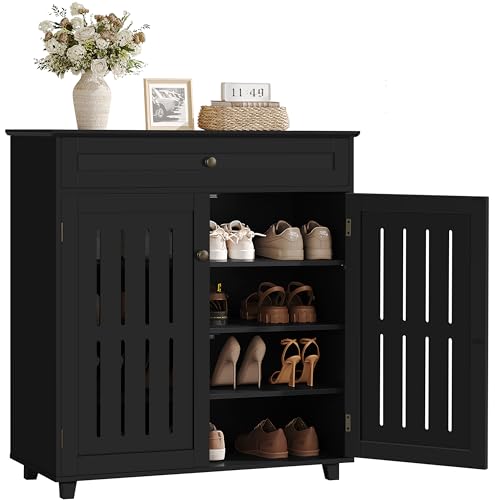
The VASAGLE Shoe Cabinet takes the shelf-cabinet route: hinged doors over interior shelves, in the warm, furniture-first styling the brand is known for. Shelves change the storage conversation — instead of tilted trays dictating what fits, you get level space that accepts trainers, heels, ankle boots and the odd shoebox, and adjustable or removable shelving on designs of this type lets one bay grow taller for boots. It asks for more depth than a flip-drawer unit and room for its doors to swing, so it suits a proper entryway, bedroom wall or closet rather than the slimmest corridor. The closed doors keep dust off and visual noise down, with the familiar ventilation caveat: store shoes dry and air the interior occasionally. Hardware and finish sit in the solid mid tier — the kind of cabinet that feels like furniture because it is built and finished like furniture. For households whose shoe mix defeated a flip drawer, this is the natural next step.
Best for: mixed shoe collections including ankle boots, and rooms with depth to spare. Not suited for: the narrowest hallways or anyone who cannot give doors swing room. Strengths: flexible shelf space; furniture styling; fits taller styles than flip drawers. Trade-offs: deeper footprint; door swing needs clearance; interior needs the usual airing habit.
HOMIDEC Shoe Cabinet — slim tipping-drawer cabinet
The HOMIDEC Shoe Cabinet represents the slim tipping-drawer school at its most straightforward: a tall, shallow, closed cabinet whose flip compartments swallow everyday low shoes while asking very little floor space in return. In prose terms it sits in the entry tier of this category — the kind of cabinet bought to solve a narrow hallway this weekend rather than to furnish a home for a decade — and judged on those terms it makes its case well. The closed front keeps a chaotic shoe collection visually silent, the tilted trays are quick to load one-handed while holding a bag, and the format suits flats, loafers, trainers and school shoes in the sizes most households wear daily. Its limits are the format’s limits, stated plainly: boots and high-tops do not fit the trays, capacity for bulky men’s trainers runs below the optimistic listing count, and the pivot hardware rewards gentle use. Anchored to the wall as every tall slim cabinet must be, it is a tidy, honest answer to a small entryway.
Best for: narrow hallways and small apartments storing mostly low everyday shoes. Not suited for: boot-heavy households or anyone wanting open airflow. Strengths: shallow footprint; closed, calm front; quick one-handed loading. Trade-offs: flip trays reject tall footwear; engineered panels dislike standing damp; hardware is entry-tier and prefers a gentle hand.

Yaheetech Shoe Rack Cabinet — tiered rack-style cabinet
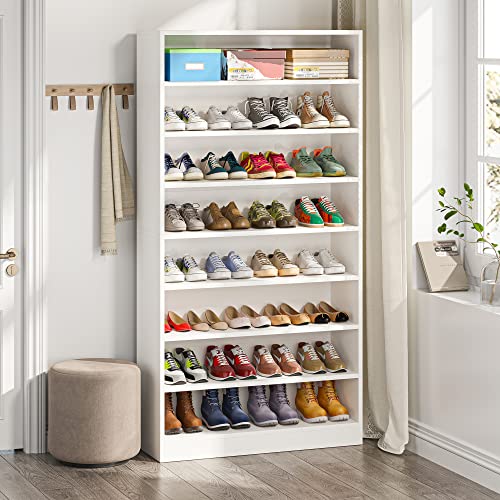
The Yaheetech Shoe Rack Cabinet leans toward the open, tiered end of the family — rack-style storage that prioritises airflow and instant access over a sealed, furniture-front look. That openness is a genuine feature for the right household: wet-weather trainers and work shoes dry instead of stewing, every pair is visible at a glance, and there are no mechanisms, pivots or doors between you and your shoes at seven in the morning. The trade-offs are equally genuine — dust settles, the look is utilitarian rather than calm, and a rack does nothing to hide a sprawling collection. Capacity in this format tends to be honest, because open tiers do not hide the space each pair takes, though tall boots still need a tier with real height. As a garage, utility or closet solution, or for a damp-climate hallway where drying matters more than appearances, this style earns its place in the line-up precisely by refusing to be a closed cabinet.
Best for: damp-heavy households, garages, closets, and anyone who values drying and access over looks. Not suited for: formal entryways where a hidden, furniture finish is the point. Strengths: best airflow of the group; no moving parts to wear; quick access. Trade-offs: dust settles on stored shoes; visual clutter stays visible; tall boots need a tall tier.
Read together, the three models map the pros-and-cons landscape: the shelf cabinet maximises flexibility and furniture presence at the price of depth; the flip-drawer cabinet maximises space efficiency at the price of tall footwear; the open rack maximises airflow at the price of looks and dust. There is no fourth option that escapes the triangle — every design in this category is a position inside it — which is why the honest question is never which cabinet has no cons, but which cons your household is best placed to live with.
How the Balance Shifts With the Seasons
A fair pros-and-cons account must admit that the balance is not static across the year. In spring and summer, the pros run the table: shoes are light, mostly dry, and fewer in daily rotation, so capacity feels generous, freshness manages itself, and the cabinet’s calm is effortless. Autumn tests the edges — the rotation grows, the first wet weeks arrive, and households learn whether their dry-shoe habit is real. Winter is the honest audit: boots demand their bay or their tray, damp tests the ventilation habits, grit tests the cleaning routine, and a cabinet that was sized for July reveals the truth in January. None of this indicts the cabinet; it indicts sizing and planning done in the easiest season. Weigh this category’s pros and cons as a winter purchase even if you buy in May — the households that do are the ones whose verdict stays positive all year, and the seasonal swing explains a share of the disappointed reviews every January from owners who bought a summer system for a winter life.
The same seasonal lens sharpens the alternatives comparison. An open rack’s cons — dust and display — matter least in winter when its pros, drying above all, matter most; a closed cabinet’s freshness con is at its annual peak in the wet months and nearly absent in the dry ones. Sophisticated households exploit the swing deliberately, running the rack for the winter working rotation and the cabinet for everything else, which is less a compromise than a recognition that the pros and cons were never properties of products at all, but of products in seasons, in households, in hallways. Choose with your hardest season in the room and the balance will hold in every other one.
A Note on Where These Pros and Cons Come From
The judgements in this article are deliberately drawn from the structure of the furniture rather than from any single household’s anecdote, because structure is what transfers to your home. A flip drawer’s exclusion of boots is not an opinion; it is geometry. A sealed cabinet’s moisture behaviour is not a complaint; it is physics, awaiting only your habits to decide its direction. Anchoring is not a preference; it is the difference between a tall box’s centre of gravity being your problem or the wall’s. Where this guide has weighed softer matters — calm, discipline, the feel of a hallway — it has said so and grounded them in the patterns owners report across the category rather than in one dramatic story. That method is itself the final pro-and-con lesson: weigh any product this way, by the properties that cannot change between the listing and your hallway, and the balance you strike on paper will be the balance you live with. Products disappoint when they are bought on the properties that do change — the photograph’s light, the showroom’s space, the first week’s enthusiasm. Buy on structure, and the pros and cons arrive as predicted.
There is a smaller, practical pair of entries that long-term owners add and short lists miss. On the pro side: a cabinet localises the smell and mess of shoes to one cleanable place, instead of distributing both across the hallway’s floor, rug and skirting — the room stays fresher even before the shoes do. On the con side: a cabinet concentrates risk in one object, so a spilled drink, a knocked panel or a failed hinge affects the whole system at once, where a pile of shoes is invulnerable to everything except tidiness. Neither entry changes the verdict, but both belong in a complete accounting, and both reward the same behaviours the rest of this article recommends — wipe the interior, mind the hardware, and let the wall carry the tall cabinet’s ambitions.
Beyond the Summary: How the Shoe Cabinet Trade-Offs Play Out at Home
Advantages and disadvantages read differently once an item is in daily use, so this section weighs the shoe cabinet the way a household experiences it over months rather than minutes. It focuses on the frictions, workarounds and quiet benefits that decide whether the balance stays positive.
Start With Your Space and Your Routine
Finally, judge the shoe cabinet against the life you actually lead this year, not the tidier or more ambitious life in the listing photographs, and the choice will usually make itself. If you shop with someone else, agree the must-haves together before looking, so that the shoe cabinet you choose is a shared decision rather than one person’s compromise discovered later. Keep the care routine simple enough to repeat: a shoe cabinet that needs ten minutes of attention weekly will usually get it, while one that needs an hour monthly often gets none. A good test is the two-week question: imagine the shoe cabinet after a fortnight of ordinary use, with no special effort from you, and ask whether you would still choose it.
The trade-off test worth doing is substitution: name what else could occupy the same space, budget of attention and storage as the shoe cabinet, and see whether the shoe cabinet still wins the comparison. Set the assembled shoe cabinet up fully before deciding it is wrong for the space, since partly built or badly positioned pieces often look worse than they will once finished and levelled. Apply the same checks to each shortlisted example, whether that is the VASAGLE Shoe Cabinet; the HOMIDEC Shoe Cabinet; the Yaheetech Shoe Rack Cabinet, because consistent testing is what makes the differences between models visible. Take a photograph of the space before you order and mark the intended position of the shoe cabinet on it, then revisit that photo whenever a listing tempts you toward a larger or different style.
If the shoe cabinet will be seen every day, its proportions matter as much as its function, so hold the listing dimensions up against a familiar piece nearby to judge the visual weight honestly. Keep the fittings, spare parts and instructions that come with the shoe cabinet together in one labelled place, because the part you need in a year is always the one that was put somewhere safe. Equally, list what your old shoe cabinet did well, because replacements sometimes quietly lose a virtue you relied on, such as a size, a shape or a simplicity the new model has redesigned away. Write down the three tasks you will do most often with the shoe cabinet and score each shortlisted option against those tasks alone, ignoring features you are unlikely to touch.
When Small Problems Appear
Check the dimensions given in the listing against your own measurements rather than relying on the room name in a photograph, since staged photos routinely make Living Room Furniture pieces look smaller than they are. The strongest argument for a shoe cabinet is usually a boring one, such as suiting the space exactly or being easy to keep clean, while the strongest argument against it is often an everyday friction rather than a dramatic flaw. Start by writing down the job the shoe cabinet has to do in your home, in one plain sentence, before you look at another listing, because a clear job statement turns a long shortlist into a short one. Consider the busiest version of the day, not the calmest one, and ask whether the shoe cabinet still works when people are hurrying, carrying things or sharing the same space.
Measure the space where the shoe cabinet will live, including the clearance needed to use it, move around it and clean behind or beneath it, and keep those numbers beside you while you compare options. Compare how each option handles the in-between moments, such as being half full, partly open, moved aside or used in a hurry, because daily life happens mostly in those moments. A shoe cabinet that fits on paper can still fail in daily use if a doorway, a corner, a cupboard door or a walkway cuts into the space it needs, so trace the full path from delivery to final position. If the listing offers accessories for the shoe cabinet, decide which ones solve a problem you already have, and set aside the ones that only solve problems the listing itself invented.
Decide in advance which single feature you would refuse to compromise on, and let that one priority settle ties between otherwise similar shoe cabinet choices. If a disadvantage of the shoe cabinet would appear daily and its advantage only occasionally, the honest balance tips against it for most households, however appealing the advantage looks in a listing. If a part of the shoe cabinet can be replaced, refreshed or re-covered separately, that option can extend its useful life well beyond the point where a sealed design would be thrown out.
A Short Decision Checklist
- What your current arrangement does well that the shoe cabinet must not lose
- Who will use the shoe cabinet most, and any limits they have
- Assembly needs, tools required and whether help is needed
- Packaging kept until the shoe cabinet has passed its first trial in place
- Where the shoe cabinet and its accessories will be stored when not in use
- The main job the shoe cabinet must do, written in one sentence
- The one feature you will not compromise on
- How the shoe cabinet will be cleaned in an ordinary week
Taken together, these checks take only a little time, yet they answer the questions that decide whether the shoe cabinet suits your home, your household and your routine, and they do so before money changes hands rather than after.
Frequently Asked Questions
What is the biggest disadvantage of a shoe cabinet?
For most households it is the gap between promised and real capacity, closely followed by tall-footwear exclusion. Listings count slim shoes in small sizes; real collections of trainers, larger sizes and boots hold noticeably fewer pairs, and flip drawers refuse boots entirely. Both disadvantages are avoidable before purchase: count your own pairs, audit your bulkiest daily shoes, and choose a format — usually a shelf cabinet with a tall bay — that your collection actually fits.
Do shoe cabinets make shoes smell?
A closed cabinet preserves whatever goes into it. Shoes stored dry, after a few hours of open air, keep a cabinet neutral; shoes stored wet make any sealed box musty over time. The fix is habit, not hardware: dry before storing, air the cabinet on dry days, and use a charcoal bag or moisture absorber in humid homes. Households with constantly damp footwear should weigh this con heavily and consider open storage for the wet rotation.
Are shoe cabinets safe for homes with children?
Yes, when two conditions are met. The cabinet must be anchored to the wall before use, because tall narrow units can tip when children pull drawers, hang on doors or climb. And flip-drawer pinch points should be taught and supervised with small children, who do best with low compartments of their own. With anchoring done and heavy shoes stored low, families consistently rate cabinets a safety improvement over the trip-hazard of a floor pile.
How long do shoe cabinets last?
It depends on tier and treatment more than on time. Entry-tier engineered cabinets under gentle, anchored, dry use serve for years; the same cabinet overfilled, unanchored and fed wet shoes loosens within a year or two. Mid-tier shelf cabinets with metal hardware last longest in family service. The habits that extend life are unglamorous: do not force mechanisms, tighten hinges and pivots twice a year, keep the interior dry, and confirm the wall anchor stays taut.
Is a shoe cabinet better than a shoe rack?
Better at some things, worse at others. The cabinet wins on appearance, dust protection, order and space efficiency; the rack wins on airflow, drying, access speed, simplicity and tall footwear. The honest answer follows your binding constraint — looks and order point to a cabinet, moisture and boots point to a rack — and many households run both, a cabinet for the tidy rotation and a rack or tray for the wet and tall pairs.
Can I avoid anchoring a shoe cabinet if it feels stable?
Feeling stable on assembly day is not the test — a cabinet is most dangerous when loaded unevenly, pulled by a child, or opened fully on an uneven floor, none of which a push test reproduces. Tall, narrow cabinets are top-heavy by design, and anchoring takes minutes with the supplied strap or a furniture anchor into a stud. If drilling is truly impossible, the safe answer is a low, wide cabinet loaded heaviest at the bottom, not an unanchored tall one.
Related Guides
best shoe racks for open storage