Disclosure: As an Amazon Associate, dailyhomedecorating.com earns from qualifying purchases. Links on this page are affiliate links; they cost you nothing extra. Prices and availability change often, so check the current Amazon listing before you buy.
Short answer first, because the question is a shoe cabinet worth it deserves one. Worth it if your entryway floor currently stores your shoes, your collection is mostly low and mid-height everyday pairs, and you will anchor the cabinet and store shoes dry — in that common case a shoe cabinet pays for itself in calm, time and protected footwear, and it pays daily. Not worth it if your household runs on tall boots and wet work shoes, if you cannot anchor a tall unit to a wall, or if your shoe count is small enough that a simple rack already keeps order — in those cases the money buys furniture that fights your life instead of organising it. Everything below is the working-out: what you actually get, the real costs beyond money, the households it pays off for, the ones it does not, and the checklist that settles the question for your home specifically.
Key Takeaways
Key takeaways: a shoe cabinet’s value is behavioural, not decorative — it converts a daily tidying chore into a system that runs itself. Its value collapses when the format mismatches the collection, because a cabinet that rejects your daily shoes stores only your indifference. The hidden costs are space, one assembly evening, anchoring, and the dry-shoe habit; the hidden returns are minutes saved daily, shoes protected from dust and pets, and an entryway that stops embarrassing you. Judge worth against your current system’s real cost — the pile, the hunt, the clutter — not against an imaginary tidy floor.
In this guide
What You Actually Get
You get, first, a hallway. That sounds like a slogan until you price the alternative: most entryways without shoe storage surrender their floor to a rotating exhibition of footwear, and the surrender is total — the space cannot be cleaned properly, decorated at all, or crossed gracefully with luggage, a pram or a tired child. A cabinet returns the floor and, with it, the room’s actual function as the home’s threshold and welcome.
You get time, in small daily instalments that add up embarrassingly well. The morning hunt for a matching pair, the evening negotiation about whose shoes are whose, the pre-guest scramble — a cabinet with assigned or obvious places deletes all three. Households consistently underestimate this return because each saving is under a minute; multiplied by every departure and arrival, every person, every day, it is the largest single return the purchase makes.
You get protection with a cash value of its own. Shoes are not cheap, and floor storage is hard on them: dust ground into fabric, sunlight fading leather, heels scuffed by passing feet and vacuum cleaners, and the ever-present interest of dogs. Closed storage removes all of it. A pair that lasts a season longer because it lived behind a door has repaid a visible slice of the cabinet, and across a household’s collection that effect repeats.
And you get a system that survives motivation. Every storage method works in the week it is bought; the question is month six. A cabinet’s doors, compartments and cubbies keep issuing their quiet instruction — shoes go here — long after the buyer’s enthusiasm has moved on. That durability of order, more than capacity or looks, is what owners are actually praising when they say the purchase was worth it a year later.
The Real Costs Beyond Money
The honest ledger has a second column. Space: a cabinet spends hallway depth permanently, and in a small home depth is currency — the purchase is only worth it if the floor it frees is worth more than the depth it takes, which is usually true and worth verifying by measurement rather than optimism. Effort: one assembly evening, done properly, with levelling and anchoring; households that resent flat-pack should count this cost at full weight, because a rushed build taxes you for years. Habits: closed storage asks that shoes go in dry and the interior be aired occasionally — a small tax, but a perpetual one, and households with constantly wet footwear pay it at a higher rate. Constraint: the format you choose fixes what can ever be stored; flip drawers will never accept boots, and that limit is part of the price. Opportunity: the same wall and budget could hold a bench, a rack or hooks — worth it is always relative to the best alternative for your constraint, not to nothing.
Treat every capacity claim on a shoe cabinet listing as optimistic. Makers count pairs using slim shoes in small sizes, perfectly nested, in every compartment including the ones real households reserve for boots or cleaning supplies. A cabinet advertised with a generous pair count may hold noticeably fewer once your household’s actual mix goes in: men’s sizes take more room than women’s flats, trainers are bulkier than sandals, and one pair of winter boots can consume a compartment a listing counted for several pairs. Flip drawers shrink usable capacity further because their tilted trays reject tall footwear entirely. The honest way to shop is to count your own shoes first — the pairs that genuinely need to live by the door, not the whole collection — and then assume any cabinet delivers somewhat less than its headline number for your mix. Leave headroom, too: a cabinet filled to one hundred percent is a cabinet nobody wants to open, and the overflow pair on the floor beside it is how entryway clutter restarts. Buying slightly more cabinet than your current count, in a format your bulkiest everyday shoes actually fit, beats buying the biggest number on the page.
Who It Pays Off For
The family with school shoes: the clearest win in the category. Multiple children generate a shoe sprawl no floor survives, and a compartmented cabinet converts the morning from search to routine. The payoff compounds with every child and every school day, and parents rate the purchase worth it at rates no other profile matches — provided the cabinet is anchored, heavy shoes sit low, and each child owns a compartment.
The small-home dweller: where floor space is the scarcest resource in the home, a slim cabinet’s vertical storage is close to alchemy — the hallway works again, and the home gains a room back. The payoff holds as long as the collection is mostly low shoes and the walkway still breathes with drawers open.
The shoe lover with a real collection: protection is the payoff. A wardrobe of good shoes stored behind doors, out of dust, light and pet reach, lasts visibly longer, and the cabinet doubles as the discipline that keeps the collection edited — when it no longer fits, something must leave, which collectors privately admit is a feature.
Who Should Skip It
The boot-and-weather household: if the daily rotation is wellies, work boots and wet trainers, closed storage fights your climate. You will store shoes damp because life is damp, the interior will turn musty, and tall footwear will not fit anyway. An open rack and a boot tray serve you better for less money, and this guide’s honesty requires saying the cabinet is not worth it for you — at least not as the primary system.
The household that cannot anchor: if your walls, lease or layout forbid fixing a tall cabinet, the safe versions of this purchase are low and wide, and if those do not suit your space, the worth-it answer may genuinely be no. An unanchored tall cabinet is not a bargain at any tier; it is a hazard with storage.
The minimal shoe owner: if your household’s entire collection is a handful of pairs and a small rack already keeps them orderly, a cabinet solves a problem you do not have. Furniture bought for an imaginary problem becomes the clutter it was meant to cure. Spend the money on the shoes instead.
Before anything else, the safety rule that shapes every tall shoe cabinet decision: a tall, narrow cabinet must be anchored to the wall. This is not optional fine print. A slim cabinet is deepest at its base only in the loosest sense — load the top shelves with heavy boots, let a child pull on an open flip drawer or climb a shelf to reach a hat, and the centre of gravity walks forward until the whole unit tips. Tip-over accidents with lightweight bedroom and hallway furniture are a well-documented household hazard, and entryway cabinets are exactly the tall, shallow, top-loaded shape that tips most easily. Every cabinet discussed in this guide should be fixed to a stud or a proper wall anchor with the anti-tip strap or bracket the maker supplies, or with a furniture strap you add yourself. If you rent and cannot drill, choose a low, wide cabinet instead of a tall slim one, load the heaviest shoes at the bottom, and never let children treat drawers as steps. Anchoring takes minutes, costs almost nothing, and turns a wobble-prone tower into a piece of furniture you can load without thinking about it. Do it on assembly day, not after the first scare, and re-check the strap whenever you move the cabinet for cleaning or redecorating.
The Strengths and Trade-Offs of Owning One
Strengths of ownership:
- Daily calm: the entryway stops displaying the collection, and arriving home feels different within a day of installation.
- Self-running order: compartments and doors keep issuing the instruction to tidy long after novelty fades.
- Protected footwear: dust, light, grit and pets are removed from your shoes’ lives, extending how long pairs stay presentable.
Trade-offs of ownership:
- Permanent footprint: the depth and wall are committed, and rearranging around an anchored cabinet takes intention.
- Managed freshness: dry-before-storing and occasional airing are perpetual small taxes on the household.
- Format ceiling: the collection the cabinet cannot hold — boots above all — still needs a home you must also provide.
Alternatives to Consider
Before deciding, price the alternatives in the same currency — order per effort. An open rack, represented in this guide’s wider coverage by the Yaheetech Shoe Rack Cabinet style, buys drying and access at the cost of looks. Over-the-door organisers buy storage with zero floor space and suit closet doors and small collections of light shoes. A storage bench buys the seat that boot-wearers use daily and accepts a modest capacity. And the zero-cost alternative deserves its hearing: a genuine clear-out, after which many households discover the storage they already own was sufficient all along. The cabinet is worth it when it beats the best of these for your constraint — not when it merely beats the pile.
best shoe racks for open storage
entryway benches for small spaces
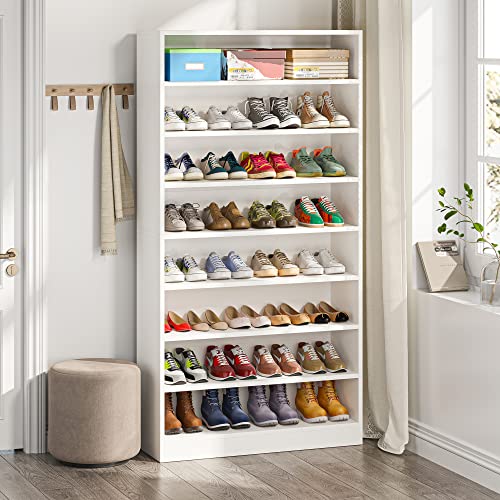
Shoe cabinets divide into a few honest families, and naming them clarifies every later decision. The flip-drawer or tipping-drawer cabinet is the slim specialist: shallow, tall, closed, brilliant for low shoes in narrow halls, useless for boots. The shelf cabinet with hinged doors is the generalist — adjustable shelves swallow trainers, heels and some boots, at the cost of more depth. The cubby cabinet divides space into fixed cells, which suits households that like assigned places and children who need simple systems, though fixed cells waste space on odd-shaped footwear. Open rack cabinets trade dust protection and looks for airflow and instant access, and remain the right answer for damp-heavy households. Bench cabinets add a seat — genuinely useful where people sit to lace boots — but seating height limits storage height. Most real products blend these families: a cabinet may pair flip drawers above with a shelf bay below, or doors over cubbies. Shop the blend that matches your shoe mix rather than the label, and check each compartment type against the shoes you actually own before falling for a handsome front.
How to Get the Most Value If You Buy
Value is maximised in the first week and defended thereafter. Measure and anchor on day one — the cabinet that is level, fixed and correctly placed starts paying immediately, while the one awaiting a free weekend pays nothing and risks everything. Assign places explicitly: a compartment or shelf per person, heavy and daily pairs at grab height, occasional shoes high or deep. Set the freshness routine while motivation is high — shoes dry before they go in, doors aired on the monthly clean, an absorber in the bottom compartment if your climate is humid. Keep the top disciplined with a tray for keys and post so the surface serves the routine instead of hosting a new pile. And run a seasonal edit: pairs that have not been worn leave the cabinet, keeping capacity honest and the system’s slack intact. A cabinet with slack is a system; a cabinet at one hundred percent is a dam about to leak shoes.
A shoe cabinet asks for little care, but the little it asks for matters. Wipe the interior shelves or trays monthly — grit carried in on soles is abrasive, and a gritty tray grinds finish off both the cabinet and your shoe heels. Vacuum the bottom compartment where dirt collects, and check the floor beneath during the same pass; damp trapped under a cabinet is invisible until it marks flooring. Keep the moisture rules from the ventilation discussion: dry shoes before storing, air the cabinet on a dry day now and then, and refresh any odour absorber before it saturates. Tighten hinges, handles and flip-drawer pivots a couple of times a year, and confirm the wall anchor is still taut — straps can slacken when a cabinet is nudged by vacuuming or enthusiastic children. Wipe exterior scuffs promptly; on foil and melamine finishes a scuff cleaned early is invisible, while one left to collect grime becomes permanent. Finally, resist the slow creep of using the top as a dumping shelf for post, keys and parcels: a clear top keeps the cabinet looking like furniture, and keeps weight off the part of the unit furthest from its base.
The Decision Checklist
Answer honestly; the pattern of answers is the verdict.
- Does footwear currently live on your entryway floor most days?
- Is your daily collection mostly low or mid-height shoes, with boots the exception rather than the rule?
- Can you anchor a tall cabinet to a wall — or choose a low, wide design instead?
- Will your household store shoes dry and air the cabinet occasionally?
- Have you measured, and does the walkway stay comfortable with drawers or doors open?
- Is a cabinet genuinely better for your constraint than a rack, bench or door organiser?
Mostly yes: buy it, in the format your bulkiest daily shoes fit, and it will be worth it within the month. Mostly no: the honest purchase is the alternative your answers point to. Split answers: fix the no that is fixable — the clear-out, the boot tray, the low design — and then decide.
Is a Shoe Cabinet Worth It? The Final Verdict
Is a shoe cabinet worth it? For the household drowning in entryway footwear with a wall it can anchor to, yes — emphatically, and the return arrives daily in calm, minutes and protected shoes. For the boot-heavy, damp-climate or anchor-forbidden household, no — and the money is better spent on open storage that suits the life actually lived. The question was never really about the cabinet. It is about whether your home matches the household this furniture was designed for, and now you have the checklist that answers it.
The Cost of Doing Nothing
Worth-it questions are usually asked as if the alternative were a tidy, cost-free status quo. It is worth pricing the status quo honestly, because for most households considering this purchase the alternative is the pile — and the pile has costs. It costs floor: the entryway cannot be used, cleaned or furnished properly while it is a shoe store. It costs time: the search for pairs, the moving of shoes to vacuum, the pre-guest scramble, repeated daily across every member of the household. It costs the shoes themselves: dust, fading, scuffs, pet damage and the slow crush of pairs stored under other pairs. And it costs something harder to invoice — the small daily friction of arriving home to disorder, and the impression your home makes on everyone who crosses the threshold, including you. A shoe cabinet does not need to be perfect to beat that ledger; it needs to fit your shoes and stand anchored. When people say the purchase was worth it within a month, this is the comparison they are making, whether they articulate it or not.
The Value Equation, Household by Household
Run the equation with rough honesty for your own home. On the value side: the minutes your household spends daily on shoe searching and shoe moving, multiplied across the year; the pairs whose condition closed storage protects; the entryway’s return as a usable, presentable room; and the tidying system that maintains itself. On the cost side: the purchase tier, the hallway depth committed, one assembly evening, and the small perpetual habits of dry storage and occasional tightening. For a family in a small home, the value side dwarfs the cost side — the equation is not close. For a single person with six pairs and a roomy hall, the sides approach each other, and the answer honestly depends on how much the visual calm is worth to that person. For the boot-heavy household, the value side shrinks because the cabinet cannot serve the main rotation, and the equation tips negative unless the format answers the boot question directly. The exercise takes ten minutes and a pencil, and it settles the worth-it question more reliably than any review — including, this guide freely admits, its own.
Three Cabinets, Three Worth-It Answers
HOMIDEC Shoe Cabinet — slim tipping-drawer cabinet
The HOMIDEC Shoe Cabinet represents the slim tipping-drawer school at its most straightforward: a tall, shallow, closed cabinet whose flip compartments swallow everyday low shoes while asking very little floor space in return. In prose terms it sits in the entry tier of this category — the kind of cabinet bought to solve a narrow hallway this weekend rather than to furnish a home for a decade — and judged on those terms it makes its case well. The closed front keeps a chaotic shoe collection visually silent, the tilted trays are quick to load one-handed while holding a bag, and the format suits flats, loafers, trainers and school shoes in the sizes most households wear daily. Its limits are the format’s limits, stated plainly: boots and high-tops do not fit the trays, capacity for bulky men’s trainers runs below the optimistic listing count, and the pivot hardware rewards gentle use. Anchored to the wall as every tall slim cabinet must be, it is a tidy, honest answer to a small entryway.
Best for: narrow hallways and small apartments storing mostly low everyday shoes. Not suited for: boot-heavy households or anyone wanting open airflow. Strengths: shallow footprint; closed, calm front; quick one-handed loading. Trade-offs: flip trays reject tall footwear; engineered panels dislike standing damp; hardware is entry-tier and prefers a gentle hand.

TRIBESIGNS Shoe Cabinet — larger cabinet with doors and drawer storage
The TRIBESIGNS Shoe Cabinet plays a different game from the slim flip-drawer pair above: it is a fuller piece of entryway furniture, combining closed shelving behind doors with drawer storage for the gloves, keys and clutter that share a hallway with shoes. That breadth makes it the family option in this line-up — more compartments, more varied spaces, and room for the shoe mix a household actually owns rather than only its flattest members. The cost is footprint: it needs a wall and floor area the slim cabinets do not, and in a narrow hall it would crowd the walkway it is meant to civilise. Assembly is a bigger job, too, simply because there is more cabinet. In return you get the generalist virtues — shelves that accept trainers and heels, closed storage that hides everything, and a top surface that works as a proper console. Anchor it, load heavy pairs low, and it anchors the entryway routine of a busy home.
Best for: families and larger entryways wanting one cabinet to hold shoes plus hallway clutter. Not suited for: narrow halls where depth is the binding constraint. Strengths: varied storage in one unit; furniture presence; shelves suit mixed footwear. Trade-offs: larger footprint; longer assembly; closed shelves still need dry-shoe discipline.

Yaheetech Shoe Rack Cabinet — tiered rack-style cabinet
The Yaheetech Shoe Rack Cabinet leans toward the open, tiered end of the family — rack-style storage that prioritises airflow and instant access over a sealed, furniture-front look. That openness is a genuine feature for the right household: wet-weather trainers and work shoes dry instead of stewing, every pair is visible at a glance, and there are no mechanisms, pivots or doors between you and your shoes at seven in the morning. The trade-offs are equally genuine — dust settles, the look is utilitarian rather than calm, and a rack does nothing to hide a sprawling collection. Capacity in this format tends to be honest, because open tiers do not hide the space each pair takes, though tall boots still need a tier with real height. As a garage, utility or closet solution, or for a damp-climate hallway where drying matters more than appearances, this style earns its place in the line-up precisely by refusing to be a closed cabinet.
Best for: damp-heavy households, garages, closets, and anyone who values drying and access over looks. Not suited for: formal entryways where a hidden, furniture finish is the point. Strengths: best airflow of the group; no moving parts to wear; quick access. Trade-offs: dust settles on stored shoes; visual clutter stays visible; tall boots need a tall tier.
The pattern across the three is the lesson. The slim flip-drawer cabinet is emphatically worth it to the narrow-hall, low-shoe household and close to worthless to the boot household — the same object, opposite verdicts, decided entirely by fit. The family cabinet is worth it where its footprint is available and its compartments match the household’s structure. The open rack cabinet is worth it precisely where the closed cabinet is not: where drying matters more than display. Worth, in this category, is not a property of products. It is a property of matches — and matches can be checked before money moves, with a tape measure, a shoe audit and the checklist in this guide.
What Changes After a Year
The worth-it verdict also has a time dimension worth stating. In the first week, the return is visual and slightly theatrical — the transformed hallway. By the third month, the return is behavioural: the system either runs itself or has been routed around, and households that assigned places and solved overflow honestly report that the cabinet has faded into infrastructure, which is the highest state entryway furniture can reach. By the first year, the return is protective and financial in the quiet sense: shoes in visibly better condition, hardware that has or has not justified its tier, and a hallway that has hosted a year of arrivals without a single shoe-pile incident. Owners whose cabinets reach that state stop evaluating the purchase entirely — it has crossed from expense to fixture. Owners whose cabinets failed, failed early and for the reasons this guide lists: wrong format, wrong size, no anchor, wet shoes. A year does not change the verdict; it reveals which purchase you actually made.
The Renter’s Version of the Question
Renters ask this question with an extra clause — is it worth it if I cannot drill, and if I may move within a couple of years? The honest answer reshapes rather than refuses the purchase. On anchoring: a tall cabinet you cannot fix to a wall is a cabinet you should not buy in tall form, but low, wide designs loaded heaviest at the bottom serve renters well, and some households place a cabinet inside a closet or alcove where its surroundings do part of the stabilising work. On moving: a cabinet that flat-packs back down, or that serves in the next home’s bedroom or closet even if its hallway differs, carries its value across addresses in a way a fitted solution cannot. On the deposit question: anchor holes in studs are small, fillable and, with a landlord’s permission asked in advance, rarely the drama tenants fear — many landlords prefer anchored furniture to the damage a fallen unit causes. The renter’s worth-it answer is therefore usually yes, with the format adjusted: portable, low or closet-placed, and chosen for a second home as well as the current one.
The Second-Hand and Hand-Me-Down Angle
One more value consideration rarely appears in worth-it discussions: shoe cabinets are among the most transferable pieces of furniture in a home. A sound cabinet outlasts the hallway it was bought for — it becomes a teenager’s bedroom storage, a garage organiser, a first-flat essential passed to a child leaving home, or a straightforward resale, because every household has shoes and hallways. That afterlife belongs in the equation. A mid-tier cabinet that serves five years by your door and five more somewhere else has halved its effective cost against a flimsier one that serves three years and then the tip. It is also an argument for buying the format your wider family or future self is likeliest to need — shelf cabinets transfer most flexibly, since their next owner inherits space rather than a mechanism matched to someone else’s shoes. Worth, properly counted, includes the years after your hallway is done with the thing, and on that count the well-chosen cabinet keeps paying long after the morning hunts it ended have been forgotten.
When the Answer Changes: Signs to Revisit the Decision
Finally, worth is not a verdict delivered once. Households change — children arrive and multiply the shoe count, a dog joins and raises the protection stakes, a move swaps a wide entryway for a narrow one, a new job replaces smart shoes with boots. Each change reopens the equation, and the right response is rarely to start again: it is to re-run the checklist in this guide against the new facts. A cabinet that stops being worth it usually fails on one identifiable line — capacity after a second child, format after the boots arrived — and the fix is targeted: a second small cabinet, a tray, a reallocation of compartments. The households that stay satisfied for a decade are not the ones that bought perfectly; they are the ones that treat the system as adjustable and revisit it when life edits the household. Keep the checklist, and the purchase stays worth it by maintenance rather than by luck.
The Environmental Footnote Worth Including
A complete worth-it account should include the footprint of the decision itself, in the plain sense: furniture is material, and buying furniture that fails is the wasteful outcome — a cabinet landfilled in year two because it never fit is worse, on every ledger including the environmental one, than a cabinet chosen carefully and used for a decade, or than no cabinet at all. This cuts in a direction some readers will not expect: it argues for the mid-tier, well-matched purchase over the cheapest available object, because durability and fit are what keep furniture in service and out of landfill. It argues, too, for the clear-out and the honest no — the household that decides against a cabinet after running the checklist has made the sustainable choice as well as the financial one. And it argues for passing cabinets on: a sound unit that no longer suits your hallway suits someone else’s, and furniture with a second life repays its making twice. Worth, counted fully, includes what happens to the thing itself — and a cabinet bought by the method in this guide is, on that count too, the one most likely to have been worth it.
The Gift and Household-Formation Angle
One situation deserves a direct word: the shoe cabinet as a purchase for a new household — the first flat, the newly shared home, the young family moving up. In that setting the worth-it calculation tilts further positive than the raw numbers suggest, because the cabinet is not only storage; it is one of the first systems a household builds, and systems built early compound. The couple that assigns compartments in their first hallway is rehearsing the cooperation every later room will need, and the family whose children grow up with a cabinet by the door inherits a tidiness norm that costs no willpower at all. There is also a plain practical tilt: new households are forming their shoe collections now, so a cabinet bought with headroom grows into its role instead of being outgrown by it. If the checklist in this guide answers mostly yes for a household just starting out, buy once, buy the format that fits, anchor it properly — and the purchase will be paying its quiet daily dividend long after the move that prompted it is a memory.
A Worked Example With Real Household Arithmetic
Make the equation concrete with a composite household drawn from the profiles in this guide: two adults, two children, a narrow hallway, twenty-two pairs in daily or weekly rotation, all but two of them low or mid-height, in a home where the floor pile has reigned for years. The daily shoe-related friction in that home is easy to estimate conservatively: a minute or two of searching and moving at each departure and arrival, multiplied across four people, plus a weekly pre-guest or pre-cleaning relocation of the entire pile. Across a year that friction sums to days of lived time — not an exaggeration, merely arithmetic nobody performs because the cost arrives in seconds. Against it, the cabinet asks for its tier, one assembly evening, a wall anchor, and two small habits. The shoes it protects, the hallway it returns and the arguments it deletes are, for this household, not marginal gains but the difference between an entrance that works and one that is apologised for. That is why the worth-it verdict for the profile is emphatic — and why the same arithmetic, run for the single minimalist with six pairs, returns a shrug. The numbers were never about the cabinet. They were always about the household, which is the entire thesis of this guide stated one final way.
The Psychology of the Threshold, Briefly
There is a reason the entryway punches above its square footage in every household’s emotional life, and it belongs in a complete worth-it account. The threshold is where the home is judged — by guests in the first seconds, and by residents at the exact moment of transition between the world’s demands and the home’s shelter. Disorder at that precise point colours both judgements disproportionately; a shoe pile is never just a shoe pile, it is the home’s opening sentence. A cabinet rewrites that sentence for a one-off cost and a few habits, which is why owners describe the purchase in language usually reserved for much larger renovations. Sceptics are entitled to discount psychology, but they should discount it knowingly: part of what this furniture buys is the feeling of arriving somewhere cared for, and for many households that feeling, repeated at every homecoming, is the largest single item on the value side of the ledger. The checklist in this guide decides the purchase on practical grounds; this section simply records that the practical grounds were never the whole story, and that the households who bought partly for the feeling report, a year later, that the feeling was the part that lasted.
And if, after all of this, you remain genuinely torn, there is a tiebreaker with a good track record: buy for the household you will be in twelve months, not the one in the mirror today. Children grow into bigger shoes and more of them; collections drift upward; hallways stay exactly the same size. A decision that looks marginal for today’s household is usually clearly right for next year’s, because every pressure in the equation — pairs, people, the value of a calm threshold — moves in the cabinet’s favour over time. Decide for the future household, and the present one will simply arrive at the answer early.
The Ownership Test: What a Shoe Cabinet Must Do Month After Month
Whether a shoe cabinet is worth it is rarely settled on the day it arrives, so this section judges value across ordinary weeks of ownership: how often it is used, what it replaces, what it costs in space and upkeep, and the point at which it has quietly paid for its place in the home.
Start With Your Space and Your Routine
Dust, moisture, sunlight and heat each age Living Room Furniture items in different ways, so match the finish and material of the shoe cabinet to the conditions of the room or outdoor spot it will occupy. Check the dimensions given in the listing against your own measurements rather than relying on the room name in a photograph, since staged photos routinely make Living Room Furniture pieces look smaller than they are. Beware of choosing a shoe cabinet for a rare occasion, such as a large gathering once a year, if that choice makes everyday use worse for the other fifty-one weeks. Where the shoe cabinet has a surface you will set things on, lean on, or load, consider the heaviest realistic load in your household rather than the lightest display load in the photos.
Count the hidden costs of owning the shoe cabinet as part of the worth question: the space it occupies, the accessories it needs, the cleaning it demands and the storage it takes when idle. Measure the space where the shoe cabinet will live, including the clearance needed to use it, move around it and clean behind or beneath it, and keep those numbers beside you while you compare options. Apply the same checks to each shortlisted example, whether that is the HOMIDEC Shoe Cabinet; the TRIBESIGNS Shoe Cabinet; the Yaheetech Shoe Rack Cabinet, because consistent testing is what makes the differences between models visible. The best shoe cabinet for a rented home may differ from the best for an owned one, because fixings, marks and alterations carry different consequences in each case.
Where the shoe cabinet meets the floor, the wall or another surface, check what protects both sides, because scuffs and marks in those contact zones are the most common early complaint. Finally, judge the shoe cabinet against the life you actually lead this year, not the tidier or more ambitious life in the listing photographs, and the choice will usually make itself. Keep the fittings, spare parts and instructions that come with the shoe cabinet together in one labelled place, because the part you need in a year is always the one that was put somewhere safe. Take a photograph of the space before you order and mark the intended position of the shoe cabinet on it, then revisit that photo whenever a listing tempts you toward a larger or different style.
When Small Problems Appear
Start by writing down the job the shoe cabinet has to do in your home, in one plain sentence, before you look at another listing, because a clear job statement turns a long shortlist into a short one. If you already own something that does part of the shoe cabinet’s job, judge the newcomer only on the improvement it adds, since paying twice for the same capability is where value usually leaks away. Consider the busiest version of the day, not the calmest one, and ask whether the shoe cabinet still works when people are hurrying, carrying things or sharing the same space. If the listing offers accessories for the shoe cabinet, decide which ones solve a problem you already have, and set aside the ones that only solve problems the listing itself invented.
Set the assembled shoe cabinet up fully before deciding it is wrong for the space, since partly built or badly positioned pieces often look worse than they will once finished and levelled. Plan where the packaging and any old item being replaced will go on delivery day, a small step that prevents a rushed, careless first setup of the new shoe cabinet. Photograph the shoe cabinet as delivered, before assembly or first use, so that any later question about condition, parts or finish can be answered from evidence rather than memory. If a part of the shoe cabinet can be replaced, refreshed or re-covered separately, that option can extend its useful life well beyond the point where a sealed design would be thrown out.
When something about the shoe cabinet starts to annoy you, note whether the cause is the product itself, its position, or the way it is being used, since each cause has a different and usually cheaper fix. A shoe cabinet earns its place when it removes a recurring irritation, and the clearest sign of value is noticing, a month later, that a small daily frustration has simply stopped happening.
A Short Decision Checklist
- The one feature you will not compromise on
- The material and finish, matched to light, moisture and wear in its spot
- Packaging kept until the shoe cabinet has passed its first trial in place
- The main job the shoe cabinet must do, written in one sentence
- Delivery path, from the door to the final position
- The measured space, including clearance to use and clean around the shoe cabinet
- How the shoe cabinet will be cleaned in an ordinary week
- What your current arrangement does badly that the shoe cabinet must fix
Taken together, these checks take only a little time, yet they answer the questions that decide whether the shoe cabinet suits your home, your household and your routine, and they do so before money changes hands rather than after.
Frequently Asked Questions
Is a shoe cabinet worth it for a small apartment?
Usually yes — small apartments gain the most, because floor space is their scarcest resource and a slim cabinet stores vertically what a pile stores horizontally. The conditions are a mostly low-shoe collection, a walkway that stays comfortable with drawers open, and wall anchoring for the tall slim unit. If your shoes are dominated by boots or your hall cannot spare any depth at all, a closet or over-the-door system may be the better small-space answer.
How long does a shoe cabinet take to pay for itself?
Not in cash — in accumulated small returns: minutes saved on every departure and arrival, shoes lasting longer out of dust and pet reach, and an entryway that needs no pre-guest scramble. Households feel the change within the first week and rate it worthwhile within the first month when the format fits their collection. The payback fails only when the cabinet does not fit the shoes, which is why measuring and counting matter more than the tier you buy.
Is a shoe cabinet worth it if I have lots of boots?
Only if you choose one with a genuinely tall bay — usually a shelf cabinet with a removable shelf — and even then, wet boots belong on a tray while they dry. A flip-drawer cabinet is never worth it for a boot household, because its trays exclude the footwear you wear most. Many boot owners land on a hybrid: a cabinet for the low and mid-height rotation, open tray storage for boots, each doing what it is good at.
What is the biggest hidden cost of a shoe cabinet?
Commitment. The cabinet takes hallway depth and a wall permanently, asks for one careful assembly evening with levelling and anchoring, and imposes two small perpetual habits — storing shoes dry and airing the interior occasionally. None of these is large, but they are real, and households that ignore them convert a good purchase into a wobbling, musty one. Count them in advance and they are simply the price of the calm the cabinet returns.
Should I buy a shoe cabinet or just declutter my shoes?
Declutter first, either way — it is the cheapest capacity in this category and it clarifies the real question. After a clear-out, count what remains and where it lives. If the survivors still colonise the floor, a cabinet sized to that honest number is worth it. If the survivors fit the storage you already own, the cabinet was never the answer and you have saved the money and the wall. The two moves are allies, not rivals.
Is a more expensive shoe cabinet worth it over a basic one?
In tier terms, the extra money buys hardware and finish: metal hinges and pivots that stay true, panels that shrug off scuffs, and a front that looks like furniture for longer. For a family cabinet opened many times a day, that durability is usually worth it. For a light-use hallway or a first apartment, a basic cabinet that fits and is properly anchored delivers most of the value. Fit and anchoring beat tier every time — spend on those first.
Related Guides
best shoe racks for open storage