Disclosure: As an Amazon Associate, dailyhomedecorating.com earns from qualifying purchases. Links on this page are affiliate links; they cost you nothing extra. Prices and availability change often, so check the current Amazon listing before you buy.
Learning how to choose sheer curtains comes down to five decisions made in the right order: how much light and privacy your window actually needs, which fabric family delivers it, what fullness and length to order, which header suits how you use the window, and which colour will still please you in a year. Get those five right and almost any well-made panel in the right family will satisfy you. Get the first one wrong, by buying an airy voile for a street-facing bathroom, and no amount of quality elsewhere rescues the purchase. This guide walks through each decision with the reasoning behind it, then shows the choices working in real rooms.
Key Takeaways
- Decide the light and privacy job first; fabric, colour and price tier follow from it.
- Plan roughly double fullness: gathered fabric screens and glows; flat fabric disappoints.
- Match the header to how often your hands move the panel each day.
- Linen-look weaves screen more and hide dust; classic voile passes more light.
- Test one panel on the real window before dressing the whole house.

What You Need to Know Before Comparing
Think of a sheer panel as a lampshade for the window. The fabric takes direct sun, which is intense, directional and full of glare, and returns it to the room as ambient light that bounces off walls and ceilings. That is why photographers like sheers, why houseplants that scorch on a bare sill often settle behind one, and why a home office with a sheer over the glass can be easier on the eyes than the same desk facing an uncovered window. The trade is real, though: on a very bright day a sheer alone will not give you a dark room for a nap or a film, and it was never designed to. Judge it as a light filter first, and everything else it does is a bonus.
Privacy also varies by distance and angle. A sheer gives good screening to a viewer far away and straight on, and much less to someone close to the glass or looking along the pane at an angle, such as a passer-by on a pavement directly outside a ground-floor window. Street-level rooms, bathrooms and bedrooms that face a footpath deserve the denser end of the sheer family, a linen-look or slubbed fabric, hung with generous fullness, ideally layered over a blind. Upper floors and windows facing a garden can happily use the airiest voile you can find. Matching the density to the sightline, rather than to a photo, is the single decision that decides whether owners love or regret this purchase.
Categorise sheers by weight in your hand as much as by name. The lightest voiles move with every draught, which is lovely in a bedroom and occasionally annoying beside a frequently opened door, where panels billow and catch. A slightly denser linen-look fabric hangs straighter, moves less and keeps its lines in a busy hallway or living room. If a panel will hang beside a door, a radiator cover or a piece of furniture it could brush against, choose the calmer fabric and consider a slightly shorter length. Fabric behaviour in a real, lived-in room matters more than fabric behaviour in a styled photograph, where nothing ever opens, closes or walks past.
In this guide
How to Choose Sheer Curtains in 6 Steps
Step 1: Define the Job Window by Window
Write down, for each window, the one job that matters most: glare control, daytime privacy, softening a view, or simply finishing the look. Then note the direction the window faces and what faces it, a garden, a pavement or a neighbour’s kitchen. South and west windows need glare thinking; street-level windows need density thinking; garden-facing upper windows need almost none. This ten-minute audit is the difference between a fabric that fits and a fabric that almost fits, and it costs nothing. Households that skip it tend to buy one fabric for every window and then wonder why two rooms love it and two rooms do not.
Step 2: Pick the Fabric Family
The sheer family splits into three broad fabrics. Classic voile is smooth, fine and floaty, with a clean, almost glassy fall; it suits modern rooms and layers invisibly under heavier drapes. Linen-look sheers are woven from synthetic yarns that imitate the slub, texture and matte finish of flax; they read warmer and more substantial, hide dust and creases better, and give a little more privacy, at the cost of a slightly heavier look. Decorative sheers add embroidery, woven stripes, burnout patterns or a subtle metallic thread; they are the focal point of the window rather than a neutral backdrop, and they reward simple furniture around them. None of these is objectively best. Voile disappears, linen-look grounds a room, and patterned sheers decorate it, so choose by the role the window plays.
Most sheer panels sold today are polyester, and that is a practical advantage rather than a compromise. Polyester voile resists shrinking, tolerates gentle machine washing, dries quickly, holds its colour in strong sun far better than many natural fibres and comes out of the packet with creases that often steam away while the panel hangs. Real linen sheers exist and have a beautiful irregular texture, but they crease readily, can shrink if washed carelessly and usually cost more in the premium tier. Cotton voile sits between the two, soft and natural feeling, a little less forgiving of sun and washing. For a first set of sheers, a good polyester voile or linen-look panel is the low-risk choice; upgrade to natural fibres once you know the look you want.
Step 3: Set the Density and Colour
How much light a sheer lets through depends on weave density, colour and how much the fabric is gathered. A loose, open voile in white passes the most light and gives the least privacy. A tighter linen-look weave in a warm grey or flax tone passes noticeably less and reads more solid from the street. Gathering matters more than most buyers expect: a panel hung flat is at its most transparent, while the same panel gathered to twice its flat width overlaps itself, deepening the colour, softening the view through it and cutting glare further. When you compare two sheers, compare them gathered, on a window, in daylight, not folded in a packet under shop lighting.
Colour choice for sheers is really a light choice. White gives the brightest, cleanest diffusion and the classic look, and it can read slightly cool in a north-facing room. Ivory, cream and soft ecru warm the light, flatter wood and traditional schemes, and hide the first hint of dust better than brilliant white. Pale grey and stone tones suit contemporary rooms and pair well with blackout drapes in charcoal or navy. Strong colours in a sheer are a commitment: a blush or sage panel tints the whole room’s daylight, which can be delightful in a bedroom and distracting in a room where you judge colours for work or hobbies. When in doubt, order the neutral, live with it, and let cushions carry the colour instead.
Step 4: Measure for Fullness and Length
Measuring for sheers follows the same rules as measuring for any curtain, with one difference: fullness matters more, because a sheer stretched flat looks thin, patchy and far more transparent than the same fabric properly gathered. Start with width. Measure the rod or track, not the window frame, then plan for the fabric to be roughly twice that width in total, so the panels fold into soft, even waves. Two panels each about one and a half times half the rod width is a common, forgiving arrangement. Too little fabric is the most common sheer mistake of all; it cannot be fixed afterwards except by buying another panel, which, fortunately, is easy with sheers because panels are usually sold singly or in pairs and match well.
Length is a style decision with practical edges. Sill length suits kitchens, bathrooms and windows above radiators or furniture. Apron length, ending a little below the sill, tidies a window without touching the floor. Floor length is the look most people picture: panels that just kiss the floor look tailored, while a small puddle looks romantic in a quiet bedroom and impractical everywhere else. For sheers, kissing the floor usually wins, because translucent fabric shows dust along a hem and a puddle of pale voile on a busy floor greys quickly. Measure from the top of the rod to the floor in three places, because floors slope, and work to the shortest measurement so the panel never drags.
Step 5: Choose the Header and Hardware Together
The header is how a sheer meets its rod, and it decides both the look and the daily handling. Grommet panels thread straight onto a rod, slide easily and fall in big, regular folds; they suit wide windows that get opened and closed often. Rod pocket panels gather tightly on the rod, giving a soft, traditional, very full look, but they resist sliding, so they suit windows where the sheers mostly stay put. Back-tab and tab-top styles sit between the two, tidier than a pocket, softer than a grommet. Pinch pleats and wave headings on a track give the most tailored, hotel-like finish and the smoothest glide, and they belong to the premium end of the market. Match the header to how often your hands will actually move the panel.
Hardware and header must be planned together. Grommets need a rod slim enough to pass through them with room to move, and the rod colour shows through the rings, so it becomes part of the design. Rod pockets hide most of the rod and forgive a plain one. A double rod is the classic layered solution, sheers on the back rod and heavier drapes in front, each moving independently. Tracks and ceiling-mounted rails make wide or awkward windows feel architectural and keep the fabric line unbroken. None of this needs to be expensive to work well, but it does need to be decided in one pass: header, rod, brackets and length are a single system, not four separate purchases.
Rod position changes the whole result. Mounting the rod a few inches above the frame and wider than the frame makes the window read larger, lets the gathered sheers sit over the wall rather than the glass when open, and keeps more daylight available. Inside a deep reveal, a tension rod or a slim track gives a neat, layered look, especially with a heavier curtain in front. Whatever you choose, fix the rod first, or at least decide its exact height, before you order lengths. Ordering fabric before the hardware position is settled is how households end up with panels that are two inches too short and no patience left to exchange them.
Step 6: Plan the Second Layer and the Safety Details
Layering is where sheers earn their keep in a layered window scheme. The classic arrangement is a sheer closest to the glass for daytime light and privacy, with a heavier, lined or blackout curtain in front for night, warmth and darkness. Each layer does the job it is good at, and neither is asked to do the other one’s work. A roller or Roman blind can play the second role instead, sitting inside the reveal while the sheer softens the whole opening. Layering also solves the colour problem: a white or ivory sheer is a neutral base that lets you change the front curtain with the seasons or the sofa, without re-doing the whole window.
Decide now, not after the first evening, what covers the window at night in bedrooms and street-facing rooms, even if you buy that layer later. At the same time, settle the safety layout: cordless hanging where children sleep or play, cleats fitted for any blind cords on the same window, lengths that do not pool in play areas, and panels hung well clear of heaters and flames. Planning these two unglamorous items at the choosing stage is what separates a window that works from a window that merely photographs well.
Gear for This Guide: Panels by Tier

MIULEE Sheer Curtains
Best for: everyday voile panels in many sizes, made for layering and multi-window homes. Tier: entry — check price on Amazon for the current listing. Not suited for: rooms that need darkness or night-time privacy from a single layer.
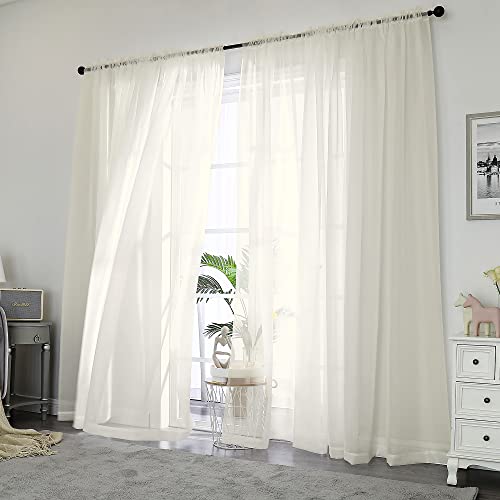
MIULEE sheers are the practical workhorse option: plain voile panels offered in a broad spread of widths and lengths, which makes them easy to match across a whole home and easy to layer behind blackout or lined curtains on a double rod. The fabric is light, neutral and unobtrusive, so the front curtain in a layered pair gets all the attention while the MIULEE panel quietly handles daylight and daytime privacy behind it. That makes the line a sensible default for landlords, new movers and anyone facing a wall of bare windows on a schedule. The honest limitation is character: plain entry voile will not add texture or pattern to a room, and like all light voiles it is more transparent at night than newcomers expect. Choose it for coverage, layering and consistency; skip it if the sheer itself needs to carry the room’s style.

H.VERSAILTEX Linen Sheer Curtains
Best for: linen-look textured panels with a warmer, more substantial hand. Tier: mid — check price on Amazon for the current listing. Not suited for: rooms that need darkness or night-time privacy from a single layer.
The H.VERSAILTEX linen sheer line is for people who find classic voile a little too glassy and thin. The linen-look weave brings visible texture, a matte finish and a slightly weightier fall, so the panels read as part of the furnishing rather than as a film over the glass. That texture buys a little extra daytime privacy, hides dust and minor creases gracefully, and pairs naturally with wood, rattan, wool throws and other matte materials. It suits living rooms and bedrooms in relaxed, natural schemes, and homes that want one fabric to work across several rooms. The limitation is light: a denser weave passes a little less of it, and in a dark, north-facing room the difference is noticeable by late afternoon. Choose it for warmth, texture and screening; skip it if maximum brightness is the whole point of the purchase.
NICETOWN Sheer Curtains
Best for: voile panels with a clean, simple finish and easy-sliding grommet options. Tier: entry — check price on Amazon for the current listing. Not suited for: rooms that need darkness or night-time privacy from a single layer.
The NICETOWN sheer line is the name many households meet first, and it earns that position by being straightforward: light voile panels, a wide choice of lengths and colours, and headers that go up on a standard rod in minutes. In a living room the fabric reads bright and neutral, the folds fall evenly once the panels have hung for a day, and the overall effect is the classic sheer look without any fuss or decoration competing with the room. It suits first-time sheer buyers, renters and anyone dressing several windows at once who wants one consistent fabric throughout the home. The honest limitation is that an entry-tier voile is at the transparent end of the family, so street-facing rooms will want generous fullness or a second layer for the evening. Choose it for bright, easy, everyday coverage; skip it if you want texture, pattern or a heavier, more private weave.
Lush Decor Sheer Curtains
Best for: decorative sheers with pattern, texture and a more designed finish. Tier: premium decorative — check price on Amazon for the current listing. Not suited for: rooms that need darkness or night-time privacy from a single layer.
Lush Decor treats the sheer as decoration rather than background, with patterned, textured and embellished designs that make the window a feature of the room. Hung in a plain room with simple furniture, a patterned sheer does the work that artwork does elsewhere: it adds movement, softness and a deliberate style note, while still filtering light like any sheer. This is the pick for a dining room, a guest bedroom or a living room that feels finished except at the window. The trade-offs are commitment and care: a bold pattern dates faster than a plain voile, dictates more of the room’s palette, and delicate embellished fabrics deserve gentler washing. Choose Lush Decor when the window should be seen; skip it when you want the curtain to disappear and let something else lead the room.
Common Mistakes
The classic mistake is ordering too little fabric, then hanging sheers flat and concluding that sheers are too transparent; the fabric was fine and the fullness was not. Next comes choosing by packet colour under artificial light, which misjudges both colour and density; always judge a sheer hanging against daylight. Third is forgetting the evening entirely and discovering the privacy reversal in front of the neighbours. Fourth is mixing lengths across one wall of windows, which looks accidental no matter how good each panel is. Fifth is hanging a long, floaty panel where it can drift across a heater or be pulled by a child or a pet. Every one of these is a planning error, not a product error, and every one is avoidable in the choosing hour.
Pro Tips
Order samples or a single panel first whenever the window is large or the room matters to you. Sheers are unusually hard to judge from a screen, because their whole character is how they behave against light, and a fabric that looks flat grey in a listing can glow warm on a sunny window. Hang the sample at different times of day, look at it from the street as well as from the sofa, and check it against the wall colour with the lamps on in the evening. One panel bought and tested is far cheaper than a full set returned, and with sheers the test panel can usually join the final set if the colour proves right.
Buy one extra panel for the sunniest window in the house. It lets you rotate panels to even out sun wear, covers you instantly if one panel is damaged, and solves the too-skimpy window without a second order. Keep the packaging or a note of the exact line and colour with your household paperwork, because sheer lines run for years and a matching panel bought later is far better than a near-match. Finally, steam or hang panels for a full day before judging the folds; fresh-from-packet creases make good fabric look cheap for the first twenty-four hours and then disappear.
Worked Examples
A west-facing home office with screen glare needs classic voile, white or ivory, grommet header for daily sliding, generous fullness to scatter the afternoon sun, and no second layer unless video calls run into the evening. A ground-floor bedroom on a pavement needs a linen-look weave in a warm mid tone, sill-to-floor length only if the rod is secure and the room is not a child’s play space, plus a blackout layer for the night, chosen at the same time. A rented flat with a large living-room window needs a tension rod, two pairs of entry voile panels for fullness, and a colour that suits both the current sofa and the next flat. Three rooms, three different right answers, one method: job, fabric, fullness, header, layer.
Safety First: Cords, Children, Heat and Secure Fixings
Window coverings and child safety belong in every sheer curtain conversation, because the danger is not the fabric, it is the cords and hardware around it. Loose cords from blinds, corded tracks and tie-backs can form loops, and loops are a strangulation hazard for babies and young children. Keep every cord well out of reach, fit a cleat high on the wall and wrap cords around it every single time, use cord tidies or tensioners where a blind shares the window, and never place a cot, bed, highchair or play area within reach of a cord. Where you can, choose cordless options: a simple rod with grommet or rod-pocket sheers has no operating cord at all, which is one more reason sheers on a plain rod are a sensible choice in a child’s room.
Length and placement matter for safety too. In rooms where small children play, avoid long panels that pool on the floor where they can be pulled, climbed on or wrapped in, and keep the hem at sill or just-below-sill length, or floor length only where the rod is firmly fixed and the fabric cannot be pulled down. Use a tension rod inside the reveal or a securely bracketed rod, check brackets and screws periodically, and move furniture that children climb on away from the window. A rod that falls is a hazard in itself, so fix into studs or use proper wall anchors for the wall type, and never rely on adhesive fixings for a long or heavy layered arrangement.
Fire safety is simpler and just as non-negotiable. Sheer fabrics are light and can move in a draught, so keep panels well away from candles, open fires, portable heaters, hobs and any naked flame, and never let a sheer hang where it can blow across a heat source when a window is open. In kitchens, choose shorter lengths that end well above worktop level and away from the cooker. If fire performance matters for a particular room, look for fabrics described by their maker as flame retardant and follow that maker’s guidance, rather than assuming any curtain fabric is treated. Distance from heat is the rule that does most of the work.
Revisit this checklist whenever you change the window treatment, move furniture in a child’s room or add a blind or tie-back to the same window. Habits, not hardware alone, keep cords tidy: a cleat only works if every adult in the house wraps the cord every time, and a tension rod only stays safe if it is checked when the seasons change and the panels come down for washing. Build the safe routine on the day the sheers go up, while the ladder is still out.
Choosing for Special Windows
Bay and bow windows reward sheers and punish guesswork. The fabric has to turn corners without bunching into the angles or leaving triangular gaps of bare glass at each bend. A flexible track or a rod joined at the angles keeps the line continuous, and panels gathered evenly across the whole span look calm rather than crowded. Measure each section of the bay separately, add the widths together, then apply the same fullness rule to the total. Sit in the bay seat, if there is one, and check the view at seated eye level, because a bay is usually read from inside at sitting height, not standing. Done well, a sheered bay becomes the softest seat in the house, bright without glare and private without curtains drawn against the day.
Sliding doors and wide patio glass are the other special case. Panels must travel clear of the opening side, stack neatly without eating the doorway, and survive being brushed past daily. Grommet headers on a sturdy rod, or a track with a smooth glide, suit doors far better than a clinging rod pocket. Length should kiss the floor and no more, because a hem dragged by a sliding panel or stepped on at the threshold wears and dirties quickly. Consider splitting the fabric so the moving side stacks over the fixed panel of glass, keeping the walkway completely clear. Households that plan the traffic path first are the ones still pleased with door sheers a year later.
Kitchen sheers deserve their own rules. Fabric near cooking collects grease vapour invisibly and yellows from the top down as much as the hem up, so kitchen panels should be the easiest-washing set in the house and on the shortest wash cycle of any room. Keep them short, sill length or cafe style, and well away from the hob and any open flame, with nothing floaty within reach of a pan handle or a draught that could carry fabric toward heat. A bright kitchen with a clean voile over the sink window is one of the pleasures of the category; a long panel drifting near a cooker is the category’s clearest misuse. Room rules, applied firmly, keep the pleasure and remove the misuse.
Bathroom sheers live with moisture, so choose synthetic weaves that shrug off humidity, dry quickly and resist the mildew that natural fibres can invite in a steamy room. Ventilation matters more than fabric: a sheer in a bathroom with an extractor or an opening window stays fresh, while any fabric in a sealed steamy box will suffer. Privacy density matters most here of all rooms, so test the panel at night with the bathroom lit, from outside if you possibly can, and add frosted film or a blind without hesitation if the test fails. A bathroom is the one room where a sheer’s limits should be given no benefit of the doubt.
Style Direction: What Looks Current and What Looks Dated
Stylistically, the modern sheer is fuller, longer and quieter than the net curtain it replaced in most people’s minds. The dated look was skimpy, short and shiny; the current look is generous fabric, a matte or lightly textured weave, and a hem that meets the floor with intention. Wave-style folds on a track give the most architectural result, grommets give relaxed regularity, and a gathered pocket gives softness. Colour has settled toward warm whites, ivory, flax and pale stone, tones that flatter daylight rather than fighting it. None of this requires a premium budget; it requires fullness, length and restraint, which are planning choices available at every tier of the market.
Small details separate a good sheer installation from a merely adequate one. Hems should be even and weighted enough to hang straight without swinging at every draught. The top of the panel should sit close under the rod or track so no harsh stripe of bare glass shows above the fabric. Where two panels meet in the middle, a slight overlap prevents the tell-tale bright vertical line that draws the eye. Side edges should return to the wall or frame rather than curling outward, which a day of hanging and a gentle steam usually settles. None of these details costs money; all of them are visible from the sofa, which is where the result is actually judged.
Six Myths That Lead Buyers Astray
Myth: Sheers Cannot Be Machine Washed
Most polyester sheers wash gently and well, and the fear of washing them causes more damage, in the form of ingrained grime, than washing ever does. The rules are simple: remove hardware, use a mesh bag, choose a gentle cool cycle, keep harsh bleach away from white voile, and rehang slightly damp so gravity finishes the pressing. Delicate embroidered designs deserve extra gentleness or hand washing. Check the individual care label, then wash without anxiety.
Myth: Expensive Sheers Are Always Better Sheers
Price in this category buys texture, design, natural fibres and refined headers more reliably than it buys function. An entry voile with proper fullness outperforms a premium panel hung flat on every measure that matters day to day: glow, screening and finish. Spend first on enough fabric, then on the header you will enjoy using, then on texture or pattern if the room asks for it. That order of spending is the closest thing the category has to a secret.
Myth: Sheers Make Rooms Look Smaller
The opposite is usually true. Bare glass with a hard frame can chop a wall into pieces, while a continuous run of soft fabric, hung high and wide, makes the wall read as one calm surface and the window as larger than it is. Sheers also keep a room bright, and bright rooms read as bigger rooms. The exceptions are dark, heavy colours and fussy patterns in a small space, which is why the pale, plain end of the range is the small-room recommendation.
The Room-by-Room Choosing Playbook
Kitchen Playbook
In the kitchen, short and washable wins every argument. A sill-length or cafe panel over the sink window keeps the worktop bright, screens the washing-up hour from the street and stays clear of water, heat and flame. Choose the easiest-care fabric you can find, expect to wash it more often than any other panel in the house, and keep a second panel ready if the kitchen is the heart of the home, so a wash day never leaves the window bare. Nothing about a kitchen sheer should be precious; its charm is that it works hard, washes easily and asks for nothing.
Bathroom Playbook
In the bathroom, density and moisture behaviour decide everything. Choose a synthetic weave that dries quickly, hang it where ventilation reaches it, and test its privacy honestly at night with the room lit. If the test is even slightly doubtful, add frosted film to the lower pane or a blind and let the sheer soften the result; bathrooms are where optimism about fabric goes to be punished. Keep panels clear of shower spray where you can, and favour shorter lengths that stay away from wet floors and bath edges. Privacy first, prettiness second, is the bathroom rule.
Nursery and Children’s Room Playbook
In children’s rooms the specification writes itself: cordless, secure, washable and calm. A plain rod, a length that stays out of the play zone, brackets fixed into solid material, and furniture placed away from the window cover the safety ground. For light, pair the sheer with a proper blackout layer for naps and early summer mornings, fitted so its own cords, if any, are cleated high and out of reach, or choose a cordless blackout option outright. Choose a fabric that washes without drama, because it will. The sheer’s softness suits the room; the discipline around it is what makes it suitable.
The Seven-Day Sample Test
Day one, hang the test panel and live with it without judging; fresh creases and novelty distort everything. Day two, check the morning: how does the room wake up, and is the light softer where you sit? Day three, check the working hours, screens, reading and plants, at the brightest time the window offers. Day four, stand outside in daylight and read the privacy honestly from the distances your neighbours and street actually keep. Day five, repeat that check at night with the lamps on, and write down which second layer the room needs, if any.
Day six, take the panel down and wash it exactly as the label allows, then rehang it slightly damp and watch the creases fall. A fabric that survives its first wash gracefully will survive the fiftieth conversation about it. Day seven, decide with the whole week in view: light, privacy, evenings, care and the look from the sofa. This slow test feels excessive for an inexpensive panel until you multiply it by every window in a house. One week on one panel protects every other window from a hasty, matching mistake, and the test panel joins the final set whenever the verdict is yes.
If the test fails, fail precisely. Too transparent means move up a density, not abandon sheers. Too dim means move from linen-look to voile. Too fussy means plainer fabric; too plain means texture. A failed sample that tells you exactly which dial to turn is a successful test, because the second panel is then a correction rather than another guess. Keep notes on the week in your phone; future rooms in future homes will thank you for the record of what your light actually does.
The Choosing Checklist, Condensed
Before ordering anything, walk each window with a phone in hand and note five things: what faces the glass, which hours hurt, whether the room is used after dark, what heat sources sit nearby, and whether children sleep or play there. Those five notes choose the fabric family, the density, the length, the header and the second layer more reliably than any amount of scrolling through listings. Photograph each window at its worst hour as well; the photo will argue with your memory later, and the photo will be right.
- Job first: glare, privacy, finish, or a named combination.
- Fabric second: voile for light, linen-look for texture and screening, decorative for features.
- Fullness always: roughly double the rod width, gathered.
- Header for habits: sliding for daily use, gathered for still windows.
- Length for the room: floor-kissing in calm rooms, short near heat, water and play.
- Evening planned: a named second layer for bedrooms and street-facing rooms.
- Safety settled: cordless hanging, secure fixings, cords cleated high.
Work the list in order and the market narrows itself. What remains is a shortlist of honest panels in the right family, and choosing among them is a matter of taste in texture and tone, which is exactly where a buying decision should end up.
A Word on Ordering More Than One Room
When several rooms pass the sample test, order room by room rather than in one heroic basket. Windows differ in width, drop and aspect even inside one house, and a list built window by window, with each rod measured and each length named, prevents the classic muddle of panels that almost fit everywhere and fit nowhere. Keep each room’s panels together when they arrive, label them with painter’s tape on the packaging, and hang one room completely before opening the next room’s parcel. The method is slower by an hour and faster by every measure that includes mistakes, returns and second orders.
The Deciding Sentence
If you remember one sentence, make it this one: choose the fabric for the window’s worst hour, not its best photograph. The worst hour reveals the density, the fullness, the header and the layer a window truly needs, and a sheer chosen for that hour performs beautifully in all the easier ones. Take the worst-hour photograph, work the checklist in order, test one panel for a week, and the choosing is done properly, once, for every window that follows the same rule.
Finally, trust the order of the decisions more than any individual answer. A buyer who settles the job, then the fabric, then the fullness, then the header, then the layer will land close to right even with imperfect information, because each step narrows the next. A buyer who starts with colour and works backwards has to be lucky. Method, in this category, is the closest thing to a guarantee that choosing well can offer.
From First Step to Final Check: Working Well With a Sheer Curtains
The main steps for the sheer curtains are covered above; what follows is the working discipline around those steps, covering preparation, order of work, the checks that catch mistakes early and the small follow-up habits that keep the result sound. It is written for real homes, where interruptions and imperfect spaces are normal.
Start With Your Space and Your Routine
Households with children or pets put different demands on a sheer curtains than the listing photographs suggest, so judge edges, stability and cleanability against your real household, not a styled one. A good test is the two-week question: imagine the sheer curtains after a fortnight of ordinary use, with no special effort from you, and ask whether you would still choose it. Storage is part of ownership, so decide now where the sheer curtains, its accessories and its seasonal extras will go when they are not in use, and measure that space too. Where the sheer curtains has moving parts, work them through their full range during your first checks, listening and feeling for roughness that a photograph cannot show.
Keep the area around the sheer curtains clear while you work and for a short while afterwards, so that nothing is knocked, spilled or leaned on before everything has settled, dried or been secured. Plan where the packaging and any old item being replaced will go on delivery day, a small step that prevents a rushed, careless first setup of the new sheer curtains. Apply the same checks to each shortlisted example, whether that is the NICETOWN Sheer Curtains; the H.VERSAILTEX Linen Sheer Curtains; the MIULEE Sheer Curtains, because consistent testing is what makes the differences between models visible. A return is easiest when you have kept the packaging until you are sure, so give the sheer curtains a fair trial period in its real position before you break down boxes and dispose of padding.
When Small Problems Appear
Ask how the sheer curtains will be cleaned on an ordinary week, with the products and time you actually have, not with a special routine you are unlikely to keep up. Beware of choosing a sheer curtains for a rare occasion, such as a large gathering once a year, if that choice makes everyday use worse for the other fifty-one weeks. If two options look nearly identical, compare the parts you will touch every day, since those contact points decide whether a sheer curtains feels solid or flimsy after the novelty wears off. Consider the busiest version of the day, not the calmest one, and ask whether the sheer curtains still works when people are hurrying, carrying things or sharing the same space.
A slight wobble, a stiff action or a small misalignment on day one rarely improves on its own, so address it during setup while adjustments are still easy to make. When you have finished, run one deliberate test of the sheer curtains doing its ordinary job, and fix small issues immediately while the steps and the tools are still fresh in your mind. Check the dimensions given in the listing against your own measurements rather than relying on the room name in a photograph, since staged photos routinely make Home Decor & Lighting pieces look smaller than they are. Think about the season in which the sheer curtains will work hardest, and judge it against that season rather than the mild week in which you happen to be shopping.
Take a photograph of the space before you order and mark the intended position of the sheer curtains on it, then revisit that photo whenever a listing tempts you toward a larger or different style. Keep the fittings, spare parts and instructions that come with the sheer curtains together in one labelled place, because the part you need in a year is always the one that was put somewhere safe.
A Short Decision Checklist
- What your current arrangement does badly that the sheer curtains must fix
- The main job the sheer curtains must do, written in one sentence
- Assembly needs, tools required and whether help is needed
- How the sheer curtains will be cleaned in an ordinary week
- What your current arrangement does well that the sheer curtains must not lose
- Packaging kept until the sheer curtains has passed its first trial in place
- The measured space, including clearance to use and clean around the sheer curtains
- Who will use the sheer curtains most, and any limits they have
Taken together, these checks take only a little time, yet they answer the questions that decide whether the sheer curtains suits your home, your household and your routine, and they do so before money changes hands rather than after.
Frequently Asked Questions
How much fuller than the window should sheer curtains be?
Plan for the gathered fabric to total roughly twice the width of the rod. That fullness is what creates the soft folds, the even glow and most of the daytime screening. Less than about one and a half times tends to look stretched and patchy, especially in voile. If a window ends up between sizes, go fuller rather than flatter; extra fabric can always be gathered more tightly, while missing fabric cannot be added without another panel.
Do sheer curtains provide privacy at night?
Not on their own. Once it is dark outside and lamps are on inside, sheers become easy to see through from the street, and shapes and movement show clearly. Pair them with a lined curtain, a blackout panel or a blind for the evening, and treat the sheer as your daytime privacy and light layer. This is the most important expectation to set before buying, because most disappointment with sheers traces back to this single misunderstanding.
Can sheer curtains be used in a child’s room safely?
Yes, with the cord rules followed properly. A plain rod with grommet or rod-pocket sheers has no operating cord, which removes the main loop hazard. Keep any blind cords on the same window wrapped on a high cleat and out of reach, choose a length that does not pool where a child plays, fix the rod securely, and keep cots, beds and climbable furniture away from the window and its cords.
Which is better for sheers, grommets or a rod pocket?
Neither is better in general; they suit different habits. Grommets slide easily and make big, regular folds, which suits windows opened and closed daily. Rod pockets gather softly and look traditional, but resist sliding, which suits windows where the sheers mostly stay in place. Choose by how often your hands move the panel, and match the rod to the header at the same time.
Should sheer curtains touch the floor?
Just kissing the floor is the most practical long length: tailored, generous and easy to keep clean. A puddle looks romantic in a quiet adult bedroom but gathers dust, gets stepped on and is a poor choice where children play or pets roam. Sill and apron lengths suit kitchens, bathrooms and windows over furniture or radiators. Let the room’s traffic, not a photograph, set the length.
Related Guides
sheer curtains for small rooms