Disclosure: As an Amazon Associate, dailyhomedecorating.com earns from qualifying purchases. Links on this page are affiliate links; they cost you nothing extra. Prices and availability change often, so check the current Amazon listing before you buy.
Is a garden sprinkler worth it? For most households with a lawn, yes, and the honest version of the answer is more useful than the short one. Is a garden sprinkler worth it for a balcony gardener, a bed-and-border devotee, or a household about to install buried irrigation? Probably not as a primary tool. This assessment works through what you actually get, what it really costs beyond money, the households it pays off for, the ones it does not, and the alternatives that sometimes deserve the money instead, so the verdict you reach is fitted to your garden rather than averaged across everyone’s.
Worth it if: you have open grass that needs watering through dry spells, your time is scarcer than your water, and you will run the tool early, placed with a minute’s thought. Not worth it if: your garden is planting rather than lawn, your watering is a pleasure you perform plant by plant and would not delegate, or your sessions would honestly run at noon, untrimmed, across the path. Between those poles sits most of the gardening public, and the sections below are written for them.
Key Takeaways
- Worth it for: lawn-owning households whose weeks are busy and whose gardens include real open grass.
- Not worth it as a sole tool for: bed-heavy gardens, container collections, and plots about to get in-ground systems.
- The real costs are storage, placement effort and behavioural discipline, not the purchase itself.
- A timer and a backflow preventer are part of the true purchase; budget your attention for them too.
- The decision checklist at the end settles borderline cases in about a minute.
What You Actually Get
A garden sprinkler is not one tool but a family of tools that happen to share a hose connection. The oscillating sprinkler is the one most people picture first: a horizontal bar that rocks slowly back and forth, laying down a fan of water in a rectangle. That rectangular pattern is exactly why oscillating models suit lawns so well, because most lawns are rectangles too. The bar sweeps, pauses almost imperceptibly at each end, and sweeps back, which gives the soil a rhythm of wetting and brief rest instead of a constant hammering. For a flat, open, roughly rectangular patch of grass, it remains the simplest honest answer.
The better oscillating models let you shape that rectangle instead of accepting whatever the factory set. Width controls narrow or widen the fan, range controls shorten or lengthen the sweep, and some bars let you water only one side when the sprinkler sits at the edge of a bed or a path. Those adjustments matter more than raw power, because the real enemy of good watering is not weakness but waste: water landing on paving, fences and the street does nothing for your grass. When you judge an oscillating sprinkler, judge it by how precisely it keeps water inside the lines of your lawn.
Rotating and gear-drive sprinklers take the opposite approach to the same problem. Instead of sweeping a fan, they throw one or more streams in a circle, turning slowly so the stream paints the whole disc over time. A full circle suits round beds, island plantings and the awkward corners where a rectangle will not fit, and most rotating heads can be limited to a part-circle when they sit against a wall or a boundary. The single travelling stream reaches differently into the grass than a fan does, and because the head turns slowly, each pass gives water a moment to soak in before the next one arrives.
Impact sprinklers, the classic clicking kind on a spike or tripod, belong to the same circular family but with a punchier character. They throw a strong stream a long way and shrug off the gritty water that can trouble finer mechanisms, which is why they have served farms and big rough lawns for generations. The trade is noise, splash and a certain agricultural bluntness around delicate planting. None of these circular designs is better than the oscillating family in the abstract. The shape of your ground decides, and the honest first question in sprinkler buying is never which model, but which geometry.
What you get, stated plainly, is area watering converted from labour into supervision. A lawn that took an evening with a hose nozzle takes a placement, a glance and a retrieval. You get gentleness: moving patterns that let soil drink at its own pace. You get rhythm: watering that can happen at dawn daily because it no longer needs your presence, only your plan. And you get visibility, the underrated gift of watching exactly where your water goes and learning your garden’s thirst from the evidence. Households underestimate that last one until their first dry patch teaches them more in a week than a year of hand watering did.
In this guide
The Real Costs Beyond Money
The purchase itself, in qualitative terms, ranges from very modest at entry tier to a considered mid-tier or premium outlay for builds that last, plus the supporting cast: a timer if you want dawn sessions without dawn alarms, spare washers, possibly a better hose than the one currently kinking behind the shed. The space cost is a shelf or a hook and a coiled hose’s worth of shed. The learning cost is one catch-cup session and a week of watching patterns. None of these is large, but they are real, and a worth-it judgement that ignores them is advertising, not advice.
The maintenance cost is minutes per season: rinse the inlet filter, brush the nozzles, replace washers when they flatten, drain everything before frost. The behavioural cost is the largest and the least discussed: the discipline to water early, trim patterns to boundaries, move the sprinkler instead of over-running it, and route the hose so nobody trips. A household unwilling to pay that behavioural cost will find the sprinkler not worth it at any tier, because the waste and friction it generates are precisely the costs the discipline exists to prevent.
Who It Pays Off For
The busy lawn owner. Grass, job, family, and a garden that must fit around all three. For this household the sprinkler is not a convenience but the difference between a watered lawn and an abandoned one, and it pays off from the first dry fortnight. The renovator. Anyone reseeding, returfing or establishing new planting across real area needs gentle, frequent, even water that no human with a can will honestly sustain; the sprinkler is the renovation’s life support. The system builder. Gardeners growing toward timers, zones and eventually buried irrigation start here, learning their garden’s shapes and thirst on a tool that will remain useful as the second string even after the system arrives.
Who Should Skip It
The border gardener. If your plot is beds from fence to fence, your water belongs at soil level among the planting, and drip or soakers will serve you better every single session; a sprinkler would be a tool in search of a lawn. The container keeper. Pots want individual judgement, a can’s worth here, a soak there, and area watering mostly waters the patio between them. The imminent installer. If a buried system is genuinely scheduled, a premium hose-end sprinkler duplicates an investment about to be superseded; buy the simplest stopgap or none. Skipping, for these three, is not frugality. It is fit.
The Strengths and Trade-Offs of Owning One
Strengths
- Time returned every dry week of every season, compounding quietly into the tool’s real value.
- Even, gentle area coverage that suits lawns, seedbeds and establishing planting alike.
- Simplicity: no power, no app, nothing to maintain beyond filter, nozzles and washers.
Trade-offs
- Water waste is one careless session away; the tool amplifies habits, good and bad.
- Foliage wetting limits its jurisdiction; beds still need their own tools and budget.
- It lives in your shed all winter and across your paths all summer: friction is part of the deal.
Alternatives to Consider
Sprinklers are lawn tools first, and their relationship with beds and borders is more complicated. A broad fan that delights grass also wets foliage deep in the border, holds moisture on leaves that would rather dry, and delivers water to the surface between plants rather than to their roots. For mixed planting, vegetables and anything prone to mildew, targeted watering at soil level, the world of drip lines and soaker hoses, usually serves better. That is not an argument against owning a sprinkler. It is an argument for knowing its jurisdiction: open grass and thirsty groundcover are its home ground; dense borders are a visit, not a residence.
That said, sprinklers earn their keep around beds in specific moments. Newly planted shrubs establishing through their first dry summer appreciate a gentle overhead drink that wets the whole root area while their roots are still the size of the pot they came in. Groundcover spreading across a bank is nearly impossible to water plant by plant, and a soft pattern over the whole slope is simply the practical tool. The skill is choosing deliberately: sprinkler for area, drip or can for individuals, and never a sprinkler blasting a rose bed at noon out of habit because the hose happened to reach.
Price the alternatives honestly before deciding. Drip irrigation, covered in our assessment of whether a drip irrigation kit is worth it, wins wherever planting dominates. A soaker hose wins along hedges and through borders at a fraction of a sprinkler’s complexity. Hand watering wins for small, precious collections. An in-ground system wins for large lawns owned by households ready for a project. The sprinkler wins the middle ground, which happens to be where most gardens live: real lawn, real life, no appetite for either an evening of hand watering or a weekend of trenching.

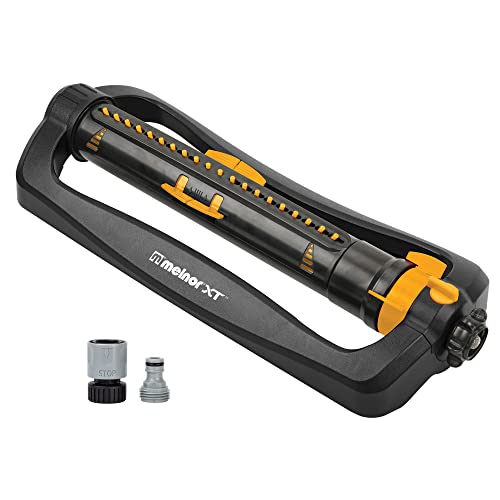
Melnor XT Turbo Oscillating Sprinkler
Best for: households whose worth-it answer is yes and whose lawn is a rectangle. Not suited for: gardens whose shape fights its pattern, or buyers who will never use its adjustments.
The Melnor XT Turbo Oscillating Sprinkler represents the oscillating family at its most developed: a metal-and-polymer bar sprinkler with pattern controls that let you trim width, adjust range and water one side only when the sprinkler sits at a boundary. In prose terms it sits in the mid-to-premium tier of hose-end sprinklers, and its appeal is precision rather than spectacle. If your lawn is a rectangle and your frustration is water on the path, this is the shape of answer to look at first. Check the current listing for the exact configuration, since the XT line includes variants with different control sets.
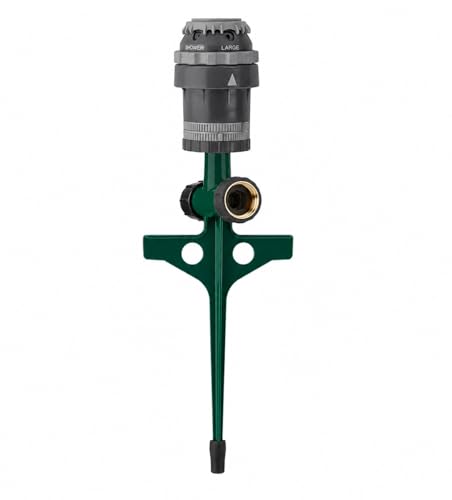
Orbit H2O-6 Gear Drive Sprinkler
Best for: households whose yes comes with irregular shapes attached. Not suited for: gardens whose shape fights its pattern, or buyers who will never use its adjustments.
The Orbit H2O-6 Gear Drive Sprinkler takes the circular route: a gear-driven head on a spike that rotates through a full or part circle and offers a choice of spray patterns from the same head, from gentle rain-like settings to stronger streams. It suits round areas, corners and irregular patches where a rectangular fan wastes water, and the spike base plants firmly in most soils. It occupies a mid-tier position, priced by the market as a step above basic rotating heads. As with every pick here it is prose-only in this draft: verify the current listing and pattern options before buying.
How to Get the Most Value If You Buy
When you water matters almost as much as how much you water. Early morning is the honest recommendation for sprinklers, and it survives every fashion in gardening advice because the physics is stable: air is cool, wind is usually at its calmest, and water lands on soil instead of evaporating mid-flight or drifting onto the paving. Grass then dries through the morning as the sun rises, which denies leaf diseases the long wet night they prefer. A sprinkler session at dawn asks an early alarm or a timer, and repays both in water that actually reaches roots.
Midday watering is not the catastrophe it is sometimes painted, but it is the wasteful option: sun and wind take their share before the soil gets its, and a breeze that was invisible at breakfast can bend a pattern several feet off target by lunch. Evening watering saves water from evaporation yet leaves foliage wet through the night, which fungus enjoys. If evenings are the only time your life allows, water early in the evening rather than at dusk, aim the pattern at soil rather than foliage where you can, and accept the small trade knowingly instead of accidentally.
Wind deserves a mention of its own, because it edits every sprinkler pattern without asking permission. A fine fan from an oscillating bar drifts more than a heavier rotating stream, and a pattern that covered the lawn on a still morning may spend a windy afternoon watering the fence. On gusty days the choices are simple: water earlier, lower the pattern if the model allows it, move the sprinkler so the drift lands on grass rather than paving, or skip the session entirely. Lawns forgive a postponed watering far more readily than a drowned one, and the soil’s moisture lasts longer than anxious gardeners usually believe.
A hose timer changes a sprinkler from an errand into a system, and for many households it is the accessory that decides whether the lawn actually gets watered in a busy week. The timer’s gifts are the early start you sleep through, the session that ends on time instead of whenever you remember, and the holiday watering that happens while the house is empty. Mechanical timers ask nothing but a twist and run one session; battery digital timers schedule days and durations and ask for fresh batteries now and then. Either way, the sprinkler you already own becomes dramatically more useful without being replaced.
Zoning is the grown-up version of the same idea. No single tap delivers unlimited flow, and a big garden watered honestly is watered in sections: this zone today at dawn, that zone tomorrow, each getting full pressure and full pattern instead of three sprinklers sharing one supply and each performing at a fraction of itself. Gardeners zone instinctively once a garden outgrows one pattern, moving the sprinkler on a rotation. Naming the rotation, writing it on the shed wall, and letting a timer run it turns a chore that depends on memory into a rhythm that depends on a plan.
Placement is a skill, and like most skills it improves fastest by observation. Run the sprinkler for a few minutes and walk the pattern’s edge: where does water actually land, where does it fall short, what is it hitting that it should not? Then adjust with intent. Shift the sprinkler so its strong middle covers the driest ground, trim the sweep so the ends stop at the paving, and note the spot, because a marked position you can return to is worth more than a stronger sprinkler placed hopefully. Experienced gardeners have favourite spots, sometimes literally marked, for every area they water.
The catch-cup check is the gardener’s version of measuring instead of guessing, and it needs no special equipment: a few identical straight-sided containers placed across the pattern, one session, then compare levels. Shallow cups near the sprinkler and deep cups far away, or the reverse, tell you exactly how uneven the delivery is and how long a session truly needs to run to give the driest cup its share. It takes one session to learn more about your sprinkler than a season of impressions. Do it once after buying, once after any change of hose or tap, and whenever a dry patch makes you suspicious.
Sprinklers fail slowly and then all at once, and almost every failure begins as neglect of a small part. The inlet filter, a little mesh screen where the hose connects, catches the grit that would otherwise jam oscillating mechanisms and rotating gears; rinse it whenever a pattern weakens and the problem often rinses away with it. Nozzles clog with mineral scale in hard-water areas and with debris everywhere; a gentle soak and a soft brush restore most, while poking with hard wire can deform the opening and bend the stream permanently. Five minutes of this attention a few times a season is the entire maintenance budget of a typical hose-end sprinkler.
Winter is the other enemy, and it works through water left inside. A sprinkler stored wet can freeze, and freezing water expands with enough force to crack housings and split seals that survived the whole summer without complaint. The autumn routine is short: drain the sprinkler, shake out what remains, let it dry, and store it under cover off a cold floor if you can. Hoses deserve the same courtesy, drained and coiled loosely rather than kinked into a corner. Come spring, the kit that was put away dry simply works, while the kit that was abandoned wet begins the season as a shopping trip.
Leaks at connections deserve their own sentence because they are the most misdiagnosed fault in garden watering. A spray of water at the tap or the sprinkler inlet is almost never the sprinkler’s fault; it is a washer that has flattened, hardened or gone missing entirely. Keep spare hose washers wherever you keep the sprinkler itself, replace them at the first sign of spray, and resist overtightening, which crushes washers and strains plastic threads. Metal-bodied sprinklers tolerate years of this handling more forgivingly than light plastic ones, which is a genuine point in metal’s favour for gardeners who connect and disconnect daily.
The Decision Checklist
Answer yes or no, honestly and quickly. Is at least a third of your watered garden open grass or groundcover? Do dry spells regularly leave it thirsty? Is your time for watering scarcer than your water itself? Will sessions realistically run in the morning, by timer or by habit? Do you have, or will you add, backflow protection at the tap and drainage in your autumn routine? Will the sprinkler complement targeted tools for beds rather than replace them? Four or more yes answers: a sprinkler is worth it for you, and the remaining guides in this series will help you choose it well. Two or fewer: spend the money on the alternatives above, and spend it without regret.
The Maths of Time, Done Honestly
Strip the question to arithmetic a household can feel. A lawn watered by hand through a dry season consumes evenings in half-hour instalments that never quite become free time; the same lawn under a sprinkler and timer consumes minutes of placement and the occasional filter rinse. Across a single summer the returned time is measured in days, not minutes, and it returns at the exact hours, warm evenings and slow weekend mornings, that households value most. Set against that return, the sprinkler’s costs, a modest purchase, a shelf in the shed, a handful of habits, are small change. This is why the worth-it verdict is so consistent among lawn owners: the tool is not buying water delivery, which the tap provides free. It is buying back the gardener.
The arithmetic reverses when the lawn is small or the gardener loves the ritual. Hand watering a pocket lawn is ten pleasant minutes with a can, among the flowers, noticing things; automating it saves almost nothing and costs the noticing. Worth-it judgements that ignore the pleasure of the manual version misprice it at zero, and gardeners who water for joy should keep watering for joy, with a sprinkler kept, if at all, for holidays and heatwaves. The honest calculus includes the value of the thing being replaced, and sometimes the thing being replaced is the best part of the gardening week.
What Owners Say a Year Later
Ask owners a year on and a pattern emerges that no first-week review captures. Almost none talk about throw or patterns. They talk about the timer that let them holiday in a heatwave without a neighbour rota; about the seedbed that actually stayed damp because the sprinkler, not their memory, was on duty; about the filter they now rinse without thinking; about the cheap first sprinkler they replaced and the mid-tier one they expect to hand down. The regrets rhyme too: the premium controls never touched, the season lost to a kinked hose misdiagnosed as a dead sprinkler, the beds watered overhead for a summer before drip arrived. A year’s testimony says the worth was never in the specifications. It was in the fit between tool, garden and household, which is what this whole assessment has been circling.
The same owners, asked whether they would buy again, divide almost perfectly along the lines of the profiles above: lawn households yes without pausing, border households with a story about what they bought instead. Nobody, in either camp, describes the decision as close once their garden’s true shape is admitted. The borderline cases that torment shoppers in spring dissolve in retrospect, because the garden was never borderline. Only the shopper’s picture of it was.
The Environmental Ledger, Kept Qualitatively
A worth-it judgement in this decade fairly includes the water itself. The sprinkler’s environmental case is neither spotless nor damning; it is behavioural. Run at dawn, trimmed to boundaries, cycled on slow soils and checked with cups, it delivers water to roots with respectable efficiency for an overhead tool, and it makes every waste visible enough to correct. Run at noon across the paving, it is a small fountain of squander. Drip will beat it in the beds on any ledger; on open lawn there is no drip to beat it, and the comparison that matters is against the realistic alternative, which for most households is a hose nozzle in a tired hand at dusk, drifting, uneven and unmeasured. Against that alternative, the disciplined sprinkler is the greener tool, and the discipline, once more, is the actual purchase.
Two Tests That Settle Most Borderline Cases
The holiday test. Picture the driest fortnight of the year, and your household away for most of it. Without a sprinkler and timer, the lawn’s survival depends on neighbours, luck or rain. With them, it depends on a programme you set in ten minutes before leaving. If that picture produces real anxiety, the sprinkler has already passed its worth-it test, because the anxiety is the price of not owning it, paid annually. The drought test. Picture instead a hosepipe-restricted or meter-squeezed summer, where every session must justify itself. The sprinkler’s case here is subtler but real: measured, dawn-timed, cup-checked watering is how a lawn survives on little, while unmeasured hand watering spends the same allowance unevenly and calls it thrift. Households that pass either test in their imagination tend to pass the purchase in fact, and households that shrug at both pictures have their answer too, equally valid: their garden does not need this tool, and the money belongs elsewhere.
A third, quieter test deserves mention: the replacement test. Owners whose sprinkler fails mid-season reveal its worth by their behaviour, most replacing it within the week, in season, without shopping around for alternatives. A tool whose absence is an emergency has answered the worth-it question more honestly than any review can. If you already own a sprinkler, you do not need this article’s verdict at all. You need only remember how you felt the last time it stopped working.
Renters, Owners and the Question of Permanence
Tenure changes the calculus without changing the tool. Renters gain most from the hose-end sprinkler’s impermanence: it installs in a minute, leaves in a minute, travels to the next garden, and asks nothing of a landlord. For them the worth-it answer tilts yes at smaller lawn sizes than it would for owners, because none of the value is stranded in the ground when they move. Owners with long horizons face the wider choice this article keeps circling: hose-end now, buried later, or buried now. The sprinkler’s worth for them is partly as tuition, a season of learning the garden’s shapes and thirst that makes any later system better designed, and tuition that also waters the lawn while teaching is rarely wasted money.
Longevity closes the argument. A mid-tier sprinkler, drained each autumn and filtered each summer, serves for many seasons; divided across those seasons, its cost per summer shrinks toward the trivial, while its returned evenings stay constant. Tools with this profile, small cost, constant service, decade-long life, are the ones households describe as obviously worth it in retrospect. The sprinkler’s tragedy, where it has one, is being bought at the wrong tier or for the wrong garden, whereupon it serves one resentful season and spends nine in the shed, the most expensive outcome of all. Fit, again, is the whole verdict.
Is a Garden Sprinkler Worth It? The Verdict for the Fence-Sitters
Most readers of a worth-it article are not opponents or enthusiasts but fence-sitters, and fence-sitting in this category usually has a specific cause: the garden is genuinely mixed, the household genuinely busy, and both answers feel half true. For that reader, the deciding evidence is not in this article but in last summer. Count, honestly, the evenings the lawn went unwatered because the hour could not be found, and the mornings a dry patch announced another week of the same. If that count stings, the sprinkler is worth it, and the sting is the receipt. If last summer’s lawn mostly thrived on your hand watering and your attention, the fence is the right place to stay, and the money will do more good in the beds.
There is also a low-regret route off the fence, and it deserves stating plainly: buy the mid-tier model in the family your garden’s shape demands, fit the timer, run it for one honest season with the habits this article describes, and judge at autumn’s end with the evidence of your own lawn in front of you. The worst realistic outcome is a well-kept tool resold or handed on; the likely outcome, on the testimony of owners a year later, is a household that cannot quite remember hand watering whole lawns. Fence-sitters fear a permanent mistake, but this purchase is among the most reversible in the garden, and reversibility, fairly counted, is part of worth.
Worth It, Final Word
A garden sprinkler is worth it when a garden has grass that thirsts, a household whose hours are precious, and a gardener willing to trade a handful of habits for a season of returned evenings. It is not worth it when the garden is planting, the gardener is a devotee of the watering can, or the plot is about to be plumbed permanently. Between those verdicts there is no universal answer, and this article has not pretended otherwise; there is only the fit, which you can now judge in a minute with the checklist above. Fit judged honestly, the purchase makes itself, in whichever direction it falls, and a decision that makes itself is the definition of a question answered well.
If You Buy One, Buy the Decision, Not Just the Sprinkler
The households that report the clearest worth-it verdicts share a pattern that has nothing to do with which model they chose: they bought a decision, not an object. The decision sounded like this: the lawn gets dawn water on set days, the sprinkler lives on its hook, the hose runs along the fence and never across the path, the filter gets rinsed when the pattern looks tired, and the whole kit is drained the weekend the clocks change. Inside that decision, almost any well-made sprinkler performs like a bargain, because the decision supplies everything the object lacks: timing, placement, maintenance, safety. Outside that decision, the finest sprinkler in this series performs like a disappointment, because an object cannot supply habits. This is why the article has insisted, perhaps to the edge of repetition, that behaviour is the real purchase. It is also the most hopeful sentence available to a fence-sitter: the worth of the tool is largely within your control, which means the risk of buying is smaller than it looks, provided the habits are honestly part of the bargain you strike with yourself.
The Answer, Garden by Garden
For the rectangle of lawn behind a family house: worth it, plainly, and the only remaining question is which family member and which tier, which the companion guides exist to answer. For the cottage garden of curves and corners: worth it in its rotating form, as the lawn’s servant and the beds’ respectful neighbour. For the balcony, the courtyard of pots, the garden of borders end to end: not worth it as a main tool, and the money is better spent where the water actually needs to go, at soil level, plant by plant. For the big plain acres of grass: worth it as a bridge, honestly labelled, toward the system the land is asking for. Four gardens, four answers, one method: admit the shape, count the hours, price the habits, and let the verdict fall where it falls. That method, more than any single verdict in these pages, is what this article hopes you keep.
A Word for the Gardener Who Already Owns One
Some readers arrive at a worth-it article not before buying but after, seeking either reassurance or an honourable exit, and both are available here. If your sprinkler sits unused, diagnose before you judge: an unused sprinkler usually indicts a missing timer, a dreaded hose, a pattern that floods the path, or a garden that quietly became beds while the sprinkler waited. Three of those four are curable for less than a replacement, and the fourth is a genuine answer, in which case sell it or give it to a lawn-owning friend with your blessing and this article’s checklist enclosed. If your sprinkler is used weekly and resented never, you did not need this verdict, but you have earned the right to give it: worth it is what a tool is called by the people whose summers it quietly holds together, and your testimony, offered at the garden gate, outweighs every paragraph here, including this one.
The One-Paragraph Verdict
For the reader who has scrolled to the end for a single paragraph: a garden sprinkler is worth it if your garden contains real open grass, your weeks are genuinely busy, and you will water early, trim the pattern, rinse the filter and drain the kit in autumn; it is not worth it if your garden is beds and pots, your watering is a pleasure performed by hand, or a buried system is already planned. Everything else in this article is the working behind that paragraph, the profiles, the tests, the ledgers and the checklist, offered so that the verdict can be checked rather than merely believed. Check it against your own garden, in the five minutes the checklist asks for, and then buy, or do not buy, with the particular peace of mind that comes from a decision your own evidence made. That peace, in the end, is worth more than the sprinkler, and it is available on both sides of the purchase.
The Break-Even Question: When a Garden sprinkler Earns Its Space, and When It Honestly Does Not
Worth it is a personal verdict dressed as a product question. The same garden sprinkler can be money well spent for one household and an expensive ornament for another, and the difference is almost never quality — it is frequency of use, fit with the space, and what it replaces. This section gives you a break-even way of thinking about the garden sprinkler: a simple accounting of cost per use, space per benefit, and effort per result, plus the honest signs that your household should skip it, borrow it, or buy the simpler version instead. Run your own numbers through it before you decide.
The Arithmetic That Actually Matters
Start with cost per use. Take the full cost of owning the garden sprinkler — purchase, any consumables, any accessories you genuinely need, and the space it occupies valued honestly — and divide it by a realistic count of uses in its first two years. Realistic is the key word: count the uses your calendar supports, not the uses your intentions promise in January. Then compare that figure with the alternatives you would actually use — hiring, borrowing, a service, or the simpler item you already own. A garden sprinkler that wins that comparison on your real schedule is worth it almost regardless of its badge; one that only wins on an imagined schedule is not.
The Signs on Each Side of the Line
On the worth-it side: you already do the task or feel the gap weekly; you have measured the space and it fits with room to live around; someone besides the buyer will use it too; and you can name what it replaces or retires. On the skip-it side: the purchase is motivated by a rare event, a visitor, or a version of your routine you have never actually kept; the space only works if something else is moved into storage; or the honest plan is to change your habits first and buy later. Neither list is a judgement — households change, and a garden sprinkler that fails the test this year may pass it easily after a move, a new job or a new family member.
Before you buy the garden sprinkler, answer these five questions out loud or on paper:
- How many times did I genuinely need this in the last three months — not wished for it, needed it?
- What exactly does it replace, retire or stop me paying for, starting in its first month?
- Where does it live when idle, measured and checked, and what currently in that spot gets moved?
- Who else in the household will use it without being asked, and who will maintain it?
- If it stopped working in a year, would I replace it immediately, manage without, or feel quietly relieved?
Beware of buying for the household you hope to become; the garden sprinkler that serves the household you already are will be used this week, not someday. A tape measure, a spirit level and ten patient minutes prevent more garden sprinkler regrets than any amount of comparison shopping after the fact. When a listing is vague about a dimension, material or included part that matters to you, treat the vagueness itself as information and look for a clearer seller. Photograph your room at the time of day you will use the garden sprinkler most, and compare candidates against that light rather than against bright midday photographs. Small households should weight compactness and easy storage more heavily, while large households should weight durability and simple operation, because the failure modes differ. If the garden sprinkler will serve children or older relatives, test the key actions with the weakest grip and the shortest reach in the house in mind. Leave a little capacity unused — in size, storage or power — because a garden sprinkler run permanently at its limit ages faster and annoys sooner than one with headroom. Notice which parts are replaceable and which are not; a garden sprinkler whose wear parts can be swapped cheaply often outlasts a sealed design twice its price in spirit, if not in years. Consider the garden sprinkler from the perspective of the person who cleans around it, because designs that trap dust, block access or demand special products quietly tax every week of ownership. Think about noise, light and heat as neighbours of the garden sprinkler, not afterthoughts, since a choice that performs well but disturbs the room around it rarely stays popular for long. Remember that guests experience your garden sprinkler without instructions, so anything that needs explaining, warning or demonstrating is worth simplifying before it is worth defending. Plan for the garden sprinkler to be moved at least twice in its life — for cleaning, redecorating or a change of room — and favour designs that forgive being shifted, tilted or carried. Look at the edges and undersides when you judge build quality, because those are the places makers save money first and the places owners discover last. Ask how the garden sprinkler behaves on your worst floor, wall or surface rather than your best one, since homes are uneven and listings are photographed in perfect rooms. Keep the receipt, delivery note and a photograph of the label together, because warranty conversations go smoothly when dates and model details are at hand. If two people in the household disagree about the garden sprinkler, let the person who will use or maintain it most have the deciding vote on practical questions.
The last question is the sharpest: immediate replacement means the garden sprinkler has become infrastructure in your home, and purchases like that are almost always worth it. Quiet relief means the opposite, however good the reviews were. Decide with your own arithmetic and your own answers, and whichever way the verdict falls you will have bought — or saved — with your eyes open, which is the only definition of value that survives contact with real life.
Frequently Asked Questions
When is the best time of day to run a garden sprinkler?
Early morning is the strongest all-round answer. The air is cool, the wind is usually calm, and water lands on the soil instead of evaporating in flight or drifting across the paving. Grass blades then dry as the sun climbs, which gives leaf diseases less of the long wet period they need. If mornings are impossible, early evening is the workable second choice, finishing well before dark so foliage is not wet all night. Midday is the wasteful slot: sun and breeze take their share first, and a pattern set at breakfast can drift noticeably by lunch.
Do I need a backflow preventer with a garden sprinkler?
A backflow preventer is a small fitting that stops water which has travelled into your hose and sprinkler from ever being drawn back into your home’s drinking water supply if mains pressure drops. Water sitting in a garden hose has met soil, fertiliser and everything a lawn collects, so keeping it out of the household supply is simple prudence. Many modern outdoor taps include protection already; a screw-on fitting between tap and hose covers those that do not. It asks nothing of you once fitted, and this guide recommends treating it as standard kit rather than an optional extra.
Why does my sprinkler’s pattern look weaker than it used to?
Work through the chain before blaming the sprinkler. Check the tap is fully open, the hose is unkinked and undamaged, and every connection is hand-tight with a washer that still flexes. Then rinse the sprinkler’s inlet filter, the small mesh screen where the hose connects, which catches the grit that slows oscillating bars and rotating gears alike. Nozzles clogged with scale or debris are the next suspect; a gentle soak and a soft brush restore most. A pattern that recovers after cleaning was never broken, only neglected, and five minutes of this attention a few times a season prevents most sprinkler disappointments.
How can I tell whether my lawn is getting even coverage?
Use the catch-cup check. Place several identical straight-sided containers at intervals across the pattern, run one normal session, and compare the water levels afterwards. Big differences between cups mean uneven delivery: the shallow cups mark where the lawn is under-watered no matter how long you run. The fix is usually placement and overlap rather than a new sprinkler: move the sprinkler so its strong middle covers the driest ground, trim the sweep to the boundaries, and let successive positions overlap generously. Repeat the check after changing hoses or taps, because the whole system shapes the pattern.
Should I water my flower beds with a sprinkler or something else?
For dense beds and borders, targeted watering at soil level usually serves better than a sprinkler. A broad fan wets foliage, holds moisture on leaves that prefer to dry, and delivers water between plants rather than to their roots; drip lines, soaker hoses and a humble watering can all aim more precisely. Sprinklers still earn their place for open lawns, thirsty groundcover on a slope, and newly planted shrubs in their first dry summer. The honest rule is jurisdiction: area watering for areas, targeted watering for individuals, chosen deliberately rather than by which tool the hose already has attached.
How should I store a sprinkler and hose for winter?
Drain everything, because water left inside expands as it freezes and can crack housings and split seals that survived the whole summer. Shake out what remains, let the sprinkler and hose dry, then store them under cover, coiled loosely rather than kinked into a corner. While the kit is in your hands, check the washers at every connection and replace any that have flattened or hardened; leaks next spring almost always begin as washers ignored this autumn. The kit put away dry and checked simply works when the season turns, while the kit abandoned wet starts spring as a shopping trip.
Related Guides and Next Steps
Keep exploring with these guides from the same garden watering series:
- the garden sprinkler pros and cons weighed in full
- the garden sprinkler buying guide
- garden sprinkler reviews
- is a drip irrigation kit worth it
- is an expandable garden hose worth it
- our guide to the best oscillating sprinklers
- the best lawn sprinklers and water timers
- the best drip irrigation system for raised beds
- the best watering cans for targeted jobs


