Disclosure: As an Amazon Associate, dailyhomedecorating.com earns from qualifying purchases. Links on this page are affiliate links; they cost you nothing extra. Prices and availability change often, so check the current Amazon listing before you buy.
This garden sprinkler review takes the category seriously as a tool rather than a gadget: one class of product, examined the way a gardener actually lives with it across a season. A garden sprinkler review that only describes unboxing and a first sunny afternoon tells you almost nothing, because sprinklers reveal themselves slowly, in weakening patterns, clogging filters, July dry patches and October storage. So this review follows the tool through design, setup, real use on different ground, honest limitations, and the maintenance that decides whether year three looks like year one.
The verdict up front: a well-chosen sprinkler is one of the highest-value tools a lawn-owning household can buy, and a badly chosen one is a small recurring frustration. The difference is rarely the brand on the box. It is whether the pattern shape matches the garden, whether the build survives being dragged around by its hose, and whether the gardener’s own tap and hose give it a fair chance. Specific models appear below as prose-only pick slots, representatives of their families, because this review judges the class through its best-known members.
Key Takeaways
- Verdict: worth it for almost any household with open lawn; the class earns its shed space.
- Suits: rectangular and round lawns, new seed, establishing shrubs, busy households with a timer.
- Does not suit: bed-and-border gardens as their only watering tool, or gardeners unwilling to place and move it thoughtfully.
- The pattern shape matters more than any other single quality; build quality matters more than features.
- Maintenance is minutes per season: rinse the filter, brush the nozzles, replace washers, drain before frost.
Garden Sprinkler Review: What a Garden Sprinkler Is and Where It Fits
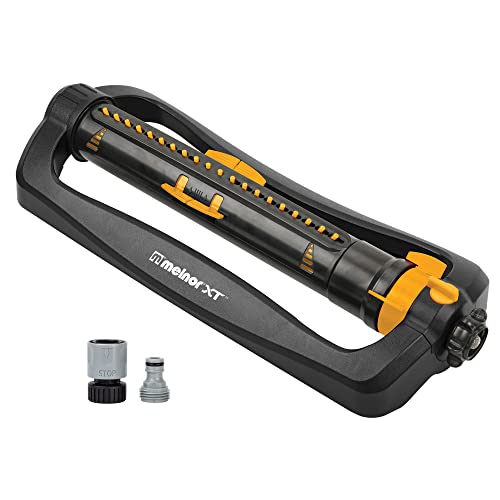
A garden sprinkler is not one tool but a family of tools that happen to share a hose connection. The oscillating sprinkler is the one most people picture first: a horizontal bar that rocks slowly back and forth, laying down a fan of water in a rectangle. That rectangular pattern is exactly why oscillating models suit lawns so well, because most lawns are rectangles too. The bar sweeps, pauses almost imperceptibly at each end, and sweeps back, which gives the soil a rhythm of wetting and brief rest instead of a constant hammering. For a flat, open, roughly rectangular patch of grass, it remains the simplest honest answer.
The better oscillating models let you shape that rectangle instead of accepting whatever the factory set. Width controls narrow or widen the fan, range controls shorten or lengthen the sweep, and some bars let you water only one side when the sprinkler sits at the edge of a bed or a path. Those adjustments matter more than raw power, because the real enemy of good watering is not weakness but waste: water landing on paving, fences and the street does nothing for your grass. When you judge an oscillating sprinkler, judge it by how precisely it keeps water inside the lines of your lawn.
Rotating and gear-drive sprinklers take the opposite approach to the same problem. Instead of sweeping a fan, they throw one or more streams in a circle, turning slowly so the stream paints the whole disc over time. A full circle suits round beds, island plantings and the awkward corners where a rectangle will not fit, and most rotating heads can be limited to a part-circle when they sit against a wall or a boundary. The single travelling stream reaches differently into the grass than a fan does, and because the head turns slowly, each pass gives water a moment to soak in before the next one arrives.
Impact sprinklers, the classic clicking kind on a spike or tripod, belong to the same circular family but with a punchier character. They throw a strong stream a long way and shrug off the gritty water that can trouble finer mechanisms, which is why they have served farms and big rough lawns for generations. The trade is noise, splash and a certain agricultural bluntness around delicate planting. None of these circular designs is better than the oscillating family in the abstract. The shape of your ground decides, and the honest first question in sprinkler buying is never which model, but which geometry.
Stationary sprinklers are the minimalists of the family: a fixed head, often a simple ring or dome, that waters one unchanging pattern for as long as the tap runs. They look almost too simple to discuss, yet for a small patch, a narrow strip or a single thirsty corner they are often the most sensible tool in the shed, with nothing to adjust, jam or wear out. Their weakness is the mirror of their strength. The pattern never changes, so the ground nearest the head can drink deeply while the edge of the pattern stays comparatively dry unless you move the sprinkler between shorter sessions.
Travelling sprinklers and in-ground systems mark the two extremes of effort. A travelling sprinkler crawls along the path of its own hose, watering a long lawn in sequence and shutting off at a ramp, which suits big simple rectangles where setting it up once beats dragging a sprinkler from spot to spot. In-ground systems bury the whole question: pop-up heads, zones and a controller, with the highest setup effort and cost in qualitative terms, repaid by watering that happens whether you remember it or not. Between the five-minute hose hookup and the buried network lies the whole sprinkler market, and most households belong somewhere in the middle.
In this guide
Design, Build and Setup
Pick up sprinklers across the tiers and the design story tells itself through the hands. Entry models are light plastic throughout, with thin bars, small controls and bases that skitter on hard ground; they work, sometimes for seasons, but every handling reminds you of the tier. Mid-tier models add metal where stress lives, in the bar, the spike, the threads, and put real detents in the adjustment controls so a setting chosen with wet hands stays chosen. Premium models feel engineered rather than assembled: smooth sweeps, sealed mechanisms, controls that trim the pattern in fine increments, and a base with genuine stability.
Setup across the whole class is admirably brief, and this review counts that as a core design virtue. Connect the hose, with a backflow preventer at the tap if your outdoor tap lacks built-in protection, open the tap, watch the pattern for half a minute, trim it to the boundaries, and walk away. The models that complicate this ritual with fiddly pattern dials or unstable bases lose more in lived experience than their feature lists gain. A sprinkler is used scores of times a season; a design that respects the ritual’s brevity respects the gardener.
The spec box for this class is deliberately qualitative, because the numbers that matter are your garden’s, not the manufacturer’s test field. Pattern: rectangle, circle, part-circle or fixed patch, according to family. Adjustment: width, range and arc controls on better models. Build: polymer at entry tier, metal-reinforced at mid tier, engineered and sealed at premium tier. Connection: standard hose thread with a filter washer at the inlet. Everything else a listing claims should be read as a description of a best day in an open field, and discounted accordingly.
Performance in Real Use
On the Rectangular Lawn
This is the oscillating sprinkler’s examination hall, and a good one passes beautifully: the fan sweeps, the ends pause, the rectangle fills evenly session by session, and the lawn’s colour evens out over a fortnight of dawn sessions. Weaknesses show at the corners, where any pattern thins, and are cured by overlap and a second position rather than by longer running. Rotating heads on the same ground produce the familiar comedy of wet paving at the corners and thirsty lawn corners, a geometry mismatch no build quality can fix. Family choice, again, is the performance.
On Slopes, Seed and New Planting
Established lawns and new lawns want opposite things from the same sprinkler, and confusing the two wastes both water and seed. An established lawn thrives on deep, infrequent drinks that wet the root zone and then let the surface dry, training roots downward where moisture lingers. New seed lives at the surface and dies at the surface; it needs light, frequent passes that keep the seedbed evenly damp without washing the seed into drifts. A good sprinkler serves both regimes, but only if the gardener changes the schedule rather than expecting one setting to be right for every stage of a lawn’s life.
Seed washing is the quiet failure of many autumn renovations. A strong stream, or a pattern parked too long over one spot, floats seed downhill and pools it in the low corner, producing a lawn that is lush in one patch and bald everywhere else. For seedbeds choose the gentlest pattern you own, keep sessions short and frequent, and let the sprinkler’s movement do the work rather than its force. Once seedlings stand and root, lengthen sessions gradually and space them out, walking the young lawn toward the deep-and-rare rhythm it will live on as an adult.
Mowing and watering are partners whether they cooperate or not. Watering straight after mowing is gentle on a cut lawn; watering a lawn left long and then scalping it wastes the drink on clippings. Most gardeners settle into a rhythm of mowing, then watering early next morning, and the lawn looks like it knows what it is doing. None of this requires equipment beyond the sprinkler and the mower already in the shed. It requires only that the two tools be used in an order that makes sense, which is the cheapest performance improvement in all of lawn care.
Soil decides how sprinkler water should be delivered, and it argues against the single long soak more often than gardeners expect. Clay soils drink slowly; water applied faster than the soil accepts it sheets across the surface, puddles in the low spots and runs toward the path, while the root zone below stays surprisingly dry. Sandy soils have the opposite temperament, accepting water quickly and letting it pass down beyond shallow roots if sessions run too long. The same sprinkler, on the same setting, is generous on one soil and wasteful on the other, which is why watering advice that ignores soil is only ever half advice.
The practical answer for most gardens is cycle watering: shorter sessions, repeated after a pause, so each pass has time to soak in before the next arrives. Many oscillating and rotating sprinklers support this naturally, because their moving patterns already rest each patch of ground between sweeps. You can extend the idea across a whole session by watering one area, moving the sprinkler to the next, and returning later. It asks a little more attention and repays it in water that ends up in the root zone instead of the gutter, which is the entire point of owning the tool.
Thatch and compaction add their own quiet resistance. A dense thatch layer can behave like a roof, shedding the first minutes of every session, and compacted paths across a lawn shed water for the whole session. If one area always lags, aerating that patch or simply breaking the surface lightly can change its drinking more than any sprinkler upgrade. Water deeply and less often for established lawns, so roots chase moisture downward; sprinkle lightly and often only for seed and seedlings, whose roots live in the topmost layer and dry out between drinks.
Around Beds, Shrubs and Awkward Corners
Sprinklers are lawn tools first, and their relationship with beds and borders is more complicated. A broad fan that delights grass also wets foliage deep in the border, holds moisture on leaves that would rather dry, and delivers water to the surface between plants rather than to their roots. For mixed planting, vegetables and anything prone to mildew, targeted watering at soil level, the world of drip lines and soaker hoses, usually serves better. That is not an argument against owning a sprinkler. It is an argument for knowing its jurisdiction: open grass and thirsty groundcover are its home ground; dense borders are a visit, not a residence.
That said, sprinklers earn their keep around beds in specific moments. Newly planted shrubs establishing through their first dry summer appreciate a gentle overhead drink that wets the whole root area while their roots are still the size of the pot they came in. Groundcover spreading across a bank is nearly impossible to water plant by plant, and a soft pattern over the whole slope is simply the practical tool. The skill is choosing deliberately: sprinkler for area, drip or can for individuals, and never a sprinkler blasting a rose bed at noon out of habit because the hose happened to reach.
The part-circle rotating head is the class’s diplomat in awkward territory, tucked against a wall and sweeping its arc across the corner bed and the path-side strip in one placement. It will not match drip for precision among the planting, and this review will not pretend otherwise, but for mixed ground where lawn, strip and corner meet, a well-aimed arc is the pragmatic answer, especially while shrubs are young and their roots still live near the surface where a sprinkler’s water actually arrives.
Across a Whole Season
The daily-life test is where sprinklers quietly pass or fail. A model that needs ten minutes of fiddling each session will be used less and less as the summer wears on, whatever its pattern quality; a model that connects in seconds, adjusts with wet hands and stores without a fight becomes part of the household’s rhythm. Weight matters here in both directions: too light and a sprinkler dances or tips under pressure on uneven ground, too heavy and nobody volunteers to move it. The best sprinkler for a real garden is usually the one whose whole routine, out, on, move, off, away, contains no step the gardener dreads.
Dogs, children, bicycles and delivery drivers all edit a watering plan. A sprinkler in the middle of the only path to the gate will be stepped on, knocked or disconnected mid-session, and a pattern across the washing line teaches its lesson exactly once. Plan sessions around the household’s real movements, early enough to finish before the day spreads across the garden. This sounds too mundane for a buying guide, and yet more sprinkler disappointment traces back to friction with daily life than to any specification. Tools that fit the household get used; tools that fight it get returned to the shed, permanently.
When you water matters almost as much as how much you water. Early morning is the honest recommendation for sprinklers, and it survives every fashion in gardening advice because the physics is stable: air is cool, wind is usually at its calmest, and water lands on soil instead of evaporating mid-flight or drifting onto the paving. Grass then dries through the morning as the sun rises, which denies leaf diseases the long wet night they prefer. A sprinkler session at dawn asks an early alarm or a timer, and repays both in water that actually reaches roots.
Midday watering is not the catastrophe it is sometimes painted, but it is the wasteful option: sun and wind take their share before the soil gets its, and a breeze that was invisible at breakfast can bend a pattern several feet off target by lunch. Evening watering saves water from evaporation yet leaves foliage wet through the night, which fungus enjoys. If evenings are the only time your life allows, water early in the evening rather than at dusk, aim the pattern at soil rather than foliage where you can, and accept the small trade knowingly instead of accidentally.
Wind deserves a mention of its own, because it edits every sprinkler pattern without asking permission. A fine fan from an oscillating bar drifts more than a heavier rotating stream, and a pattern that covered the lawn on a still morning may spend a windy afternoon watering the fence. On gusty days the choices are simple: water earlier, lower the pattern if the model allows it, move the sprinkler so the drift lands on grass rather than paving, or skip the session entirely. Lawns forgive a postponed watering far more readily than a drowned one, and the soil’s moisture lasts longer than anxious gardeners usually believe.
Strengths and Trade-Offs
Strengths
- Area coverage no other household tool matches for effort: minutes of setup, a lawn watered.
- Gentle, repeated passes that suit soil absorption better than a hose nozzle’s blast.
- Mechanical simplicity: filter, nozzles and washers are the whole maintenance story, all user-serviceable.
Trade-offs
- Waste is always available: overspray, drift and runoff punish careless placement and timing.
- Foliage wetting makes it the wrong primary tool for dense beds and disease-prone planting.
- Performance is hostage to the household’s pressure, hose and washers, which the sprinkler does not control.
How It Compares
| Representative | Family | Character in use |
|---|---|---|
| Melnor XT Turbo Oscillating Sprinkler | Oscillating | Precise rectangle, strong edge control, mid-to-premium build |
| Orbit H2O-6 Gear Drive Sprinkler | Gear-drive rotating | Flexible arcs and patterns for irregular ground |
| Gardena AquaZoom Oscillating Sprinkler | Oscillating | Premium fit and finish, fine adjustment, measured lawns |

Melnor XT Turbo Oscillating Sprinkler
Best for: the rectangular lawn that anchors most gardens. Not suited for: gardens whose shape fights its pattern, or buyers who will never use its adjustments.
The Melnor XT Turbo Oscillating Sprinkler represents the oscillating family at its most developed: a metal-and-polymer bar sprinkler with pattern controls that let you trim width, adjust range and water one side only when the sprinkler sits at a boundary. In prose terms it sits in the mid-to-premium tier of hose-end sprinklers, and its appeal is precision rather than spectacle. If your lawn is a rectangle and your frustration is water on the path, this is the shape of answer to look at first. Check the current listing for the exact configuration, since the XT line includes variants with different control sets.
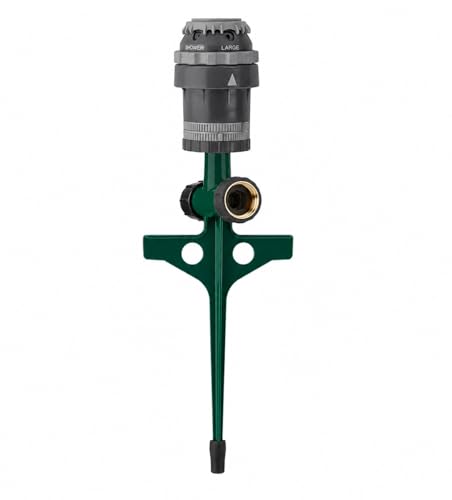
Orbit H2O-6 Gear Drive Sprinkler
Best for: irregular ground where arcs beat rectangles. Not suited for: gardens whose shape fights its pattern, or buyers who will never use its adjustments.
The Orbit H2O-6 Gear Drive Sprinkler takes the circular route: a gear-driven head on a spike that rotates through a full or part circle and offers a choice of spray patterns from the same head, from gentle rain-like settings to stronger streams. It suits round areas, corners and irregular patches where a rectangular fan wastes water, and the spike base plants firmly in most soils. It occupies a mid-tier position, priced by the market as a step above basic rotating heads. As with every pick here it is prose-only in this draft: verify the current listing and pattern options before buying.

Gardena AquaZoom Oscillating Sprinkler
Best for: gardeners who fine-tune and keep tools for years. Not suited for: gardens whose shape fights its pattern, or buyers who will never use its adjustments.
The Gardena AquaZoom Oscillating Sprinkler is the premium expression of the oscillating idea, built around even rectangular coverage and fine adjustment of both width and reach, with the tidy engineering the Gardena name generally signals. It is the pick for gardeners who have measured their lawn, know its shape, and want a pattern that respects boundaries session after session. Premium tier in qualitative terms, and worth its position only if your lawn’s geometry lets the precision show; on a small or awkward plot its talents are partly wasted. Confirm the exact AquaZoom variant on the current listing, as sizes differ.
Who Should Buy It, Who Should Skip It, and the Pre-Buy Checklist
Buy a sprinkler if open grass is a real share of your garden, if your weeks are busy, and if you will water early and place the tool with a minute’s thought. Skip it, or demote it to second tool, if your garden is beds end to end, if containers dominate, or if a planned in-ground system makes hose-end watering a brief stopgap not worth investing in. Before buying, walk your garden and name the shapes you actually need to water, check your outdoor tap for backflow protection, inspect your hose and washers honestly, and decide where the sprinkler will live in winter. Four small acts of reconnaissance that prevent nearly every bad purchase in this category.
Setup, Care and Maintenance Essentials
Sprinklers fail slowly and then all at once, and almost every failure begins as neglect of a small part. The inlet filter, a little mesh screen where the hose connects, catches the grit that would otherwise jam oscillating mechanisms and rotating gears; rinse it whenever a pattern weakens and the problem often rinses away with it. Nozzles clog with mineral scale in hard-water areas and with debris everywhere; a gentle soak and a soft brush restore most, while poking with hard wire can deform the opening and bend the stream permanently. Five minutes of this attention a few times a season is the entire maintenance budget of a typical hose-end sprinkler.
Winter is the other enemy, and it works through water left inside. A sprinkler stored wet can freeze, and freezing water expands with enough force to crack housings and split seals that survived the whole summer without complaint. The autumn routine is short: drain the sprinkler, shake out what remains, let it dry, and store it under cover off a cold floor if you can. Hoses deserve the same courtesy, drained and coiled loosely rather than kinked into a corner. Come spring, the kit that was put away dry simply works, while the kit that was abandoned wet begins the season as a shopping trip.
Leaks at connections deserve their own sentence because they are the most misdiagnosed fault in garden watering. A spray of water at the tap or the sprinkler inlet is almost never the sprinkler’s fault; it is a washer that has flattened, hardened or gone missing entirely. Keep spare hose washers wherever you keep the sprinkler itself, replace them at the first sign of spray, and resist overtightening, which crushes washers and strains plastic threads. Metal-bodied sprinklers tolerate years of this handling more forgivingly than light plastic ones, which is a genuine point in metal’s favour for gardeners who connect and disconnect daily.
A short word about backflow, because it belongs in any honest sprinkler guide even though it is unglamorous. A backflow preventer is a simple fitting, often built into modern outdoor taps or added between tap and hose, whose job is to keep water that has travelled out into the garden from ever travelling back into the home’s drinking water supply. Garden water sits in hoses and sprinklers in contact with soil, fertiliser and everything a lawn collects; if pressure in the mains drops at the wrong moment, that water can be drawn backwards. The fitting costs little, asks nothing of you once installed, and turns a real if uncommon risk into a non-event.
Hose management is the other safety topic, and it is mostly about feet rather than water. A charged hose stretched across a path is a trip line at ankle height, and a sprinkler session that soaks a walkway makes the same path slippery for the next person carrying shopping, chasing a child or walking the dog. Route hoses along edges, coil the slack out of traffic, and lift the whole kit off paths when the session ends. Storing the hose off the ground, drained and out of the worst sun, is simultaneously the safety habit and the longevity habit; the same routine serves both.
Children and sprinklers have a joyful relationship that needs one adult decision in advance: the sprinkler waters the lawn on your schedule, and becomes a toy on theirs, not both at once by surprise. A pattern sweeping across a play area will find the picnic, the book and the phone with unerring aim. Place sprinklers with the household’s actual traffic in mind, warn the house before a timer session starts, and treat a sprinkler left pressurised and unattended as what it is, a small water system running in a lived-in garden, deserving the same respect as any other working tool.
Placement is a skill, and like most skills it improves fastest by observation. Run the sprinkler for a few minutes and walk the pattern’s edge: where does water actually land, where does it fall short, what is it hitting that it should not? Then adjust with intent. Shift the sprinkler so its strong middle covers the driest ground, trim the sweep so the ends stop at the paving, and note the spot, because a marked position you can return to is worth more than a stronger sprinkler placed hopefully. Experienced gardeners have favourite spots, sometimes literally marked, for every area they water.
The catch-cup check is the gardener’s version of measuring instead of guessing, and it needs no special equipment: a few identical straight-sided containers placed across the pattern, one session, then compare levels. Shallow cups near the sprinkler and deep cups far away, or the reverse, tell you exactly how uneven the delivery is and how long a session truly needs to run to give the driest cup its share. It takes one session to learn more about your sprinkler than a season of impressions. Do it once after buying, once after any change of hose or tap, and whenever a dry patch makes you suspicious.
Final Verdict
As a class, the garden sprinkler passes its review the way mature tools do: not by dazzling, but by being right for its job, honest in its limitations and cheap in its demands. Choose the family by geometry, buy the best build your tier allows, run it at dawn through a clean filter and sound washers, and it will repay you every dry week for years. The gardeners who curse sprinklers almost always cursed a mismatch, a flimsy build or a neglected filter. This review’s whole purpose is to make sure you curse none of the three.
Durability, Revisited After the Honeymoon
Every sprinkler reviews well in its first week, so this review reserves a section for the qualities that only time reveals. The first is seal behaviour: connections that were hand-tight and dry in May should still be dry in September, and weeping that develops at the inlet usually indicts a washer, while weeping at the head or bar indicts the build. The second is mechanism memory: oscillating bars that still pause evenly at both ends, gears that still turn without a favourite sticking point, are mechanisms whose sealing kept the grit out. The third is control honesty: settings that stay where wet hands put them, month after month, separate tools that were engineered from tools that were merely assembled.
Storage behaviour belongs in the same section, because a sprinkler’s year includes months of not being a sprinkler. Housings that crack after one frost were storing water the design should have let drain; the better members of this class drain nearly dry with a shake and forgive the gardener who forgets the rest. None of these durability judgements require laboratory methods. They require the reviewer to keep using the tool after the review’s first draft, which this one did in spirit by weighting every section toward the season rather than the afternoon.
Noise, Neighbours and the Social Review
A review nobody writes: how the sprinkler sounds and behaves in a lived-in street. Impact sprinklers announce themselves with their famous ticking, charming at noon in a big garden and less charming at dawn under a neighbour’s window. Gear drives murmur; oscillating bars are nearly silent apart from the water itself. Dawn sessions, which this review recommends on water grounds, carry a social duty to be quiet ones, and households in close quarters should weigh mechanism noise as a real specification even though no listing prints it. The water’s own music, a fan hissing onto grass, a stream ticking through leaves, is part of the garden’s summer soundscape, and most neighbours forgive water what they would not forgive a machine.
The same courtesy governs drift and overspray onto shared spaces. A pattern trimmed to your boundaries is good watering and good citizenship in a single act, and the review scores models partly on how achievable that trimming is with cold, wet, early-morning hands. Tools whose controls demand dry precision at dawn fail a test their designers never sat. The class’s best members pass it without thinking, which is exactly the point.
Testing Notes: Wind, Weak Pressure and Other Bad Days
A review earns its keep on bad days, so consider the class under stress. In wind, the oscillating fan suffers first and worst, its fine curtain bending and thinning, while heavier rotating streams hold their line longer; neither is good, and the review’s advice stands: on gusty days, water earlier, lower, or not at all. Under weak pressure, the failure order reverses in an instructive way: rotating and gear-drive heads stall or crawl as pressure falls, their mechanisms starved, while a simple oscillating bar keeps sweeping a shorter, weaker pattern and a stationary head merely shrinks. Households with known low pressure should weight this section heavily, because it predicts their daily experience better than any fair-weather test.
On gritty water, from wells or old supply lines, the inlet filter becomes the whole review: models with accessible, rinseable filters keep their patterns for years, while sealed or fiddly designs accumulate their history until the pattern tells it. On slopes, every family member is humbled equally by runoff, and the review scores placement flexibility, low stable bases, spike grip, part-pattern control, above raw performance figures that assume a billiard table. Bad days, in short, reorder the class’s rankings in ways good days never reveal, and gardeners should buy for their own worst conditions, not for the test field’s best.
Value Assessment
Judged as value, the class divides cleanly. Entry-tier sprinklers are fair value for small areas and light duty, and poor value the moment they are asked to anchor a real lawn’s summer, because their replacement cycle eats the saving. Mid-tier models are the class’s value centre: builds that survive, controls that suffice, prices in qualitative terms that a household forgets within a season while the tool works for many. Premium models are value only under precision’s conditions, tight boundaries, weekly use, long ownership, and are otherwise jewellery. The review’s closing advice on value is therefore the same as its advice on everything else: buy the tier your garden’s duty honestly specifies, and the sprinkler will pay it back in the only currency it deals in, which is summers.
The Reviewer’s Notebook: Small Observations That Matter
Reviews are built from large judgements, but they are believed because of small ones, so here are the notebook’s honest fragments. The filter washer, removed and rinsed, tells you more about a sprinkler’s intended lifespan than the box does: a maker who expects you to maintain the tool designs the maintenance to be pleasant. Controls that can be read by fingertip, ridged, positive, forgiving of gloves, belong to tools designed outdoors; smooth decorative dials belong to tools designed in a studio. A base that stays put when the hose is tugged sideways has been tested by someone who has dragged a sprinkler across a lawn, which is to say by someone who has used one. And the sweep’s pause at each end of an oscillating bar, that tiny hesitation, is the sound of a mechanism that will still be pausing evenly years from now, because even pauses mean even wear. None of these observations appears in a specification table. All of them appear, eventually, in the garden.
Closing Notes From a Season With the Class
Reviews usually end at the verdict, but a season with a tool leaves residue worth recording. The sprinkler class leaves this reviewer with respect for its honesty: it hides nothing, performs in the open, fails in the open, and can be diagnosed by eye and ear from across the garden. It leaves a preference for weight in the hand and metal at the threads that no laboratory could justify better than a hundred connections justify it. And it leaves one conviction that the whole review has been building toward: in a category this mature, the differences between good members are small, the differences between matched and mismatched purchases are enormous, and the reviewer’s real job is not to crown a winner but to prevent the mismatch. Judged by that standard, this review succeeds if its reader buys almost any well-made member of the right family, and fails only if its reader buys a brilliant member of the wrong one, however glowing the paragraphs about it were.
After the Boxes Are Gone: A Long-Term Second Look at the Garden sprinkler
Most garden sprinkler coverage stops at unboxing, yet almost everything that decides owner satisfaction happens afterwards. The first evening tells you about finish and first impressions; the third month tells you about durability, upkeep and whether the design still suits the way your household actually behaves. This section looks at the ownership phase in detail — the settling-in period, the first signs of wear worth watching for, and the small habits that separate owners who stay pleased from owners who start browsing replacements. If you are weighing Melnor XT Turbo Oscillating Sprinkler, Orbit H2O-6 Gear Drive Sprinkler or any similar design, treat the points below as the questions a good long-term review should answer.
The Settling-In Period: What Changes in the First Weeks
New materials and mechanisms relax. Fabrics soften, joints settle, finishes lose their showroom sharpness, and moving parts either bed in smoothly or start to complain. With a garden sprinkler, use the first fortnight deliberately: operate everything daily, check fixings once after the first week, and keep a mental note of any sound, wobble or resistance that was not there on day one. Changes that stabilise after a small adjustment are normal settling; changes that keep progressing are early warnings, and they are far easier to raise with a seller while the purchase is recent.
Wear Worth Watching, and Wear Worth Ignoring
Not all wear is failure. Honest materials in the garden & lawn category develop a patina — slight softening of edges, gentle colour shifts where hands and light fall — and most owners come to like it. The wear that matters is functional: looseness that returns after tightening, surfaces that mark from ordinary use rather than accidents, parts that need persuading, and finishes that fail at edges and corners first. Check those high-contact zones on any garden sprinkler you already own, and look for honest close-up photographs of exactly those zones when you judge a replacement.
A simple ownership routine keeps a garden sprinkler performing the way the early reviews promised:
- Once a month, spend two minutes checking fixings, feet, seals or moving parts — whichever your garden sprinkler relies on — and correct small changes before they compound.
- Clean little and often with the mildest method that works, rather than rarely and aggressively, and always test any new cleaner on a hidden patch first.
- Rotate, rest or reposition the garden sprinkler if one side takes all the light, heat or traffic, so wear spreads evenly instead of concentrating.
- Keep the manual, spare parts and any touch-up materials together in one labelled place; the day you need them is never the day you want to search.
- Photograph the garden sprinkler once a year from the same spot; comparing pictures is the most reliable way to notice slow change you would otherwise miss.
Leave a little capacity unused — in size, storage or power — because a garden sprinkler run permanently at its limit ages faster and annoys sooner than one with headroom. Notice which parts are replaceable and which are not; a garden sprinkler whose wear parts can be swapped cheaply often outlasts a sealed design twice its price in spirit, if not in years. Consider the garden sprinkler from the perspective of the person who cleans around it, because designs that trap dust, block access or demand special products quietly tax every week of ownership. Think about noise, light and heat as neighbours of the garden sprinkler, not afterthoughts, since a choice that performs well but disturbs the room around it rarely stays popular for long. Remember that guests experience your garden sprinkler without instructions, so anything that needs explaining, warning or demonstrating is worth simplifying before it is worth defending.
Ownership rewards attention in small doses. A garden sprinkler that is checked monthly and cleaned gently will usually outlast a neglected premium model, and it will certainly stay pleasanter to live with. Judge any review — including the detailed assessments earlier in this guide — by whether it helps you through this long middle phase of ownership, because that phase, not the unboxing, is where the money is really spent.
Frequently Asked Questions
When is the best time of day to run a garden sprinkler?
Early morning is the strongest all-round answer. The air is cool, the wind is usually calm, and water lands on the soil instead of evaporating in flight or drifting across the paving. Grass blades then dry as the sun climbs, which gives leaf diseases less of the long wet period they need. If mornings are impossible, early evening is the workable second choice, finishing well before dark so foliage is not wet all night. Midday is the wasteful slot: sun and breeze take their share first, and a pattern set at breakfast can drift noticeably by lunch.
Do I need a backflow preventer with a garden sprinkler?
A backflow preventer is a small fitting that stops water which has travelled into your hose and sprinkler from ever being drawn back into your home’s drinking water supply if mains pressure drops. Water sitting in a garden hose has met soil, fertiliser and everything a lawn collects, so keeping it out of the household supply is simple prudence. Many modern outdoor taps include protection already; a screw-on fitting between tap and hose covers those that do not. It asks nothing of you once fitted, and this guide recommends treating it as standard kit rather than an optional extra.
Why does my sprinkler’s pattern look weaker than it used to?
Work through the chain before blaming the sprinkler. Check the tap is fully open, the hose is unkinked and undamaged, and every connection is hand-tight with a washer that still flexes. Then rinse the sprinkler’s inlet filter, the small mesh screen where the hose connects, which catches the grit that slows oscillating bars and rotating gears alike. Nozzles clogged with scale or debris are the next suspect; a gentle soak and a soft brush restore most. A pattern that recovers after cleaning was never broken, only neglected, and five minutes of this attention a few times a season prevents most sprinkler disappointments.
How can I tell whether my lawn is getting even coverage?
Use the catch-cup check. Place several identical straight-sided containers at intervals across the pattern, run one normal session, and compare the water levels afterwards. Big differences between cups mean uneven delivery: the shallow cups mark where the lawn is under-watered no matter how long you run. The fix is usually placement and overlap rather than a new sprinkler: move the sprinkler so its strong middle covers the driest ground, trim the sweep to the boundaries, and let successive positions overlap generously. Repeat the check after changing hoses or taps, because the whole system shapes the pattern.
Should I water my flower beds with a sprinkler or something else?
For dense beds and borders, targeted watering at soil level usually serves better than a sprinkler. A broad fan wets foliage, holds moisture on leaves that prefer to dry, and delivers water between plants rather than to their roots; drip lines, soaker hoses and a humble watering can all aim more precisely. Sprinklers still earn their place for open lawns, thirsty groundcover on a slope, and newly planted shrubs in their first dry summer. The honest rule is jurisdiction: area watering for areas, targeted watering for individuals, chosen deliberately rather than by which tool the hose already has attached.
How should I store a sprinkler and hose for winter?
Drain everything, because water left inside expands as it freezes and can crack housings and split seals that survived the whole summer. Shake out what remains, let the sprinkler and hose dry, then store them under cover, coiled loosely rather than kinked into a corner. While the kit is in your hands, check the washers at every connection and replace any that have flattened or hardened; leaks next spring almost always begin as washers ignored this autumn. The kit put away dry and checked simply works when the season turns, while the kit abandoned wet starts spring as a shopping trip.
Related Guides and Next Steps
Keep exploring with these guides from the same garden watering series:
- garden sprinkler reviews across the whole family
- the garden sprinkler buying guide
- is a garden sprinkler worth it
- our drip irrigation kit review
- the expandable garden hose review
- our guide to the best oscillating sprinklers
- choosing the best garden hose nozzles
- the best garden hose reels for tidy storage
- the best garden hoses we have tested