Disclosure: As an Amazon Associate, dailyhomedecorating.com earns from qualifying purchases. Links on this page are affiliate links; they cost you nothing extra. Prices and availability change often, so check the current Amazon listing before you buy.
Floating shelves vs wall shelves is the oldest argument in home storage, and it is usually fought with photographs when it should be fought with physics. On one side, the floating shelf: a board on a concealed bracket, no visible support, a look that reads as architecture. On the other, the traditional wall shelf: a board on visible brackets — metal, wood or decorative corbels — a design that has carried household weight for centuries and never pretended otherwise. The quick verdict: choose floating shelves when the look, the floor space and the display function lead your brief and your loads are light to medium. Choose bracketed wall shelves when capacity leads — books in quantity, kitchen weight, workshop duty — or when the visible bracket is itself part of the style you want. Everything below is the working-out of that verdict, criterion by criterion, with an honest line at the end of each.
Key Takeaways
- Looks: floating wins in modern and minimal rooms; bracketed wins where the bracket is a design feature, as in farmhouse and industrial schemes.
- Capacity: bracketed wins clearly — visible triangular support is simply stronger engineering for heavy loads.
- Installation: both need studs or proper anchors; floating is less forgiving of sloppy levelling and fit, bracketed is more forgiving but leaves more hardware on show.
- Flexibility: floating compositions are freer; bracketed shelves are easier to reposition and their brackets can be reused at new spacings.
- Most well-stored homes run both, each where its strengths rule.
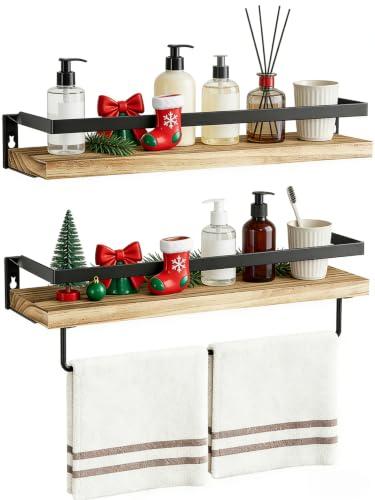
Floating Shelves vs Wall Shelves at a Glance
| Criterion | Floating shelves | Bracketed wall shelves |
|---|---|---|
| Support | Concealed rod bracket inside the board | Visible brackets beneath the board |
| Look | Clean, architectural, modern | Ranges from industrial to decorative; hardware is part of the style |
| Load capacity | Light to medium duty | Medium to heavy duty |
| Best cargo | Display, toiletries, everyday items, books in moderation | Book collections, dinnerware, tools, appliances |
| Installation forgiveness | Low — fit and level are critical | Moderate — shimming and adjustment are possible |
| Cleaning | Board only; nothing beneath to dust around | Board plus brackets, which gather dust and grease |
| Rearrangement | Composition fixed by holes; objects move freely | Brackets can move; boards can be swapped or extended |
| Failure style | Slow tilt if fixings relax; sudden if overloaded | Usually visible sag at a bracket first; very tolerant |
Read the table as a map of the argument rather than its conclusion: the two designs tie or trade small margins on most rows, and separate decisively on exactly two — load capacity, where the bracketed triangle is simply stronger, and looks, where the floating board is simply cleaner. Every other criterion in this comparison is a negotiation between those two poles, conducted differently by each room and each household. That is why the sections that follow take the criteria one at a time and end each with a verdict line: the reader whose brief is decided by one row can stop there, and the reader whose brief is genuinely mixed gets the full working-out before the final recommendation.
In this guide
Looks and Style
The floating shelf’s entire reason to exist is in this section. Removing the visible bracket changes a shelf from furniture applied to a wall into a feature of the wall itself, and in contemporary, minimal and transitional rooms nothing else at the price produces that calm. Objects sit against an unbroken plane; the eye reads the composition, not the carpentry. The bracketed shelf answers with a different aesthetic asset: the bracket as ornament. A wrought-iron scroll, a chunky timber corbel, an industrial pipe bracket — these are style statements in farmhouse, rustic, traditional and industrial rooms, where a floating board can look oddly bare, as if the shelf were unfinished. Neither look is superior in the abstract; each is superior in the rooms that speak its language. The mistake is mixing the argument with the wrong room: floating shelves in a panelled traditional study can look like an omission, and ornate brackets in a white minimal kitchen look like clutter with a job.
Scale mediates the argument too. In a large room with high ceilings, a floating board can read as slight — a line too thin for the wall — where a deep board on substantial corbels holds its own against the architecture. In a small room the same corbels crowd the eye while the floating board’s restraint is precisely the luxury the room needs. Ceiling height, wall length and the size of the furniture beneath all vote in this section, and a household choosing well will stand in the actual room, at the actual viewing distance, rather than deciding from a catalogue’s white void. Looks are the floating design’s home criterion, but even here the verdict is local.
Verdict: floating for modern calm and small rooms where visual lightness matters; bracketed where hardware is welcome as decoration or the room’s style is historical.
One refinement matters for real rooms, which are rarely pure of style. Transitional rooms — the majority of lived-in homes — can carry either design, and the tiebreaker there is the room’s other metal and wood: a room with visible black hardware on its doors and lights can absorb black brackets as a rhyme, while a room whose furniture floats on legs and whose palette is pale will usually thank the floating board for continuing the sentence. Look at what the wall already says before asking the shelf to speak.
Load Capacity
Here the argument ends quickly, because engineering is not a matter of taste. A bracketed shelf carries its load through a triangle — the strongest simple structure in the carpenter’s vocabulary — with the board resting on a horizontal arm and the diagonal or vertical leg transferring force into the wall across a spread of fixings. A floating shelf carries the same load through a concealed lever: rods inside a hollow board, resisting rotation through a back plate. The lever is elegant and adequate; the triangle is stronger, and the gap widens with load. In practice: both designs handle display and everyday cargo without distinction. Books in long upright rows, stoneware, a microwave on a kitchen shelf, workshop storage — this is bracketed territory, and no premium floating set honestly contests it. Floating marketing that implies otherwise should be read the way all heroic load claims should be read: as a statement about a test wall, not about your plasterboard.
Verdict: bracketed wins, decisively, for anything beyond the everyday band; within the everyday band the two are tied and the choice returns to looks.
It is worth being precise about where the everyday band ends, because households misjudge it in a predictable direction: they weigh the cargo once, statically, and forget the dynamics. A shelf is loaded by hands that set jars down firmly, pull books out one-handed and occasionally steady themselves on the board. Bracketed engineering absorbs those moments with margin to spare; floating engineering absorbs them within its band and resents them beyond it. The practical translation: if the cargo list includes anything you would describe as “quite heavy, actually,” the argument is already over, and the remaining sections of this comparison are about the other shelves in the house.
Installation
Both designs obey the same wall physics — studs are best, hollow-wall anchors must be the real thing, masonry wants its own plugs — and both punish the fantasy that a shelf can be hung like a picture. The differences are in forgiveness. A floating installation has two critical tolerances: the bracket must be truly level, because the board cannot be adjusted afterward, and the board must fit the rods snugly, because no bracket screw can correct a sloppy fit. A bracketed installation can be shimmed, nudged and levelled at the board stage; a slightly imperfect bracket line disappears under the board, and a single bracket can be repositioned without disturbing its neighbours. Bracketed shelves also scale more casually — add a bracket, extend the board — where floating runs are planned compositions. Against that, the floating install is cleaner work: one bracket line, no hardware to align beneath a board, and nothing projecting to catch a sleeve in a narrow hall.
The safety discipline is identical in kind for both and worth stating once, plainly, because it decides more outcomes than the choice between the designs: find the studs and use them wherever the composition allows; where fixings land in hollow plasterboard, use anchors genuinely rated for the wall and the load; keep loads honest for the design you chose; in children’s rooms and bedrooms, place shelves out of climbing reach, carry only light and unbreakable things on any shelf a child can reach toward, and never hang a loaded shelf of either type above the pillow end of a bed. A bracketed shelf is more forgiving of load, not of placement.
Time is the other installation difference, and it favours brackets for the first-timer: a bracketed run can be hung bracket by bracket, checked as it grows, and corrected mid-job with the board resting in place as the reference. A floating run front-loads its precision into the bracket stage, when nothing yet shows what the finished line will look like — which is why experienced floating installers rehearse with tape and rehearse the board fit at ground level, converting the design’s unforgivingness into procedure. Neither install is long; both are an afternoon’s careful work for a run of shelves. The honest summary is that bracketed installation forgives the installer, and floating installation instructs them.
Verdict: bracketed is the easier, more forgiving install; floating is the cleaner one. Beginners with heavy loads should choose bracketed; beginners with light loads can learn on floating with care.
Flexibility and Rearrangement
Floating compositions are designed, and design commits: the pattern of holes fixes the arrangement, and moving a board means filling and repainting. Within the composition, though, the objects rearrange freely, and the composition itself can grow by adding matched boards. Bracketed shelving is the tinkerer’s system: brackets unbolt and move, boards swap for longer or deeper ones on the same brackets, a run can be extended a bracket at a time as a collection grows, and the hardware outlives several generations of boards. Households that rearrange rooms seasonally, or whose storage needs are visibly evolving — a growing library, a workshop taking shape — get more from the bracketed system’s loose joints. Households that design a wall once and live with it happily for years get more from the floating system’s finished quality.
Verdict: bracketed for evolving needs and frequent rearrangers; floating for set-once compositions.
One asymmetry deserves emphasis because it surprises people at the second installation, not the first. Floating boards are keyed to their brackets: the hole pattern in the board matches the rod spacing of its own bracket design, so boards and brackets from different makers — and sometimes different ranges — do not interchange. A household extending a composition years later needs the same family’s boards, or a fresh composition. Bracketed components, by contrast, are a folk standard: any board rests on any brackets of suitable size, which is why a bracketed run can absorb a salvaged board, a hardware-store replacement or a grandfather’s brackets without ceremony. For households that value long, repairable systems over finished compositions, that interchangeability is a genuine, if unglamorous, point in the older design’s favour.
Cleaning and Maintenance
A small section with a consistent result. Floating shelves present one surface to the dust and the cloth; bracketed shelves present the board plus a set of brackets, each with ledges, angles and fixings that collect dust in living rooms and grease film in kitchens, and each requiring the cloth to work around it. The difference per shelf is a minute; across a kitchen run or a house of shelves it is a standing difference in the cleaning round. Maintenance otherwise converges: both want a seasonal check of fixings, both announce relaxed anchors early if their owners look, and both forgive the audit’s small corrections. Solid boards of either type can be refinished; laminate boards of either type cannot.
Verdict: floating wins modestly, and the margin grows with the number of shelves and the greasiness of the room.
The maintenance difference sharpens in two specific rooms. In kitchens, bracket undersides collect the grease film that rises from cooking, and the film sets hard in the angles where bracket meets wall — the least reachable geometry in the room. Floating boards in the same kitchen present one flat underside that a cloth crosses in a single pass. In bathrooms, metal brackets in daily steam want watching for finish failure at their fixings, while a floating board’s only metal is sealed inside it. Neither difference is decisive alone; both belong in the ledger of a household deciding for a steamy or greasy decade.
Cost and Value Over Time
Money is the criterion where the comparison is closest, and the honest summary is that the two systems spend differently rather than one spending less. Floating shelves concentrate cost in the set: board, bracket and hardware arrive as one purchase, composed to finish a wall, and the mid tier is where most households land. Bracketed shelving distributes cost: brackets and boards are bought separately, boards can be plain timber cut to length, and a serviceable run can be assembled very economically — or, with decorative corbels and hardwood boards, can outspend any floating set in this article. The floating system’s money advantage is staging and certainty: one box finishes one composition. The bracketed system’s advantage is substitutability: a damaged board is replaced without touching the hardware, and the hardware itself is a lifetime purchase that outlasts several boards and several homes.
Over a decade, the value curves cross in instructive places. The floating composition, correctly specified, asks for nothing but dusting and audits; its cost is front-loaded and its value is the daily calm. The bracketed run asks for the same audits and returns a different dividend: adaptability, as boards are swapped, extended and repurposed through the household’s changes. Households that stay put and style once extract more value from floating; households in flux extract more from brackets. Neither curve dominates, which is why this criterion, alone among the seven, is scored a genuine tie — and why the decision should be made on the criteria where the two designs actually differ: looks, capacity and forgiveness.
Verdict: a tie on money, decided by household pattern — staged certainty versus lifetime hardware.
Durability and Lifespan
Both systems are, at heart, a board and a fixing, and both can serve for decades; their ageing differs in character. A floating shelf ages as a unit: the board’s finish and the bracket’s fit decline together, and the first symptom of age is usually the slow tilt that announces relaxing fixings or a loosening fit — correctable early, terminal if ignored. Its vulnerability is moisture at the board’s edges, in the wrong room, exactly as the floating side’s own literature admits. A bracketed shelf ages as a system of parts: boards warp, scuff and get replaced; brackets endure; fixings announce their fatigue as visible sag at one bracket, which is both a warning and an invitation to a ten-minute repair. The bracketed system’s great durability asset is that every component is inspectable — nothing is concealed, so nothing fails unobserved.
There is a fashion dimension to lifespan as well. Bracket styles date: the scroll that charmed in one decade apologises in the next, though the board above it can be restyled to compensate. Floating boards date more slowly because there is less to date — a plain board is a plain board in any decade — and their boards can often be refinished or replaced on sound brackets when a room is redecorated. A household choosing for a twenty-year horizon in a room it loves should weigh that slowness; a household choosing for a workshop should weigh inspectability instead.
Verdict: bracketed for inspectable, repairable longevity in working spaces; floating for slow-dating longevity in finished rooms.
Room by Room: The Verdict in Practice
Living room. Floating, in most cases, and it is not close: the room’s shelves are display first, the loads are moderate, and the calm wall is the single largest aesthetic return available in this comparison. Bracketed earns the room only where the scheme is rustic or industrial enough to make the hardware a feature, or where the shelves are, in truth, a library wearing display clothing — in which case capacity rules and the verdict follows it.
Bathroom. Floating, in its specialist form, for reasons that compound: no metal hardware to mark or corrode in the steam, a clean underside in the room where every surface is wiped, proportions designed for bottles rather than adapted to them. Bracketed bathroom shelves exist and serve in utility-style rooms, but in the ordinary family bathroom the floating specialist wins on hygiene, looks and fit simultaneously — the only room in this comparison where one design sweeps every criterion.
Kitchen. The split room, and the one where the hybrid earns its keep. Everyday open storage — mugs, jars, glasses, the daily dozen — floats beautifully and reads as design. The heavy shift — dinnerware stacks, appliances, the preserving season’s output — belongs on brackets, at working height, where the triangle does its quiet work. Kitchens that choose only one system usually choose wrong for half their cargo; kitchens that divide the labour rarely regret either half.
Bedroom and child’s room. Floating for the adult bedroom’s nightstand alternatives and dressing compositions, where loads are light and the clean underside sits in the sleeper’s sightline. In children’s rooms the verdict carries its conditions on both sides: any shelf must be fixed to the full safety discipline, placed out of climbing reach, and loaded only with the light and unbreakable — and under those conditions the floating board’s lack of projecting hardware makes it the kinder underside in a room where small heads move fast at unpredictable heights. Low, reachable storage for children belongs to furniture in both systems’ judgement.
Hallway and entryway. Floating, narrowly: the landing-strip shelf profits from the clean underside in the home’s tightest traffic line, and the composition pairs with a mirror without hardware competing in the reflection. Bracketed shelves serve wide, rustic halls where a corbel is practically furniture, but in the ordinary narrow entry the floating board is the design that respects the shoulders passing beneath it.
Workshop, garage and utility. Bracketed, without a contest: capacity, adjustability, inspectability and indifference to appearance are the whole brief, and the triangle wins every line of it. This is the room that keeps the bracketed tradition honest — and the room whose verdict should remind floating enthusiasts that the older design is not a relic but a specialist in its own right.
A Short History, and Why It Explains the Argument
The bracketed shelf is the original: boards on brackets appear wherever households have stored things above floors, from pantry larders to workshop walls, because the triangle is obvious engineering that any carpenter can execute. The floating shelf is the modern arrival, waiting on two technologies — reliable hollow-wall anchors and precision-made concealed brackets — and on a taste shift toward unbroken surfaces. That history explains the argument’s odd emotional charge. Bracketed partisans speak the language of honesty: support you can see, loads you can trust, nothing pretending. Floating partisans speak the language of calm: the support has not vanished, it has been engineered out of sight, and the pretence accusation rather misses that all finished joinery conceals its structure.
The mature view is that the two designs are answers to two different centuries’ scarcities. The bracketed shelf answers a scarcity of materials and certainty — make it strong, make it inspectable, make it from what is at hand. The floating shelf answers a scarcity of space and visual quiet — make it disappear, make the small room feel larger, make storage stop shouting. Modern homes contain both scarcities in different rooms, which is why the hybrid household keeps winning this argument in practice while the purists win it in comment sections. Choose per room, per load, per wall, and the history stops being an argument at all.
Renting, Resale and Other People’s Walls
The comparison shifts when the wall is not entirely yours. For renters, the floating system’s economy of holes — one bracket line per board, compositions that achieve a finished wall from two or three boards — usually beats a bracketed run’s multiplication of fixings, and the making-good at move-out is correspondingly lighter. The exception is the renter whose lease permits nothing at all, for whom both designs lose to furniture. For sellers preparing a home, floating shelves present storage in bathrooms and entryways with a modernity buyers read instantly, while dated decorative brackets can pull a room backward; a seller’s bracketed shelves are best kept only where they are genuinely handsome or genuinely load-bearing in a utility space. For landlords furnishing between tenancies, bracketed shelving’s inspectability and part-by-part repair argue for it in working areas, while floating boards in bathrooms survive tenancies gracefully if — and only if — the specification was bathroom-built from the start.
Verdict: floating for renters who may drill and for presentation; bracketed for landlords’ working spaces; furniture for walls under a drilling ban.
Strengths and Trade-Offs of Each Side
Floating shelves — strengths
- The cleanest wall storage look available without joinery; rooms feel larger and calmer.
- Nothing beneath the board: no head-knocking brackets in halls, no dust traps, clear floor and air beneath.
- Compositions compose freely — steps, grids, corners, flanking pairs — around the room’s architecture.
Floating shelves — trade-offs
- Light-to-medium duty by mechanism; the ceiling on load is real and low compared with brackets.
- Unforgiving installation: level, fit and anchors must all be right at once.
- The arrangement is committed by its holes; revision means making good.
Bracketed wall shelves — strengths
- Capacity: the triangular bracket carries books, dinnerware and workshop loads that floating shelves should never be asked to hold.
- Forgiving and adjustable: shimming, repositioning and extending are all part of the system’s normal life.
- The bracket as style: in rustic, farmhouse, traditional and industrial rooms the hardware is an asset, not an apology.
Bracketed wall shelves — trade-offs
- The hardware is always visible, interrupting the wall and dating more readily with fashion.
- Brackets project beneath the board — a consideration in narrow halls, above beds and anywhere heads pass close.
- More surfaces to clean, and a heavier visual footprint in small rooms.
The Hybrid Home: How Most Households Actually Settle It
Spend time in real homes rather than in arguments and a pattern emerges: the either-or framing dissolves, and households allocate the two designs the way they allocate every other tool — by job. The bathroom floats, because steam and hygiene reward it. The living room floats, because display rules it. The library wall brackets or becomes a bookcase, because weight rules it. The workshop brackets, because everything about the room is the triangle’s home ground. The kitchen splits at working height, heavy below on brackets, light above afloat. This is not indecision; it is the comparison’s actual conclusion, reached by thousands of households independently, and it deserves to be stated as a recommendation rather than discovered as a compromise.
The hybrid has one design rule that keeps it coherent: let the finishes converse. A home whose floating boards are warm wood-look and whose brackets are matte black is telling one story in two dialects; a home that mixes chrome brackets, rustic boards, white ledges and pine planks room by room without a thread is telling none. Choose a household palette — two finishes, one metal — and both designs can live under it indefinitely, each in the rooms where its engineering belongs. Households planning a whole-home storage pass should make that palette decision first, before a single bracket of either kind is bought, because it is the decision that makes the hybrid look designed rather than accumulated.
Who Each Option Suits — and Who Should Skip Each
Floating shelves suit the small-home household first: floor space is its binding constraint and display-led storage is its real need. They suit modern and minimal rooms, bathrooms (in their specialist form), styled living rooms, and any household that designs a wall once and enjoys it for years. Skip floating shelves if the cargo is a collection, if the household rearranges seasonally, or if the installer dreads precision work — the design will spend years quietly reporting those mismatches.
Bracketed wall shelves suit readers, cooks with heavy kit, workshop and utility spaces, and rooms whose style welcomes hardware. They suit evolving households — the growing library, the expanding craft empire — and beginners who want an installation that forgives. Skip bracketed shelves in the smallest rooms where visual lightness is the whole project, in narrow traffic lines where projecting brackets meet shoulders and heads, and above beds and sofas where the underside hardware sits in the sightline of anyone reclining — a floating board reads calmer from below, and in those positions calm is the brief.
Two further profiles sharpen the choice. The heritage household — old house, old walls, period detail — should lean bracketed in its main rooms, where corbels and timber brackets speak the house’s language and can be spaced to whatever the ancient studwork offers, and floating only in its modernised wet rooms. The first-apartment household should lean floating for its main composition, because the floating set arrives complete, stages cheaply and leaves the lightest making-good behind it, and bracketed only if a book habit is already undeniable. Profiles, like rooms, decide this comparison more honestly than preferences do.
How to Decide: The Branching Questions
Work down the questions; the first decisive answer usually settles it. What is the heaviest thing this shelf must hold? If the honest answer is a row of books, dinnerware or equipment, choose bracketed and stop — no other criterion outranks physics. What does the room’s style do with visible hardware? If brackets would read as decoration, bracketed gains a point that floating cannot answer; if they would read as interruption, floating gains it back. How small is the room, and how close do heads and shoulders pass? Small rooms and tight traffic lines favour the floating board’s clean underside. Will this arrangement still suit in three years? If the need is visibly evolving, bracketed flexibility is worth real money; if the composition is a finished design, floating finish is worth more. Who is installing, and how do they feel about precision? A careful beginner can do either; a hurried one should be handed brackets and a forgiving design. Two or more answers pointing the same way is a decision. A split decision usually means the hybrid most good homes land on: floating where display rules, bracketed where weight rules — often in different rooms, occasionally on the same wall’s different tiers.
If the questions still tie, use the wall itself as the referee. Walls with studs exactly where a composition wants them flatter the floating design, whose bracket line is fixed once drawn; walls whose studs fall awkwardly flatter brackets, which can be spaced to the studs and the board cut to suit. Tiled walls argue for whichever design needs fewer holes in the tile — usually a floating composition of fewer, longer boards. Very old or fragile walls argue for neither, and the honest referee’s whistle sends both designs to the furniture shop. The wall, the load and the room: in that order, they have decided every section of this comparison, and they will decide yours.
Where to Buy: The Floating Side’s Leading Sets
If the decision lands floating, these are the design families this site recommends, each matched to its brief; all are real, widely sold sets, positioned by tier — check price on Amazon for the current listing. Bracketed shelving, being a hardware-store staple of brackets and boards bought separately, is best chosen in person where bracket gauge and board quality can be handled; the guidance in the installation section above is the specification to carry.
BAYKA Floating Shelves — the mainstream floating choice
Warm wood-look sets for living rooms and bedrooms, with the snug bracket fit that keeps boards level. Best for: display and everyday storage in modern and transitional rooms. Not suited for: book collections. Tier: mid.
QEEIG Bathroom Floating Shelves — the bathroom floating choice
The specialist that makes the floating case in the one room where bracketed shelves rust, crowd and clank: sealed, proportioned for bottles and towels. Best for: bathrooms of every size. Not suited for: living room display. Tier: mid.

AMADA HOMEFURNISHING Floating Shelves — the working floating choice
Plain, wipeable sets for kitchens and utility rooms where the floating look is wanted without preciousness. Best for: everyday working storage. Not suited for: heavy kitchen kit — that shelf should be bracketed. Tier: entry to mid.

Wallniture Floating Shelves — the rustic floating choice
The answer when the room wants character: pronounced rustic boards and system variations for kitchens and craft rooms. Best for: farmhouse schemes where a floating board might otherwise look bare. Not suited for: minimalist rooms. Tier: mid.
Sorbus Floating Shelves — the styled floating choice
Decor-coordinated sets for grids and flanking pairs, where the composition is the point. Best for: styled living rooms and hallways. Not suited for: working storage. Tier: entry to mid.

Greenco Floating Shelves — the light floating choice
Simple boards and corner towers for light display in rentals and first homes. Best for: photographs, plants, corners. Not suited for: anything a bracketed shelf would carry better. Tier: entry.
Final Recommendation by Use Case
Living room display: floating — the look is the function. The serious book collection: bracketed, or a bookcase; see best bookcase for small spaces. Bathroom: floating, in its specialist form — the room rewards the clean underside and punishes metal hardware. Kitchen, everyday items: floating, conservatively installed. Kitchen, heavy kit and appliances: bracketed, without debate. Child’s bedroom: floating for the clean underside and high, light display, installed to the safety discipline; bracketed low shelving has no place within climbing reach either. Workshop and utility: bracketed — capacity and adjustability rule, and nobody is judging the wall. Rental: floating for the fewest, largest boards and the cleanest making-good; bracketed runs leave more holes per metre of shelf. For the full floating brief, continue to the floating shelves buying guide, floating shelves pros and cons and are floating shelves worth it.
If a single sentence must carry the whole comparison, let it be this one: float the shelves whose job is to be looked at, bracket the shelves whose job is to be loaded, and let the rare shelf that must do both be bracketed — because a beautiful heavy shelf is a success, while a floating shelf that fails under its cargo is a story the household tells for years. The designs are not rivals for a crown; they are colleagues with different strengths, and the well-stored home employs both on purpose.
The Tie-Breaker Tests: Floating Shelves Against Wall Shelves in the Same Room
Head-to-head comparisons of a floating shelves often end in a draw on paper, so this section offers tie-breaker tests you can run mentally against your own room before committing to either side. First tie-breaker: give each contender the worst realistic day in your routine — the biggest load, the tightest timing, the least convenient position — and ask which version of the floating shelves question copes with that day rather than with an average one. When something about the floating shelves disappoints, change one variable at a time — position, setting, timing, load, accessory or technique — and give the change a fair trial, because changing three things at once leaves you with a better or worse result and no idea why. Second tie-breaker: count the supporting purchases and habits each side demands, because a floating shelves choice that also needs new storage, new accessories, a different cleaning routine or a moved piece of furniture costs more than its listing admits.
Check the floor, wall, ground or surface the floating shelves will meet, since level, texture, moisture and finish decide more about everyday performance in home decor & lighting settings than most shoppers expect when they are comparing listings on a screen. Test the floating shelves in the first week under deliberately ordinary conditions rather than saving it for a special occasion, so that any problem surfaces while returning, exchanging or adjusting your setup is still simple. Plan the storage home for the floating shelves before it arrives, naming the exact cupboard, corner, shelf, hook or stretch of floor, because a product without a home migrates around the house and slowly becomes the clutter it was bought to reduce. Third tie-breaker: imagine handing each option to the least patient person in your household, since the version of a floating shelves that survives being used carelessly, quickly and without instructions is usually the version still earning its place in year two.
Look at replacement parts and consumables for the floating shelves while you are still comparing, confirming that the pieces most likely to wear, clog, tear, fade or get lost can actually be obtained without replacing the whole product. Think about who else will use the floating shelves and what they will do differently: shorter reach, less patience, stronger habits, no interest in the manual, and a tendency to leave things wherever they were last set down. Measure before anything else, and measure the floating shelves in its working state rather than its packed or folded state, because handles extend, lids open, cords trail, doors swing and users stand somewhere, and all of that belongs in the measurement. If a problem with the floating shelves repeats in the same spot or the same stage of the job, treat the pattern as the clue — patterns point to setup, surface or technique, while random problems point more often to the individual unit.
If you want a concrete listing check, take a name already shortlisted in this guide, such as BAYKA Floating Shelves, QEEIG Bathroom Floating Shelves and AMADA HOMEFURNISHING Floating Shelves, and verify that exact floating shelves listing against the measurements and compatibility questions above, field by field, rather than trusting the headline description alone. For troubleshooting, start with the boring causes first: power, water, fit, blockage, alignment, a full container, a loose connection or a setting changed by the last person who used the floating shelves, because boring causes account for most apparent failures. If the tie still will not break, choose the floating shelves option whose weakness you can fix with a habit — a mat, a timer, a different storage spot — over the one whose weakness is built into its shape, size or mechanism. Use a simple decision checklist at the end: the floating shelves fits the measured space, suits the real frequency of the job, matches the household’s cleaning temperament, has obtainable parts, and has a named storage home — five yeses make a confident order.
Watch for edge cases in your own home: the pet that investigates everything, the child who treats every new object as furniture, the guest who uses force where you use familiarity, and the weather, light or season that changes how a floating shelves behaves. Fourth tie-breaker: picture removing it, because the option that is easier to clean around, move for guests, store out of season or pass on when you upgrade quietly wins arguments that feature lists never settle for a floating shelves. Keep the packaging of a larger floating shelves until those first ordinary tests are done, flattened if space is tight, because re-boxing an awkward shape from scratch is the hidden difficulty inside many otherwise straightforward returns. Consider the cleaning rhythm honestly: a floating shelves that needs attention after every use suits a household that enjoys small rituals, and frustrates a household that wants to finish a job and walk away, so match the upkeep to the temperament, not the intention.
Keep a short note of what you adjusted on the floating shelves during the first month, even just a line on your phone, since those notes turn vague impressions into a setup you can repeat, share or troubleshoot months later. Finally, remember that the best floating shelves for your home is the one whose size, habits and upkeep disappear into your routine, leaving only the result behind — a cleaner surface, a better-lit seat, a tidier shelf, an easier job — week after ordinary week. Photograph your setup once the floating shelves is working well — the position, settings, arrangement or layout you settled on — so that after a move, a deep clean or a seasonal break you can recreate the arrangement that worked instead of rediscovering it.
Frequently Asked Questions
Are floating shelves as strong as regular wall shelves?
No, and the difference is structural rather than a matter of brand quality. A visible bracket supports the board through a triangle, spreading load into the wall across a wide fixing pattern; a floating bracket works as a concealed lever and resists rotation through a back plate. For display and everyday cargo both are comfortably sufficient, which is why the strength question only decides the matter when the cargo is genuinely heavy — books in quantity, stoneware, equipment — where the bracketed design is the correct tool. One clarification protects buyers from a common confusion: a floating shelf’s strength in a listing photograph is the strength of its best case, on a solid wall with perfect fixings, while the bracketed design’s strength degrades more gracefully as conditions worsen. Households with uncertain walls should read that asymmetry as part of the comparison — the more doubtful the wall, the more the forgiving design earns its visibility.
Do floating shelves damage walls more than bracketed shelves?
Generally less, metre for metre: a floating composition typically uses one bracket line per board, while a bracketed run uses two or more brackets with several fixings each. Both are patterns of fillable holes in sound walls, and both are made good the same way. The damage stories in this category come from overloaded anchors tearing out, which is an installation and load failure available to both designs — and more likely, in practice, when a floating shelf is asked to do a bracketed shelf’s job. There is one honest exception to log: a floating board removed carelessly, levered off its rods instead of slid, can gouge the plaster around its bracket line, so removal technique matters — slide the board straight off, support its weight, and never pry against the wall. Done properly, the floating wall underneath is the cleanest of any shelving system once the holes are filled.
Which looks better in a small room?
Floating, in most small rooms, for two compounding reasons: the unbroken wall reads as more space, and the clear underside lets sightlines and light run beneath the storage. Bracketed shelves can work beautifully in a small rustic or industrial room where the hardware is the style, but in a small neutral room the brackets’ visual weight works against the room’s scarcest asset, which is the feeling of room itself. When in doubt in a small space, float it.
Can I replace bracketed shelves with floating shelves on the same wall?
Yes, with a making-good stage between: remove the brackets, fill and repaint the old holes, then mark the floating composition fresh — the stud positions that served the brackets will often serve the new brackets too, which is a genuine convenience. Plan the new composition from the wall’s studs outward rather than from the old shelves’ positions, and expect the room to feel noticeably calmer; owners who make this swap consistently report it as one of the highest-effect, lowest-cost changes in a room.
Which is better above a bed or sofa?
Floating, on both looks and safety reasoning: the clean underside reads calmer from below, there is no projecting hardware in the zone where heads rest and rise, and the board can be fixed high with light display cargo. Whichever design is chosen for that position, the rules are strict — fixings into studs or proper anchors, light and unbreakable objects only, and nothing heavy over the pillow zone. A shelf above a bed is a display for the soft and the flat, not a storage unit. It is also worth planning the position from the bed rather than from the doorway: lie down, look up, and mark where the shelf reads as composition rather than as cargo suspended over sleep — the right height from that viewpoint is frequently a hand’s breadth different from the height that looked right standing up, and the bed’s viewpoint is the one the shelf will be judged from nightly.
Can one wall use both types?
It can, and working kitchens do it often: a bracketed run at working height for the heavy everyday kit, floating boards above for the light and the beautiful. The combination reads as deliberate when the roles are visibly different and the finishes are coordinated; it reads as accidental when the two types compete at the same height with the same cargo. Give each design its own tier and its own job, and the wall tells a coherent story. The same principle governs whole homes: the reader who finishes this comparison still torn should not force a single winner, but should assign each design the rooms its verdicts won — which is, in the end, the recommendation this article has been building toward since its first table.
Related reading: floating shelves review, floating shelves reviews, how to install floating shelves, best wall mirror ideas, and best wall sconce picks.