Disclosure: As an Amazon Associate, dailyhomedecorating.com earns from qualifying purchases. Links on this page are affiliate links; they cost you nothing extra. Prices and availability change often, so check the current Amazon listing before you buy.
This floating shelves review looks at the shelf style that has quietly taken over modern walls: a clean board that appears to hover, with every bracket, screw and support hidden inside the shelf itself. Floating shelves promise the storage of a bookcase and the look of a built-in, without visible hardware interrupting the line of the wall. The question this review answers is whether that promise survives real life — heavy books, steamy bathrooms, curious toddlers, crooked rental walls and the ordinary afternoon it takes to hang a set properly. The short verdict: a well-made floating shelf, anchored into studs or with the correct wall anchors, is one of the most satisfying small upgrades in a home. It suits anyone who wants display and light storage that reads as architecture rather than furniture. It does not suit anyone who needs to store a full library, a stack of stoneware or anything a child might climb on, and it punishes rushed installation more than almost any other shelf type.
Key Takeaways
- The hidden bracket is the whole product: a steel rod frame concealed inside a hollow or routed shelf board. Its quality decides whether the shelf stays level or slowly tilts.
- Installation matters more than brand. The same shelf feels rock solid into studs and disappointing into bare drywall with the wrong anchors.
- Floating shelves excel at display, bathroom storage, kitchen overflow and small-room storage where floor space is precious.
- They are light-to-medium duty by nature. Books in moderation, yes; a full encyclopedia run or a microwave, no.
- Sets differ mainly in board material, finish realism, bracket engineering and the hardware included in the box — all covered below, room by room and load by load.
What Floating Shelves Are and Where They Fit
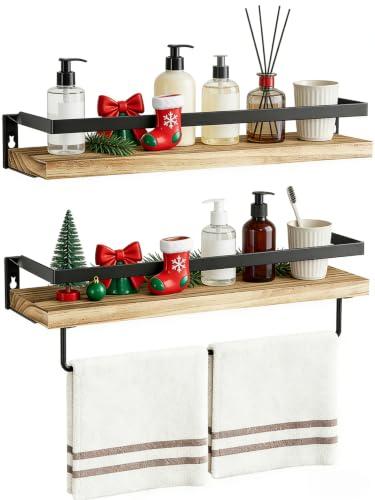
A floating shelf is a shelf board with a concealed mounting system. In the most common design, a metal bracket — typically a frame with two or more horizontal steel rods — is screwed to the wall first. The shelf board, hollow at the back or routed with matching holes, slides over those rods and is locked in place with small set screws underneath. From every normal viewing angle there is no visible support at all, which is why the shelf appears to float. That single trick explains both the appeal and the limitations of the category, and understanding it will help you read every other section of this floating shelves review with the right expectations.
The category divides into a few broad families. Solid wood shelves are the premium end: a real timber board, often pine, paulownia or a harder wood, with a warmth and grain that printed finishes imitate but never quite match. They can be sanded, restained and repaired, and they carry weight confidently when the bracket matches. Engineered wood shelves — MDF or particleboard cores with a laminate or veneer skin — are the mainstream. They are lighter, cheaper per shelf, perfectly flat and consistent in colour, which makes them easy to match in sets of three or four. Their weakness is moisture and edge damage: once the skin chips or swells, the board rarely recovers. A third family is the purpose-built bathroom shelf, often narrower, sometimes with a raised edge, a guard rail or an integrated towel bar, designed around bottles and jars rather than books. Finally there are corner floating shelves, which turn dead wall junctions into small display towers, and long single ledges sold for picture leaning and gallery arrangements.
Where do they fit in a home? Almost everywhere a wall is doing nothing. In living rooms they carry plants, ceramics, framed photographs and the small objects that make a room feel collected rather than furnished. In bathrooms they are frequently the only storage that fits, holding towels and toiletries above a pedestal sink where a cabinet cannot go. In kitchens they take the everyday overflow — spice jars, mugs, cookbooks, a row of glasses — within reach of the worktop. In bedrooms they replace nightstands in small rooms, hold paperbacks and lamps, and give teenagers a place for trophies and headphones. In hallways and entryways they become landing strips for keys, mail and a mirror above. The common thread is that floating shelves serve the layer of a home that is part storage, part display. They are not a substitute for deep closed storage, and judging them as if they were misses the point of the design.
One more thing defines the category: it is sold in sets. Most households do not buy one shelf; they buy two, three or four matched boards and compose an arrangement. That means consistency matters — boards that vary in colour or thickness between boxes will show it on the same wall — and it means the per-shelf experience of installation repeats, so a kit that is pleasant to install once stays pleasant, and a frustrating kit frustrates you three times in a row.
In this guide
Design, Build and Setup
Judge a floating shelf from the back, not the front. The front is a finish; the back is the engineering. A good bracket is welded steel with rods that are level with each other and long enough to support most of the board’s depth. The rods should fit the board’s holes snugly — a sloppy fit is the seed of the slow forward tilt that owners complain about months later. Better kits add a small bubble level, decent wall plugs for more than one wall type, and set screws that bite properly. Cheaper kits skimp exactly here, in the parts you cannot see in a product photograph.
Board construction varies in ways that matter over years. Solid wood boards feel dense and sound dull when knocked; they shrug off small knocks and can be refinished. Hollow engineered boards are surprisingly rigid for their weight because the skin and internal honeycomb or frame work together, but they dent at corners and dislike standing water. Finish quality is the third leg: a convincing wood-look laminate has varied grain, a matte sheen and edges that wrap cleanly. A poor one repeats the same printed pattern on every board in the set, which the eye catches immediately once three identical “grains” hang in a row.
Setup follows the same sequence for nearly every design, and it is worth describing once, carefully, because this review’s performance findings all trace back to it. You hold the bracket against the wall at the chosen height, level it, and mark the screw holes. If fortune smiles, two of those holes land on studs — the vertical timbers behind the plasterboard — and the bracket gets its strongest possible fixing. Where holes miss studs, you drill and fit wall anchors matched to your wall type: toggle or snap-toggle anchors for hollow plasterboard, proper plugs for masonry, and the specific fixings tile and brick demand. The bracket is screwed home, checked for level again, and the board slides over the rods until it meets the wall. Set screws underneath lock it. From unboxing to styled shelf, a first shelf typically takes most people the better part of an hour; the second and third go much faster.
Safety First: The Block Every Installer Should Read
Floating shelves concentrate their load on a hidden bracket, so safe installation is not optional decoration — it is the product. Find the studs whenever you can: use a stud finder, confirm with a second pass, and plan shelf positions so at least part of the bracket lands on timber. Where studs are impossible, use anchors genuinely rated for hollow-wall use and for loads of this kind, not the small plastic plugs thrown in with picture hooks. Match the anchor to the wall — plasterboard, lath and plaster, brick, block and tile all behave differently and fail differently. Keep loads honest and qualitative: light decorative objects and everyday toiletries are the natural cargo; do not load a floating shelf with dense, heavy stacks simply because it has not sagged yet, because brackets usually fail suddenly rather than gradually. In children’s rooms and bedrooms, fix shelves with particular care, keep them out of climbing reach, never place a shelf where a child could pull up on it, and never hang a loaded shelf directly above a pillow where a falling object would land on a sleeper. Check every shelf a few weeks after installation and then seasonally: a board that has begun to tilt or a bracket with any play in it comes down and is refixed, not loaded more carefully.
None of this is difficult, but all of it is unforgiving of shortcuts. The difference between the glowing and the furious ownership experiences of this category is almost never the board. It is whether the person installing it treated the wall as part of the product.
Performance in Real Use
Living Room Display
This is the duty floating shelves were born for, and they perform beautifully. A run of two or three boards at staggered heights carries the exact mixture a living room accumulates — a trailing plant, a stack of art books lying flat, a ceramic bowl, framed photographs — and presents it as a composition rather than clutter. Because there is no bracket breaking the wall line, objects read against the wall colour and the whole arrangement feels intentional. The practical limits show up in depth and weight rather than looks. Shelf depth in this category is sized for paperbacks, small plants and decor, not for large-format coffee table books standing upright or for bulky board game boxes. Weight discipline matters too: a shelf that looks wonderful holding a plant and three novels should not then be asked to hold a dense row of hardbacks end to end. Spread heavy items across shelves, keep the heaviest pieces nearest the wall where leverage is least, and the display stays crisp for years.
Bathroom Storage
Bathrooms are where floating shelves stop being decoration and become infrastructure. The wall above a toilet, beside a mirror or over a pedestal sink is usually the only storage volume in the room, and a pair of shelves there holds rolled towels, skincare, spare loo rolls and a small plant with room to spare. Performance here is a story about moisture. Steam finds every weakness in an engineered board: unsealed edges swell, laminate bubbles at the underside, and a shelf that looked perfect in month one can look tired by month twelve in a small, unventilated bathroom. Solid wood with a proper sealed finish, and boards sold specifically for bathroom duty with protected edges, fare much better. Wipe-down behaviour matters as well — toothpaste, cosmetics and hard-water spots are daily events, and a smooth matte finish that cleans with a damp cloth beats a deeply grained rustic surface that traps residue in its texture. Purpose-built bathroom designs with a raised lip or guard rail earn their keep here, because bottles on a narrow shelf above a sink eventually get knocked, and a rail turns a falling bottle into a rattling one.
Kitchen Duty
In kitchens, floating shelves trade the dust protection of cupboards for openness and reach, and households divide sharply on whether that trade suits them. As open storage for the things used every day — mugs, glasses, spice jars, the olive oil, a small stack of bowls — they perform superbly: everything visible, everything one motion away, and the wall of a small kitchen suddenly contributes storage instead of merely enclosing it. The honest costs are grease and dust. In a working kitchen, an airborne film settles on open shelves and their contents, so items stored there should be items in constant rotation that get washed by use, not the good crystal that comes out twice a year. Weight is the second consideration: stoneware and cast iron are dense, and a shelf run carrying dinnerware should be the most conservatively installed in the house, studs wherever possible, loads spread, nothing stacked high. Judged as everyday open storage, kitchen floating shelves are a genuine pleasure. Judged as a replacement for a full wall cabinet, they will disappoint.
Bedrooms, Kids’ Rooms and Small Spaces
In small bedrooms, a floating shelf beside the bed does the nightstand’s job — lamp, book, phone, glass of water — while leaving the floor clear for a basket or simply for the visual calm of empty floor. In children’s rooms they hold the rotating cast of treasures, library books and a night light, with the safety conditions from the installation section applied strictly: fixed into studs or proper anchors, out of climbing reach, nothing heavy overhead. For renters and small-space households generally, the category’s appeal is that it adds storage volume without adding furniture footprint, and a wall of shelves in a studio can separate a sleeping zone from a living zone as effectively as a bookcase while taking up none of the floor. The performance caveat is permanence: every shelf is a set of holes in a wall, and in a rental that means a filling-and-painting session at move-out, which most owners we hear from consider a fair trade and a few consider a dealbreaker.
Hallways, Entryways and the Landing-Strip Effect
The last performance test is the narrowest room in the house: the hall. A floating shelf in an entryway becomes the landing strip for keys, post, sunglasses and the dog lead, with a mirror above it and a basket beneath, and in that role it outperforms almost any alternative because it gives a small, defined home to the objects that otherwise migrate across every surface in the house. The discipline it demands is honesty about depth: a hallway shelf must be shallow enough to pass with a coat on and a bag in hand, and its contents must be corralled — a small tray or bowl on the board — because an entry shelf without a container becomes a row of small things waiting to be brushed off by a sleeve. Households also report an unexpected benefit here: the shelf’s visibility enforces the habit. Because everything on it is on show, it stays edited, and the edited entryway makes the whole home feel calmer from the front door inward. It is the smallest installation in this review and, for many owners, the one they would repeat first in the next home.
Strengths and Trade-Offs
Strengths
- A genuinely clean look. No visible brackets means the wall reads as one calm surface, and even inexpensive boards look considered once styled.
- Storage without furniture. Shelves add capacity high on the wall, in rooms where another cabinet or bookcase simply would not fit.
- Composability. Sets can be arranged in lines, steps, grids or corners and rearranged as a room’s life changes, which fixed furniture cannot match.
Trade-offs
- Installation is the product. Results depend on your wall, your anchors and your patience more than on the brand in the box.
- Light-to-medium duty only. The hidden bracket trades raw capacity for looks; dense, heavy storage belongs elsewhere.
- Everything is on show. Open shelves display clutter as faithfully as they display treasures, and they collect dust in proportion.
Read those two lists together and the category’s character is clear. Floating shelves are a display-led storage system with real but bounded capacity, and they reward households who style them and install them properly. The trade-offs are not flaws to be engineered away in the next model year; they are the price of the floating effect itself, and every brand in the comparison below pays it in the same currency.
How It Compares: The Main Designs on the Market
Because this category is defined by a mechanism rather than a model, the useful comparison is between the leading design patterns households actually buy. Each pick below is a real, widely sold product family; treat the notes as guidance on which pattern suits which wall, and check price on Amazon for the current listing of any that fit your room.
BAYKA Floating Shelves — the rustic wood-look reference set
BAYKA’s floating shelves are the pattern most people picture first: warm wood-look boards in matched sets, sized for living rooms and bedrooms, with a hidden bracket and a finish that leans rustic-modern. As a reference design it does the mainstream job well — the boards are thick enough to read as substantial, the finish photographs honestly, and the sets are composed so two or three boards make a complete arrangement without buying extras. Best for: living room and bedroom display in rustic, farmhouse and transitional rooms. Not suited for: steamy bathrooms, where a sealed or purpose-built board is the wiser choice, or for anyone wanting genuine solid timber rather than a wood-look finish. Overall tier: mid.

AMADA HOMEFURNISHING Floating Shelves — the practical all-rounder
AMADA HOMEFURNISHING sells floating shelves aimed squarely at everyday storage rather than showpiece display, with sets pitched at bathrooms, kitchens and laundry rooms as much as living rooms, and some configurations adding practical touches for rooms where things get knocked. The design language is simpler and more utilitarian, which is precisely its appeal in working rooms: these are shelves you load, wipe and forget. Best for: bathrooms, kitchens and utility spaces where function outranks styling. Not suited for: a formal living room wall where finish realism is the whole point. Overall tier: entry to mid.
QEEIG Bathroom Floating Shelves — the bathroom specialist
QEEIG builds floating shelves specifically around bathroom storage, with designs that anticipate bottles, jars and towels: narrower boards, protective edges and configurations meant to sit above a toilet or beside a vanity. In a category full of living room shelves being pressed into bathroom service, a specialist pattern shows its value in the details — how the board handles splashes, how items are kept from sliding, how the set composes in a small tiled room. Best for: bathrooms of every size, especially small ones with a pedestal sink and no cabinet. Not suited for: book storage or living room display, where its proportions and detailing look out of place. Overall tier: mid.
Sorbus Floating Shelves — the decorator’s set
Sorbus approaches floating shelves from the decor side, with sets in a range of finishes intended to coordinate with picture frames, wall art and the other Sorbus storage pieces a room might already hold. The boards present well in groups and suit the symmetrical, styled arrangements — a pair flanking a mirror, a grid above a sofa — that decor-led households favour. Best for: styled living rooms, hallways and bedrooms where the shelf is part of a composed wall. Not suited for: heavy everyday kitchen or bathroom loading. Overall tier: entry to mid.

Wallniture Floating Shelves — the rustic problem-solver
Wallniture’s floating shelves lean into rustic wood character and practical variations, including designs that add under-shelf utility for kitchens and workspaces — the shelf as a small storage system rather than a bare board. The aesthetic is warmer and more textured than the minimalist mainstream, which makes it a natural fit for farmhouse kitchens, craft rooms and coffee stations. Best for: kitchens, coffee bars and craft spaces wanting character plus function. Not suited for: sleek contemporary rooms where a pronounced rustic grain fights the scheme. Overall tier: mid.

Greenco Floating Shelves — the simple, light-duty option
Greenco’s floating shelves are the straightforward end of the market: simple boards and corner configurations for light display — photos, small plants, collectibles, a few paperbacks. They install easily, ask little of the wall, and suit the renter or first-apartment brief of getting things off surfaces without a major project. Best for: light display, corners, rentals and first homes. Not suited for: anything dense or heavy, or for rooms where the shelf must carry daily working storage. Overall tier: entry.
Who Should Buy Floating Shelves — and Who Should Skip Them
Buy with confidence if your storage problem is really a display problem: objects scattered on surfaces, walls doing nothing, small rooms where furniture has run out of floor. Buy if you enjoy arranging things and will keep the composition edited, because an edited floating shelf looks designed and an overstuffed one looks like a cry for help. Buy if you are willing to spend the installation hour properly — studs found, anchors matched, level checked twice — because the category rewards that hour every day afterwards.
Skip, or choose a different storage type, if your need is dense capacity: a serious book collection, full dinner services, archive boxes. A bookcase or a bracketed shelf with visible supports will serve you better and cost you less worry. Skip if your walls are fragile, crumbling or forbidden to drill, and look instead at leaning shelves and furniture. Skip if the shelf would hang above a bed’s pillows or a child’s play zone and you cannot relocate it — no storage gain is worth a falling-object risk. And skip the very cheapest end of the market for anything beyond featherweight display; the bracket is the product, and it is the first place a bargain kit saves money.
A short pre-purchase checklist:
- Measure the wall and the objects: shelf depth should exceed your largest item’s depth with a small margin, and length should suit the composition, not just fit the gap.
- Know your wall type before ordering, and be ready to buy proper anchors separately if your walls are hollow plasterboard.
- Decide the load honestly — display, everyday storage, or books — and choose board and bracket quality for that duty, not for the lightest version of it.
- Plan the arrangement on the floor or with painter’s tape on the wall before the first hole is drilled.
- If the set will live in a bathroom, choose sealed, moisture-tolerant boards and protected edges from the start.
For help narrowing the field, our companion guides walk through the decision step by step: the floating shelves buying guide and how to choose floating shelves. If you are still deciding whether the style suits your home at all, read are floating shelves worth it and the balanced floating shelves pros and cons.
Setup, Care and Maintenance Essentials
Care begins at installation. Wipe boards down before styling them — factory dust and packaging residue dull a finish — and let bathroom shelves cure their sealant and settle for a day before loading them with bottles. In the first month, check each shelf once for the early signs of trouble: a hairline gap opening between board and wall at the top, a board that rocks slightly when pressed at the front edge, set screws that have relaxed. All three are five-minute fixes early and a refit later.
Routine care is light. Dust weekly with a dry or barely damp cloth; open shelves show dust quickly, and a regular thirty-second pass is the difference between styled and neglected. In kitchens, degrease boards on the same rhythm as the splashback, and rotate stored items so nothing bonds to the finish. In bathrooms, dry the underside edge after steamy showers if your boards are engineered wood, and never let a wet bottle stand in a puddle on the board. Solid wood shelves benefit from an occasional refresh of their oil or seal coat in high-use rooms, following the maker’s guidance. Once or twice a year, do the honest audit: press, look for tilt, confirm nothing has crept heavier over the months — shelves accumulate load the way drawers accumulate objects — and edit back to the weight and composition you installed for. The full step-by-step, with tools and troubleshooting, lives in how to install floating shelves.
The Bracket, Explained: Why Some Shelves Sag and Others Never Do
Every performance difference in this category traces back to a component most buyers never think about until it fails, so it deserves a plain-language explanation. The standard hidden bracket is a back plate that screws flat to the wall, with two or more steel rods welded or bolted to it at right angles. The shelf board is a box with no back: its rear face has holes that receive the rods, and the board’s depth is supported along the rods’ length. When you load the front edge of the shelf, you create a rotational force — the front wants to go down, the back wants to lever up and out. The bracket resists that rotation in two ways: the rods bear against the inside of the board’s holes, and the back plate’s lower screws are pulled while its upper screws are pushed. This is why screw quality and anchor choice dominate everything. The rotational force multiplies the load at the fixings, so a shelf carrying a modest stack of books can be testing its top fixings far harder than the raw weight suggests.
Three design details separate brackets that age well from brackets that tilt by spring. First, rod length: rods that extend through most of the board’s depth support the load along its whole lever arm, while short rods concentrate force near the wall and let the front of the board flex. Second, fit: the holes in the board should receive the rods with a firm, sliding fit. A loose fit gives the rotation a head start, and no set screw fully compensates for sloppy machining. Third, the back plate’s screw pattern: plates with holes spread vertically resist rotation better than plates with a single horizontal row, because the spread gives the fixing couple more leverage against the load’s leverage. When you compare kits in a store or study listing photographs, these are the details to hunt for — they predict the ownership experience more reliably than the board’s finish, which is the part every listing photographs best.
Wall material is the bracket’s other half. Into a stud, a screw develops its full grip in solid timber and the system is only as weak as the bracket itself. Into hollow plasterboard, the anchor must spread the load across the board’s inner face, and the plasterboard itself becomes the limit — it is a sandwich of gypsum and paper, strong in compression across a wide area, weak against a concentrated pull. This is why the same shelf, the same bracket and the same books can be a triumph in one home and a slow-motion failure in another, and why honest guidance in this category always starts with the wall, not the product.
Living With Them: The First Month, Honestly
Week one is the honeymoon, and it is real. Rooms genuinely do feel larger and calmer when storage leaves the floor and the eye can travel under it. The objects you chose to display get noticed — guests ask about the plant, the photograph, the bowl — in a way they never did when the same objects sat on a sideboard. Most owners spend the first week adjusting: an object moves two inches left, a stack gains a book, loses a book. This micro-styling is not indecision; it is the category working as intended, because a floating shelf is a composition surface and compositions settle by eye.
Week two is when dust introduces itself. An open shelf in a living room gathers a visible film faster than enclosed furniture, and the first wipe-down sets the household rhythm: thirty seconds with a cloth while the kettle boils, or a monthly archaeological dig. Kitchens accelerate the lesson, adding grease to the dust, which is why the owners who stay happy with kitchen shelves are the ones who store only high-rotation items there. Bathrooms teach the moisture lesson in the same period — a ring under a bottle left standing in a splash zone, the first sign of an edge swelling on an unsealed board. None of these are surprises to anyone who read the trade-offs section; all of them are reasons the trade-offs are worth taking seriously before purchase rather than after.
By week four, the installation tells its truth. Shelves fixed into studs or proper anchors feel exactly as they did on day one — press the front edge and nothing moves. Shelves that were rushed begin their small betrayals: a hairline shadow gap at the top rear, a board that yields a fraction when a book is pulled out, a faint creak that was not there before. The encouraging finding of this review is that week-four problems are almost always correctable at week four: unload, refit with the right anchors or shift the bracket to catch a stud, reload lighter at the front. The shelves that fail outright in month six are nearly always the ones whose month-one warnings were styled over rather than fixed.
The longer arc — six months, a year — separates materials. Solid wood boards look essentially unchanged, gathering at most a patina. Good laminate boards look unchanged too, provided their edges stayed dry. Bathroom boards are the honest exception, and the pattern is consistent: sealed and specialist boards age gracefully, general-purpose boards pressed into steamy service age visibly at the edges first. None of this condemns the category; it simply confirms that floating shelves are a buy-once, install-properly, match-to-the-room purchase, and households who treat them that way report the highest satisfaction of any open storage we cover.
Sizes, Depths and Arrangements: Getting the Composition Right
Floating shelves are sold in a fairly standard envelope of sizes, and choosing within it is a design decision as much as a storage one. Depths cluster in a band suited to their cargo: shallow boards for photographs, small plants and bathroom bottles; mid-depth boards that take paperbacks, mugs and folded towels; and the deepest boards, which begin to rival small bookcase shelves and suit kitchens and living rooms with larger objects. The rule that keeps arrangements looking right is to let the deepest object you actually own set the depth — a shelf barely deeper than its contents looks tailored, while a shelf far deeper looks like a landing strip and tempts overloading at the front edge, exactly where leverage punishes the bracket most.
Lengths shape the composition. A single long shelf makes a calm horizontal line and suits a gallery ledge of leaning frames or a kitchen run of jars. Pairs and trios of shorter boards are the flexible classic: stacked vertically with even spacing for a bookcase effect, stepped for movement on a stair wall, or split either side of a window or mirror for symmetry. Vertical spacing deserves a tape measure, not a guess: leave clear headroom above the tallest object the shelf will hold — a plant that touches the shelf above looks cramped and gets watered awkwardly — and keep bathroom and kitchen shelves within the comfortable reach of the shortest regular user. Corner configurations deserve special mention for small bathrooms and box rooms, where the junction of two walls is otherwise dead volume; a short tower of corner boards holds a surprising amount while occupying space nothing else wanted.
Two arrangement habits separate the shelves that photograph well from the shelves that merely hold things. The first is editing by thirds: group objects in odd numbers, vary heights within each group, and leave deliberate empty board at the ends so the composition breathes. The second is anchoring each shelf with one larger piece — a plant, a framed print leaning on the wall, a stack of books lying flat — and letting smaller pieces orbit it, rather than lining up six similar objects in a row, which reads as a shop display. These are styling points, but in a category bought for its look, styling is performance.
Floating Shelves Review: Final Verdict
Floating shelves earn their popularity honestly. The mechanism is simple, the effect is architectural, and a properly installed set quietly reorganises how a room stores and displays the things that make it yours. This review’s through-line is that the category has no bad products so much as bad matches: a light-duty board asked to be a bookcase, a living room shelf steamed daily in a bathroom, a good bracket betrayed by the wrong anchors. Match the design pattern to the room — a rustic reference set like BAYKA for living spaces, a specialist like QEEIG for bathrooms, a practical all-rounder like AMADA HOMEFURNISHING for working rooms, a rustic system like Wallniture for kitchens, a decorator set like Sorbus for styled walls, a simple Greenco board for light display — install it as if the wall were part of the product, and the floating effect delivers exactly what it promises. For the head-to-head against the traditional alternative, see floating shelves vs wall shelves, and for more owner-focused reading, floating shelves reviews.
One closing observation from reviewing this category as a whole: floating shelves have quietly changed what a wall is for. A generation ago, walls held pictures and rooms held furniture; the floating shelf merged the two, turning the wall itself into the furniture and the objects on it into the picture. That is why satisfaction with these shelves runs deeper than their modest capacity suggests, and why owners so often install a second set after the first succeeds. Buy the pattern that fits your room, respect the wall, keep the load honest, and a floating shelf stops being a shelf at all — it becomes part of the architecture of the home.
What a Longer, Slower Check Reveals About This Floating Shelves
A single review session can flatter or condemn a floating shelves unfairly, so this section slows the judgement down and looks at what only repeated, ordinary use tends to reveal. Run the floating shelves through your least favourite version of its job first, not the easiest demonstration: the awkward corner, the rushed weekday timing, the fuller load, the lower light, or whatever condition in your routine makes this category work hardest. Check the floor, wall, ground or surface the floating shelves will meet, since level, texture, moisture and finish decide more about everyday performance in home decor & lighting settings than most shoppers expect when they are comparing listings on a screen. Read the manual’s warnings page for the floating shelves even if you read nothing else, because that page is a compressed list of every way the product has ever been misused, and it tells you exactly which of your own habits needs adjusting.
Photograph your setup once the floating shelves is working well — the position, settings, arrangement or layout you settled on — so that after a move, a deep clean or a seasonal break you can recreate the arrangement that worked instead of rediscovering it. Notice the small recovery moments: how the floating shelves behaves when you pause mid-task, change your mind, need to move it, clean it sooner than planned, or hand it to someone in the household who has never used it before. Seasonal thinking helps more than expected: a floating shelves bought in one season will meet different light, humidity, mud, heat, guests and routines in another, so judge its size, storage and upkeep against the hardest season it will face. Look at replacement parts and consumables for the floating shelves while you are still comparing, confirming that the pieces most likely to wear, clog, tear, fade or get lost can actually be obtained without replacing the whole product.
Finish the longer check by looking at wear points rather than features: the hinge, seam, edge, wheel, latch, surface or joint on a floating shelves that moves, flexes or gets handled most is where its second year is decided, whatever its first week felt like. Plan the storage home for the floating shelves before it arrives, naming the exact cupboard, corner, shelf, hook or stretch of floor, because a product without a home migrates around the house and slowly becomes the clutter it was bought to reduce. Measure before anything else, and measure the floating shelves in its working state rather than its packed or folded state, because handles extend, lids open, cords trail, doors swing and users stand somewhere, and all of that belongs in the measurement. If you want a concrete listing check, take a name already shortlisted in this guide, such as BAYKA Floating Shelves, AMADA HOMEFURNISHING Floating Shelves and QEEIG Bathroom Floating Shelves, and verify that exact floating shelves listing against the measurements and compatibility questions above, field by field, rather than trusting the headline description alone.
Watch for edge cases in your own home: the pet that investigates everything, the child who treats every new object as furniture, the guest who uses force where you use familiarity, and the weather, light or season that changes how a floating shelves behaves. Decide in advance what good enough looks like for the job the floating shelves does in your home, because chasing a flawless result usually costs more time than the flaw itself, and most households are happier with a reliable ninety percent they actually repeat. If a problem with the floating shelves repeats in the same spot or the same stage of the job, treat the pattern as the clue — patterns point to setup, surface or technique, while random problems point more often to the individual unit. A well-judged floating shelves explains itself to that second person without a lecture, with controls, grips, openings or adjustments that make sense on contact, and that intuitiveness is worth recording because guests, partners and teenagers will all test it.
When something about the floating shelves disappoints, change one variable at a time — position, setting, timing, load, accessory or technique — and give the change a fair trial, because changing three things at once leaves you with a better or worse result and no idea why. Use a simple decision checklist at the end: the floating shelves fits the measured space, suits the real frequency of the job, matches the household’s cleaning temperament, has obtainable parts, and has a named storage home — five yeses make a confident order. Keep a short note of what you adjusted on the floating shelves during the first month, even just a line on your phone, since those notes turn vague impressions into a setup you can repeat, share or troubleshoot months later.
Frequently Asked Questions
How much weight can a floating shelf really hold?
It depends almost entirely on the fixing, not the board. A bracket screwed into studs with a well-fitting board carries everyday loads — a row of paperbacks, toiletries, kitchen jars — with confidence. The same shelf on weak anchors in hollow plasterboard is a light-display item only. Treat any single headline figure with suspicion, keep loads modest and spread out, place the heaviest items closest to the wall, and never load a shelf that has begun to tilt until it has been refixed properly.
Can floating shelves work in a rental?
Yes, with eyes open. The shelves themselves are renter-friendly — they free up floor space and need no floor footprint — but every bracket means several screw holes to fill and paint at move-out. Choose fewer, larger shelves rather than many small ones to limit holes, keep the filler and touch-up paint from the day you install, and check your lease for rules about drilling into tile or masonry, which are harder to make good than plasterboard.
Why does my floating shelf tilt forward?
Forward tilt is the category’s signature fault and it has three usual causes: rods that fit the board’s holes loosely, so the board rotates on them; anchors that have relaxed in hollow wall material; or chronic overloading at the front edge, where leverage is greatest. Unload the shelf, remove the board, and check each cause in turn. Snug the fit as the maker allows, refit with proper hollow-wall anchors or move the bracket to catch a stud, and reload with heavy items against the wall.
Are floating shelves safe in a child’s bedroom?
They can be, under strict conditions. Fix the bracket into studs or with anchors genuinely suited to the wall and load, position shelves well out of climbing and pull-up reach, keep only light soft or unbreakable items on them, and never place a shelf above the pillow end of the bed. Re-check fixings regularly, because children’s rooms get knocked and climbed on in ways adult rooms do not. If any of those conditions cannot be met, choose low furniture storage instead.
What is the best material for bathroom floating shelves?
Moisture behaviour decides it. Sealed solid wood and boards built specifically for bathrooms, with protected edges and a finish that shrugs off splashes, outlast general-purpose engineered boards in steamy rooms. Whatever the material, ventilation is the silent partner: a bathroom with an extractor fan or a window is kind to every shelf, while a sealed steamy box of a room will test the best board made. Wipe standing water rather than letting it sit, especially along the underside edge.
How high should floating shelves hang?
Hang them for the objects and the people, not for a formula. Display shelves work at or slightly above eye level for the room’s main viewpoint; kitchen shelves should clear worktop appliances below and stay within comfortable reach above; bathroom shelves above a toilet should clear the head of the tallest user when seated and standing. Before drilling, mark the arrangement with painter’s tape, live with it for a day, and adjust — the tape stage is where height mistakes are free. If you are hanging a vertical stack, measure the spacing from the objects outward: tallest item first, then its breathing room, then the next shelf line. Getting this right on paper is what makes the finished wall look inevitable rather than approximate.
Related reading: best wall mirror ideas for small rooms, best wall sconce picks, best bookcase for small spaces, and best entryway runner rugs.