Disclosure: As an Amazon Associate, dailyhomedecorating.com earns from qualifying purchases. Links on this page are affiliate links; they cost you nothing extra. Prices and availability change often, so check the current Amazon listing before you buy.
This floating shelves buying guide is for the moment before the purchase, when the wall is still blank and every option looks identical in a thumbnail. Floating shelves are bought badly more often than they are made badly: the wrong depth for the objects, the wrong board for a steamy room, the right shelf betrayed by the wrong anchors. This guide works through the decisions in the order they actually matter — what the shelf must do, which type fits that job, how much it will honestly carry, what your wall allows, and only then which of the market’s leading sets deserves your money. By the end you will have a specification, not just a preference, and a shortlist of real products matched to it.
Key Takeaways
- Start with the room and the cargo, not the finish. Moisture and load eliminate half the market before style gets a vote.
- The bracket and the fixing decide real-world capacity; the board decides looks and longevity. Budget your attention in that order.
- Depth should be set by your deepest object plus a small margin — no more, or the shelf tempts front-edge overloading.
- Buy the set that finishes the wall in one composition; matched boards from one set hang together best.
- Every pick in this guide is a real, widely sold product family, positioned by tier (entry, mid, premium) rather than a fixed price — check price on Amazon for the current listing.
Floating Shelves Buying Guide: What They Do and the Main Types
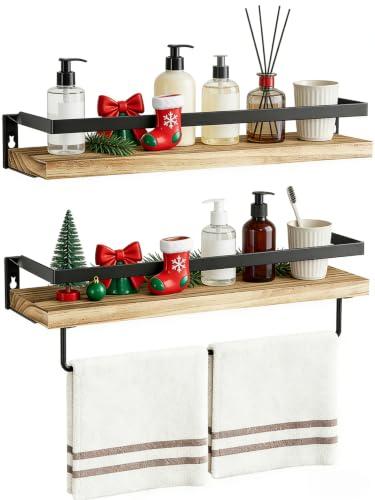
A floating shelf is storage that borrows its structure from the wall. A concealed bracket — usually a steel back plate with rods — is screwed to the wall, and a hollow-backed board slides over the rods and locks in place, leaving no visible support. What it does for a room is twofold: it adds storage and display volume without consuming floor space, and it does so with an architectural cleanliness that furniture cannot imitate. What it does not do is replace deep, enclosed, heavy-duty storage. Every buying decision in this guide flows from that honest job description.
The Standard Hidden-Bracket Set
The mainstream of the market: matched boards in pairs, trios and fours, in wood-look or painted finishes, sized for living rooms, bedrooms and hallways. This is the type to default to for display and light everyday storage, and the type with the widest choice of finishes and set compositions. Its quality spread is also the widest, so the criteria sections below matter most here — bracket fit and included hardware separate the satisfying sets from the sagging ones.
The Bathroom Shelf
A specialist subtype designed around bottles, jars and towels: narrower boards, sealed or protected edges, and in some designs a raised lip, guard detail or towel provision. Bathroom shelves are the correct answer to the wettest room in the house, where general-purpose boards age at their edges. If your project is a bathroom, start your shortlist here and only leave the subtype if your bathroom is large, dry and well ventilated.
The Rustic and System Shelf
Boards with pronounced wood character, sometimes extended into small storage systems with under-shelf utility for kitchens, coffee stations and workspaces. This type suits rooms where the shelf is meant to be seen and to work — farmhouse kitchens, craft rooms, rustic living spaces — and its textured surfaces ask for slightly more deliberate cleaning in greasy or dusty service.
The Corner Shelf
Quarter-round or angled boards that stack into the junction of two walls, turning dead volume into a display tower. Corner shelves are the small-space specialist: bathrooms without walls to spare, box rooms, studio corners. Their cargo is light by nature — small plants, photographs, toiletries — and they reward households who think of them as vertical display rather than storage.
The Long Ledge
A single extended board, often with a shallow lip, sold for leaning picture frames and creating gallery arrangements that can be rearranged without new holes. Ledges are the decorator’s tool and the renter’s friend, because one fixing run supports an ever-changing display. They carry the least working storage of any type and should be bought for display alone.
In this guide
Top Picks at a Glance
These are the design families this guide recommends, mapped to the jobs they do best. Full mini-reviews follow after the criteria sections, so you can read the picks against your own specification.
| Pick | Badge | Best job | Tier |
|---|---|---|---|
| BAYKA Floating Shelves | Best Overall | Living room and bedroom display sets | Mid |
| QEEIG Bathroom Floating Shelves | Best for Bathrooms | Wet-room storage, small bathrooms | Mid |
| AMADA HOMEFURNISHING Floating Shelves | Best for Working Rooms | Kitchens, laundry, utility storage | Entry to mid |
| Wallniture Floating Shelves | Best Rustic System | Kitchens, coffee stations, craft rooms | Mid |
| Sorbus Floating Shelves | Best for Styled Walls | Symmetrical arrangements, gallery compositions | Entry to mid |
| Greenco Floating Shelves | Best Simple and Light | Corners, rentals, light display | Entry |
Badges in this guide are job descriptions, not rankings: the Best Overall pick is the wrong buy for a steamy bathroom, and the bathroom pick would be a strange choice for a gallery wall. Read the criteria first if your brief is unusual; read the picks first if it is not.
How Much Will It Honestly Carry?
This is the criterion buyers most want reduced to a number, and the one this guide most firmly refuses to fake. A floating shelf’s real capacity is a property of a system — bracket, board fit, fixings and wall — not of the board alone, and the same set can be a confident book shelf in one home and a light display shelf in another. Think in bands instead. Display band: plants, frames, ceramics, a few objects per board — every type in this guide handles it on any sound fixing. Everyday band: toiletries, kitchen jars, mugs, folded towels, paperbacks in moderation — needs a decent bracket and proper fixings, ideally catching studs. Book band: rows of books, the densest common cargo — needs the strongest sets, stud fixings wherever possible, loads spread across boards and weighted toward the wall. Beyond those bands — stoneware stacks, archives, appliances — the honest answer is a different storage type entirely.
Two habits keep any shelf in its band over time. Load the back of the board first and the front last, because leverage multiplies toward the front edge. And audit seasonally, because loads creep: the jar added in March and the stack added in June are how a display shelf becomes an overloaded one without anyone deciding it should.
It helps to understand why the bands are bands rather than numbers. When a shelf is loaded, the force trying to rotate it forward grows with the distance of the weight from the wall, so the same stack of books is a gentle load against the wall and a serious one at the front edge — position is a multiplier, not a detail. The bracket resists that rotation through its fixings, and the fixings’ grip depends on what they are screwed into, which is why a stud fixing and a plasterboard anchor produce different shelves from identical hardware. Dynamic loads count too: the book pulled out one-handed, the jar set down firmly, the child who steadies themselves on the board once. A shelf loaded to its static limit has nothing left for those moments, which is why this guide’s bands all carry an unspoken margin — stay visibly inside the band that fits your fixing, and the shelf will feel over-engineered in exactly the way good household engineering should.
What Size and Depth Do You Need?
Measure the objects, then the wall, in that order. Depth is set by your deepest intended item — a shelf should exceed it by a small margin and no more, because surplus depth invites front-edge loading and looks ungainly under small objects. As a orientation, bathroom bottles and toiletries live happily on the shallowest boards in the category; paperbacks, mugs and folded towels want the middle band; large-format books, dinnerware and storage baskets want the deepest boards on offer, and even then only in the everyday band of loading. Length is a composition decision: a single long board makes one calm line, while pairs and trios of shorter boards compose more flexibly and let you step an arrangement around windows, mirrors and radiators. Vertical spacing should be measured from the cargo outward — tallest object, plus its breathing room, plus the next board — rather than divided evenly by eye, which is how plants end up scalped by the shelf above.
Count the wall’s constraints before falling for a composition: stud positions, sockets, light switches, door swings, and the head clearance over toilets, baths and sofas. The tape stage — marking the full arrangement in painter’s tape and living with it for a day — is the cheapest design tool in this entire guide, and the one whose absence generates the most regret.
Which Material and Finish Will Survive Your Room?
Board materials divide into camps with predictable behaviour. Solid timber is the premium camp: repairable, restainable, warm in the hand, and the most forgiving of knocks; it is also the heaviest and the most demanding of its bracket. Engineered boards with a laminate or veneer skin are the mainstream: perfectly flat, colour-consistent across a set, light for their stiffness, and entirely dependent on their skin — once an edge chips or swells with moisture, there is nothing underneath worth repairing. In dry rooms the mainstream camp is the rational buy. In wet rooms the question narrows to sealing: choose boards sold for bathroom duty, with protected edges and a finish that tolerates standing splashes, and pair them with the room’s ventilation, which does as much for shelf life as the board does.
Finishes should be judged by sheen and texture before colour. Matte and satin hide dust and fingerprints and flatter most rooms; gloss wipes cleanest in greasy kitchens but announces every mark. Pronounced rustic textures hide knocks and suit characterful rooms, while holding dust and grease that smooth boards shed. Dark finishes show pale dust; pale finishes show scuffs and rings. The forgiving middle — mid-tone, matte, smooth — is where most satisfied owners end up, and it is no accident that the mainstream sets cluster there.
What Does Your Wall Allow?
The wall is a component of the product, and this guide treats it as one. Stud walls — plasterboard over timber framing — are the friendly case: a bracket that catches studs achieves the system’s full potential, and a stud finder is the first tool to buy. Hollow plasterboard without a stud in the right place is the common case, and it is entirely workable with anchors designed for hollow walls and shelf loads, of which toggle-style anchors are the reliable pattern; the small plugs in many kits are the weak point to upgrade. Masonry and brick take plugs and patience and reward both with excellent grip. Tile adds a drilling discipline — the right bit, no hammer action until through the glaze, and a detector sweep for pipes and cables first, because bathroom walls hide plumbing exactly where shelves want to go.
The Safety Block: Read Before Any Drilling
Floating shelves fail at their fixings, so safety is a fixing discipline. Find the studs wherever the composition allows and put at least part of every bracket into timber. Where studs are impossible, use anchors genuinely rated for hollow-wall shelf loads and matched to your wall material — never the lightest plug in the drawer. Keep loads honest and qualitative: display and everyday items are the cargo; dense, heavy stacks belong on furniture. In children’s rooms and bedrooms, fix shelves with extra care, position them out of climbing and pull-up reach, store only light and unbreakable things on them, and never hang a loaded shelf above the pillow end of a bed or over a play area. After installation, press-test every board, and re-check fixings a few weeks later and each season after; any shelf with play or tilt comes down and is refixed, not merely unloaded. None of this is advanced DIY — it is the ordinary care that separates the category’s successes from its cautionary tales.
How Many Shelves, and in What Arrangement?
Buy for the finished composition, not for the single shelf. Most successful installations are two to four boards: a vertical stack reading as a light bookcase, a stepped run following a stair or a sofa line, a flanking pair around a mirror or window, or a grid in a hallway. Compositions succeed when they are edited — objects grouped in odd numbers, heights varied, deliberate empty board left at the ends — and when the arrangement is solved on the wall in tape before it is solved with a drill. If your plan needs more than four boards on one wall, consider whether a bookcase or a ledge run serves the same wall with less drilling; if it needs one board, consider whether a pair would finish the composition, because single floating shelves often look like the start of an unfinished sentence.
Spacing and Symmetry Rules of Thumb
A few regularities save most compositions. Vertical stacks want consistent gaps measured between boards, with the gap set by the tallest object plus its breathing room; if the cargo varies wildly in height, a stepped arrangement hides the irregularity better than a stack does. Flanking pairs want their inner edges aligned to the feature they frame and their heights matched to the centimetre — the eye forgives a pair that is low, but never a pair that is uneven. Shelves above sofas and beds should sit high enough to clear a seated person’s head with margin, and shelves above worktops should clear the tallest appliance while staying inside the comfortable reach of the shortest regular user. Long runs read best when they stop short of the wall’s ends; a shelf that runs corner to corner leaves the composition nowhere to breathe. And every arrangement benefits from one rehearsal at full size in tape, viewed from the doorway and from the seat it will be seen from, because shelves are composed for viewpoints, not for the person standing on the ladder.
Reading Listings Like an Engineer
Product listings in this category are written to be photographed, not interrogated, so a buyer needs a translation routine. When a listing leads with the board’s styling, look immediately for the bracket: is it shown at all, are the rods long, does the back plate spread its screws? A listing that hides the hardware is telling you where its money went. When a listing quotes a heroic load figure, ask the engineer’s question — on what wall, with what fixings, tested how? A figure without a wall is marketing, because the wall is half the system. When a listing shows the shelf in a bathroom, check whether the description ever mentions sealing, edges or moisture; a board photographed in a bathroom but never specified for one is a living room board in costume. When set compositions are shown, count the boards in the photograph against the boards in the box — arrangements in listing images routinely use two sets, and the honest comparison is composition against composition.
Photographs deserve the same scepticism as text. Grain that repeats identically across boards in a photograph is printed grain, which is fine at the mainstream tier and mis-sold at anything above it. A shelf shown floating against a seamless studio wall tells you nothing about the bracket’s fit; look instead for the underside shots, the set screws, the rear view. Scale is the last deception: boards are photographed with small objects to look generous, so read the stated dimensions against your own measured objects rather than against the photograph’s staging. None of this requires expertise — it requires reading a listing as a specification sheet with illustrations, instead of as a promise with dimensions attached. The buyers who do it are, overwhelmingly, the owners who report no surprises.
What Is in the Box: Brackets, Plugs and Instructions
Listings photograph boards; ownership is decided by the rest of the box, so this guide inspects it. The bracket should be steel, with rods long enough to support most of the board’s depth and a back plate whose screw holes spread vertically — that spread is what resists the rotational force a loaded front edge applies. Test the board’s fit on the rods before anything touches the wall: a firm sliding fit is the single best predictor of a shelf that stays level, and a loose, rattling fit is a reason to return a set rather than install it hopefully. Set screws should be present and should bite; a board locked only by friction is a board waiting for a knock.
The plugs and screws are where kits diverge most honestly. Good kits include fixings for more than one wall type and say which is which; weak kits include one small pattern of plug and leave hollow-wall owners to discover its limits at the worst moment. Treat included fixings as a starting point, not a promise: if your walls are hollow plasterboard and the shelves will carry more than display weight, plan to add toggle-style hollow-wall anchors to the order. Instructions matter more than pride admits — a paper template for marking holes, a stated drilling sequence and a levelling step in the right order are worth real money in avoided mistakes, and their absence is a fair reason to choose a competing set at the same tier. A small bubble level in the box is a courtesy; a household should own a proper level regardless, because the bracket must be level to a standard the board cannot later correct.
Room-by-Room Buying Plans
Living room. The brief is display with a working minority: plants, frames and ceramics in front, paperbacks and a few hardbacks behind them. Buy the standard hidden-bracket set in a finish that survives eye-level scrutiny, depth matched to your largest book or planter, and a composition of two or three boards. Prioritise bracket reserve, because living room loads grow socially — gifts, new plants, one more stack — and the set with margin absorbs the growth. BAYKA’s sets are the template here, with Sorbus the alternative when the wall is a formal composition and Wallniture when the room leans rustic.
Bathroom. The brief is survival, then storage. Buy the bathroom subtype — QEEIG is the template, AMADA HOMEFURNISHING the all-rounder alternative — in shallow depths, with protected edges, and compose the above-toilet and beside-vanity walls together. Fixings must suit tile or plasterboard as found, and the plan should include the room’s ventilation: an extractor that runs during showers is a shelf-life purchase as surely as the board is. Keep the cargo to bottles, jars, towels and spares, and let rails or lips earn their place wherever hands are wet.
Kitchen. The brief is open storage for high-rotation items. Buy depth for your largest everyday container, a smooth wipe-clean finish, and the most conservative installation in the house — studs wherever the composition allows. Wallniture’s system variations suit the coffee-station version of this brief; AMADA HOMEFURNISHING suits the working version. Whatever the set, buy it for the items you touch daily and keep the rarely used pieces behind doors, because grease and dust tax everything left open.
Bedroom and child’s room. The brief splits in two. For an adult bedroom, a standard set as a nightstand alternative or a dressing-table companion is a straightforward display purchase. For a child’s room, the buying criteria reorder completely: fixing strength and placement first, cargo restricted to the light and unbreakable, boards positioned out of climbing reach and never above the pillow. Buy the set whose hardware you trust most, not the one whose finish matches the bedding, and revisit the fixings as the child grows into new climbing abilities.
Hallway and entryway. The brief is the landing strip: shallow depth that passes a coat and a bag, a composition that pairs naturally with a mirror, and a container strategy — tray, bowl, small basket — bought with the shelf, because an entry shelf without containment becomes a row of small things awaiting a sleeve. Standard sets and ledges both serve; choose by whether the wall’s job is storage or display.
Home office and craft room. The brief is supplies within reach and off the desk. Depth for your largest box or machine accessory, a finish that forgives ink, glue and dust, and compositions that run above and beside the work surface. System-style shelves earn their premium here, and the load discipline is the kitchen’s: everyday items, spread well, nothing precious balanced at the front edge above a workspace where elbows fly.
Tiers, Explained Without Prices
Because listings change constantly, this guide positions picks by tier, and it is worth knowing what the tiers buy. The entry tier buys the floating effect honestly: light boards, simple brackets, display duty. It is the right spend for rentals, spare rooms, corners and first projects, and its limit is reserve — there is little margin for growing loads or wet rooms. The mid tier buys the things ownership actually tests: snugger bracket fits, better hardware, sealed or more realistic finishes, set compositions that finish a wall. Most households should buy here for most rooms; it is where the category’s value concentrates. The premium tier buys solid materials, refined hardware and finishes that survive the closest scrutiny, and it earns its place in permanent installations in high-visibility rooms — and only there, because a premium board on a casual brief is money spent where no one will ever notice it. In every tier, the same rule caps the value of upgrading: no tier repeals wall physics, and a mid-tier set in studs outperforms a premium set on bad anchors every single time.
How to Prioritise by Use Case
The small bathroom. Priority order: moisture behaviour, then proportions, then everything else. Choose the bathroom subtype, shallow boards, protected edges, and plan the above-toilet and beside-vanity walls as one composition. The kitchen. Priority order: fixing strength, then wipe-clean finish, then depth for your largest everyday item. Store high-rotation items only, and treat the installation as the most conservative in the house. The living room. Priority order: finish realism at eye level, then set composition, then bracket reserve for the books-and-plants load you will actually apply. The child’s bedroom. Priority order: safety, then safety again — stud fixings, high placement, light soft cargo — then a finish that forgives knocks. The rental. Priority order: fewest holes for the most storage, which usually means fewer, longer boards, plus a tube of filler bought on day one. For the value question behind all of these, see are floating shelves worth it; for the balanced ledger, floating shelves pros and cons.
The Picks in Detail
BAYKA Floating Shelves — Best Overall
The mainstream answer, and the set this guide hands to the widest range of buyers. BAYKA’s wood-look boards have the finish realism living rooms ask for at eye level, the set compositions finish a wall without a second purchase, and the bracket fit is the snug kind that stays level. It is the pick for display-plus-paperbacks duty in living rooms, bedrooms and hallways. Best for: most households, most rooms. Not suited for: steamy bathrooms, where the specialist below wins, or buyers who specifically want solid timber. Tier: mid — check price on Amazon.
QEEIG Bathroom Floating Shelves — Best for Bathrooms
The specialist, recommended without hedging for the wettest brief in the house. QEEIG’s bathroom-first proportions, protected detailing and moisture-tolerant behaviour solve the problems that age general-purpose boards, and in a small bathroom the set can be the difference between a room that works and one that stores products on the bath rim. Best for: bathrooms of every size, especially small ones. Not suited for: living room display or book storage. Tier: mid — check price on Amazon.

AMADA HOMEFURNISHING Floating Shelves — Best for Working Rooms
The all-rounder for rooms that earn their keep. AMADA HOMEFURNISHING’s plain, wipe-clean design and forgiving installation suit bathrooms, kitchens and laundry rooms where the shelf is loaded, splashed and forgotten rather than styled. Best for: utility storage and first installs in working rooms. Not suited for: a formal styled wall where finish realism is the point. Tier: entry to mid — check price on Amazon.

Wallniture Floating Shelves — Best Rustic System
The character pick, with system variations that add under-shelf utility for kitchens, coffee stations and craft rooms. Wallniture’s pronounced rustic boards make the shelf a feature, and in farmhouse and workshop-flavoured rooms nothing else in this guide wears the wall better. Best for: rustic kitchens, coffee bars, craft spaces. Not suited for: sleek minimal rooms; textured surfaces also ask a deliberate wipe in greasy service. Tier: mid — check price on Amazon.
Sorbus Floating Shelves — Best for Styled Walls
The decorator’s set: finishes coordinated for composed walls, consistency across boards for grids and flanking pairs, and an easy install. Sorbus shelves are display furniture and should be bought as such — within that brief they are excellent. Best for: gallery walls, symmetrical arrangements, styled bedrooms and hallways. Not suited for: wet rooms or daily working storage. Tier: entry to mid — check price on Amazon.

Greenco Floating Shelves — Best Simple and Light
The honest entry point: plain boards and corner configurations for light display, easy to install, easy on the wall. Greenco is the renter’s and first-apartment pick, and its corner towers are the most space-efficient light storage in this guide. Best for: corners, rentals, photographs and plants. Not suited for: books in quantity, kitchen storage, or any load that will grow. Tier: entry — check price on Amazon.
Colour, Style and Living With the Choice
A buying guide that stops at engineering abandons the buyer at the decision they will actually look at every day, so here is the styling counsel that experience supports. Match the shelf to the room’s existing wood tones loosely rather than exactly: an exact match attempted between different materials usually lands close enough to look like a mistake, while a deliberate step lighter or darker reads as design. In rooms with no wood to match, white and pale boards disappear against pale walls for the calmest effect, while dark boards make a feature of the wall and demand the most edited styling. Consider the wall colour as part of the purchase — the same board reads warm on a warm wall and stark on a cool one — and if the room is due a repaint, paint first and shelve second, because the reverse order guarantees a fiddly masking job around every bracket.
Think about the shelf’s silhouette in the room’s sightlines. Thick boards read as substantial and suit rooms with generous proportions and chunky furniture; slim boards suit smaller rooms and modern schemes where the objects should carry the visual weight. A run of shelves at staggered heights adds movement to a plain wall but complicates the composition; a disciplined horizontal line is calmer and more forgiving. None of these choices is permanent in the way a bookcase purchase is — boards can be restained, repainted or replaced on the same brackets in some designs — but the holes are where they are, so the composition deserves the tape treatment regardless of how changeable the boards feel.
Three Worked Specifications
The renter with a blank living room wall. Specification: one set of standard boards in a mid-tone matte finish, mid depth, composition of three in a level line above the sofa, display cargo with a few paperbacks, fixings upgraded to proper hollow-wall anchors because the studs do not fall kindly, and filler bought in the same order. Pick: BAYKA if the room leans warm, Sorbus if it leans formal. This buyer should not buy the bathroom subtype, the corner tower or the premium tier, and the reason in each case is the brief, not the budget.
The family with a tiny bathroom. Specification: bathroom subtype, shallow boards, protected edges, one pair above the toilet and one beside the vanity bought as a single plan, fixings matched to tile with a detector sweep before drilling, cargo limited to bottles, towels and spares. Pick: QEEIG, with AMADA HOMEFURNISHING as the alternative if the household prefers a plainer working look. This buyer should not buy a living room set and hope, because hope is not a moisture strategy, and should treat a working extractor fan as part of the same project budget.
The cook building a coffee station. Specification: rustic system shelf with under-shelf utility, depth for the largest mug and jar, smooth-enough finish for a weekly degrease, bracket fixed into studs because the cargo is ceramic and daily, composition kept to one strong run rather than a scattered arrangement. Pick: Wallniture. This buyer should not buy a decorator set, however well it photographs, because the brief is a working station and the shelf will be judged with wet hands at seven in the morning.
Notice what the three specifications share: room, cargo, wall, then product — in that order, every time. A buyer who can state those four things in one sentence each does not need this guide’s picks at all, which is the sincerest compliment a buying guide can pay its reader. For everyone still forming the sentences, the criteria above and the picks that follow them are the shortcut.
First Setup and Care Essentials
Setup follows one sequence for every pick above: tape the composition, find the studs, level the bracket, fit the anchors your wall actually needs, slide the board home, lock it, and press-test before styling. The step-by-step, with tools and the mistakes to avoid at each stage, is in how to install floating shelves, and the choosing framework that precedes this guide is in how to choose floating shelves. Care thereafter is a small routine: dust weekly, degrease kitchen boards with the splashback, dry bathroom boards after steam, and audit fixings seasonally. Shelves maintained on that rhythm, from any family in this guide, stay level and good-looking for years; shelves installed casually and loaded optimistically generate the category’s bad reputation, regardless of which box they came out of.
One setup habit deserves emphasis because buyers consistently underrate it: dry-fit everything at ground level first. Assemble each board on its bracket on the floor, confirm the fit is snug, locate the set screws by touch, and only then take the bracket to the wall. Discovering a stiff board or a shy set screw while standing on a stool, holding a shelf at shoulder height, converts a two-minute check into a twenty-minute struggle — and rushed, tired installations are where levels get skipped and anchors get under-driven. The floor rehearsal also reveals whether the set’s boards match each other in colour and thickness before any of them is committed to the wall, which is the last moment that discovery is free.
Mistakes to Avoid
The five errors that account for nearly every disappointing floating shelf purchase: buying by photograph without checking depth against your largest object; choosing a living room board for a steamy bathroom; trusting the included plugs on hollow plasterboard instead of fitting anchors made for the job; composing on the wall with a drill instead of with tape; and loading the front edge with the heaviest items because that is where the space was. Each is avoidable at the buying stage, which is the entire premise of this guide. Two more deserve honourable mention: mixing boards from different families in one composition, where small differences in thickness and finish become loudly visible, and hanging a shelf above a bed or a child’s play zone because the wall looked empty — an empty wall is never a problem that needs solving at that price. For the comparison against the traditional alternative before you commit, read floating shelves vs wall shelves, and for owner-level detail on each pick, floating shelves reviews and the category floating shelves review.
Two purchasing-stage mistakes deserve their own warning because they cannot be fixed at installation. The first is buying a single shelf to test a composition that needs three: the test shelf proves the mechanism works and nothing about the finished wall, and boards bought later may not match its production run. Commit to the composition or test with tape, not with one lonely board. The second is ordering before measuring the wall’s hidden geography — the stud that is not where the composition wants it, the pipe run behind the bathroom tile, the socket exactly at shelf height. Ten minutes with a tape, a stud finder and a detector, spent before the order rather than after the delivery, is the highest-value step in this entire guide, and it is the one most often skipped by buyers who were certain they already knew their own walls.
A Pre-Purchase Measurement and Compatibility Audit for Your Floating Shelves
Use this audit in the final ten minutes before you order a floating shelves, because that is when most buying-guide advice stops being abstract and starts being a tape measure, a doorway and a return label you would rather not need. Write down three numbers for the floating shelves you are considering: the footprint where it will sit or be stored, the largest dimension it reaches in normal use, and the clearance it needs so doors, drawers, lids, handles or moving parts can work without catching. Check the floor, wall, ground or surface the floating shelves will meet, since level, texture, moisture and finish decide more about everyday performance in home decor & lighting settings than most shoppers expect when they are comparing listings on a screen. If a problem with the floating shelves repeats in the same spot or the same stage of the job, treat the pattern as the clue — patterns point to setup, surface or technique, while random problems point more often to the individual unit.
Test the floating shelves in the first week under deliberately ordinary conditions rather than saving it for a special occasion, so that any problem surfaces while returning, exchanging or adjusting your setup is still simple. Read the manual’s warnings page for the floating shelves even if you read nothing else, because that page is a compressed list of every way the product has ever been misused, and it tells you exactly which of your own habits needs adjusting. Then measure the route, not just the destination, since a floating shelves that fits its final spot perfectly can still fail at a narrow hallway, a tight turn, a low doorway or a cupboard mouth that is smaller than the space behind it. Consider the cleaning rhythm honestly: a floating shelves that needs attention after every use suits a household that enjoys small rituals, and frustrates a household that wants to finish a job and walk away, so match the upkeep to the temperament, not the intention.
For troubleshooting, start with the boring causes first: power, water, fit, blockage, alignment, a full container, a loose connection or a setting changed by the last person who used the floating shelves, because boring causes account for most apparent failures. When something about the floating shelves disappoints, change one variable at a time — position, setting, timing, load, accessory or technique — and give the change a fair trial, because changing three things at once leaves you with a better or worse result and no idea why. Keep a short note of what you adjusted on the floating shelves during the first month, even just a line on your phone, since those notes turn vague impressions into a setup you can repeat, share or troubleshoot months later. Measure before anything else, and measure the floating shelves in its working state rather than its packed or folded state, because handles extend, lids open, cords trail, doors swing and users stand somewhere, and all of that belongs in the measurement.
Share the checklist result with anyone who shares the space, since a floating shelves chosen by one person and resented by another rarely survives, however sensible the purchase looked on paper. Plan the storage home for the floating shelves before it arrives, naming the exact cupboard, corner, shelf, hook or stretch of floor, because a product without a home migrates around the house and slowly becomes the clutter it was bought to reduce. Seasonal thinking helps more than expected: a floating shelves bought in one season will meet different light, humidity, mud, heat, guests and routines in another, so judge its size, storage and upkeep against the hardest season it will face. Use a simple decision checklist at the end: the floating shelves fits the measured space, suits the real frequency of the job, matches the household’s cleaning temperament, has obtainable parts, and has a named storage home — five yeses make a confident order.
Decide in advance what good enough looks like for the job the floating shelves does in your home, because chasing a flawless result usually costs more time than the flaw itself, and most households are happier with a reliable ninety percent they actually repeat. Compatibility is the second audit, and for a floating shelves it means checking what it must work alongside: the surfaces, fittings, power or water access, storage and other pieces already in your home decor & lighting setup that the new purchase has to cooperate with every day. If a listing for a floating shelves leaves one of those compatibility questions unanswered, treat the gap itself as information and look for the answer in the manual, the dimension diagram or the question section rather than assuming the generous interpretation. Photograph your setup once the floating shelves is working well — the position, settings, arrangement or layout you settled on — so that after a move, a deep clean or a seasonal break you can recreate the arrangement that worked instead of rediscovering it.
Frequently Asked Questions
What is the best type of floating shelf for a small home?
The type that matches the room’s job: standard sets for living spaces, the bathroom subtype for bathrooms, corner towers where walls are scarce. In small homes the winning quality is not size but fit — depth matched to the objects, compositions that use dead wall, and boards that free floor space without demanding it back in visual clutter. A measured, edited run of two or three boards outperforms a wall of shelves in almost every small room.
How do I know if my wall can hold floating shelves?
Identify the wall first: stud walls and masonry are straightforward with the right fixings; hollow plasterboard needs anchors designed for hollow walls and shelf loads; tile needs the right drill bit and a pipe-and-cable check. If you cannot identify the wall or find any secure fixing, that is the wall answering the question — choose furniture storage for that spot and put the shelves on a wall that can take them.
Should I buy solid wood or engineered boards?
Buy solid wood for longevity, repairability and eye-level living room duty where the budget allows; buy engineered boards for colour consistency across a set, lighter weight and value in dry rooms. In bathrooms, let sealing decide rather than material: a sealed, edge-protected board of either kind outlasts an unsealed one. The bracket and fixing matter more than the board material to how the shelf behaves, so never fund a timber upgrade by skimping on anchors.
How many shelves come in a typical set, and is that enough?
Sets commonly group boards in pairs, trios and fours, which matches how compositions are actually built — most finished walls use two to four boards. One set is enough for one wall composition in most rooms. If your plan spans two walls or two rooms, buy both sets at the same time where you can: boards from the same production run match in colour and thickness more reliably than boards bought months apart. The same logic applies within a room that will grow: if there is any realistic chance of a second composition next season — the matching run in the hallway, the pair for the other side of the window — buying both sets together protects the match, and spare boards store flat and harmlessly in a way that mismatched boards on a wall never do.
Are expensive floating shelves worth it over budget ones?
The premium buys bracket fit, board material and edge sealing, and finish realism — in that order of importance. For a bathroom or a permanent living room installation, those are worth paying for. For light display in a spare room or a rental, an honest entry-level set installed properly will serve as well in practice. What never pays is the reverse allocation: a beautiful board on a bargain bracket, or any shelf at all fixed with the wrong anchors.
Can floating shelves replace a bookcase?
For display and a modest reading collection, they can, and they do it while returning the floor to the room. For a serious library, no: the hidden bracket is a light-to-medium duty mechanism, and long upright rows of books belong on furniture or visibly supported shelving built for the load. Many households run both — shelves for the current and the beautiful, a bookcase for the archive — and that division of labour is the category at its best.
Related reading: best wall mirror ideas, best bookcase for small spaces, best entryway runner rugs, and best wall sconce picks.