Disclosure: As an Amazon Associate, dailyhomedecorating.com earns from qualifying purchases. Links on this page are affiliate links; they cost you nothing extra. Prices and availability change often, so check the current Amazon listing before you buy.
The expandable garden hose pros and cons debate tends to split gardeners into camps, and both camps are usually telling the truth about different gardens. This article lays out the ledger plainly: five to seven genuine advantages, the same number of honest disadvantages, what the trade-offs mean for different households, how the format compares with its alternatives, and the buying and care moves that shrink the cons. No camp recruiting, no pretending the weaknesses away: durability against convenience is the real exchange here, and by the end you should know which side of it your garden lives on.
Quick Verdict and Key Takeaways
- The pros are about every session: light weight, tiny storage, no kinking battles and quick deployment.
- The cons are about the calendar: shorter life than rubber, pressure sensitivity and handling rules that cannot be skipped.
- The format suits small-to-medium gardens, containers and anyone for whom a heavy hose is a genuine barrier.
- Care habits shrink most cons; no habit removes the core durability gap entirely.
Short verdict: Worth it for gardeners who value daily ease and will follow the draining routine. Skip it if you need a hose to live outdoors permanently, cross rough ground daily or serve for many years untouched. The purchase-focused companion is the expandable garden hose buying guide, and the money question is examined in is an expandable garden hose worth it.
In this guide
The Pros
Pro: Dramatically Lighter Than a Conventional Hose
Weight is the headline advantage and it is not a marginal one. A drained expandable hose can be carried in one hand, lifted by gardeners who struggle with a charged rubber hose, and moved around beds without the dragging tail that crushes seedlings and knocks pots. Over a summer of daily container rounds, that difference compounds into the main reason owners defend the format so warmly. Watering stops feeling like hauling equipment and starts feeling like carrying a tool, and jobs that get easier get done more often and more thoroughly.
Pro: Stores in a Fraction of the Space
A contracted expandable hose fits in a plant pot, a bucket or a small basket by the door. For balconies, small sheds, flats without outdoor storage and tidy gardeners generally, this is transformative: the hose stops being a permanent green snake decorating the patio and becomes an object that genuinely goes away. Small storage also means indoor winter storage is realistic, which quietly extends the hose’s life, because the damaging months are spent in a cupboard rather than on a frozen wall.
Pro: Quick to Deploy and Put Away
There is no uncoiling ritual, no walking backwards feeding out loops, and no wrestling a stiff coil back onto a reel in the rain. You carry the bundle to the tap, connect, open the water and watch the hose grow along its route; afterwards it shrinks itself as it drains, doing half the putting-away for you. For short, frequent jobs — the evening pot round, a quick rinse of the patio, filling a paddling pool — that speed is the difference between a two-minute task and a production, and it is why these hoses get used for jobs a conventional hose would never be fetched for.
Pro: Resists the Kinking Habit
Conventional hoses kink at the same beloved spots, cutting flow and testing patience. An expandable hose, soft and fabric-covered, is far less prone to the hard fold that stops water entirely, and it drapes around pots and corners without the springy resistance of rubber. It can still tangle if handled carelessly, and it dislikes being trapped under doors or furniture, but the everyday experience is smoother: the hose follows you rather than arguing with you, which matters most in planted borders where attention should be on the plants.
Pro: Gentle Around Plants and Paving
A soft, light hose is kinder to the garden it serves. It slides past stems without the crushing weight of a charged rubber hose, it does not scuff decking or drag grit across paving in the same way, and when it contracts at the end of a session it shortens away from beds rather than needing to be hauled back through them. Gardeners with dense planting, gravel paths they would rather keep in place and delicate new growth consistently rate this gentleness as an under-sung advantage of the format.
Pro: Encourages Timely Watering
The least technical pro may be the most valuable: because using the hose is easy, watering happens when plants need it. Containers do not wait for a convenient moment; they dry on hot afternoons whether the gardener feels like wrestling a reel or not. Owners repeatedly report that the expandable hose changed their watering reliability more than any other purchase, and a garden watered on time looks better than a garden with superior equipment used reluctantly. Judge this pro honestly against your own habits rather than dismissing it as soft.
Hand-watering containers is the expandable hose’s home ground. Pots dry out faster than beds, they are usually clustered near the house where the tap also lives, and watering them is a daily, short, repetitive job where hose weight is felt most keenly. A hose that lives in a pot by the back door, lifts out in one hand and reaches every container without a wrestling match genuinely changes how pleasant that round feels, and plants benefit because a job that is pleasant gets done on time. The same logic covers small borders, herb planters, hanging baskets reached from below, and the quick evening top-up that keeps a new planting alive through a dry spell.
Sprinklers and larger lawn jobs are a more qualified fit. An expandable hose can feed a small sprinkler for a modest lawn, but the format’s flow and pressure behaviour, and the need to keep the hose extended and untangled for the whole session, make it less serene than a conventional hose for long, set-and-forget watering. Gardeners whose main job is moving a sprinkler around a big lawn for hours will usually be better served by a standard hose on a reel. Where the expandable design shines is the mixed garden: some pots, some beds, a small lawn patch, a car to rinse and a patio to wash down, all in one varied round.
Washing jobs deserve their own mention, because they are half the reason many households buy a hose at all. Rinsing muddy boots, washing the car on the drive, sluicing a patio, filling a paddling pool and cleaning garden furniture are all short, mobile tasks where dragging a heavy rubber coil is pure friction and a light expandable hose is a pleasure. The cautions still apply: keep the sleeve off sharp gravel where you can, do not leave the hose charged and closed in hot sun while you take a break, and remember that the water is for washing, not drinking, however tempting a sip looks mid-job.
The Cons
Con: Shorter Service Life Than Rubber
This is the central, non-negotiable weakness. The elastic core that makes the hose work is also a wearing part, stressed by every fill, every stretch and every sunny afternoon under pressure. Even well-kept expandable hoses should be expected to serve seasons, while a quality rubber hose can serve for many years with crude treatment. Buyers must price that difference into the decision emotionally as well as financially: if a hose failing after a few summers will feel like a betrayal, this format will disappoint you regardless of brand.
Con: Pressure Sensitivity and Burst Risk
Every expandable hose has a pressure limit, and honest writing about the category has to treat that limit qualitatively rather than with invented numbers. Domestic tap pressure varies from house to house and street to street, and a hose that behaves perfectly on one supply can be stressed on another, especially if a nozzle is left closed against a running tap or a booster pump feeds the line. The practical reading is simple: expandable cores are elastic by design, elasticity is what makes them convenient, and elasticity is also what sets a ceiling on how much sustained pressure the tube should be asked to hold. Open the tap gently, avoid leaving a charged hose baking in full sun, and never use one of these hoses with pressure-boosting equipment it was not sold for.
Burst stories in this category almost always share a plot: the hose was left pressurised, often in heat, often kinked or trapped underfoot, until the inner tube gave way at its weakest point. That is not a reason to fear the format; it is a reason to use it as designed. Water should be flowing or released, not stored under pressure inside a stretchy tube. If your household supply is known to run strong, or a previous hose has failed at the tap end, a traditional rubber hose tolerates that environment more forgivingly, and choosing one is not a defeat but a correct match of tool to conditions.
Con: The Draining Routine Is Mandatory
The habit that decides how long an expandable hose lives is what happens in the five minutes after watering ends. Turn off the tap, then open the nozzle and let the hose push its own water out as it contracts, walking the stream along the bed until the flow fades. A drained hose is a light hose, and a light hose stores easily: coil it loosely into a pot, a bucket or a wall basket, out of direct sun, and let it dry fully before it sits for any length of time. Storing an expandable hose wet and bunched invites mildew on the fabric cover and stress on the inner tube, while storing it drained and dry is the simplest protection against cracking, smells and early failure.
Winter and long gaps between uses deserve the same discipline, only more so. Before a hose is put away for the season, drain it completely, because water left inside any hose can freeze, expand and split the core, and the stretchy inner tube of an expandable model has less tolerance for that abuse than thick rubber does. Let the empty hose dry in open air, coil it without tight kinks, and keep it somewhere shaded and frost-free rather than on a sun-baked wall hook. None of this is difficult, but it is non-negotiable: almost every disappointed owner story begins with a hose that was left full, left in the sun, or left tangled in a corner.
Draining also protects the fittings and the tap. When a charged expandable hose sits in summer heat, the water inside warms and expands, and the elastic core keeps squeezing, so pressure sits on the connectors and on the nozzle seals for hours. Releasing that pressure after every session takes seconds and spares every joint in the system. Make it a rhythm rather than a chore: tap off, nozzle open, walk the water out, coil loosely, hang or pot the hose in shade. Owners who build that rhythm stop thinking about it within a fortnight, and their hoses quietly outlast those of neighbours who treat storage as an afterthought.
Con: Vulnerable to Sharp and Rough Routes
The outer sleeve is the hose’s armour and its Achilles heel at the same time. Woven fabric protects the elastic core from sunlight, scuffs and small punctures, and denser, tougher weaves generally survive driveways and patio edges better than thin, silky ones. What no fabric sleeve survives gracefully is being dragged repeatedly over sharp stone, thorn stems, rose prunings left on the path, or the corner of a metal raised bed. The experienced owner’s trick is route discipline: carry the gathered hose to the bed rather than hauling it across the garden, lift it over obstacles instead of pulling it around them, and keep it off hot paving where possible. Two minutes of carrying saves the sleeve months of abrasion.
Fabric care is mostly about dryness and shade. A sleeve that is put away damp, session after session, will eventually smell musty and can develop mildew spots, especially in humid climates or in a closed storage box. The fix costs nothing: let the hose dry before it is stored for more than a day, store it in a ventilated pot or basket rather than a sealed container, and keep it out of prolonged direct sun, which fades and weakens woven fibres over a season. None of this requires products or effort beyond a habit, but it is the difference between a sleeve that looks tired by midsummer and one that starts its second spring in decent shape.
Con: Length Is Only Real Under Pressure
Choosing length is the decision buyers most often get backwards, because the number on the box describes a hose under pressure, fully stretched, on a cooperative day. In the garden, corners, beds, pots and furniture all consume length, and a hose that must stretch to its absolute limit to reach the far bed will spend its life under maximum strain, which is exactly the life-shortening condition the format dislikes. The calmer rule is to measure the real route from tap to farthest plant, following the path the hose will actually travel rather than a straight line, and then choose the next size up. A little slack in use is comfort; permanent full extension is a slow form of damage.
Very long is not automatically better, either. A longer hose holds more water, takes longer to fill and drain, and gives you more fabric to coil, store and keep out of the sun. Gardeners with one tap and a genuinely large plot may need that length and accept the handling cost, but gardeners watering a terrace, a small lawn and a row of pots usually find a mid-length hose covers everything with far less fuss. Think in routes rather than in garden size: where the tap sits, which beds are watered daily, which are reached weekly, and whether a second shorter hose or a watering can serves the far corner more sensibly.
Con: Not a Drinking-Water Tool
One safety point belongs near the front of any honest discussion of garden hoses, and it matters more with expandable models than with almost any other watering tool: do not drink directly from a garden hose, and do not fill drinking glasses, water bottles or pet bowls straight from the nozzle as a habit. Garden hose materials, including the inner tubes and outer fabrics used in expandable designs, are not made or certified to drinking-water standards. Water that sits inside a warm hose between uses can also pick up tastes and residues from those materials. Use the hose for plants, washing and outdoor cleaning, and take drinking water from the kitchen tap instead.
Gardeners sometimes ask whether a quick sip on a hot afternoon really matters, and the sensible answer follows general guidance rather than alarm: hose water is for the garden, not for people. The inner core of an expandable hose is chosen for stretch and recovery, not for contact with drinking water, and the fittings are garden fittings rather than food-grade plumbing. Children in particular love drinking from a hose in summer, so it is worth setting the household rule early and kindly: the hose fills watering cans, paddling pools get filled and then emptied, and drinks come from indoors. That single habit removes the one genuine health question these products raise.
Con: Flow and Sprinkler Limitations
For long sprinkler sessions and jobs wanting the strongest, steadiest flow, the expandable format is outclassed by a good conventional hose. The core’s elasticity, the need to stay extended, and the general light-duty design all point the same way: this is a hand-watering and light-duty tool. Households whose watering is mostly lawn sprinkling will feel they bought the wrong instrument, however well it performs at the pots.
Expandable Garden Hose Pros and Cons: What the Trade-Offs Mean for You
Profiles clarify this category faster than specifications do. The container gardener with twenty pots, a small terrace and a tap by the door is the natural owner: daily short sessions, light loads, easy storage, and a hose that disappears into a pot between uses. The allotment or large-garden gardener with long runs, rough ground and sprinkler marathons is the natural sceptic, better served by rubber for the heavy work. Between them sits the typical suburban household with beds, a modest lawn and a car to wash, and for that household the honest answer is that an expandable hose handles most of the week beautifully, provided it is drained, shaded and not dragged over the roughest ground.
Physical comfort is a legitimate profile factor and should not be treated as a soft one. A heavy conventional hose is a real barrier for gardeners with sore shoulders, weak grip or limited strength, and a watering job that hurts is a watering job that gets skipped, to the plants’ cost. For those gardeners the expandable format is not a novelty but an enabling tool, and its shorter service life is a fair price for seasons of watering that actually happen. The same applies to anyone storing a hose in a small flat’s balcony cupboard or carrying it through the house to a front garden with no rear tap.
Expandable Compared With the Alternatives
The comparison every buyer is really making is against the traditional rubber hose, so it should be made honestly. A good rubber hose is heavy, awkward to coil and miserable to drag around corners, but it is also famously durable: it tolerates being left out, driven over occasionally, dragged across rough ground and repaired with simple fittings, and it can serve for many years. An expandable hose reverses nearly every term of that bargain. It is dramatically lighter and stores in a fraction of the space, yet its inner tube and fabric cover are consumable parts by comparison, and shorter service life is the known weakness of the whole category. Buyers who accept that trade with open eyes tend to be happy; buyers who expect rubber-hose longevity from a fabric-and-latex design tend to feel cheated.
There is no universal winner between the two formats, only a better match for a given garden and gardener. Small gardens, balconies, patios and anyone who waters pots and borders by hand feel the expandable hose at its best, because the weight saving is felt on every single outing. Large plots, rough surfaces, frequent sprinkler sessions and households that leave a hose permanently out in all weathers play to rubber’s strengths instead. Many experienced gardeners end up owning both: the heavy hose lives on the reel for big jobs, and the expandable hose handles the daily round of containers and beds. That mixed answer is unfashionable in review writing, but it is what real gardens actually look like.
Cost thinking belongs in the same honest frame, without naming figures. An expandable hose should be budgeted as a convenience item with a service life measured in seasons of careful use, while a quality rubber hose is closer to a long-term fixture. If replacing a hose every few seasons would genuinely irritate you, weight that irritation heavily in the decision, because no amount of lightness compensates for a purchase that feels like a subscription. If, on the other hand, a heavy hose currently means watering happens less often than your plants need, the expandable format can pay for itself in thriving containers alone.
Alternatives deserve a fair hearing in any guide to this category. The traditional rubber hose remains the durability benchmark and the right answer for rough, large or permanently plumbed gardens. A lightweight conventional hose in modern materials splits the difference, staying in one piece and tolerating more abuse than an expandable core while weighing less than old rubber. A simple coil or spiral hose suits tiny patios where reach is short and storage is everything. And for gardeners whose real burden is carrying water to containers, a good watering can or a drip system on a timer may remove the hose question entirely for most days, leaving any hose as an occasional tool rather than a daily one.
Drip irrigation in particular pairs interestingly with expandable hoses rather than simply competing with them. A drip system handles the scheduled, root-level watering of beds and pots, while the hose handles everything irregular: new plantings, washing, filling and the beds the drip lines do not reach. Many gardens run exactly that combination, and readers planning a fuller watering setup will find the two topics worth reading together. The expandable hose decision then becomes smaller and easier, because the hose no longer has to be the garden’s entire watering strategy, only its flexible helper.
For storage pairings, see best garden hose reels; for the nozzle you will hold every session, see best garden hose nozzles; for hand-watering alternatives, best watering cans; and for scheduled bed watering, the drip irrigation kit buying guide may remove the daily hose job altogether.
How to Buy Smart
Three prose-only profiles show how the ledger above maps onto real product styles. They are not linked recommendations; use them to see which side of each trade-off a given style leans towards.

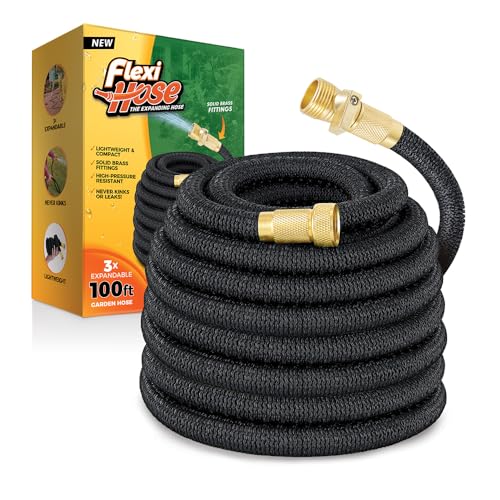
Flexi Hose Expandable Garden Hose
The Flexi Hose is a widely sold expandable model built around a stretchy inner core and woven outer sleeve, commonly offered in several lengths and usually bundled with a spray nozzle. On the pros side it represents the mainstream convenience case at its purest: light, compact and quick. On the cons side it carries the mainstream caveats unchanged, so its lifespan will be decided by draining, shade storage and smooth routes rather than by anything unusual in its design.

Giraffe Tools Expandable Garden Hose
The Giraffe Tools expandable line is typically positioned around sturdier fittings and more substantial construction, aimed at buyers whose first concern is the durability side of the ledger. That positioning buys margin on the cons side without erasing it: the core remains an elastic, wearing component, and the care routine remains compulsory. For households with slightly rougher routes or stronger-handed users, this style is the natural reference point when weighing the trade-offs.
Pocket Hose Expandable Garden Hose
The Pocket Hose is one of the best-known names in the category, sold on compactness and lightness above all. It therefore sits at the far convenience end of the ledger: maximum storage and carrying advantage, with the format’s durability caveats applying in full. For balconies, patios and small gardens where runs are short and routes are smooth, that is often exactly the right end of the trade to choose, provided the hose is drained and stored dry after every use.
Fittings decide more real-world satisfaction than fabric patterns do. The connectors at each end are handled every session, threaded onto taps and nozzles, and asked to seal under pressure while being pulled at angles. Solid-feeling metal fittings, commonly brass in better models, generally inspire more confidence than thin plastic ones, which can crack if dropped on paving or overtightened by strong hands. Whatever the material, the habits matter as much as the hardware: thread connectors on straight, tighten by hand rather than with tools, replace the small rubber washer when a drip appears at the tap, and avoid yanking the hose sideways to test how strong the joint feels. Most leaks in this category are born at the ends, not in the middle.
A spray nozzle or gun is usually bundled or bought alongside, and it deserves a moment of the choosing effort. The nozzle is the part you actually hold, squeeze and adjust for an entire session, so its comfort and its spray patterns shape the experience more than the hose colour ever will. Look for a grip that suits your hand, settings that cover a gentle shower for seedlings through to a jet for rinsing paving, and a lock or a comfortable trigger if long watering rounds are your norm. Keep the nozzle’s filter washer clean, because grit caught there is a common and entirely fixable cause of disappointing spray.
Setup and Care That Reduce the Cons
Experienced owners develop small rituals that keep these hoses alive. Open the tap gradually rather than snapping it fully on, so the core stretches progressively instead of being shocked. Let the hose extend along its route before you start pulling it sideways around corners. When you finish a section, ease off rather than letting the contracting hose whip fittings against paving. Keep a spare washer or two in the same pot the hose lives in, so a tap-end drip is a thirty-second fix rather than a reason to abandon the session. And inspect the sleeve occasionally as you coil: small snags caught early can be kept away from rough routes before they become tears.
If the hose will feed from a tap that also serves other tools, a simple routine helps: expandable hose sessions start with a check that the nozzle is open or ready, so pressure never builds against a closed end while you walk to the far bed. Gardeners who water at dawn or dusk, when the sun is off the hose and the garden takes up water best, also remove the heat factor from the hose’s life entirely. Small things, all of them, but expandable hoses are a product where small things are the whole story: the design has little margin to give, so the owner’s habits supply the margin instead.
Maintenance for an expandable hose is refreshingly short as lists go. Drain after use, dry before storage, coil loosely, keep out of prolonged sun, keep off sharp and thorny routes, check washers when drips appear, and bring the hose indoors or into a frost-free spot before hard winter weather. There are no filters to change in the hose itself, no lubrication schedule and no servicing ritual. If a nozzle is fitted, its small inlet filter benefits from an occasional rinse, and a hose that has been used with liquid feed through a dilutor should be flushed with plain water before storage so residues do not sit in the core. That is the whole programme, and its brevity is part of the product’s appeal.
When something does go wrong, diagnosis is usually simple. A drip at the tap is almost always a washer or a cross-threaded connector. A loss of extension suggests the core has tired or the supply pressure has changed. A visible bulge or a sleeve worn through at one spot points to local damage from a sharp route or a pressure incident, and a hose with a damaged core should be retired rather than trusted, because a core that has failed once will fail again at the worst moment, usually mid-session with the tap far away. Keep the replacement decision calm and prompt; limping on with a bulging hose helps nobody.
Bottom Line
The ledger balances differently for every garden, but it never balances to zero: you are trading years of service for daily ease, and the trade is either obviously right or obviously wrong once your route, your storage and your habits are honestly described. Gardeners who make the trade knowingly, and who spend the small daily effort the format asks, form the satisfied majority of owners. Gardeners who need a hose to be infrastructure should buy infrastructure. The single-product view in expandable garden hose review and the selection method in how to choose an expandable garden hose will help you act on whichever conclusion you reach.
Deeper Notes From the Garden
An expandable hose is built around a simple trick. Inside a woven fabric sleeve sits an elastic inner tube, usually latex or a similar stretchy material, attached to fittings at both ends. At rest, with no water inside, the tube is relaxed and the whole hose is short, soft and easy to gather. Open the tap and water pressure stretches the inner tube lengthwise, the fabric sleeve smooths out as it extends, and the hose reaches its working length. Close the tap and release the water, and the tube contracts again, squeezing the remaining water out through the open nozzle as it shortens. Everything people love and everything people find fragile about these hoses follows from that one mechanism.
Understanding the mechanism explains most ownership advice at a stroke. The hose only reaches full length under pressure, so the length printed on the box is the stretched length, not the length you carry to the tap. The inner tube does the work and takes the strain, so it is the part that eventually fails. The fabric sleeve is a protective skin rather than a pressure vessel, so dragging it over sharp edges, thorns and rough concrete wears the very layer that keeps the tube safe. And because the tube contracts as pressure falls, the hose behaves differently at the start and end of a session than a rigid hose does, shortening and lightening in your hands as it empties.
The classic mistakes with expandable hoses are so consistent that they read like a script. Buying by headline length and discovering the hose only reaches the far bed at full, straining stretch. Leaving the hose charged with the nozzle closed, in full sun, while lunch happens. Dragging the sleeve across gravel, thorns and the sharp corner of a raised bed. Storing it wet, tangled and forgotten in a corner of the shed. Running it from a pressure-boosting setup it was never meant for. And judging the whole category by a first failure that one of those habits caused. Every item on that list is avoidable with information rather than money, which is why guides like this one spend so long on habits.
Close behind the handling mistakes come buying mistakes. Choosing the thinnest, lightest model for a rough driveway garden. Ignoring the fittings because the fabric looked attractive. Assuming every expandable hose behaves the same when construction varies widely between brands. Forgetting to check what the tap end needs, so the new hose arrives and cannot connect without an adapter the household does not own. And buying a second identical hose after the first failed from mistreatment, without changing the mistreatment. The category rewards a thoughtful first purchase and gentle handling far more than it rewards spending in either direction.
Value in this category is not really about the ticket; it is about cost per season of pleasant use, and that figure is decided mostly by handling. A carefully kept expandable hose that serves several seasons of daily container rounds has delivered enormous convenience for its class. The same hose left charged in the sun and dragged over gravel may not finish its first summer, and at that point it was expensive at any price. This is why worth-it questions about expandable hoses always turn into handling questions: the product is a partnership between a clever, delicate mechanism and an owner willing to spend five gentle minutes per session protecting it.
There is also a hidden value line that rarely appears in comparisons: watering that actually happens. Plants lost to a dry week because the heavy hose felt like too much trouble are a real cost of the conventional setup for some households, and containers in particular forgive nothing. If a lighter hose converts watering from a chore postponed into a round enjoyed, the plants, the gardener’s evenings and the look of the terrace all improve together. That benefit does not appear in any specification table, but experienced gardeners rate it highly, and it is the strongest argument the format has.
More Practical Notes
Water conservation and expandable hoses get along well when the gardener is paying attention. Because the hose is light and pleasant, watering tends to be targeted: pot by pot, bed by bed, with the nozzle in hand and the flow under direct control, rather than a sprinkler broadcasting over paths and fences. Water early or late in the day so less is lost to evaporation, direct the flow at soil level rather than over foliage where possible, and let the hose’s convenience serve precision. A tool that makes careful watering easy is, indirectly, a water-saving tool.
Storage containers are an underrated part of the system. A simple terracotta or plastic pot by the back door, a wall basket in the shade, or a lidded box on the balcony gives the drained hose a home that keeps it dry, coiled and out of the sun. Ventilation matters: a container that traps damp against the sleeve invites the mustiness the care routine works to avoid. Size the container generously, because a hose crammed into too small a pot gets the tight bends and kinks that shorten its life. The container is cheap; the habit it enables is the valuable part.
Seasonal rhythm shapes hose life more than any single incident. Spring asks for inspection: uncoil the hose, check the sleeve for winter damage, run water through it and confirm the fittings seal before the busy season starts. Summer asks for shade discipline and the draining routine under maximum temptation to skip both. Autumn asks for one thorough clean, a full drain and a decision about indoor storage before the first hard frost. Winter asks only that the hose be left alone in its dry, frost-free place. Owners who think in seasons stop being surprised by their hoses.
Raised beds and expandable hoses are natural partners with one sharp caveat. The beds concentrate planting at a comfortable height, the hose reaches them easily, and hand-watering at soil level suits the deep, targeted soaking raised beds prefer. The caveat is the bed’s edge: timber corners, metal cladding and protruding screws are exactly the surfaces that wear sleeves. Approach raised beds from a consistent side, lift the hose over the edge rather than hauling it across, and check the route for hardware once at the start of the season. That single route habit protects the hose all summer.
Hanging baskets and window boxes make their own case for the format. They dry faster than any other planting, they sit high, and watering them with cans involves ladders, spills and repeated trips. A light hose with a gentle shower pattern, used from below or from a step, turns the basket round into a calm job, provided the gardener minds the contracting hose on the way down and keeps the sleeve off rough wall render. Baskets watered reliably are also baskets that actually thrive, which is the visible dividend of the whole arrangement by midsummer.
Greenhouses and polytunnels reward the format differently. Space inside is tight, paths are narrow, and a heavy hose dragged between staging and pots causes real damage in a confined crop. An expandable hose carried in and deployed along the path keeps the weight low and the footprint small, and its gentle patterns suit seedlings and young plants. Ventilation heat inside a greenhouse in summer is intense, though, so the hose should live outside the structure and visit only for watering sessions, never baking on the staging between uses.
Shared gardens and family watering rotas expose the human side of the category. A hose with a care routine is only as safe as its least careful user, so households do best to make the routine visible and easy: the storage pot by the door, the spare washers inside it, and a shared understanding that the hose gets drained and put in shade, every time, by whoever used it last. When that culture exists, shared use is no problem at all. When it clearly cannot exist, the honest purchase is a conventional hose that forgives strangers.
Caravan, boat and small-space users read this category with different eyes, and their enthusiasm is instructive. Where every storage centimetre is argued over and every carried kilo counts, a hose that shrinks to a bundle and weighs very little is not a compromise but the obvious tool. Their watering jobs are small and their routes are short and smooth, which places them deep inside the format’s best envelope. Mainland gardeners with a terrace and a tap are closer to this profile than to the estate gardener’s, and can borrow the confidence accordingly.
Muddy dogs, bikes and boots form the unglamorous third of hose work, and the format handles it cheerfully. A quick deploy, a rinse at the back door, a drain and a coil away: the whole episode takes minutes, and because it takes minutes it actually happens, keeping mud out of the house and salt off the bike. Keep the jet setting for these jobs and away from plant stems, rinse the nozzle’s filter if the spray weakens after a gritty session, and remember that the dog’s drinking water, like everyone else’s, comes from the indoor tap.
Finally, a word about second hoses, because many households end up there. The second purchase is usually smarter than the first: the gardener now knows their route, their storage and their habits, and chooses length, fittings and build level from experience rather than from listings. Some buy the same again as a known quantity; some step up to a tougher build for a rougher route; some add a short hose for the front garden while the original serves the back. Treat the first hose as tuition as well as equipment, and the category’s economics look considerably kinder.
Frequently Asked Questions
What is the biggest disadvantage of an expandable garden hose?
Durability. The elastic inner core is a wearing part, and even careful owners should expect a service life measured in seasons rather than the many years a quality rubber hose can deliver. Pressure sensitivity, mandatory draining and vulnerability to sharp routes all flow from the same design. Buyers who accept that exchange for lightness and compact storage tend to be satisfied; buyers who expect rubber-hose longevity tend not to be.
What is the biggest advantage?
Everyday ease. The hose is dramatically lighter than a conventional one, stores in a pot or basket, deploys in moments and largely refuses to kink. For daily container rounds and small-to-medium gardens, that ease changes behaviour: watering happens on time because it no longer feels like hauling equipment. Over a season, reliably watered plants are worth more than any single specification.
Do expandable hoses really shrink back to their stored size?
Yes, that is the mechanism working as designed. As water drains out through the open nozzle, the elastic core contracts and pulls the hose back towards its resting length, squeezing remaining water out as it goes. The contraction is also why draining matters: a hose left full stays stretched, heavy and stressed, while a drained hose returns to the compact bundle that makes storage one of the format’s headline advantages.
Can I leave an expandable hose outside all year?
It is strongly discouraged. Sunlight weakens the fabric sleeve, heat stresses a charged core, and freezing water can split the tube outright. The format’s small stored size makes indoor or sheltered storage easy, so use that advantage: drain fully, dry, coil loosely and keep the hose shaded and frost-free. Owners who store expandable hoses outdoors in all weathers are the ones reporting the shortest lives.
Is an expandable hose better than a rubber hose?
Neither is better in the abstract. Rubber wins on durability, pressure tolerance and permanent outdoor installation. Expandable wins on weight, storage, deployment speed and gentleness around plants. Large, rough or sprinkler-heavy gardens suit rubber; small-to-medium gardens, containers and gardeners who struggle with heavy hoses suit expandable. Many households sensibly own both and use each where it is strongest.
Are expandable hoses safe for filling a child’s paddling pool?
Filling a pool is a normal hose job, but follow the drinking-water rule for anything children will swallow in quantity: hose materials are not made to drinking-water standards. Fill the pool, supervise play as usual, and serve drinks from indoors. For a baby pool that will inevitably be drunk from like a cup, filling from the indoor tap with buckets is the cautious route many parents choose.