Disclosure: As an Amazon Associate, dailyhomedecorating.com earns from qualifying purchases. Links on this page are affiliate links; they cost you nothing extra. Prices and availability change often, so check the current Amazon listing before you buy.
These electric lawn mower reviews take the six machines that define the current market — from a premium self-propelled flagship to a simple corded runabout — and assess each one the way an owner would: what it is like to live with, what it does brilliantly, where it asks for compromise, and exactly whose lawn it belongs on. There is no single winner here, because lawns differ more than mowers do. Instead, each review ends with a plain best-for and not-suited-for verdict, and the closing sections help you match the verdicts to your own garden. Read the two or three reviews that match your lawn size and budget tier, then use the comparison section to settle between them. If you are new to the category entirely, read the Sun Joe and EGO reviews first — the two poles of the market explain each other, and everything else in the roundup sits intelligibly between them, in price, in power, in size, and in spirit.
Key Takeaways
Six machines, six territories. The EGO Power+ Select Cut LM2135SP owns the premium self-propelled territory. Greenworks’ Pro brushless line owns platform value. Ryobi’s HP CrossCut models own the existing-Ryobi-owner territory. Toro’s battery Recycler owns the mulching traditionalist. Makita’s LXT mower owns the workshop-shed logic. The Sun Joe MJ401E owns small-lawn simplicity. Every one of them is the right answer somewhere and the wrong answer somewhere else, and these electric lawn mower reviews are organised to make the somewhere unmistakable. A note on method before you read on: these reviews judge machines by class, design, support, and ownership character rather than by prices or scores, because prices and scores expire while character does not. Where a model’s range contains several variants, the review describes the line’s centre of gravity and flags the variant choice as part of your job at the listing. That discipline keeps the reviews useful long after any single season’s catalogue has changed, and it means the verdicts below can be trusted in the way that matters: not as snapshots of a moment’s pricing, but as a durable map of which machine belongs on which lawn, drawn from design, support, and the accumulated pattern of owner experience across many seasons of real gardens.
In this guide
Electric Lawn Mower Reviews: The Six Machines That Define the Market

EGO Power+ Select Cut LM2135SP — The Premium Benchmark
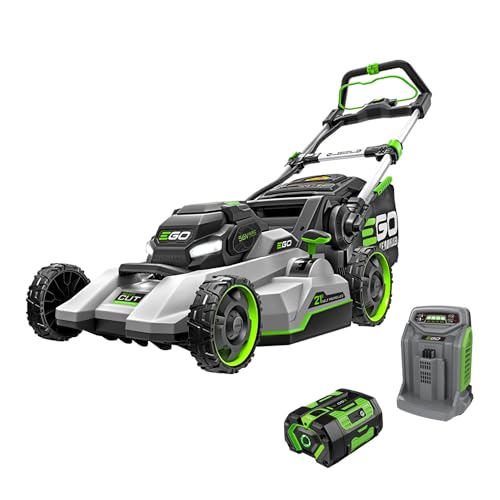
The EGO Power+ Select Cut LM2135SP is the machine other battery mowers are measured against, and spending time with its design shows why. The Select Cut system uses a multi-blade arrangement intended to cut grass and then cut the clippings again, which shows up in the two places owners care about: a fine, even finish on the weekly cut, and mulching that genuinely disappears into the lawn instead of lying on it in rows. The self-propelled drive is the other half of its character — strong, adjustable to your walking pace, and happy on the slopes and long runs where a push mower starts to feel like exercise equipment. Around those headlines, the details are properly thought through: the handle folds for storage, the height adjustment is a single confident lever, and the whole machine feels assembled to a standard rather than to a price.
In use, its personality is calm competence. It starts instantly, holds its composure when a patch of lawn has got ahead of you better than most battery rivals, and bags or mulches with equal willingness across the season. The battery platform behind it is one of the deepest in the garden world, so the packs you buy for this mower will run trimmers, blowers, and saws, and replacements will be findable for years. The honest limitations are the ones its class always carries: it is a substantial machine, not a light one, and it is a premium purchase whose abilities are wasted on a pocket lawn. Owners of medium and larger lawns who want one mower to feel like a permanent upgrade report the highest satisfaction in this entire roundup.
Strengths: outstanding finish and mulching; confident self-propelled drive; deep, well-supported battery platform. Trade-offs: weight and size beyond small-lawn needs; premium tier positioning. Best for: medium to larger lawns, slopes, and buyers wanting the category’s ceiling. Not suited for: tiny lawns, tight sheds, or minimal budgets.

Greenworks Pro Brushless Cordless Mower — The Platform Value Play
Greenworks approaches the market as a system builder, and its Pro brushless mower line is designed to be the centre of a yard full of matching tools. The mowers themselves are strong mainstream machines: brushless motors that hold blade speed well in normal growth, decks that mulch and bag credibly, and a spread of push and self-propelled variants so the line can be matched to flat or sloping lawns without leaving the family. The handling is unremarkable in the best sense — balanced, predictable, easy to live with — and the controls follow the modern pattern of key, bar, and button that makes electric mowing feel effortless from the first cut.
What elevates the line in these reviews is everything around the mower. Greenworks sells one of the widest cordless garden catalogues anywhere, and its batteries are correspondingly easy to find, easy to replace, and constantly useful across tools. For a household building an electric shed from scratch, that breadth converts the mower from a purchase into a foundation. The limitations are those of a broad mainstream line: individual models are very good rather than class-defining in finish, and buyers must read listings carefully to distinguish variants, battery inclusions, and charger types, because the range’s width creates lookalike options. Choose the variant deliberately and the line rewards you for years.
Strengths: broad platform and easy battery availability; strong mainstream cutting; variant choice for different terrains. Trade-offs: finish a step behind the premium benchmark; listings require careful reading. Best for: households building a one-brand electric shed over time. Not suited for: buyers already invested in a rival platform.
Ryobi 40V HP Brushless CrossCut Mower — The Ecosystem Favourite
Ryobi’s mower line makes its case on familiarity and reach. The HP brushless models, including the CrossCut variants with their multi-blade cutting system, are aimed at the enormous number of households whose garages already hold Ryobi tools, chargers, and batteries. For those owners, the mower arrives as a natural extension of a system they trust: the packs fit, the charger is on the shelf, the handling language is familiar, and the purchase can even be a tool-only one that represents the best value in this entire roundup for the already-equipped. The CrossCut arrangement pursues the same fine-mulching goal as EGO’s system, and on a weekly cut the finish is clean and the clippings well processed.
Assessed cold, as a mower for a household with no existing kit, the Ryobi is a solid mainstream machine rather than the obvious first choice — capable, comfortable, and well supported, but in a class where Greenworks and Toro argue strong cases of their own. Its limitations mirror that position: nothing about it disappoints, and little about it, beyond the ecosystem logic, demands to be chosen over rivals. That is not a criticism so much as a locating of its true strength. Reviews should say where a machine wins, and this one wins in the garages of the already-converted, where it wins by a distance.
Strengths: superb value and convenience for existing Ryobi owners; clean CrossCut finish; wide retail support. Trade-offs: fewer distinguishing strengths for buyers starting from zero. Best for: Ryobi households adding a mower. Not suited for: buyers seeking the outright class leader regardless of platform.

Toro 60V Max Recycler — The Mulching Traditionalist
Toro’s name in walk-behind mowers predates the battery era by generations, and the Recycler line carries that heritage into cordless form with a specific promise: mulching done properly. The Recycler concept — a deck and blade system designed to keep clippings circulating and cut them repeatedly until they fall invisibly into the lawn — was Toro’s signature long before it was electric, and in battery form it gives traditionalists a switch that does not feel like a compromise of their standards. The mower’s general design shows the same long experience: sensible controls, a deck shape informed by decades of clippings, and handling that feels like a mower first and a gadget never.
In these reviews the Toro earns its place as the finish-focused choice for gardeners who mulch most cuts and judge a mower by what the lawn looks like an hour later. Its battery platform is smaller than the giant tool ecosystems, which is the honest trade-off: you are buying into a mower specialist’s system rather than a hundred-tool universe, and for many gardeners that focus is a feature. Bagging performance is perfectly serviceable for spring and autumn duties. Owners who cross-shopped on finish tend to land here; owners who cross-shopped on catalogue breadth tend to land elsewhere. Both are right, which is what a good roundup should reveal.
Strengths: mulching pedigree and finish; mower-first design from a specialist; reassuring heritage. Trade-offs: smaller tool ecosystem than the platform giants. Best for: mulching-focused gardeners and petrol switchers loyal to finish. Not suited for: buyers wanting one battery for every conceivable tool.
Makita LXT Cordless Mower — The Workshop Logic Choice
Makita arrives in the garden from the professional workshop, and its LXT cordless mower line is built for the many households whose shelves already run Makita drills, drivers, and saws. The design language is unmistakably Makita: robust, workmanlike, free of gimmicks, with controls and fittings that feel made for people who use tools daily. The mower uses the platform’s familiar packs — in its larger models, paired packs working together — which means the workshop owner’s existing battery shelf becomes the mower’s fuel supply with no new system to buy into. For that owner, this is not merely a good mower; it is the only mower purchase that makes complete economic sense.
Judged purely as a garden machine for a newcomer, the Makita is capable and durable but less garden-specialised than the mower-first brands: its range is narrower, its accessories more functional than fancy, and its charms are the charms of build and compatibility rather than of cutting innovation. That is a fair trade and a clearly signposted one. In a roundup organised by territories, the Makita’s territory is the best-defined of all — it is the mower for the Makita household, and within that territory it has no serious rival.
Strengths: professional build feel; uses existing Makita batteries; honest, durable design. Trade-offs: narrower garden range; fewer mower-specific refinements. Best for: Makita tool owners. Not suited for: newcomers wanting the widest mower catalogue.

Sun Joe MJ401E — The Small-Lawn Simplicity Pick
Every roundup needs its honesty anchor, and the Sun Joe MJ401E is this one: a compact corded mower that does a small job completely and pretends to nothing more. It is light enough to carry comfortably, simple enough that its entire manual could be summarised on a card, and free of every battery consideration — no charging, no packs, no platform, no eventual replacement. On a small flat lawn near a socket, with a mowing pattern that keeps the cable trailing behind, it cuts, it bags, it stores in a corner, and it asks for nothing but a sharp blade and a clean deck in return. For first homes, small gardens, and owners who value simplicity above all, it remains a genuinely rational purchase in an age of platforms.
Its limitations are the format’s, stated without apology: the cable defines its world, the compact deck and modest power define its grass, and long, wet, or sprawling lawns are simply not its assignment. Reviewed within its territory it scores highly; reviewed outside it, it would score poorly, and the difference is the reviewer’s responsibility to state, which this one does. If your lawn is small and your socket is close, this may be the smartest money in the entire article. If not, it was never pretending to be for you.
Strengths: lightest, simplest, and freest of battery concerns; tiny storage footprint; minimal upkeep. Trade-offs: cable-limited range; compact power for small lawns only. Best for: small flat lawns near a socket, first-time owners. Not suited for: large, sloped, or obstacle-heavy gardens.
How the Six Compare, Criterion by Criterion
Finish and mulching: EGO’s Select Cut system and Toro’s Recycler lead the field from opposite philosophies — blade multiplicity versus deck design — with Ryobi’s CrossCut close behind. Greenworks and Makita finish cleanly in mainstream fashion. The Sun Joe finishes a small lawn neatly within its power. Power in heavy grass: the premium battery class leads, the mainstream battery classes follow in order, and the corded compact should not be asked. Ease of ownership: the Sun Joe is simplest of all, followed by whichever battery mower matches the platform already in your shed — a reminder that ease is partly a property of your shelf, not just the machine.
Handling and storage: the Sun Joe wins on weight outright; among battery models, push variants from Greenworks and Ryobi are the handiest, while the self-propelled EGO trades a little heft for drive assistance that repays it on any slope. Folding handles are common across the battery field and should be treated as a requirement in a small shed. Platform and support: Ryobi, Greenworks, EGO, and Makita all offer deep ecosystems with readily available packs and blades; Toro offers a focused mower-centred system; Sun Joe needs no platform at all. Value: value is personal arithmetic — tool-only pricing makes Ryobi and Makita unbeatable for their existing owners, Greenworks spreads value across a growing shed, EGO concentrates it in one excellent machine, Toro in one excellent finish, and Sun Joe in needing almost no money or thought at all.
Noise and everyday pleasantness: all six live in the electric format’s quiet world, and differences between them are smaller than the difference between any of them and a petrol machine. The corded Sun Joe, with the smallest motor of the group, is the quietest of all, while the big self-propelled machines trade a little of that hush for their capability — still at a level that permits conversation and early starts. Starting and routine: identical in spirit across the battery five — key, bar, button — and simpler still on the corded machine. If a household contains anyone who has ever been defeated by a pull cord, every machine in this roundup solves their problem, and that shared virtue is worth stating in the comparison because it is easy, amid brand differences, to forget how much of the category’s appeal is common to all of it.
Choosing Between Them: A Short Decision Path
Start by deleting the machines your lawn deletes. A large or sloping lawn removes the Sun Joe and the lightest push models. An existing battery shelf promotes its own brand to the top of the list automatically. A mulching-first mowing style promotes Toro and EGO. A from-scratch shed promotes Greenworks or EGO on platform breadth. What remains after those honest deletions is usually two machines, and between two machines you should choose by the things you will touch weekly: handle feel, drive control, bag handling, folded size against your shed. The full criteria method is in the electric lawn mower buying guide, the staged method in how to choose an electric lawn mower, and the category verdict in our electric lawn mower review.
One more decision aid, borrowed from how the happiest owners in these reviews actually chose: they bought for the lawn they have this year, in the class one step above the minimum it needs. That single step of headroom absorbed the spring surge, the missed week, and the garden’s slow expansion, and it is the difference between a mower that copes and a mower that delights. Headroom is not extravagance; in a machine bought for years, it is the cheapest insurance in the whole purchase, and every territory in this roundup offers a way to buy it — a stronger variant, a second battery, a self-propelled drive. Choose your territory, then take the step up within it, and these reviews will have done everything reviews can do.
Whichever you choose, apply the same ownership disciplines these reviews assume: charge batteries on a non-flammable surface and never leave them charging unattended against the manufacturer’s advice; store packs dry and cool and never use a swollen or damaged one; remove the battery or unplug and take out the safety key before any work under the deck, and wear gloves around the sharp blade; mow dry grass, because wet grass is slippery and cuts badly; and keep children and bystanders well clear of the mowing area. The routine behind those lines is taught step by step in how to use an electric lawn mower, and the ownership balance is weighed in electric lawn mower pros and cons.
And a final encouragement from the pattern of all six reviews: owners rarely regret the machine they chose from this class of list; they regret choosing in a hurry. The grass will wait a week while you measure the gate, walk the slope, check the shed shelf, and read the two reviews that match your lawn. That week of patience is the highest-value time in the whole purchase, because a mower is one of the few household machines still bought on a decade’s horizon — and a decade of the right machine, quietly starting at the press of a button, is a genuinely good decade of gardening.
What Owners Praise and Regret, Model by Model
EGO LM2135SP. Praise concentrates on the finish and the drive: owners describe lawns that look professionally kept and slopes that stopped being a consideration. The mulching earns specific compliments in summer, when clippings vanish instead of decorating the lawn. Regrets are few and predictable — the machine’s size in a small shed, and buyers who purchased it for a lawn that never needed its abilities and feel the surplus every time they manoeuvre it into a corner. It is the roundup’s clearest case of a machine whose owners and whose lawn are well matched reporting near-total satisfaction.
Greenworks Pro line. Praise goes to the system: owners who bought the mower as a first step report a shed that quietly standardised around its batteries, with each subsequent tool feeling like a bargain. The mowing itself earns solid, unexcited approval, which in garden machinery is a compliment. Regrets involve variant confusion at purchase — a push model bought for a sloping lawn, a listing misread on battery inclusion — rather than the machines themselves, which is why the review above stresses deliberate variant choice. Owners who chose carefully describe exactly the mower they expected, season after season.
Ryobi HP CrossCut. Praise is warmest from the converted: owners with shelves of Ryobi kit describe the mower as the easiest purchase of their gardening lives, with tool-only pricing making it feel almost free relative to its usefulness. The CrossCut finish gets genuine compliments on weekly cuts. Regrets come mostly from cold buyers who expected a class leader and found a class citizen — a reminder that this machine’s superpower is contextual. Within its context, satisfaction is high and loyalty higher; Ryobi owners rarely leave the platform over a mower.
Toro Recycler. Praise is about the lawn, not the machine: owners talk about mulching that finally works as promised and a finish that satisfies people who notice finishes. Switchers from Toro petrol models describe the least adjustment of any group in this roundup. Regrets are about breadth, not quality — owners who later wanted a dozen other cordless tools found a smaller catalogue than the giant platforms offer. Gardeners who mow, and mostly only mow, never meet that regret at all.
Makita LXT. Praise sounds like a workshop talking: build, toughness, and the deep convenience of one battery shelf for work and garden alike. Owners who use tools professionally bring a professional’s intolerance for flimsiness, and this mower passes their inspection. Regrets are the newcomer’s, not the owner’s — buyers without Makita kit who purchased on build reputation and then found themselves starting a platform for one tool. For its intended household, it is close to a default decision.
Sun Joe MJ401E. Praise is about freedom from fuss: owners of small lawns describe a machine that simply lives in a corner and works, year after year, with nothing asked of them. First-time owners praise its forgiveness while they learn. Regrets are almost entirely territorial — bought for a lawn too big, too sloped, or too far from a socket, it becomes the wrong tool through no fault of its own. Its lesson generalises across this whole roundup: most mower regret is matching regret, and matching is the one thing fully in the buyer’s control.
Battery and Running Notes Across the Six
Five of these six machines run on lithium-ion packs, and the running notes are shared. Treat the pack as the machine’s valuable core: charge it on a non-flammable surface, do not leave it charging unattended against the manufacturer’s guidance, store it dry and cool — indoors through winter — and never use a pack that is swollen, cracked, or damaged. Rotate two packs on larger lawns rather than exhausting one in heavy grass. Expect gradual fading over years, not sudden death, and remember that a faded pack often remains useful in lighter tools long after mower duty. The sixth machine, the corded Sun Joe, replaces all of that with a single discipline: respect the cable, plan the pattern, and keep the lead behind the mower and away from the blade at all times.
Running costs across the six are uniformly small — electricity, blade sharpening, the occasional bag or wheel — and the differences between models are dwarfed by the difference between any of them and a petrol machine’s fuel-and-service appetite. The real running variable is not money but attention: every machine here rewards a two-minute post-cut routine of emptying, scraping, and putting things on charge, and quietly punishes its neglect with clogging, dull cuts, and flat batteries at the worst moment. That routine, more than any specification, is what the owners quoted above actually share.
A Season With Each Machine: Spring Surge to Autumn Leaves
Reviews compress time; ownership does not, so here is each machine across the season that tests it. In spring’s surge, the premium EGO and the stronger Greenworks and Ryobi variants earn their classes, holding composure in fast, lush growth where lighter machines need a two-stage cut; the Toro mulches the surge well provided cuts stay frequent; the Makita works steadily in its workmanlike way; the Sun Joe should be kept to its small lawn and forgiven everything else. Summer flattens the field: on dry, weekly grass all six produce good lawns, and the differences become ergonomic — drive assistance, handle comfort, bag size — rather than horticultural.
Autumn separates the baggers. Leaves reward collection capacity and a deck that keeps moving air when the bag fills, and here the larger battery machines again justify themselves, gathering leaves and clippings in one pass while the compact corded machine’s small bag turns the job into a series of trips. Winter separates the owners rather than the machines: every battery model here asks the same small favours — a clean deck, a sharpened blade, packs resting indoors dry and cool — and every one of them repays those favours with an instant spring start. Read across the season and the roundup’s verdicts hold: the territories are real, they are stable, and a buyer who chooses by territory rather than by headline will still be agreeing with these reviews in October.
Where These Reviews Might Mislead You
Honest reviewing includes its own limitations. These electric lawn mower reviews assess classes and representative models as they are sold and supported now; manufacturers revise models, rename variants, and adjust battery inclusions, so the listing you face may differ in detail from the machine described, which is why every review here ends by urging a listing check. Individual experiences also vary with grass type, climate, and cutting rhythm in ways no roundup can fully hold: a mower praised for mulching in a dry climate may clump in a wet one, and a machine faulted for weight may be carried by a stronger gardener without a thought. Treat the verdicts as well-lit maps rather than guarantees.
The reviews also share one deliberate omission: they contain no prices, no ratings, and no runtime promises for specific models, because all three change faster than advice should. That omission protects you from the commonest review failure — a verdict built on a number that expired — at the cost of leaving the final arithmetic to you at the listing, where the current facts actually live. What does not change, and what these reviews stake themselves on, is the character of each machine and the shape of each territory. Models get revised; territories endure.
The Roundup in One Table of Territories
Compress the six reviews into a single mental table and the pattern is tidy. Premium self-propelled battery: EGO, for medium-to-large lawns and buyers who want the ceiling. Mainstream battery, system-first: Greenworks, for sheds being built from scratch. Mainstream battery, loyalty-first: Ryobi, for the already-equipped. Battery, finish-first: Toro, for mulchers and traditionalists. Battery, workshop-first: Makita, for tool owners. Corded, simplicity-first: Sun Joe, for small flat lawns. Notice what the table does not contain: a bad machine. It contains six good answers to six different questions, and the only way to buy badly from this list is to answer a question your lawn never asked — the premium machine for the pocket lawn, the compact corded for the sloping acre, the stranger’s platform for the equipped shed.
That is also why this roundup resists the single-winner format. A winner implies a contest on one field, and mowing is played on thousands of different fields every weekend. The better service a reviews page can do is what this one attempts: describe each machine’s character faithfully, mark its territory clearly, admit its trade-offs in the same breath as its strengths, and leave the final matching — the part only you can do — confidently in your hands, with the companion guides in this series standing by for the criteria, the steps, and the value argument whenever you want them. Take those companions in whatever order suits your question: criteria first if you are still learning the category, steps first if you know your lawn and want a process, value first if the whole electric idea is still on trial in your household. The reviews will still be here when you return, and they read better — sharper, more obviously sorted into your shortlist and your rejections — with each companion you finish.
Three Head-to-Heads Buyers Actually Face
EGO Select Cut vs Toro Recycler: Blade System or Deck Heritage?
This is the connoisseur’s contest, between the newest answer to fine cutting and the oldest. EGO’s multi-blade approach attacks clippings mechanically, cutting them repeatedly at the blade, and pairs it with the strongest self-propelled package in the roundup. Toro’s Recycler attacks the same problem aerodynamically, with a deck shaped to keep clippings aloft and circulating through the blade’s path. On a weekly mulching rhythm both produce lawns their owners boast about, and choosing between them comes down to the rest of the machine: EGO if you want the premium drive, the deep tool platform, and the flagship feel; Toro if your loyalty is to a mower specialist’s finish and you prefer a focused system. Gardeners who mostly bag should note both machines bag well, and decide on platform instead.
Greenworks Pro vs Ryobi HP: The From-Scratch Shed vs the Equipped Garage
This contest is decided before it starts, by your shelf. If the shelf is empty, Greenworks’ breadth and mower-first range make it the natural foundation, and its Pro line’s variants let you match drive and deck to your terrain within one family. If the shelf already holds Ryobi batteries and chargers, the Ryobi mower’s effective cost and instant compatibility beat any marginal specification difference, and choosing otherwise means paying to duplicate a system you own. The genuinely undecided — no shelf, no loyalty — should compare the two on handle feel, folded size, and which brand’s wider catalogue better matches the tools they realistically plan to buy next, because the mower is a platform decision wearing a mower’s clothes.
Makita LXT vs the Garden Brands: One Shelf or Two?
The Makita question is really about household organisation. One shelf of batteries serving workshop and garden is a powerful simplicity: fewer chargers, deeper familiarity, packs always rotating. Two specialised systems — Makita for work, a garden brand for the lawn — buy you each field’s best catalogue at the price of duplicated batteries and chargers. Households that garden more than they build should let the garden brand lead; households that build more than they garden should let Makita absorb the mower without a second thought. The mower itself is good enough that the decision never needs to be about the mower, which is perhaps the most Makita outcome imaginable.
Durability and Support, Reviewed Brand by Brand
A mower review that stops at the first season is a first impression, so this section takes the longer view the other sections promise. Durability across these six is governed less by the badge than by three shared factors: deck care, blade care, and battery treatment. A steel deck kept clean and dry, a composite deck kept out of constant weather, a blade kept sharp so the motor never strains, and packs kept cool, dry, and un-swollen will carry any of these machines through many seasons. The brands differ instead in what happens when something does wear or break — and there, support is the reviewable fact.
EGO, Greenworks, Ryobi, and Makita all sit inside large organisations with normal spare-parts channels: blades, bags, wheels, and batteries are catalogue items rather than treasure hunts, and warranty handling runs through established networks. Toro adds a mower-specialist dealer culture that traditionalists value, particularly for blade and deck parts. Sun Joe’s support task is the smallest of all, because the machine has the fewest things to support; a blade and a cable’s condition are nearly the whole story. The practical advice is identical across the six and worth repeating in a reviews context: before buying, spend two minutes confirming that your exact model’s blade is in normal sale. That single check predicts more about five-year ownership than any other fact on the listing.
Resale and hand-me-down value follow the same logic. Battery mowers from supported platforms hold their appeal second-hand because a buyer can assess them easily — no engine to diagnose — and can refresh them with a new pack. Corded machines hold a humbler, steadier value for the same reason. Obscure brands, absent from this roundup by design, are where value goes to die, because a mower whose battery cannot be replaced is a mower with an expiry date. Every machine reviewed here avoids that trap, which is not an accident: support was a selection criterion for the roundup itself.
Detail by Detail: Reading a Electric Lawn Mower Listing Like an Inspector
Listings present a electric lawn mower at its best, so this section slows the assessment down and looks at the evidence an individual model offers: its construction, its finish, its listing detail and the checks you can run before and just after it arrives. The aim is a verdict based on inspection rather than impression.
Start With Your Space and Your Routine
Finally, judge the electric lawn mower against the life you actually lead this year, not the tidier or more ambitious life in the listing photographs, and the choice will usually make itself. Keep the fittings, spare parts and instructions that come with the electric lawn mower together in one labelled place, because the part you need in a year is always the one that was put somewhere safe. If two options look nearly identical, compare the parts you will touch every day, since those contact points decide whether a electric lawn mower feels solid or flimsy after the novelty wears off. A return is easiest when you have kept the packaging until you are sure, so give the electric lawn mower a fair trial period in its real position before you break down boxes and dispose of padding.
Consistency is the detail to hunt for in a electric lawn mower: consistent gaps, even finish, matching parts and smooth actions usually indicate care in manufacture that shows up later as reliability. Seasonal checks suit most Garden & Lawn items well, so tie a quick inspection of the electric lawn mower to a job you already do, such as changing clocks or clearing gutters. Apply the same checks to each shortlisted example, whether that is the Greenworks Pro Brushless Cordless Mower; the Ryobi 40V HP Brushless CrossCut Mower; the Makita LXT Cordless Mower XML11, because consistent testing is what makes the differences between models visible. If the listing offers accessories for the electric lawn mower, decide which ones solve a problem you already have, and set aside the ones that only solve problems the listing itself invented.
A electric lawn mower that fits on paper can still fail in daily use if a doorway, a corner, a cupboard door or a walkway cuts into the space it needs, so trace the full path from delivery to final position. Keep a short note of the questions each listing leaves unanswered, and treat a seller who answers them clearly as a better prospect than one who repeats general claims. Start by writing down the job the electric lawn mower has to do in your home, in one plain sentence, before you look at another listing, because a clear job statement turns a long shortlist into a short one. Decide in advance which single feature you would refuse to compromise on, and let that one priority settle ties between otherwise similar electric lawn mower choices.
When Small Problems Appear
Beware of choosing a electric lawn mower for a rare occasion, such as a large gathering once a year, if that choice makes everyday use worse for the other fifty-one weeks. Details that look minor in isolation, such as how a electric lawn mower is finished at the back or underneath, matter because they reveal whether shortcuts were taken where the camera rarely goes. If you shop with someone else, agree the must-haves together before looking, so that the electric lawn mower you choose is a shared decision rather than one person’s compromise discovered later. The best electric lawn mower for a rented home may differ from the best for an owned one, because fixings, marks and alterations carry different consequences in each case.
Where the electric lawn mower meets the floor, the wall or another surface, check what protects both sides, because scuffs and marks in those contact zones are the most common early complaint. Think about the season in which the electric lawn mower will work hardest, and judge it against that season rather than the mild week in which you happen to be shopping. Consider the busiest version of the day, not the calmest one, and ask whether the electric lawn mower still works when people are hurrying, carrying things or sharing the same space. Take a break between shortlisting and ordering if you can, and return to the listings with fresh eyes, because fatigue makes almost any electric lawn mower look acceptable late in a long search.
Small problems are easiest to solve in order: check position first, then adjustment, then cleaning, and only then conclude that the electric lawn mower itself is at fault. When you examine a electric lawn mower in detail, work from the largest element to the smallest, checking overall proportions first, then construction, then finish, and only then the small features sellers emphasise. Keep the care routine simple enough to repeat: a electric lawn mower that needs ten minutes of attention weekly will usually get it, while one that needs an hour monthly often gets none. Set the assembled electric lawn mower up fully before deciding it is wrong for the space, since partly built or badly positioned pieces often look worse than they will once finished and levelled.
A Short Decision Checklist
- The one feature you will not compromise on
- The main job the electric lawn mower must do, written in one sentence
- What your current arrangement does well that the electric lawn mower must not lose
- The measured space, including clearance to use and clean around the electric lawn mower
- Delivery path, from the door to the final position
- Assembly needs, tools required and whether help is needed
- The material and finish, matched to light, moisture and wear in its spot
- Where the electric lawn mower and its accessories will be stored when not in use
Taken together, these checks take only a little time, yet they answer the questions that decide whether the electric lawn mower suits your home, your household and your routine, and they do so before money changes hands rather than after.
Frequently Asked Questions
Which of these electric lawn mower reviews should a medium-lawn owner trust most?
Start with the EGO, Greenworks, and Toro reviews, because medium lawns are their shared territory, then let two facts decide: whether you already own a battery platform, and whether you mulch or bag most cuts. Platform owners should honestly promote their own brand’s review to first place, since shared batteries change both cost and convenience more than small performance differences do. Mulchers should weight the Toro and EGO verdicts; baggers and mixed users can choose freely among the three. There is no wrong answer in that trio for a medium lawn — only better and worse matches.
Are the premium models in these reviews worth their tier?
For the lawns they are built for, yes. The premium self-propelled class buys you finish, mulching quality, drive assistance, and composure in heavier grass, and those are felt on every cut of a medium or large lawn rather than occasionally. On a small lawn the same money buys abilities that will never be used, and the honest reviews above say so in their not-suited-for lines. Tier worth is therefore a matching question, not a quality question, and the matching is exactly what the best-for verdicts in each review are for.
Why is there a corded mower in a modern reviews roundup?
Because for its territory — small, flat, near a socket — it remains one of the most rational purchases in the category: nothing to charge, nothing to fade, almost nothing to maintain, and a weight anyone can handle. A roundup that omitted it would be reviewing fashion rather than lawns. The cable is a real constraint and the review states it plainly, but constraints only disqualify a machine when they conflict with your garden. Where they do not, simplicity wins, and any honest set of electric lawn mower reviews should be willing to say so.
How do I choose between two mowers that both fit my lawn?
Choose by weekly touchpoints and by support. Handle comfort, drive control feel, bag emptying, height adjustment, and folded storage are the differences you will actually live with, and they rarely appear in headline comparisons. Then check the unglamorous support facts: replacement blades and bags in normal sale, batteries available singly, and a brand with a service story. If the two are still level, choose the one whose platform you would rather build the rest of your shed around, because the mower is rarely the last cordless tool a household buys.
Do these reviews apply if my lawn is large?
Partially. The premium battery class, run with multiple packs and self-propelled drive, is the only territory in this roundup that reaches confidently into large lawns, and even there the honest advice is to size the battery plan as carefully as the mower. Corded and compact models do not scale, and the reviews mark them accordingly. Large-lawn owners should also read the value analysis in is an electric lawn mower worth it, because at that scale the format decision itself — not just the model decision — deserves the full argument.
What should I check on the listing before buying any of these?
Confirm exactly what is included: tool only, or batteries and charger, and if batteries, how many and of what size within the platform. Confirm the drive type and deck configuration match the variant reviewed, because several of these lines sell near-identical listings in push and self-propelled forms. Check the folded dimensions against your storage and the gate width against the deck. Finally, confirm that a replacement blade for the exact model is a normal order. Ten minutes of this checking prevents nearly every disappointment these reviews cannot protect you from.
Related Guides
Complete the set with the working routine in how to use an electric lawn mower and the supporting kit: grass edge trimmers for the finishing pass, leaf blower vacuums for autumn, and garden hoses for cleanup day. Gardeners building the full electric shed will also want cordless hedge trimmers on the same battery logic these reviews keep recommending. And if the striped, formal finish calls to you more than any machine here can answer, roller lawn mowers is the honest next read — a different tradition, pursued with different tools, for gardeners who know exactly the lawn they want to see from the kitchen window.