Disclosure: As an Amazon Associate, dailyhomedecorating.com earns from qualifying purchases. Links on this page are affiliate links; they cost you nothing extra. Prices and availability change often, so check the current Amazon listing before you buy.
This bookshelf review takes a slightly unusual approach: instead of pretending one model can stand for a whole category, it reviews the modern bookshelf as most households actually buy it — the mid-tier open frame, tested against the jobs a living room, office, and family home actually assign it — and then shows where the leading alternatives bend the verdict. The category has converged on a recognisable formula: a steel or engineered-wood frame, four to six shelves of graduated usefulness, an anti-tip strap in the box, and an assembly that takes an afternoon. Within that formula, the differences that matter are construction details most listings barely mention. This review hunts those details down.
The verdict up front: the modern bookshelf, bought at the mid tier with sensible spans and honest loading, is one of the best-value pieces of furniture in the home — storage, display, and room architecture for a modest outlay. It suits readers, families, and anyone anchoring a living room around a collection. It does not suit households that will not anchor it, collectors who need archival protection, or buyers expecting light-duty frames to carry a hardcover library. The rest of this review earns those conclusions section by section.
Key Takeaways
- Construction geometry — shelf span and board thickness — predicts long-term performance better than brand, material label, or shelf count.
- Real-use testing separates the field: full hardcover loads, daily browsing, and family traffic expose flex and racking that empty showroom shelves hide.
- The best designs share three traits: a fixed bracing shelf, closely spaced adjustment holes, and a back treatment — panel or cross-brace — that kills side-to-side rack.
- Assembly quality is user quality: a frame tightened out of square stays out of square, and every later wobble is born in the first hour.
- Anchored and loaded bottom-heavy, a mid-tier bookshelf is a decade-plus piece of furniture; unanchored or overloaded at the top, it is a liability.
In this guide
What a Bookshelf Is and Where It Fits
A bookshelf is organised vertical storage: a frame that holds horizontal surfaces at book-friendly heights, open enough that everything on it can be seen and reached without opening anything. That openness is the defining trait. It separates the bookshelf from the cupboard and the storage box, and it explains both the category’s charm and its chores — what is open is browsable, and what is open gathers dust.
In the home, the bookshelf sits at the intersection of three furniture families. From storage furniture it takes capacity discipline: shelf depths matched to book formats, load limits that must be respected, and a footprint traded against floor space. From display furniture it takes the styling brief: graduated heights, negative space, and the expectation that its contents will be looked at as much as used. From architectural furniture — the bookcase’s grander cousin — it takes the room-anchoring role: a filled bookshelf is a wall treatment, and rooms are arranged around it. Buyers comparing the open and enclosed branches of the family should read bookcase vs bookshelf, compared honestly; buyers who want the whole category’s map should start with the bookshelf buying guide.
The market segments cleanly into three bands. The entry band is light-duty: thin boards, tube or simple frames, honest service for paperbacks and décor, short expected life under heavy loads. The mid band — where this review concentrates — brings steel frames or substantial engineered panels, adjustable shelves, bracing, and per-shelf capacities suited to real mixed libraries. The premium band adds solid timber, joinery-grade hardware, doors and drawers, and furniture presence that justifies heirloom language. The bands are not strictly better and worse; they are matched to different loads and different lengths of stay. A student in a one-year rental is rationally served by the entry band; a family furnishing a ten-year living room is not.
Where does the bookshelf not fit? In damp rooms without ventilation, where books and board finishes both suffer. In direct harsh sun, where spines fade in stripes. In the homes of the determinedly mobile, where its moving-day cost is paid too often. And in any room where it cannot be anchored and children climb — a combination this review treats as disqualifying rather than merely unfortunate. Everywhere else — living rooms, studies, bedrooms, hallways, landings, even kitchens with cookbook collections — the bookshelf earns its wall.
The form has a longer pedigree than its flat-pack present suggests. Purpose-built book furniture began as the preserve of libraries and studies — presses and cases with doors, built by joiners, priced for institutions and the wealthy. The twentieth century democratised it twice: first through department-store bookcases in respectable timber, then through the flat-pack revolution that put a serviceable shelf within reach of a student budget. The modern category is the negotiation between those inheritances — furniture presence at flat-pack logistics — and most of its remaining flaws are the seams of that negotiation: cam locks where dovetails used to be, printed grain where veneer once served. Judged against its actual ancestors rather than an ideal, the contemporary bookshelf is a success story, and its ubiquity is earned.
Design, Build and Setup
Judged as an object, the contemporary mid-tier bookshelf is a study in adequate engineering. The frames that perform best in real use share a recognisable anatomy. Uprights are either steel tube or flat bar with a powder-coated finish, or engineered-wood side panels thick enough to take fixings without splitting. Shelves rest on the frame rather than hanging from it, so loads travel down the uprights instead of prising at joints. One shelf — typically at mid-height or at the base — is fixed permanently, converting the frame from a stack of rectangles into a braced structure. And the back is treated somehow: a thin panel, a pair of crossing straps or bars, or at minimum the explicit instruction that the wall anchor completes the structure.

The Reference Design: VASAGLE 6-Tier Bookshelf
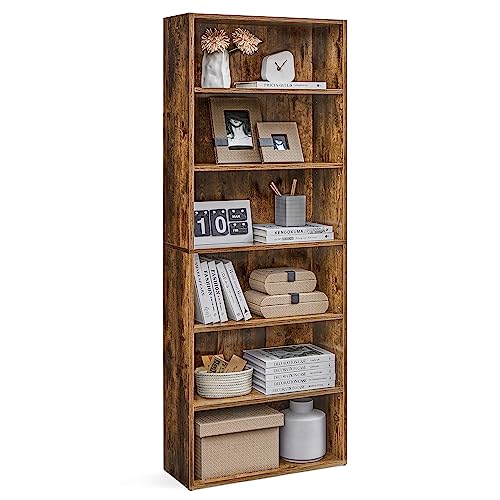
The VASAGLE 6-tier is a fair reference for the class because it makes the standard choices competently. A steel frame carries wood-look boards across six levels; the spans stay short because the frame is not over-wide; adjustable feet cope with imperfect floors; and the industrial styling suits the transitional rooms most households have. In use, its virtues are the class’s virtues — it disappears behind its contents, feels planted once anchored, and asks nothing of its owner beyond sensible loading. Its limits are also the class’s: the boards, not the frame, set the load ceiling, and the open back means book rows need ends or bookends. Buyers should check price on Amazon and confirm the current board and bracing specification, which manufacturers revise quietly.
Setup across the category follows the same arc, and the reviewer’s advice is identical for every model in this article: assemble in the room of use, on a soft surface, with fixings only snugged until the frame is demonstrably square; stand the unit with a second person; level it; anchor it; and only then load it, heaviest first and lowest. The full procedure, with the safety reasoning, lives in how to install a bookshelf, step by step. Assembly times in this class run from under an hour for tool-free tube designs to a couple of hours for backed bookcases with many cam locks, and the difference is mostly fastener count rather than difficulty.
Two build details deserve a buyer’s magnifying glass. The first is the shelf support system: metal pins in closely spaced holes are the flexible standard, while fixed plastic clips at sparse intervals are a cost-cut that owners curse for years. The second is the foot design. Adjustable feet are not a luxury on real floors, which are rarely level; a frame that cannot be levelled rocks, and a rocking frame works its fixings loose over time. Glides or pads matter too on hard floors — a loaded shelf shifted for cleaning can score wood and laminate flooring in a single drag.
The Details That Separate Good From Adequate
Two bookshelves can share a silhouette, a shelf count, and a tier, and still be different products. The separation lives in details that listings photograph poorly and reviewers exist to name. The first is edge treatment. Shelf boards take their knocks on the front edge — books sliding in and out, baskets dragged, children’s toys posted like letters — and a board whose edge banding is thick and well bonded survives years of it, while a thin, poorly bonded edge lifts, chips, and exposes the pale core beneath. Run a thumbnail along the front edge of a display model if you can; in a listing, look for close photographs of corners rather than lifestyle shots.
The second detail is hardware quality. Cam locks, bolts, and pins are invisible in the finished piece and decisive in its life. Metal fixings that bite cleanly and can be re-tightened give a frame a second and third assembly; soft fixings that round out or pull through their holes make the first move the last. This is the hidden reason two apparently identical flat-pack shelves age differently, and it is why this review keeps returning to re-tightening as maintenance: the frames that allow it are the frames that last.
The third is the back. A surprising number of open frames ship with no back treatment at all and rely entirely on the wall anchor for lateral stiffness — acceptable in a braced design, inadequate in a tall narrow one. Cross-bars, X-straps, and thin panels all work; what matters is that something triangulates the rectangle. The fourth detail is finish consistency inside the shelf compartments, where photography rarely goes: a finish that stops at the front edge, leaving raw board inside, will absorb moisture unevenly and age in patches. And the fifth is the humble parts bag — spare pins, spare fixings, wall-anchor hardware that matches real walls. Manufacturers who include spares understand their product’s life; the reviewer’s shelf of small kindnesses is short, and that one is on it.
Performance in Real Use
Holding a Full Book Load
The defining test of a bookshelf is boring to describe and decisive in outcome: fill every shelf with real books, including one shelf of nothing but hardcovers, and live with it. Well-built mid-tier frames pass without drama — shelves stay level, the frame stays silent, and the only maintenance is dusting. The failures appear at the extremes of the category. Light-duty boards develop a visible smile under a full hardcover row within months; frames without back bracing develop a lateral sway that announces itself every time a book is pulled from a tight row. Load placement delays or prevents both: the heaviest row belongs on the fixed shelf or the lowest shelf, centred, with dense sets split across two shelves rather than concentrated. A bookshelf is one of the few products where the user’s technique genuinely co-authors the product’s lifespan, and this review counts that as a characteristic of the category rather than a defect of any model.
Daily Browsing and Family Traffic
Bookshelves live a social life. Books are pulled and replaced daily, children treat the low shelves as a library and the frame as furniture to lean on, vacuum cleaners bump the feet, and the top surface accumulates the household’s passing objects. The designs that age gracefully under this traffic have three qualities: finishes that wipe clean and do not show every scuff — matte laminates beat gloss here — shelf edges that tolerate knocks without chipping into pale substrate, and a stance that feels immovable when a teenager leans a shoulder against it mid-conversation. That last quality is the anchor’s doing as much as the frame’s. In family service, the bookshelf’s open design shows its behavioural virtue daily: the books at child height get chosen, carried, and read, which is the entire point of owning them. Seating arranged nearby completes the circuit — the reading chairs in chairs chosen for reading comfort pair naturally with a well-placed shelf.
Display Duty
Judged purely as display furniture, the bookshelf’s graduated shelves and open front make it the most forgiving display surface in the home. Objects can be grouped at varied heights, horizontal book stacks become plinths, and the frame’s rhythm organises even an eclectic collection into something that reads as intentional. Ladder designs perform this job with the most flair and the least book capacity; standard frames do it nearly as well while holding twice the books. The display weakness is shared across the category: there is no hiding place. Every object is on show, including the ones you would rather not exhibit, and the only remedies are curation or a different furniture type. Owners who want display with a panic button — doors — are bookcase customers, and the enclosed branch is reviewed in the bookcase review.
Small Rooms and Rental Duty
In compact and rented homes the bookshelf’s performance brief changes: footprint efficiency and landlord-friendliness join capacity as first-order criteria. Tall narrow frames score well on the first and, if the lease permits a single anchor fixing, adequately on the second. Tool-free and light designs — the entry band’s speciality — trade load capacity for painless moving and deposit safety. The honest reviewer’s note is that rental duty is where buyers most often overbuy: a substantial mid-tier unit is a fine purchase for a stable tenancy and a recurring moving burden for a mobile one. Match the furniture’s commitment to the tenancy’s, and the category serves renters as well as owners.
Open-Plan and Room-Divider Duty
In open-plan homes the bookshelf takes on a job its designers only half intended: dividing space. A low or mid-height unit set perpendicular to a wall zones a living area from a dining area while keeping sightlines and light, and its two finished faces — if the model has a back panel or a tidy open frame — work from both sides. Performance in this role hinges on stability, since a divider is bumped from two directions, and on back treatment, since an open frame’s contents are visible from behind. Anchoring options narrow in mid-room placements, which is a genuine argument for the low formats here: a waist-high divider, heavily loaded at the base, is its own anchor in all but name. Judged as architecture, the bookshelf divider is the cheapest room-reshaping tool in the catalogue.
Pets, Tremors, and Other Real Life
Real households include cats, and cats regard a bookshelf as a climbing frame with amenities. The review implications are practical: anchored units shrug off feline mountaineering; top shelves should hold nothing breakable that a cat can displace; and a shelf with one deliberately cleared, sunny level will be occupied by the cat on the cat’s terms rather than by ambush among the ceramics. Dogs matter at the other end — a large dog’s tail clears low shelves with metronomic regularity, so the lowest shelf of a dog household is for books and boxes, never for the good vase. In regions with seismic activity, the anchor stops being advice and becomes the product’s primary safety system, supplemented by museum putty under display objects and lipped shelf edging where available. None of these edge cases indicts the category; all of them reward the buyer who plans for the household they actually have.
Strengths and Trade-Offs
Strengths
- Capacity per footprint. Nothing else in the furniture catalogue stores this much on this little floor.
- Behavioural effect. Visible books are read books; the shelf quietly changes household habits for the better.
- Adaptability. The same frame serves student texts, family games, vinyl, and display across decades of changing life.
Trade-Offs
- Openness cuts both ways. Display and dust, access and exposure, are the same feature viewed from different days.
- Load discipline is required. The category punishes careless loading — heavy rows high, spans ignored — with sag and sway.
- Anchoring is mandatory homework. Safety depends on a twenty-minute task that the product cannot do for you.
The fuller two-sided ledger, with the household profiles that flip each item, is laid out in bookshelf pros and cons, weighed in full.
How It Compares
| Rival | Where the rival wins | Where the bookshelf wins |
|---|---|---|
| Backed bookcase (Sauder 5-Shelf class) | Enclosure, dust control, formal presence | Visual lightness, moving ease, tier |
| Cube storage | Mixed clutter with bins, reconfigurability | Book fit, adjustability, capacity per wall |
| Floating shelves | Zero floor footprint | Total load, adjustability, fewer wall fixings |
| Ladder shelf (Nathan James Theo class) | Display flair, small-room lightness | Book capacity, shelf depth up top |

The Enclosed Alternative: Sauder 5-Shelf Bookcase
Sauder’s backed five-shelf design is the comparison that matters most, because it answers the open shelf’s two honest weaknesses — dust and exposure — with a panel, sides, and doors of visual formality. In review terms it trades the bookshelf’s lightness for presence: it reads as furniture from every angle, keeps rows tidy without bookends, and its adjustable shelves handle binders and tall formats gracefully. It is heavier to move and slower to assemble. Households torn between the two should decide on the visibility question and stop there; the specifications will not separate them further. Check price on Amazon.
The Display Alternative: Nathan James Theo Ladder Bookcase
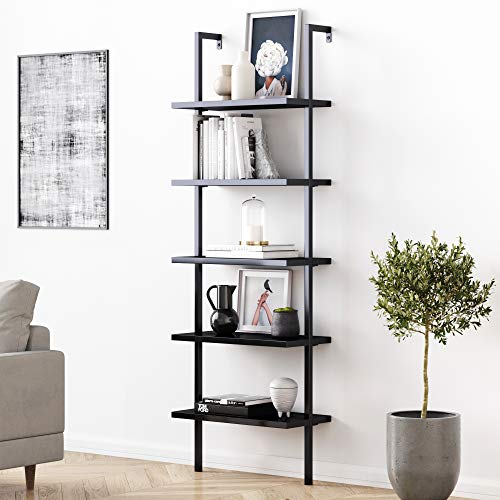
The Theo shows what happens when a bookshelf is optimised for looking at rather than loading up: graduated depths, a leaning profile, and a silhouette that flatters every photograph. As a review subject it is excellent at its actual job — curated display with a supporting row of books — and miscast as a library. Its top shelves refuse oversized volumes and its lean makes anchoring doubly mandatory. Judged on its own brief, it is among the most likeable pieces in the category; judged as bulk storage, it is the wrong tool. Check price on Amazon.

The Low and Wide Alternative: IRIS USA 3-Shelf Wide Bookshelf
IRIS USA’s moulded three-shelf unit reviews well precisely because it refuses the tall frame’s compromises: nothing to tip in any meaningful sense once anchored, nothing a small child cannot reach, nothing that cannot be wiped clean after a juice incident. As a bookshelf for picture books and early readers it is close to ideal. As a living-room library it is out of its depth, and the reviewer’s point in including it is taxonomic honesty — “bookshelf” spans furniture with almost nothing in common but the name, and matching the format to the reader’s height is a more important decision than any specification. Check price on Amazon.
Living With It: The Long-Term Report
Reviews are usually written in the first flush of ownership, but furniture is a long relationship, so this section reports the pattern of the later years. Year one is the honeymoon and the shakedown together: the arrangement settles, the anchor is forgotten, and any assembly error announces itself as a faint rack or a door — on backed models — that never quite closes true. The fix, re-squaring and re-tightening, is still easy in year one, which is why the annual check matters.
Years two to five are where construction quality files its report. Shelves that were going to sag have begun; finishes have either settled into the room or started to look tired at the edges; and the household has usually re-purposed at least one shelf — books out, games in, a plant where the atlases were. The frames that pass these years gracefully are the ones this review has been describing: braced, thick-boarded, honestly loaded. Years five and beyond separate furniture from furnishing: the survivors become invisible infrastructure, the background of family photographs, and are typically replaced only when the room itself is reimagined. A bookshelf that reaches that stage has cost, per year of service, less than the household spends on light bulbs — the quiet arithmetic behind the verdict below. Owners planning for that horizon should also read the ownership ledger in the worth-it analysis.
Sizes and Formats, Reviewed
Format is the review variable buyers feel most and research least. The tall tower — five or six shelves in a narrow footprint — maximises capacity per square foot and minimises styling flexibility: it is a column, and rooms either have a place for a column or they do not. Its top shelf is display-only territory for anyone without a stool, and its anchoring is the least negotiable in the category. The standard family format, roughly waist-to-head height across a moderate width, is the category’s centre of gravity for a reason: every shelf is reachable, the proportions sit comfortably against sofas and sideboards, and two of them make a library wall without joinery.
The low horizontal format reviews better than its capacity suggests. It stores less, but it works as a room divider in open plans, as a television’s companion, as the under-window solution in rooms where the walls are mostly glass, and as the only responsible format for unsupervised children’s spaces. Its top surface is a second display shelf that tall units waste at ceiling height. The corner format is the opportunist: genuine capacity from dead space, at the price of awkward shelf shapes that suit plants and objects better than long book runs. And the ladder, already discussed, is the stylist of the family. A household reviewing its own rooms honestly will usually find it needs two formats, not one — which is an argument for buying within a single product family whose finishes match across sizes.
How This Bookshelf Review Judged the Category
A note on method, because review conclusions are only as good as the tests behind them. The judgements in this article rest on the criteria that predict ownership satisfaction in this category: structural behaviour under full and uneven loads; stiffness against lateral force before and after anchoring; assembly accuracy and the quality of instructions and hardware; adjustability in practice, meaning pin spacing and shelf count rather than marketing claims; finish behaviour under wiping, knocks, and sunlight-adjacent placement; and the small ergonomics of daily life — shelf edge comfort, book retrieval from tight rows, cleaning access behind and beneath. Where a model’s behaviour depends on a specification the manufacturer revises quietly — board composition, bracing, included hardware — this review says so and directs you to confirm the current listing rather than trusting any review, including this one, as a permanent record. Furniture changes under the same name more often than buyers realise; the wise habit is to treat every review as a map of what to check, and the listing in front of you as the territory.
One more methodological honesty: no review can test your floor, your wall, your children, or your cat. The category-level conclusions here are robust; the fit to your household is yours to confirm with a tape measure and the checklist below.
Who Should Buy It, and Who Should Skip It
Buy the modern bookshelf if your household reads physical books weekly, if you are furnishing for a stay measured in years, if a room needs an organising anchor, or if a child’s reading corner is on your list. Buy it in the mid tier unless your circumstances argue otherwise, size it a quarter larger than today’s collection, and choose the frame whose construction — spans, board thickness, bracing, pin spacing — survives the inspection this review describes. The shortlist logic is expanded in bookshelf reviews across the current field, and the value case is argued in is a bookshelf worth it.
Skip it — or choose a different furniture type — if any of the following are true. You cannot or will not anchor a tall unit and children use the room: choose low and wide, or an enclosed case, instead. Your collection is valuable, old, or light-sensitive: choose enclosed, glazed, or cabinet storage on a shaded wall. Your reading is digital and your objects are few: a small display shelf or none at all serves you better, and the wall will thank you. You move annually: choose the lightest honest unit or defer the purchase. None of these is a failure of the product; they are the boundaries of its brief, and respecting them is what separates a good purchase from a category error.
Between the buyers and the skippers sits the largest group: households that should buy, but smaller or simpler than first imagined. A couple with forty beloved books does not need the six-tier tower; a household of five readers should not pretend the slim unit will do. The review’s recurring theme — match the furniture to the measured collection and the actual household — is unglamorous advice, and it is the whole secret of satisfaction in this category.
The Pre-Purchase Checklist
- Wall measured: height, width, skirting depth, and ceiling clearance at the exact spot.
- Collection measured: total shelf metres today, plus a quarter for growth.
- Largest format checked: tallest book, deepest box, against shelf height gaps and depth.
- Construction inspected: board thickness, span, fixed bracing shelf, pin-hole spacing.
- Anchor planned: stud located, kit confirmed in the box, landlord permission if renting.
- Delivery route walked: doors, stairs, and turns between the street and the wall.
- Tier matched to stay: entry for short stays and light loads, mid for family service, premium for keeps.
The Light-Duty Option: Furinno Turn-N-Tube 5-Tier Bookshelf
Every category review should name its honest budget boundary, and in this one it is Furinno’s tool-free design. The tubes twist together by hand, the whole unit can be carried under one arm, and for a dorm room or a first rental loaded with paperbacks it performs its brief without complaint. The reviewer’s duty is to mark the boundary clearly: this is not the frame for a hardcover library, a climbing household, or a decade of service, and loading it as if it were produces the sag-and-wobble stories that give the whole category an undeserved reputation. Bought for its actual brief, it is a perfectly respectable piece of furniture. Check price on Amazon.

The Braced Option: Tribesigns 5-Tier Industrial Bookcase
Tribesigns’ five-tier answers the open frame’s racking weakness with visible X-bracing, and in use the difference is feelable: the unit shrugs off the sideways nudge that sets lesser frames swaying. The deep shelves accept baskets and larger volumes, and the industrial styling suits studies and lofts. It remains an open design — dust and exposure included — and its assertive look will not sit quietly in a formal room. For buyers whose main hesitation about open frames is structural confidence, this is the design language to look for. Check price on Amazon.
The Bookshelf and the Rest of the Room
A bookshelf never performs alone, and part of reviewing it honestly is reviewing its partnerships. With seating, the rule is proximity with clearance: a reading chair belongs within arm’s reach of the shelves it serves, angled toward the room’s light, with a small table for the cup and the current book — the arrangement surveyed in living room chairs that complete a reading corner. With rugs, the shelf’s feet should stand either fully on or fully off the rug’s edge; a frame rocking between two levels will work its anchor and its fixings loose. The proportions in rugs sized for living room layouts help keep the shelf and the floor covering on the same visual plan.
With light, the bookshelf is a gift: a shaded wall of books absorbs glare and sound alike, and a lamp placed on or beside the shelves turns the whole wall into the room’s evening feature. With a television, the relationship needs diplomacy — a large screen and a full bookcase compete for the same wall and the same attention, and the usual peace treaty is separation: screen on one wall, shelves on the adjacent one, so the room offers both focal points without forcing them to share. With radiators and heat, keep a clear gap; sustained heat dries timber, warps boards, and is unkind to book bindings. And with the room’s other storage, the bookshelf should be the designated home of its category, not one of several — a collection split across three rooms is a collection that gets browsed in none of them.
Setup, Care and Maintenance Essentials
Setup quality determines service life more than any other variable the owner controls. Assemble on a soft surface in the room of use; snug fixings progressively and square the frame before final tightening; stand the unit with help; level it on its adjustable feet; anchor it to a stud; then load it from the bottom up, heaviest rows lowest and centred, with the fixed shelf carrying the densest category you own. Photograph the loaded result if you like — you will rearrange within a month, and the photograph will remind you what tidy looked like.
Maintenance is a short liturgy. Dust surfaces monthly with a dry cloth, working top-down so debris lands where you have not yet cleaned. Unload and wipe fully twice a year, and use the occasion to inspect: shelf boards sighted for bow, fixings checked for relaxation, anchor strap checked for tension, feet re-levelled if the floor has settled. Keep plants in saucers, drinks on coasters, and direct sun off the spines with placement or a curtain. A bookshelf maintained on this rhythm does not age visibly for many years; one neglected does not fail dramatically either — it simply becomes, slowly, the tired piece in the room that everyone stops seeing.
Repairs and Rescue: What Can Be Fixed
Ownership reviews should say what happens when things go wrong, so: most bookshelf ailments are treatable. A shelf board that has begun to bow can be unloaded, flipped if the design permits, and reloaded lighter and lower in the frame; early bows partially recover, and a discreet centre support — a small block or bracket under the span’s midpoint — can return a tired shelf to service for lighter duty. Loose cam locks re-tighten; stripped fixing holes can be re-drilled a few millimetres away or packed and re-set by anyone handy. Chipped laminate edges touch up convincingly with furniture repair markers matched to the finish, and a lifted edge band can be re-bonded with heat from a household iron through a cloth. A missing shelf pin is a hardware-store triviality — take an original as the sample.
What cannot be rescued is a frame whose uprights have split at the fixing points, a board that has cracked through, or a unit that has actually tipped and racked its joints in the fall. Those are structural deaths, and the honest advice is replacement — ideally informed by this review’s construction checklist, so the successor is chosen on span, thickness, and bracing rather than on the photograph that misled the first purchase. Furniture this simple should fail rarely and legibly; when it does, let it teach.
A Note on Footprint and Longevity
A review in this decade should spare a paragraph for what a product costs the world. The bookshelf scores well by furniture standards: it is mostly board, steel, and cardboard packaging; it contains no electronics, no consumables, and no planned obsolescence; and its service life, properly bought, is measured in decades. The footprint differences within the category follow construction again — solid timber sequesters carbon longest and repairs indefinitely, steel frames recycle cleanly at end of life, and the cheapest boards, replaced three times in the span of one good unit’s life, are the expensive option environmentally as well as financially. The greenest bookshelf is the one you do not have to buy twice, which is the environmental restatement of this review’s entire argument: buy the construction, load it honestly, and keep it.
Final Verdict
The bookshelf is a mature product category that has quietly solved most of its own problems: the mid-tier frames available today are stiffer, safer, and better finished than their predecessors, and the remaining failures are almost all failures of matching — the wrong tier for the load, the wrong size for the collection, the anchor left in the box. Matched properly, a bookshelf returns its cost in organisation, in reading habits, and in room character many times over, and it does so daily for years. That is as strong a verdict as this reviewer gives to any furniture category. Buy the construction, not the photograph; anchor it the day it stands; load it like you understand gravity. The shelf will do the rest.
For readers who want the verdict translated into a shortlist, the companion pieces divide the labour: the category map and criteria live in the buying guide, the head-to-head model comparisons live in the reviews roundup, and the two-sided ledger lives in the pros-and-cons analysis. Read the one that matches your remaining question. But if the question is simply whether the modern bookshelf deserves its place in your home, this review’s answer — earned across the sections above — is yes, with the anchoring caveat stated once more for the record: yes, provided it is fixed to the wall.
After the Boxes Are Gone: A Long-Term Second Look at the Bookshelf
Most bookshelf coverage stops at unboxing, yet almost everything that decides owner satisfaction happens afterwards. The first evening tells you about finish and first impressions; the third month tells you about durability, upkeep and whether the design still suits the way your household actually behaves. This section looks at the ownership phase in detail — the settling-in period, the first signs of wear worth watching for, and the small habits that separate owners who stay pleased from owners who start browsing replacements. If you are weighing VASAGLE 6-Tier Bookshelf, Sauder 5-Shelf Bookcase or any similar design, treat the points below as the questions a good long-term review should answer.
The Settling-In Period: What Changes in the First Weeks
New materials and mechanisms relax. Fabrics soften, joints settle, finishes lose their showroom sharpness, and moving parts either bed in smoothly or start to complain. With a bookshelf, use the first fortnight deliberately: operate everything daily, check fixings once after the first week, and keep a mental note of any sound, wobble or resistance that was not there on day one. Changes that stabilise after a small adjustment are normal settling; changes that keep progressing are early warnings, and they are far easier to raise with a seller while the purchase is recent.
Wear Worth Watching, and Wear Worth Ignoring
Not all wear is failure. Honest materials in the living room furniture category develop a patina — slight softening of edges, gentle colour shifts where hands and light fall — and most owners come to like it. The wear that matters is functional: looseness that returns after tightening, surfaces that mark from ordinary use rather than accidents, parts that need persuading, and finishes that fail at edges and corners first. Check those high-contact zones on any bookshelf you already own, and look for honest close-up photographs of exactly those zones when you judge a replacement.
A simple ownership routine keeps a bookshelf performing the way the early reviews promised:
- Once a month, spend two minutes checking fixings, feet, seals or moving parts — whichever your bookshelf relies on — and correct small changes before they compound.
- Clean little and often with the mildest method that works, rather than rarely and aggressively, and always test any new cleaner on a hidden patch first.
- Rotate, rest or reposition the bookshelf if one side takes all the light, heat or traffic, so wear spreads evenly instead of concentrating.
- Keep the manual, spare parts and any touch-up materials together in one labelled place; the day you need them is never the day you want to search.
- Photograph the bookshelf once a year from the same spot; comparing pictures is the most reliable way to notice slow change you would otherwise miss.
Small households should weight compactness and easy storage more heavily, while large households should weight durability and simple operation, because the failure modes differ. If the bookshelf will serve children or older relatives, test the key actions with the weakest grip and the shortest reach in the house in mind. Leave a little capacity unused — in size, storage or power — because a bookshelf run permanently at its limit ages faster and annoys sooner than one with headroom. Notice which parts are replaceable and which are not; a bookshelf whose wear parts can be swapped cheaply often outlasts a sealed design twice its price in spirit, if not in years. Consider the bookshelf from the perspective of the person who cleans around it, because designs that trap dust, block access or demand special products quietly tax every week of ownership. Think about noise, light and heat as neighbours of the bookshelf, not afterthoughts, since a choice that performs well but disturbs the room around it rarely stays popular for long. Remember that guests experience your bookshelf without instructions, so anything that needs explaining, warning or demonstrating is worth simplifying before it is worth defending. Plan for the bookshelf to be moved at least twice in its life — for cleaning, redecorating or a change of room — and favour designs that forgive being shifted, tilted or carried. Look at the edges and undersides when you judge build quality, because those are the places makers save money first and the places owners discover last. Ask how the bookshelf behaves on your worst floor, wall or surface rather than your best one, since homes are uneven and listings are photographed in perfect rooms. Keep the receipt, delivery note and a photograph of the label together, because warranty conversations go smoothly when dates and model details are at hand. If two people in the household disagree about the bookshelf, let the person who will use or maintain it most have the deciding vote on practical questions. Beware of buying for the household you hope to become; the bookshelf that serves the household you already are will be used this week, not someday. A tape measure, a spirit level and ten patient minutes prevent more bookshelf regrets than any amount of comparison shopping after the fact.
Ownership rewards attention in small doses. A bookshelf that is checked monthly and cleaned gently will usually outlast a neglected premium model, and it will certainly stay pleasanter to live with. Judge any review — including the detailed assessments earlier in this guide — by whether it helps you through this long middle phase of ownership, because that phase, not the unboxing, is where the money is really spent.
Frequently Asked Questions
What should I look for first when reviewing a bookshelf?
Construction geometry: the span of the longest shelf, the thickness of its board, and whether the frame has a fixed bracing shelf or back treatment. These three predict sag and sway — the two ways bookshelves actually fail — far better than finish, shelf count, or brand. After geometry, check the shelf support system for closely spaced pin holes, and confirm an anti-tip kit is included.
How long does assembly usually take?
Tool-free tube designs can be standing in well under an hour. Typical mid-tier open frames take one to two unhurried hours with basic tools, and backed bookcases with many cam-lock fixings can take a little longer. A second person is genuinely useful for standing the unit upright and holding it while the anchor is fitted. Rushing the squaring step is the false economy: a frame tightened crooked stays crooked.
Can a bookshelf hold heavy hardcover books on every shelf?
A well-built mid-tier unit can hold a serious hardcover collection provided the load is distributed with sense: the densest rows on the lowest and fixed shelves, heavy sets split across shelves rather than concentrated in one span, and the top shelves reserved for lighter material. Light-duty entry designs should not be asked to do this at all. When in doubt, the manufacturer’s per-shelf limit for the specific model is the governing figure.
Is an open bookshelf or a backed bookcase better for a living room?
For most living rooms the open bookshelf wins on lightness: it stores and displays without visually closing the wall, and it suits the mixed book-and-object loading living rooms actually have. The backed bookcase wins where dust, formality, or hiding clutter dominates — and in rooms viewed from behind, such as open-plan spaces where the unit divides zones. Many homes use both, each where its strength applies.
How do I stop a bookshelf from wobbling?
In order: level it on its adjustable feet, since most wobble is an unlevel floor announcing itself; confirm the frame was tightened square; fit the back panel or bracing correctly if the design has one; and anchor it to the wall, which removes the last degree of freedom. If a unit still racks after all four, the frame itself is under-built for its load — lighten the top shelves and redistribute downward before blaming the floor.
What is the best room for a first bookshelf?
The living room, for most households: it holds the shared collection, anchors the room’s layout, and gets the browsing traffic that makes a shelf earn its keep. A child’s bedroom is the close second, with a low wide unit chosen for access and safety. Offices reward capacity most but forgive styling least — choose the backed, formal end of the category there. Hallways and landings are opportunistic wins with slim units once the main rooms are served.
Related Guides
Keep reading within this cluster: the complete bookshelf buying guide, bookshelf pros and cons, how to install a bookshelf, and the best bookshelves gathered in one place.


