Disclosure: As an Amazon Associate, dailyhomedecorating.com earns from qualifying purchases. Links on this page are affiliate links; they cost you nothing extra. Prices and availability change often, so check the current Amazon listing before you buy.
These airtight food storage containers reviews gather the whole field in one place: the premium push-button systems, the latched all-rounders, the locking originals, the family clip-lid ranges and the big uniform bundles. Where a single-product review goes deep on one temperament, this roundup goes wide, comparing how each set behaves across the households that actually buy them, so you can find your kitchen in the descriptions and shortlist with confidence.
The pattern that emerges across all of them is reassuring: there is no bad set in this group, only mismatched ones. Every set seals dry goods well when new and maintained. They diverge on speed, liquid security, footprint discipline, price tier and how gracefully they age. Read the divergences, not the superlatives, and the right set usually identifies itself. Our single-category deep dive sits alongside this roundup in airtight food storage containers review, and the criteria behind every judgement are explained in airtight food storage containers buying guide.
Key Takeaways
- All six sets reviewed seal dry staples effectively; they differ in speed, liquid security and ageing.
- OXO POP is the baker’s favourite; Rubbermaid Brilliance and LocknLock are the wet-and-dry all-rounders.
- Sistema Klip It Plus covers a family pantry for the least money per container.
- Vtopmart and Chef’s Path bundles deliver the fastest, cheapest full-pantry transformation.
- Long-term satisfaction tracks footprint discipline and gasket care more than brand prestige.
Airtight Food Storage Containers Reviews: The Field at a Glance
Six sets anchor this roundup, and between them they cover the realistic budgets and briefs of nearly every household. At the premium end, OXO Good Grips POP sells mechanism pleasure and an accessory ecosystem. In the versatile middle, Rubbermaid Brilliance and LocknLock Easy Essentials sell seals you can trust with soup. At the value end, Sistema Klip It Plus sells breadth and simplicity, while the Vtopmart and Chef’s Path bundles sell uniformity at scale. The sections below take each in turn, then compare them across the uses that separate them.
In this guide
What We Looked For Across Every Set
Four tests shaped these reviews. First, the seal in daily conditions: not a laboratory vacuum reading, but whether staples stayed right across weeks of ordinary openings. Second, the hands test: how the lid behaves at 7 a.m., mid-recipe and in a child’s grip. Third, geometry: whether the set stacks, lines up and shares lids well enough to keep a real shelf orderly. Fourth, ageing: how the design treats its own wear points, and whether the parts that wear, gaskets and clips and hinges, can be cleaned, serviced or replaced. A set that wins three of the four will make its owner happy; the reviews below show which three each set wins.
Performance Across the Uses That Matter
The Baking Pantry
OXO POP leads here and the reason is choreography: one-handed opening, a scoop under the lid, a canister that pours cleanly, repeated six times a recipe without breaking rhythm. Sistema and the flip-top bundles follow closely on speed, with wider mouths on several sizes. The locking sets trail, not on freshness, where they excel, but on the small repeated cost of working four hinges with floury hands. Bakers should weight this section heavily; everyone else can treat it as a tiebreaker.
Leftovers, Freezing and Lunch Bags
Rubbermaid Brilliance and LocknLock separate themselves from the field the moment food gets wet. Their seals carry liquids, their bodies stack under fridge weight, and their lids stay honest through freezer cycles. The other four sets are pantry instruments and should stay in the pantry, a boundary these reviews keep repeating because ignoring it is the main source of angry disappointment in this category. Households needing one fleet for everything wet and dry should start their shortlist with these two and stop apologising for it.
Family Throughput
Measured by containers opened per day without complaint, Sistema Klip It Plus and the flip-top bundles win family kitchens. Their lids forgive small hands and tired adults, their bodies forgive drops, and their prices forgive the inevitable lost lid. The premium sets perform beautifully in calmer households and can absolutely serve families, but the value sets absorb family chaos with less financial pain when something does crack, vanish or get left at school.
Small and Awkward Pantries
Geometry decides this contest. Uniform bundles stack into the tightest walls, provided their sizes divide your shelf height, while the locking sets’ hinge tabs cost width on every row. In genuinely small kitchens, the winning move across all these reviews is restraint: fewer, well-chosen sizes, two-high stacks, heavy staples low. The sets that nest when empty, LocknLock notably, return drawer space that small kitchens feel immediately.
Strengths and Trade-Offs Across the Field
Strengths
- Every set delivers the core promise: slower staling, pest containment and visible stock
- Mechanism choice lets households optimise for speed, security or price without leaving the category
- Systems thinking, shared footprints and lids, keeps pantries orderly long after purchase day
Trade-offs
- No set is best at everything: speed and liquid security pull in opposite directions
- Value bundles demand shelf measuring and gentler lid care to age well
- Premium pricing buys refinement and ecosystems, not a different freshness outcome
How the Sets Compare
| Set | Tier | Seal | Speed | Best household |
|---|---|---|---|---|
| OXO Good Grips POP | Premium tier | Push-button freshness | Fastest | Bakers, display pantries |
| Rubbermaid Brilliance | Mid-to-premium tier | Latched, liquid-tight | Moderate | Meal preppers, one-system homes |
| LocknLock Easy Essentials | Mid tier | Four-hinge locking | Slowest | Mixed wet and dry storage |
| Sistema Klip It Plus | Entry-to-mid tier | Four-clip freshness | Fast | Families, whole-pantry coverage |
| Vtopmart set | Entry tier | Flip-top freshness | Fast | First pantry reset |
| Chef’s Path set | Entry-to-mid tier | Flip-top freshness | Fast | Tall staples, labelled systems |
Two honest conclusions fall out of the table. First, the freshness outcome for dry goods is broadly shared, so price differences buy mechanism, versatility and longevity rather than a different category of result. Second, the only hard boundary in the field is liquids: respect it, and every set here can be the right set for somebody. The remaining questions are about your shelves, your staples and your patience, which is why how to choose airtight food storage containers may serve you better than any further brand comparison, and why the material debate in airtight food storage containers vs glass food storage containers matters only if glass is genuinely on your table.
Every Set Reviewed in Detail

OXO Good Grips POP Container Set
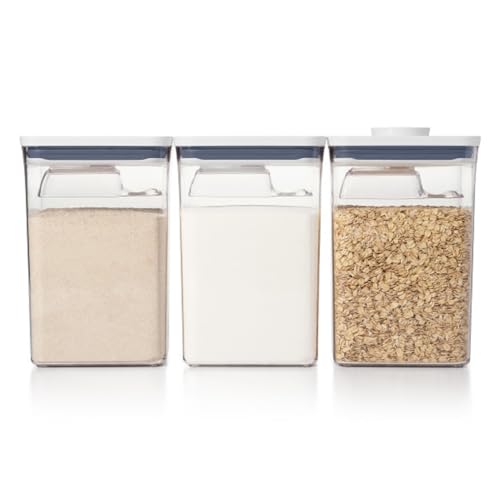
The OXO Good Grips POP line is the set most pantry organisers reach for when looks matter as much as sealing. The lid seals with a single push of the central button, which drives a silicone gasket down against the rim, and the same button doubles as a handle for lifting the lid clear. In daily use that one-handed operation is the real advantage: you can open a flour canister while your other hand holds a scoop, and the lid goes back on with a press rather than a wrestle. The bodies are clear, the corners are rounded for pouring, and the lids are designed so containers stack into a flat, stable grid instead of a leaning tower.
Where the POP system earns its keep is the ecosystem around it. Scoops that clip under the lid, levelers for flour, and brown-sugar savers all exist because the range has been stable for years, so a set bought today still matches accessories bought later. The trade-offs are equally clear. The lids are not meant to be submerged for long soaks, the gasket needs a proper dry before reassembly, and the push-button seal is a freshness seal rather than a liquid-tight one, so this is a dry-goods specialist, not a soup carrier. Treat it as pantry furniture for flour, sugar, rice, pasta and cereal and it is hard to fault; ask it to do fridge and lunchbox duty as well and other sets do that wider job better.
Strengths
- One-handed push-button opening and closing
- Flat lids stack into a stable, tidy grid
- Large accessory ecosystem that stays compatible over time
Trade-offs
- Freshness seal is not designed for liquids
- Lids need full drying before reassembly
- Premium tier pricing for full-pantry coverage
Best for: readers who want a premium tier system with a clear job to do. Not suited for: anyone expecting one container to be perfect at every task in the kitchen.

Rubbermaid Brilliance Pantry Set
Rubbermaid Brilliance is the workhorse answer to the question of one set that can do pantry, fridge and freezer without apology. The lids latch on both sides and seal with a silicone gasket, and the seal is genuinely liquid-tight, so a container of stock or marinated chicken can travel in a bag without the slow leak that ruins trust in a storage system. The bodies are crystal clear and notably stain resistant, which matters for tomato sauces, turmeric-heavy curries and beet salads that cloud lesser plastics within a few uses. Vents under the latches let you microwave with the lid ajar rather than fully removed, cutting splatter without extra dishes.
As a pantry system, Brilliance brings a modular footprint: the containers share lid sizes across several capacities, so you are not hunting through a drawer of near-miss lids. The latches do add width, and the chunkier lid profile means a Brilliance row takes slightly more shelf depth than a slim push-button set. The lids also have more moving parts to rinse after a greasy meal-prep session. None of that undermines the central proposition: if your containers must move between dry goods, leftovers, freezer portions and a lunch bag, this is the most forgiving single system to own, and its clarity keeps fridge audits quick.
Strengths
- Liquid-tight latched seal suits fridge, freezer and transport
- Clear bodies resist staining from sauces and spices
- Shared lid sizes across capacities simplify storage
Trade-offs
- Latched lids take more shelf width and height
- Hinges need rinsing after greasy foods
- Costs more than basic clip-lid sets
Best for: readers who want a mid-to-premium tier system with a clear job to do. Not suited for: anyone expecting one container to be perfect at every task in the kitchen.

LocknLock Easy Essentials Set
LocknLock built its reputation on the four-hinge locking lid, and the Easy Essentials line carries that design into everyday pantry and fridge service. Each lid locks on four sides over a silicone gasket, producing a seal that handles liquids with confidence and keeps dry goods genuinely fresh. The four-hinge system has a long track record, replacement pieces circulate widely, and the containers nest when empty, which matters more than it sounds in a small kitchen where the container drawer is prime real estate.
Four hinges are also the friction point: each lid takes a few seconds longer to open and close than a flip-top, and the hinge tabs add width, so the densest possible pantry grid belongs to slimmer designs. The lids are also the part to wash carefully after oily foods. In exchange you get one of the most trustworthy seals in mainstream food storage, equally at home with flour, soup, cut fruit and a freezer portion of bolognese. For households that want one locking system everywhere rather than specialists per zone, LocknLock remains the benchmark the imitators are measured against.
Strengths
- Four-hinge locking seal handles liquids confidently
- One system covers pantry, fridge and freezer
- Empty containers nest to save drawer space
Trade-offs
- Hinges are slower than flip-top or push-button lids
- Hinge tabs widen the footprint
- Crevices need rinsing after oily foods
Best for: readers who want a mid tier system with a clear job to do. Not suited for: anyone expecting one container to be perfect at every task in the kitchen.

Sistema Klip It Plus Set
Sistema Klip It Plus uses the oldest trick in food storage and does it well: clips on all four sides pressing a lid onto a sealing gasket. The result is a container that children can open, adults can close one-handed at a pinch, and nobody needs instructions to use. The range is broad, the footprints are modular, and the whole system is priced so that buying enough containers to actually organise a pantry does not require a strategy meeting. For dry goods, snacks, baking supplies and everyday leftovers, the seal is more than sufficient.
Expect the limits that come with the design. Clip lids are freshness seals, not transport seals for thin liquids, and the clips are moving parts that eventually wear. The styling is functional rather than display-grade, so a showpiece open pantry looks tidier in a premium canister line. None of that matters in a working family kitchen, where Klip It Plus quietly does the largest number of jobs per dollar in this roundup. It is the set we point to when the goal is full coverage of a real pantry on a sane budget.
Strengths
- Four-clip lids are simple for the whole household
- Broad size range with modular, stackable footprints
- Strong value for covering a whole pantry
Trade-offs
- Clip seal is not the best choice for transporting liquids
- Clips are the long-term wear point
- Functional styling rather than display styling
Best for: readers who want a entry-to-mid tier system with a clear job to do. Not suited for: anyone expecting one container to be perfect at every task in the kitchen.

Vtopmart Airtight Food Storage Containers Set
Vtopmart built its name on the big uniform bundle: a shelf-ready row of clear canisters with flip-top lids, usually arriving with labels and a scoop or measuring cup. The flip-top is the fastest lid in this roundup for dry goods, opening with a thumb press and closing with a click, and the identical footprints mean the set stacks and lines up without the improvisation mixed sets demand. For cereal, oats, rice, pasta, flour and snacks, the air-limiting seal does the freshness job that matters.
Buy it with clear eyes about the category. These are dry-goods canisters, not liquid containers, and the lids prefer hand washing if you want the hinges to stay crisp for years. The bundle format also means the sizes are chosen for you; measure shelf height and depth first, especially in older kitchens with shallow cupboards. Households that want the organised-pantry result quickly and affordably, and that keep liquids in dedicated fridge containers, will find the Vtopmart formula hard to beat on value.
Strengths
- Uniform footprints make a full pantry reset fast
- Flip-top lids are quick for daily dry-goods access
- Bundles often include labels and a measuring cup
Trade-offs
- Freshness seal only, not for liquids
- Lids last longest with gentle hand washing
- Fixed bundle sizes require shelf measuring first
Best for: readers who want a entry tier system with a clear job to do. Not suited for: anyone expecting one container to be perfect at every task in the kitchen.
Chef’s Path Airtight Food Storage Containers Set
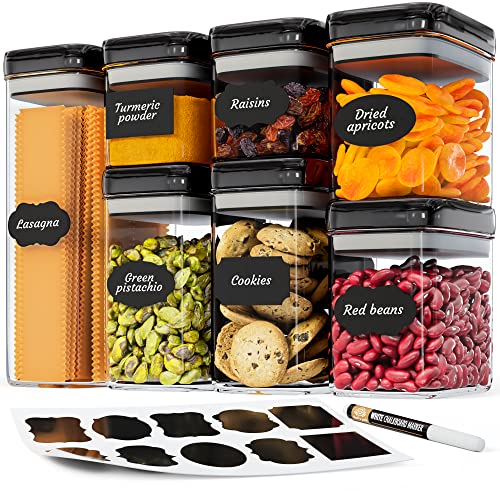
Chef’s Path focuses on the classic pantry bundle: clear tall and mid-height canisters, flip-top lids with silicone rings, and the labelling extras that turn a shelf of containers into a system. The tall canisters swallow spaghetti and cereal boxes whole, which solves the two most common sources of pantry mess in one move, and the flip-top action is quick enough for weekday breakfasts. Everything is visible, everything is labelled, and the torn-bag era ends.
The limitations mirror the category: dry goods only, lids that prefer kind treatment, and bundle sizes that need checking against your shelves before you commit. Within those lines, Chef’s Path competes directly with the other bundle brands and wins some pantries on the strength of its tall sizes and included labels. If your current system is a graveyard of half-open packets, this is one of the fastest routes to a cupboard that stays tidy after the first week.
Strengths
- Tall canisters suit spaghetti, cereal and flour
- Labels and measuring extras included in many bundles
- Clear bodies make stock levels obvious
Trade-offs
- Dry-goods freshness seal, not for liquids
- Bundle contents vary, so sizes need checking
- Flip-top hinges prefer gentle washing
Best for: readers who want a entry-to-mid tier system with a clear job to do. Not suited for: anyone expecting one container to be perfect at every task in the kitchen.
Who Should Buy What, and Who Should Skip the Category
Bakers and display-pantry households: OXO POP. One-system households and meal preppers: Rubbermaid Brilliance, with LocknLock the pick if nesting storage and the strongest lock matter most. Families covering a whole pantry: Sistema Klip It Plus. First resets on a budget, especially tall-staple chaos: the Vtopmart and Chef’s Path bundles, chosen by whose size list fits your shelves. Skip the category for now if your dry storage fits in three jars already; the system economics argued in are airtight food storage containers worth it need a pantry of a certain size before they turn favourable, and the two-sided ledger in airtight food storage containers pros and cons will tell you honestly whether you are there.
Setup, Care and Maintenance Essentials
All six sets reward the same small liturgy: wash and dry before first use, decant fully, label with product and month, keep gaskets clean and bone-dry before reseating, air-dry lids, and store the pantry cool. The value bundles ask for gentler lid treatment; the locking sets ask for a rinse of their hinge channels after oily food; the push-button lids ask not to be soaked. None of it is onerous, and all of it is cheaper than replacement. Households that enjoy this kind of visible order often extend it with best storage baskets for shelves and closets and best makeup organizers for counters elsewhere in the home.
Final Verdict
Across six sets and every common household brief, the category delivers. The reviews converge on a simple buying rule: choose by dominant use, verify the fit against your shelves, and maintain the gasket like the working part it is. Do that and any set in this roundup will keep staples fresher, pantries calmer and shopping lists shorter for years. The differences that remain are pleasures and frictions, and you now have them mapped.
How to Read Airtight Food Storage Containers Listings Without Being Misled by Headlines
This section exists to look again after the first impression has faded, because the qualities that sell a product in the first hour are rarely the ones that decide whether it is still liked in month three. It adds a layer that a feature list cannot give you, grounded in the food storage & organization context this airtight food storage containers will actually live in. Where this guide names examples such as OXO Good Grips POP Container Set, Rubbermaid Brilliance Pantry Set, LocknLock Easy Essentials Set, use them as test cases for the checks below rather than as shortcuts past them.
Consider the edge cases that sit just outside normal use, because a airtight food storage containers will meet all of them eventually. The unusually large load, the unusually small task, the day you are in a hurry, the day something else in the room is broken and this has to cover for it. Versatility is not about a long feature list; it is about behaving predictably when conditions are imperfect. Where a design offers settings, modes, attachments or configurations, ask what each one is actually for in your home, and be suspicious of flexibility you cannot attach to a real occasion. One well-judged configuration used weekly beats five clever ones used once, and the honest airtight food storage containers for your home is the one whose strengths line up with your most frequent edge case, not your rarest.
Build a simple decision checklist and score it in writing. Five lines are enough: fit in the space, fit with the routine, ease of cleaning or upkeep, quality of the parts that move or wear, and how the airtight food storage containers will be stored or will look when it is not the centre of attention. Score each contender quickly, then look only at the lowest scores, because purchases are usually ruined by their weakest point rather than saved by their strongest. If two options tie, choose the one whose weakness is cheapest or easiest to live with. This sounds mechanical, and it is meant to: a written checklist is the best defence against the very human habit of falling for the last photograph you looked at.
Finally, plan the first fortnight. Decide where the airtight food storage containers will live from day one, what it replaces, what accessory or companion it needs straight away and what small job you will use to learn its habits while returning it is still simple. Keep the packaging until that learning period is over, note anything that surprises you, and deal with a mismatch early rather than adapting yourself around a poor fit for years. The households that end up happiest with a airtight food storage containers are rarely the ones that researched longest; they are the ones that checked fit honestly, bought for the ordinary week, and paid attention during the first days instead of assuming the decision ended at checkout.
One more angle is worth your time: the second-order costs. A airtight food storage containers changes what happens around it. It can demand a different cleaning product, a new storage habit, a moved piece of furniture, a rearranged cupboard or a standing arrangement with the people you live with. List those knock-on effects before you buy and decide whether you accept them as part of the deal. Sometimes the answer is an easy yes, and the airtight food storage containers earns its place by improving the whole routine around it. Sometimes the honest answer is that the supporting changes are the real project, and the purchase should wait until you are ready for them. Either answer is useful; the only bad outcome is discovering the knock-on effects by accident, one irritation at a time, after the decision can no longer be revisited.
Frequently Asked Questions
Which airtight container set is best overall?
There is no honest single winner, because the sets optimise for different kitchens. Rubbermaid Brilliance is the most versatile, sealing dry goods and liquids across pantry, fridge and freezer in one system. OXO POP is the most pleasurable for a dry baking pantry. Sistema Klip It Plus covers the most pantry for the least money. Best overall for you is the set whose strengths match your dominant use, which is why this roundup organises its verdicts by household rather than crowning one box.
Are the cheap bundle sets actually airtight?
Yes, for their intended job. The flip-top bundles seal with a genuine gasket and keep dry staples fresh for weeks, contain pests and organise a shelf as well as anything sold. Their limits are liquid security, where they were never designed to compete, and long-term lid wear, where gentler care extends their life considerably. Judged as dry-goods systems they are legitimately good; judged as soup carriers they will leak and disappoint, as would a bicycle judged as a boat.
How many containers should a first set include?
Enough to cover the staples you actually decant, which for most households means somewhere between ten and twenty pieces once lids are counted, spanning one or two large canisters, several mediums and a handful of smalls. Count your open bags and boxes before ordering; that number, plus two, is your set size. Systems that sell add-on sizes in the same footprints are worth favouring, because the correct count reveals itself only after a month of living with the first purchase.
Do airtight containers help with pantry moths?
They are the single most effective household measure, because they attack the mechanism of infestation: spread. Moths and weevils arrive inside purchases and migrate through bags and boxes; a rigid gasketed container quarantines each staple in both directions. A container cannot decontaminate food that arrives infested, so inspect flour and grains as you decant, but it converts a potential whole-pantry disaster into the loss of a single container’s contents, which is the difference between an annoyance and a weekend of scrubbing.
Plastic or glass: which do reviewers recommend for a pantry?
For the dry pantry specifically, most reviewers land on plastic systems: lighter on high shelves, resistant to drops, and sold as modular, stackable sets with shared lids, which glass rarely is. Glass wins for leftovers, reheating and table service, where its inert, stain-proof surface matters. The settled answer in most kitchens is a hybrid, plastic system for dry staples, glass for wet and hot duty, and this roundup’s plastic focus reflects the pantry brief rather than a universal material verdict.
How long will a good set last?
Bodies routinely last many years. The wearing parts are gaskets, clips and hinges, whose performance fades gradually and can often be restored by proper washing, full drying or a replacement gasket where the brand sells one. Premium systems tend to age more gracefully and support parts longer; value sets ask for kinder treatment. In every tier, the household that services its seals gets multiples of the lifespan of the household that never thinks about them.
Related Guides
- airtight food storage containers buying guide
- airtight food storage containers pros and cons
- airtight food storage containers review
- airtight food storage containers vs glass food storage containers
- are airtight food storage containers worth it
- how to choose airtight food storage containers
- best storage baskets for shelves and closets
- best makeup organizers for counters
- best closet organizer shelves
Rice, Pasta and Grains: Bulk Staples Done Properly
Rice, pasta and dry grains are bought in the largest bags and stored the longest, which makes them the stress test of any system. Their enemies are moisture, which invites mould and mustiness, and pantry pests, which treat a torn bag of rice as an open invitation. A rigid, gasketed canister answers both, and its clarity answers the third problem, the forgotten half-bag mouldering behind newer shopping. Grains also pour constantly, so a container that pours cleanly from a wide mouth, or accepts a scoop without a fight, saves small daily annoyances that compound.
Bulk buying is where sealed storage turns into measurable savings: the large bag costs less per kilo, but only if the last kilo is as good as the first. In an open bag it often is not. Long-grain rice keeps for many months sealed and dry; wholegrain and brown rice carry more natural oils and are best bought in quantities you will use sooner, or kept cooler. Pasta is forgiving but absorbs odours, another quiet argument for a real seal. Match the canister to the biggest bag you buy, decant on arrival, and the staple wall of the pantry runs itself.
The Baker’s Pantry: Flours, Sugars and Leaveners
Baking staples are the strongest case for airtight storage because they are hygroscopic, pest-prone and used in precise mixtures. Flour cakes and compacts as it trades moisture with the air, and a compacted cup measures heavier than a fresh one, quietly skewing recipes. Brown sugar is the famous casualty: left to dry air it sets into a brick, while a well-sealed canister keeps it scoopable for months. Baking soda and baking powder lose potency as they absorb moisture and odours, and both are cheap insurance to keep sealed and dated.
A baker’s layout usually runs one large canister for the main flour, a medium for sugar, smaller ones for brown sugar, cocoa and cornflour, and small sealed jars for leaveners and salt. Wide mouths matter here more than anywhere, because a measuring cup should enter the container rather than the container visiting the cup. Levelers and scoops that live inside or under the lid remove the last friction from the system. If you bake weekly, this cluster alone justifies a quality set; if you bake twice a year, it is where a modest set earns its shelf space anyway.
Pantry Pests and Why Sealed Containers Stop Them
Sealing also removes the smells that attract pests in the first place. An open bag of rice or dog kibble advertises itself; a gasketed canister is close to odour-neutral from the outside. If you ever do find webbing or larvae in one container, the system pays for itself in that moment: you discard one sealed unit instead of stripping and treating an entire pantry. Freezing a new bag of flour for a few days before decanting is a belt-and-braces habit many bakers adopt, but the container is the structural defence that works every day without thought.
The most persuasive argument for airtight storage is not freshness but containment. Pantry moths and weevils typically arrive inside a purchased bag of flour, grain or pet food, not through your walls, and in paper or thin plastic packaging they spread from product to product until half the cupboard is infested. A rigid container with a real gasket breaks that chain in both directions: an infested product cannot seed the shelf, and clean products cannot be reached. Experienced bakers decant flour on arrival for exactly this reason, treating the container as quarantine as much as storage.
Lid Mechanisms Compared: Clips, Latches, Flip-Tops and Push Buttons
Choosing between them is really choosing your dominant use. A container opened six times during a baking session should be fast; a container carrying soup in a work bag should be locked; a family cereal canister should be operable by the youngest person who uses it. Problems start when one mechanism is forced into every role. The households happiest with their storage usually run two mechanisms deliberately: fast lids in the dry pantry, locking lids for everything wet, and no guilt about the overlap.
Every lid mechanism is a trade between speed and sealing force. Flip-top lids are the fastest: a thumb press opens them, a click closes them, and the gasket gives a solid freshness seal for dry goods. Push-button lids match that speed with a cleaner look and one-handed operation, which bakers love mid-recipe. Clip lids spread moderate force around the rim and are simple enough for children to use reliably. Locking lids, with latches or four hinges, apply the most even and powerful compression, which is what makes them trustworthy with liquids, but each opening costs a few seconds and both hands.
Washing and Gasket Care That Keeps Seals Honest
Dishwasher guidance varies by brand, and the honest general rule is that bodies tolerate dishwashers better than lids do. Heat and detergent are hardest on the moving parts and on printed measurement markings. A soft brush keeps hinge crevices honest after oily foods. When a gasket has gone stiff, cracked or permanently compressed, replacing that one part, where the brand sells it, restores the container for a fraction of a new set’s cost. Treat the gasket as the consumable it is, and a good set’s working life stretches from seasons to years.
Most airtight containers do not fail dramatically; they fade. The gasket collects flour dust, spice oils and dishwasher detergent film, the compression weakens a fraction, and one day the cereal is soft and nobody knows why. The fix is a small routine. Gaskets that remove should be removed and washed separately every few weeks in a working pantry, then dried completely before reassembly, because a gasket put away damp can hold odours and, in a closed container, create exactly the stale environment you bought the seal to prevent. Lids with mechanisms, hinges, buttons and latch channels, deserve a rinse and an air-dry rather than a long soak.
What Airtight Storage Can and Cannot Do for Freshness
The limits deserve equal clarity. A sealed container cannot revive food that was stale when it went in, cannot protect against heat, which is why the pantry should be cool and away from the oven wall, and cannot substitute for buying sensible quantities of slow-moving items. Light also degrades some foods, though a closed cupboard solves that for most households. Used with realistic expectations, a good seal typically stretches the good life of dry staples from days in an open bag to weeks or months in a canister, and that difference is the entire economic case for owning a set.
Airtight storage slows staling; it does not stop time. Crackers soften because they trade moisture with the air, and a good seal slows that trade to a crawl. Coffee and spices fade because their aromatic compounds oxidise and evaporate, and limiting air exchange keeps more of both in the food. Wholegrain flours and nuts carry fragile fats that oxygen turns rancid, which is why they benefit most dramatically from a sealed canister, and why many bakers keep wholegrain flour in the freezer in its sealed container for the longest life of all.
Snacks, Cereal and the High-Turnover Shelf
Portion discipline is the hidden benefit. Decanting snacks into containers removes the rustling bag that invites grazing straight from the packet, and a household that wants to slow snack turnover can choose smaller canisters deliberately. For parties and lunchboxes, the pantry canister becomes the refill station rather than the serving vessel, which keeps hands out of the main supply. Judge snack storage by behaviour, not laboratory sealing numbers: speed, visibility and a lid a tired person will close properly at midnight.
The snack shelf lives by different rules: containers are opened many times a day, often by children, and contents turn over fast. Here the best seal is the one that actually gets closed, which is why flip-top and push-button lids dominate this zone despite their modest sealing force. A cereal that stays crisp for its week of life in a flip-top canister beats a cereal abandoned in a locking container nobody bothers to reseal. Visibility matters too, because a clear canister ends the morning ritual of shaking boxes to guess which one still holds breakfast.
Fridge and Freezer Duty: Where Pantry Sets Reach Their Limit
Dry-goods canisters and fridge containers look alike and behave differently. In the fridge, a container faces liquids, condensation and frequent stacking under weight; in the freezer it faces expansion as food freezes, brittle cold and the need to leave headroom. Locking, gasketed containers designed for wet food handle all of this, which is why the versatile sets in this category earn their place. Flip-top and push-button pantry lids, by contrast, are usually rated for dry storage: their seals can weep with liquids, and their bodies may not be freezer-rated at all.
The practical division of labour in most kitchens is therefore simple. Pantry canisters stay in the pantry, where their speed and stackability shine. A separate, smaller fleet of locking containers handles leftovers, meal prep and freezing, chosen in sizes that match portions rather than ingredient bags. Trying to make one fleet do both jobs usually means owning the wrong compromise twice. Check any container’s stated freezer and microwave guidance before pressing it into service, and leave expansion headroom in anything you freeze, because even the best seal cannot negotiate with physics.
Coffee, Tea and Spices: Small Foods, Big Aroma Stakes
Size discipline matters more here than capacity. A small canister filled often beats a large one holding a month of ground coffee, because every opening exchanges the air inside, and a half-empty large canister is mostly a jar of air ageing your coffee. Buy or decant in the quantity you use in a few weeks, keep the container small and full, and let the seal do the rest. These are also the items where a truly tight gasket justifies itself fastest, since the difference between sealed and merely covered is obvious in the cup within a fortnight.
Coffee, tea and ground spices lose quality faster than almost anything in the pantry, because what you are storing is largely aroma, and aroma escapes with air exchange. A small, well-sealed canister kept in a dark cupboard protects ground coffee and loose tea far better than the opened retail bag with a folded top. Whole beans are hardier but still benefit from a seal once the bag is open. Spices follow the same logic: ground spices fade within months in poor storage, and a sealed, dated jar makes the fade visible and manageable instead of mysterious.
Households With Children and Pets: Storage That Survives Real Life
Pet food is its own storage problem: it is bulky, oily and strongly scented, and its fats go rancid in an open bag exactly like any other food. A large, well-sealed canister on a low shelf or floor of the pantry keeps kibble fresher, contains the smell, and removes the torn bag that spills at every feeding. Scoops sized to the pet’s portion, stored in or on the canister, complete the system. In a busy household the measure of a storage set is not its showroom seal but whether, six months in, every lid still closes, every container is intact, and the routine still holds on a tired weekday evening.
Children and pets change the storage brief. Lids must be operable by small hands for the foods children serve themselves, and genuinely secure for the foods they should not, from coffee to pet treats to the cat biscuits that otherwise scent a whole cupboard. Drop resistance stops being a nice feature and becomes the feature, because a container will meet the floor, probably full. This is the environment where sturdy plastic earns its place over glass without argument, and where simple clip and flip mechanisms outlast clever ones.
Small Kitchens and Rental Constraints
Renters face the extra rule that nothing can be screwed, glued or built in, which makes a container system one of the few upgrades that moves house with you. It also argues for restraint: a tight fleet of versatile sizes beats a sprawling collection, because every container you own must itself be stored. Nesting empty containers and shared lids are worth real money in a small kitchen. Done well, a sealed system can return an entire cupboard of chaos as usable space, which in a small home is the most valuable thing any purchase can give back.
In a small kitchen, storage containers are not an accessory; they are part of the architecture. The winning moves are vertical and uniform: containers that stack two high on the shelf you have, share footprints so no space is stranded, and are clear enough that you never need to open three to find the lentils. Measure before buying with unusual honesty, including the shelf you avoid because the door frame eats its corner, and favour sets whose sizes divide your shelf height cleanly rather than almost.
The Honest Economics: Where the Money Goes and What It Buys
Spending more buys specific things, not magic: better gaskets that seal longer, mechanisms that stay smooth for years, clearer and tougher bodies, and size ranges that stay consistent so you can add pieces later. Spending less buys adequate seals and simpler lids that may need replacing sooner. The value mistake at both ends is mismatch: a premium wall of canisters for a household that eats out, or a bargain set worked so hard its lids fail within the year. Match the tier to the turnover of your pantry and the economics take care of themselves.
Airtight containers ask for money up front and repay it in avoided waste, which makes the maths household-specific. The clearest savings come from bulk staples that survive to the last scoop, snacks that stay crisp instead of being replaced half-eaten, and the pantry infestation that never happens. Against that, set the real costs: the purchase itself, the shelf space the system occupies, and the small ongoing effort of decanting and washing. Households that cook from staples daily sit deep in profit; households that mostly buy ready food may never recoup a premium set, and a modest one serves them better.
Mistakes That Quietly Ruin Good Containers
The same few errors undo good storage in every kitchen. The first is decanting new food onto old without ever emptying the container, which buries ageing stock at the bottom and can seed a fresh bag with pests from the last one. The second is sealing containers while the food or the container is still warm or damp, trapping the moisture the seal then preserves. The third is storing the pantry above or beside the oven, where heat accelerates every decline the seal is fighting. Each is a habit, not a purchase, and each is free to fix.
Hardware mistakes follow. Forcing a lid that is misaligned wears the gasket unevenly; soaking complex lids invites water into mechanisms that then dry slowly and smell; and using a dry-goods canister for soup teaches a household to distrust a product that was never built for the job. Finally, there is the orphan-lid spiral: sets bought without a shared-lid logic eventually fill a drawer with almost-right lids, and the daily friction of that drawer is what kills the decanting habit. Systems survive on ease. Protect the ease and the containers protect the food.
How an Airtight Seal Actually Works
An airtight seal does not create a vacuum, and it does not need to. What it does is sharply limit the exchange of air between the inside of the container and the room, and with that exchange goes most of what makes stored food decline. Oxygen drives oxidation in fats, which is why nuts, wholegrain flours and coffee turn rancid in a half-open bag but stay sweet for far longer in a sealed canister. Moisture moves the other way: dry goods like crackers, cereal and brown sugar pull humidity from kitchen air, while flour and rice can cake or stale as their moisture balance shifts. A gasketed lid interrupts both flows at once.
The gasket is the working part. Silicone or rubber is compressed between lid and rim, filling the microscopic gaps that hard plastic alone cannot close, and the lid mechanism, whether clips, latches, hinges or a push button, exists mainly to keep that compression even. This is why a lid that rocks, a gasket that has gone stiff, or a rim with a crack quietly turns an airtight container into an ordinary box. It is also why seals should be tested rather than assumed: a container that cannot hold its lid under a gentle lift by the lid alone is telling you the gasket is no longer doing its job.


