Disclosure: As an Amazon Associate, dailyhomedecorating.com earns from qualifying purchases. Links on this page are affiliate links; they cost you nothing extra. Prices and availability change often, so check the current Amazon listing before you buy.
Any honest account of airtight food storage containers pros and cons has to hold two truths at once. Sealed containers genuinely transform how long staples stay good and how a pantry feels to use, and they also demand money, shelf space, washing and a decanting habit that not every household will keep. This article works through both sides in detail, five to seven points at a time, with the reasoning shown, so you can judge which side weighs more in your kitchen rather than being sold a verdict.
The short version first. Airtight containers suit households that cook from dry staples, buy any food in bulk, fight pantry pests or stale snacks, or simply think better with a visible, labelled stock. They suit far less the household that stores little, eats mostly fresh or ready food, or knows it will never decant a bag in its life. Everything below is the long version of that paragraph, ending with the buying and care habits that shrink the cons to their smallest honest size.
Key Takeaways
- The biggest pro is slowed staling: seals limit the air exchange that oxidises fats and softens crisp foods.
- Containment is the underrated pro: one infested bag cannot spread through a sealed pantry.
- The biggest con is system cost and effort: containers, shelf space and a decanting routine are all real.
- Cons shrink dramatically when the set matches the household’s actual foods and shelf dimensions.
- Most disappointment traces to mismatched duty, dry-goods lids asked to carry liquids, not to sealing itself.
Airtight Food Storage Containers Pros and Cons: The Quick Verdict
If your pantry holds more than a few open bags at any time, the pros outweigh the cons for a simple structural reason: an open bag is a food exposed to air, moisture, odours and pests around the clock, and a sealed container removes all four exposures at once. The cons are mostly one-off or habitual, money spent once, minutes spent decanting weekly, while the pros recur at every meal. The households for whom the balance flips are those with genuinely little to store, for whom the system’s fixed costs buy almost no recurring benefit. The detailed ledger follows.
In this guide
The Pros
Food Stays Good for Longer
This is the founding promise and it holds. Crisp foods stay crisp because the moisture trade with kitchen air is throttled; wholegrain flours, nuts and coffee resist rancidity because oxygen access is limited; spices and tea keep their aroma because volatile compounds are not continuously escaping into the cupboard. The improvement is not marginal. Staples that slump within days in a clipped bag routinely stay right for weeks in a healthy sealed canister, and slow staples like rice and dried beans effectively stop ageing at any rate a household can detect. Every other pro on this list is a bonus compared with this one.
Pantry Pests Are Contained, Not Invited
Pantry moths and weevils almost always arrive inside a purchase. In bags and boxes they migrate freely, and by the time the first moth is noticed the infestation usually owns several products. Rigid, gasketed containers quarantine each staple: an infested item harms nothing else, and clean items cannot be reached. The same seal contains odours, which removes much of what attracts pests to explore further. For anyone who has once stripped, frozen and scrubbed an entire pantry, this single pro can justify the whole system on its own.
You Can See Your Stock, So You Waste Less
Clear containers convert the pantry from a memory test into a display. You see that the rice is low before the evening it runs out, you see the duplicate bag of lentils before buying a third, and you see the expiry problem while it is still small. Households consistently report that the visible pantry is the pro they feel most in their shopping bills: fewer duplicates, fewer emergency purchases, fewer forgotten items discovered months past their best. Labels with decanting dates complete the effect, turning a cupboard into a stock list.
Portions, Pouring and Daily Handling Improve
A rigid canister with a wide mouth and a scoop is simply better equipment than a floppy bag. It pours without dusting the counter, it stands open while you measure, it accepts a measuring cup directly, and it stacks into the shelf space instead of slumping into it. These are small mercies, but a pantry is used many times a day, and small mercies compound. Bakers in particular feel the upgrade, because consistent, uncompacted flour measures more honestly than flour dug from a settling bag.
Bulk Buying Starts to Pay
The large bag of rice, flour or oats is cheaper per kilo, but only if the last kilo is as good as the first. Sealed storage is what makes that true, so the system quietly subsidises itself in households that cook staples daily. The same logic applies to warehouse packs of snacks and cereal that defeat a small household in an open box. Where bulk buying was previously a false economy that ended in stale food, a canister wall turns it into a genuine one, and the savings recur with every shop.
One System Replaces a Cupboard of Chaos
There is a behavioural pro that spec sheets miss: a uniform, labelled system makes tidiness the default rather than a project. Containers return to the same footprints, lids match without a search, and putting shopping away becomes a two-minute decant rather than a negotiation with a collapsing shelf. Visitors consistently underestimate how much of the benefit is this friction removal, right up until they live with it. A pantry that stays orderly without effort is a pantry whose stock you actually know.
The Cons
The Upfront Cost Is Real
A full pantry of quality containers costs meaningful money, and the premium systems cost several times what the basic ones do. The expense is one-off and the sets last years, but it lands in a single week, usually alongside the grocery shop that fills them. Households should budget honestly: measure the pantry, count the staples, and price the coverage before falling for a flagship set. A mid-tier system fully deployed beats a premium system covering half the shelf, because the uncovered half keeps every problem the system was bought to solve.
Containers Themselves Need Storing and Washing
Every container you own occupies shelf or drawer space even when empty, and every one joins the washing cycle. Gaskets need periodic removal and proper drying, lids with mechanisms need rinsing and air-drying, and a household that hates washing up will feel the system’s overhead weekly. Nesting designs and shared lids reduce the storage burden considerably, but they do not abolish it. This con is the strongest argument for restraint: buy the fleet your staples need, not the fleet in the photograph.
The Decanting Habit Is a Real Behaviour Change
Sealed storage only works if food actually gets decanted, promptly, every shop, including the tired Friday shop. For some households that routine becomes a pleasure; for others it is the chore that quietly stops happening by month three, leaving expensive containers empty and bags open beside them. Be honest about which household you are. If the habit is doubtful, start with the five highest-value staples, flour, rice, cereal, sugar and the snack supply, prove the routine there, and expand only if it sticks.
Not Every Seal Suits Every Food
The category’s most abused word is its own name. Many pantry canisters are airtight for dry goods yet will weep with liquids, soften their seal in freezer cold, or carry bodies not rated for reheating. A household that buys one fleet expecting it to cover pantry, fridge, freezer and microwave will be disappointed somewhere, and the disappointment usually lands on the product rather than on the mismatch. The fix is knowledge, two fleets for two duties, but the need for that knowledge is itself a genuine con of a confusing category.
Size and Shelf Mismatches Are Common
Bundles are photographed on generous shelves. Real kitchens have shallow cupboards, low shelf gaps and one awkward corner, and a set that ignores them creates a second storage problem out of the first. Tall canisters exile themselves to counters, deep ones strand the row behind them, and the largest container that cannot swallow your flour bag leaves the bag in service beside it. Measuring first converts this con into a non-event, but the category makes measuring necessary, which not every purchase demands.
Seals Age and Parts Wear
Gaskets stiffen and compress, clips loosen, hinges collect grime, and a container’s fifth year is rarely as airtight as its first unless parts are maintained or replaced. This is maintenance, not failure, but it is ongoing in a way a glass jar’s screw top is not. Brands differ in how gracefully they age and whether replacement lids and gaskets are sold at all. A household buying for a decade should weigh parts support as seriously as the initial seal, because the seal is a consumable wearing a permanent costume.
What the Trade-Offs Mean for You
For the staple-cooking household, the ledger is not close: the pros recur daily and the cons are mostly a purchase and a habit. For the small, fresh-food household, the honest answer may be a five-container starter set rather than a wall, capturing most of the freshness and pest benefits at a fraction of the cost and overhead. For the baker, the pros concentrate so heavily in the flour-and-sugar cluster that even a premium mini-system pays. The general rule is that the pros scale with how much dry food you store, while the cons are roughly fixed, so the more pantry you run, the better the deal becomes. The fuller financial version of this argument is in are airtight food storage containers worth it.
Set choice then decides how large the cons loom. The detailed assessments in airtight food storage containers review and airtight food storage containers reviews exist to match mechanisms to households, while the criteria in airtight food storage containers buying guide help you size and specify a set before money moves. Readers weighing the material question itself, plastic systems against glass, will find the direct comparison in airtight food storage containers vs glass food storage containers more useful than either side’s marketing.
Context: How the Alternatives Compare
| Option | Strengths | Trade-offs |
|---|---|---|
| Airtight container system | Best freshness, pest containment, visibility and stacking | Upfront cost, washing, decanting habit |
| Original bags with clips | No cost, no extra storage | Weak seal, pests spread, stock invisible, pouring is messy |
| Glass jars | Inert, stain-proof, beautiful, long-lived | Heavy, breakable, rarely modular or stackable as a system |
| Vacuum-sealed bags | Maximum air removal for freezer and long storage | Consumable bags, poor for daily-access staples |
The table clarifies why the container system wins the daily-access staples while losing specialty roles. Vacuum sealing beats it for a six-month freezer stash; glass beats it for reheating and table service; the clipped bag beats it only on price. The staples you touch every day, however, need speed, visibility and a seal that survives being opened twice a day for months, and that is precisely the contest the container system was designed for.
How to Buy Smart
Buying smart in this category is mostly defensive. Measure the shelves and the staple bags first. Decide the duties, dry only or wet as well, and refuse to let a dry-goods set promise wet work. Favour shared footprints and lids, check whether replacement gaskets exist, and read the size list of any bundle rather than its photograph. Start with the staples whose staling or pest risk you have personally suffered, because motivation maintains habits. The ordered method in how to choose airtight food storage containers turns this checklist into steps, and the same visible-stock logic extends naturally to projects like best closet organizer shelves once the pantry proves the principle.
Three Sets That Illustrate the Ledger
Abstract pros and cons land harder with concrete examples. These three sets sit at different points of the ledger: a premium mechanism whose cons are price and specialisation, an all-rounder whose cons are size and parts, and a value range whose cons are wear and liquid limits. Read them against the lists above and the trade-offs stop being theoretical.

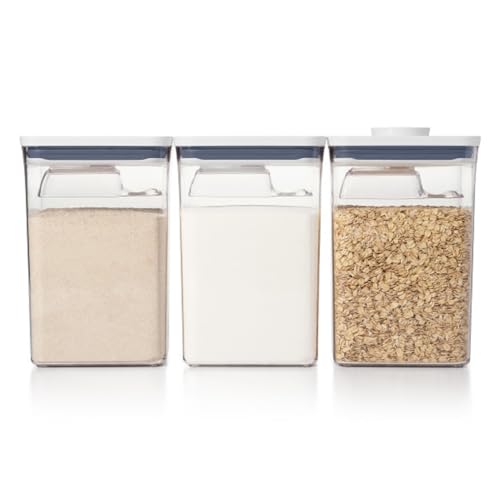
OXO Good Grips POP Container Set
The OXO Good Grips POP line is the set most pantry organisers reach for when looks matter as much as sealing. The lid seals with a single push of the central button, which drives a silicone gasket down against the rim, and the same button doubles as a handle for lifting the lid clear. In daily use that one-handed operation is the real advantage: you can open a flour canister while your other hand holds a scoop, and the lid goes back on with a press rather than a wrestle. The bodies are clear, the corners are rounded for pouring, and the lids are designed so containers stack into a flat, stable grid instead of a leaning tower.
Where the POP system earns its keep is the ecosystem around it. Scoops that clip under the lid, levelers for flour, and brown-sugar savers all exist because the range has been stable for years, so a set bought today still matches accessories bought later. The trade-offs are equally clear. The lids are not meant to be submerged for long soaks, the gasket needs a proper dry before reassembly, and the push-button seal is a freshness seal rather than a liquid-tight one, so this is a dry-goods specialist, not a soup carrier. Treat it as pantry furniture for flour, sugar, rice, pasta and cereal and it is hard to fault; ask it to do fridge and lunchbox duty as well and other sets do that wider job better.
Strengths
- One-handed push-button opening and closing
- Flat lids stack into a stable, tidy grid
- Large accessory ecosystem that stays compatible over time
Trade-offs
- Freshness seal is not designed for liquids
- Lids need full drying before reassembly
- Premium tier pricing for full-pantry coverage
Best for: readers who want a premium tier system with a clear job to do. Not suited for: anyone expecting one container to be perfect at every task in the kitchen.

Rubbermaid Brilliance Pantry Set
Rubbermaid Brilliance is the workhorse answer to the question of one set that can do pantry, fridge and freezer without apology. The lids latch on both sides and seal with a silicone gasket, and the seal is genuinely liquid-tight, so a container of stock or marinated chicken can travel in a bag without the slow leak that ruins trust in a storage system. The bodies are crystal clear and notably stain resistant, which matters for tomato sauces, turmeric-heavy curries and beet salads that cloud lesser plastics within a few uses. Vents under the latches let you microwave with the lid ajar rather than fully removed, cutting splatter without extra dishes.
As a pantry system, Brilliance brings a modular footprint: the containers share lid sizes across several capacities, so you are not hunting through a drawer of near-miss lids. The latches do add width, and the chunkier lid profile means a Brilliance row takes slightly more shelf depth than a slim push-button set. The lids also have more moving parts to rinse after a greasy meal-prep session. None of that undermines the central proposition: if your containers must move between dry goods, leftovers, freezer portions and a lunch bag, this is the most forgiving single system to own, and its clarity keeps fridge audits quick.
Strengths
- Liquid-tight latched seal suits fridge, freezer and transport
- Clear bodies resist staining from sauces and spices
- Shared lid sizes across capacities simplify storage
Trade-offs
- Latched lids take more shelf width and height
- Hinges need rinsing after greasy foods
- Costs more than basic clip-lid sets
Best for: readers who want a mid-to-premium tier system with a clear job to do. Not suited for: anyone expecting one container to be perfect at every task in the kitchen.

Sistema Klip It Plus Set
Sistema Klip It Plus uses the oldest trick in food storage and does it well: clips on all four sides pressing a lid onto a sealing gasket. The result is a container that children can open, adults can close one-handed at a pinch, and nobody needs instructions to use. The range is broad, the footprints are modular, and the whole system is priced so that buying enough containers to actually organise a pantry does not require a strategy meeting. For dry goods, snacks, baking supplies and everyday leftovers, the seal is more than sufficient.
Expect the limits that come with the design. Clip lids are freshness seals, not transport seals for thin liquids, and the clips are moving parts that eventually wear. The styling is functional rather than display-grade, so a showpiece open pantry looks tidier in a premium canister line. None of that matters in a working family kitchen, where Klip It Plus quietly does the largest number of jobs per dollar in this roundup. It is the set we point to when the goal is full coverage of a real pantry on a sane budget.
Strengths
- Four-clip lids are simple for the whole household
- Broad size range with modular, stackable footprints
- Strong value for covering a whole pantry
Trade-offs
- Clip seal is not the best choice for transporting liquids
- Clips are the long-term wear point
- Functional styling rather than display styling
Best for: readers who want a entry-to-mid tier system with a clear job to do. Not suited for: anyone expecting one container to be perfect at every task in the kitchen.
Setup and Care That Reduce the Cons
Most cons shrink under a light routine. Decant on shopping day, never onto old stock, and label with the month. Wash bodies as needed, but schedule the gaskets: out, washed, dried fully, reseated, every few weeks in a busy pantry. Air-dry lids before closing containers for storage. Keep the pantry cool and the heavy canisters low. Replace a tired gasket instead of replacing a set. None of this exceeds a few minutes a week, and it is the difference between a system that fades in year two and one that is still sealing honestly in year seven.
Bottom Line
The pros of airtight containers are structural and recurring: fresher staples, contained pests, visible stock, better handling and bulk buying that pays. The cons are real but front-loaded or habitual: cost, space, washing and the decanting routine. Households that store and cook dry staples will find the balance clearly favourable; households that store little should buy small and capture the core benefits cheaply. Either way, the decision improves when it is made from your shelves and your shopping list rather than from a product photograph, and the guides linked throughout this article exist to help you do exactly that.
Where the Trade-Offs Show Up in Daily Use: Airtight Food Storage Containers in Practice
This section exists to move past the tidy two-column summary and watch where each advantage and disadvantage actually appears during an ordinary week. It adds a layer that a feature list cannot give you, grounded in the food storage & organization context this airtight food storage containers will actually live in. Where this guide names examples such as OXO Good Grips POP Container Set, Rubbermaid Brilliance Pantry Set, Sistema Klip It Plus Set, use them as test cases for the checks below rather than as shortcuts past them.
Start with the unglamorous measurements. For a airtight food storage containers, the numbers that decide satisfaction are rarely the headline ones in a listing; they are shelf depth, door swing, stack height and the reach to the back row. Write the real dimensions of your space down, including the awkward constraints you normally work around without thinking, and hold every contender up against that sheet rather than against a showroom photograph. Then walk the route the airtight food storage containers will take on delivery day and during normal use. A choice that fits on paper but fights you every time it is moved, opened, cleaned or stored will lose its shine quickly, however strong its other qualities look in a comparison table.
Next, rehearse the week, not the ideal day. Picture the airtight food storage containers inside a full weekly shop, leftovers from two dinners, and the odd bulky item that never quite fits the neat plan. Most disappointment comes from buying for the best-case scenario: the tidy version of the household, the motivated version of yourself, the weather or the guest list you hope for rather than the one you usually get. If the airtight food storage containers only makes sense when everything goes to plan, it is the wrong size, the wrong format or the wrong purchase for now. If it still looks useful on the tired, rushed, slightly chaotic version of the day, it has passed the most honest test there is, and the remaining questions are about detail rather than direction.
Pay close attention to the recurring friction points, because they compound. With a airtight food storage containers, owners tend to run into lids, seals and containers drifting apart in a drawer until nothing matches anything else. None of these is dramatic on its own, and that is exactly why they get underestimated at buying time. Ask how the design you are considering handles each one: can the wearing part be replaced, can the awkward part be reached without tools, does the job take two minutes or twenty. A airtight food storage containers that makes its own upkeep easy gets maintained; one that makes upkeep a project gets neglected, and neglected products perform badly in ways that then get blamed on the original purchase.
Use the listings as a checklist rather than as entertainment. For each airtight food storage containers you shortlist, note the exact variant, the included parts, what is sold separately, and which photographs show the item in a setting like yours rather than in a studio. If a model named elsewhere in this guide catches your eye, treat it as a worked example for this process: run it through the same measurements, the same weekly rehearsal and the same friction list before letting familiarity turn into preference. Consistency is the whole trick. Shoppers go wrong not by choosing the objectively weaker airtight food storage containers, but by judging one contender on features, the next on looks and the third on a single enthusiastic anecdote.
Think about who else has a vote. A airtight food storage containers is usually shared, moved, cleaned or complained about by more than one person, and the second user’s priorities are often the ones that surface after the return window closes. Check height, weight, reach, noise, heat, sharp edges or sheer visual presence, whichever apply, against the smallest, oldest or least enthusiastic person who will live with it. If you are buying for a household that includes children, pets, elderly relatives or lodgers, run the clumsy scenario too: the spill, the knock, the curious tug, the door left open. A robust airtight food storage containers choice survives other people; a fragile one only survives its buyer.
Frequently Asked Questions
What is the biggest advantage of airtight food storage containers?
Slowed staling, because most dry-food decline is driven by air exchange. Oxygen oxidises the fats in nuts, wholegrain flours and coffee, humidity softens crisp foods and cakes dry ones, and aromas escape into the cupboard. A gasketed seal throttles all of that at once, stretching the good life of staples from days in an open bag to weeks or months in a canister. Pest containment runs a close second, since one infested bag can no longer spread through a sealed pantry.
What is the biggest disadvantage?
The combination of upfront cost and ongoing routine. Covering a whole pantry costs real money in a single purchase, and the system then asks for decanting on shopping day and periodic gasket washing forever. Households that store little dry food may never recover the cost in saved waste, and households that will not decant will own expensive empty boxes. Both risks are manageable, buy a smaller set, start with five staples, but they are the honest centre of the cons case.
Do airtight containers keep food fresh indefinitely?
No, and any product implying otherwise should be distrusted. A seal slows the exchange of air and moisture; it does not stop time, heat or the ageing that was already in the food when it was sealed. Expect a dramatic extension, days becoming weeks, weeks becoming months for stable staples like rice, rather than permanence. Dates still matter, rotation still matters, and a cool cupboard still matters. The container is a powerful brake, not a time machine.
Are there foods that should not go in airtight containers?
Foods that need to breathe or stay crisp-dry in moving air are poor candidates, and anything still warm should cool before sealing so condensation does not form inside. Very oily or strongly spiced wet foods belong in containers rated for them, not in dry-goods canisters. Brown sugar is a special case in the other direction: it wants the seal, because air is what turns it into a brick. As a rule, dry staples are the natural citizens of airtight storage and everything else needs a suitability check.
Do airtight containers prevent pantry moths completely?
They prevent spread, which in practice is what saves a pantry. The insects usually arrive inside a purchased bag, and a sealed container quarantines that bag’s contents from everything else while protecting clean staples from anything already present. A container cannot guarantee that no purchased product ever arrives infested, which is why inspecting flour on decanting, and freezing suspect bags before storage, are good companion habits. What the system guarantees is that one bad bag stays one bad bag.
How long do airtight containers last before the seal weakens?
Bodies last many years; seals are the wearing part. Gaskets gradually stiffen or compress, clips loosen, and performance fades rather than fails. With gaskets washed, dried and occasionally replaced where the brand sells them, a good set seals honestly for years of daily use. The warning signs are a lid that no longer grips, a gasket that stays flattened after washing, or dry goods staling faster than they used to. Treat the gasket as a consumable and the set as long-lived furniture.
Related Guides
- airtight food storage containers buying guide
- airtight food storage containers review
- airtight food storage containers reviews
- airtight food storage containers vs glass food storage containers
- are airtight food storage containers worth it
- how to choose airtight food storage containers
- best closet organizer shelves
- best storage baskets for shelves and closets
- home organization deals worth checking
How an Airtight Seal Actually Works
The gasket is the working part. Silicone or rubber is compressed between lid and rim, filling the microscopic gaps that hard plastic alone cannot close, and the lid mechanism, whether clips, latches, hinges or a push button, exists mainly to keep that compression even. This is why a lid that rocks, a gasket that has gone stiff, or a rim with a crack quietly turns an airtight container into an ordinary box. It is also why seals should be tested rather than assumed: a container that cannot hold its lid under a gentle lift by the lid alone is telling you the gasket is no longer doing its job.
An airtight seal does not create a vacuum, and it does not need to. What it does is sharply limit the exchange of air between the inside of the container and the room, and with that exchange goes most of what makes stored food decline. Oxygen drives oxidation in fats, which is why nuts, wholegrain flours and coffee turn rancid in a half-open bag but stay sweet for far longer in a sealed canister. Moisture moves the other way: dry goods like crackers, cereal and brown sugar pull humidity from kitchen air, while flour and rice can cake or stale as their moisture balance shifts. A gasketed lid interrupts both flows at once.
Plastic, Glass and What the Body Material Changes
Container bodies come in three broad families, and the differences are practical rather than moral. Modern food-grade plastics, including Tritan-style copolyesters and polypropylene, are light, drop-resistant and cheap enough to own in full sets, which is why most pantry systems are plastic. Their weaknesses are staining and odour retention in lower grades, and gradual clouding after years of dishwasher cycles. Glass is heavier and breakable but inert: it never stains, never holds last week’s curry smell, and can move between freezer, oven and table in ways most plastics cannot. Stainless steel blocks light completely and lasts decades, but you cannot see contents or levels without opening it.
For dry pantry goods specifically, the hierarchy flattens. The food is at room temperature, rarely acidic, and not being reheated in the container, so a good food-grade plastic performs essentially as well as glass for freshness, while weighing less on high shelves and surviving drops onto tile. Where glass pulls ahead is wet storage, reheating and long freezer duty. Many settled kitchens end up hybrid: plastic systems for the dry pantry wall, glass for leftovers and reheating, each doing the job its material suits.
Lid Mechanisms Compared: Clips, Latches, Flip-Tops and Push Buttons
Every lid mechanism is a trade between speed and sealing force. Flip-top lids are the fastest: a thumb press opens them, a click closes them, and the gasket gives a solid freshness seal for dry goods. Push-button lids match that speed with a cleaner look and one-handed operation, which bakers love mid-recipe. Clip lids spread moderate force around the rim and are simple enough for children to use reliably. Locking lids, with latches or four hinges, apply the most even and powerful compression, which is what makes them trustworthy with liquids, but each opening costs a few seconds and both hands.
Choosing between them is really choosing your dominant use. A container opened six times during a baking session should be fast; a container carrying soup in a work bag should be locked; a family cereal canister should be operable by the youngest person who uses it. Problems start when one mechanism is forced into every role. The households happiest with their storage usually run two mechanisms deliberately: fast lids in the dry pantry, locking lids for everything wet, and no guilt about the overlap.
Washing and Gasket Care That Keeps Seals Honest
Most airtight containers do not fail dramatically; they fade. The gasket collects flour dust, spice oils and dishwasher detergent film, the compression weakens a fraction, and one day the cereal is soft and nobody knows why. The fix is a small routine. Gaskets that remove should be removed and washed separately every few weeks in a working pantry, then dried completely before reassembly, because a gasket put away damp can hold odours and, in a closed container, create exactly the stale environment you bought the seal to prevent. Lids with mechanisms, hinges, buttons and latch channels, deserve a rinse and an air-dry rather than a long soak.
Dishwasher guidance varies by brand, and the honest general rule is that bodies tolerate dishwashers better than lids do. Heat and detergent are hardest on the moving parts and on printed measurement markings. A soft brush keeps hinge crevices honest after oily foods. When a gasket has gone stiff, cracked or permanently compressed, replacing that one part, where the brand sells it, restores the container for a fraction of a new set’s cost. Treat the gasket as the consumable it is, and a good set’s working life stretches from seasons to years.
Rice, Pasta and Grains: Bulk Staples Done Properly
Rice, pasta and dry grains are bought in the largest bags and stored the longest, which makes them the stress test of any system. Their enemies are moisture, which invites mould and mustiness, and pantry pests, which treat a torn bag of rice as an open invitation. A rigid, gasketed canister answers both, and its clarity answers the third problem, the forgotten half-bag mouldering behind newer shopping. Grains also pour constantly, so a container that pours cleanly from a wide mouth, or accepts a scoop without a fight, saves small daily annoyances that compound.
Bulk buying is where sealed storage turns into measurable savings: the large bag costs less per kilo, but only if the last kilo is as good as the first. In an open bag it often is not. Long-grain rice keeps for many months sealed and dry; wholegrain and brown rice carry more natural oils and are best bought in quantities you will use sooner, or kept cooler. Pasta is forgiving but absorbs odours, another quiet argument for a real seal. Match the canister to the biggest bag you buy, decant on arrival, and the staple wall of the pantry runs itself.
Snacks, Cereal and the High-Turnover Shelf
The snack shelf lives by different rules: containers are opened many times a day, often by children, and contents turn over fast. Here the best seal is the one that actually gets closed, which is why flip-top and push-button lids dominate this zone despite their modest sealing force. A cereal that stays crisp for its week of life in a flip-top canister beats a cereal abandoned in a locking container nobody bothers to reseal. Visibility matters too, because a clear canister ends the morning ritual of shaking boxes to guess which one still holds breakfast.
Portion discipline is the hidden benefit. Decanting snacks into containers removes the rustling bag that invites grazing straight from the packet, and a household that wants to slow snack turnover can choose smaller canisters deliberately. For parties and lunchboxes, the pantry canister becomes the refill station rather than the serving vessel, which keeps hands out of the main supply. Judge snack storage by behaviour, not laboratory sealing numbers: speed, visibility and a lid a tired person will close properly at midnight.
Mistakes That Quietly Ruin Good Containers
The same few errors undo good storage in every kitchen. The first is decanting new food onto old without ever emptying the container, which buries ageing stock at the bottom and can seed a fresh bag with pests from the last one. The second is sealing containers while the food or the container is still warm or damp, trapping the moisture the seal then preserves. The third is storing the pantry above or beside the oven, where heat accelerates every decline the seal is fighting. Each is a habit, not a purchase, and each is free to fix.
Hardware mistakes follow. Forcing a lid that is misaligned wears the gasket unevenly; soaking complex lids invites water into mechanisms that then dry slowly and smell; and using a dry-goods canister for soup teaches a household to distrust a product that was never built for the job. Finally, there is the orphan-lid spiral: sets bought without a shared-lid logic eventually fill a drawer with almost-right lids, and the daily friction of that drawer is what kills the decanting habit. Systems survive on ease. Protect the ease and the containers protect the food.
Small Kitchens and Rental Constraints
In a small kitchen, storage containers are not an accessory; they are part of the architecture. The winning moves are vertical and uniform: containers that stack two high on the shelf you have, share footprints so no space is stranded, and are clear enough that you never need to open three to find the lentils. Measure before buying with unusual honesty, including the shelf you avoid because the door frame eats its corner, and favour sets whose sizes divide your shelf height cleanly rather than almost.
Renters face the extra rule that nothing can be screwed, glued or built in, which makes a container system one of the few upgrades that moves house with you. It also argues for restraint: a tight fleet of versatile sizes beats a sprawling collection, because every container you own must itself be stored. Nesting empty containers and shared lids are worth real money in a small kitchen. Done well, a sealed system can return an entire cupboard of chaos as usable space, which in a small home is the most valuable thing any purchase can give back.
Fridge and Freezer Duty: Where Pantry Sets Reach Their Limit
The practical division of labour in most kitchens is therefore simple. Pantry canisters stay in the pantry, where their speed and stackability shine. A separate, smaller fleet of locking containers handles leftovers, meal prep and freezing, chosen in sizes that match portions rather than ingredient bags. Trying to make one fleet do both jobs usually means owning the wrong compromise twice. Check any container’s stated freezer and microwave guidance before pressing it into service, and leave expansion headroom in anything you freeze, because even the best seal cannot negotiate with physics.
Dry-goods canisters and fridge containers look alike and behave differently. In the fridge, a container faces liquids, condensation and frequent stacking under weight; in the freezer it faces expansion as food freezes, brittle cold and the need to leave headroom. Locking, gasketed containers designed for wet food handle all of this, which is why the versatile sets in this category earn their place. Flip-top and push-button pantry lids, by contrast, are usually rated for dry storage: their seals can weep with liquids, and their bodies may not be freezer-rated at all.
The Baker’s Pantry: Flours, Sugars and Leaveners
Baking staples are the strongest case for airtight storage because they are hygroscopic, pest-prone and used in precise mixtures. Flour cakes and compacts as it trades moisture with the air, and a compacted cup measures heavier than a fresh one, quietly skewing recipes. Brown sugar is the famous casualty: left to dry air it sets into a brick, while a well-sealed canister keeps it scoopable for months. Baking soda and baking powder lose potency as they absorb moisture and odours, and both are cheap insurance to keep sealed and dated.
A baker’s layout usually runs one large canister for the main flour, a medium for sugar, smaller ones for brown sugar, cocoa and cornflour, and small sealed jars for leaveners and salt. Wide mouths matter here more than anywhere, because a measuring cup should enter the container rather than the container visiting the cup. Levelers and scoops that live inside or under the lid remove the last friction from the system. If you bake weekly, this cluster alone justifies a quality set; if you bake twice a year, it is where a modest set earns its shelf space anyway.
Coffee, Tea and Spices: Small Foods, Big Aroma Stakes
Coffee, tea and ground spices lose quality faster than almost anything in the pantry, because what you are storing is largely aroma, and aroma escapes with air exchange. A small, well-sealed canister kept in a dark cupboard protects ground coffee and loose tea far better than the opened retail bag with a folded top. Whole beans are hardier but still benefit from a seal once the bag is open. Spices follow the same logic: ground spices fade within months in poor storage, and a sealed, dated jar makes the fade visible and manageable instead of mysterious.
Size discipline matters more here than capacity. A small canister filled often beats a large one holding a month of ground coffee, because every opening exchanges the air inside, and a half-empty large canister is mostly a jar of air ageing your coffee. Buy or decant in the quantity you use in a few weeks, keep the container small and full, and let the seal do the rest. These are also the items where a truly tight gasket justifies itself fastest, since the difference between sealed and merely covered is obvious in the cup within a fortnight.
Households With Children and Pets: Storage That Survives Real Life
Pet food is its own storage problem: it is bulky, oily and strongly scented, and its fats go rancid in an open bag exactly like any other food. A large, well-sealed canister on a low shelf or floor of the pantry keeps kibble fresher, contains the smell, and removes the torn bag that spills at every feeding. Scoops sized to the pet’s portion, stored in or on the canister, complete the system. In a busy household the measure of a storage set is not its showroom seal but whether, six months in, every lid still closes, every container is intact, and the routine still holds on a tired weekday evening.
Children and pets change the storage brief. Lids must be operable by small hands for the foods children serve themselves, and genuinely secure for the foods they should not, from coffee to pet treats to the cat biscuits that otherwise scent a whole cupboard. Drop resistance stops being a nice feature and becomes the feature, because a container will meet the floor, probably full. This is the environment where sturdy plastic earns its place over glass without argument, and where simple clip and flip mechanisms outlast clever ones.
The Honest Economics: Where the Money Goes and What It Buys
Airtight containers ask for money up front and repay it in avoided waste, which makes the maths household-specific. The clearest savings come from bulk staples that survive to the last scoop, snacks that stay crisp instead of being replaced half-eaten, and the pantry infestation that never happens. Against that, set the real costs: the purchase itself, the shelf space the system occupies, and the small ongoing effort of decanting and washing. Households that cook from staples daily sit deep in profit; households that mostly buy ready food may never recoup a premium set, and a modest one serves them better.
Spending more buys specific things, not magic: better gaskets that seal longer, mechanisms that stay smooth for years, clearer and tougher bodies, and size ranges that stay consistent so you can add pieces later. Spending less buys adequate seals and simpler lids that may need replacing sooner. The value mistake at both ends is mismatch: a premium wall of canisters for a household that eats out, or a bargain set worked so hard its lids fail within the year. Match the tier to the turnover of your pantry and the economics take care of themselves.


