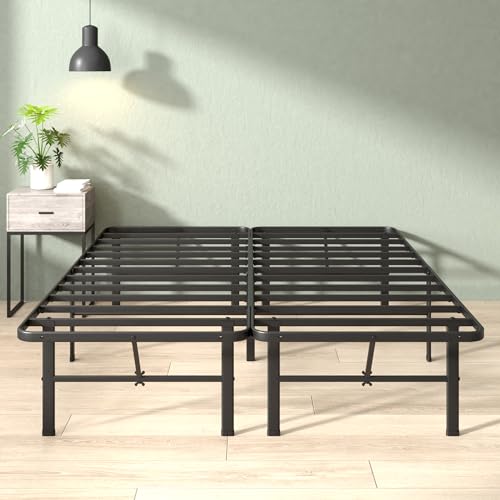
Disclosure: As an Amazon Associate, dailyhomedecorating.com earns from qualifying purchases. Links on this page are affiliate links; they cost you nothing extra. Prices and availability change often, so check the current Amazon listing before you buy.
The best metal bed frame is the one you stop thinking about in the first week and never think about again — no creak when you turn, no wobble when you sit on the edge, no valley forming where the mattress should be level. Metal earned its place as the default bed-base material by being strong for its weight, indifferent to humidity, immune to the pests and warping that trouble timber, and recyclable at the end of a long life. Three verified queen-size steel frames anchor this guide: the Zinus SmartBase, the tool-free foundation that defined the modern category; the EMODA, an eighteen-inch heavy-duty tall frame built for maximum storage and demanding loads; and the Zinus Rumi, a fourteen-inch quick-assembly design that balances height, storage and polish. This guide approaches them as engineering — spans, legs, joints and heights — because a bed frame is a structure first and furniture second, and the structure is what your sleep actually rests on.
Height is the variable that organises the whole comparison, so learn to read it like an engineer. Fourteen inches of frame under a mattress produces the classic modern bed height and a generous storage void beneath. Eighteen inches produces a statement: a tall bed, a storage stratum that swallows large boxes whole, and a sleeping surface that changes how a room feels and how older knees experience the morning. Neither is better in the abstract; each is a decision about the room’s proportions, the sleepers’ bodies and the household’s storage hunger. The reviews and the buying guide that follow keep returning to that triangle, because it decides more satisfaction than any other specification on the page.
Key Takeaways
- The Zinus SmartBase is the category benchmark: fourteen inches, tool-free assembly, a steel platform that replaces the box spring entirely.
- The EMODA stands eighteen inches tall with a heavy-duty build, maximising underbed storage and suiting sleepers who prefer a high bed.
- The Zinus Rumi matches the fourteen-inch class with quick assembly and an eco-conscious package, a polished all-rounder.
- All three are queen size, need no box spring, and support mattresses directly on steel.
- Centre support and leg count decide a queen frame’s long-term flatness more than rail thickness alone.
- Total sleeping height — frame plus mattress — should be tested against the sleeper’s knees before any frame is ordered.
In this guide
Quick Picks: Best Metal Bed Frame at a Glance
| Pick | Height | Assembly | Known for |
|---|---|---|---|
| Zinus SmartBase | 14 inches | Tool-free | The benchmark platform foundation |
| EMODA Queen Bed Frame | 18 inches | Standard assembly | Tallest storage and heavy-duty build |
| Zinus Rumi | 14 inches | Quick assembly | Polished storage all-rounder |
The shortlist divides by four inches and by temperament. The two fourteen-inch Zinus frames are the mainstream: proven platforms with enormous installed bases, differing in assembly style and detailing. The EMODA is the specialist, stretching the format upward for households whose storage problem or whose bodies genuinely want the height. A reader who knows their height answer already knows their shortlist; a reader who does not should spend their time in the height sections of this guide rather than in the reviews, because that single number will govern their satisfaction more than the brand on the box.
Each frame links to its Amazon listing, where the size variant and current details can be confirmed before ordering — bed frames are the classic wrong-size purchase, and the queen designation should be verified in the cart, not assumed. All three models were verified against catalogue data, and each carries its official product image beside its review.
How Did We Choose These Metal Bed Frames?
Structural criteria led, in the order a frame experiences load. First, the support architecture: how the platform distributes a queen mattress’s weight across legs and a centre line, because the middle of a queen span is where weak frames confess. Second, the steel itself — the gauge and section of the rails and legs as far as listings and design disclose them, and the weld and bolt quality that joinery implies. Third, assembly engineering: whether the design locates its own joints accurately, locks them positively, and can be dismantled and rebuilt without losing its truth, because a frame that cannot survive a house move is a frame with a hidden expiry date. Fourth, acoustic design — the small choices, from locking hardware to foot pads, that decide whether steel stays silent. Fifth, the height-and-storage equation in real boxes, and sixth, mattress compatibility across foam, hybrid and innerspring designs, since a steel platform’s support spacing is the mattress’s working environment.
The category’s modern history helps the judging. The platform revolution — led by designs like the SmartBase — replaced the box spring and the four-legged frame with a single engineered foundation that ships flat and assembles without tools, and it won because the engineering was better, not merely cheaper. The picks here are that revolution’s mature products, plus the tall specialist it eventually produced, and they are judged as structures that must hold their geometry for a decade of nightly load cycles.

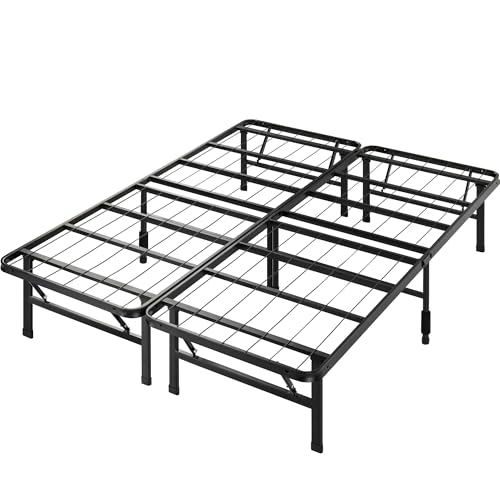
Zinus SmartBase 14 Inch — the Benchmark Foundation
Badge: Best overall metal frame
| Spec | Detail |
|---|---|
| Size | Queen |
| Height | 14 inches, with underbed storage clearance |
| Assembly | Tool-free assembly mattress foundation |
| Support | Sturdy steel platform, no box spring needed |
The SmartBase is the frame that taught the market what a metal platform could be, and its design intelligence is in the joints. The foundation unfolds and locks together without tools, its legs and rails locating positively so the assembled structure is square because it cannot be otherwise. That matters more than convenience: a frame whose geometry is built into its hardware cannot be assembled crooked by a tired person on a Sunday, and a square frame is a silent, evenly loaded frame. The steel platform presents the mattress with continuous, even support — the environment foam and hybrid designs are engineered for — and the fourteen-inch stance leaves the storage void that made the format famous, tall enough for real boxes, low enough for real people.
In service, the SmartBase’s reputation rests on absence: no creaks developing at the joints, no centre sag announcing itself in year two, no drama when the bed is moved for cleaning or carried to another flat and rebuilt true. It is the reference against which this guide’s other frames are read — the EMODA must justify its extra height against it, the Rumi its variations — and most households whose needs are ordinary will find it is simply the answer, arrived at early.
Strengths
- Tool-free, self-locating assembly that cannot be built crooked
- Even steel platform support suited to modern mattresses
- Proven design with a long record of silent service
Trade-offs
- Fourteen inches may be too much height under very thick mattresses
- Industrial appearance relies on bedding for softness
- No headboard included in the foundation concept
Best for: most households wanting the definitive platform foundation. / Not suited for: anyone needing the tallest storage class.
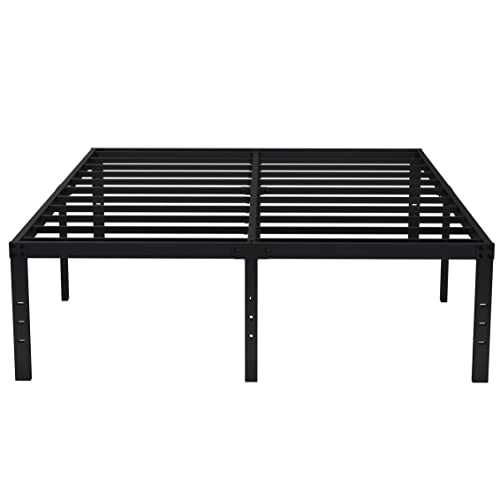
EMODA Queen Bed Frame 18 Inch — the Tall Heavy-Duty
Badge: Best for maximum height and storage
| Spec | Detail |
|---|---|
| Size | Queen |
| Height | 18 inches, tall profile with large storage space |
| Build | Heavy-duty metal platform, no box spring needed |
| Assembly | Easy assembly design |
The EMODA takes the platform idea and stretches it to eighteen inches, and everything about the design follows from that decision. The legs are longer, the structure is specified heavy-duty to keep a tall frame’s geometry honest, and the void beneath becomes the largest storage space in this guide — the class that takes tall boxes, stacked cases and the household archive without negotiation. For the right household this is transformative: a small flat gains a cupboard it did not have, hidden inside the bed it already owned.
Height is also a body decision, and the EMODA suits the bodies that want it: taller sleepers, anyone who finds rising from a high seat easier than from a low one, and households whose aesthetic runs to grand, high beds with bedding that drapes like a hotel’s. The same height is the honest trade-off — under a thick mattress the total can challenge shorter adults and children, and the room’s proportions must be able to carry a taller bed without feeling crowded. Choose this frame deliberately, for its height, and it is the best tool in the guide; choose it accidentally and no engineering will save the match.
Strengths
- Eighteen-inch clearance stores what fourteen-inch frames cannot
- Heavy-duty specification suits demanding, long-term use
- High sleeping surface eases sitting and rising for many adults
Trade-offs
- Total height with a thick mattress can overwhelm smaller sleepers
- Tall stance dominates small rooms visually
- More structure to assemble than the tool-free benchmark
Best for: storage-hungry households and fans of a high bed. / Not suited for: low-ceiling rooms or shorter sleepers with thick mattresses.
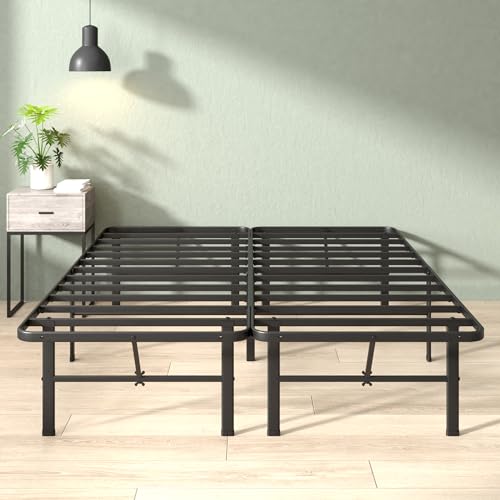
Zinus 14 Inch Rumi — the Quick-Assembly All-Rounder
Badge: Best polished fourteen-inch alternative
| Spec | Detail |
|---|---|
| Size | Queen |
| Height | 14 inches |
| Assembly | Quick Assembly SmartBase design |
| Support | Heavy-duty sturdy steel platform, no box spring needed |
The Rumi is the SmartBase idea in its newer, quicker suit: a fourteen-inch steel platform in the same family, with assembly refined toward speed and packaging designed with an eco-conscious eye. Structurally it asks for the same trust as its famous sibling — a sturdy steel grid, centre-supported, presenting modern mattresses with the even foundation they want — and it delivers the same fourteen-inch storage dividend beneath. The differences are in the ownership experience: how the box arrives, how the afternoon of assembly flows, how the finished frame’s detailing reads in the room.
Buyers choosing between the two Zinus frames are choosing between generations of the same good idea, and either choice is defensible on the evidence. The Rumi suits the buyer who values the newest iteration and the fastest build; the SmartBase suits the buyer who wants the longest track record in the category. In the room, both disappear under bedding and get on with the silent work that is the whole point of a metal frame, which is why this guide ranks temperament and assembly preference — not structure — as the honest grounds for choosing between them.
Strengths
- Quick assembly with the SmartBase family’s structural virtues
- Fourteen-inch storage height in a polished package
- Sturdy steel platform for foam and hybrid mattresses
Trade-offs
- Shares the fourteen-inch class limits on total height
- Newer design has a shorter public track record than the benchmark
- Plain steel looks need textiles to warm the room
Best for: buyers wanting the modern, fast-build version of the classic platform. / Not suited for: households needing eighteen-inch storage.
How Tall Should Your Bed Actually Be?
Do the arithmetic the furniture industry hopes you will skip. Sleeping height equals frame height plus mattress thickness, and the number that matters is the one your knees meet when you sit on the bed’s edge with your feet flat. For most adults, a total near the height of a comfortable chair seat — where thighs rest roughly level and rising is a single, unassisted motion — is the ergonomic sweet spot. Fourteen-inch frames under slim-to-medium mattresses land there naturally. Eighteen-inch frames are designed for the totals above that point, and they serve the people who prefer them — taller bodies, easier rising, a grander bed — while punishing, mildly and nightly, the shorter sleeper who bought the storage and forgot the climb. Measure a chair you love, compare the candidate totals honestly, and let your legs cast the deciding vote between the fourteen-inch pair and the EMODA.
Room proportion casts the second vote. A tall bed raises the room’s visual centre of gravity, suiting high ceilings and large footprints while crowding small, low rooms where the ten-inch profiles of the wider market flatter better. Bedding behaviour changes with height too: tall frames want longer drapes and reward the full-skirted, hotel manner of dressing a bed, while standard heights accept ordinary throws. None of this is decoration for its own sake; a bed is the largest object in its room, and its height is the room’s architecture.
How Do You Keep a Steel Frame Silent for a Decade?
Steel’s only vice is noise, and noise is a maintenance outcome rather than a material flaw. The physics are simple: any joint with play will move under load, and moving metal announces itself. The cures follow the physics. Assemble the frame fully tight, in stages, so every joint starts life clamped. Recheck every fastener after the first fortnight, when new joints have settled — the single most valuable ten minutes in a frame’s life. Keep the feet padded, both to protect floors and to absorb the micro-movements that become clicks. Confirm the centre legs stand squarely on the floor, carrying their share rather than hovering. And when the bed is moved, lift or dismantle rather than dragging, because a dragged frame twists its joints loose in a way no retightening fully forgives. Frames maintained on that rhythm stay silent for years, and the three designs here — with their positive, engineered joints — reward the rhythm better than the friction-fit frames at the market’s careless end.
What Mistakes Do Metal Frame Buyers Make?
The first is buying height by storage alone and discovering the climb. The second is assuming all steel platforms support all mattresses equally, when foam designs in particular want the close, even support these three provide rather than a few wide-spaced bars. Third, shoppers skip the fortnight retightening and condemn quiet designs as creaky. Fourth, many forget the headboard plan: platform frames are foundations, and a headboard is a separate decision — bolt-on brackets, a freestanding design or a wall-mounted panel — best made before the frame arrives. Fifth, buyers drag assembled frames between rooms and houses, bending the geometry they paid for. Each mistake is small, avoidable and entirely out of proportion to its consequences, which is the definition of the mistakes worth printing in a guide.
Final Recommendation: Which Metal Bed Frame Should You Buy?
Default to the Zinus SmartBase: its tool-free, self-squaring assembly and proven platform make it the frame most households should simply buy. Choose the Zinus Rumi if you prefer the newer quick-build iteration of the same idea and its packaging ethos. Choose the EMODA when height itself is the requirement — the storage archive, the high-bed preference, the bodies that rise easiest from a tall seat — and choose it with your eyes open about total sleeping height. All three will hold a queen mattress without a box spring and, maintained as this guide describes, will do it silently for years. Complete the bed with a mattress topper for surface comfort and sheets that fit deep modern mattresses, compare the value-led shortlist in affordable bed frames compared, and dress the finished bed from bedspreads and quilts for a layered finish.
Steel Against Wood and Upholstery: an Honest Material Comparison
Metal’s case rests on indifference. A steel frame does not swell in a humid summer, shrink in a heated winter, harbour pests, or ask for polish; its geometry on delivery day is its geometry in year ten, provided its joints are kept tight. Timber frames answer with warmth — visual and tactile — and with a repairability steel cannot match, since a wooden rail can be planed, glued and refinished by hand. Upholstered frames answer with softness and silence, wrapping the structure in padding that forgives shins and absorbs sound, at the cost of fabric that ages, stains and dates. The households in this guide’s audience — movers, renters, storage hunters, the practically minded — are steel’s natural constituency, and the three picks serve them without pretending the other materials have no virtues. Choose steel when the bed’s job is structure; choose the others when the bed’s job includes being looked at, and know that a steel platform under beautiful bedding performs the first job while borrowing the second’s clothes.
Reading a Steel Frame Like an Engineer
A listing photograph contains more structural truth than its description, if you know where to look. Count the legs and trace the load path: a queen’s weight should travel from the platform through rails to legs that include a centre line, because the middle of a wide bed is a bridge span, and bridges need their piers. Look at how the platform is made — a grid or close members distribute pressure, while a few heroic bars concentrate it. Examine the joints for bolts that clamp or mechanisms that lock, and distrust any connection you cannot identify. Check the feet for pads or caps, the small print of acoustic design. Finally, weigh the shipping weight against the category’s norms, because steel cannot be conjured from air and a suspiciously light queen frame has spent its metal budget somewhere invisible. The three frames in this guide pass that reading cleanly, which is not a coincidence but the selection itself.
The Centre of the Bed: Where Frames Are Won and Lost
Every wide bed is two beds sharing a border, and the border is where foundations fail. Without centre support, a queen platform flexes along its middle line, the mattress follows it into a shallow valley, and two sleepers roll gently toward each other whether romance intends it or not. The frames here answer with centre structure — rails and legs along the spine — which converts the platform from a diving board into a table. When comparing any metal frame, in this guide’s company or beyond it, ask the centre question first and let the answer veto the purchase if it is vague. A frame can survive plain looks, a missing headboard and a hundred small compromises, but it cannot survive a soft middle, because the middle is where the bed actually is.
Storage Engineering: Using the Void Properly
Underbed space is only storage if it can be organised, and height changes the organisation’s physics. At fourteen inches, the void takes the standard kingdom of low boxes, shoe organisers and vacuum bags, best arranged with the frequently needed at the perimeter and the archive at the centre. At the EMODA’s eighteen, the void becomes a stratum: tall boxes stand, cases stack two deep, and the household can think in categories — a season per box, a hobby per case — with labels facing outward like a warehouse that respects its keeper. Two disciplines protect the system in either class: leave the centre legs’ positions in the plan rather than discovering them with a box corner, and keep a small air margin so the space can be cleaned rather than becoming the room’s forgotten geology. Storage bought with frame height is only saved money if the household can retrieve what it stores.
What Should You Verify on the Listing Before Ordering?
Confirm the size in the listing title and again in the cart; queen and full are the market’s most confused pair. Check the stated height and whether it describes the frame alone, then add your mattress. Look for the centre support in the photographs and the description, and for the assembly style — tool-free, quick or standard — that your patience prefers. Confirm whether headboard brackets are offered or compatible if a headboard is part of the plan. Finally, read the manufacturer’s stated capacity for the exact size, since that figure, and not a category’s reputation, governs your specific frame.
Pairing Steel With Each Mattress Type
Foam mattresses are the platform’s natural partners, conforming to bodies and demanding in return a surface that will not let them conform to gaps; the close steel support in all three picks is specified with exactly that demand in mind. Latex behaves like foam with more spring and more weight, and appreciates the same evenness plus the centre structure under its considerable mass. Hybrids split the difference — coils that tolerate modest spacing over a foam comfort layer that does not — and sit happily on these platforms. Traditional innerspring designs, the most forgiving of all, were built for box springs but accept a firm platform readily, often feeling a touch firmer for the honesty of the support. In every pairing the rule is the mattress maker’s foundation clause, checked once and then forgotten, because these three frames were chosen to satisfy the strictest common version of it.
Rooms That Ask the Most of a Frame
The rental property is steel’s proving ground: tenants change, mattresses change, the frame must be dismantled, stored, rebuilt and silenced by whoever arrives next, and the tool-free SmartBase pattern was practically designed in that world. The teenager’s room asks for edge strength and indifference to being sat on by a committee. The guest room asks for a kind, standard height and a silence that does not report a visitor’s every turn to the household. The primary bedroom asks the subtlest thing — that the frame vanish from consciousness for a decade — and all three picks answer it, with the choice among them returning, as this guide keeps concluding, to height and assembly temperament rather than to any difference in structural worth.
The Decade Test: a Frame’s Life in Chapters
Year one is the honeymoon this guide has engineered: correct height chosen, assembly true, the fortnight retightening done, storage organised while enthusiasm lasts. Years two and three bring the first house move or the first mattress change, the moments when flat-pack steel proves its second-life design and lesser frames begin their creaking memoirs. The middle years are the frame’s invisibility, interrupted only by the annual bolt check folded into some larger ritual — the spring clean, the mattress rotation — and by guests who sleep well and say nothing about the bed, which is the highest compliment a foundation can receive. The late years test the centre and the joints, and a frame that was specified with both, and maintained with ten minutes a year, passes without drama into its second decade or its second household. Read backwards, the decade test explains every criterion in this guide: nothing here was chosen for the first night, because the first night is the one night any frame can fake.
Floors, Rugs and the Frame’s Footprint on the Room
A metal frame meets the room at its feet, and the meeting deserves design. On hard floors, pads or caps under every leg prevent the slow migration that ends with a frame leaning on a wall it then taps at night, and they protect finishes from the concentrated pressure of a loaded bed’s small contact points. On carpet, the same legs settle and hold, though a rug under the whole bed remains the decorator’s friend, defining the sleeping zone and absorbing the room’s small sounds. Downstairs neighbours hear a bed through its feet as well, and the padded, rug-softened arrangement is a courtesy with a return address. Plan the feet when you plan the frame, and the structure’s last inch receives the same engineering as its first.
Why the Queen Size Tests Frames Hardest
Every pick in this guide is a queen, and that is not an accident of inventory: the queen is the size at which domestic engineering gets interesting. A single or double can survive on four legs and optimism, because their spans are short and their loads modest. A queen widens the span past the point where rails alone stay honest, doubles the sleeper count as a matter of routine, and hosts the heaviest mattresses in the mainstream market. It is therefore the size where centre support stops being a feature and becomes the product, where joint quality separates the decade frames from the two-year frames, and where a buyer’s structural reading — legs, spine, platform, joints — earns its highest return. Households furnishing smaller sizes can apply every lesson here with confidence, since a design philosophy that holds a queen holds anything beneath it; households furnishing kings should demand the same philosophy restated at the larger span, with even more respect for the middle.
Assembly Afternoon: What Each Build Actually Asks of You
The SmartBase asks the least: floor space, the unfolding of a designed structure, and the discipline to check that every lock has seated — an assembly measured in minutes and remembered as suspiciously easy until the first silent night explains it. The Rumi asks a little more in exchange for its quick-build polish: parts laid out, a sequence followed, the satisfaction of a frame that rises in an orderly half-hour. The EMODA asks the most, as an eighteen-inch heavy-duty structure should: a helper is wise, the staging of taller legs and longer rails wants a clear room, and the final squareness check deserves the spirit level’s honesty. In all three cases the same closing ritual applies — mattress on, every edge sat upon, a walk around the bed listening for the sound that should not be there — and in all three, silence at that audit predicts silence for years.
Steel’s Second and Third Lives
Few furniture categories recycle as gracefully as this one. A steel platform that leaves a household usually leaves it assembled in someone else’s spare room, because the flat-pack design that delivered it can reverse the journey at any age; the second-hand market in these frames is brisk precisely because their condition is legible — steel shows its history honestly, in straight rails and tight joints or not at all. At the true end of life, the material itself returns to the metal stream without the landfill guilt of composite furniture. None of this should be the headline reason to buy steel — the headline is a silent, level bed — but a household furnishing several rooms over a decade will feel the compound interest of furniture that can be handed down, handed over and finally handed in, rather than thrown out at the second move.
The One-Page Version for the Impatient
Everything above compresses without loss into a short drill. Choose your height by sitting on a surface that matches frame-plus-mattress, not by admiring storage photographs. Demand centre support and identify it in the pictures. Prefer joints that lock or clamp over joints that merely meet. Assemble in stages, sit on every edge, and retighten everything at the fortnight. Pad the feet, plan the headboard separately, and never drag the finished frame anywhere. Followed exactly, that drill lands a household on one of this guide’s three frames nine times in ten — the SmartBase for the benchmark answer, the Rumi for the quick modern build, the EMODA for the tall brief — and on a decade of not thinking about bed frames, which is the prize the whole category exists to award.
The Edge Test and Other Ways a Frame Confesses
Sit on the edge of any assembled bed, in a showroom or in your own room on delivery day, and the frame will tell you its future. A good platform takes the concentrated load without a dip, a creak or a sense of negotiation; the edge is simply there, like a chair’s. A weak frame answers with movement, and movement at the edge on day one becomes noise at the joints by month six. Roll to the centre and lie still: the surface should feel like one plane, not two slopes with an opinion about each other. Stand and watch the bed recover — steel this honest returns instantly and silently. These three tests take ninety seconds, require no instruments, and have never lied to anyone who performed them slowly. Perform them on whichever of this guide’s frames you buy, on the day it is built, while correction is still a matter of a fastener rather than a return.
When a Metal Frame Is Not the Answer
Completeness requires the exceptions. A household furnishing a forever bedroom around a statement bed — carved timber, upholstered wings, a four-poster’s architecture — is buying furniture, and a platform foundation, however excellent, is not that object and should not pretend to be. Sleepers who know they are exquisitely sensitive to any transmitted motion may prefer the mass and damping of heavy furniture designs. And a mattress under a warranty that demands a specific proprietary foundation should get exactly that foundation. Outside those honest exceptions, the steel platform’s case is as strong as this guide has made it — which is why the exceptions are worth stating plainly: they mark the boundary of a recommendation this page is otherwise happy to make without qualification.
The Frame Beneath the Frame: a Note on Foundations
Older sleepers grew up on a two-piece system — frame below, box spring above — and the platform’s single-piece logic can feel like a missing layer. It is worth stating plainly what the platform replaced and why nothing is missing. The box spring’s historical job was to give an innerspring mattress a flat, slightly yielding partner and to raise the bed to fashion’s height. Modern mattresses internalised the first job in their own construction and ask only for flatness, which the steel platform supplies more honestly than a ageing box spring with its own sagging biography. The second job, height, the platform performs with its legs. What vanished in the merger is not support but a failure point — one less object to squeak, sag and be replaced — and the households that make the switch rarely mourn it past the first, noticeably level night.
Frequently Asked Questions
Is an eighteen-inch frame too tall?
It is too tall only in combination — with a thick mattress, for a shorter sleeper, in a small low room. For taller adults, for anyone who rises most easily from a high seat, and for households buying the storage deliberately, eighteen inches is the correct engineering. Add your mattress thickness to the frame height, sit on a surface of that total height, and let your own knees file the verdict before ordering; the EMODA rewards the households that do this arithmetic and frustrates the ones that skip it.
Do metal frames damage mattresses?
A well-designed steel platform does the opposite: its even support is the environment modern foam and hybrid mattresses are built for, and it protects them from the sagging that wide-spaced or worn foundations cause. Damage stories in this category trace back to frames with a few bare crossbars, protruding hardware or collapsed centres — the designs this guide’s criteria exist to exclude. Check your mattress maker’s foundation requirements, match them to the platform’s support, and the pairing is a long and quiet one.
Can a metal frame hold heavier sleepers safely?
The frames here are steel structures with centre support, built for queen loads, and the EMODA’s heavy-duty specification addresses demanding use directly. Manufacturers state capacities in their listing details, and that figure is the authority for a specific purchase. Heavier households should also prioritise perfect assembly, the fortnight retightening, and a mattress rated for their needs, since frame, foundation behaviour and mattress operate as one system under load.
Will a steel frame rust or squeak over time?
Finished steel in a normal bedroom does not rust in any timeframe that matters; the coatings on frames in this class are made for indoor decades. Squeaking, as this guide’s maintenance section explains, is a joint-tightness story rather than a material story, and it yields to assembly discipline and one scheduled retightening. A frame that develops noise years later is almost always reporting a loose fastener or a moved house, both of which are ten-minute diagnoses rather than replacements.
Can I attach a headboard to a platform frame?
Often yes, with brackets made for the purpose, though designs differ and the listing for your specific frame is the place to confirm compatibility. The alternatives are equally respectable: a freestanding headboard braced by the bed’s weight, or a wall-mounted panel that lets frame and headboard live independent lives. Decide which look you want before the frame arrives, because retrofitting the decision is the only version of it that ever feels like a problem.
Does a metal frame feel cold or industrial in a bedroom?
Only if it is asked to perform as decoration, which is not its job in these designs. A platform frame’s visible territory is a few inches of leg and rail beneath the bedding; dress the bed with a drape that reaches toward the floor and the steel disappears entirely, leaving its structure to work invisibly. Households that want the bed itself to be the room’s ornament should buy furniture frames for that purpose. Households that want the room’s textiles to be the ornament will find steel the most cooperative foundation ever made.
How long should a steel platform frame last?
Measured against mattresses, which are replaced on a cycle of years, a well-kept steel frame should outlast at least two of them. The components that age are fasteners and feet rather than rails, and both are maintainable with the habits this guide describes. The realistic killers are abuse in moving and chronic looseness left uncorrected, not time. Buy a frame with centre support and honest joints, keep it tight, move it dismantled, and its lifespan stops being a purchasing variable at all.
How do I move a metal bed frame to a new home?
Dismantle it fully, bag the fasteners by joint, and bundle the rails and platform sections so nothing bends in transit. The tool-free and quick-assembly designs here were engineered for exactly this second life, and a frame moved this way reassembles true in the new room. The one unforgivable method is dragging or carrying the assembled frame through doorways, which twists joints and writes the squeaks of the next five years in a single afternoon.
How should centre-support legs be set, and how do I protect the floor beneath them?
Centre legs only do their job when each foot meets the floor squarely and carries its share of the load. During assembly, extend or level every centre foot until it touches firmly without lifting the side rails, then recheck those contacts after the mattress goes on and again after the first fortnight, since bedding weight and ordinary movement can settle the frame slightly. On timber, laminate or vinyl floors, slip a broad felt or rubber pad beneath every leg, including the centre feet that owners often forget. Broad pads spread pressure, quiet small movements and prevent the scuffs and dents that narrow steel feet can leave when a bed is nudged during sheet changes. On carpet, smaller hard caps stop the feet sinking unevenly into the pile. If one centre leg hovers, hangs or rocks when you press down along the middle rail, correct it that day: an unsupported centre is where bounce, creaks and eventual rail stress begin, and a two-minute adjustment protects both the frame and the flooring underneath it.
A squeak appeared after a year of quiet use — how do I track it down?
Work like a detective rather than reaching straight for a replacement. First, remove the bedding and press firmly along each rail, corner and centre joint in turn, listening for the exact spot that answers back. Most late-arriving squeaks come from a single fastener that has eased by a fraction, a centre foot that no longer quite touches down, or the frame shifting slightly after the bed was dragged for cleaning. Tighten the suspect joint evenly, reseat any hovering foot, and add a thin felt pad or washer between metal faces that meet directly. Next, rule out impostors: a headboard brushing the wall, the mattress edge rubbing a rail, or a loose storage box underneath can all masquerade as frame noise. Test the bare frame again before remaking the bed. If the sound survives careful tightening at one stubborn joint, note its location and contact the maker for the correct replacement hardware, rather than forcing mismatched bolts that could damage the threads permanently.
There is a temptation, when a product category becomes this engineered, to keep shopping for a cleverer answer — a frame with more features, more adjustments, more novelty. Resist it on the evidence of this guide. A bed frame’s excellence is subtractive: it is measured in the noises not made, the sags not formed, the thoughts not thought about the object under the mattress. The SmartBase achieved its benchmark status by removing the box spring, the tools and the doubt in one design. The Rumi refined the removal. The EMODA redirected it upward, toward storage and height. None of them adds anything your sleep can feel, and that is precisely their virtue, because everything your sleep can feel belongs to the mattress and the bedding above them. Buy the frame whose height fits your body and your boxes, assemble it like you mean it, tighten it twice, and then spend the rest of your bedroom budget and attention where a sleeper can actually tell the difference.
A closing note for the household furnishing several rooms at once, which is where metal frames quietly outperform every alternative on logistics alone. Standardising on one platform design across the spare room, the teenager’s room and your own means one assembly skill learned once, one set of spare fasteners in one labelled bag, and beds that can be swapped between rooms as the household’s life rearranges itself — the tall EMODA inheriting the archive room’s duties, a fourteen-inch frame graduating to the guest bed. Furniture that can be rearranged without penalty is furniture that keeps serving as needs change, and in that long, practical sense the steel platform is not merely the best metal bed frame format in this guide. It is the closest thing the bedroom has to infrastructure, and infrastructure, chosen well once, is the cheapest luxury a home can buy.
Let the decision end where it began, under the mattress. Lie on a bed whose foundation you trust and the body knows it before the mind does — the surface is level, the edges are honest, the night is quiet — and every other quality a bedroom can offer builds on that trust. The three frames in this guide earn it in the same steel language at two heights and three temperaments, and the buyer’s whole task is to match the dialect to the room: benchmark, quick-build or tall. Do that, tighten twice, and then forget the frame entirely, which is the fate it was engineered for and the finest review it will ever receive.
A word, in closing, about the pleasure of a category with no surprises left in it. Metal bed frames have been refined for decades toward a stable answer — platform, centre support, honest joints, a choice of heights — and the three models in this guide are that answer at its most mature, differing only where households genuinely differ. There is no disruption coming to rescue a buyer who waits, and no secret model that outperforms the structure described here. That stability is a gift to the shopper: decide the height, pick the temperament, and the purchase closes behind you like a well-made joint, silently and for good.
Order with the room’s next five years in mind and the frame will still be right when they arrive: children taller, mattresses replaced, rooms repainted, the bed itself perhaps promoted from the main bedroom to the guest room as finer furniture arrives. Steel platforms accept those promotions without complaint, which is more than can be said for most of what a household buys. Choose the height once, choose it honestly, and let the frame begin its long, silent career underneath everything else the bedroom becomes.
Keep the fasteners’ tool, the spare bolts and a photograph of the assembled frame in the same labelled place, and every future version of you — the one moving house, the one chasing a midnight creak, the one handing the bed to a student leaving home — will be grateful for the household that thought ahead. That small archive is the final piece of engineering in this guide, and like the frames themselves, it costs almost nothing and works for years.
Sleep is the third of a life, and the frame is the third of the bed that nobody sees. That invisibility is exactly why the purchase deserves the engineering attention this guide has given it: the parts of a home that are never thought about are the parts that must never fail, and a steel platform, correctly heightened, honestly jointed and twice tightened, is as close to never failing as bedroom furniture gets. Buy it once, buy it right, and let the mattress, the bedding and the dreams do the visible work above it for a decade.
The tape measure, the chair test and the fortnight retightening — three small acts of diligence — are the entire difference between the households in this guide and the households writing unhappy reviews of identical frames. Steel rewards diligence perfectly and punishes its absence audibly, which makes it the most honest material in the bedroom. Be diligent once, at the beginning, and the frame will be honest with you every night that follows.
And with that, the comparison rests where it should: on the floor, level, carrying the bed and everything the bed means to the household above it, asking nothing. Benchmark, quick-build or tall — the frame you choose from this page will be forgotten by next month and thanked, unconsciously, for ten years of nights. That is the whole ambition of the best metal bed frame, and all three of these designs achieve it.
Measure twice, sit once on a surface of the right total height, and order with confidence. The frame that arrives will ask for one careful afternoon and one fortnight retightening, and in exchange it will hold your household’s sleep level, silent and forgotten, through mattresses, moves and makeovers. Few purchases in a home offer that exchange rate, and none of them do it in steel this honest.