Disclosure: As an Amazon Associate, dailyhomedecorating.com earns from qualifying purchases. Links on this page are affiliate links; they cost you nothing extra. Prices and availability change often, so check the current Amazon listing before you buy.
The best indoor watering cans share one quality that has nothing to do with how they look on the shelf: they pour where you point them, at the speed you choose, without a drip down the spout or a glug across the plant stand. Indoor watering is precision work — a litre of water delivered into a 15-centimetre pot, under low leaves, beside furniture that water damages — and the wrong vessel (a kitchen jug, a mug, the outdoor can with its rose like a showerhead) makes it a mopping exercise. This guide works through what separates a good indoor can from a decorative one: the long narrow spout that reaches under foliage and meters the flow, the capacity matched to a household’s plant census, the balance of a full can in one hand, and the detachable shower head that serves seedlings. Five verified cans are reviewed below — two half-gallon plastic workhorses with shower heads, two stainless one-litre cans in black, and a small 350 ml bonsai-scale can — followed by the watering technique that makes any of them perform, because a can is only half of a watering system.
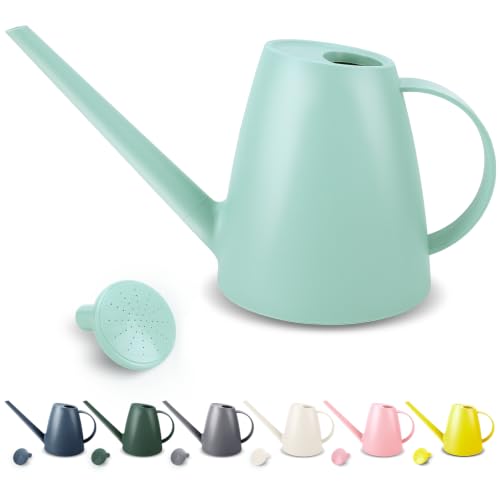
What makes a watering can an indoor watering can
Length and narrowness of spout, first. The indoor spout is a delivery instrument: long enough to reach the soil of a plant at the back of a stand without moving three others, narrow enough that the stream lands as a controlled thread rather than a splash, and angled so the pour starts and stops with the wrist rather than continuing in a dying dribble. Control of flow is the second quality, and it lives in the spout’s geometry and the can’s balance — a can that pours faster as it empties, or surges when tilted, will excavate a crater in a small pot’s compost and expose roots. Capacity is the third: indoor cans run small on purpose, from a third of a litre for bonsai work to two litres for a household jungle, because a can is carried one-handed through furnished rooms and refilled at a tap, and a four-litre can is an outdoor tool visiting indoors. The fourth quality is the shower head — a detachable rose that breaks the stream into rain for seedlings, germinating trays and plants that resent a jet — present on the plastic pair below and absent, by design, from the precision metal cans. And the fifth is the honest one: whether the can drips. A spout that weeps after every pour will mark every surface it crosses, and the reviews below treat drip behaviour as a headline property rather than a footnote.
In this guide
Quick picks
- Most households: the 0.48-gallon plastic can with detachable shower head — capacity, reach and both pour styles in one tool.
- The same again, second source: the 60 oz plastic can — a near-twin specification for comparison shoppers.
- The shelf-worthy litre: the 35 oz stainless can in black — precision spout, decorative finish.
- The curved-spout alternative: GUKJOB’s 35 oz metal can — a different spout geometry for bonsai and shelf plants.
- Bonsai and seedlings: the 12 oz stainless can — 350 ml of total control.
How these cans were chosen
Every can’s ASIN was confirmed through this site’s Amazon catalogue check on 2026-11-24, and the capacities, materials and spout descriptions in the spec boxes come from the returned listings. The set spans the indoor category’s real range — plastic versus stainless, half-gallon versus bonsai-scale, shower-headed versus precision-only — because “indoor watering can” is five different tools wearing one name, and a guide that reviewed five near-identical cans would serve no one’s shelf. Pour behaviour, balance and drip notes are the guide’s own assessments of the designs, written as such.

0.48 Gallon Watering Can with Detachable Shower Head — the household default
Best for a mixed collection of a dozen or more plants
This is the can the average indoor garden actually needs: roughly half a gallon — 60 ounces, about 1.8 litres per its listing — in light plastic, with a long spout for the precision work and a detachable shower head that converts it, in seconds, into a rain-maker for seed trays and thirsty ferns. The capacity is the quiet genius of the format: one fill waters a dozen medium pots, and the can is still light enough at the start of the round to pour one-handed at the end of it. Plastic keeps the price and the weight down and forgives the inevitable knocks against the tap; the translucent body, on cans of this class, lets the water level — and any fertiliser tint — be read at a glance.
- Capacity: approx. 0.48 gallon / 60 oz per its listing
- Material: plastic
- Spout: long, with detachable shower head
- Brief: house plants and garden flowers
Strengths
- Two tools in one — jet for pots, shower for seedlings — with a head that swaps by hand.
- The round’s worth of capacity without the round’s weight.
- The long spout reaches the back of a stand like a can three times its price.
Trade-offs
- Plastic is a utility finish — it will not be the shelf’s ornament.
- The shower head is a small part, and small parts get lost in real households; store it on the can.
- Half a gallon is overkill for a three-plant windowsill, which the small cans below serve better.
Best for: the general indoor collection and anyone raising seedlings. Not suited for: bonsai precision work, where its flow is a river beside the 350 ml can’s thread.

60 oz Watering Can with Long Spout and Shower Head — the twin specification
Best for comparison shoppers wanting the same brief from another maker
Listed at the same 60 ounces — approximately half a gallon — with the same long spout and detachable shower head, this can is the category’s reminder that popular specifications get made by many hands. Its presence here is deliberate: when two listings match on paper, the buyer’s decision moves to the details the listings do show — the handle’s shape, the head’s fit, the seller and the delivered price on the day — and to the household’s own tiebreakers. Functionally it promises the identical round: a dozen pots a fill, a shower for the trays, a spout that reaches. Households outfitting two watering stations — upstairs plants and downstairs plants, the two-can system this guide recommends below — could do worse than one of each twin and a season’s honest comparison.
- Capacity: 60 oz, approx. 0.5 gallon per its listing
- Material: plastic
- Spout: long, with detachable shower head
- Brief: indoor plants, houseplants, garden flowers
Strengths
- The full household specification — capacity, reach, both pours — in the value format.
- A second source for the same brief hedges stock and price on the day.
- Light enough for the whole round, large enough to finish it.
Trade-offs
- Near-identical listings demand the buyer’s care to order the intended one.
- Plastic utility finish, as with its twin.
- The shower head’s storage discipline applies equally.
Best for: the same households as the first pick, and two-station homes. Not suited for: the buyer who wants the can itself to be a decorative object — that is the stainless pair’s department.

35 oz Stainless Steel Watering Can, Black — the precision ornament
Best for visible shelves and a moderate collection
A litre of water in a stainless can with a long spout, finished in black and sold, per its listing, as much for decoration as for duty — this is the can for the plant shelf that appears in the household’s photographs. The metal body’s virtues are real beyond looks: it will not crack in a cold snap on a windowsill, it cleans without staining, and its weight gives the pour a steadiness plastic cannot imitate. The long spout is a precision instrument in the bonsai tradition this design descends from, delivering a thread of water to a pot’s edge under leaves. One litre is a deliberate size — six to ten small and medium pots a fill — for collections that live within a room or two of the tap.
- Capacity: 35 oz / 1000 ml per its listing
- Material: stainless steel, black finish
- Spout: long, precision style
- Brief: house plants, bonsai, garden, decorative
Strengths
- A genuine ornament that also happens to be the right tool.
- Metal durability and a pour steadied by the body’s weight.
- The litre size balances capacity against one-handed control.
Trade-offs
- No shower head — seedlings get the thread or nothing.
- A litre runs out mid-round in a jungle household; the plastic pair carry double.
- The black finish shows water spots in hard-water homes unless wiped.
Best for: styled shelves, moderate collections, gifts for plant people. Not suited for: seed trays, or a thirty-plant round where refills become the hobby.

GUKJOB 35 oz Metal Watering Can, Curved Spout — the bonsai-leaning litre
Best for bonsai and shelf plants watered at close range
GUKJOB’s litre can distinguishes itself by geometry: a long curved spout, per its listing, in a stainless black body pitched at bonsai and modern decorative use. The curve matters at close range — it lets the spout’s tip arrive over a small pot’s soil from a shallower tilt, so the pour begins gently at a fuller can, which is the bonsai keeper’s daily requirement and the shelf gardener’s relief. Against the straight-spouted stainless above, the choice is ergonomic taste and plant geography: deep stands favour reach, dense small-pot clusters favour the curve’s early, gentle start. Its capacity and class are otherwise the same honest litre.
- Capacity: 35 oz per its listing
- Material: stainless steel, black
- Spout: long, curved
- Brief: indoor plants, bonsai, modern decorative
Strengths
- The curved spout starts the pour gently at close range — small pots stay unexcavated.
- The same metal durability and shelf presence as its straight rival.
- A litre is the bonsai bench’s natural unit.
Trade-offs
- No shower head, as with the precision class generally.
- The curve reaches less far than a straight spout at the back of a deep stand.
- Two near-identical black litre cans in one guide is the category’s fault, not the buyer’s — decide by spout, as advised.
Best for: bonsai keepers and dense small-pot shelves. Not suited for: deep stands or seedling rain.

Lizhluzh 12 oz Stainless Watering Can — the miniature
Best for bonsai, seedlings-by-hand and the single shelf
Twelve ounces — 350 ml per its listing — is not a compromise size; it is a specialisation. The miniature stainless can exists for the work where water is measured in tablespoons of consequence: a bonsai’s saucer-sized soil, a propagator’s cells, an air plant’s weekly drink, a single shelf of succulents whose keeper’s whole doctrine is restraint. Its long spout at this scale delivers drops with the thread’s control, its ergonomic handle (the listing’s word) suits a can that is picked up twenty times a day for twenty seconds, and its black finish keeps it in the family photograph with the litre cans above. No household with forty plants should own it as their only can; every serious indoor gardener eventually discovers the job only it does well.
- Capacity: 12 oz / 350 ml per its listing
- Material: stainless steel, black
- Spout: long, fine
- Handle: ergonomic, per its listing
Strengths
- Total control at the scale where control is the entire task.
- Light enough to live in the hand during a propagation session.
- Matches the litre cans as a set for households building one.
Trade-offs
- 350 ml is three medium pots — as a sole can, it is a refill hobby.
- No shower head; its rain is a thread.
- Its specialisation means the generalist cans outrank it for a first purchase.
Best for: bonsai, propagation, succulents and the second-can role. Not suited for: being any collection’s only vessel.
Watering technique: the can is half the system
Water the soil, not the plant: the stream belongs at the pot’s edge, moving in a slow circle, until water just begins to leave the drainage hole — the signal that the whole root ball, not its top inch, has drunk. Leaves splashed and left wet invite the fungal troubles that indoor gardeners then misdiagnose as watering problems of the other kind. Water in the morning where the household’s rhythm allows, so foliage and surfaces dry through the day. Empty the saucer after half an hour; roots standing in the drained water are being watered twice, once by you and once by drowning. Let the water stand or use it at room temperature for the sensitive genera, and keep the fertiliser dilute and occasional rather than strong and frequent — a can with a translucent body earns its keep here, since the tint of a feed is visible before it reaches a plant that did not need it. And learn the lift test, the indoor gardener’s core skill: a pot’s weight, learned by lifting it after watering and again days later, reports its water more honestly than any schedule, and the can’s round becomes a round of lifting first and pouring second.
Matching the can to the collection
Count the plants and be honest about the geography. Under six plants on one sill: the miniature or the litre, chosen by whether the pots are small or merely few. Six to twenty across a room or two: the litre stainless for the pleasure of it, or the half-gallon plastic for the efficiency. Twenty and upward, or any household raising seedlings: the half-gallon with the shower head is the working tool, and the miniature joins it when propagation starts. Two-storey plant households should keep a can on each floor — a can that must be carried upstairs full will, in practice, be carried upstairs empty and the upstairs plants will be watered next week. The can’s price is small; the plants’ replacement price, in money and in years, is not, and watering systems fail at their inconveniences rather than at their specifications.
Care of the can itself
Rinse and store the can empty and dry where possible — a can kept full grows a biofilm and, in hard-water country, a scale that eventually perfumes every pour with the tap’s geology. The shower heads want a soak in a descaling solution when their rain turns to needles. Stainless cans wipe clean and ask only to be dried against water spots; plastic cans eventually cloud and are retired without ceremony, which is their class’s bargain. A can stored on the plant shelf, in the light, among the collection it serves, will be used at the right frequency; a can stored under the sink will be used at the frequency of good intentions, and the plants can tell the difference even if the household cannot.
Common mistakes with indoor watering
Watering by the calendar instead of by the pot’s weight and the soil’s testimony is the first and the most expensive. The second is the little-and-often sip that wets the top inch and trains roots to the surface — water deeply, then wait, is the doctrine the cans in this guide are built to deliver. Third is the mug-and-jug improvisation that splashes crowns and stands. Fourth is leaving every saucer full. Fifth is buying the beautiful can in the wrong size and spending a year refilling it — or not refilling it, which is the same mistake with the plants paying. Each is a system error, and the system is can plus technique plus placement, which is why this guide insists on all three.
Final word
An indoor watering can is a small purchase that a plant collection feels every week of its life. Buy the spout first — long, narrow, controlled — the capacity second, and the beauty third, and the five cans above cover every honest combination of those priorities from the seed tray to the shelf portrait. Then water by weight, at the soil, in the morning, and let the saucers be emptied: the plants will file their review in new growth, which is the only rating this guide has ever trusted.
Plants with opinions: watering by genus
Succulents and cacti
The miniature can’s congregation. Their doctrine is drought between drinks, and when the drink comes it should be a thorough one delivered at the soil, never over the rosette, where standing water rots the crown. A fine spout that can thread between leaves is the whole requirement, and the 350 ml can was practically designed by a succulent keeper: its entire capacity is one shelf’s monthly ration.
Ferns and the humidity lovers
Ferns forgive the shower head what succulents never would — they evolved under dripping canopies and take their water over the fronds gladly, though the soil remains the destination that counts. Their keepers water often and lightly at the surface’s testimony, and the half-gallon’s capacity suits a fern household’s frequency better than any litre can’s elegance.
Orchids and air plants
Orchids in bark want a flood-and-drain at the sink more than a can’s thread, and the honest guide says so — the can’s role is the weekly measured drink for the mounted and the miniature genera, and the air plants’ misting belongs to a sprayer entirely. A guide that sells one tool for every genus is selling; this one would rather keep the reader’s trust for the cans’ real kingdoms.
Seedlings and propagation
The shower head’s kingdom and the miniature’s second job. Germinating soil must never be jetted — a displaced seed is a failed sowing — so rain from the rose, or the fine can’s thread at the tray’s edge, is the technique. Propagation benches are where the two-can household is born: the big can for the established, the small one living permanently at the trays.
The watering round, designed
Keepers with thriving collections share a logistics secret: the round is a route, not a mood. It starts where the can is filled, proceeds plant to plant in the order the rooms arrange them, and ends with the saucers’ emptying on the return leg — fifteen unhurried minutes for a twenty-plant home, with the lift test at every stop and the can refilled once at the route’s midpoint tap. Holidays are covered by the same design thinking: the round is written down for the plant-sitter as a route with names, because “water the plants” is an instruction that has killed more collections than any drought. A can that lives at the route’s start, a cloth that lives with the can, and a route that lives on paper — the system is humble, and it is the difference between a collection that survives its keeper’s absences and one that merely survives its keeper.
Frequently asked questions
What size watering can is best for indoor plants?
For most collections, around a litre to half a gallon: enough for the round without a refill, light enough full for one-handed precision. Small collections and bonsai work drop to the 350 ml class; large collections and seedling raisers should take the half-gallon with a shower head. The wrong sizes are the extremes — the outdoor can indoors, and the miniature as a jungle’s only tool.
Why does the spout need to be long and narrow?
Reach and control. A long spout delivers water to the soil of a plant behind others without moving the stand, and a narrow spout meters the flow into a thread that lands where it is aimed instead of splashing crowns and excavating compost. It is the defining feature of the indoor category — a can without it is a jug with ambitions.
Do I need the shower head attachment?
If you raise seedlings, germinate trays, or water anything whose soil a jet would blast apart, yes — the rose turns the stream into rain. For established pots watered at the soil edge, the plain spout is the better tool and the head stays in its storage place. The plastic pair in this guide include it; the metal precision cans omit it by design.
Plastic or stainless steel?
Plastic wins on price, weight and capacity per fill, and loses on looks and longevity. Stainless wins on durability, pour steadiness and shelf presence, at smaller capacities and higher prices. Working gardeners with big collections usually land on plastic for the round and metal for the bench; a styled shelf reverses the order. Both materials pour identically well when the spout is right.
How do I stop the can dripping after each pour?
Partly technique — return the can to level slowly and let the spout’s last water fall into the pot, not across the stand — and partly the can: spouts whose tips angle upward at rest hold their last drops better than straight drooping ones. A drip caught by habit is a drip that never reaches the furniture; keep a small cloth on the watering round for the rest, as every experienced indoor gardener does without thinking about it.
Can I leave water standing in the can between rounds?
Briefly, and many gardeners keep a can standing so its water reaches room temperature and sheds some chlorine — a kindness to sensitive plants. As a permanent arrangement it grows biofilm and scale, so the rhythm is: fill for the round, stand a day if your plants prefer it, empty and dry between rounds. The can stored dry lasts longer and pours cleaner.
How often should indoor plants be watered?
When their soil says so, which is the only honest general answer: most houseplants want water when the top inch or two of compost is dry, succulents when the whole pot is, ferns before the surface fully dries. The lift test and a fingertip are the instruments; the calendar is a reminder to check, never the instruction to pour. The can’s job is to make the checking-and-pouring round pleasant enough to happen at that rhythm.
Is tap water all right?
For most houseplants, yes — the exceptions are the calcifuges and the drama genera that prefer rain or distilled water, and the household that collects them already knows their names. Letting tap water stand overnight in the can takes its chill off and lets some chlorine dissipate, which is the standing can’s legitimate use. Hard water’s real cost lands on the can and the leaves’ looks — scale and spots — more than on most plants’ health.
What is bottom watering, and does the can matter there?
Filling the saucer or a tray and letting the pot drink upward — the method for plants whose crowns must stay dry and for rehydrating a pot that has gone hydrophobic. The can becomes a tray-filler, and capacity is its whole virtue in that role; the half-gallon pair serve it best. Many keepers alternate: bottom waterings for the deep drink, the spout’s thread for the top-up, and the plant’s new growth as the referee.
How do I water plants on a high shelf safely?
With the can that can be lifted full without a wobble — which for most adults is the litre class, not the half-gallon — or by taking the plant down, which is the method the plants prefer and the shelf’s arrangement should anticipate. A step stool and a light can beat a stretched arm and a heavy one on every axis including the floor’s. Collections that live high should be the drought-tolerant genera, watered rarely and thoroughly on their descents.
Can a watering can be a good gift?
The stainless litre cans are the plant world’s reliable present — beautiful, useful, sized to almost any collection, and incapable of being the wrong model in a way a plant itself can be. Pair one with the miniature for a bonsai keeper and the gift becomes a system. The plastic pair gift less ceremoniously but serve a new gardener’s actual needs better; choose by whether the occasion wants the object or the capability honoured.
Why does my can pour faster as it empties — or slower?
Head pressure: a full can’s water column pushes the stream, and as the level falls toward the spout’s intake the flow eases — the physics every can obeys and good design disguises. Narrow spouts mask the change best, which is one more reason the indoor category converged on them. The pourer’s adaptation is a steadily increasing tilt through the pot’s drink, learned in a week and invisible thereafter.
Should each room have its own can?
Each floor, certainly, in a multi-storey collection — the stairs are where watering rounds go to be postponed. Each room is a luxury that pays in a large flat with plants at both ends, and the twin plastic listings in this guide make the two-station household cheap to equip. The principle is the article’s recurring one: watering systems fail at their inconveniences, and distance is the largest.
How do I clean a scaled-up can?
A soak with a citric-acid or vinegar solution loosens the tap’s geology from spout and body, followed by a bottle brush where the shape allows and a thorough rinse — with the shower head soaked separately, since its fine holes scale first and announce themselves as needles in the rain. Descale on the kettle’s rhythm if they share a tap; the can’s water is the kettle’s water, and their maintenance calendars are one calendar.
What about self-watering pots and globes — do they replace the can?
They replace its frequency for the plants that suit them, and they introduce their own failure modes — reservoirs that empty unnoticed, wicks that clog, roots that rot in a kindness of constant moisture. Most experienced keepers run a mixed economy: self-watering for the thirsty and the holiday-proof, the can for everything with opinions. The can remains the system’s instrument of judgement, because it is the one that arrives with a human attached.
How long will a good can last?
The stainless cans, a decade or more with nothing but descaling — there is almost nothing in them to fail. The plastic pair, years of service before the body clouds or a seam tires, at a price that makes the retirement painless. Cost per watering across either lifespan rounds to nothing, which is why this guide keeps steering the decision toward spout geometry and size: they are the only variables the plants will ever notice.
What is the best can for a child learning to care for plants?
The miniature, or the litre at half fill — light enough for small hands to control, with a spout that rewards aim instead of punishing it. A child’s first plant and a can they can actually pour are a pair; the jug from the kitchen teaches splashing and, soon after, that watering is a chore involving mops. The 350 ml can’s whole second career is as the training instrument of the next generation of indoor gardeners.
Do expensive cans pour better than cheap ones?
Within this category, the price buys material, finish and quality control more than hydraulics — a well-made plastic can’s spout geometry can match a metal can’s pour, which is why the half-gallon pair headline this guide’s value case. What money reliably buys is the absence of flaws: the seam that does not weep, the head that fits, the handle that does not flex. Judge listings by those specifics rather than by the number.
How do I water hanging plants without a ladder incident?
Bring the plant to the can where the hanger allows it — most indoor hangers lift off their hooks in seconds, and a plant watered at the sink can drain there too, which solves the dripping-onto-furniture problem in the same motion. For fixed hangers, the long spout earns its name: from a step stool, the spout reaches the pot while the can stays low and controlled. The miniature and litre cans are the safe tools aloft; the half-gallon belongs at ground level.
What colour or finish should I choose?
The one that will be left out. A can stored in sight is a can used on rhythm, and in a styled home the black stainless pair disappear into a shelf’s composition where a utility plastic would be exiled to a cupboard — and exiled tools miss waterings. Choose the finish your room tolerates permanently on display, because display is a watering feature, whatever the listings say.
Can I mix fertiliser in the can?
Yes — it is the standard method — with two disciplines: mix at the label’s dilution or weaker, since indoor plants in small pots burn at concentrations outdoor soil forgives, and rinse the can after a feed round so the next plain watering is plain. The translucent plastic bodies show the feed’s tint, which prevents the classic accident of feeding the same plant twice in a week from two unlabelled cans.
What is the sign a plant has been overwatered?
Yellowing lower leaves, a soil surface that never dries, fungus gnats rising when the pot is tapped, and a sour smell at the drainage hole — a quartet that indicts the schedule, not the plant. The cure is the can’s absence: let the pot dry to its genus’s depth, resume with the lift test as the only authority, and consider whether the collection’s watering day should become a checking day instead, with pouring only where the evidence asks.
Why do the two plastic cans look almost identical?
Because the specification — half a gallon, long spout, detachable rose — is the category’s settled answer to the general indoor garden, and manufacturers converge on settled answers. This guide lists both deliberately, with the tiebreakers named: handle shape, head fit, seller and the day’s delivered price. Convergence is information; it tells the buyer the brief is right and the brand is negotiable.
And the two black litre cans — how do I actually choose?
By the plants’ geography. A stand of small pots at close range, bonsai among them: the curved spout, whose gentle early pour was designed for exactly that crowd. A shelf where the spout must travel to reach the back row: the straight spout’s extra effective length. Everything else about them — litre, steel, black, presence — is shared, and a household that buys one of each for two rooms has made the connoisseur’s choice and will enjoy comparing them.
What should a beginner’s first purchase be?
The half-gallon plastic can with the shower head, if the collection is general and growing; the stainless litre, if the collection is small, styled and settled. Beginners underbuy capacity more often than any other error, because the collection they are buying for is the one they have today, and indoor gardening’s first law is that there will be more plants. Buy for the shelf you are becoming.
How do I keep the watering cloth and can from becoming clutter?
Give them a designed home — the can on the plant shelf as an object among objects, the cloth folded over its handle — so the system reads as part of the display rather than as equipment awaiting storage. The stainless cans were made for exactly this visibility; the plastic pair earn it by being the colour of water and leaf-light in most listings’ photographs. A watering station that looks intentional gets used intentionally.
Does the can matter for water quality issues like leaf spots?
Indirectly: spots come from water sitting on leaves, and the long spout is precisely the tool that keeps water off leaves and on soil — so the can is the spots’ prevention, while the water itself is blameless in most homes. Ferns and African violets, the famous spot-sufferers, are watered under their foliage by a spout that can arrive horizontally beneath the crown; no jug in the kitchen can do that manoeuvre, which is the indoor can’s founding argument restated.
What is the oldest mistake in indoor watering?
The loving daily sip — a little water for every plant every day, administered with whatever vessel is nearest, keeping every surface damp and every root ball’s core dry. It predates every product in this guide and will outlive them all unless the keeper learns the deep drink and the dry interval. The cans above exist to make the correct rhythm easy: fill, pour deeply at the soil, wait days, lift, and pour again only where the weight says so.
How do I water while I’m on holiday without a sitter?
Move the collection into one room’s kindest light, water everything deeply at departure, and group the pots so they share humidity; add self-watering spikes or a capillary mat for the thirsty genera, and accept that the succulents will simply wait, as is their genius. The can’s holiday role is the deep drink at the start and the rescue round at the return — plan the return round for the day you land, not the day after, and most collections forgive a fortnight.
Is rainwater worth collecting for indoor plants?
For a household with a balcony butt or a clean collection point, yes — the sensitive genera prefer it and every plant tolerates it, and the can is the distribution system either way. City readers should let the first minutes of a storm wash the roof before collecting. It is an enthusiast’s refinement rather than a requirement, and this guide ranks it below spout geometry and the lift test in the order of things that keep plants alive.
What do I do with a can whose spout has clogged with scale?
Soak the whole spout end in the descaling solution rather than poking at it — a wire or pin enlarges and roughens the fine opening that makes the thread, and roughness is turbulence, and turbulence is splash. Prevention is the standing rhythm: the can stored dry, the descale on the kettle’s calendar. A spout is a precision bore that happens to be attached to a bucket; treat it with the bore’s respect.
Final verdict: which one, if only one?
The half-gallon plastic can with the shower head, for the median reader of this guide — it waters the most plants, in the most styles, with the fewest refills and the least ceremony, and its compromises are cosmetic. The stainless litre is the connoisseur’s answer and the miniature the specialist’s, and a household that ends up owning all three across the years has not wasted money; it has assembled, piece by piece, the complete indoor watering kit this guide describes.
How do I stop algae growing in a translucent can?
Light plus standing water plus time is algae’s whole recipe, so break any leg of the tripod: store the can empty, or store it in the cupboard’s dark, or rinse it at each round. A green tinge is cosmetic long before it is a plant problem, and a brush and a rinse retire it; the translucent body’s benefit — the visible level and the feed’s tint — is worth the small housekeeping it asks.
What about watering seedlings from below?
The professional’s preference and the home grower’s upgrade: trays watered from beneath keep the surface dry, discourage the damping-off fungi, and never displace a seed. The can fills the tray, the rose stays in its place, and the miniature is retired to the bonsai for the season. A guide can hold both truths — the shower head is the right tool for the established fern and the wrong one for the germinating tray — because watering was never one task.
Is a long-spout can worth it for just three plants?
If the three plants are on a stand, a sill above furniture, or anywhere a jug has ever dripped — yes, and the miniature makes the entry price trivial. Three plants watered precisely for a decade justify the tool many times over in un-wiped surfaces alone. The category’s floor is low because its task is universal: every indoor plant, however few, is watered by something, and the only question is whether that something was designed for the room it works in.
How should the can be held for the steadiest pour?
Handle in the dominant hand, the other hand free to steady the spout’s tip or move a leaf aside — never both hands on the can, which marries the pour to your balance instead of your wrist. Pour from low, close to the soil, and let the spout’s length do the travelling rather than your arm. The posture looks like a tea ceremony because it is one: the same physics of a controlled thread from a vessel, practised by the same means.
What is the watering can’s place in a smart-home garden?
Beside the sensors, unbothered. Moisture probes and app reminders have genuinely improved the checking half of watering, and this guide’s lift test has a digital cousin it respects — but the pouring half remains gloriously manual, because water must still be carried to a pot by something, and a well-shaped can in a practised hand is a finer instrument than any pump-and-tube arrangement at household scale. Technology took the calendar; the can keeps the craft.
One last check before buying?
Fill the decision with the collection’s census, the stand’s depth, and the shelf’s vanity — in that order — and pick the can whose spout, size and finish answer all three. Then put it where the plants are, keep it dry between rounds, and let a season of new growth deliver the review that matters. The five cans above have been waiting through several thousand words for exactly that verdict.
How do I water a very large floor plant indoors?
Slowly, in two visits — the first pour wets the surface and opens the compost’s pores, the second, ten minutes later, reaches the depth — because a big pot’s dry core sheds a single fast pour straight down its edges to the drainage hole, reporting a drink the roots never got. The half-gallon cans exist for this citizen; the litre pair will need a refill mid-plant, which the plant, at least, experiences as the correct two-stage technique.
And a terrarium?
With the miniature, in drops, against the glass rather than onto the plants — terrariums are watered like the sealed weather systems they are, in millilitres per month. The 350 ml can is the largest vessel that should ever approach one, and most terrarium keepers use it half-empty for the balance. It is the extreme end of the indoor watering spectrum, and it is why the small can exists.
What separates a collection that thrives from one that survives?
Rarely the plants, and almost never the light — it is the watering, in its rhythm and its precision, repeated for years. The can is that rhythm’s instrument, which is why a guide can spend this long on a vessel: choose it well, keep it at hand, and the collection’s whole future tilts. The reader who has followed the argument this far is already keeping the kind of plants that notice.
A final practical note on price
Every can in this guide sits in the price band where the decision should be made on fit rather than finance — the difference between the cheapest and the dearest is a houseplant or two. Buy the geometry your shelves need and the capacity your census demands, and let the small premium for the version you actually want stand; it amortises over a decade of Wednesdays.
How do I stop algae and mineral crust building up inside a can?
Empty it, dry it, and do not let water live in it permanently. Algae needs light and standing water, so a can stored empty, upside down or with its opening uncovered in a dry cupboard, gives it neither for long. Mineral crust, the white tide mark left by hard tap water, softens if the inside is filled with a solution of equal parts water and ordinary white vinegar and left for an hour before rinsing, though check first that your can’s material and finish tolerate vinegar, and never use that routine on a reactive metal without the maker’s guidance. A narrow bottle brush reaches the shoulder and spout where deposits start, and catching them monthly takes a minute, while chipping away a season’s scale risks scratching the interior into a surface that collects deposits faster than ever.
What size can suits a few plants, and what suits a large collection?
Match the can to the length of one complete watering round. A household with three or four small plants on a single sill is best served by a modest can that is light enough to control with one hand and precise at a trickle, because an oversized can is heavy, awkward between pots, and encourages a flood where a sip was wanted. A large collection spread across several rooms reverses the logic: there, a bigger can that finishes the round without a refill saves the repeated trips that make watering feel like a chore and lead to plants being skipped. Judge by weight as much as by stated capacity, since a full can is mostly water and water is heavy. If one full can is uncomfortable to carry up stairs, two smaller trips with a lighter can is the better design.