Disclosure: As an Amazon Associate, dailyhomedecorating.com earns from qualifying purchases. Links on this page are affiliate links; they cost you nothing extra. Prices and availability change often, so check the current Amazon listing before you buy.
A dog, a wet walk and a car’s back seat are three facts that belong in a insurance claim, and back seat covers for dogs exist to keep them in a anecdote instead. The cover’s job is unglamorous and absolute: to stand between the dog — muddy, shedding, occasionally car-sick, always clawed — and the upholstery whose cleaning bill or resale deduction the household would otherwise meet. The best covers do it for years; the rest do it until the first wet November.
This roundup tests the category’s architectures against the briefs households actually bring: the daily dog car, the large dog on long journeys, the occasional lift to the vet, the family car that carries a child seat on weekdays and a spaniel on Saturdays. Each pick is graded on protection, fit, the dog’s comfort and footing, washing survival and the small print of seatbelts and airbags, because a cover that defeats the car’s safety equipment has failed before the dog gets in.
A note on evidence and links: the picks below were verified against the site’s own Amazon data where the programme links them, and are covered in prose where a confident listing match could not be made — the category’s marketplace is a churn of near-identical listings, and this programme links only what it can pin down. Prices are left to the listings, as this site’s rules require; the value judgements here are about construction, which does not change with a coupon.
Back Seat Covers For Dogs: The Short Version
| Pick | Known for |
|---|---|
| Meadowlark XL Hammock Cover | Best all-round hammock |
| Hard-Bottom Platform Cover | Best for large dogs and long journeys |
| URPOWER Hammock Cover | Best value hammock |
| Split-Bench Hammock Cover | Best for child seats and shared duty |
| Simple Bench Cover | Best for occasional, clean journeys |
The best back seat covers for dogs share one design: a waterproof hammock that spans the bench, protects the doors’ lower panels and the seat’s seams, anchors at the headrests, and survives the washing machine. The picks below divide the honours by brief — the all-round hammock for most cars, the hard-bottom platform for large dogs and long journeys, the budget cover for occasional duty, and the split design for households that carry children and dogs in the same week. Measure your bench before choosing; car seats differ more than covers do.
In this guide
The three architectures and what each protects
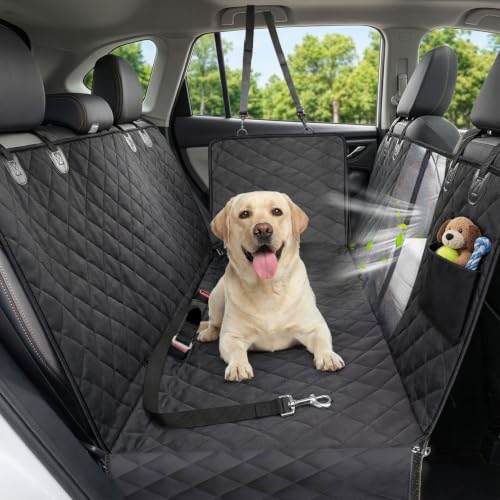
The hammock is the category’s default for a reason: slung between the front and rear headrests, it covers the bench, drops into the footwell as a barrier, and rises at the sides to guard the doors’ lower panels where paws and shaken water land. It also changes the dog’s experience — a contained, fabric-floored space with no footwell to fall into at a roundabout — which nervous travellers and puppies visibly prefer. For most dogs in most cars, the hammock is the answer, and the picks below start from it.
The hard-bottom platform is the hammock’s evolution for size: a rigid base that bridges the footwell entirely, giving large and elderly dogs a flat, supportive floor at seat height across the whole rear compartment. The dog gains a bed it can turn on; the household gains protection for the seat’s front edge and the footwell’s carpet. The costs are bulk, price and storage — a rigid platform is furniture, where a hammock is laundry — and the architecture suits households whose journeys are long and whose dogs are large.
The simple bench cover — a fitted sheet for the seat alone — protects upholstery from hair and light dirt and nothing else. It has one honest constituency: the occasional, short, clean journey with a calm dog, in a car whose footwells and doors can fend for themselves. Households that buy it for daily duty will replace it within the season, and this roundup lists it as the budget pick with its borders stated rather than letting it be bought by mistake for a hammock’s job.
Fit, belts and the safety small print
Rear benches differ — in width, in headrest posts, in the split of their folding backs, in where their seatbelt buckles hide — more than covers’ ‘universal fit’ titles admit. Measure the bench’s width, check the headrests the straps must reach, and decide whether the cover must split for a folding seat or a centre armrest before choosing. A cover that fits badly slides, bunches and exposes exactly the seams it was bought to protect, usually at the first emergency stop.
Seatbelts are the safety core of the whole subject. Human passengers in the rear need their belts and buckles accessible — good covers provide zipped or velcro openings at the buckle points and, for child seats, a design that does not fight the ISOFIX anchors or the belt path the child seat’s manual prescribes. Side airbags housed in the rear seats, where fitted, must not be wrapped by a cover that ignores them; the car’s manual and the cover’s instructions should agree, and where they cannot, the car’s manual wins.
For the dog itself, a cover is not a restraint: pair it with a proper crash-tested harness and belt attachment or a secured crate for any journey beyond the shortest, because an unrestrained dog in a collision endangers every occupant. The cover protects the car; the harness protects the dog and the family; households should buy both sentences together and let no cover’s marketing blur them.
Materials, washing and the year-two test
The working surface of a good cover is a heavy, tightly woven fabric — the category’s better makers use dense polyester weaves with a waterproof backing — quilted for comfort and grip, with a non-slip underside that keeps the whole assembly planted under a turning dog. Grip matters more than softness: a dog that slides at every corner arrives stressed and scratches in self-defence, while a dog on a grippy, padded floor lies down and stays down, which is the behaviour the cover was bought to produce.
Washing is where covers are separated into equipment and consumables. Mud is the category’s native soil, and a cover that cannot be machine-washed — or hosed, shaken and dried in an hour — will be washed late, rarely and resentfully, until it is replaced by one that can. Check the washing instructions before the first journey, buy the cover whose care matches the household’s laundry reality, and consider a second, cheap cover for the wash day if the dog travels daily.
The year-two test is seams and straps: the stitching at the headrest anchors, the buckle openings’ edges, the waterproof layer’s survival of fifty washes. The picks below were chosen for construction that plausibly passes it — reinforced anchor points, bound edges, membranes rather than sprayed coatings — because a cover’s first month tells a household nothing its second winter will not correct.
Covers and the car’s second life
A dog car leads two lives: the daily one, in which the cover is invisible infrastructure, and the exceptional one — the family visit, the airport run, the day the car must carry humans in the back and present itself as civilised. Good covers serve both: fitted in minutes, removed in fewer, and leaving a bench that needs a vacuum rather than a valet. Households should rehearse the removal before they need it at a kerbside, and store the cover where the rehearsal assumed it would be.
The resale chapter closes the argument. Upholstery is among the first things a used-car buyer inspects and among the most expensive to remedy, and a bench that spent its dog years under a hammock presents as a car that had a careful owner — which, in the only sense the market grades, it did. The cover’s price should be set against that inspection, not against the fabric it is made of.
Dogs that hate the car, and what a cover can do
Some dogs travel badly for reasons no cover fixes — motion sickness, old associations, noise — and their households should work with a vet or behaviourist on the cause. But a share of car misery is footing misery: the slide, the scramble, the footwell fall at the first roundabout. For those dogs the hammock’s contained, grippy floor — or the platform’s flat one — is a genuine intervention, and owners in this roundup’s research repeatedly date a dog’s conversion to travelling from the cover that finally gave it a floor it trusted.
The test is cheap and kind: borrow or buy the value hammock, drive the familiar short route, and watch the dog rather than the road ahead in the mirror. A dog that lies down by the second corner has graded the purchase more honestly than any review can, and households should let that verdict stand whichever way it falls.
The Picks in Detail: Back Seat Covers For Dogs Contenders
Meadowlark XL Hammock Cover — Best all-round hammock
The Meadowlark’s XL hammock is the category’s reference design executed completely: a waterproof, quilted hammock spanning the bench with side panels for the doors, headrest anchors with proper reinforcement, a non-slip base, and openings where the seatbelts live. It fits the larger benches of family cars and SUVs that standard covers leave exposed at the edges — the detail that decides whether a cover protects a seat or merely decorates its middle.
In service it behaves like equipment: hosed or machine-washed, dried fast, and back on the seat without ceremony. For the daily dog car — the school run with a spaniel, the weekend walk circuit — it is this roundup’s default recommendation, and the pick the others are graded against.
| Style | Hammock with door panels |
|---|---|
| Fit | XL / large bench |
| Care | Machine washable |
Strengths
- Complete hammock protection including door panels
- Waterproof construction with reinforced anchors
- XL sizing fits family benches honestly
Trade-offs
- Bulky to store between journeys
- Overkill for the occasional clean trip
- Side panels need care around door seals
Best for: daily dog cars, family SUVs and muddy-walk households
Not suited for: small cars with narrow benches and occasional travellers
Positioning: back seat covers for dogs — Meadowlark XL Hammock Cover is described rather than linked; this programme links only verified listings, so confirm its terms with the maker.
Hard-Bottom Platform Cover — Best for large dogs and long journeys
The hard-bottom design replaces the hammock’s slung floor with a rigid platform bridging the footwell, and for a large, elderly or anxious dog the difference is the journey itself: a flat bed at seat height, room to turn and settle, no sagging into the well at every brake. The platform models in this class pair the rigid base with the hammock’s sides and waterproofing, and they are the long-distance pick of this roundup.
The costs are the architecture’s: price, bulk, and a storage footprint that suits a garage rather than a boot. Households whose dog is large, whose journeys are hours rather than minutes, or whose elderly dog can no longer manage the hammock’s give should pay them without resentment — the platform is the rare upgrade whose beneficiary can be watched enjoying it in the rear-view mirror.
| Style | Hammock with rigid platform base |
|---|---|
| Fit | Large bench |
| Care | Wipe and washable cover |
Strengths
- Rigid flat floor: the large dog’s proper bed
- Full hammock protection around the platform
- Eases elderly dogs’ travel visibly
Trade-offs
- Bulkiest and priciest architecture
- Storage needs a garage, not a boot corner
- Heavier to fit and remove
Best for: large and elderly dogs, long journeys, anxious travellers
Not suited for: small cars, small dogs and occasional use
Positioning: back seat covers for dogs — the Hard-Bottom Platform Cover appears as a prose pick rather than a linked one; the maker’s own current listing is the place to confirm its terms.
URPOWER Hammock Cover — Best value hammock
URPOWER’s hammock has been the value tier’s reference for years: the full hammock architecture — bench, footwell barrier, door flaps, belt openings — in a waterproof quilted fabric at a price that admits a second cover for wash days. Its fittings and finish sit a tier below the Meadowlark’s, and its sizing suits standard benches rather than the largest, but the protection per pound is the category’s benchmark.
For households entering the category — a new puppy, a new dog, a newly valued car — it is the sensible first purchase: cheap enough to learn from, good enough that the lesson may be that no upgrade is needed. This roundup lists it as the value pick with its borders — size, finish, the heaviest mud seasons — stated in its trade-offs rather than discovered in November.
| Style | Hammock with door flaps |
|---|---|
| Fit | Standard bench |
| Care | Machine washable |
Strengths
- Full hammock protection at a value price
- Waterproof and machine washable
- Cheap enough to own two for wash rotation
Trade-offs
- Finish and fittings a tier below the premium picks
- Standard sizing can leave XL benches exposed
- Straps are the wear point to watch
Best for: new dog households, standard cars and value-first buyers
Not suited for: the largest benches and the heaviest daily duty
Positioning: back seat covers for dogs — no linked listing is offered for the URPOWER Hammock Cover; it is covered in prose, so check the maker’s own current terms before deciding.
Split-Bench Hammock Cover — Best for child seats and shared duty
The split design answers the family car’s actual week: a hammock that divides, so one side carries the dog while the other carries a child seat or a human passenger with their belt properly threaded. The better models in this class zip or velcro at the split, keep the waterproofing honest on the dog’s side, and respect the child seat’s belt path — the combination that makes the school-run-and-spaniel household’s logistics possible without daily refitting.
It is a compromise architecture — the split is a seam in the protection, and a determined mud distribution will find it — and households without the sharing brief should take the full hammock’s completeness instead. For the households with it, this is the only pick in the roundup that fits their week, and it is listed for them by name.
| Style | Split hammock |
|---|---|
| Fit | Standard to large bench |
| Care | Machine washable |
Strengths
- Divides for a child seat or passenger beside the dog
- Keeps belt access honest on both sides
- Ends the daily fit-and-remove ritual
Trade-offs
- The split is a seam in the waterproofing
- Costs more than a plain hammock
- Child-seat fit must be checked against both manuals
Best for: family cars sharing the bench between dog and child seat
Not suited for: dog-only cars, which should take the full hammock
Positioning: back seat covers for dogs — the Split-Bench Hammock Cover appears as a prose pick rather than a linked one; the maker’s own current listing is the place to confirm its terms.
Simple Bench Cover — Best for occasional, clean journeys
The fitted bench sheet — no hammock, no platform, just a waterproof, washable cover for the seat itself — is the category’s honest minimum. For the occasional short journey with a calm, clean dog — the vet’s annual visit, the lift to a friend’s — it protects the upholstery’s face for very little money and stores in a door pocket.
Its borders are this listing’s whole content: it does not protect the footwell, the doors or the seat’s front edge, it will not contain a wet dog’s shake, and it is not a daily cover. Bought inside those borders it is a bargain; bought outside them it is a disappointment with a barcode, and the roundup lists it so that households can tell the difference before the first muddy paw does.
Strengths
- The lowest price for real seat protection
- Stores anywhere, fits in minutes
- Washable and adequate for light duty
Trade-offs
- No footwell, door or edge protection
- Will not contain a wet dog’s weather
- Not a daily-duty cover
Best for: occasional short journeys with calm, clean dogs
Not suited for: daily dog cars and muddy-walk households
Positioning: back seat covers for dogs — no linked listing is offered for the Simple Bench Cover; it is covered in prose, so check the maker’s own current terms before deciding.
How the Back Seat Covers For Dogs Field Compares
The category divides by architecture. The classic hammock — fabric slung between front and rear headrests — protects the bench, the floor well and the doors’ lower edges while giving the dog a contained, den-like space. The hard-bottom platform extends a rigid floor over the footwell, buying large dogs a bigger, flatter bed and sparing the hammock’s sag. The simple bench cover protects the seat alone and suits the occasional, clean, short journey. Everything else — material, quilting, colour — is commentary on those three decisions.
Against the universal enemy, water, the picks divide by construction rather than by claim: a genuinely waterproof membrane or coating, seams that do not wick, and edges that contain a spill long enough to reach a petrol station. Every cover in this list was chosen for evidence of that construction rather than for the word ‘waterproof’ in its title, because the category’s titles all say it and the category’s puddles vote differently.
Buying Guide: Judging Back Seat Covers For Dogs on the Right Criteria
A seat cover is graded by what it survives: a wet, muddy, car-sick dog on a wet day, a year of claws and washing, and the seatbelt geometry of the car it lives in. The criteria below apply that standard to every pick, because a cover that fails in month two protects nothing but the manufacturer’s margin.
Waterproof construction, evidenced. a membrane or sealed coating, seams that do not wick and edges that contain a spill — graded on construction details rather than on the word in the title, which every listing in the category shares In the picks above, that grading is why the platform and hammock designs outrank prettier sheets: their membranes, bound seams and containing edges are described in their construction, not merely asserted in their titles.
Bench fit, measured. the bench’s width, headrest reach and folding split decide the fit, and a cover bought by measurement protects while a cover bought by hope decorates Fit has a second dividend beyond protection: a cover that stays planted under a turning dog does not migrate into the belt paths or the door seals, so measurement is a safety act as well as a cosmetic one.
Belt and airbag respect is where back seat covers for dogs stops being marketing and becomes measurable, because buckle openings where the belts live, a child-seat path the car’s manual accepts, and no wrapping of seat-mounted airbags — the safety small print outranks every other feature The fitting ritual this roundup prescribes — belts threaded, buckles clicked, child-seat path verified — takes ten minutes and should be repeated after every refit, because a cover reinstalled carelessly after washing is the category’s commonest safety failure.
The dog’s footing: a grippy, padded, non-slip floor produces a dog that lies down, and a lying dog is the cover’s real product — protection follows behaviour, not the reverse Footing can be auditioned in a car park: a dog that can brace, turn and lie without sliding on a test drive will travel calmly, and one that scrambles on the chosen surface is telling the household the cover, not the dog, needs changing.
Washing survival: machine-washable or hose-able, fast to dry, with seams and straps that survive the fiftieth wash — because mud is not an event in this category but a climate Survival includes the waterproof layer itself: membranes die by heat and harsh cycles, so the care label is a specification — follow it, and the cover’s fiftieth wash protects like its fifth.
Judge architecture matched to brief before anything else on the page: hammock for the daily car, platform for the large dog and the long road, split for the shared bench, sheet for the occasional lift — the architecture is the decision and the brand is the footnote The matching cuts both ways: a hammock in an occasional car is harmless overkill, but a sheet in a daily dog car is an under-purchase that will be paid for twice — once at the till and once at the valeting bill.
Back Seat Covers For Dogs in Real Households
The daily dog car. School run, walk circuit, vet, repeat: the full hammock, fitted once and left in place, washed weekly. This household should buy the all-round pick, consider a value second cover for wash rotation, and treat the cover as the car’s upholstery from now on — because functionally, it is.
The large elderly dog. A big dog in its stiff years needs the platform: flat, supportive, at seat height, with a ramp or a helped lift at the door. The journey’s quality is visible in the dog’s willingness to get in, and households should let that willingness, watched over a month, grade the purchase.
The puppy’s first season. Puppies are mud, accidents and chewing in one small passenger. The value hammock, a waterproof liner beneath it if the household is wise, and a washing rhythm measured in days: this is the season the cheap cover earns its keep and the expensive one should wait for.
Picture the family car with a child seat for a moment. The split cover, fitted once with both manuals open — the car’s and the child seat’s — and the belt paths verified by hand. This household’s victory condition is a week with no refitting, and the split architecture is the only one that offers it.
The clean occasional journey: A calm adult dog, a dry day, a twenty-minute lift: the simple bench cover, or even the hammock borrowed from its hook. Occasional households should resist buying the daily architecture for a monthly brief — the sheet exists, honestly, for them.
How To Get Back Seat Covers For Dogs Right, Step by Step
Step 1: Measure the bench before anything. Width between the doors, headrest post positions, the folding split’s location, and where the buckles hide. Write the numbers down; the category’s listings are a fog of near-identical photographs, and measurements are the only light.
Step 2: Fit it once, properly. Anchors firm, base flat and non-slip side down, side panels seated, belt openings aligned and tested with an actual buckle. Twenty unhurried minutes at fitting saves a season of bunching, sliding and exposed seams.
Step 3: Thread and test every belt. Each rear belt pulled through its opening and clicked home, the child seat’s path checked against both manuals if one is fitted. This step is the cover’s safety case, and it should be repeated after every wash-day refit.
Step 4: Add the dog’s restraint. A crash-tested harness with its belt attachment, or a secured crate, fitted alongside the cover. The pair — cover for the car, restraint for the dog — is the complete purchase this category is actually selling.
Step 5: Set the washing rhythm. Shake and hose weekly, machine-wash on the cover’s instructions as the season demands, and dry it fully before refitting. A second value cover for rotation turns wash day from a gap in protection into a non-event.
Step 6: Inspect the wear points monthly. Anchor stitching, strap webbing, the buckle openings’ edges and the waterproof layer’s survival. Covers fail at their fittings first, and a monthly glance converts a mid-journey failure into a planned replacement.
Mistakes That Undermine Back Seat Covers For Dogs
Buying by ‘universal fit’ sounds harmless in the showroom and expensive at home. Benches differ more than titles admit. A cover that slides exposes the seams it was bought to protect, and the failure arrives at the first emergency stop, fully loaded.
Blocking the seatbelts sounds harmless in the showroom and expensive at home. A cover fitted over buckles and belt paths endangers the humans the car exists for. Fit the openings, thread the belts, and check a rear passenger can buckle without archaeology — every time the cover is refitted.
Treating the cover as a restraint: Covers protect cars; harnesses and crates protect dogs and families. An unrestrained dog is a hazard in a collision at any speed, and no fabric hammock changes that physics.
Choosing softness over grip: A plush, slippery cover produces a scrambling dog, scratched doors and a stressed arrival. Grip and padding — in that order — are the floor’s real specification.
Skipping the wash until it smells sounds harmless in the showroom and expensive at home. Mud ground into a cover’s seams becomes the car’s permanent background. The weekly wash is the product’s maintenance and the car’s odour control in one act — which is why washability outranks quilting in this roundup’s criteria.
Going Deeper on Back Seat Covers For Dogs
The seat cover is a small lesson in buying for the failure you actually face. Households shop for hair — the visible, daily nuisance — and are ruined by water: the shaken-off river, the car-sick puppy, the wet November spaniel whose moisture finds the seat’s seams and stays for the car’s life. The category’s good covers are designed by people who priced the water first and the hair second, and the roundup’s criteria simply follow their arithmetic. Buy for the worst wet day of the year, and the hair will take care of itself.
There is a behavioural economy inside the hammock design that deserves its due. A dog on a grippy, contained, fabric floor settles; a dog sliding on leather scrambles, scratches and arrives in a state. The cover’s protection is therefore partly self-fulfilling — the calmer passenger damages less — and households that have watched a dog’s travel behaviour transform on a proper hammock understand that they bought a sedative made of friction, at a fabric’s price.
The category’s marketplace, finally, is a fog of cloned listings in which the same photographs sell at five prices with five brand names, and the programme’s verification discipline — link what can be pinned, prose what cannot — is the reader’s protection as much as the site’s. In such a market the durable shopping skills are the ones this roundup teaches: measure the bench, grade the construction, respect the belts, and let brands compete for a decision the architecture has already made.
So the best back seat cover for dogs is the one whose architecture matches the household’s week, whose waterproofing survives its washing, and whose fittings respect the car’s safety as faithfully as its upholstery. Bought that way, it disappears into the car’s life — shaken out on Sundays, washed without resentment, and noticed only on the day the household sells the car and lifts it to find a clean seat underneath. That discovery is the product’s whole promise, kept.
The cover also quietly renegotiates the household’s relationship with the dog’s weather. Without one, every wet walk ends in a negotiation — towels, guilt, the good car versus the old car — and the dog’s world shrinks to what the upholstery permits. With one fitted, the rain stops being a logistics problem and becomes just weather again: the dog gets its walk, the car gets its cover’s sacrifice, and the household gets its Sundays back. That restoration, more than any resale arithmetic, is what the daily hammock’s owners are actually describing when they call it the best money they spent on the dog.
Choosing between the picks: a household decision tree
Start with the bench, not the brand. If the rear seat must sometimes carry a child seat or a passenger beside the dog, the split design is the only honest answer and the tree ends there. If the dog is large, elderly or travels for hours, the platform’s flat floor outranks every fabric consideration. If neither applies, the full hammock is the default — the Meadowlark class for the largest benches and the heaviest duty, the URPOWER class where value or a wash-rotation pair matters more — and the simple sheet is the answer only when the honest answer to ‘how often, how muddy?’ is ‘rarely, barely’.
Then let the household’s laundry cast the final vote. A cover whose care matches the home’s rhythm will be washed; one that demands a special expedition will be endured dirty and replaced resentfully. The category’s best purchase is therefore partly a diary decision — which is why this roundup’s criteria put washing survival beside waterproofing, and why the value pick’s cheapness (two covers, no gap) is a feature of protection and not merely of price.
Renting, borrowing and the borrowed car problem
Dog households eventually face the borrowed car: the hire car on holiday, the courtesy car, the friend’s vehicle pressed into a vet run. The value hammock is the traveller’s answer — light, car-agnostic, fitted in five minutes from its bag — and keeping one for the purpose protects friendships and deposits alike. Hire-car households should photograph the bench before and after, fit the cover before the dog’s first ride rather than after its first shake, and return the car with the cover’s evidence removed and its protection unneeded but complete.
The same logic covers the household’s own second car, which is where old covers retire to: the platform or premium hammock serves the main dog car, the veteran serves the runabout, and the category’s whole economy — buy once, cascade down — plays out in one driveway.
Covers for the seats dogs actually sit on
Not every dog rides the bench: some ride the front seat beside their person, some the boot behind a guard, some a hammock slung in a pickup’s cab. The roundup’s principles travel even where its picks do not — waterproof construction over claims, measured fit over universality, belts respected, grip under the dog — and households with those layouts should shop the same criteria in the shapes their vehicle dictates, front-seat covers and boot liners included.
The front-seat case carries one extra warning that outranks all others: a dog on the front seat must never be able to reach the driver, and the passenger airbag’s rules — weight, position, the car’s manual — govern whether a dog should ride there at all. Where any doubt exists, the back seat with its hammock is not merely the tidier answer but the safer one, which is why this roundup’s subject is the bench.
Field Notes on Back Seat Covers For Dogs
There is a behavioural economy inside the hammock design that deserves its due. A dog on a grippy, contained, fabric floor settles; a dog sliding on leather scrambles, scratches and arrives in a state. The cover’s protection is therefore partly self-fulfilling — the calmer passenger damages less — and households that have watched a dog’s travel behaviour transform on a proper hammock understand that they bought a sedative made of friction, at a fabric’s price.
In real homes, the enemy a seat cover is really bought for is water, not hair: hair brushes off a seat in minutes, while one wet dog’s shake, ground into the seams, can perfume a car for the rest of its ownership a hammock changes the dog’s behaviour as much as the car’s fate, because a contained, grippy floor is a den at speed — and a settled dog scratches, scrambles and sheds its stress measurably less rear benches vary by inches between models that look identical in photographs, which is why the category’s returns are dominated by fit and its reviews by the word ‘universal’ used as a complaint the seatbelt openings are the cover’s safety case in physical form: a cover that cannot present every buckle, every time, has failed its first duty to the humans in the car
Separately, a second, cheap cover for wash rotation is the category’s best-value accessory, because protection that pauses for laundry day is protection with a weekly hole in it the platform architecture exists because large dogs age: the flat, supported floor that a young dog does not need becomes, in the elderly dog’s tenth year, the difference between a journey and an ordeal in the end a good cover is judged at the car’s resale, when it is lifted for the first time in years and the seat beneath it testifies — the only review of this product that cannot be argued with the footwell is where a hammock earns its design fee: it is the space a braking dog falls into, the carpet a wet dog’s paws reach first, and the panel no simple bench sheet even attempts to protect
Quietly, door panels fail before benches in dog cars, because the shake happens at the window — the side flaps that look like an accessory are aimed at the car’s most-damaged square foot a cover’s colour is a hair-management decision before it is an aesthetic one: match the fabric to the dog, not the car, and the daily evidence of ownership halves at a stroke in the end the category divides households by a single habit — those who fit the cover before the first muddy journey and those who fit it after — and the price difference between the two groups is one professional valet the first fitting is the cover’s longest: twenty minutes with the belts threaded and the anchors firm, against ninety seconds for every refit after — households should budget the twenty once and never pay it again
Worth knowing: a hammock’s side flaps have a second job in winter: they keep the salt-and-grit slurry that a dog’s coat imports off the door cards, whose textured plastic holds ground-in dirt longer than any fabric in the car the shake is a physics event before it is a laundry one: a dog’s shake throws water at speeds that defeat any cover without raised edges, which is why the hammock’s walls matter more than its floor’s thickness boot-liner households learn the same lesson in a different shape — the liner that contains a spill is worth three that merely resist one — because a contained puddle is an errand and a leaked one is a smell with tenure a cover also protects against the dog’s other cargo: the stick collection, the found tennis ball’s archaeology, the beach’s entire sand budget, all of which arrive home in the coat and leave it in the car
Quietly, and the weekly shake-out has a diagnostic use: what falls out of the cover is a record of the dog’s week — seeds, ticks to check for, the burr that explains the scratching — read by owners who know to look
Back Seat Covers For Dogs: Cases Worth Studying
The spaniel, the river and the resale. A household ran a hammock through three years of a spaniel’s river walks — weekly mud, two car-sick incidents, one memorable shake captured mid-ford — and lifted it only when the car was sold. The bench beneath was unmarked, and the buyer’s surprise paid for the cover several times over in the negotiated price. The case is the category’s promise with a receipt attached, and it is why the daily households in this roundup are told to fit the hammock once and never take it off.
Final Recommendation on Back Seat Covers For Dogs
For most households the waterproof hammock — the Meadowlark class for complete protection, the URPOWER class for value — is the best back seat cover for dogs, because it protects the bench, the well and the doors while giving the dog a floor it can settle on. Large dogs and long roads should take the platform; shared benches the split; occasional lifts the sheet.
Whichever architecture you choose, measure the bench, thread the belts, add the dog’s own restraint, and wash the cover like you mean it. The dog will supply the mud, the weather will supply the water, and the cover — correctly chosen — will supply the household with the only thing it ever wanted from this category: a back seat that survives its dog.
Frequently Asked Questions About Back Seat Covers For Dogs
What is the best type of back seat cover for most dogs?
A waterproof hammock: it protects the bench, the footwell and the doors’ lower panels, gives the dog a contained and grippy floor, and fits the daily reality of mud and hair. Large dogs and long journeys argue for the hard-bottom platform; shared benches for the split design; occasional clean lifts for the simple sheet — the architectures in this roundup, in that order of generality. Fit it once and leave it fitted: the daily hammock earns its keep by being present for the unplanned muddy journey, not just the scheduled one, and households that store it between trips reliably meet the one journey it was bought for, uncovered.
Will a hammock cover fit my car?
Most benches, if measured: check the bench’s width against the cover’s size (XL designs exist for family cars and SUVs), confirm the headrest straps can reach front and rear headrests, and decide whether you need a split for a folding seat or a child seat. ‘Universal’ is a starting point; your tape measure is the verdict. Convertibles, benches without rear headrests and seats with integrated belts can defeat standard hammock straps; check your car’s furniture against the design before ordering, and where headrests are absent, look for the strap systems made for that case rather than improvising.
Are back seat covers safe with child seats?
The split designs are built for exactly that sharing, provided the child seat’s belt path or ISOFIX fitting is kept exactly as its manual prescribes and the cover does not pad or obstruct it. Check both manuals — the car’s and the child seat’s — at fitting, and never let a cover sit between a child seat and the vehicle seat unless both manuals accept it. Re-verify after every change: a child seat refitted after cleaning, a cover washed and replaced, a belt re-threaded — the combination is safe when it is checked, and the check belongs in the household’s routine, not its memory.
Do dog seat covers work with seat airbags?
Rear seats with integrated side airbags must not be wrapped in ways that obstruct their deployment. Choose a cover whose design and instructions account for your car’s equipment, follow the car’s manual where there is any doubt, and treat that manual as senior to any listing’s assurances. Where rear seat airbags are fitted, some makers offer breakaway-stitched panels for the deployment zone; whether yours does is a question for the cover’s instructions read against the car’s manual, in that order of authority reversed — the car’s manual first.
How do I clean a dog seat cover?
Shake and hose it weekly; machine-wash on the maker’s instructions as needed, and dry fully before refitting. The waterproof layer’s survival is the thing to protect — avoid heat and harsh cycles the instructions warn against — because a cover that has lost its waterproofing has retired without telling you. Hair first, water second: a stiff brush or a vacuum before the wash keeps the machine’s filter out of the story, and a line-dry in moving air returns most covers to service within the hour the dog needs for its own bath.
Does my dog still need a harness with a seat cover?
Yes. The cover protects the car; it restrains nothing. A crash-tested harness with a proper belt attachment — or a secured crate — protects the dog and every human in the car, and the two purchases belong together for any journey beyond the shortest and slowest. The harness has a comfort dividend too: a belted dog settles in one place on the cover instead of surfing it, which keeps the cover planted, the dog calmer and the driver’s attention where the road requires it.
Reading: back seat covers for dogs — from our own guides: bringing your new dog home getting rid of dog smells in the house vacuums for dog hair washable rugs for dogs sofa covers for dog protection area rugs for dogs