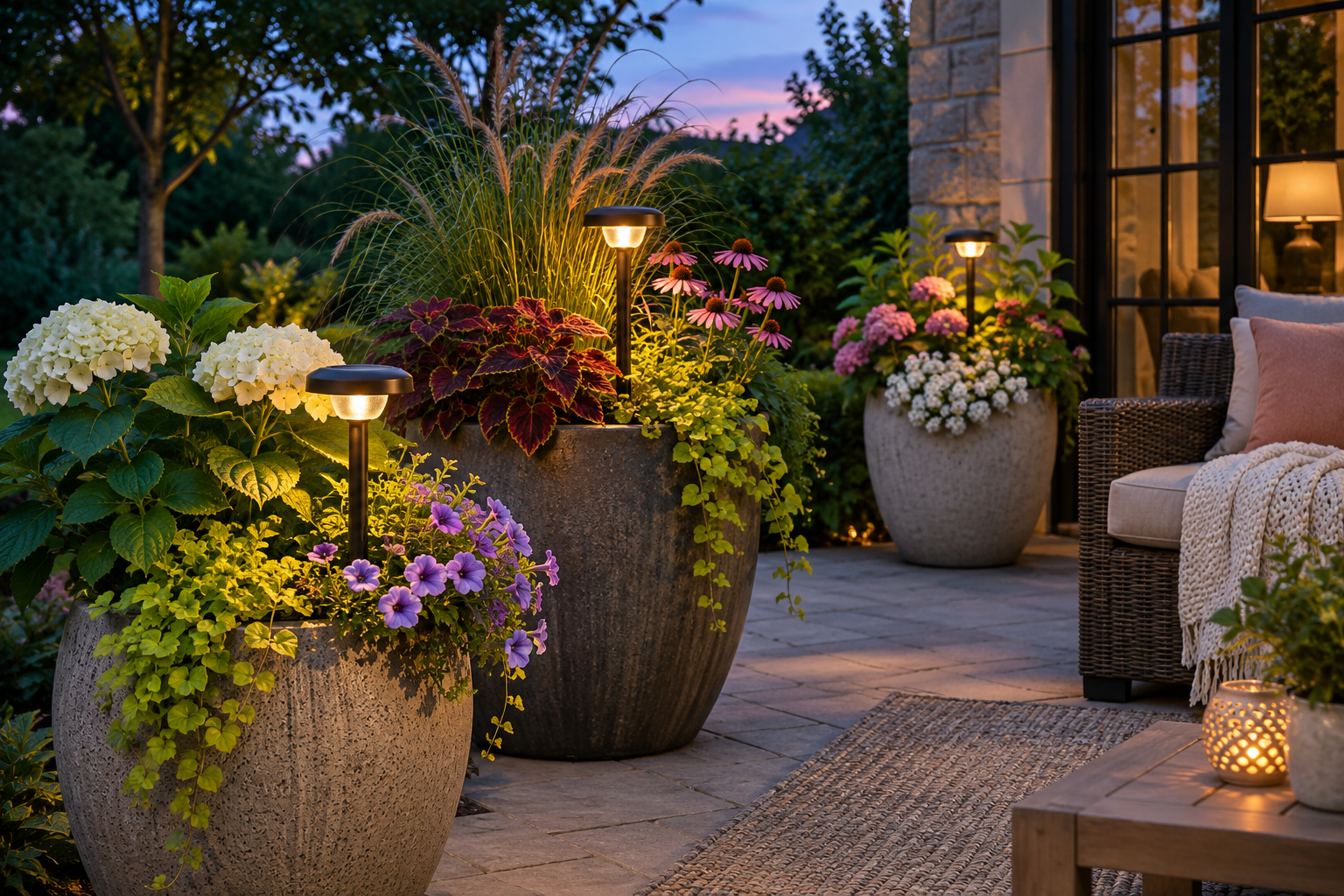
The best outdoor lights for planters make a container garden feel welcoming after sunset while keeping the plants and the path easy to see. A small solar stake can add a gentle point of light to one pot; a directional spotlight can reveal the shape of ornamental grass or a compact tree; and a short strand of outdoor LEDs can tie a group of containers together on a patio. The right choice depends on the planter’s size, the plant’s mature shape, the amount of daylight available for charging, and whether the light is meant for ambiance or practical visibility.
Planter lighting works best when it feels integrated with the garden rather than brighter than everything around it. Start with a single focal pot or a small cluster, aim light toward foliage or texture, and leave darker areas between illuminated features. This guide compares suitable light types, explains power and weather considerations, and shows how to plan an attractive, low-glare setup that remains easy to water and maintain.
Affiliate disclosure: DailyHomeDecorating.com may earn a commission from qualifying purchases made through links in this article. This does not affect the price you pay.
Amazon product examples for planter lighting
The following product titles, ASINs, and images were retrieved through Amazon Creators API. They are examples to compare for lighting plants and outdoor containers, not lab-tested rankings. Check each current listing for fit, specifications, included hardware, and availability.


Certain content that appears on this site comes from Amazon. This content is provided “as is” and is subject to change or removal at any time.
What makes a good light for an outdoor planter?
Start by naming the job. Accent lighting highlights the plant’s leaves, flowers, or silhouette. Path lighting helps people see steps and changes in level. Task lighting is useful when you need to water, inspect, or prune. One miniature stake light may add atmosphere but will not reliably light a whole walkway. Separating these jobs avoids expecting a decorative pot light to act like a safety fixture.
Next, consider where the container sits. A planter under an eave or tree canopy may not receive enough direct sun to charge an integrated solar panel. A remote-panel solar light can place its panel in a brighter location while keeping the lamp near the pot. A balcony with limited sunlight may be better served by a rechargeable lamp or an outdoor-rated low-voltage system. A sunny entry can often use a simple solar stake.
Check the product’s instructions for outdoor exposure. Rain, irrigation spray, humidity, dust, and temperature changes all matter. Product labels use terms such as water-resistant and weatherproof differently, so look for a stated rating and the manufacturer’s specific placement guidance. For wired landscape lighting, inspect the listing and markings on the complete system, including the power unit, connectors, cable, and fixture. UL Solutions explains that outdoor and landscape luminaires are evaluated according to standards appropriate to their voltage and intended location; do not judge electrical suitability by a decorative appearance alone.
Finally, check scale and installation. A tall stake can overwhelm a small herb pot. A clamp needs a stable rim or railing. A spotlight needs a firm spot beside the container. Note whether the panel is built into the lamp or attached by a lead, how long the cable is, and whether any stake or mounting hardware is included.
Quick comparison of outdoor planter lighting
| Light type | Good fit | Check before buying |
|---|---|---|
| Integrated solar stake | Sunny individual pots and small groupings | Panel exposure, stake height, battery replacement, expected runtime |
| Solar light with separate panel | Shaded planter with a nearby sunny mounting spot | Lead length, outdoor connectors, panel mounting, cable routing |
| Adjustable spotlight | Focal foliage, small trees, textured containers | Beam angle, glare, power source, mounting stability |
| Outdoor string lights | Several pots beneath a pergola or along a patio | Outdoor rating, plug and cord, spacing, support points |
| Clip-on light | Railing planters, narrow window boxes, balconies | Clamp width, grip, wind exposure, safe cord path |
| Low-voltage landscape fixture | Repeated lighting across a larger container display | Compatible listed system, transformer capacity, installation rules |
Best outdoor lights for planters by use
1. Solar planter stakes for a simple accent
Solar stakes are among the easiest choices for individual pots. They usually combine a small panel, LED, battery, and a spike that presses into the potting mix. There is no long cord to route, and you can move the fixture as plants grow or containers change position. A stake can mark the center of a small pot or add a soft point of light behind a low mound of foliage.
Choose a height that suits the mature plant, not only the plant’s size on purchase day. A stake hidden by summer growth will collect little light and show little at night. On the other hand, a bright, tall stake in a compact pot can look like a pathway marker inserted into the middle of a plant. Keep the panel clear of leaves, and avoid damaging large roots when inserting it.
Solar runtime varies with direct sunlight, season, cloud cover, panel cleanliness, battery age, and the light’s operating mode. Treat promotional runtime as a result under specific conditions, not a promise for every garden. Check whether the battery is replaceable and whether the light has an automatic dusk sensor or manual switch. A panel that can be wiped clean and positioned toward the sun is easier to maintain.
Search Amazon for solar planter stake lights for outdoor pots.
2. Separate-panel solar lights for covered or shaded pots
When a pot sits under a porch roof or dense tree, the integrated panel may stay shaded all day. A solar fixture with a separate panel solves this placement problem: the lamp stays near the planter and the panel sits where it can receive daylight. This setup works well on a covered deck, beside a north-facing wall, or along a balcony with a sunny railing.
Measure the route between the proposed panel location and the light before ordering. Secure the lead so it cannot be pinched in a door, snagged by garden tools, or stretched across a walking path. Keep connectors and the panel within the maker’s permitted outdoor placement. Do not splice or extend the cable with an improvised connection unless the manufacturer provides an approved accessory and instructions.
Search Amazon for outdoor solar lights with a separate panel.
3. Adjustable spotlights for a feature plant
A small directional spotlight can reveal the form of a compact evergreen, ornamental grass, large-leaf tropical plant, or sculptural pot. Place it a short distance from the container and aim the beam through the leaves or across the surface of the planter. An adjustable head lets you keep the brightest part of the beam away from people’s eyes and neighboring windows.
Compare beam angle and color appearance as well as brightness. A narrow beam creates a focused highlight; a wider beam can cover more foliage but may spill onto the wall or patio. Warm-white light often feels relaxed in a seating area. A neutral tone may look cleaner against pale stone or modern metal. Color preference is personal, so testing one fixture is more informative than buying a multi-pack immediately.
Solar spotlights are straightforward to place if the panel has enough sun. A low-voltage fixture can give more consistent use in a larger setup, but the transformer, connectors, wire, and lamps should be a compatible outdoor system. For mains-voltage installations or fixed wiring, use a qualified electrician and follow local rules. Never bring an indoor lamp or power adapter outside simply because it fits the design.
Search Amazon for adjustable low-voltage outdoor LED spotlights.
4. String lights for a group of containers
Outdoor string lights can make a collection of planters feel like one intentional patio feature. Hang the string above or behind the containers, or attach it to a freestanding support. Avoid winding wire tightly around living stems; plants move in wind and grow through the season, and tight wires can rub or restrict branches.
Check the weather-use instructions for the string, plug, sockets, and any controller. Use an outdoor-rated receptacle and extension equipment designed for the intended load. Keep plug connections out of puddles and away from irrigation spray. Do not overload a receptacle or connect multiple strings together unless the manufacturer allows the configuration.
Spacing and brightness influence the mood. A few widely spaced bulbs can add warmth without washing out the plants. A dense, bright string can create glare or compete with flowers. Consider the view from inside the house and from neighbors’ windows, and use a timer or switch so the display is not on all night if it is not needed.
Search Amazon for warm-white outdoor patio string lights.
5. Clip-on lights for railing planters and narrow boxes
Railing planters and narrow window boxes may have little space for a stake. A clip-on light can attach to a planter rim, balcony rail, or nearby support. Check the clamp’s opening range, padding, and grip. The clamp that fits a thin metal bar may not fit a broad wood cap, and a metal jaw could scratch a finished railing.
Position the fixture so it does not block drainage, crush the planter, or protrude into a walkway. On a high balcony, wind can catch both the lamp and its wire. Follow building rules for railing attachments, and do not use an unstable clip as a safety device or support for a heavy fixture.
Search Amazon for clip-on planter and railing lights.
6. Integrated lighted planters for a built-in feature
Some planters include built-in LEDs or translucent walls that glow. These can make a striking focal point at an entry or beside outdoor seating, and the light source is already sized for the container. Before choosing one, inspect how the plant is separated from electrical components, where water drains, how the unit is powered, and whether the light module or battery can be replaced.
Filled planters are heavy. A large container with soil, water, and integrated lighting may be difficult to move after planting. Confirm the empty dimensions, drainage design, and available power lead first. Integrated lighting can simplify the look, but a separate lamp may be easier to replace if the light eventually stops working.
Search Amazon for outdoor lighted LED planters.
How to match a light to the planter and plant
Use the container’s scale and the plant’s form as the starting point. A shallow bowl with succulents may need only a small glow along the rim. A tall grass, miniature tree, or broad-leaf plant may look better with a fixture near the ground, aimed upward through the foliage. For a group of pots, choose one focal container and use gentler accents around it rather than giving every pot an equally bright lamp.
Think about mature growth. A stake that looks balanced in April may disappear beneath leaves by July. Leave room for the plant to expand and keep the solar panel exposed. If using a spotlight, leave space to tilt it as the plant grows. Decorative lights are not grow lights; they are not designed to provide the spectrum and intensity plants need for photosynthesis.
Planter material changes how light appears. Dark ceramic or metal absorbs more light, making a small source seem subdued. Pale stone and glazed finishes can bounce the beam and create unexpected glare. A matte finish under a warm beam often feels softer than a shiny pot under a cool bright source. Test after dusk from the places where people sit and walk.
Keep watering and drainage easy. Do not place a stake over a drainage hole, trap water in a saucer, or route a cable where it will need to be moved at every watering. Container plants may need frequent watering in warm conditions, and a convenient path to the soil is part of a workable design. Water and electrical components should remain separated according to product instructions.
For window boxes and rail planters, aim for fixtures that light the foliage without shining into the room. See our guide to choosing window box planters for sizing and drainage ideas that can make lighting placement easier. If you are creating a hanging display, our article on flowers for hanging planters covers plant form and exposure; a small directional light from a nearby support can highlight trailing flowers without wrapping a wire around the basket. For edible container gardens, see strawberry planters and keep lighting hardware clear of watering access and harvest paths.
Choosing solar, rechargeable, or wired power
Solar: Solar fixtures suit sunny locations and avoid a long cord. Their output depends on panel exposure, battery condition, season, and weather. Place the panel where it can receive daylight, not where it is hidden behind the very plant the lamp is meant to illuminate. If the patio is shaded, select a separate-panel design or another power source.
Rechargeable battery: A USB-rechargeable lamp can be convenient for covered patios, rentals, or occasional events. Check the charging method, operating controls, and whether the unit can remain outdoors while charging. Some portable fixtures are meant to be brought indoors during severe weather. A built-in battery may eventually need replacement, so check whether parts and service are available.
Low-voltage landscape system: A low-voltage system can provide repeatable lighting across several planters. The power unit and fixtures must be designed to work together. Check transformer capacity, cable length, connection method, and the product’s location markings. UL Solutions describes standards for low-voltage landscape lighting systems and their power units; use compatible listed components and follow the manufacturer’s layout and installation instructions. If wiring or local code is unfamiliar, get professional assistance.
Plug-in decorative lights: Plug-in string lights work well where a suitable outdoor receptacle is close enough. Route cords along a wall or railing with outdoor-rated clips, never across a doorway or walking path. Use only an outdoor-rated extension cord if permitted by the instructions, and protect connections from water. Do not assume that a covered porch makes an indoor-rated cable safe outside.
Placement plan for a softer, safer patio
- Map the area: Mark steps, doors, seating, and the route to the garden. Keep essential path lighting distinct from decorative planter accents.
- Choose a focal point: Start with one large or distinctive planter. Aim a low-output light at leaves or the pot’s texture.
- Check glare: View the fixture from seated height, the doorway, and nearby windows. Tilt or shield the lamp if the source is directly visible.
- Test solar exposure: Observe the panel location through the day. A few hours of unobstructed sun can matter more than the planter’s orientation.
- Secure cables and fixtures: Keep them away from water flow, mower paths, pet routes, and door hinges.
- Build gradually: Add one or two fixtures, live with the result for several evenings, and only then decide whether a larger system is necessary.
Use the lowest practical brightness and aim light downward or toward the feature. The U.S. Department of Energy notes that reducing total output, eliminating upward light, and using controls can help address sky glow. A timer, motion control, or manual switch can reduce needless nighttime operation and make the patio more comfortable for neighbors and wildlife.
Installation and outdoor safety
Read the light’s instructions before assembly, especially when it includes a transformer, detachable panel, or multiple connectors. Use only the specified power adapter and compatible cable. If the fixture requires a receptacle or wiring change, hire a qualified electrician. Do not run exposed cable through standing water, bury cable unless it is marked for that use, or make a connection with household tape.
Secure stakes so they do not wobble when the pot is watered or moved. Keep the lamp and panel from touching leaves if heat or abrasion could damage them. For string lights, use supports intended to carry their load rather than tying them to plant stems. Keep lamps away from dry foliage where heat buildup could be an issue, and follow clearances from the manufacturer.
After storms, check for loose clamps, cracked housings, exposed wire, and water inside a fixture. Stop using a damaged light. Sealed electrical assemblies are not safely repaired with tape or glue; replace the item or have it serviced as directed. For wired landscape products, turn off power at the correct source before servicing and follow the manual.
Buying checklist
Before you order, compare total height, beam pattern, light color, power source, charging location, and weather instructions. Confirm what is included in the package: photos may show a remote solar panel, batteries, transformer, extension lead, clips, or multiple fixtures that are not included in every configuration. Check the model number and listing variant, not just the headline.
Look for clear warranty terms and replaceable parts. Solar batteries and integrated LED modules have finite lives, so the ability to replace them can extend the useful life of a fixture. Read current reviews for comments about the exact variant, mounting method, and brightness. Ratings may combine several sizes or power options, and a review for another variant may not apply to your purchase.
We have not verified specific ASINs for the products linked in this guide. The Amazon links are searches using the full product type and the affiliate tag dailyhomedecorating.com-20, not direct product-detail claims. Results can change over time; confirm title, dimensions, seller, package contents, and outdoor-use information before checkout.
Care and troubleshooting
Clean solar panels with a soft cloth and keep dust, leaves, and bird droppings from blocking them. If a solar lamp becomes dim, check its switch, panel exposure, and battery condition before deciding it has failed. Follow the manufacturer’s battery replacement instructions and do not substitute an unspecified cell type. For remote panels, inspect the lead and connectors for damage.
In winter or during severe storms, follow the storage instructions. Some solar fixtures may remain outside, while rechargeable accent lights are better stored indoors. Remove seasonal strings if wind or ice could pull down their supports. Store small stakes, clips, and connectors together so the parts are available next season.
As plants grow, revisit the arrangement. Move a stake out of dense foliage and retest solar exposure. Re-aim spotlights so they still reveal the intended shape and do not shine into a neighbor’s window. If you change the planter’s location, check the cord path and panel sun before leaving the light in its new position.
Frequently asked questions
Are solar lights bright enough for planters?
They are often suitable for decorative accents, but brightness and runtime depend on sunlight, panel condition, battery age, and the product’s design. If a shaded patio needs reliable use, consider a separate-panel solar lamp, a rechargeable fixture, or a properly installed low-voltage system.
Can I put a solar stake directly in potting mix?
Only if it is designed with a stake for that purpose. Place it where it will not damage major roots, block drainage, or interfere with watering. Keep the panel exposed, and do not bury any part the instructions say to leave above soil.
What color light works best around flowers?
Warm-white light often creates a relaxed mood, while neutral white can look crisp against modern planters. Colored LEDs can suit seasonal displays. Test the chosen tone in the actual patio because flowers, wall color, and container finish all affect how the light looks.
Can decorative planter lights help plants grow?
No decorative accent lamp should be assumed to replace a horticultural grow light. Its spectrum, intensity, and operating schedule may not meet a plant’s needs. Choose plants for the daylight the location receives and use purpose-built growing lights only when the growing conditions require them.
How many lights should I use around one planter?
Usually one restrained accent is a good starting point. A large specimen or group of containers might benefit from two carefully aimed sources, but adding lights until every leaf is uniformly bright can flatten the display and create glare. Test at night before expanding the setup.
Can string lights be wrapped around the plant?
It is better to support the string independently. Plants grow and sway, and a wire wrapped around stems can rub, pull, or become entangled. Use a trellis, railing, or freestanding support and follow the string-light maker’s outdoor instructions.
Final thoughts
The best outdoor lights for planters fit the real conditions around the container. Solar stakes work well in sunny pots, separate-panel designs help in shaded spaces, adjustable spotlights shape a focal display, and string or clip-on lights suit grouped pots and narrow rail planters. A compatible low-voltage system can serve a larger patio when installed correctly.
Keep the light modest, choose outdoor-rated equipment, protect cables and connections, and preserve access to drainage and watering. Start with a small test rather than buying a large set before you know how the color, angle, and brightness look. A thoughtful placement lets the plants remain the feature while making the patio feel welcoming after dusk.
Design examples for common planter locations
Front porch containers
For a pair of planters beside a front door, treat the containers as part of the arrival route. A warm accent on the outside edge of each pot can frame the entry, while a separate porch fixture does the work of helping visitors see the door and threshold. Keep decorative light sources out of direct eye level. If the pots sit close to a glass door, check the reflection from indoors; a bright dot reflected in the glass can be more distracting than the fixture appears outside.
Solar lights can be attractive here if the porch receives enough sun, but a shaded front stoop often charges poorly. In that case choose a rechargeable battery light or use an existing outdoor landscape-lighting system that is designed for the location. Keep the mounting arrangement symmetrical without requiring both sides to be exactly identical. Plants grow unevenly, so adjust each lamp to highlight its own container instead of forcing a matching beam angle.
Balcony and apartment railings
On a balcony, space, building rules, and wind exposure shape the choice. Clip-on lamps and solar lights with a remote panel can avoid floor cords, but every clamp should fit securely and leave the railing usable. Confirm whether the lease or building policy allows objects attached to the rail. A fallen light or cable can injure someone below, so avoid loose items and do not rely on a weak clamp when the balcony is exposed to gusts.
Check whether the planter itself blocks sunlight from the solar panel. A panel tucked behind a full trailing plant may receive almost no useful charge. Mount it above or on the outer side only when that is allowed and safely secured. For a narrow balcony, one low-glare fixture can be enough; several bright lights aimed outward may disturb neighboring apartments.
Patio seating groups
When containers surround a table or chairs, light should help the space feel comfortable rather than turn the plants into a row of spotlit objects. Select one or two taller plants as focal points and use soft string lights above or behind the arrangement. Keep a clear dark zone around the seating area so guests can look beyond the patio and relax. If the table already has a lantern or overhead light, planter accents can be dimmer.
Think about the direction people face while seated. A spotlight aimed from a low angle across the patio may shine directly into someone’s eyes. Test the setup from the chair, not just while standing next to the pot. A small shield, a lower setting, or a different angle can make the difference between a pleasing outline and an uncomfortable glare source.
Window boxes and hanging baskets
Elevated planters are visually effective because the leaves and flowers are already near eye level, but they need a careful fixture placement. A light mounted under the box can accent the container and a cascading plant, while an adjacent wall-mounted fixture may be easier to service. Avoid attaching a heavy lamp to a planter that was designed only to hold soil. The support should carry the light independently if the pot’s bracket rating is uncertain.
For a window box, a subtle wash along the wall may be more effective than several small lamps hidden among the stems. Direct light downward and away from the glass. If the window is a bedroom window, consider a timer or switch so decorative light does not remain on through the night. See our window box planter guide for design and drainage choices that affect where a lamp or cable can sit.
Brightness, color, and the nighttime view
Product pages may describe brightness in lumens, but the fixture’s optics and distance also affect what you see. A low lumen lamp with a narrow beam can create a sharp highlight, while a brighter wide-beam lamp can spread light across a wall and neighboring pots. Use brightness as one comparison point, not as a complete prediction of the scene. Manufacturer product photos are often taken in dark conditions and may not reflect an ordinary patio with nearby porch lights.
Color temperature is usually expressed in kelvin. Lower warm-white values can appear golden, while higher values tend to appear cooler or bluer. Warm light often suits wood, brick, terracotta, and relaxed seating areas. A neutral appearance can suit concrete and contemporary planters. If accurate flower color matters, avoid mixing many different white tones in one small display. A practical approach is to buy one sample, view it next to the actual planter after dark, then select the rest of the fixtures.
Consider how much of the light source itself is visible. Exposed LED points can look harsh, especially near reflective glazed pots or glass doors. A diffused lens or indirect angle can create a more comfortable glow. For string lights, place bulbs above the direct line of sight and keep them far enough from foliage that the leaves do not cover the bulbs as they grow.
Outdoor light can affect insects and wildlife as well as people. Avoid leaving bright decorative lights on all night when no one is using the space. A timer or manual off switch makes it easy to limit operating hours. Aim the light at the plant rather than upward into open sky, and use only the brightness necessary for the intended effect. These simple decisions can make a container garden pleasant without making the whole yard brighter.
Choosing the right option by budget and maintenance
A low-cost solar stake can be a sensible experiment for a small pot. Its limitations are usually panel size, battery performance, and construction, so use one unit to test how much charge the location receives before buying a large set. A multi-pack may reduce the cost per light, but it is less useful if the color or mounting style is wrong. Confirm return eligibility for the exact product bundle.
A mid-range adjustable spotlight or remote-panel lamp can offer more placement flexibility. Look for accessible controls, a stable stake or bracket, and a panel lead long enough for your layout. If the light depends on a rechargeable battery, check the charging port cover and whether the device’s instructions permit year-round outdoor use. A replaceable battery can be a valuable feature when the fixture itself is still serviceable.
A larger low-voltage installation can be appropriate when many planters need consistent light, but it has more parts and requires planning. The transformer must have capacity for the connected fixtures; connections and cable must suit outdoor use; and the route should avoid digging, water, and foot traffic. Follow the maker’s design limits for cable length and load. A professional installer can help when the electrical work, local rules, or layout is beyond a homeowner’s comfort level.
Maintenance is part of the real cost. Solar panels need occasional cleaning, batteries eventually lose capacity, and strings need inspection after storms. An integrated lighted planter may be beautiful but harder to repair than a separate lamp. Before purchase, look for replacement parts, warranty instructions, and a clear way to contact the manufacturer. This helps avoid replacing the entire display because one small component fails.
Common mistakes to avoid
- Buying many fixtures before testing: Color and beam shape can look different in your space. Test one lamp first.
- Putting a solar panel in shade: The light may switch on at dusk but run dimly or briefly if it did not charge well.
- Using a decorative lamp as path lighting: Keep steps and route visibility covered by appropriate fixtures.
- Blocking drainage or watering access: Place stakes and cables so plants can be watered and containers can drain normally.
- Assuming any outdoor-looking item is weather-rated: Verify markings and follow the instructions for the exact model.
- Creating glare: Aim lights away from eyes, windows, and neighboring properties.
- Leaving loose cords on the floor: Route and secure cables so they do not cross a walking path.
- Wrapping lights tightly around living stems: Use independent supports so growth and wind do not pull or rub the plant.
Avoid choosing a light solely because its product image shows a dramatic garden. The image may use multiple fixtures, a long exposure, or a dark background. For your own patio, a restrained design is often more attractive and easier to maintain. Let the plant’s natural shape do the work and use light to bring out one detail at a time.