Where to buy
Check the latest price, availability and delivery on Amazon. Orders are placed on Amazon. We may earn a commission from qualifying purchases.
- Best overall for backyard kettles: Pizzacraft PC7001 PizzaQue Deluxe Kettle Grill Conversion Kit — Check on Amazon
- Best for backyard gas grills: Cuisinart CPS-445 3-Piece Pizza Grilling Set — Check on Amazon
- Best big stone for grill and oven: Unicook 15 x 12 Inch Pizza Stone for Oven and Grill — Check on Amazon
- Best four-piece tool bundle: Onlyfire Round Pizza Stone Set (prose-only pick — see review below for why)
- Best enclosed grill-top box: Cuisinart CPO-700 Grill Top Pizza Oven Kit (prose-only pick — see review below for why)
- Best five-sided stone chamber: BakerStone Original Series Pizza Oven Box (prose-only pick — see review below for why)
Disclosure: As an Amazon Associate, dailyhomedecorating.com earns from qualifying purchases. Links to Amazon on this page are affiliate links; they cost you nothing extra. Listing details such as price and availability change often, so check the current Amazon listing before you buy. Picks marked prose-only are recommended on merit but carry no purchase link, because we could not verify a live in-budget offer for that exact model when this guide was written.
A backyard is where the best outdoor pizza oven for backyards under $75 gets to stop apologising. There is room for a full-size kettle, room for a prep table, room for the cook to work a peel without elbowing a railing — and, crucially, room to run the grill the way pizza wants it run: flat out, lid working hard, stone saturated with heat. In this tier there is still no standalone oven — every verified self-powered outdoor pizza oven starts above this budget — but a backyard removes the compromises that dominate apartment and small-patio shopping. What under $75 buys here is conversion hardware for the grill you already have, and in a backyard the best of that hardware, the kettle conversion kit, performs close enough to a dedicated oven that the gap stops mattering at the table. This guide ranks the in-budget options first, labels every attachment as an attachment, and keeps the two enclosed grill-top boxes as honest prose-only stretch picks for readers whose budget turns out to be flexible.
The backyard changes the buying maths in three ways. First, capacity: a yard fits the 22.5 inch kettle that the top pick was designed around, and it fits a prep surface next to it, which turns pizza from a one-at-a-time performance into a small production line — dough stretched, topped, launched and retrieved in rhythm. Second, fuel freedom: charcoal, the fuel apartment rules so often ban, is at home here, subject to the ordinary disciplines of clearances, supervision and respect for dry weather and neighbours. Third, permanence: backyard gear can live where it works. A kettle with its conversion ring inside it, a stone stored in the grill cabinet, a box on a garage shelf — none of it has to be carried through the house or negotiated with a closet, so the convenience gap between a conversion kit and a dedicated oven narrows to almost nothing.
What a backyard does not change is physics or safety. Pizza still wants a saturated stone and hot air over the top of the pie; a conversion ring still beats a bare stone for thin, fast pizzas; and a grill running at maximum output still demands a level, heat-resistant surface, the maker’s full clearances from fences, siding, decks and overhangs, and a cook who stays with it from lighting to the last cold ash. Backyards add their own footnotes: keep the cooking zone clear of dry grass, leaves and garden furniture; position the grill so smoke drifts away from the table and the house; keep children and dogs briefed and back while the kettle is at pizza temperature; and let stones, rings and boxes cool completely in place before anything is moved, covered or stored. Cordierite still cracks under thermal shock, so the hot stone never meets cold water, and the cold stone never lands on a ripping-hot grate without a gradual warm-up.
The short version: backyard kettle owners should buy the Pizzacraft PizzaQue Deluxe — check price on Amazon — and stop shopping; it is the only true oven chamber in the tier and a backyard is its natural habitat. Gas-grill households start with the Cuisinart CPS-445 set, and cooks who already own tools should put the money into the Unicook stone. Set the scene with proper backyard seating and a table that seats the whole queue, keep a fire going for after dinner if your evenings run long, and the backyard pizzeria is complete for less than a single mid-range dedicated oven.
In this guide
Quick Picks
| Pick | Best for | Type | Needs | Link |
|---|---|---|---|---|
| Pizzacraft PC7001 PizzaQue Deluxe | Backyard kettles | Kettle ring kit with stone, fence and peel (attachment) | 18.5 or 22.5 inch kettle grill | Check on Amazon |
| Cuisinart CPS-445 3-Piece Set | Backyard gas grills | 13 inch cordierite stone, folding peel, cutter (attachment) | Any grill or home oven | Check on Amazon |
| Unicook 15 x 12 Inch Pizza Stone | Big-stone bakers | Rectangular cordierite stone (attachment) | Any grill or home oven | Check on Amazon |
| Onlyfire Round Pizza Stone Set | Four-piece tool bundle | 15 inch stone, peel, server and cutter (attachment) | Any grill or home oven | Prose-only |
| Cuisinart CPO-700 Grill Top Pizza Oven Kit | Enclosed grill-top box | Steel oven box with stone and peel (attachment) | Gas, charcoal or pellet grill | Prose-only |
| BakerStone Original Series Pizza Oven Box | Five-sided stone chamber | Enamel grill-top box with peels (attachment) | 3-burner or larger gas grill | Prose-only |
Three picks carry links — the three with a verified model and a verified in-budget price sighting at research time. The others are real products priced above the tier or lacking a verifiable live offer, reviewed honestly in prose rather than dressed up as bargains.
How we chose the best outdoor pizza oven for backyards under $75 picks
Backyard criteria start where apartment criteria end. With space and fuel freedom assumed, we ranked on cooking performance first: ceiling geometry — how close hot air sits above the pizza — then stone size and material, then temperature feedback, then throughput, because a backyard session usually means a queue of pizzas rather than a single pie. The kettle conversion leads because it is the only in-budget design that manufactures true oven geometry: a raised lid, a front opening, and a charcoal fence that banks fuel behind the stone so heat rolls forward and down over the toppings. The stone sets follow, valued for breadth of fit and for the way a big stone turns a strong gas grill into a perfectly serviceable pizza station.
The verification bar matched the rest of this series. A pick earned a purchase link only with a confirmed model identity — PC7001, CPS-445 and CPO-700 checked against maker materials or the Amazon detail table, included components confirmed against the maker’s description — plus a price sighting at or under the tier ceiling from a real listing or a reputable price report. Anything failing the price test was either dropped or, if it was genuinely among the best in its class, reviewed as a prose-only stretch pick with the reason printed in the review. No link in this guide rests on a guess.
Recall screening came before ranking. We searched the U.S. Consumer Product Safety Commission database for pizza oven and grill-top products with fire, burn or shattering hazards, and any product under an active heat-related recall was excluded entirely — not ranked with a caveat, excluded, and not named in the article. None of the six picks matched a recall in that check; the single pizza-oven recall the search surfaced concerned a full-size grill appliance that is not a pick here. Because recall status can change, we recommend a fresh check before any heat-appliance purchase, particularly a second-hand one.
We also weighed backyard ownership honestly. A conversion kit that lives in the kettle costs no storage and no setup beyond the preheat; a stone set asks for a dry shelf and a peel’s worth of drawer; a grill-top box asks for garage space and a genuinely large grill. Weight, cleaning and cool-down behaviour all counted, because the best backyard tool is the one still being used in its third summer, not the one with the most impressive first weekend. Finally, each review ends with a choose-or-skip verdict tied to the grill you own — in this tier, compatibility is destiny, and a brilliant kettle kit is a paperweight to a gas household.
Detailed reviews
Pizzacraft PC7001 PizzaQue Deluxe Kettle Grill Conversion Kit — Best overall for backyard kettles
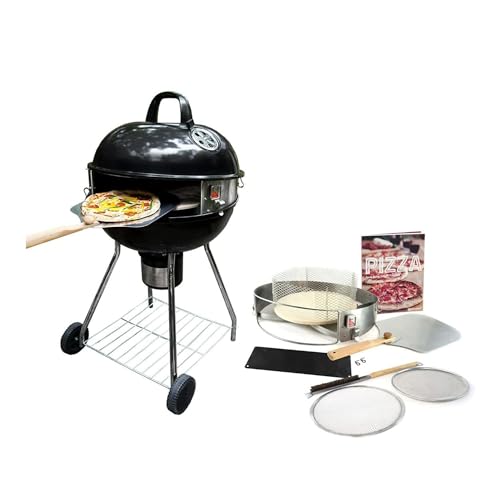
What it is: an attachment, not a standalone oven. A stainless steel ring sits between the bowl and lid of an 18.5 or 22.5 inch kettle grill, raising the lid to form a proper pizza chamber with a front opening. The kit includes the converter with a built-in thermometer, a 15 inch round cordierite stone, an aluminum charcoal fence, a 13 inch wide folding aluminum peel and a flex door with hooks. Pizzacraft describes the converted kettle reaching around 900 degrees Fahrenheit, with pizzas baking in roughly three to five minutes once the system is fully heated.
Who it suits: backyard kettle owners — which is to say, the readers this guide was written for. The charcoal fence is the heart of it: coals banked behind the stone send heat up the back wall and rolling forward under the raised lid, so the top of the pizza cooks in the same fierce air as the base. That is the behaviour every pizza maker is actually buying, and in a backyard you can exploit it fully — a side table for stretching and topping, a rhythm of one pizza baking while the next is built, a queue of eaters who never wait long. If pizza night at your house means six pies, not two, this is the only in-tier tool designed for the job.
Pros: true enclosed chamber with a low ceiling; the largest linked stone at 15 inches; a built-in thermometer for launching by temperature; fast bakes that make feeding a group realistic; the fence doubles as a banked-coal accessory for ordinary kettle cooking; and the whole kit stores inside the kettle, so the backyard setup has zero footprint between sessions.
Honest limitation: kettles only — gas, barrel and pellet households cannot use it, full stop. It also asks for charcoal craft: a generous chimney of fuel per session, ash management, and one mid-bake rotation per pizza for an even finish. The converted kettle runs at the top of its temperature range and sits taller and less stable than a stock kettle, so it belongs on level, heat-resistant ground with full clearances, supervised continuously, and left to cool completely before the ring or stone is handled. None of that is a flaw; it is the honest price of the tier’s best performance.
Choose it if you own a compatible kettle and pizza is a recurring backyard event. Skip it if your grill is gas — take the Cuisinart set and be happy — or if your pizza ambitions are twice a summer, where a stone’s simplicity will serve you better than a conversion’s ceremony.
Check on Amazon — check price on Amazon, and confirm your kettle diameter before ordering.
Cuisinart CPS-445 3-Piece Pizza Grilling Set — Best for backyard gas grills
What it is: an attachment set, not a standalone oven: a 13 inch round cordierite stone, a folding stainless steel peel and a stainless steel pizza wheel, under Cuisinart’s one-year limited warranty. No enclosure, no thermometer — your grill’s lid is the roof and its burners are the engine. It works on gas, charcoal and pellet grills, and in the home oven when the weather turns.
Who it suits: the enormous population of backyard gas-grill owners, especially first-timers. Gas is the backyard’s convenience fuel — instant on, steady, no ash — and this set is the fastest legal route from a standard gas grill to pizza night: stone on the grate, lid down, full preheat, launch, close, one rotation, retrieve, slice with the wheel that came in the box. For households whose entertaining style is weeknight-casual rather than ceremony-heavy, that simplicity is worth more than the kettle kit’s extra ceiling heat.
Pros: complete in one box, nothing else to order; cordierite rather than crack-prone ceramic; the folding peel stores in the grill cabinet or a drawer; works across grill types and indoors, so it survives grill upgrades and seasons; and the price leaves budget for gloves, flour and the second peel that busy backyard cooks eventually want.
Honest limitation: a bare stone under a tall gas lid cooks the base ahead of the top, so thin Neapolitan ambitions should temper themselves — expect excellent family-style pizza, with thicker or loaded pies needing a patient, lid-down finish. The 13 inch stone caps pie size and punishes sloppy launches; flour the peel every time. And the stone obeys stone law: gradual heating, gradual cooling, no soap, no soaking, no cold water on hot cordierite, ever.
Choose it if you cook on gas and want pizza this weekend with zero fuss. Skip it if you already own a peel — the Unicook stone spends more of the money on stone — or if you own a kettle and crave the highest-heat results.
Check on Amazon — check price on Amazon.
Unicook 15 x 12 Inch Pizza Stone for Oven and Grill — Best big stone for grill and oven
What it is: an attachment reduced to its essence — one rectangular cordierite stone, 15 by 12 inches, with a dough scraper included. No peel, no cutter, no enclosure: the money buys stone, and a lot of it. The rectangle suits grill grates and oven racks alike, holds a family pizza or two personal pies, and moonlights for bread, flatbreads and roast vegetables all year.
Who it suits: backyard cooks who already own a peel and cutter — often because a previous set’s stone cracked — and anyone whose pizza night includes bakers’ ambitions beyond pizza. In a backyard with a big grill, the rectangle’s extra area is working room: space to rotate without drama, space for a second small pie, space for the garlic bread that keeps the queue patient. It is also the natural second stone for PizzaQue owners who want an oven option for winter.
Pros: the largest surface per dollar in the guide; thermal-shock-resistant cordierite when treated gradually; dual grill-and-oven life across all seasons; a useful scraper in the box; and with no parts or coatings, nothing to fail but the stone itself.
Honest limitation: stone only — a peel is a separate, mandatory purchase if you lack one, because launching raw dough onto hot cordierite bare-handed is how burns and folded pizzas happen. The stone is heavy, needs gloved handling and a planned, heatproof cooling spot in a busy backyard, and on the grill it shares the bare-stone pattern of strong bases and gentler tops. Measure your grate, too: the rectangle needs clearance on all sides for airflow and lid closure.
Choose it if your tools are sorted and the stone is the missing piece. Skip it if you are starting from zero, where the Cuisinart set’s completeness wins, or if a round stone suits your kettle better.
Check on Amazon — check price on Amazon.
Onlyfire Round Pizza Stone Set — Best four-piece tool bundle (prose-only)
What it is: an attachment set, not a standalone oven: a 15 inch round cordierite stone with an aluminum peel, a pizza server spatula and a cutter — the fullest tool list in this guide, on the largest round stone, at what is usually set pricing.
Who it suits: backyard beginners starting from zero who want everything in one box, and kettle owners who prefer a round stone on a round grate.
Pros: four genuinely useful pieces; a forgiving 15 inch stone; cordierite construction; a peel sized to the stone.
Honest limitation: we verified the set’s identity and contents on its Amazon listing but could not verify a current in-budget United States price sighting for the exact set at research time, so it carries no link here. Check its live price yourself before ruling it out — in this category, prices move enough that it may sit inside the tier when you look. The bare-stone caveats apply: lid-roof tops, gradual heating and cooling, dry storage.
Choose it if you find it in budget and want maximum kit per dollar. Skip it if you prefer the linked Cuisinart set’s verified price, or the Unicook rectangle’s shape.
Prose-only pick: no purchase link, because a live in-budget offer for this exact set could not be verified at research time.
Cuisinart CPO-700 Grill Top Pizza Oven Kit — Best enclosed grill-top box (prose-only)
What it is: an attachment, not a standalone oven: a steel box that sits on the grill grate with a cordierite floor, a reflective stainless interior, an integrated thermometer and a 12 inch aluminum peel included. Cuisinart rates it to about 800 degrees Fahrenheit over gas, charcoal or pellet heat, baking in roughly five to seven minutes, in a compact 16 by 14 inch footprint.
Who it suits: backyard gas-grill owners who want the kettle kit’s enclosed-chamber effect without changing fuels. In a backyard with a strong three-burner grill, this is the gas route to properly browned tops — and the benchmark for what the next tier buys, which is exactly how this guide presents it.
Pros: a genuine enclosure for the grills most backyards run; thermometer and peel included; compact storage; major-brand warranty backing.
Honest limitation: verified prices sit at roughly double this tier, and the Amazon listing showed no featured offer at research time — prose-only on both counts. Pizza capacity is about 12 inches, and the box is only as strong as the grill beneath it; a tired two-burner will not drive it to its ratings. Buy it as a step-up, not as a bargain.
Choose it if the budget stretches — see our Best Outdoor Pizza Oven Under $100 guide for its natural tier. Skip it if the budget is firm or you own a kettle, where the PizzaQue delivers the idea in-tier.
Prose-only pick: no purchase link, because verified prices sit above this tier and no featured Amazon offer was live at research time.
BakerStone Original Series Pizza Oven Box — Best five-sided stone chamber (prose-only)
What it is: an attachment, not a standalone oven: a porcelain-enameled box whose chamber is stone on five sides — floor, walls and ceiling — sitting on a three-burner or larger gas grill, or a larger charcoal, pellet or wood grill. A wood launching peel, a turning peel and a dust cover are included. It is the most oven-like architecture in this guide, and a backyard with a big grill is precisely its intended home.
Who it suits: serious backyard pizza makers shopping a tier or two up, and patient watchers of sales. If your long-term plan is a dedicated oven, this box is the alternative worth weighing against one; if your budget is this guide’s, it is the aspiration that explains what more money buys — heat from every direction, evenly, pie after pie.
Pros: the best heat architecture here; a generous chamber; both launching and turning peels included, the professional pairing; a storage cover; and years of favourable reviews behind the design.
Honest limitation: verified prices are roughly double the tier ceiling, so no link — and no apology for saying so. It is heavy, it needs a genuinely large grill with lid clearance, and it is the biggest storage commitment in the guide. Its full case is made in our Best Outdoor Pizza Oven Under $200 roundup, where its price belongs.
Choose it if you are stepping up a tier for the long term. Skip it if the budget is the budget — in-tier, the PizzaQue’s chamber is the smart backyard money.
Prose-only pick: no purchase link, because verified prices sit above this tier.
Comparison table
| Pick | Type | Stone | Thermometer | Peel included | Works with | Status |
|---|---|---|---|---|---|---|
| Pizzacraft PC7001 PizzaQue Deluxe | Kettle conversion ring (attachment) | 15 inch round cordierite | Yes, built in | Yes, folding aluminum | 18.5 and 22.5 inch kettle grills | Check on Amazon |
| Cuisinart CPS-445 Set | Stone and tools set (attachment) | 13 inch round cordierite | No | Yes, folding stainless | Any grill or home oven | Check on Amazon |
| Unicook 15 x 12 Stone | Stone only (attachment) | 15 x 12 inch rectangular cordierite | No | No | Any grill or home oven | Check on Amazon |
| Onlyfire Stone Set | Stone and tools set (attachment) | 15 inch round cordierite | No | Yes, aluminum | Any grill or home oven | Prose-only |
| Cuisinart CPO-700 Kit | Enclosed grill-top box (attachment) | Cordierite, about 12 inch pizzas | Yes, integrated | Yes, aluminum | Gas, charcoal or pellet grills | Prose-only |
| BakerStone Original Box | Five-sided grill-top box (attachment) | Five-sided stone chamber | No | Yes, wood peel and turning peel | 3-burner and larger gas grills, large charcoal and pellet grills | Prose-only |
Backyard readers should read the table by throughput. The PizzaQue bakes fastest and hottest; the big stones bake the largest pies; the boxes brown tops best on gas. Match the column to the way your household actually eats, and the row chooses itself.
Running a backyard pizza session
The backyard’s gift is workflow, so set the session up like one. Stage three zones: the grill zone, kept clear of everything but the cook, gloves and a heatproof resting surface; the build zone, a side table with dough, sauce, toppings and a floured peel per pizza in progress; and the landing zone, where finished pizzas meet the cutter, a board and the people. Keep the zones in that order and the cook never crosses the yard carrying anything hot. Fuel generously — a kettle conversion session eats a full chimney of charcoal before the first pizza and wants more banked for a long run — and preheat longer than feels necessary, because a stone saturated through its core holds its temperature across a queue of pizzas while a merely surface-hot stone fades by the third pie.
Pace is the second discipline. Each pizza chills the stone a little; give the chamber a brief closed recovery between pies rather than launching relentlessly onto a cooling surface. Rotate every pizza once, halfway, for the even finish that separates backyard legends from backyard apologies. Keep toppings drier and lighter than instinct suggests — wet toppings are the leading cause of the soggy middle that gives grill pizza a bad name — and let the last pizza of the night be the experimental one, when the eaters are full and forgiving. When the cooking ends, the safety routine begins: burners off or coals left to die in the closed grill, everything cooling in place, ash treated as live until it has had a full day and more to prove otherwise, and stones cleaned later, cool, with a scrape and a brush rather than water and haste. A backyard session run this way is not a compromise version of a pizzeria; on a good evening, it is the original and the pizzeria is the copy.
Fuel, heat and the backyard advantage
It is worth understanding what your fuel is actually doing, because backyard cooks have a choice that apartment cooks do not. Charcoal in a converted kettle burns as a radiant bed: the coals themselves glow, the stone absorbs their heat from below and the banked fence arrangement throws a second wave of heat across the lid. The result is the highest ceiling temperature in this tier and a faint, genuine wood-fire character when a small hardwood chunk joins the coals — the flavour note that dedicated-oven owners talk about, available here for the price of a ring and a bag of charcoal. The costs are time and attention: lighting, waiting for the bed to ash over, arranging the fence, and feeding a long session. A backyard absorbs those costs gracefully — there is somewhere for the chimney starter to sit, somewhere for ash to cool, and no neighbour’s window directly above the smoke.
Gas trades a little of that ceiling for a great deal of control. A strong multi-burner grill under a stone gives you a dial instead of a ritual: full power for the preheat, small adjustments as the session settles, and an instant, clean end to the evening. What gas cannot do is give a bare stone a low ceiling — which is why gas households chasing top-browned, fast pizzas eventually look at the enclosed boxes reviewed below, and why the honest gas recommendation in this tier is a stone set used with realistic expectations and excellent results on the pizzas most families actually make. Pellet grills sit between the two: real fire, dial convenience, and a stone-friendly steadiness, with the same bare-stone ceiling caveat as gas.
Whichever fuel you run, the backyard’s structural advantage is the same: separation. The hot zone can be hot, the eating zone can be comfortable, and the two never have to negotiate over the same square metres. Use that separation deliberately. Site the grill where its smoke clears the table, keep the cook’s working triangle — grill, build table, landing board — inside a few steps, and let everyone else enjoy the part of pizza night that needs no equipment at all. That division of space is something no product in this guide can sell you, and it is the real reason backyard pizza, even at this budget, so often beats the dedicated-oven version cooked in a cramped corner somewhere else.
How to choose an outdoor pizza oven for a backyard under $75
Start with your grill, because every pick is an attachment. Kettle owners get the tier’s best product; gas owners get its most convenient; if you own no grill, this tier cannot start your pizza life — put the money toward the grill first, using our Best Charcoal Grill Under $75 or Best Gas Grill Under $75 guides, and return for the attachment with the next budget.
Decide your pizza style honestly. Thin, fast and blistered wants a low ceiling — the kettle ring, or a box if you step up. Thick, loaded and family-style is content with a stone’s gentle top. Most households make the second kind while dreaming of the first; buy for the calendar you keep, not the photograph you admire.
Size the stone to the crowd. Fifteen inches is forgiveness: room for a crooked launch, a mid-bake rotation and a family-size pie. Thirteen inches is fine for couples and careful cooks. Rectangles suit ovens and batch baking; rounds suit kettles. Whatever you choose, confirm grate fit and lid clearance with the stone in place and a gloved hand able to work.
Count the full kit. Peel, cutter, gloves and fuel are part of the true price. A bundled set often beats a bare premium stone on total cost even when the stone itself is better; do the whole sum before deciding which pick is really the budget pick. The tools roundup in our Best Grill Accessories Under $75 guide fills any gaps a set leaves.
Site the station like it matters — it does. Level, heat-resistant ground; full manufacturer clearances from fences, siding and overhangs; no dry vegetation underfoot; smoke drifting away from the table; a clear, lit path between grill and build table; children and pets outside the cooking zone; and a cool-down area where hot hardware can sit untouched until cold. Backyard space makes all of this easy, which is no excuse for skipping any of it.
Buy for the third summer. Stainless, cordierite and enamel survive; thin painted steel and novelty gadgets do not. In a tier this cheap, durability is the value metric — a kit that cooks two hundred pizzas is cheaper per pizza than a bargain that cooks twenty, whatever the receipts say.
Plan the second purchase before the first. Backyard pizza has a natural growth path, and buying with it in mind saves real money. The stone set you start with becomes the oven line or the second station when the kettle kit arrives; the kettle kit’s folding peel becomes the spare when a turning peel joins the kit; the first stone, retired from grill duty by a crack in year three, still serves as a baking steel’s understudy in the oven for bread. Nothing in this tier is wasted by an upgrade, because every piece is a tool rather than a system — which is the deep reason the conversion route beats a cheap standalone oven even where one could be found: tools accumulate, appliances are replaced. Buy the piece your next two years can still use, and the tier’s cheapness turns from a compromise into a strategy.
Respect the learning curve as a feature. The first session teaches your grill’s hot spots, your stone’s appetite for preheat and your own launch. The third session is competent. The tenth is a ritual the household organises itself around. Hardware that rewards that progression — a thermometer to read, a fence to arrange, a stone that responds to patience — keeps a backyard cook interested long after a push-button appliance would have become furniture. When you choose between the gentle stone and the demanding conversion, you are really choosing the hobby you want: pizza as a weeknight shortcut, or pizza as a craft with a fire at its centre. Both are legitimate; only one of them is yours.
Common mistakes when buying a backyard pizza oven
Expecting a standalone oven at this price. Every product here needs your grill. Readers who miss that sentence are the ones leaving angry reviews on perfectly good conversion kits; do not join them.
Under-fuelling the session. Pizza temperatures are a grill’s maximum effort. A half chimney of charcoal or a nearly empty gas tank produces one good pizza and a evening of decline. Start full, bank extra, and treat fuel as an ingredient.
Launching onto a half-heated stone. Surface-hot is not saturated. A rushed preheat gives the classic grill-pizza failure — scorched-looking edges over a pale, soft middle. Preheat with the lid down until the stone has had real time at temperature, and use the thermometer where your kit provides one.
Drowning the pie. Wet sauce, watery vegetables and a heavy hand with cheese defeat any stone. Sauce thin, toppings dry and light, cheese in a single confident layer — the backyard’s fierce heat does the rest.
Thermal-shocking the stone. Cold stone onto a maxed grill, hot stone into cold water, cold water splashed on for cleaning: each risks the crack that ends the stone’s life. Heat and cool with the grill, scrape warm, brush cool, never soap.
Cooking in the wrong spot. Against the fence, under the pergola’s low beam, on dry grass, beside the cushion storage — a grill at pizza temperature forgives none of it. Clearances, heat-resistant ground, supervision and a complete cool-down are the whole safety system; run all of it, every time, however routine the evening feels.
Final recommendation
Backyard kettle owners: buy the Pizzacraft PizzaQue Deluxe — check price on Amazon — and build your pizza nights around it. Gas households: start with the Cuisinart CPS-445 — check price on Amazon — and add the Unicook stone — check price on Amazon — when the hobby takes hold. Check the Onlyfire set’s live price before deciding, and treat the CPO-700 and BakerStone boxes as the honest shape of the next tier. However you equip it, the formula is the same: a saturated stone, a disciplined station, and a backyard full of people who have stopped ordering takeaway. One last encouragement for the undecided: the first session will not be perfect, and it does not need to be. Dough is forgiving, toppings are generous, and a yard full of people eating pizza they watched being made over a fire is a success by any measure that matters. Start this weekend; the second session is where the legend begins.
Frequently asked questions
What is the best pizza setup for a backyard on this budget?
A kettle conversion kit if you own a kettle — it creates a true oven chamber with rolling top heat and the fastest bakes in the tier. On gas, a complete stone set is the practical champion, and a bigger stone is the first upgrade. Either way, the grill you own decides the pick; there is no standalone oven at this price.
How many pizzas can I cook in one backyard session?
As many as your fuel and stone recovery allow. A saturated stone on a well-fuelled kettle or gas grill will turn out pizzas back to back with brief recovery pauses between pies; plan a generous chimney of charcoal or a full gas tank for a long session, and expect each pizza to take a few minutes once the system is at temperature.
Charcoal or gas for backyard pizza?
Charcoal, through a conversion kit, reaches the highest temperatures and adds a whisper of smoke; gas is steadier, cleaner and easier for weeknight cooking. Both make excellent pizza on a proper stone. Choose by the grill you own and the ritual you enjoy — the cook who loves tending a fire should not buy for the cook who wants a weeknight shortcut, or the reverse.
Can I leave a pizza stone on the grill between sessions?
Many cooks store the stone in the closed grill or kettle, and a conversion kit is designed to live in its kettle. Keep everything dry, covered and protected from weather; bring stones indoors for winter if your grill lives uncovered. Never leave a stone where rain can soak it and a later preheat can steam-crack it — dry storage is stone survival.
Why does my pizza stick to the peel or the stone?
Sticking to the peel means too little flour or semolina, too much time sitting topped on the peel, or a dough that is too wet — build fast, dust generously, and shake-test before you walk to the grill. Sticking to the stone usually means the stone was not fully preheated; a saturated stone releases a set base cleanly.
Is it safe to run a grill at pizza temperature near a fence or deck?
Only with the grill maker’s full clearances observed, on a level heat-resistant surface, away from overhangs and combustibles, supervised throughout, and cooled completely before covering or moving. Pizza temperatures are a grill’s maximum output; site the grill for that reality, keep the zone clear of dry vegetation and furniture, and never let routine turn into carelessness.
What about wind, rain and cold evenings in the backyard?
Wind is the backyard variable nobody plans for and everybody meets. It fans charcoal into hot spots, bends gas flames away from the stone and strips heat from every surface, so on a windy evening position the grill in the yard’s shelter, expect longer preheats, and keep the lid discipline strict — every unnecessary opening costs temperature the wind will not give back. Rain ends outdoor sessions honestly; that is what the stone’s second life in the oven is for, and a cook who moves the operation indoors without drama loses nothing but the backdrop. Cold evenings, by contrast, are pizza weather at its best: the grill cares little, the stone cares not at all once it is saturated, and the cook works in a comfort that a July session cannot offer. Dress the table, light the yard, and let the fire do what fires have always done in the cold half of the year — gather people around it, feed them from it, and make the season’s short evenings feel like the point rather than the obstacle.


