Where to buy
Check the latest price, availability and delivery on Amazon. Orders are placed on Amazon. We may earn a commission from qualifying purchases. Three of the six picks below are sold on Amazon with live listings we could verify; the other three are covered in prose because their makers sell mainly direct or their Amazon listings carried no live offer when we checked — each review says which is which, and why.
- Best complete furniture-grade setup: Vivere Double Cotton Hammock with Solid Pine Arc Stand — sold mainly through Vivere and home retailers; see the review below for where it fits
- Best complete set with a live Amazon listing: Vivere Double Cotton Hammock with Space Saving Steel Stand — Check on Amazon
- Best classic rope hammock: Original Pawleys Island Large DuraCord Rope Hammock — covered in prose; the maker’s own store is the reliable source
- Best king-size weatherproof bed: LA SIESTA Brisa Classic Hammock, King — covered in prose; Amazon listing carried no live offer at research time
- Best hanging retreat for two: Vivere Double Cacoon Hanging Chair — Check on Amazon
- Best fabric hammock value in this guide: Wise Owl Outfitters DoubleOwl Hammock — Check on Amazon
Read the full guide ↓
Disclosure: As an Amazon Associate, dailyhomedecorating.com earns from qualifying purchases. Links to Amazon on this page are affiliate links; they cost you nothing extra. Listing details such as price and availability change often, so check the current Amazon listing before you buy.
Shopping for the best hammock under $1500 starts with a fact almost no listing will tell you: a single hammock, on its own, essentially never costs anywhere near that much. The most expensive fabric hammocks from respected makers — handwoven beds, king-size Colombian classics, handcrafted American rope hammocks — sit in the low hundreds of dollars, not the high hundreds. So a budget of $1500 is not really a hammock budget at all. It is the budget for a complete outdoor relaxation corner: a flagship hammock, a furniture-grade stand in teak-toned or solid pine arc form, a pillow, a cover, proper mounting hardware, and money left over. This guide treats the keyword honestly, as a whole-setup budget, and it spends the imaginary money the way a careful buyer would — on the parts that actually change how the hammock feels in year three, not on the parts that only change the product photo.
Here is what that means in practice. The stand is where most of the money should go, because the stand is the furniture. A powder-coated steel frame is the sensible default and the one most households should buy. A solid wood arc stand is the upgrade that turns a hammock into a piece of garden architecture, and it is the single purchase that can legitimately absorb a third or more of this budget. The hammock bed itself rewards spending up to a point — better fabric, more suspension cords, honest handcrafted construction — and then stops rewarding it entirely. Past that point you are paying for a second hammock, a hanging chair for the corner nobody uses, or accessories. We would rather tell you that plainly than pretend six products in this guide each cost just under the ceiling. Only one famous flagship combination we looked at — a handcrafted rope hammock paired with its maker’s seven-ply cypress arc stand, sold direct — actually exceeds this entire budget on its own, and we flag it in its review so you can see what genuine top-of-market pricing looks like.
For most households, the right answer in this guide is the Vivere steel-stand set if you want the proven, put-it-anywhere package, or the Vivere solid pine arc combo if the stand will live permanently in view and you want it to look like furniture. If you have two strong trees, the Pawleys Island rope classic and the LA SIESTA Brisa King are the beds to hang between them. Below you will find the quick picks, how we chose them, full reviews of all six, a side-by-side comparison, a buying guide built around how a $1500 budget should actually be allocated, the mistakes that waste a budget this size, and the questions buyers at this tier ask most.
In this guide
Quick Picks: The Best Hammock Under $1500 at a Glance
Each row names a buyer type and the hammock or set that suits it. Linked picks carry a live Amazon listing we verified; prose-only picks are labelled, with the reason in their full reviews. Check the current price on Amazon for every linked pick before you buy — and remember that at this budget, the question is never whether you can afford the hammock, but whether the whole setup is the right one.
| Buyer type | Pick | Why it stands out | Link |
|---|---|---|---|
| Best furniture-grade setup | Vivere Double Cotton Hammock with Solid Pine Arc Stand | An FSC-certified solid pine arc frame with a densely woven double cotton bed, 450 lb maker capacity — the set that looks like garden furniture, because it is | Prose-only — sold mainly direct and through home retailers |
| Best complete set on Amazon | Vivere Double Cotton Hammock with Space Saving Steel Stand | The category’s benchmark combo: double cotton bed on a 9 ft space-saving steel stand, carry bag included, no trees needed — check price on Amazon | Check on Amazon |
| Best classic rope hammock | Original Pawleys Island Large DuraCord Rope Hammock | Handcrafted in the USA, 13 ft by 55 in, DuraCord rope with varnished white oak spreader bars, 450 lb capacity | Prose-only — Amazon listing had no live offer; buy from the maker |
| Best king-size weatherproof bed | LA SIESTA Brisa Classic Hammock, King | A 5 ft 11 in wide polypropylene bed with 92 suspension cords and a 440 lb capacity, handmade in Colombia, built to live outdoors | Prose-only — Amazon listing had no live offer at research time |
| Best hanging retreat | Vivere Double Cacoon Hanging Chair | A two-person hanging tent-chair in polyester canvas, 440 lb capacity, hangs from a single point — a different kind of lounging entirely — check price on Amazon | Check on Amazon |
| Best fabric hammock value | Wise Owl Outfitters DoubleOwl | A 10 ft by 6 ft 6 in double bed with a full strap kit in the bag and a 500 lb maker capacity — the proof that fabric quality tops out early — check price on Amazon | Check on Amazon |
How We Chose These Picks
A guide at this tier has a different job from a budget guide. At low prices, the work is filtering out junk. At $1500, almost everything from a reputable maker is competently built, so the work shifts to allocation: which parts of a complete setup deserve the money, which products are genuinely flagship rather than merely expensive, and which purchases would be waste dressed as luxury. We applied four tests to every candidate. First, verifiable identity: every pick is a real product from a named maker with published specifications — dimensions, materials and a stated weight capacity — that we could confirm from the maker’s own pages, retailer listings or independent testers. Second, honest pricing position: we recorded what each product actually sells for during research, and any pick whose real price sits far below the ceiling is described as such in its review, because pretending otherwise would be the easiest way to make this guide useless. Third, a live-buying test for links: a pick is only linked when we could verify its Amazon listing identity and a price sighting for that exact product comfortably inside this tier; picks sold mainly direct, or whose Amazon page showed no live offer, are covered in prose with the reason stated. Fourth, a recall check: we searched CPSC records for every maker named here, and the pattern in this category is worth knowing — hammock recalls concentrate in stands, hooks and hardware from other brands, which is one more reason the stand decision gets so much attention below.
We also held the line on what counts as a hammock purchase at this level. A complete setup at $1500 can reasonably include the hammock, the stand, suspension or mounting hardware rated for the load, a pillow designed for hammock use, and a weather cover — because a setup left outdoors is a setup that ages. It should not need to include a second full-price hammock to reach the number, and none of our recommendations depends on buying duplicates. Where a maker’s own flagship combination exceeds the budget — one does, and it is named in its review — we say so rather than quietly rounding it into the tier. Finally, every capacity figure in this guide is a maker’s published claim, not a certified figure; treat each as a ceiling to stay well under, especially with two people and the dynamic load of climbing in, which multiplies forces at the anchor points well beyond static body weight.
The Six Picks in Detail
1. Vivere Double Cotton Hammock with Solid Pine Arc Stand — the furniture-grade flagship
Who it suits: Homeowners whose hammock will sit permanently in a visible spot — beside a pool, on a main deck, in the part of the garden guests see first — and who want the setup to read as outdoor furniture rather than camping gear that never got put away. If the look of the thing matters to you almost as much as the lie of it, this is your pick.
This combo pairs Vivere’s densely woven double cotton bed — 87 inches long by 63 inches wide, big enough for two adults to lie side by side rather than stacked — with an arc stand built from FSC-certified solid pine. The maker’s capacity for the set is 450 lb. The stand’s footprint is about 102 inches long by 47 inches wide, which is compact for a wooden arc: long timber arcs from other makers stretch to fourteen feet and dominate a patio, while this one fits a deck corner. Independent roundups of wooden stands consistently place this combo at or near the top of the category, and the reasons are practical as much as aesthetic — the hammock and frame are designed for each other, so there is no compatibility arithmetic, no chain-length guessing, and the bed height adjusts at the hooks.
What we like: The pine arc is genuinely beautiful in a way powder-coated steel never is, and its weight makes the set feel planted when you climb in. The cotton bed is the breathable, body-wrapping Brazilian style, with polyester end strings for durability where cotton is weakest. Buying bed and stand as one engineered set removes the most common premium-tier mistake, which is pairing a hammock and a stand that were never sized for each other.
Honest limitation: Wood is a maintenance commitment. Pine left outdoors wants a sealer coat and periodic inspection, and cotton wants bringing in during long wet spells — this is a flagship you look after, not a set you abandon to the weather. It is also, like everything in this guide, far below the ceiling on its own: the honest way to spend the rest of a $1500 budget around it is a quality cover, a hammock pillow, and perhaps a second bed in a weatherproof fabric for the wet months.
Choose it if the hammock is a permanent landscape feature and you will enjoy owning a piece of wooden furniture. Skip it if you want zero-maintenance outdoor gear, or your space is a small balcony — look at the Cacoon and the steel-stand set instead. This pick is covered in prose because we could not verify a live Amazon listing identity for the exact pine-arc configuration during research; it is sold through Vivere directly and through major home retailers, and its price at those sellers sat comfortably inside this tier.
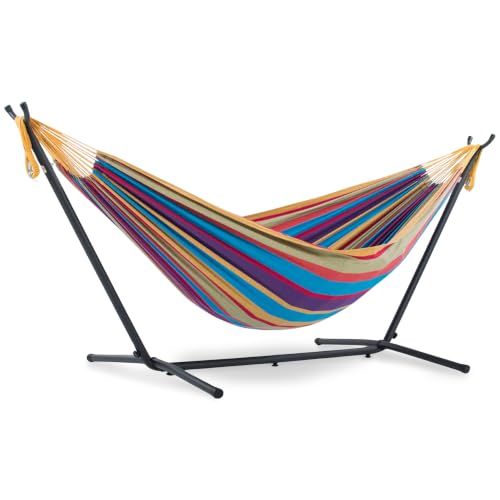
2. Vivere Double Cotton Hammock with Space Saving Steel Stand — the benchmark complete set
Who it suits: Almost everyone else. If you want one box that becomes a two-person hammock spot anywhere flat — lawn, deck, patio, campsite — with no trees, no drilling and no second purchase, this is the set the rest of the category is measured against.
The package combines a double cotton hammock — bed 63 by 94 inches, total length 130 inches — with a nine-foot space-saving steel stand, at a maker capacity of 450 lb. The stand assembles without tools in minutes and breaks down into an included carry bag, which is why this set keeps appearing in tester roundups year after year: OutdoorGearLab’s reviewers praised exactly that freestanding convenience, the ability to set up on a beach or a desert campsite where straps have nothing to hold. The steel frame is powder-coated, the footprint is far smaller than a wooden arc, and the whole thing stores in a closet over winter.
What we like: It is the lowest-risk purchase in this guide. The design has been sold for years, parts and replacement beds are easy to find, and the space-saving stand geometry works in spots where a full-length frame will not. At this budget it also leaves most of your $1500 unspent, which is a feature: add a weatherproof second bed, a stand cover and a pillow and you own a genuinely complete corner for a fraction of the ceiling.
Honest limitation: Cotton is the comfort choice, not the weather choice — it should come inside during extended rain, and the steel stand, while sturdy, is utilitarian to look at. Tall users should also know the nine-foot stand keeps the bed lower and shorter than a fourteen-foot arc does; if you are well over six feet, test the geometry against the Brisa King or the pine arc instead.
Choose it if you want the proven all-in-one answer and prefer spending the surplus on accessories and a second bed. Skip it if the hammock will live permanently outdoors in a wet climate and never come in — choose weatherproof fabrics first. Check on Amazon
3. Original Pawleys Island Large DuraCord Rope Hammock — the American classic
Who it suits: Traditionalists with two strong trees or posts fourteen to sixteen feet apart, who want the open, airy lie of a rope hammock and the satisfaction of buying a handcrafted product made the same way for over a century.
The Large measures 13 feet by 55 inches with a bed of 6 feet 10 inches, carries a 450 lb maker capacity, and is handcrafted in the USA. The rope is DuraCord, the maker’s proprietary solution-dyed synthetic blend engineered to feel like cotton while resisting the fading, mildew and weather damage that destroy cotton rope; the spreader bars are solid white oak dipped in marine-grade varnish, and the hardware is zinc-plated. Rope hammocks breathe like nothing else — on a hot afternoon there is no fabric against your back at all — and the double-latch weave supports without the bulky knots cheaper rope beds use.
What we like: This is the hammock as heritage object, and unusually for heritage objects it is also the practical choice for leave-it-up-all-season households, because DuraCord tolerates weather that would ruin a cotton bed. It is also the pick that teaches the tier’s biggest lesson: the hammock itself, even handcrafted, is a few hundred dollars. Pair it with the maker’s own steel stand and the total is still mid-tier. Pair it with the maker’s seven-ply cypress Roman Arc stand — a 150 lb piece of furniture in its own right — and the maker’s combined price passes this guide’s entire $1500 ceiling. That is what the genuine top of this market looks like, and it is a stand, not a hammock, that gets you there.
Honest limitation: A spreader-bar rope bed is the least forgiving style here: it wants to be hung taut and level, it can feel tippy to new users, and the open weave leaves rope-pattern marks on skin after a long nap. It also needs that full fourteen-plus feet of span, which rules out many patios.
Choose it if you have the trees, the span and the taste for the classic. Skip it if you want the cocoon feel of a fabric bed or your span is under fourteen feet. This pick is prose-only because its Amazon listing showed no live offer when we checked; the maker’s own store is the dependable source, and we would rather send you there than link a dead listing.
4. LA SIESTA Brisa Classic Hammock, King — the weatherproof king bed
Who it suits: Couples and families who want the biggest, most forgiving fabric bed in this guide and intend to leave it outdoors — the Brisa is built from the fibre out for exactly that life.
The King bed is 5 feet 11 inches wide with a cloth length of 8 feet 6 inches and a total length of 13 feet 1 inch, suspended by 92 cords that spread load so evenly the lie feels like floating rather than sagging. Capacity is 440 lb. The fabric is polypropylene — LA SIESTA’s weather-resistant, tear-resistant outdoor fibre — and the hammock is handmade in Colombia, the home of this gathered-end tradition. It needs a minimum span of about 11 feet 10 inches and a hanging height around 5 feet 11 inches, and it rolls up to roughly pillow size for storage, which no other bed this large manages.
What we like: Width is the luxury in a fabric hammock, and nothing else in this guide gives a couple this much of it, in a fabric that shrugs off sun and showers. The maker’s ecosystem is the other flagship story: the same bed pairs with the maker’s steel stand or its wooden Elipso stand for buyers building a full premium corner over time, and the listing’s own bundle table shows how quickly a stand, not a hammock, consumes a budget like this one.
Honest limitation: Polypropylene is functional rather than lush — it does not have cotton’s softness against skin — and the King genuinely needs its span; cramp it into a shorter gap with deep sag and you have bought width you cannot use. Suspension is not included with the bed alone, so tree straps or a mounting kit are a necessary second line on the order.
Choose it if you have the span and want a leave-outside family bed. Skip it if your hang distance is under twelve feet or you prioritise fabric softness over weather resistance — the cotton picks above are softer. This pick is prose-only because its Amazon listing carried no live offer at research time; specialist hammock retailers stock it, and the maker’s sizing guidance is worth reading wherever you buy.
5. Vivere Double Cacoon Hanging Chair — the hanging retreat
Who it suits: Anyone whose idea of relaxing is more nest than bed: readers, nappers who like an enclosed, shaded spot, and households where a hanging chair will be fought over by exactly two people at a time.
The Double Cacoon is a hanging tent-chair in polyester canvas with a 440 lb maker capacity, suspended from a single point by an 18-foot rope and carabiner included in the box. That single-point hang is its superpower: it needs one strong branch, one beam, or a tripod stand, and its ground footprint is a circle a few feet across rather than a thirteen-foot span. Inside, the canvas walls cut glare and breeze, which makes it the best reading seat in this guide and a genuine garden feature — guests ask about it in a way they never ask about a hammock.
What we like: It converts corners nothing else can use, it travels between a tree and a pergola beam in minutes, and price tracking on its Amazon listing shows it living in the premium-but-sensible band of this tier — leaving, again, most of a $1500 budget for the rest of the corner. For small-space and apartment readers especially, this is often the flagship purchase that actually fits their lives.
Honest limitation: It is a chair, not a bed: you sit and recline rather than stretch out flat, two adults fit cosily rather than spaciously, and the canvas that makes it a retreat also makes it warm on still, hot days. The single anchor point must be genuinely structural — a branch or beam you would trust with well beyond the occupants’ weight, because swinging adds dynamic load.
Choose it if you want a statement seat and your space rewards a small footprint. Skip it if full-length lying is the whole point. Check on Amazon
6. Wise Owl Outfitters DoubleOwl — the value anchor that proves the tier’s point
Who it suits: The sceptic. If you have read this far suspecting that hammock comfort might top out long before $1500, this is the pick that agrees with you — and the one to buy first if you are new to hammocks and want to learn what you like before building the expensive corner.
The DoubleOwl is a gathered-end double in parachute nylon, 10 feet by 6 feet 6 inches, with a 500 lb maker capacity, and — the detail that shames several premium names — a complete hanging kit in the bag: two nine-foot tree straps and two carabiners, so it hangs the day it arrives between any two anchors ten to fifteen feet apart. Independent testers who weigh and measure these things put the full kit at about thirty ounces, which makes it the only pick in this guide you can also take camping, to the park, or on holiday.
What we like: As a second hammock — the portable one, the guest one, the one that lives in the car — nothing else here competes, and as a first hammock it is the cheapest education available: one season in a DoubleOwl teaches you your preferred sag, span and fabric feel, knowledge worth more than any single flagship purchase made blind.
Honest limitation: Nylon is not cotton: it crackles, it holds static, and it is not a leave-outside-all-season fabric, since sun and moisture degrade it over time. It also looks like what it is — camping gear — and will not anchor a designed garden corner the way the pine arc does.
Choose it if you want portability, a guest bed, or a low-risk first hammock before committing to furniture. Skip it if this purchase is meant to be the permanent, beautiful centrepiece — that is the pine arc’s job. Check on Amazon
Side-by-Side Comparison
| Pick | Type | Bed size | Maker capacity | Stand / hang needs | Amazon link |
|---|---|---|---|---|---|
| Vivere Solid Pine Arc Combo | Brazilian cotton double with wood arc stand | 87 x 63 in | 450 lb | Included pine arc, ~102 in footprint | Prose-only |
| Vivere Steel Stand Combo | Brazilian cotton double with steel stand | 94 x 63 in | 450 lb | Included 9 ft steel stand, carry bag | Check on Amazon |
| Pawleys Island Large DuraCord | Spreader-bar rope hammock | 13 ft x 55 in overall | 450 lb | Trees/posts 14–16 ft apart, or a 15 ft stand | Prose-only |
| LA SIESTA Brisa King | Gathered-end polypropylene, king | 71 in wide, 13 ft 1 in overall | 440 lb | Span ~11 ft 10 in min; suspension sold separately | Prose-only |
| Vivere Double Cacoon | Hanging chair for two | Single-point hang | 440 lb | One structural anchor point; rope included | Check on Amazon |
| Wise Owl DoubleOwl | Gathered-end nylon double | 10 ft x 6 ft 6 in | 500 lb | Anchors 10–15 ft apart; straps included | Check on Amazon |
Read the table by hang geometry first and fabric second. Every disappointment at this tier traces back to a span, footprint or anchor that did not match the space — never to a few dollars of price difference, because at this budget there effectively is none.
How to Choose: Spending a $1500 Hammock Budget Honestly
Allocate by component, not by product. The healthiest way to use a budget this size is to decide what each part of the corner deserves before you shop. As a rule of thumb drawn from the real prices in this guide: the stand or mounting solution is the largest single line, the bed is the second, and hardware, pillow and cover together are a modest third — with a genuine surplus left over that you should feel no pressure to spend. If a single product claims nearly the whole budget, it had better be a hammock plus a furniture-grade stand from a named maker, the way the cypress arc combination discussed above is; a bare hammock priced anywhere near this ceiling would be a pricing anomaly, not a flagship.
Decide the hang before the hammock. Measure your span (the Brisa King needs roughly twelve feet minimum, the Pawleys fourteen to sixteen), your footprint (a wooden arc wants a clear rectangle; the nine-foot steel stand wants much less), and your anchors (the Cacoon needs one point you would trust with a swinging load). Readers planning the wider garden project may also want our guide to the Best Hammock For Backyards Under $700, which covers many of the same sets at the tier where their prices actually live, and the Best Adirondack Chair Under $1500 guide for the seating that usually completes the corner.
Match fabric to your weather honesty. Cotton is the softest lie and the least weatherproof. Polypropylene and DuraCord exist for people who know, truthfully, that the hammock will stay out in rain. Nylon is for hammocks that travel and get put away. Choose for the owner you are, not the owner you intend to become.
Treat capacity as a ceiling with margin. Maker capacities are claims, not certifications. For two-person use, stay meaningfully under the published figure, hang low — a hammock you can sit into like a chair, with the bed around eighteen inches off the ground at its lowest loaded point — and aim for the classic thirty-degree strap angle, which keeps anchor forces reasonable. Inspect hooks, chains and stand welds each season; the category’s recall history is a hardware story, and hardware is inspectable.
Buy the ecosystem, not just the item. At this tier, replacement beds, matching stands, covers and mounting kits from the same maker are worth real money over five years. That is the quiet advantage of the Vivere, LA SIESTA and Pawleys Island names in this guide: each sells the whole system, so a worn bed never orphans a good stand.
Three Ways to Build the Corner: Worked Examples
Abstract allocation advice is easy to nod at and hard to use, so here are three complete corners assembled from this guide’s picks, each comfortably inside the budget, each built for a different household. None of them spends the whole $1500, and that is the point: at this tier a well-built corner leaves a surplus, and the surplus is not a failure of ambition.
The permanent garden corner. Start with the Vivere solid pine arc combo as the anchor piece and treat it like the furniture it is: budget for a breathable fitted cover from day one, a hammock pillow for the afternoon-nap position, and a small side table’s worth of the budget for the sealer the pine will want in its second year. Add the Wise Owl DoubleOwl as the household’s second bed — the one that travels to the park, the beach house and the guest room — and the corner still lands well inside budget with money unspent. This is the build for owners who entertain in the garden and want the hammock to hold its own visually against real outdoor furniture.
The two-tree classic corner. Hang the Pawleys Island DuraCord between the trees with the maker’s own chains and hooks, and spend the difference between its price and this ceiling on the things that make a rope hammock a season-long pleasure: a proper storage bag for winter, a pillow designed for spreader-bar beds, and a second, fabric bed — the Brisa King — for the days when someone wants the cocoon instead of the open weave. Two genuinely different lies, one pair of trees, and the whole arrangement still costs less than a single flagship stand combination. Households with mature trees get more hammock per dollar than anyone else in this guide, because nature provides the most expensive component free.
The flexible, no-commitment corner. Take the Vivere steel-stand set as the base — it moves with the sun, stores in a closet, and asks nothing of your trees or your walls — and pair it with the Double Cacoon on a tripod stand or a strong pergola beam for the reading seat. The two pieces serve different moods, set up in different spots, and together they furnish a relaxation corner that can migrate from patio to lawn to a rented holiday home. What remains of the budget covers covers, pillows and mounting hardware with room to spare. This is the build we would hand to renters, movers and anyone whose outdoor space is borrowed, small or likely to change.
Notice what none of the three builds does: none buys a hammock because it was expensive, none duplicates a purchase to reach a number, and none skips the unglamorous lines — covers, hardware, storage — that decide whether a flagship setup still delights in its fourth summer. That discipline, not the dollar figure, is what a $1500 budget is actually for.
Common Mistakes at This Budget
Assuming the price must be spent. The most expensive mistake at $1500 is inventing purchases to reach it. A flagship bed, a good stand and the right accessories leave a surplus for most buyers; bank it, or put it toward the surrounding space — the Best Deck Box For Apartments Under $1500 guide covers the storage that keeps cushions and covers alive, for example.
Buying a hammock and stand from different guesses. Mismatched span, hook height and bed length are the premium tier’s version of a sizing error. Combos exist precisely to remove the guesswork; if you mix brands, do the arithmetic twice.
Leaving cotton out all season. Cotton beds and rope hammocks in cotton will mildew and weaken if they live wet. Weatherproof fibres exist — two picks in this guide are built from them — and choosing cotton anyway, then storing it outdoors, is paying flagship money for a one-season product.
Hanging a spreader-bar bed like a gathered-end bed. Rope hammocks with bars want to be taut and level; gathered-end beds want sag. Hang either one the other’s way and you will conclude, wrongly, that hammocks are uncomfortable.
Ignoring the anchor math on single-point hangs. A hanging chair concentrates the entire load, plus swing, on one fixing. Lag bolts into genuine structure, a branch with real diameter, or a rated stand — never a decorative pergola rafter.
Final Recommendation
If you buy one thing from this guide, buy the setup that matches your space and be done: the Vivere steel-stand combo for the proven all-rounder with money to spare, the Vivere pine arc combo when the stand is furniture, the Pawleys Island DuraCord between two good trees, the Brisa King when the bed must live outdoors, the Cacoon when a single-point nest fits your space better than a bed, and the DoubleOwl whenever portability or a second hammock is the real need. Readers working with less room should also see the Best Hammock For Small Patios Under $1500 companion guide, and apartment readers the Best Hammock For Apartments Under $1500 edition — both apply this same budget honesty to spaces where $1500 cannot buy a single extra inch. The budget was never the hard part of this purchase. The fit is.
Care and Longevity at the Flagship Tier
Spending flagship money buys materials that can last a decade, but only with flagship habits. Cotton beds should be shaken out, dried fully after any damp day, and stored indoors through the wet season; their enemies are mildew and ultraviolet, in that order. Polypropylene and DuraCord tolerate being left out, but even they last longer under a breathable cover, and a cover is the cheapest longevity purchase in this entire guide. Wooden stands want an annual inspection — fasteners snugged, finish checked, a fresh coat of sealer where the maker recommends it — and steel stands want their welds and hook points looked at each spring, a two-minute ritual borrowed directly from the category’s recall history: the failures on record were hardware failures, and hardware announces itself to anyone who looks. Suspension straps and ropes are consumables; replace any that show fraying, flattened fibres or stiff, sun-bleached sections. A $1500 corner maintained this way is a ten-year purchase. The same corner neglected is a three-year one, and the difference was never the price tag.
Frequently Asked Questions
Does any single hammock actually cost $1500?
Essentially, no. The most expensive individual hammock beds from established makers — handwoven, handcrafted or king-size — sell in the low hundreds of dollars. Four-figure money in this category buys combinations: a hammock plus a furniture-grade wooden stand, and in one flagship case we found, a handcrafted rope hammock with its maker’s cypress arc stand priced above this entire budget when bought direct. Treat any bare hammock listed near $1500 with suspicion.
What should I actually spend a $1500 hammock budget on?
A flagship bed, the best stand your space suits — wood arc for permanence and looks, steel for flexibility — rated mounting hardware, a hammock pillow, and a breathable cover. Most readers will land well under the ceiling with all of that included, and the remaining money is better spent on the surrounding patio than on a second hammock nobody uses.
Is a wooden arc stand worth it over a steel stand?
If the hammock is a permanent, visible feature, yes: the arc is furniture, it is heavier and more planted underfoot, and it holds the bed at a more generous height and span. If the hammock moves around, stores away in winter, or lives on a small patio, the nine-foot steel stand is the smarter buy at a fraction of the cost.
How long will a premium hammock last outdoors?
Weatherproof fibres such as polypropylene and DuraCord can live outside for many seasons with basic care. Cotton cannot: bring cotton beds in during prolonged wet weather and store everything dry over winter. Stands last longest with an annual hardware check and, for wood, a fresh coat of sealer as the maker directs.
What weight capacity should two adults look for?
Choose a maker capacity comfortably above your combined weight and stay well under it in use — dynamic loads from climbing in and shifting around exceed static weight. The picks in this guide publish capacities in the 440 to 500 lb range, which suits most couples with sensible margin, hung low at a proper thirty-degree angle.
Can I hang one of these without trees?
Yes — that is what stands are for, and two of this guide’s picks include one. If you are comparing stands on their own across budgets, our Best Hammock Under $700 guide covers the tier where most stand-inclusive sets are actually priced.
Is it worth paying more for a handcrafted hammock?
For the bed itself, craftsmanship buys things you can verify: denser rope or weave, more suspension cords sharing the load, better hardware, and a maker who sells replacement parts years later. It does not buy a different category of comfort — a well-made mid-priced bed, correctly hung, delivers most of the experience. Pay for craft when you value the object and the longevity; do not pay for it expecting a cheap hammock’s lie to be transformed beyond recognition.
Should I buy a hammock with a stand or hang it between trees?
If your trees stand at the right distance — roughly ten to fifteen feet for gathered-end beds, fourteen to sixteen for rope hammocks — and you are happy for the spot to be permanent, hanging is cheaper and simpler, and nature provides the most expensive component free. A stand buys freedom: placement anywhere, seasonal moves, storage, and no dependence on the garden you happen to have inherited. At this budget the stand is not the extravagant option; for most households it is the practical one.