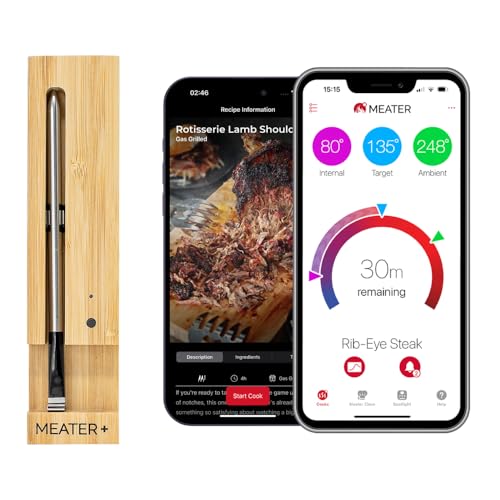
Where to buy
Check the latest price, availability and delivery on Amazon. Orders are placed on Amazon. We may earn a commission from qualifying purchases.
- Best apartment temperature pick: MEATER Plus Smart Wireless Meat Thermometer — check price on Amazon
- Best dual-use investment: ThermoWorks Thermapen ONE — check price on Amazon
- Best indoor-outdoor surface: Lodge Double Play Reversible Cast Iron Grill/Griddle LDP3 — check price on Amazon
- Best safe cleaning pick: Kona Safe/Clean Bristle-Free Grill Brush — check price on Amazon
- Best sear upgrade for a permitted grill: GrillGrate Interlocking Grill Grates, 4-Panel Set — check price on Amazon
- Best compact fire starter, where charcoal is allowed: Weber Compact Rapidfire Chimney Starter 7447 — check price on Amazon
The Keter Unity XL prep cabinet and the onlyfire kettle rotisserie kit are discussed in prose only in this guide — the cabinet because many leases forbid it on balconies regardless of budget, and the rotisserie because we could not verify a clean US price sighting for its exact listing. Read the full guide ↓
Disclosure: As an Amazon Associate, dailyhomedecorating.com earns from qualifying purchases. Links to Amazon on this page are affiliate links; they cost you nothing extra. Listing details such as price and availability change often, so check the current Amazon listing before you buy.
Here is the truth that has to open any honest guide to the best grill accessories for apartments under $1500: a bigger budget does not change a single line of your lease. If your building bans charcoal on balconies — and a great many do, along with local fire codes that restrict open-flame cooking near combustible railings and above lower balconies — then no accessory at any price makes a charcoal setup legal, and if your lease bans storing a prep cabinet or a fuel canister on the balcony, a flagship storage unit is a violation with wheels. So this guide spends the $1500 differently from our general system guide. It treats the figure as a total budget for an apartment-legal grilling life: premium tools that work identically indoors and out, monitoring that suits the small electric or gas grill your building does allow, surfaces that earn their keep on the stovetop all winter, and safe cleaning that will never drop a metal bristle where neighbours walk. Much of the budget, frankly, should stay unspent or go toward quality within the permitted categories — and this guide will tell you exactly where the line falls.
Start by establishing what your situation actually permits, because apartment grilling is not one situation but three. Situation one: your building allows a small gas or electric grill on the balcony. This is the reader most of this guide serves, and the accessories below assume a compact permitted grill. Situation two: grilling happens in a shared courtyard, rooftop or amenity deck with house rules and booking etiquette — your accessories need to be portable, quick to cool and easy to carry, and nothing can live outside permanently. Situation three: no outdoor flame is allowed at all, and your “grilling” is a stovetop grill pan, a countertop electric grill or a cast-iron griddle indoors. Even situation three has a real shopping list — the thermometer, the cast iron and the cleaning logic in this guide all apply indoors — and it is better to build that kit honestly than to buy balcony gear that earns you a lease warning.
Two safety threads run through everything below. The first is fire and fuel: follow your lease and your local fire code before any product advice, keep any permitted grill the required distance from railings and siding, never store spare fuel beyond what your building allows, and never leave a balcony grill unattended — small spaces concentrate risk. The second is quieter but just as serious: in 2026 the US Consumer Product Safety Commission recalled millions of metal wire-bristle grill brushes — over three million Weber brushes in February and over ten million Nexgrill brushes in March — because loose bristles were being swallowed and requiring medical treatment. On a shared balcony or courtyard, a shed bristle is not only your problem. Every cleaning recommendation here is bristle-free, and retiring a wire brush is the first purchase decision in this guide, before any thermometer.
Below: the quick picks, how the apartment version of the budget was allocated and why, detailed reviews with the lease-and-space reality of each item, a comparison table, a how-to-choose section built around rules and footprints, the mistakes apartment grillers make at this budget, and a FAQ that answers the permission questions directly. Where a famous apartment-unfriendly product is discussed — the big prep cabinet above all — it is covered in prose with its conditions attached, not linked as if every reader could use it.
In this guide
Quick Picks: The Best Grill Accessories for Apartments Under $1500, Rules First
These six linked picks assume a permitted compact grill and a typical lease. Read the detailed reviews for the conditions on each — in an apartment guide, the conditions are half the review.
| Apartment need | Pick | Why it fits apartment life | Link |
|---|---|---|---|
| Leave-in monitoring | MEATER Plus Smart Wireless Meat Thermometer | One wire-free probe, no cables across a small balcony, app alerts while you prep indoors | Check on Amazon |
| Instant verification, anywhere | ThermoWorks Thermapen ONE | One-second checks on the balcony, the stove and the oven — a true dual-use flagship | Check on Amazon |
| Flat-top and grill-pan surface | Lodge Double Play Reversible Cast Iron Grill/Griddle LDP3 | Lives on your stovetop, visits the grill — the hardest-working square footage in this guide | Check on Amazon |
| Safe cleaning | Kona Safe/Clean Bristle-Free Grill Brush | Coil head sheds nothing — essential where neighbours share the space below and beside you | Check on Amazon |
| Sear upgrade | GrillGrate Interlocking Grill Grates, 4-Panel Set | Tames flare-ups on small gas and electric grills — flare-up control is smoke control, and smoke is neighbour relations | Check on Amazon |
| Compact charcoal starting | Weber Compact Rapidfire Chimney Starter 7447 | The small chimney for small kettles — only for the minority of buildings that explicitly allow charcoal | Check on Amazon |
How These Picks Were Chosen
The first filter was permission, applied before quality. Every pick had to be usable in at least one common apartment scenario without breaching a typical lease: no product that requires storing fuel the building forbids, no product whose only use is a banned fuel type, and nothing that must live permanently on a balcony where leases commonly prohibit storage. Products that failed the typical-lease test but matter to the minority with permissive buildings — the full-size prep cabinet, the kettle rotisserie — were not deleted from the guide; they were demoted to clearly-labelled prose, with their conditions stated, because pretending they suit everyone is how readers end up with a cabinet they must sell.
The second filter was dual-use value. Apartment kitchens punish single-purpose tools, so each pick had to earn its storage space across seasons and cooking methods. The Thermapen works on every heat source you own. The Lodge plate is a stovetop griddle first and a grill accessory second. The MEATER probe monitors a Sunday roast in the oven as happily as a balcony chicken. An accessory that only works on one small grill, a few months a year, had to justify itself exceptionally — most could not, and the money stayed in the reserve.
The third filter was verification, identical to our other guides: a linked pick is a real Amazon listing whose identity we confirmed and for which we recorded a genuine price sighting for that exact product during research, documented in the notes accompanying this article. The rotisserie kit’s listing identity was verified but no clean US price sighting for that exact listing was captured, so it is prose-only. No exceptions were made for famous brands.
The fourth filter was the safety record, with the 2026 brush recalls treated as disqualifying for an entire design: no wire-bristle brush is recommended anywhere in this guide. The Kona’s continuous-coil head cannot shed individual bristles, which matters doubly in shared spaces. We also favoured accessories that reduce smoke and flare-ups — the GrillGrates above all — because in apartment life the practical limit on your grilling is often not the lease text but the neighbour’s open window, and gear that keeps you a good neighbour keeps you grilling.
Finally, the budget itself was allocated honestly. The six linked picks together use a modest fraction of the $1500 ceiling at the prices sighted during research. That is the correct outcome for this variant, and the guide says so rather than inventing expensive filler: the remainder belongs to your permitted grill itself if you are still choosing one, to a quality cover and indoor storage that keep the kit legal and tidy, and to the simple reserve every renter needs for the deposit-relevant accidents of life. A guide that spends a renter’s full $1500 on balcony hardware has not understood renting.
Detailed Reviews: Apartment-Tested, Lease-Aware
1. MEATER Plus Smart Wireless Meat Thermometer — Monitoring Without the Balcony Hover
Who it suits: The apartment cook whose permitted grill is small, whose prep happens in the kitchen, and whose balcony fits one person and a grill — not one person, a grill, a table of raw food and a phone propped against the railing.
The MEATER Plus is a single, completely wire-free probe: it sits in the food, reports internal and ambient temperature to the MEATER app, and its bamboo charging block doubles as a Bluetooth repeater that extends the link well beyond the probe’s own range. For apartment cooking, the wire-free part is the whole argument. There is no cable to route out of a small grill lid, no base unit competing for the square foot of side shelf you may not even have, and no reason to stand outside — you season in the kitchen, put the food on, go back inside, and let the app tell you when to return. The guided-cook system estimates finishing times, which suits the apartment rhythm of side dishes finishing in the kitchen while the protein finishes outside.
Pros: Zero footprint beyond the probe itself. Works identically in the oven, which makes it a year-round kitchen tool rather than a seasonal balcony gadget. Alerts end the cycle of opening the balcony door and the grill lid every five minutes, losing heat and letting smoke roll in. Dishwasher-safe probe, trivial storage in a kitchen drawer.
Honest limitation: It is one probe — a mixed grill of chicken and steak at different targets means choosing which one gets monitored and checking the other manually, which is what the Thermapen below is for. Wire-free probes have maximum ambient temperature limits, so this is not the tool to leave in food over a raging direct fire. And its range, while extended by the repeater block, still depends on your balcony layout and wall materials; keep the block near the door.
Choose it if you have a permitted grill and cook whole cuts — chickens, roasts, thick steaks. Skip it if your grilling is only burgers and dogs; the instant-read alone covers that menu.
2. ThermoWorks Thermapen ONE — The One Flagship Every Apartment Cook Uses Daily
Who it suits: Every apartment cook, including situation-three readers with no outdoor grill at all. If only one premium item survives this guide’s budget cuts, it is this one.
The Thermapen ONE reads in about a second with professional accuracy, from a folding probe, with an auto-rotating backlit display. Its apartment virtue is universality: the same tool verifies a balcony chicken, a stovetop steak, a tray of oven meatballs and a reheated casserole, indoors and out, all year. Apartment kitchens accumulate cheap thermometers that disagree with each other; one reference instrument ends that. For food safety — the ground where apartment cooks feeding roommates and partners cannot afford vibes — a second is the difference between checking everything and checking the first piece and assuming.
Pros: Speed makes thorough checking realistic, even on a cramped balcony in February. Accuracy you can trust for poultry. Takes a drawer corner, needs no charging base, works with greasy hands and low light. Cost-per-use over a year of indoor and outdoor cooking is the lowest in this guide.
Honest limitation: It monitors nothing — you must be present, which is why it pairs with the MEATER rather than replacing it. It is also a premium price for a single-function tool, and ThermoWorks sells mainly direct while warning that marketplace sellers are not authorized dealers; the listing linked here is the one verified in our research, but check the seller on the page before buying, or buy from the maker.
Choose it if you do not already own a fast, accurate instant-read. Skip it only if you do — this is a buy-once slot.
3. Lodge Double Play Reversible Cast Iron Grill/Griddle LDP3 — The Surface That Lives Indoors
Who it suits: Situation-three cooks entirely, and everyone else who wants smash burgers, onions, bacon and breakfast without depending on balcony weather or permission.
The LDP3 is a pre-seasoned cast-iron plate, roughly sixteen and three-quarter by nine and a half inches, flat on one side and ribbed on the other, spanning two stovetop burners indoors and sitting across a permitted grill’s grates outdoors. In an apartment, that reversibility is a lifestyle feature: the flat side is your smash-burger and grilled-cheese station on the stove; the ribbed side is your grill-pan for the nights the balcony is rained out, too cold, or simply not worth it. Cast iron’s thermal mass gives crust that thin apartment pans cannot, and there is no coating to baby and no electronics to store.
Pros: The highest dual-use score in this guide — genuinely a kitchen staple that also grills. Nearly indestructible, made in the USA, improves with use. Solves the no-grill-allowed problem instead of pretending it away. Stores vertically in a cabinet like a baking sheet.
Honest limitation: It weighs over nine pounds, which matters on glass cooktops — check your stove maker’s guidance — and when carrying it through a small kitchen. Cast iron wants to be dried and lightly oiled after washing; left wet in a sink it will rust. And on a small balcony grill it may cover most of the grate, so measure both homes before buying.
Choose it if your grilling life is even partly indoors. Skip it if you already own a heavy cast-iron griddle or a dedicated electric griddle you love.
4. Kona Safe/Clean Bristle-Free Grill Brush — The Shared-Space Obligation
Who it suits: Anyone who cleans a grill anywhere near another human’s living space — which in an apartment building is always.
The Kona Safe/Clean scrubs with continuous stainless-steel coils, dipped in water and worked over the hot grate so steam does half the cleaning. It contains no individual bristles, and that design choice became non-negotiable in 2026, when the CPSC recalled over three million Weber wire-bristle brushes in February and over ten million Nexgrill brushes in March after bristles detached, stuck to grates and food, and were swallowed, in some cases requiring surgery. In a single-family backyard a shed bristle endangers your own table; on a balcony it can end up on a shared courtyard grill or a neighbour’s food. The coil design removes the failure mode entirely, works on porcelain, ceramic, steel and cast iron, and the long handle suits reaching across a small grill without leaning over it.
Pros: Eliminates the one grilling hazard with a federal recall trail. Coil heads outlast bristle heads and never need the constant replacement bristle brushes quietly demand. Steam method cleans a hot grate in the minute before cooking, fitting the apartment routine of minimal outdoor time. Cheapest insurance in the guide.
Honest limitation: The steam-and-coil technique takes a little more patience on heavy carbon than scouring with bristles did, and the brush should still be inspected regularly and replaced if a coil is damaged. If your building provides shared grills, check whether house rules assign cleaning to staff before scrubbing communal equipment yourself.
Choose it if you clean any grill, anywhere. Skip it only if you already use a bristle-free coil or steam system — and retire any wire-bristle brush you own today, at home or anywhere else.
5. GrillGrate Interlocking Grill Grates, 4-Panel Set — Flare-Up Control Is Smoke Control
Who it suits: Owners of a permitted small gas or electric grill whose cooking is limited less by heat than by flare-ups, smoke complaints and uneven corners.
GrillGrates are hard-anodized aluminium panels with raised rails and valleys, sized in interlocking sections to sit over your grill’s cooking surface. The valleys catch drippings before they hit the burner or element, which is where flare-ups — and the smoke plumes that drift into the neighbour’s window — are born. The aluminium spreads heat far more evenly than thin stock grates, so a small grill’s hot centre and cold corners behave more like one surface, and the rails lay down proper sear marks that small grills usually cannot. For apartment cooks, read the feature list in neighbour terms: less flare, less smoke, fewer apologies.
Pros: Directly attacks the two things that get apartment grilling banned in practice: smoke and flare-ups. Improves sear quality on modest grills more than any other single accessory. Panels lift out for sink cleaning — a genuine advantage when your cleaning station is a kitchen sink, not a yard hose. Transferable to your next grill or your next apartment.
Honest limitation: Panels must be sized to your grill’s depth; on the smallest balcony grills a full set may be more coverage than you need, so measure and consider covering the main zone only. The valleys need periodic cleaning or their flare-up benefit fades. And no panel fixes a grill your building does not allow — permission first, always.
Choose it if you have a permitted grill and smoke or flare-ups limit your cooking. Skip it if your grill already sears evenly and your neighbours are far away — a luxury this variant does not assume.
6. Weber Compact Rapidfire Chimney Starter 7447 — Only Where Charcoal Is Explicitly Allowed
Who it suits: The minority of apartment readers whose lease and local code explicitly permit a small charcoal grill — some townhouse-style rentals and ground-floor units with proper patios — and who cook on a small kettle.
The Compact Rapidfire is Weber’s smaller chimney, sized for compact kettles, lighting a modest load of briquettes evenly in well under half an hour with a single fire starter cube and no lighter fluid. If charcoal is legal in your situation, a chimney is the only respectable way to light it: no fluid taste, no flare of accelerant near railings, and a contained column of coals that is easier to manage in a small space than a pile lit in the bowl. Its compact size matches both small kettles and small storage — it lives in a closet or a storage bench, not on the balcony, if your lease requires that.
Pros: The safest, cleanest charcoal-lighting method, sized for apartment-scale kettles. No lighter fluid to store — a real lease and safety advantage. Small footprint in storage. Inexpensive enough that it should never be the reason a charcoal cook cuts corners with fluid.
Honest limitation: It is a charcoal accessory, and charcoal is the fuel most often banned on balconies by leases and fire codes alike. If your documents do not clearly allow it, this pick is not for you, and no review paragraph outranks your lease. A lit chimney is also a column of intense heat: it needs a safe, non-combustible place to sit while it works and while it cools, which some balconies genuinely do not have.
Choose it only if charcoal is explicitly permitted where you live and you cook on a small kettle. Skip it — without regret — if there is any doubt about permission; doubt means no.
7. Keter Unity XL Prep Cabinet — Prose-Only, Because Your Lease Decides
In our general system guide, this stainless-topped storage cabinet is the anchor pick. In an apartment guide it is prose-only for a reason that has nothing to do with price verification: at roughly four and a half feet wide, it is balcony furniture, and many leases prohibit storing furniture, cabinets or equipment on balconies at all, quite apart from the clearance a hot grill requires. If — and only if — your lease permits balcony storage, your balcony genuinely fits it with safe clearance from the grill, and your building’s rules allow it, it remains an excellent prep-and-storage anchor. Otherwise, the apartment-correct substitute is indoor storage: a lidded bin in a closet for tools and the brush, the Lodge in the kitchen where it belongs, and the thermometers in a drawer. Spend nothing to solve a storage problem your lease forbids you to have.
8. Onlyfire Rotisserie and Pizza Combo Kit — Prose-Only
This stainless ring kit turns a 22-inch kettle into a rotisserie and a pizza oven, and for a ground-floor patio where a kettle is explicitly allowed, it is the most fun per dollar in the category. It appears in prose because we verified the product and its listing identity but captured no clean US price sighting for that exact listing during research. The apartment caveats matter more than the price anyway: it requires the kettle, the kettle requires charcoal permission, and a rotisserie cook is a long, smoky session — the exact profile most likely to test a building’s patience. Permitted patio, patient neighbours, then — and only then — search the product name and check the current listing.
Comparison Table
| Pick | Apartment role | Key verified spec | Permission / space note |
|---|---|---|---|
| MEATER Plus | Leave-in monitoring | Wire-free probe; repeater block extends Bluetooth range | None — drawer storage |
| Thermapen ONE | Instant checks, all cooking | ~1-second readings; auto-rotating display | None — works indoors too |
| Lodge LDP3 | Stovetop + grill surface | 16.75 x 9.5 in pre-seasoned cast iron, reversible | Check glass-cooktop guidance; 9+ lb |
| Kona Safe/Clean | Cleaning, safely | Bristle-free coil head; steam method | Replaces recalled wire-bristle designs |
| GrillGrate set | Sear + flare-up control | Anodized aluminium rails and valleys | Measure grill depth first |
| Weber Compact Chimney | Charcoal lighting | Compact chimney for small kettles (model 7447) | Only where charcoal is explicitly allowed |
| Keter Unity XL (prose) | Prep + storage anchor | Stainless top; large enclosed storage | Only if lease allows balcony storage |
| Onlyfire combo (prose) | Rotisserie + pizza | Ring kit for 22-in kettles | Requires a permitted kettle |
How to Choose Apartment Grill Accessories Without Breaching Your Lease
Read your documents before any product page. Your lease, any balcony addendum, and your municipality’s fire code decide what may be cooked, with what fuel, stored where, and how far from the building. Where documents are ambiguous, ask management in writing. An email that says a small electric grill is fine is worth more than any accessory in this guide.
Classify your situation honestly. Permitted balcony grill, shared amenity space, or indoor-only. Buy for the situation you have, not the one the product photos assume. Shared-space cooks should weight portability, fast cooling and indoor storage; indoor-only cooks should weight the stovetop performance of everything they buy.
Score every candidate on dual use. Ask: does this work in my kitchen, in winter, if I move to a building with stricter rules? Thermometers and cast iron pass perfectly. Fitted, fuel-specific gear fails by design — buy it last, cheapest-first, and only with written permission in hand.
Manage smoke like it is the real budget. In practice, apartment grilling survives on neighbour goodwill. Prefer gear that reduces flare-ups and dripping fat fires, trim excess fat, keep the grate clean with the bristle-free brush, and cook strong-smoke items at considerate hours. A $1500 system that gets grilling banned was the most expensive option of all.
Plan storage indoors by default. Assume everything must come inside: thermometers in a drawer, cast iron in the kitchen, brush and tools in a lidded bin, grill covered only if balcony rules allow the grill itself to stay out. If an item cannot be stored inside your unit, it is not an apartment accessory, whatever the listing calls it.
Keep the reserve. The correct apartment outcome is money unspent: a cushion for a permitted grill upgrade, a fitted cover, replacement batteries and probes — and the knowledge that your setup stays legal if you move. Portability of the whole kit is a feature; buy nothing you would dread carrying down three flights of stairs.
Common Mistakes Apartment Grillers Make at This Budget
Buying the house-sized system anyway. The big prep cabinet, the four-probe hub, the full-size chimney — the general $1500 build assumes a yard. Transplanted to a balcony, it breaches leases and crowds out the cook. This variant exists precisely because the transplant fails.
Assuming a rule nobody wrote down. “Other people grill here” is not permission. Buildings enforce after complaints, and the day of enforcement is the day your expensive setup becomes a storage-unit problem.
Storing fuel and gear on the balcony by default. Spare fuel and stored equipment are the clauses leases actually enforce. If it is not in your hands being used, it probably belongs inside.
Keeping the wire-bristle brush. After the 2026 CPSC recalls of Weber and Nexgrill wire brushes — millions of units, bristles swallowed, surgeries reported — there is no version of apartment life where the old brush is acceptable, and in shared spaces the risk extends past your own household.
Spending the whole ceiling because it is there. The keyword says under $1500, not “exactly $1500, all on hardware.” Apartment-correct spending stops when the permitted kit is complete.
Ignoring the move. Renters move. A kit that fits in two bins and a kitchen drawer survives the move; a balcony installation does not. Future-you, carrying boxes, is a stakeholder in every purchase.
Final Recommendation
For apartment life, the winning version of this budget is smaller, smarter and mostly dual-use: a MEATER Plus watching the permitted grill while you work in the kitchen, a Thermapen ONE verifying everything everywhere, a Lodge cast-iron plate that grills indoors all winter and outdoors all summer, GrillGrates keeping flare-ups and smoke neighbourly, a bristle-free Kona brush protecting your table and everyone else’s, and a compact chimney only for the explicitly-charcoal-legal few. Add the big prep cabinet or the kettle rotisserie only when your written permissions genuinely cover them. Keep the rest of the $1500 in reserve — in an apartment, restraint is not a compromise version of the system. It is the system.
Frequently Asked Questions
Can I use a $1500 accessory budget to make charcoal grilling OK on my balcony? No. Permission comes from your lease and local fire code, not from equipment. If charcoal is banned, no chimney, kettle or accessory changes that — build the indoor and permitted-fuel kit instead.
What if my lease says nothing about grilling? Silence is not the same as permission, and fire codes may still apply. Ask management in writing before buying fuel-specific gear; buy the dual-use thermometers and cast iron first, since they are safe purchases under every answer.
Why is so much of this budget left unspent? Because the permitted apartment kit is genuinely smaller. At the prices sighted during research, the six linked picks use a modest share of the ceiling. The remainder is better held for a permitted grill, storage and replacements than spent on gear your building may not allow.
Are wire-bristle brushes really that dangerous? Regulators treated them that way in 2026: the CPSC recalled over three million Weber wire brushes in February and over ten million Nexgrill brushes in March, after bristles detached and were swallowed, with medical treatment and surgery among the outcomes. Bristle-free coil brushes remove the hazard entirely.
Which single purchase helps an apartment cook most? The Thermapen ONE. It is the only pick that improves every cooking method you own, indoors and out, in every building you will ever rent.
Can I keep the prep cabinet if my balcony is large? Size is only one test; the lease’s storage clause and safe clearance from the grill are the others. If all three pass, it is an excellent anchor. If any fails, store the kit indoors and skip it without regret.
Three Apartment Scenarios, Worked Through Honestly
Because “apartment” covers such different realities, it is worth walking the budget through the three situations named in the introduction and showing exactly where the money lands in each. If your building’s answer differs from the one assumed here, the scenario changes — the discipline does not.
Scenario one: a small gas or electric grill is permitted on your balcony. This is the full version of this guide’s system: the MEATER Plus in the food, the Thermapen verifying, the GrillGrates civilizing the little grill’s flare-ups, the Lodge splitting time between balcony and stove, the Kona keeping the grate safe. The chimney stays unbought unless charcoal is separately and explicitly allowed — on a gas or electric permit, it is not an accessory, it is evidence. Your total spend lands at the modest level described throughout, and the reserve waits for the grill’s cover, its replacement parts, and your next home, where this entire kit — drawer, cabinet and hook — moves with you in one trip.
Scenario two: grilling happens in a shared courtyard or amenity space. Now portability and etiquette run the budget. The kit that travels is the kit that matters: both thermometers, the brush, gloves and tools in a single lidded bin you can carry in one trip, because a system that needs three trips does not get used. The Lodge stays home as your indoor surface. The GrillGrates only make sense if the shared grill is a model they fit and management allows accessories on it — ask, because communal equipment has communal rules, and cleaning a shared grill with your own bristle-free brush is a courtesy, while modifying it may not be. Spend less in this scenario, not more: the shared-space cook’s scarcest resource is not money but permission and goodwill, and the correct kit is the one that protects both.
Scenario three: no outdoor flame is allowed at all. Then the honest name for your project is not balcony grilling but serious indoor grilling, and the budget follows the food indoors. The Thermapen and the Lodge plate become the core — together they reproduce most of what a grill does to food: fierce surface heat, real crust, verified doneness. The MEATER Plus joins them for roasts and oven work. The brush, panels and chimney leave the list entirely, and their share of the budget is better spent on the things indoor grilling actually demands: ventilation that works, a splatter discipline, and the reserve. Readers in this scenario sometimes feel the guide has less for them. The opposite is true: they are the only readers whose entire system works twelve months a year, in any weather, in any building they will ever rent.
What to Do With the Rest of the Budget
Every scenario above ends with money unspent, and an apartment guide owes you a considered answer about it rather than a shrug. The first claim on the reserve is the permitted grill itself: if yours is still to be chosen, the difference between a mediocre compact grill and a good one is worth more than any three accessories in this guide, and our companion grill guides in the related links work through those choices tier by tier. The second claim is protection and storage: a fitted cover where balcony rules allow the grill to stay out, and proper indoor storage that keeps the kit legal and invisible the rest of the time. The third claim is consumables done properly — fuel your building allows, starter cubes instead of fluid, drip pans, heat-resistant gloves, replacement batteries — the unglamorous list that separates a system from a photo of one.
What the reserve should not become is a second wave of balcony hardware bought to make the total feel complete. Apartment grilling succeeds on a ratio: maximum cooking capability per unit of permission, space and neighbour goodwill consumed. Every pick in this guide was chosen to raise the numerator. Filler purchases raise only the denominator, and in a small home attached to other people’s homes, the denominator is what gets enforced, complained about and remembered. Keep the reserve. It is the most apartment-literate line in the whole budget.
Care and Storage in a Small Kitchen: Keeping the Kit Invisible
An apartment system succeeds or fails in the cupboard, not on the balcony, so the care routine is designed for small kitchens and zero spare surfaces. The thermometers live in one drawer, in their cases, away from the damp zone under the sink; the MEATER block gets its batteries checked at the same rhythm as the smoke alarm you already test, because a dead probe on a cooking day is how households drift back to guessing. The Lodge plate is washed, dried on the burner it will be stored beside — thirty seconds of residual heat is the apartment dry cycle — oiled with a fingertip’s worth of oil, and slid vertically into its cabinet slot; never leave it soaking, and never let a well-meaning flatmate put it in a dishwasher, the two events that account for nearly all cast-iron misery in shared homes.
The brush hangs inside a cupboard door or on a hook by the balcony door, head inspected whenever it is used: apartment grills are often smaller and dirtier per square inch than yard grills, and the coil brush’s honesty is that it shows its wear. The GrillGrate panels, when they come in for their periodic deep clean, fit the kitchen sink — a genuine and underrated apartment advantage over yard-scale equipment that needs a hose and a driveway. The chimney, for the charcoal-permitted few, cools completely — completely, not mostly — before it returns to its closet corner, and it travels in the same lidded bin as the gloves and starter cubes, so the whole fire kit is one object to store, carry and account for.
Once a season, run the audit that renting demands: every item out, every item judged — does it still earn its volume, is it still permitted under the lease you currently hold, would it survive your next move without resentment? Apartment kits fail by accumulation, one plausible gadget at a time, until the drawer will not close and the balcony has become a storage unit with a view. The system in this guide was built to pass that audit indefinitely: two thermometers, one plate, one brush, one set of panels, one conditional chimney. If a future purchase cannot name the item it replaces or the job it uniquely does, the audit’s answer is already written.
The Exact Questions to Ask Your Landlord or Manager
Permission conversations go better in writing and better with specifics, so here is the short list that covers every accessory decision in this guide. Ask: Is any grill permitted on the balcony, and if so, which fuel types — gas, electric, charcoal — exactly? Is there a size or fuel-storage limit that applies to me? May I store equipment or furniture on the balcony, or must everything live inside the unit? Are there hours, smoke or courtesy rules for the shared spaces, and does the courtyard grill have a booking or cleaning policy? Finally: does the building’s insurance or the local fire code impose anything beyond the lease text? Five questions, one email, and every answer converts a paragraph of this guide from conditional to decided. Keep the reply with your lease. If the answers forbid more than you hoped, remember scenario three’s consolation: the indoor half of this system — both thermometers and the cast-iron plate — is not a compromise kit. For a great many apartment cooks it becomes, in practice, the main kitchen upgrade of the year, and it moves to every future home without a single permission slip.
One Last Apartment Truth: The Kit Is the Deposit Strategy
It is worth ending on the renter’s arithmetic that runs under this whole guide. A security deposit is also a budget, and grill damage is charged against it at landlord prices: scorched railings, grease-stained balcony concrete, a cabinet that marked the wall it leaned on. The system above was built to leave no trace — everything stores indoors, nothing mounts, nothing stains that a wipe does not fix, and the one hot column of metal in the kit, the chimney, is framed by permission and a safe landing spot or not bought at all. Cooks who own houses optimize for the next decade of evenings; renters optimize for evenings that cost nothing at move-out. This kit is one of the rare systems that does both, which is why its unspent reserve should be read as profit, not as failure to shop.


