Where to buy
Check the latest price, availability and delivery on Amazon. Orders are placed on Amazon. We may earn a commission from qualifying purchases.
- Best overall: MEATER Plus Smart Wireless Meat Thermometer — Check on Amazon
- ThermoWorks Thermapen ONE Instant-Read Thermometer — Check on Amazon
- Keter Unity Outdoor Prep Table and Serving Cart, 40 Gallon — Check on Amazon
- Weber 2290 22-Inch Charcoal Kettle Rotisserie — Check on Amazon
- MEATER Block WiFi Smart Meat Thermometer, 4-Probe — Check on Amazon
Read the full guide ↓
Disclosure: As an Amazon Associate, dailyhomedecorating.com earns from qualifying purchases. Links to Amazon on this page are affiliate links; they cost you nothing extra. Listing details such as price and availability change often, so check the current Amazon listing before you buy.
The best grill accessories for small patios under $300 are judged by a unit of measure no other guide in this series uses: the square foot. On a small patio, every accessory pays rent. A prep station that earns its footprint is a bargain at almost any price; a gadget that squats in the corner consuming the space where a chair should go is expensive at any price, because the currency it spends is the patio itself. So this guide applies the footprint test to everything: what does it do, where does it live when it is not doing it, and does the space it occupies work for anything else the rest of the week? The picks that survive are the ones that either live in a drawer, live inside another pick, fold flat against a wall, or hold down a footprint that doubles as furniture.
Within that discipline, $300 is best read as a collection budget. A small patio does not need — and cannot house — a single $300 monument. It needs a small number of high-function objects: a wire-free probe that supervises the cook while the cook sits down for once, because on a small patio the grill’s heat is always in your lap; an instant-read that verifies a compact grill’s notoriously uneven cooking surface; a right-sized prep-and-storage cart that gives the cook a counter and gives every accessory a home in the same 40 gallons; and, for kettle owners, the one transformation kit that stores flat enough to be a small-space product despite its ambitions. One cleaning pick is prose-only, for a verification reason stated plainly in its review, and it matters more here than anywhere: no wire-bristle grill brush is recommended in this guide, because federal regulators have recalled millions of them after loose bristles were swallowed and caused serious injuries — and a small patio’s grate deserves the same bristle-free discipline as any other. Renters on balconies will find the closest cousin of this guide at Best Grill Accessories For Apartments Under $300.
In this guide
Quick Picks
Short on time? Each row names a small-patio situation and the accessory that suits it, with a link where one was verified.
| Buyer type | Pick | Why it stands out | Link |
|---|---|---|---|
| Best overall | MEATER Plus | One wire-free probe; lives in a drawer, supervises from your chair | Check on Amazon |
| Best instant-read | ThermoWorks Thermapen ONE | Fast truth on a small grill’s uneven heat | Check on Amazon |
| Best footprint bargain | Keter Unity Prep Table, 40 Gallon | Counter plus enclosed storage in one rolling footprint | Check on Amazon |
| Best transformation | Weber 2290 Kettle Rotisserie | A second cooking method that stores flat | Check on Amazon |
| Best for patio hosts | MEATER Block, 4-Probe | Four probes for the nights the small patio feeds a crowd | Check on Amazon |
| Best cleaning (prose only) | Kona Safe/Clean Bristle-Free Brush | Coiled, bristle-free cleaning for compact grates | See review |
How These Picks Were Chosen
The first filter was verification, applied the same strict way as everywhere in this series: a pick carries an Amazon link only if its ASIN was confirmed against an independent record of the Amazon listing and a price sighting for that exact ASIN sat at or under $300 at research time. The cleaning pick could not be verified to that standard and is therefore prose-only, with no link and no price — a procedural distinction, documented in the sources file beside this guide, not a judgment on the product. Because grill gear is seasonal, this article prints no fixed figure for any product: check price on Amazon for the number that will apply to your order.
The second filter was the footprint test, and it eliminated most of the general guide’s list. The 78-gallon prep station: too much furniture. Full tool sets in roll-up bags: a storage problem wearing a bargain’s clothes. Anything whose resting state is “leaning in the corner” had to justify the corner, and almost nothing could. What survived either disappears (a probe in a drawer, a thermometer in a pocket), consolidates (a cart whose cabinet swallows the rest of the list), or flattens (a rotisserie ring that hangs on a wall). We did not use these products ourselves; we compared maker listings, specifications and independent price records, and weighted stored dimensions and dual-duty design as heavily as cooking performance — because on a small patio, they are cooking performance.
The third filter was safety. The U.S. Consumer Product Safety Commission has recalled millions of wire-bristle grill brushes — Weber, Cuisinart and Nexgrill models among them — after bristles detached, stuck to grates and food, and were swallowed, in some cases requiring surgery. Small grills concentrate cooking on a small grate, which concentrates the risk per square inch rather than reducing it. No wire brush is recommended here; the one cleaning pick is bristle-free by design.
The 6 Best Grill Accessories for Small Patios Under $300
MEATER Plus Smart Wireless Meat Thermometer
Who it suits: The small-patio cook who currently spends every cook standing — because the grill is two steps away, the chair is three, and the food cannot be trusted alone.
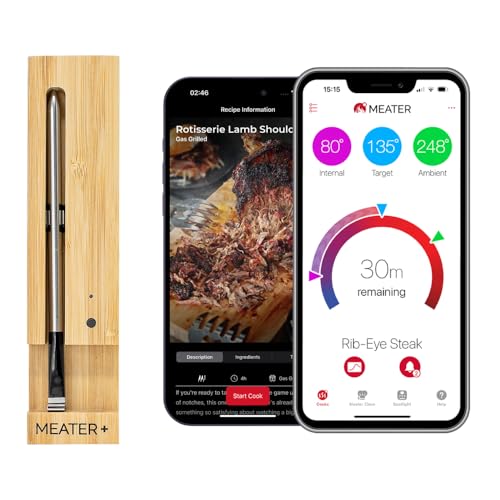
Small patios invert the usual grilling posture. The grill is close, the heat is close, and the cook hovers not from anxiety alone but because there is nowhere obvious to be instead. The MEATER Plus is the accessory that gives the cook permission to sit down. Its single wire-free probe — an internal sensor at the tip, an ambient sensor at the handle end — stays in the meat and reports to the app on your phone, while the bamboo charging block’s built-in Bluetooth repeater stretches the link to a maker-rated 165 feet, vastly more than any patio needs, which means the connection is never the problem it can be in a big yard. The app’s guided cook estimates the finish and alerts at target, so the thick chicken breast announces itself while you are in the chair with the drink, and the two steps to the grill become a short, purposeful walk instead of a residence.
The footprint accounting is perfect: the whole system stores in a block the size of a glasses case, in the kitchen drawer, consuming zero patio. The probe is dishwasher safe, which suits sink-scale cleanup. The limits are the family’s: 212°F internal and 527°F ambient ceilings make it a roasting and indirect-cooking instrument, not a searing companion — compact grills run fierce direct zones, so pull the probe before the final sear and verify with the instant-read below. One probe means one tracked cut; the patio host cooking four different proteins should read the Block’s review further down. Check price on Amazon — the Plus sits at the accessible end of this budget, and on a small patio it buys the rarest commodity of all: a cook who gets to sit at their own cookout.
- Single wire-free probe with internal and ambient sensors.
- Repeater in the charger — range far beyond any patio’s needs.
- Zero patio footprint: stores in a kitchen drawer.
- Dishwasher-safe probe for sink-friendly cleanup.
Honest limitation: One probe watches one cut, the 527°F ambient ceiling excludes direct searing, and monitoring runs through a phone and app with no display on the unit.
Choose it if you cook one main protein at a time and want to sit down while it cooks. Skip it if your patio regularly hosts multi-protein productions — see the Block.
ThermoWorks Thermapen ONE Instant-Read Thermometer
Who it suits: Every small-patio cook — and especially anyone whose compact grill cooks like a landscape of hot and cold countries, which is to say every compact grill.
Small grills are honest about one thing: their heat is uneven, and the smaller the grill, the more dramatic the map. The center sears while the edge simmers, and two pieces an inch apart live different lives. On a big grill you cook around the map; on a small one you must read it, piece by piece, which makes the instant-read thermometer the hardest-working tool in the small-patio kit. The Thermapen ONE is the professional standard — ThermoWorks’ flagship, reading in about a second with the accuracy serious kitchens rely on — and at a compact grill it works like a surveyor: this thigh is done, that one needs the hot spot for two minutes, this burger is the rare one and should come off now. No cutting, no juice loss, no guessing at a scale where guessing fails most.
Its storage story is the small patio’s ideal: it folds into a pocket or the same drawer as the tongs, wakes when opened, sleeps when closed, and asks for no pairing, charging or counter space in between. Its display rotates to your grip, useful when the patio’s geometry has you reaching across the grill from the side the chair left you. And because small-patio cooks are usually indoor cooks too, it earns its drawer all winter at the oven and the stove. Check price on Amazon — a modest share of this budget — and consider it non-negotiable in a way the other picks are not: a small patio can skip the cart, skip the rotisserie, and still cook well, but it cannot skip knowing the temperature.
- Professional-grade instant readings — the spot-check standard.
- Folds to pocket size; no app, pairing or charging routine.
- Maps a compact grill’s hot and cold zones piece by piece.
- Equally at home indoors year-round.
Honest limitation: It reads only while you stand at the grill — no remote alerts — so for long cooks it verifies a leave-in probe’s work rather than doing it.
Choose it if your grill is compact and its heat is uneven. Skip it if you cook only on an indoor grill at arm’s length with a thermometer you already trust.
Keter Unity Outdoor Prep Table and Serving Cart, 40 Gallon
Who it suits: Small-patio cooks whose accessories currently live in a plastic bin, whose trays land on chair arms, and whose patio has exactly one furniture-sized space left to allocate.
This is the one furniture decision in the guide, so it has to be the right size of furniture. The Unity is the compact sibling of the big station in our general guide: a rolling cart with a stainless steel top that serves as a genuine prep and landing surface, above a weather-resistant resin body with a 40-gallon enclosed cabinet. On a small patio that cabinet is not storage in the abstract — it is the difference between a patio and a pile. Tongs, brushes, drip pans, fuel, the grill cover, cleaning supplies: the whole accessory population moves into the cabinet, at the grill, and the bin in the corner — and the chair it was displacing — come back into your life. Hooks, a paper towel holder and a bottle opener ride along, and the casters let the cart serve beside the grill during the cook, against the wall after it, and as a drinks surface when the patio turns social.
Measure with a tape, not with optimism: lay out the cart’s footprint against your patio’s remaining space, count the chairs it must coexist with, and check the path it rolls through. If the math works, this is the highest-value square footage on the patio, because it is the only purchase in the guide that makes every other purchase easier to own. The honest notes: assembly takes an unhurried hour, the resin body is practical rather than premium, the steel top wants a trivet under pans straight off the grate, and on a truly tiny patio even this right-sized cart may be one piece too many — in which case the drawer-stored thermometer pair above is your whole kit, and a good one. Check price on Amazon; it sits in the upper-middle of this budget.
- Stainless worktop: the counter a small patio grill never has.
- 40 gallons of enclosed storage — the accessory population, housed.
- Weather-resistant resin body on casters; rolls to the wall after cooks.
- Hooks, paper towel holder and bottle opener built in.
Honest limitation: It is still one furniture footprint — measure honestly — with an hour of assembly and practical, not premium, materials.
Choose it if your gear lives in a bin and your trays live on chairs. Skip it if the patio’s remaining footprint belongs to a second chair you actually use.
Weber 2290 22-Inch Charcoal Kettle Rotisserie
Who it suits: Small-patio owners whose grill is the classic 22-inch Weber kettle — a very common small-patio arrangement — and who suspect their compact setup has a second act in it.
A rotisserie sounds like the opposite of a small-space product, and in most forms it is. The Weber 2290 is the exception, because of how it stores. In use, it is Weber’s factory kit for the 22-inch kettle: a porcelain-enameled ring that raises the kettle’s rim, a stainless spit and forks, and an electric motor that turns a whole chicken, a pork loin or a leg of lamb slowly over banked coals, self-basting and browning on every side in a way no static grate matches. At rest, the ring and spit come off and store essentially flat — hung on a wall, slid into the Unity’s cabinet, or stacked with the kettle’s own gear — which is why this transformation, alone among rotisseries, passes the footprint test. A small patio with a kettle does not need a second grill to cook a second way; it needs this ring and an hour.
The small-patio specifics deserve attention. The motor needs an outlet within cord reach, and on a small patio cords cross living space — route deliberately, away from chair legs and the path to the door. Drips and smoke behave as they do anywhere: coals banked to the sides, a drip pan under the turning food, and the pan juices promoted to sauce. Trussing matters as always; a balanced bird turns, a loose one flops. And check the social geometry: a kettle with its lid up and a spit turning needs its circle of clearance, which on a small patio may mean the rotisserie nights are the nights the second chair folds away. Check price on Amazon — mid-budget — and count it the best menu expansion per stored inch in this guide.
- Factory Weber kit: ring, stainless spit, forks and electric motor.
- Self-basting birds and roasts from the kettle you already own.
- Stores flat — the rare transformation that passes the footprint test.
- Fits the 22-inch Weber kettle exactly; installs in minutes.
Honest limitation: Kettle-only fitment, an outlet and cord to manage in a small space, and a working circle of clearance while it runs.
Choose it if a 22-inch kettle is your patio’s grill and chicken night deserves an upgrade. Skip it if your grill is gas, electric or another size — your transformation budget is better spent on the thermometer stack.
MEATER Block WiFi Smart Meat Thermometer, 4-Probe
Who it suits: The small-patio host — the cook whose eight-by-ten feet regularly feed six people, with proteins sequenced like trains through a small station.
It seems paradoxical to offer the biggest thermometer system to the smallest spaces, until you watch a small patio host work. The grill is small, so nothing cooks all at once; the menu is a sequence, and a sequence lives or dies on timing. The Block’s four wire-free probes — each reading its cut’s internal temperature and the surrounding air — dock in a wooden block with its own display and standalone mode, and its built-in WiFi relays four finish-time estimates to your phone anywhere in the home. The thick items go on first, probed; the thin items join by estimate; everything lands in waves that the alerts conduct. The dock itself is the size of a small breadbox and lives indoors on a counter or in a cabinet — its patio footprint during a cook is a few square inches beside the grill, which is the correct way for a premium system to behave in a small space.
The constraints are the family constraints: probes rated to 212°F internal and 527°F ambient belong in indirect work, with the instant-read handling sears; probe-to-dock range shrinks through heavy steel, so the dock sits by the grill during the cook; and the honest question — does a small patio need four probes? — is really a question about your guest list, not your square footage. Two-person patio, two steaks: buy the Plus and keep the change. Patio as dinner venue: the Block is how a small grill feeds a crowd without the cook dissolving. Check price on Amazon — upper half of this budget, buying simultaneity, not accuracy.
- Four wire-free probes with internal and ambient sensors.
- WiFi plus standalone dock display — sequences a small grill’s waves.
- Dishwasher-safe probes; dock stores all four indoors.
- Turns limited grate space into a managed timetable.
Honest limitation: Overkill for couples’ weeknight cooks, with the family’s 527°F ambient ceiling and a dock that wants to perch near the grill.
Choose it if your small patio hosts beyond its size. Skip it if your typical cook is one protein for two — the Plus is the same idea at patio scale.
Kona Safe/Clean Bristle-Free Grill Brush (Prose Only)
Who it suits: Every small-patio cook, because compact grates foul fast and the cleaning tool is the one accessory used after literally every cook.
The procedural note first, because this guide keeps its promises visible: the Kona Safe/Clean carries no Amazon link here because we could not verify its ASIN and a matching price sighting to the standard the linked picks had to meet. It is recommended in prose — check price on Amazon if you shop for it. The product earns the slot on design. Where a traditional brush cleans with hundreds of individual wire bristles, the Safe/Clean scrubs with continuous stainless steel coils: there are no separate bristles to fatigue, snap off and hide on the grate. Dipped in water and worked over a hot grate, the coils steam-clean as they scrub — a method compact grills reward, since their small grates accumulate concentrated residue and their owners clean at close quarters, often at a kitchen sink afterward. It is made for the grate materials small grills actually use — porcelain-enameled, ceramic, steel and cast iron — with a long handle that keeps hands clear of close heat.
The reason a brush holds a pick slot in a $300 guide is the alternative. Wire-bristle brushes from the biggest names in grilling have been recalled in the millions after detached bristles were swallowed and caused serious internal injuries, and regulators advise abandoning the category. On a small patio there is no version of that risk that shrinks with the grill. The bristle-free discipline costs almost nothing — coils, steam heads or a wooden scraper, inspected before each use and retired at the first sign of damage — and it is the only cleaning advice this guide gives, at any budget, on any patio size.
- Bristle-free continuous-coil head — nothing individual to shed.
- Steam-cleans on a hot grate when dipped in water first.
- Suited to porcelain, ceramic, steel and cast iron grates.
- Long handle for close-quarters compact grills.
Honest limitation: Prose-only in this guide — verify the listing and price yourself — and the coil motion takes a clean or two to learn after years of wire-brush habits.
Choose it if any wire brush currently serves your patio. Skip it if you already own a bristle-free cleaner in good condition.
Comparison Table
| Product | Type | Best use | Link |
|---|---|---|---|
| MEATER Plus | Single wire-free probe | Sitting down while one cut cooks itself watched | Check on Amazon |
| ThermoWorks Thermapen ONE | Instant-read thermometer | Reading a compact grill’s uneven heat map | Check on Amazon |
| Keter Unity, 40 Gallon | Prep table and storage cart | Counter and cabinet in one rolling footprint | Check on Amazon |
| Weber 2290 Kettle Rotisserie | Charcoal kettle rotisserie kit | A flat-storing second cooking method for kettle owners | Check on Amazon |
| MEATER Block, 4-Probe | Wire-free thermometer system, WiFi | Sequencing crowd menus on a small grill | Check on Amazon |
| Kona Safe/Clean Brush | Bristle-free coil brush | Safe cleaning for compact grates (prose only) | See review |
How to Choose Grill Accessories for Small Patios
- Apply the footprint test to everything. Where does it live at rest? Drawer, cabinet, flat against a wall — or it does not live on your patio. Price is the second question; rent is the first.
- Measure the patio, then the product. Tape out the grill’s working circle, the chairs, the door swing and the cart’s footprint before ordering anything furniture-sized. Small patios punish optimism in inches.
- Prioritize temperature on a compact grill. Small grills have the most uneven heat and their cooks the least room to compensate. A leave-in probe plus an instant-read is the highest-value pairing at this scale.
- Respect the wire-free heat ceiling. Compact direct zones run fierce; keep probes in indirect work at or under their ambient rating and finish with the instant-read.
- Consolidate storage into one cabinet. Five homes for five tools is a yard’s luxury. On a small patio, one enclosed cart that swallows the kit beats any collection of bins and hooks.
- Prefer flat and folding transformations. A rotisserie ring that hangs on a wall expands a kettle’s menu for almost no stored space — the model for what a small-patio upgrade should look like.
- Clean bristle-free, without exception. The wire-brush category’s recall record — millions of units, serious injuries — does not shrink with your grate. Coils, steam heads or wood only.
- Check the live price before judging value. Seasonal pricing moves small-patio gear as much as any; this guide prints no fixed prices, so check price on Amazon on buying day.
Measuring a Small Patio: The Five-Minute Audit
Before any purchase in this guide, spend five minutes with a tape measure and learn your patio’s true numbers, because small spaces forgive nothing. First, the grill’s working circle: the grill’s footprint plus the space your body occupies in front of it and the lid’s swing above it — nothing flammable, stored or seated belongs inside that circle while it runs. Second, the seating reality: the chairs as they are actually used, pulled out, with legs and elbows in their honest positions, not nested for a photograph. Third, the remainder: whatever is left after those two claims is your accessory budget in square feet, and it is usually smaller than you hoped and exactly big enough for this guide’s kit — a cart’s footprint, or nothing at all beyond what drawers hold.
Fourth, the vertical dimension, the small patio’s secret reserve: walls and railings hold what floors cannot, from the rotisserie ring on a hook to tools on a rail inside the cabinet door. Fifth, the door and the path — every item in this guide arrived through your home, and the cart that cannot make the turn from hallway to patio is a return waiting to happen. Write the five numbers down. They will outlast any single purchase, and they turn every future accessory question into arithmetic instead of regret.
The Drawer Kit: Everyday Tools at Small-Patio Scale
Beneath the picks above sits the everyday layer — the tools used on every cook — and small patios should buy this layer with the same footprint discipline. The working kit is three tools: tongs long enough to keep a hand clear of a compact grill’s close heat, a turner with a thin, flexible edge for the fish and burgers a small grate specializes in, and the bristle-free brush from this guide’s picks. That is the whole list. Everything beyond it — the fork that pierces and dries the meat it serves, the knife that belongs in the kitchen anyway, the novelty multi-tool that unfolds into mediocrity — is drawer clutter auditioning for a patio it will never improve. Buy the three tools well rather than fifteen tools cheaply: heavier steel, real rivets, handles that survive a dishwasher and a decade. Their combined cost is a small share of this budget, their combined storage is one drawer or one cabinet shelf in the Unity, and their combined service life will likely exceed the grill’s.
Two supporting items earn their inches honestly. A pair of drip pans, bought in a modest stack, protects the small grill’s internals, catches the rotisserie’s drippings for sauce, and lines the cabinet shelf against the inevitable leak — utility out of all proportion to their size. And a fitted cover for the grill itself, sized to your exact model, is the accessory that defends all the others: a small patio offers no garage to retreat to, so the cover is the roof under which the whole kit lives. Neither item is glamorous, neither appears in a headline, and both will be used more than any gadget marketed to patio owners this year. That is the small-patio doctrine in one sentence: the unglamorous, correctly sized basics, bought once and bought well, are what a $300 budget is for.
Small Patio, Full Menu: Cooking Bigger Than the Footprint
The persistent myth of the small patio is that it limits the menu. It limits the batch size — nothing else. The techniques that make backyard cooks proud are all available at compact scale, sequenced rather than simultaneous. A whole chicken turns on the kettle’s rotisserie while the potatoes wait their turn in a foil pouch at the grate’s edge. A thick steak reverse-sears under the probe’s supervision at low heat, then finishes in ninety seconds of direct fire verified by the instant-read. Vegetables, which forgive everything, ride the gaps. The menu reads identically to a yard’s; only the choreography differs, and choreography is precisely what this guide’s picks supply — estimates to sequence by, verification to land each wave, a cart to hold the waves in order. Hosts on small patios discover, usually with some surprise, that guests cannot tell the food came from eight feet of patio rather than eighty of yard. The food does not know the square footage. Only the cook does — and with the right kit, the cook barely knows either.
Renters, Balconies and the Small-Patio Overlap
Many small patios belong to renters, and the renter’s version of the footprint test adds a second question: can it leave with me, unchanged, when the lease ends? Every pick in this guide passes that test without trying. The thermometers live in drawers and move in a kitchen box. The cart rolls out the way it rolled in, owing the patio nothing — no anchors, no mounts, no marks. The rotisserie ring hangs on a hook in the next home’s garage as happily as it hangs beside this patio’s kettle. Nothing here is installed, plumbed, wired or built in, which means the entire $300 investment is portable equity in your cooking rather than an improvement you donate to a landlord. For renters whose buildings also regulate the grilling itself — fuel types, balcony storage, shared-space rules — the companion apartment guide in this series covers that regulatory layer in full; the two guides share a kit, because a small patio and a strict balcony are, from the accessories’ point of view, nearly the same problem wearing different paperwork.
Owners of small patios face the mirror-image temptation: permanence. A built-in counter or a fixed outdoor kitchen unit can be lovely, but it spends the one resource the space cannot make more of — flexible square footage — and it spends the budget several times over before a single thermometer is bought. The rolling, storing, folding kit in this guide preserves the patio’s ability to be re-imagined each season: grill corner this summer, reading corner next, both on the weekends that matter. On a small patio, flexibility is not a compromise position. It is the luxury good — and at this budget, it is entirely affordable.
Common Buying Mistakes
- Buying the 78-gallon station for a 40-gallon life — furniture optimism is the small patio’s most expensive error.
- Keeping the wire-bristle brush that came with the grill; the recalled category is not safer on a small grate.
- Leaving a wire-free probe in the fierce direct zone of a compact grill and exceeding its ambient rating.
- Filling a drawer with a giant tool set when tongs, a turner and a brush are the whole working kit.
- Trusting the lid thermometer on a compact grill, where its reading is the least representative in the product’s life.
- Ordering a rotisserie for the wrong grill — kettle kits fit kettles, by diameter, and nothing else.
- Letting accessories colonize the seating: if a purchase costs a chair, it must cook better than the chair sits.
- Judging by a review’s price in a seasonal category — verify on the listing.
Final Recommendation
- Most small-patio cooks: MEATER Plus.
- The non-negotiable verifier: ThermoWorks Thermapen ONE.
- One footprint, everything housed: Keter Unity Prep Table, 40 Gallon.
- Kettle owners: Weber 2290 Kettle Rotisserie.
- Patio hosts: MEATER Block, 4-Probe.
- Cleaning, safely: Kona Safe/Clean Bristle-Free Brush (prose only).
The small-patio two-purchase answer is the MEATER Plus and the Thermapen ONE: supervision and truth, in a combined footprint of one kitchen drawer, leaving nearly all of the budget — and all of the patio — still yours. Add the Unity when the bin-and-chair era has lasted long enough, and the rotisserie when the kettle asks for its second act. A small patio does not need less ambition than a big yard. It needs ambition that stores well.
One Season Later: What Actually Gets Used
Accessory guides are written at the moment of purchase, but small patios deliver their verdict a season later, in the archaeology of what is dusty and what is worn. The pattern is consistent enough to plan by. The instant-read is worn smooth — it comes out for every cook, indoors and out, and its drawer spot is the one within arm’s reach of the stove. The probe’s dock holds a permanent counter corner, because a tool used weekly stops being stored and starts being stationed. The cart’s top shows the honorable scars of a working surface, and its cabinet has quietly become the patio’s only organized volume. The rotisserie ring hangs ready, used monthly rather than weekly, and earns its wall space every single time — a fair rate for a transformation. What gathers dust, in patio after patio, is the layer this guide refused to sell: the novelty tools, the oversized sets, the single-task gadgets whose function a knife already owned. If you are standing at the beginning of the season with this budget in hand, buy for the archaeology: the worn, the stationed, the scarred and the ready. A year from now, your patio will show you exactly what your $300 was worth — plan for it to show well.
The Bottom Line for Small Patios
Everything in this guide reduces to a single exchange rate: function per square foot, verified per dollar. The thermometer pair delivers the highest rate in the kit — total temperature command for the footprint of a paperback. The cart delivers the highest absolute function — counter, cabinet and serving surface — for the one footprint it honestly declares. The rotisserie ring delivers a second cuisine for the footprint of a wall hook. And the bristle-free brush delivers safety, the one purchase whose return is measured in the accident that never happens. Spend the $300 along those rates, in that order, and a small patio stops being the constraint on the cooking. It becomes what it should have been all along: simply the room where the cooking happens, sized like a room and equipped like a kitchen.
Frequently Asked Questions
How should a small patio spend $300 — one big item or a kit?
A kit, almost always. Small spaces need several modest functions — monitoring, verification, a work surface, safe cleaning — more than they need one anchor product, and the footprint test punishes monuments. This guide’s linked picks combine well inside the budget, and each review states what a pick costs in the currency small patios actually run short of: space at rest.
Is a prep cart worth it on a really small patio?
Only if the tape measure says so. If the cart’s footprint fits the remainder after the grill’s working circle and real seating, it is the hardest-working purchase in this guide, because it houses everything else. If it would cost you a chair you use, skip it — the thermometer pair alone, drawer-stored, is a complete and honorable small-patio kit.
Can a rotisserie really work in a small space?
Yes, in the kettle case: the Weber 2290’s ring and spit store flat, the kettle it fits is already a common small-patio grill, and the working clearance it needs is the grill’s own circle plus room for the cook. The disciplines are cord routing and a rehearsal cook. Gas-grill rotisseries, by contrast, belong to the full-size grills they fit and fail the footprint test here.
Are wire brushes a concern on a small grill?
Entirely. The hazard — a fatigued bristle snapping off, lodging on the grate, transferring to food and being swallowed — has driven recalls of millions of brushes from major brands, and regulators advise against the category at any scale. A compact grate concentrates cooking, and therefore residue and risk, rather than diluting them. Bristle-free cleaning is the only recommendation this guide makes.
What is the best first purchase for a small patio?
The instant-read thermometer. A compact grill’s uneven heat makes guessing least reliable exactly where space is tightest, and the Thermapen folds into a drawer when its second of work is done. Add the wire-free probe when you start cooking thicker cuts, and the cart when storage — not cooking — becomes the frustration.
Do wireless probes work when the patio is close to the kitchen?
Yes — proximity is their easiest environment. The repeater-equipped charger sits by the grill, the phone is rarely more than a room away, and range ratings measured in hundreds of feet become irrelevant in the best way. The constraints that remain are the thermal ones: respect the probe’s ambient ceiling in a compact grill’s direct zone.