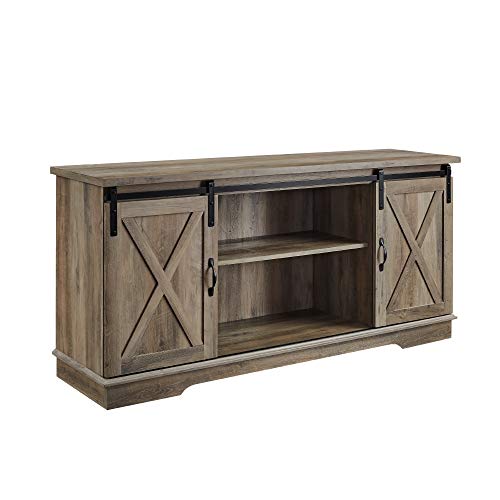
Where to buy
Check the latest price, availability and delivery on Amazon. Orders are placed on Amazon. We may earn a commission from qualifying purchases.
- Best furniture-grade console: Walker Edison Richmond Modern Farmhouse Sliding Barn Door TV Stand, 58 Inch, Grey Wash — Check on Amazon
- VASAGLE Farmhouse TV Stand for TVs up to 65 Inches, ULTV535W01, Rustic White and Honey Brown — Check on Amazon
- WLIVE TV Stand for 55 to 60 Inch TVs, Mid Century Modern TV Console, Retro Brown — Check on Amazon
- Yaheetech Industrial TV Stand for TVs up to 55 Inches, 47.5 Inch, Grey — Check on Amazon
- Furinno JAYA TV Stand, French Oak Grey and Black — Check on Amazon
- JUMMICO TV Stand for 65 Inch TV, Sliding Barn Doors, Bright White — prose only in this guide, see the review below for why
Read the full guide ↓
Disclosure: As an Amazon Associate, dailyhomedecorating.com earns from qualifying purchases. Links to Amazon on this page are affiliate links; they cost you nothing extra. Listing details such as price and availability change often, so check the current Amazon listing before you buy.
The best tv stand for families under $200 has a job description no other room in the house writes: it must survive childhood. A family TV stand gets climbed toward, crashed into, sticky-fingered, used as a stage for toy cars and a hiding place for snacks, while quietly holding the most breakable expensive object in the home a few feet off the floor. It has to hide a jungle of cables from curious toddlers, swallow board games, blankets, controllers and the DVD collection nobody admits to still owning, and do all of that for under $200, because family budgets have a hundred competing claims. This guide picks six stands against that job description, not against a showroom checklist.
Three family tests shaped every choice below. The first is stability and safety: a family stand should be wide, low-slung rather than top-heavy, honest about its TV size rating, and compatible with a wall anchor strap — the single cheapest safety device in the room, and one we recommend for every stand in this guide without exception. The second test is containment: doors and drawers that close over the mess, because a family living room resets to chaos daily and the fastest tidy-up is the one where everything disappears behind a front in ten seconds. The third test is forgiveness: finishes that wipe clean, surfaces that do not show every fingerprint, and construction that tolerates being bumped by ride-on toys without shedding parts.
The picks reflect those tests. Two barn-door consoles — a furniture-grade Walker Edison and a much cheaper VASAGLE — lead because sliding doors cannot swing into a toddler’s face and because they hide the most. A mid-century WLIVE serves families whose kids are older and whose style matters again. Two open budget stands, a Yaheetech and a Furinno JAYA, serve the playroom, the kids’ gaming corner and the years when furniture is honestly semi-disposable. And one farmhouse console, the JUMMICO, appears prose-only: it fits the brief well, but we could not confirm a US Amazon ASIN for it to the standard this site requires, so it is described without a link and the sources note explains why. Families shopping the tier below should also see Best Tv Stand For Families Under $150, and the general roundup at Best Tv Stand Under $200 covers the picks without the family filter.
In this guide
Quick Picks: best tv stand for families under $200
In a hurry? Match your room and your TV to a row below. Each linked pick goes straight to its Amazon listing so you can confirm the live price and the exact dimensions before you commit.
| Buyer type | Pick | Why it stands out | Link |
|---|---|---|---|
| Best furniture-grade console | Walker Edison Richmond Modern Farmhouse Sliding Barn Door TV Stand, 58 Inch, Grey Wash | Wide, stable 58-inch console; sliding doors hide everything and cannot swing into small faces | Check on Amazon |
| Best farmhouse storage | VASAGLE Farmhouse TV Stand for TVs up to 65 Inches, ULTV535W01, Rustic White and Honey Brown | The same barn-door containment for much less money — the family value pick | Check on Amazon |
| Best mid-century value | WLIVE TV Stand for 55 to 60 Inch TVs, Mid Century Modern TV Console, Retro Brown | A lighter look for families with older kids, with cabinet storage for 55 to 60 inch TVs | Check on Amazon |
| Best compact open stand | Yaheetech Industrial TV Stand for TVs up to 55 Inches, 47.5 Inch, Grey | Cheap, open and unbothered — the playroom and gaming-corner stand | Check on Amazon |
| Best simple budget stand | Furinno JAYA TV Stand, French Oak Grey and Black | The simplest budget stand here; fine for the years when furniture takes a beating | Check on Amazon |
| Farmhouse alternative (prose only) | JUMMICO TV Stand for 65 Inch TV, Sliding Barn Doors, Bright White | A well-fitting farmhouse alternative we could not verify an ASIN for — prose only, no link | Prose only — no link |
How These Picks Were Chosen
Verification came first, as it does in every guide in this batch: a real Amazon listing from an identifiable brand, a manufacturer TV size rating, and dimensions cross-checked against brand material or a second source. A stand that could not prove what it holds does not get to hold a family’s TV. Price came second: the exact configuration reviewed needed a genuine sighting under $200, flagged in the accompanying sources file wherever the sighting came from a sibling finish rather than the exact listing. This article prints no static prices; check price on Amazon for the live figure.
Family criteria came third, and they overruled style. We favored width over height, because a wide console is inherently harder to tip and because the stand must be wider than the TV it carries. We favored sliding doors over swinging doors, and doors over open shelves wherever the budget allowed, because containment is the daily family need. We looked for cable cutouts that let leads drop behind the unit rather than dangle where small hands explore, and we note in each review where a stand’s finish or shelf layout will fight you. Every stand here should be anchored to the wall with a strap in a home with climbing-age children — that advice is not pick-specific, it is universal, and it matters more than which stand you choose.
We also kept one honest budget seat at the table. Families in the high-chair years often, rationally, do not want to put a $200 console in the splash zone. The two open stands in this guide exist for that season of life and for the secondary rooms — playrooms, grandparents’ corners, teen dens — where the family TV actually lives half the time.
Detailed Reviews: Best TV Stand for Families Under $200, Pick by Pick
Walker Edison Richmond Modern Farmhouse Sliding Barn Door TV Stand, 58 Inch, Grey Wash
Best for: families with a 55 to 65 inch TV who want maximum hidden storage and a stand that still looks good when the toys are cleared.
Start with the doors. The Walker Edison Richmond’s barn doors slide on a metal rail rather than swinging on hinges, and in a family room that is a genuine safety and sanity feature: no door arcs into the walkway, no small fingers get pinched in a closing swing, and the doors can be parked over whichever half of the setup is currently embarrassing. Behind them, adjustable shelves in a 58-inch-wide, roughly 28-inch-tall console hold the streaming boxes, the game console, the board-game stack and the blanket surplus that family viewing generates. It is rated for TVs up to 65 inches, and its Grey Wash finish shrugs off the daily wipe-down better than gloss finishes do.
The width deserves emphasis for this audience. A 58-inch console under a 65-inch TV gives you a stable, low-center-of-gravity platform with room at the ends that is not under the screen — the natural landing zone for the water bottles and snack bowls that must never sit on top of the TV’s own surface. Cable cutouts in the back panel let power leads drop straight to a strip behind the unit, out of the toddler sightline. Fit a wall anchor strap; the console’s heft helps stability, but anchoring is what makes it a non-issue.
The costs are assembly and altitude. Assembly is a two-adult project with a door rail to align — schedule it during a nap or after bedtime, not with helpers under six. And at about 28 inches tall, it pairs with standard sofas but puts the screen high for floor-sitting kids; if your family’s viewing is mostly from a rug, the lower picks below may suit better.
What we like
- Sliding doors: no swing arc, no pinched fingers, instant tidy-up
- 58-inch width properly carries a 65-inch TV with landing space to spare
- Adjustable shelves swallow games, blankets and boxes
- Grey Wash finish tolerates daily wiping
Honest limitations
- Assembly is a long two-adult job
- Taller than ideal for floor-level viewing
- Top-of-budget price — confirm it is still under the ceiling
Choose it if your main room needs one stable, good-looking console that hides family clutter completely. Skip it if your viewers mostly sit on the floor, or the stand is for a playroom where budget should stay low.
VASAGLE Farmhouse TV Stand for TVs up to 65 Inches, ULTV535W01, Rustic White and Honey Brown
Best for: families who want the barn-door containment of the leader for far less money.
The VASAGLE farmhouse console (ULTV535W01) applies the same family logic as the Walker Edison at a much friendlier price. It is about 58 by 16 by 24 inches, rated for TVs up to 65 inches, with sliding barn doors over storage cabinets, in a rustic white and honey brown two-tone finish. Slide the doors, and the console-and-cables half of family life vanishes; the 24-inch height is a touch lower than the leader’s, which floor-sitters and low sofas will appreciate.
For families, the white body is the honest debate. It brightens the room and shows you exactly where the jam is — which is either a cleaning feature or a daily accusation, depending on temperament. The surface wipes clean with a damp cloth, and the honey brown top is the forgiving half where cups and remotes land. Storage volume is genuinely useful: two cabinet zones for the gear and the games, with the center available for the box that needs air.
Limitations are budget-class ones: engineered board rather than solid wood, doors that need clear sliding space (teach the household not to park the toy basket against the front), and a top that is for the TV and soundbar, not for sitting, standing or fort-building — a rule worth stating out loud in a family room. Anchor it to the wall like every pick here.
What we like
- Barn-door containment at a mid-tier price
- Slightly lower height suits floor viewing and low sofas
- Cabinets hide the full family gear pile
- Wipe-clean surfaces; forgiving two-tone top
Honest limitations
- White body shows marks and needs wiping
- Doors need unobstructed space to slide
- Engineered board — enforce a no-standing rule
Choose it if you want the leader’s storage idea with money left over for the rest of the room. Skip it if your household is hard enough on furniture to justify the heavier build of the Walker Edison.
WLIVE TV Stand for 55 to 60 Inch TVs, Mid Century Modern TV Console, Retro Brown
Best for: families with school-age and older kids, where the stand can be furniture again instead of fortification.
There is a season when the sticky-finger era ends and a family starts wanting its living room back. The WLIVE mid-century console is for that season: a lower, lighter cabinet on tapered legs, in retro brown, with cabinet storage plus an open shelf for the console or cable box, sized for 55 to 60 inch TVs. The raised legs matter practically, too — a robot vacuum passes underneath, and so does every toy car, which means fewer things permanently lost under the furniture.
Storage is a step down from the barn-door pair, deliberately: one cabinet zone for the mess, one open zone for the gear that needs air and remote signals. For a family whose setup is a TV, a streaming box and one console, that is exactly enough, and the room gains a piece of furniture that looks chosen rather than defensive. The retro brown finish is also more forgiving of dust and fingerprints than white or gloss black.
The family caveats are real: it is not rated for a 65-inch TV, the tapered-leg design has a higher center of gravity than the wide consoles — wall anchoring is non-negotiable with climbers in the house — and our price sighting for this model family came from a sibling finish, so confirm the live price on the retro brown listing as the sources note flags.
What we like
- Restores a styled look once kids are older
- Robot-vacuum-friendly clearance underneath
- Cabinet plus open shelf covers a typical family setup
- Dust-forgiving retro brown finish
Honest limitations
- Not for 65-inch TVs
- Leggy design must be wall-anchored around climbers
- Less hidden storage than the barn-door picks
Choose it if your kids are past the climbing stage and the room can be styled again. Skip it if you have toddlers, a 65-inch TV, or a mountain of gear to hide.
Yaheetech Industrial TV Stand for TVs up to 55 Inches, 47.5 Inch, Grey
Best for: playrooms, kids’ gaming corners and any room where the stand should be cheap, open and unworried.
The Yaheetech is the stand you buy with your head during the years when furniture is a consumable. A 47.5-inch open industrial frame in grey and black, four compartments, a top rated to 88 pounds and shelves rated at 22 pounds each, for TVs up to 55 inches — at a small fraction of this guide’s budget. In a playroom it holds the TV, the console and the game cases, runs cool because nothing is enclosed, and if it gets drawn on, the financial damage is a shrug.
Open storage, usually a compromise, is arguably correct for kids’ gaming: consoles vent freely, cables are reachable when a controller needs untangling, and there are no doors to slam, swing or hang off. It is light enough for one adult to move for cleaning or room reshuffles, and assembly is the quickest in this guide by a wide margin.
The limits are the visible kind: every cable shows unless you add your own ties and a cable box, dust settles on open gear, and 22 pounds per shelf excludes the big toy-storage ambitions. It is also a 55-inch ceiling. Treat it as the right-priced tool for secondary rooms and younger years, and it will not disappoint; ask it to anchor the main living room and it will.
What we like
- Very low price for the years furniture takes abuse
- Open design keeps kids’ consoles cool and reachable
- Light, quick to assemble, easy to move
- Top rated to 88 pounds for TVs up to 55 inches
Honest limitations
- Cables and dust fully visible
- Shelf limit of 22 pounds each
- No doors — nothing hides, nothing contains
Choose it if the room is a playroom or gaming corner and budget discipline matters more than looks. Skip it if this is the main family TV and you need containment and a 65-inch fit.
Furinno JAYA TV Stand, French Oak Grey and Black
Best for: a simple, cheap main stand for a TV up to 50 inches in a family on a strict budget.
The Furinno JAYA is the simplest idea in this guide: a roughly 47-inch-wide open stand in French Oak Grey and Black, with tiered shelves for the TV gear and a price that our tracking sighting put at the very bottom of this guide’s range. For a family furnishing a first living room, a rental, or a grandparents’ visiting setup around a TV of 50 inches or under, it covers the fundamentals — the TV sits at a sensible height, the boxes get shelves, the remotes get a surface — without touching money the family needs elsewhere.
Furinno’s JAYA line is built around straightforward assembly with basic tools and panels a single adult can handle, which suits the reality of family logistics better than a two-person cabinet project. The open shelves keep consoles breathing, and the grey-oak finish is neutral enough to survive room changes and hand-me-downs to the next room or the next family member.
Be clear-eyed about the class: the top panel is rated for modest loads (the JAYA line’s up-to-50-inch models carry a 40-pound top rating in the line’s specifications), shelves are light-duty, and nothing is enclosed. This is a stand for a smaller TV and a streaming box, not for a receiver stack and a vinyl collection. Within that lane it is honest value; outside it, step up to the VASAGLE. Full spec sourcing, including the line-level cross-checks, is in the sources file.
What we like
- Lowest-commitment price in this guide
- One-adult assembly, hand-me-down friendly
- Open shelves keep gear cool
- Neutral finish survives room changes
Honest limitations
- For TVs up to about 50 inches only
- Light-duty top and shelf ratings
- Open storage hides nothing
Choose it if the TV is 50 inches or under and the budget is genuinely tight. Skip it if you need enclosed storage, a bigger TV fit, or heavy shelf loads.
JUMMICO TV Stand for 65 Inch TV, Sliding Barn Doors, Bright White
Best for: families who like the bright white farmhouse look and are willing to shop the listing directly.
The JUMMICO barn-door console fits this guide’s family brief on paper as well as anything here: a 58-inch bright white console for TVs up to 65 inches, two sliding barn doors on steel rails, two cabinets plus open sections, and shelves adjustable across three levels, so the storage can be re-divided as the family’s gear changes. The white finish lifts a dark room, the sliding doors give the same no-swing, hide-the-mess behavior we praised in the leaders, and independent price sightings for this model have consistently sat in the middle of this guide’s budget range.
So why is there no link? Because our verification standard requires a confirmed US Amazon ASIN for the exact model before we link a pick, and for this console we could verify the product, its specifications and its price range through multiple secondary sources — but not pin the ASIN itself to that standard. Rather than guess an identifier, the pick runs prose-only. If you shop it, search the exact name on Amazon, confirm the 58-inch bright white configuration, and check the seller and the live price carefully.
On the family merits, it shares the barn-door caveats: doors need clear sliding space, the white finish will show the household’s art projects, and it should be wall-anchored like every console here. As a design it belongs in this company; as a link it did not meet the bar, and we would rather tell you that than dress up a guess.
What we like
- 58-inch width for TVs up to 65 inches
- Sliding barn doors and adjustable shelves suit changing family gear
- Bright white finish lightens family rooms
- Mid-range price sightings from multiple sources
Honest limitations
- No verified ASIN — no link in this guide
- White finish shows marks readily
- You must verify size, finish and seller yourself at purchase
Choose it if you love the look and are comfortable verifying the exact listing yourself. Skip it if you want every pick in this guide to be a one-click verified link — use the VASAGLE instead.
Prose only — no Amazon link in this guide; see the sources note for the reason.
Comparison Table
Family priorities first: how much each pick hides, how it behaves around kids, and what it fits.
| Pick | TV fit | Storage style | Look and notes |
|---|---|---|---|
| Walker Edison Richmond Modern Farmhouse Sliding Barn Door TV Stand, 58 Inch, Grey Wash | Up to 65 in | Full — sliding doors over cabinets and shelves | Most stable, most storage; anchor it and forget it |
| VASAGLE Farmhouse TV Stand for TVs up to 65 Inches, ULTV535W01, Rustic White and Honey Brown | Up to 65 in | Full — sliding doors over cabinets | Same idea for less; white finish needs wiping |
| WLIVE TV Stand for 55 to 60 Inch TVs, Mid Century Modern TV Console, Retro Brown | 55 to 60 in | Partial — cabinet plus open shelf | For older-kid households; vacuum passes underneath |
| Yaheetech Industrial TV Stand for TVs up to 55 Inches, 47.5 Inch, Grey | Up to 55 in | None — four open compartments | Playroom-proof price; consoles run cool |
| Furinno JAYA TV Stand, French Oak Grey and Black | Up to 50 in | None — open tiered shelves | Strict-budget basic for smaller TVs |
| JUMMICO TV Stand for 65 Inch TV, Sliding Barn Doors, Bright White | Up to 65 in | Full — sliding doors, adjustable shelves | Prose only: strong fit, unverified ASIN |
How to Choose a Family TV Stand
Anchor first, argue later. Whatever you buy, budget ten minutes and a few dollars for a wall anchor strap, install it the day the stand is built, and check it when you rearrange. Tip-over is the one TV-stand risk that is almost entirely preventable, and no design feature substitutes for the strap.
Width is safety and sanity. The stand must be wider than the TV — a 65-inch screen is about 57 inches wide — and width also buys the landing zones at each end where cups and remotes live instead of on the TV. In this guide that means the 58-inch consoles for big TVs, and it rules out putting a large screen on the budget opens.
Choose doors that cannot swing. Sliding doors and drawers contain the daily reset without a swing arc through toddler head height. If you do choose hinged doors, check the swing against the room’s traffic path. Behind the doors, insist on a cable cutout so power leads drop out of sight and out of reach.
Match the spend to the season. Households with children under five are in the impact years: the VASAGLE or the open budget picks price that reality honestly. Households past it can buy the Walker Edison and expect it to serve a decade. There is no virtue in putting the most expensive console in the splash zone, and no shame in the playroom stand being the cheap one.
Plan for the gear you actually have. A streaming stick needs nothing; a console needs air; a receiver needs depth and ventilation; board games need a shelf that fits their boxes. Measure the two biggest items and check them against the cabinet and shelf dimensions on the listing before ordering. Families furnishing around a smaller screen can also compare Best Tv Stand Under $100 for the entry tier, and style-led households may prefer Best Tv Stand For Modern Homes Under $200.
Common Mistakes to Avoid
Skipping the wall anchor. The most consequential mistake on this page. Wide consoles feel immovable — until a child climbs a shelf like a ladder. Anchor every stand, every time.
Leaving cables dangling. A loop of HDMI and power cord at toddler height is an invitation. Route leads through back cutouts, bundle them, and keep the power strip behind the stand, not beside it.
Buying open shelves for a main family room. Open stands are right for playrooms, but in the main room they mean the mess is always on display and the reset never ends. Doors are the family feature; everything else is secondary.
Putting drinks on the TV. It happens in every family room eventually. A stand wider than the screen gives cups a home on the furniture instead; coasters on the top corners are a cheap insurance policy for the finish.
Overloading light shelves with toy storage. Budget open stands carry modest shelf ratings. Books, toy bins and game libraries add up fast — keep heavy storage low, in cabinets rated for it, or in separate furniture like the options in Best Bookcase For Families Under $150.
Final Recommendation
For the main family room, buy the Walker Edison Richmond if the budget stretches, and the VASAGLE if it does not — both give a family the two things that matter daily: a stable, properly wide platform for the TV, and doors that make the mess disappear in seconds. Put the Yaheetech or the JAYA in the playroom without a second thought, graduate to the WLIVE when the climbing years end, and anchor whichever stand you choose to the wall on day one. That combination — right stand, right room, strap installed — is the whole secret of the best tv stand for families under $200.
Safety in Detail: Anchoring, Loads and the Climbing Years
Everything in this section matters more than anything else in this guide. A TV stand in a family home is furniture, playground equipment and a climbing frame in the eyes of a three-year-old, and it should be set up for the third job whether or not you approve of it. The anchor strap is the foundation: it connects the top rear of the stand — and ideally the TV itself, via its own tether points — to a wall stud or a rated anchor, so that a child hanging on an open drawer or shelf cannot bring the unit forward. Install it the day the stand is built, check it after every move or rearrangement, and treat a stand that cannot be anchored where it stands as a stand in the wrong place.
Load discipline is the second half. Put the heaviest items — receivers, game collections, the toy bins — on the lowest shelves, where they lower the center of gravity instead of raising it. Respect shelf ratings even when a shelf looks strong; a rating is a promise about the panel, the pins and the frame together. Keep the TV itself as far back on the top as its feet allow, never perched at the front edge for a cleaner photo. And teach the household’s one inviolable rule early: the stand is not sat on, stood on or jumped from, by anyone, ever — stated calmly, enforced boringly, it becomes furniture culture rather than a daily battle.
Edges and doors deserve a parent’s eye at purchase time. Sliding doors eliminate the swing arc and the pinch point of hinged doors, which is why this guide favors them for young families. Rounded or softened front edges forgive the collisions that toddlers specialize in. Glass, where it appears, should be tempered — as on the tabletop base in our small-space guide — and even then belongs above toddler reach. None of these features costs much; all of them are cheaper than the alternative.
The Ten-Second Reset: Storage Systems That Survive Weeknights
The family room’s real test is not the weekend tidy — it is 7:40 on a school night, when the room must go from full occupation to calm in the time it takes to run a bath. Storage that survives that test shares three traits, and they are worth more than any style feature in this guide. First, every category of family clutter has a designated home behind a front: games in one cabinet, blankets in another, chargers and remotes in the drawer or the basket that lives on the same shelf every day. Second, the homes are big enough — a system at ninety percent capacity fails by Friday, because nothing new can be put away. Third, closing up requires no decisions: doors slide, lids drop, and the room is done.
This is the deeper reason the barn-door consoles lead this guide. Their cabinets are not just storage volume; they are a reset mechanism sized for family scale. The open stands in the playroom work because the playroom’s standard is different — there, the reset is a toy bin and a door that closes on the room itself. Match the mechanism to the room’s standard, keep the system at seventy percent full, and the nightly reset stays at ten seconds instead of becoming the argument that ends the day.
Setting Up the Family TV Corner: Zones and Rules
A family TV corner works when it is zoned, even inside a single room. Zone one is the screen zone: the stand, anchored, with the TV set back on its top and nothing stored on the screen’s own surface, ever. Zone two is the gear zone: everything powered lives inside the stand’s cabinets or on its shelves, with cables routed behind and the power strip inaccessible to small hands. Zone three is the soft zone in front: the rug, the cushions, the blanket basket — the part children are allowed to rearrange, fort and demolish daily, because a room where nothing may be touched will be touched everywhere. Zoning sounds like interior design; in a family it is actually a peace treaty, because it tells everyone, including the adults, what may happen where.
Two rules keep the zones alive. The first is the landing rule: drinks, remotes and snacks land on the stand’s ends, on a side table or on the floor cushions’ tray — never on the TV, never on the warm vents of a console, never balanced on a cabinet door. The second is the reset rule from earlier in this guide, enforced by design rather than by nagging: if putting something away takes more than opening one door, the system is wrong, and the fix is to move the home, not to blame the child. Families that get these two rules into the furniture itself stop re-litigating them every evening.
Age changes the zones, and the stand should be allowed to change with it. The toddler years want doors closed, shelves low and heavy, and the soft zone dominant. School years add homework at the coffee table, game consoles with their charging docks, and a first demand for a say in the room’s look — the moment the WLIVE-style picks start making sense. Teen years move the action to the den or the bedroom corner, where the open budget stands take over. A stand bought for one season and honestly handed down to the next room is not a failed purchase; in a family, it is the normal life cycle of furniture, and it is why this guide refuses to sneer at its cheapest picks.
What the Family Tier Buys: An Honest Ladder
Families cross-shopping this guide against the cheaper tiers deserve the differences stated plainly. At the lowest prices, a family stand is an open frame: the TV is up, the boxes are visible, and containment does not exist. Crossing into the middle of the market buys the first doors — and for a family, doors are not a style upgrade but the entire point, the difference between a room that resets and a room that accumulates. The top of this guide’s budget buys what the middle cannot: cabinet volume for the full family inventory, hardware that survives daily sliding for years, and a build substantial enough to anchor a main room through the whole childhood of the people using it.
What the tier does not buy is worth naming too. It does not buy solid wood, soft-close everything, or immunity from a determined toddler with a juice box. It does not buy safety by itself — the anchor strap and the load discipline in this guide do that, at any price. And it does not buy permanence of taste: the stand that suits a household of toddlers will be restyled by the same household of teenagers, which is why the ladder’s middle rung, honestly chosen, is where most families should land. Spend for the doors and the width; save on everything the children will outgrow before the furniture wears out.
Second Rooms and Hand-Me-Downs
Family furniture rarely dies; it migrates. The main-room console of the toddler years becomes the playroom stand, then the teen den stand, then the piece that furnishes a first apartment across town. Planning for that migration changes what a smart family buys: neutral finishes outlast themed ones, standard widths fit more future rooms than dramatic ones, and honest construction — the kind that survives being moved, stored and moved again — beats delicate design at every step. Every pick in this guide was chosen with a second room in mind, which is why the budget opens are here without apology and why the leaders are classics rather than novelties.
It is also why the guide’s advice ends where it began: buy the stand the family needs now, at the rung the season justifies, anchor it, load it low, and let it serve. The rest — the migration, the hand-me-down, the decade of service — is what well-chosen furniture does on its own.
A Note on Grandparents’ Houses and Shared Custody Rooms
Family viewing does not happen in one home only. The TV corner at a grandparent’s house, or in a second household a child splits time between, runs the same safety rules with a fraction of the budget and attention — which is exactly the situation the open budget picks in this guide were chosen for. A JAYA or Yaheetech, anchored, loaded low, with its cables bundled behind, gives a child the same safe setup in the second room without duplicating the main room’s spend. Consistency helps the child, too: the same rules — nothing on the TV, remotes land on the stand, doors stay closed — travel between houses more easily when the furniture behaves the same way. Buy the second-room stand to the same standard, at the rung the room’s use justifies, and the system holds everywhere the family watches.
Frequently Asked Questions
What is the safest type of TV stand for toddlers?
A wide, low console with sliding doors or drawers, placed flat against the wall and secured with an anti-tip anchor strap. Width and anchoring matter more than brand. Keep cables routed behind the unit and heavy items on the lowest shelves.
Are sliding barn doors practical with kids?
Yes — they are arguably the most practical family door. They cannot swing into a child, they do not pinch like a closing hinged door can, and they let you hide whichever half of the setup is messy. Keep the sliding path clear of toys and baskets.
Should a family TV stand have open or closed storage?
Closed for the main room, open for playrooms. Closed storage ends the daily visual clutter and keeps small hands off gear and cables; open storage keeps game consoles cooler and costs much less, which suits secondary rooms.
How wide should the stand be for a family TV?
At least as wide as the TV itself — about 57 inches for a 65-inch screen, 48 inches for a 55-inch — and a little wider is better, because the ends become the landing zone for drinks and remotes that should never sit on the screen’s surface.
Is it worth spending near $200 with young kids in the house?
Only if the stand is the main room’s anchor and you will keep it past the toddler years. Many families rationally buy the mid-priced VASAGLE or a budget open stand now and upgrade later; the safety essentials — width, doors, anchoring — are available well under the ceiling.
Related reading for the rest of the family room: Best Tv Stand For Small Apartments Under $200 if the family room is also a small room, and our coffee table guide for families under $150 covers the other surface kids will inevitably climb on.


