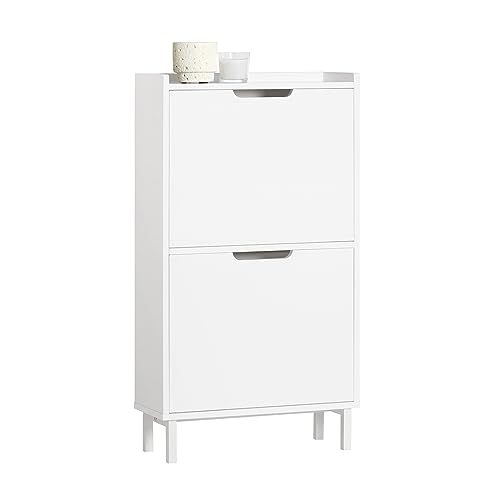
Where to buy
Check the latest price, availability and delivery on Amazon. Orders are placed on Amazon. We may earn a commission from qualifying purchases.
- Best for small apartments overall: Haotian Slim Shoe Cabinet with 2 Flip Drawers, FSR151 — Check on Amazon
- Best compact with airflow: IRONCK Shoe Cabinet with 2 Flip Drawers, Rattan Doors, Oak — Check on Amazon
- Best three-zone compact: Sscaktu Shoe Storage Cabinet with 3 Flip Drawers, Fluted, Natural — Check on Amazon
- Best if you have a real entry nook: VASAGLE LIRY Collection Shoe Cabinet, 3-Tier with Hinged Doors — Check on Amazon
- Best warm-finish compact: Maupvit Shoe Storage Cabinet with 2 Flip Drawers, Rustic Brown — Check on Amazon
- IKEA HEMNES Shoe Cabinet with 4 Compartments — prose-only pick, sold by IKEA directly; renters, read its fixing warning in the review below
Read the full guide ↓
Disclosure: As an Amazon Associate, dailyhomedecorating.com earns from qualifying purchases. Links to Amazon on this page are affiliate links; they cost you nothing extra. Listing details such as price and availability change often, so check the current Amazon listing before you buy.
Finding the best shoe cabinet for small apartments under $1000 is a geometry problem wearing a shopping costume. Your entry is probably not an entry at all — it is the first four feet of the living room, a hallway the width of the front door, or a studio wall that also holds the coat hooks, the bike and the recycling. In that space, a shoe cabinet succeeds or fails on three measurements: how deep it stands from the wall, how much floor its doors or drawers need to open, and whether it can stand safely in a rental where drilling into studs may not be an option. This guide ranks six verified closed cabinets on apartment geometry first — and it can afford to, because the budget is a non-issue: every linked pick was sighted at a small fraction of the $1000 ceiling, so not one decision below is a price decision.
The format rule matters even more in a small apartment: cabinet, not rack. Open shelving in a studio does not just look untidy, it annexes visual space you do not have, and it puts footwear on display in the room where you also eat, work and host. A closed cabinet — flip drawers or hinged doors — returns that wall to the room. Flip drawers are the apartment default for a reason: they tip toward you in the space you are already standing in, and they keep the cabinet itself under ten inches deep. Hinged doors store more kinds of shoes but demand depth and a swing arc, which is why the one hinged pick here is recommended only for apartments with a genuine entry nook, and why we say so plainly rather than selling it to a hallway it will block.
Renters get a dedicated thread through this guide, because the category’s open secret is fixing: slim cabinets are tall and light, their makers include anti-tip kits for a reason, and one famous pick in this guide is not freestanding at all. Each review states the fixing situation as verified, and the how-to-choose section covers the conversation to have with a landlord and the honest alternatives when the answer is no. You will also find realistic capacities derated for apartment life — a rotation, not a collection — a comparison table sorted by depth, the mistakes that make small entries smaller, and an FAQ for the questions apartment dwellers actually type at midnight.
In this guide
Quick Picks: Best Shoe Cabinet for Small Apartments Under $1000
Each row matches an apartment constraint to its cabinet. Use check price on Amazon to confirm the live listing before you buy; prices shift with coupons and seasonal sales.
| Apartment constraint | Pick | Why it stands out | Link |
|---|---|---|---|
| Best for small apartments overall | Haotian Slim Shoe Cabinet, FSR151 | About 7.5 inches deep, flush front — the slimmest verified closed cabinet | Check on Amazon |
| Best compact with airflow | IRONCK Shoe Cabinet, Rattan Doors, Oak | 23.6-inch width, woven ventilating fronts, legs that clear robot vacuums | Check on Amazon |
| Best three-zone compact | Sscaktu Shoe Storage Cabinet, 3 Flip Drawers | Three drawers zone two people’s rotation in one slim footprint | Check on Amazon |
| Best with a real entry nook | VASAGLE LIRY Collection Shoe Cabinet | Hinged doors and adjustable shelves — boots and big sizes, if depth allows | Check on Amazon |
| Best warm-finish compact | Maupvit Shoe Storage Cabinet, 2 Flip Drawers | Rustic finish hides studio-life scuffs; metal legs, slim flip depth | Check on Amazon |
| Best benchmark — with a fixing caveat | IKEA HEMNES Shoe Cabinet, 4 Compartments | About 8.6 inches deep, but NOT freestanding — covered prose-only, sold by IKEA | See review |
How These Picks Were Chosen
Apartment geometry was the first filter. A pick had to close fully — open racks, towers and cubbies were excluded, because in a small home concealment is space — and its depth, width and opening clearance had to suit real apartment entries, which we took to mean: under ten inches deep for the flip picks, a footprint that fits a short wall stub, and no door swing except where explicitly flagged. It also had to be verifiable: a real Amazon listing with a confirmable ASIN, specifications cross-checked against manuals or independent coverage, and a dated price sighting far under the $1000 ceiling. Check price on Amazon before ordering; a sighting proves the tier, not today’s number.
Fixing honesty was a selection criterion in its own right. Slim cabinets are front-heavy with a drawer tipped open, and apartment life adds tight clearances and, often, tenancy rules. We verified each pick’s fixing situation from maker material where available and stated it in the review: which include anti-tip hardware, and which — the HEMNES — cannot stand unfixed at all. A listing that hid its fixing requirements was not promoted to an apartment shortlist, because discovering them after delivery is how cabinets get returned.
We did not use these cabinets ourselves. Capacities were derated to apartment reality — the daily rotation of one or two people — using the most conservative figures the sources supported, and products whose own listings contradicted themselves on dimensions were dropped rather than guessed at. One pick is prose-only on principle: IKEA sells the HEMNES directly, Amazon carries only third-party resellers at markups, and renters especially should not pay reseller prices for a cabinet whose fixing rules they may not be able to meet — read its review before falling for its footprint. If your apartment entry is shared or family-sized, our Best Shoe Cabinet For Families Under $1000 guide ranks the same verified pool by zoning instead of geometry.
Detailed Reviews
Haotian Slim Shoe Cabinet, FSR151 — Best for Small Apartments Overall
Who it suits: Studios, one-bedrooms and any apartment where the entry is a rumor. At about 7.5 inches deep, the Haotian FSR151 is the slimmest fully closed shoe cabinet we could verify — slimmer than the famous IKEA benchmark — and in apartment geometry, those inches are not a specification, they are the difference between a cabinet and an obstacle.
The numbers: about 7.5 inches deep, 19.7 inches wide, 35.8 inches high, in engineered wood, with two flip drawers, an adjustable shelf detail, a raised bottom and hollowed-out handles that leave the front entirely flush — nothing protrudes to catch a bag strap in a narrow pass, and nothing visual interrupts a studio wall. Independent apartment coverage of this cabinet put realistic capacity at about six pairs, and that is the correct apartment frame: the daily rotation of one person, or the shared rotation of a couple who keep the rest in the wardrobe. Its taller three-drawer sibling in the same range suits couples who have ceiling height to trade for the same shallow depth. The top is a ledge — keys, post, a small plant — and in a studio even a ledge that gathers the entry clutter into one spot is doing real work.
Pros: Nothing closed and verified goes slimmer; it fits behind-door walls and corridor pinch points the other picks cannot enter. The flush front disappears against a white wall, returning visual space to the room. Its sighted price is the lowest in this guide, which matters even under a generous ceiling — apartment money is better spent on the wardrobe storage this cabinet deliberately does not try to be. Light enough to move at the next lease, unlike the wide cabinets.
Honest limitation: Six pairs is a rotation, and households that will not rotate will overflow it. Shallow buckets squeeze the largest men’s sizes and exclude tall boots entirely. Most importantly for renters: tall, slim and light is the profile anti-tip kits exist for, so plan the fixing conversation before you order — if your tenancy forbids wall fixings entirely, choose a lower, wider pick or secure the landlord’s permission in writing, but do not leave it unfixed in a home with children or large pets.
Choose it if depth is your binding constraint and your rotation is disciplined. Skip it if you need collection capacity or cannot fix it to a wall. Check price on Amazon before you buy.
IRONCK Shoe Cabinet with 2 Flip Drawers, Rattan Doors — Best Compact with Airflow
Who it suits: Small apartments without a separate hallway, where the shoe cabinet lives in the living room and the shoes in it are worn daily. The IRONCK Shoe Cabinet answers both apartment problems at once: its hand-woven rattan fronts make it presentable as living-room furniture, and its weave ventilates, so daily shoes dry in a small sealed space instead of ripening in it.
At about 9.25 inches deep, 23.6 inches wide and 39.6 inches tall, weighing roughly 45 pounds, it occupies the short wall section apartments actually have free — beside the door, at the end of a sofa run, under a window. Metal legs lift it clear of the floor, which in a small home is doubly useful: the room reads lighter, and a robot vacuum or mop passes underneath instead of the cabinet annexing a permanent dust border. Each flip drawer carries two levels split by a panel that adjusts or removes — one tall space for ankle boots, two shallow for trainers and flats — and the wider sibling in the range is specified to fit men’s sizes up to 11.5 without removing the panel, with three panel positions. An anti-tipping device is included, and the brand’s manuals put two-person assembly well under an hour — a real consideration when your build space is also your living space.
Pros: Living-room presentable and ventilating — the only pick that solves the small-space odor problem by construction. Compact width fits apartment wall stubs. Raised legs lighten the room and simplify cleaning. Adjustable panels stretch its footwear range beyond most flip cabinets. Warm oak-and-rattan suits the rental-friendly palette of pale walls and wood floors.
Honest limitation: Capacity is a couple’s rotation, not a collection, and not a family’s. Rattan varies slightly in tone and can be scratched at by pets. The woven front conceals fully at normal distance but is not a flat minimal plane, if that is your studio’s language. And like every slim pick here, it wants its anti-tip device fitted.
Choose it if the cabinet will live in your main room and your shoes are worn daily. Skip it if you need maximum pairs or a flat-front minimal look. Check price on Amazon to confirm the listing.
Sscaktu Shoe Storage Cabinet with 3 Flip Drawers — Best Three-Zone Compact
Who it suits: Couples and sharers in small apartments, where the entry problem is not just space but whose shoes are whose. Three drawers is a peace treaty. The Sscaktu Shoe Storage Cabinet stacks three flip drawers in a 31.5-inch-wide fluted natural front, keeping a slim flip depth while giving two people a drawer each and a third for guests, gym kit or the seasonal overflow.
Each drawer tips to two levels, so a personal drawer is itself sortable — work shoes below, trainers above. The fluted front earns its place in a small home specifically: in a studio, every surface is in sight all the time, and a front with genuine reeded texture reads as a chosen piece of furniture at breakfast, at work calls and at dinner, where a flat budget front reads as storage. The natural finish hides the dust that small, sunlit apartments generate visibly on gloss white. The cabinet is sold through the Raysom Home storefront on Amazon, within a fluted range that includes a larger hinged-door sibling — relevant to apartment dwellers mainly because a matching piece can follow you to a bigger home later instead of being replaced.
Pros: Three zones end the shared-entry negotiation in one slim footprint. A design-led front that survives being looked at all day, every day — the studio test. Slim flip depth preserves the room’s circulation. The wide top gathers keys, post and a lamp into one sanctioned landing spot, which in a small apartment is half the battle against surface creep.
Honest limitation: At 31.5 inches wide it needs a real wall section; studios whose only free wall is a stub should take the IRONCK or Haotian. Flip limits on tall boots and the largest sizes apply per drawer. The fluted front wants a soft brush for dusting. And its height plus slim depth means the anti-tip fixing matters — plan it with your tenancy in mind, as with the Haotian.
Choose it if two people share a small entry and both have full rotations. Skip it if your free wall is under about 32 inches or boots dominate. Check price on Amazon — sightings sit far below the ceiling. Pair it with one of the Best Entryway Bench For Small Apartments Under $300 picks and the apartment entry is a system, not a compromise.
VASAGLE LIRY Collection Shoe Cabinet — Best with a Real Entry Nook
Who it suits: The minority of small apartments blessed with an actual entry nook, alcove or wide landing — and the boot-owners among them. The VASAGLE LIRY is this guide’s only hinged-door cabinet, included with its condition stated in the headline: if you have the depth, nothing else here stores boots, high-tops and large sizes as gracefully.
The cabinet measures about 13.8 inches deep, 31.5 inches wide and 27.6 inches high. Behind two doors, three flat tiers — the upper shelf adjustable through five holes about 1.2 inches apart — take footwear the way a wardrobe does: flat, paired, a whole row visible at once. VASAGLE’s manual rates nine to twelve pairs and a 165-pound maximum static load, with an anti-tip kit and elevated base included. In a nook, its depth becomes a feature: the top is a true console surface, deep enough for the lamp and mirror combination that makes a small apartment’s entry feel like a room instead of a corridor, and its low, wide stance is the most inherently stable shape in this guide — the one pick whose fixing, while still recommended, is not compensating for a tall slim profile.
Pros: Accepts the footwear every flip cabinet rejects. Adjustable shelving adapts between seasons. Whole-row visibility suits shared households. The deep top creates a genuine entry moment in a small home. Low and stable, with fixing hardware in the box.
Honest limitation: In a narrow hallway this cabinet is simply wrong: fourteen inches plus door swing will block circulation, and no capacity argument survives a bruised hip. It is also the heaviest commitment here for renters who move often — a piece you place once, in the right apartment. Measure the nook, then measure the swing, then order.
Choose it if you have a nook and boots. Skip it if your entry is a corridor. Check price on Amazon — it is discounted often enough that checking always pays.
Maupvit Shoe Storage Cabinet with 2 Flip Drawers — Best Warm-Finish Compact
Who it suits: Small apartments with warm, lived-in schemes — and tenants realistic about scuffs. The Maupvit Shoe Storage Cabinet in rustic brown brings the flip format’s slim depth, about 9.45 inches, in the finish that best survives studio life.
Two flip drawers, two levels each, hold a couple’s daily rotation, in an MDF body on metal legs. The apartment case for it is practical poetry: in a small home the cabinet is always in peripheral vision, and rustic brown neither shows every mark like white nor dominates like black; the metal legs tolerate the wet mop-around that small-space cleaning involves and leave clearance for the shoes that get kicked underneath in every real household. Independent long-term coverage measured the same shallow depth class and found the drawers happiest with the everyday rotation — trainers, loafers, flats — which is exactly the apartment use case. The top surface gathers the entry clutter of a home where every surface is contested.
Pros: The most forgiving finish for small-space living. Slim flip depth, raised metal legs, easy-clean stance. Warmth that suits the wood-floor, pale-wall rental standard. A sighted price that leaves apartment budgets intact for storage that matters more, like wardrobe organizers.
Honest limitation: Rustic is a register: in a cool, minimal studio it will read as country. Capacity is a rotation for two, not a collection. Flip limits on tall boots and largest sizes apply, and the anti-tip fixing should be fitted like every slim pick here.
Choose it if your apartment runs warm and your life runs busy. Skip it if your scheme is cool minimal or your rotation is large. Check price on Amazon for the live figure.
IKEA HEMNES Shoe Cabinet with 4 Compartments — The Benchmark, With a Renter’s Warning (Prose-Only)
Who it suits: Apartment owners, and renters whose landlords say yes. The HEMNES four-compartment cabinet — about 42.1 inches wide, 8.6 inches deep and 39.8 inches high — is the slim cabinet benchmark, and its footprint is genuinely apartment-perfect. IKEA’s buying-guide dimensions and independent measurements agree, and realistic capacity is around eight pairs. It is in this guide because any honest apartment shortlist must reckon with it — and its review carries the guide’s most important warning.
The warning: the HEMNES is not freestanding. It stands on two front legs and must be fixed to the wall to stand safely at all. For a homeowner that is ten minutes. For a renter whose tenancy forbids fixings, it is a hard stop — do not buy it and lean it, prop it or weight it; choose a cabinet designed to stand with an anti-tip kit you are permitted to fit, or get the landlord’s written permission first. It is prose-only for the usual reason as well: IKEA sells it directly, Amazon offers only third-party resellers at markups without IKEA’s support, and apartment budgets deserve the direct price, sighted at a modest figure from IKEA itself.
Pros: Benchmark design and longevity, with spare parts available — buy-it-for-two-leases furniture. Four compartments zone a couple elegantly. Slim depth with real substance, and the most polished instructions in the category for a build on a living-room floor.
Honest limitation: The fixing requirement, again — it is absolute. Eight pairs is a rotation, the flip compartments limit tall and very large footwear, and at 42 inches wide it needs a wall run some studios do not have free.
Choose it if you can wall-fix and value the original. Skip it if your tenancy says no — in that case the Haotian gives you an even slimmer cabinet with a conventional anti-tip kit, at a lower sighted price, delivered by Amazon.
Comparison Table
Sorted by depth, because in a small apartment depth is destiny. Capacities are conservative rotation figures. Prices are never printed — use check price on Amazon on each review’s link.
| Pick | Format | Dimensions (D × W × H) | Rotation capacity | Apartment trait |
|---|---|---|---|---|
| Haotian FSR151 | 2 flip drawers | ~7.5 × 19.7 × 35.8 in | ~6 pairs | Slimmest verified; flush front |
| IKEA HEMNES 4 | 4 flip compartments | ~8.6 × 42.1 × 39.8 in | ~8 pairs | Benchmark — wall-fixing mandatory |
| IRONCK Rattan | 2 flip drawers | ~9.25 × 23.6 × 39.6 in | Compact rotation | Ventilates; living-room presentable |
| Maupvit 2-Flip | 2 flip drawers | ~9.45 in deep class | Couple’s rotation | Scuff-forgiving rustic finish |
| Sscaktu 3-Flip | 3 flip drawers | Slim class; 31.5 in wide | Three zoned drawers | Two people’s full rotation, zoned |
| VASAGLE LIRY | Hinged doors, flat shelves | ~13.8 × 31.5 × 27.6 in | 9–12 pairs (maker figure) | Boots and big sizes — nooks only |
The apartment reading of this table is a decision tree. Corridor or behind-door wall: Haotian, full stop. A short living-room wall: IRONCK, for the ventilation and the furniture looks. A full wall section and two rotations to house: Sscaktu. A nook: VASAGLE, and enjoy the boots fitting. A warm scheme and a busy life: Maupvit. A fixable wall and a love of the original: HEMNES, from IKEA. Notice that price appears nowhere in the tree — at this ceiling it should not. If your constraint is genuinely budget rather than geometry, the same tree is drawn tier by tier in our Best Shoe Cabinet For Small Apartments Under $300 guide.
How to Choose a Shoe Cabinet for a Small Apartment
Measure the wall, the depth and the opening — in that order. Width tells you which picks are candidates. Depth tells you whether the room still circulates: stand where the cabinet would stand, open an imaginary drawer, and walk past it carrying a laundry basket. Then measure the opening: flip drawers need the space you stand in; hinged doors need a swing arc that must not meet the front door’s own arc. Apartments fail cabinets on the third measurement more than the first two.
Settle the fixing question before you fall in love. Slim cabinets need anti-tip fixing; the HEMNES needs wall-fixing to stand at all. Read your tenancy, ask the landlord early — many say yes to two small holes that are fillable at move-out, especially when you explain it is a safety fixing — and get a yes in writing. If the answer is a firm no, choose low and wide over tall and slim, place the cabinet where a tip would meet a wall or heavy furniture rather than open floor, and never place any slim cabinet unfixed in a home with climbing children.
Budget capacity as a rotation. Apartment shoe storage works when it holds what you wear this fortnight. Count those pairs, add two for guests and gym kit, and buy that cabinet — not the one that promises your whole collection, which will be deeper, wider and still not hold it honestly. The wardrobe is the archive; the cabinet is the working set. This single doctrine is why a six-pair Haotian can serve a person better than a twenty-pair claim in a deeper box.
Make the top earn rent. In a small apartment every horizontal surface is contested, so decide the cabinet top’s job in advance: landing strip with a tray, lamp base, or plant spot — one job, done neatly. The wide flip cabinets and the VASAGLE support a real composition; the Haotian’s ledge supports the tray alone, which is still a victory over keys distributed across four rooms.
Think one move ahead. Apartments change. A cabinet that one person can carry, that fits a hallway in the next place too, and whose finish survives a second assembly is worth more than a slightly larger piece that will not survive the van. The compact picks here — Haotian, IRONCK, Maupvit — travel well; the wide Sscaktu and the VASAGLE are place-once pieces for homes you expect to keep. Coordinate the entry with a mirror that returns light to a small space from our Best Decorative Wall Mirror For Apartments Under $200 picks, and the geometry problem becomes a designed corner.
Common Mistakes in Small Apartments
Buying for the collection instead of the rotation. The deepest, widest cabinet still will not hold everything, and it will hold your hallway hostage in the attempt. Rotate ruthlessly; archive elsewhere.
Forgetting the front door’s swing. The most common apartment collision is literal: cabinet door, drawer or stored shoe meeting the entry door’s arc. Tape the arcs on the floor before you order anything with a hinge.
Leaning a wall-fix cabinet and hoping. The HEMNES warning bears repeating as a mistake, not just a specification: a two-legged cabinet unfixed is furniture waiting to fall. Renters have excellent alternatives in this guide — use them, or get permission.
Choosing an open rack to save money. In a studio, an open rack spends your scarcest asset — visual calm — to save your most abundant one at this budget, which is money. Closed cabinets are the small-apartment technology; the rack is the false economy.
Trusting pair counts over dimensions. A listing’s thirty-pair promise assumes shoes you do not own, arranged by someone who does not wear them. Work from the depth and the conservative rotation figures in this guide.
Letting the cabinet top become the junk surface. In a small home, one unmanaged surface metastasizes. Tray it, cap it, and review it weekly — or choose the slim ledge that physically cannot accumulate more than a tray’s worth.
The Apartment Entry Audit: Door to Sofa in Four Feet
Before any cabinet is ordered, walk your entry as an auditor rather than an owner, because apartment entries fail in sequence, not in isolation. Stand outside your front door with shopping in both hands. Open the door. Everything that happens in the next four feet — the door’s swing, your turn, the put-down, the coat, the shoes — is the system the cabinet must join, and any element of it that currently ends on the floor is a specification for the cabinet’s job.
First station: the swing. Mark the front door’s arc on the floor with tape. In many apartments that arc covers the only wall a cabinet could use, which is why the slimmest picks dominate this guide: the Haotian at about 7.5 inches deep can stand inside the arc’s shallow edge where a ten-inch cabinet would be struck daily, and a flip drawer opens toward you rather than sweeping its own arc into the door’s. If your tape shows a collision for every candidate, the cabinet does not belong on that wall at all — move the audit to the wall beside the door, where the IRONCK’s compact width or the Sscaktu’s three drawers usually find their home.
Second station: the put-down. Where do keys, post and bags currently land? In most small apartments the honest answer is “the floor, then the kitchen counter.” The cabinet top is the corrective — but only if it is at the natural put-down point, within one step of the door, and only if it is trayed. Choose the cabinet whose top your hand already wants to use: the wide flip cabinets and the VASAGLE offer a real landing surface; the Haotian offers a ledge that still gathers keys and post into one sanctioned spot. A cabinet one step too far from the door will be walked past, and its top will stay pristine while the floor takes the strain — placement beats capacity, again.
Third station: the sit. Almost no apartment entry has room for a dedicated bench, yet almost every shoe change involves a wall-lean, a doorframe grab or a hop. The cabinet audit should note where a person could perch — a sturdy low cabinet top is not a seat unless its maker rates it as one, and none in this guide should be treated as seating — which is why this guide keeps pointing at the separate small bench: in a four-foot entry, a narrow bench opposite or beside the cabinet converts the hop into a sit, and the pair of them together still cost a fraction of the ceiling. If there is genuinely no room, a fold-down or hallway-adjacent perch in the next room is the honest compromise; pretending the cabinet top is a bench is how tops get cracked.
Fourth station: the overflow path. Trace where shoes go when the cabinet is full — because in the first month, it will be full, while the household calibrates its rotation. If the overflow path is “beside the cabinet,” the system has a designed failure point; if it is “to the wardrobe, where the archive lives,” the system is sound. The audit’s purpose is to make that path deliberate before delivery day: archive box in the wardrobe, donation bag by the door for the pairs the rotation vote excludes, and the cabinet sized to the rotation that remains. Do the audit with tape, a bag and twenty honest minutes, and the cabinet you order will be the first piece of apartment storage that fits the life as lived rather than the life as photographed.
Moving Day and the Second Lease: Apartment Furniture Economics
An apartment cabinet is bought under a condition homeowners forget: it will probably move. The average tenancy turns over in a small number of years, and the cabinet’s second life — in a different hallway, with different geometry — is part of what your money buys. This is where the picks in this guide separate quietly. The compact cabinets — Haotian, IRONCK, Maupvit — are one-person carries, fit in a car rather than a van, and re-place easily because their footprints suit the standard apartment walls that recur from lease to lease: the stub beside the door, the short living-room wall, the corridor run. A cabinet that has served three apartments is, per year of service, among the cheapest furniture you own, whatever its ticket said.
The wide and tall picks ask more of the future. The Sscaktu’s three drawers justify themselves in any home with a 32-inch wall and two rotations, which is most of them, but it is a two-person move and a piece you measure the next hallway for. The VASAGLE is a place-once cabinet: buy it for the apartment you expect to keep, in the nook you have measured twice. Neither is a mistake — they are commitments, and the error is only in making them accidentally, for a tenancy you already know is short. The HEMNES occupies the interesting middle: IKEA’s spare-parts and resale ecosystem means a benchmark cabinet can be repaired, re-homed or sold with unusual ease, one more reason its prose-only presence in this guide is a recommendation and not a dismissal.
There is also a deposit argument, unglamorous and decisive: a cabinet that stands with its included anti-tip kit fitted to a stud leaves two small, fillable holes; a cabinet that falls, or is dragged unfixed across a floor for a year, leaves damage no filler fixes. Landlords know the difference, and so do deposit adjudicators. The renter who fixes properly, photographs the wall before and after, and fills on departure is not merely safer — they are, measurably, richer at the end of the tenancy than the renter who leaned a slim cabinet and hoped.
Two moving-day disciplines protect any of them.
Keep the hardware: bag the screws, the Allen key and — critically — the anti-tip kit’s wall strap, taped inside a drawer, because a cabinet re-placed without its fixing is a cabinet half-bought. And photograph the assembled cabinet and its wall before disassembly; at the next lease, that photograph is the instruction manual for placement, leveling and fixing that your memory will not be. Apartment life rewards furniture that travels light and re-earns its place quickly. Judged on that full economics — first hallway, second lease, third home — the slim picks of this guide are not the budget options. They are the durable ones.
Sound, Neighbors and Thin Walls
One apartment consideration no listing mentions: noise. Flip drawers and cabinet doors in a small hours-quiet flat announce themselves — a drawer tipped shut at midnight carries through a studio and, in older buildings, through the wall. The mitigations are small and worth knowing before you choose. Felt pads on drawer stops and door contact points, available for pennies, soften every closure in this guide to a murmur. Raised-leg cabinets like the IRONCK and Maupvit transmit less vibration to the floor than plinth bases when a drawer is worked firmly. And placement matters: a cabinet on a party wall shares your mornings with the neighbors, while the same cabinet on an interior partition keeps them private. None of this disqualifies any pick — it simply belongs in an apartment buyer’s arithmetic alongside depth and depth alone, because in a small home every quality of a piece of furniture is amplified, including its acoustics. Choose the cabinet that fits your walls in every sense, and the entry will be quiet in all of them.
Final Recommendation
For most small apartments, buy the Haotian FSR151: nothing closed goes slimmer, and slimness is the apartment superpower. Take the IRONCK when the cabinet must live in the living room and breathe; the Sscaktu when two rotations need zoning on one wall; the Maupvit when warmth and scuff-forgiveness lead; and the VASAGLE only when a true nook offers its depth a home. Keep the HEMNES for the fixable wall, bought from IKEA. Every one of these decisions is a geometry decision — which is why, at this budget, they can finally be made correctly.
FAQ
What is the slimmest shoe cabinet that actually closes? The Haotian FSR151, at about 7.5 inches deep, is the slimmest fully closed cabinet we could verify, ahead of the IKEA HEMNES benchmark at about 8.6 inches. Anything slimmer that calls itself a cabinet is usually an open rack in disguise — check for real doors or flip drawers in the specification.
I rent and cannot drill into the wall. What are my options? First, ask — many landlords permit small, fillable safety fixings, and a written yes covers the anti-tip kits these cabinets include. If the answer is no, choose low and wide over tall and slim, avoid the HEMNES entirely because it cannot stand unfixed, and never leave a tall slim cabinet unfixed around children or large pets.
How many pairs should an apartment shoe cabinet hold? Your rotation, not your collection: typically four to eight pairs for one person, eight to twelve for a couple, plus guest overflow. The conservative figures in this guide are built on exactly that doctrine, which is why the compact picks serve apartment life better than inflated capacity claims.
Flip drawers or hinged doors in a small entry? Flip drawers, almost always: they keep the cabinet under ten inches deep and open into the space you are standing in. Hinged doors win only where a genuine nook provides depth and swing — and where boots or large sizes make flat shelves necessary, as with the VASAGLE here.
Where else can a shoe cabinet go in a small apartment? At the end of a sofa run as a side table, under a window, in a bedroom corner as a dresser-adjacent piece, or on a wide landing. Closed fronts make all of these respectable; the IRONCK’s rattan and the Sscaktu’s fluting were chosen with exactly those placements in mind. More placement-first picks are in our Best Shoe Cabinet For Small Spaces Under $1000 guide.
Can I use a shoe cabinet as a room divider in a studio? A low, wide cabinet can mark the entry zone of a studio — the VASAGLE’s sideboard format is the candidate here — but respect two limits: it must be stable and fixed or weighted as its maker directs, since a freestanding divider is bumped from both sides, and its back must be finished or placed against a sofa’s back, because a raw cabinet rear is not a wall. Done carefully, the divider trick gives a studio the entry it was never built with; done casually, it gives it a wobbling partition. Measure, fix, and style both faces.
Is it worth spending up to $1000 furnishing a small apartment entry? Not on the cabinet alone — every pick here was sighted far below the ceiling. The apartment-correct spend is the slim cabinet that fits, plus a mirror, plus a tray, plus permission-friendly fixing: a system at a fraction of the budget that makes the smallest room in the home feel intentional.


