Where to buy
Check the latest price, availability and delivery on Amazon. Orders are placed on Amazon. We may earn a commission from qualifying purchases.
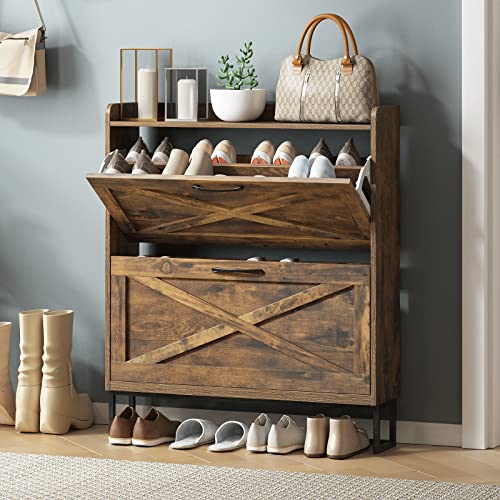
- Best for families overall: Maupvit Shoe Storage Cabinet with 2 Flip Drawers, Rustic Brown — Check on Amazon
- Best for boots and big sizes: VASAGLE LIRY Collection Shoe Cabinet, 3-Tier with Hinged Doors — Check on Amazon
- Best zoned drawers: Sscaktu Shoe Storage Cabinet with 3 Flip Drawers, Fluted, Natural — Check on Amazon
- Best ventilated: IRONCK Shoe Cabinet with 2 Flip Drawers, Rattan Doors, Oak — Check on Amazon
- Best second-door slim cabinet: Haotian Slim Shoe Cabinet with 2 Flip Drawers, FSR151 — Check on Amazon
- IKEA HEMNES Shoe Cabinet with 4 Compartments — prose-only pick, sold by IKEA directly; see the review below for why there is no Amazon link
Read the full guide ↓
Disclosure: As an Amazon Associate, dailyhomedecorating.com earns from qualifying purchases. Links to Amazon on this page are affiliate links; they cost you nothing extra. Listing details such as price and availability change often, so check the current Amazon listing before you buy.
Choosing the best shoe cabinet for families under $1000 is not really a shopping problem — it is a crowd-control problem. A couple owns shoes. A family generates them: school shoes and the trainers that replaced them mid-term, wellies in three sizes, football boots caked in last Sunday, the good shoes nobody may touch, and a permanent drift of single shoes whose partners live under sofas. The cabinet that solves this is not the prettiest one or the one with the largest invented capacity. It is the one that gives every person a zone, survives being opened forty times a day by people who did not pay for it, hides the chaos completely when the door closes, and stays standing when a determined toddler treats it as a climbing frame with handles. This guide judges six verified closed cabinets on exactly those family terms.
Two ground rules before the picks. First, cabinet, not rack: open shelving in a family entry is a display of everything you least want displayed, and it puts small shoes at exactly the height where they get carried off by toddlers and dogs. Every pick here closes — hinged doors or flip drawers — so the mess vanishes and stays vanished. Second, honesty about the budget: no family needs to spend anywhere near a thousand dollars on one shoe cabinet, and nothing in this guide pretends otherwise. Every linked pick was sighted at a small fraction of the ceiling. What the headroom really buys a family is a system: the right main cabinet, perhaps a slim second cabinet by the back door, and the bench to sit on while the morning shoe negotiation happens. We will show you the cabinets, the zoning logic that makes them work, and the safety details that matter more than any finish.
Capacity deserves a family’s skepticism. Brands count pairs the way airlines count legroom — optimistically, and assuming everyone is small. Children’s shoes genuinely do pack tighter, so family capacity is real, but it is uneven: a drawer of size-3 school shoes and a drawer of a teenager’s high-tops are different universes. The reviews below use conservative working figures, flag which cabinets swallow boots and big sizes without a fight, and mark which ones are daily-rotation cabinets rather than whole-collection archives. You will also find a comparison table, a how-to-choose section built around headcount and hallway width, the mistakes families specifically make, and a FAQ that answers the questions parents actually ask — including the safety one, which we put first in importance even if it appears last in the structure.
In this guide
Quick Picks: Best Shoe Cabinet for Families Under $1000
Each row matches a family situation to the cabinet that handles it best. Use check price on Amazon to see the live listing before you buy; prices in this category shift with coupons and seasonal sales.
| Family situation | Pick | Why it stands out | Link |
|---|---|---|---|
| Best for families overall | Maupvit Shoe Storage Cabinet, 2 Flip Drawers | Scuff-forgiving rustic finish, metal legs, two deep two-level drawers for daily chaos | Check on Amazon |
| Best for boots and big sizes | VASAGLE LIRY Collection Shoe Cabinet | Hinged doors and adjustable flat shelves — wellies, high-tops and size-large trainers fit | Check on Amazon |
| Best zoned drawers | Sscaktu Shoe Storage Cabinet, 3 Flip Drawers | Three drawers = three zones: parents, kids, guests and sports kit | Check on Amazon |
| Best ventilated | IRONCK Shoe Cabinet, Rattan Doors, Oak | Woven fronts air out school shoes and sports trainers behind closed doors | Check on Amazon |
| Best second-door slim cabinet | Haotian Slim Shoe Cabinet, FSR151 | About 7.5 inches deep — a back-door or garage-entry cabinet for overflow | Check on Amazon |
| Best a-compartment-each design | IKEA HEMNES Shoe Cabinet, 4 Compartments | Four compartments, one per person — covered prose-only, sold by IKEA | See review |
How These Picks Were Chosen
The family filter came first. A pick had to close fully — no open racks, cubbies, fabric pockets or spinning towers — because family entries need concealment and containment, not display. It had to be a verifiable Amazon listing with a confirmable ASIN, specifications we could cross-check against maker manuals or independent coverage, and a dated price sighting far under the $1000 ceiling. Check price on Amazon before ordering; a sighting establishes the tier, never today’s figure. It also had to answer at least one real family job: zoning by person, swallowing boots, ventilating sports shoes, forgiving scuffs, or fitting the narrow wall by a second door.
Safety was a selection criterion, not a footnote. Slim cabinets are tall, narrow and front-heavy when a drawer tips open, and children climb. Every linked pick either ships with an anti-tip device or belongs to a range whose manuals include one, and the reviews say so where we verified it — and the HEMNES, which is not freestanding at all and must be wall-fixed, is flagged in the strongest terms. If a listing could not confirm its fixing hardware, it did not make this family list, however handsome it looked.
We did not use these cabinets ourselves. We read listings, manuals and long-term review coverage, and we derated capacity claims the way a family should: children’s shoes pack small, teenagers’ shoes do not, and any figure that assumed a cabinet full of ballet flats was replaced with a working range. Where a brand’s own material disagreed with itself, we printed the conservative number. One pick is prose-only by principle: IKEA sells the HEMNES directly, Amazon offers only third-party resellers at markups, and a family guide should not route you to a worse deal for the sake of a link. If your household is smaller and style leads the decision instead, our companion guide to the Best Shoe Cabinet For Modern Homes Under $1000 applies the same verification to the design-first shortlist.
Detailed Reviews
Maupvit Shoe Storage Cabinet with 2 Flip Drawers — Best for Families Overall
Who it suits: The median busy family: two adults, one to three children, one hard-working entryway, zero interest in furniture that needs to be babied. The Maupvit Shoe Storage Cabinet in rustic brown takes the top spot for families because it is built for the way families actually treat furniture — as infrastructure.
Start with the finish. Rustic brown is the only color in this guide that genuinely hides a family week: the scuff from a scooter, the drip line from wet school runs, the grey dust that settles on every horizontal surface by Thursday. On white lacquer each of those is a cleaning task; on this finish they are invisible until the weekend wipe. The body is MDF at about 9.45 inches deep — slim enough for most hallways — standing on metal legs that tolerate mopping, puddles and the occasional indoor football better than wooden plinths, with clearance underneath for the shoes that will inevitably be kicked there anyway. Two flip drawers, each with two levels, organize the daily rotation naturally: adults up top where small hands reach less, children below where they can serve themselves — a small thing that ends the morning chorus of missing-shoe announcements.
Pros: The most forgiving surface in the guide. Metal legs shrug off wet and grit. The two-drawer, two-level layout zones cleanly by person or by level. Flip geometry keeps depth hallway-friendly while the top surface runs a family’s landing strip — keys, school passes, the dog lead, a basket for gloves. Its sighted price leaves most of the budget free for the bench and the back-door cabinet, which is how family money should be spent.
Honest limitation: Two drawers is a rotation, not an archive: a family of five with a full sports schedule will outgrow it as sole storage and should pair it with the Haotian at the back door or step up to the three-drawer Sscaktu. Flip buckets keep their usual limits — tall wellies and the largest teenage sizes may need the divider out and a diagonal fit, and true boot storage belongs to the VASAGLE below. And like every slim cabinet here, it must be wall-fixed with its anti-tip hardware, especially in a house with climbers.
Choose it if your entry works hard and your aesthetic is rustic, farmhouse or simply realistic. Skip it if you need three-plus zones in one unit or your household’s footwear runs tall and huge. Check price on Amazon before buying — it has been sighted at the modest end of this guide’s range.
VASAGLE LIRY Collection Shoe Cabinet — Best for Boots and Big Sizes
Who it suits: Families whose footwear defeats flip drawers: the wellington phase, the hiking phase, the teenager whose trainers are longer than the buckets designed for them. The VASAGLE LIRY is the only hinged-door cabinet in this guide, and for boot-owning families it is not a preference, it is the answer.
Two doors open onto three tiers of flat shelving, the upper shelf adjustable through five holes about 1.2 inches apart, inside a cabinet roughly 13.8 inches deep, 31.5 inches wide and 27.6 inches high. Flat shelves change family logistics: boots stand upright instead of being folded into buckets, a whole row is visible at once so nobody excavates for the left shoe, and a shelf can be re-spaced in a minute when the season turns from sandals to winter boots. VASAGLE’s manual rates nine to twelve pairs — honest, because flat storage trades raw count for total flexibility — and rates the structure at a 165-pound maximum static load, with an anti-tip kit and elevated base in the box. The low, wide stance is also the most inherently stable shape here, a genuine point in its favor around small children.
Pros: Accepts the footwear other picks reject. Adjustable shelf adapts as children grow through shoe categories. Whole-row visibility ends excavation. The deep top works as a family console — lamp, post tray, the bowl of everything. Sturdy load rating and included fixing hardware suit a house that will lean on it, literally.
Honest limitation: It needs depth — about fourteen inches plus door swing — which rules out pinch-point hallways, and its nine-to-twelve-pair honesty means big families may need it plus a second unit rather than instead of one. It is also the shortest cabinet here, so it stores less wall-height than the tall flip models. Assembly is a real furniture project; recruit the other adult and a free hour.
Choose it if boots, wellies or large sizes are non-negotiable in your house. Skip it if your hallway is narrower than the swing of its doors. Check price on Amazon — this model is discounted often enough that checking is always worth it. Families building the full entry system around it will find the seating half in our Best Entryway Bench For Families Under $300 roundup.
Sscaktu Shoe Storage Cabinet with 3 Flip Drawers — Best Zoned Storage
Who it suits: Larger families and anyone who has ever said the words “whose shoes are these?” Three drawers is a filing system. The Sscaktu Shoe Storage Cabinet stacks three flip drawers in a 31.5-inch-wide fluted natural front, and that third drawer is the difference between a cabinet and an argument.
Zone it by person — parents, older kids, younger kids — or by purpose: daily shoes, school and sports, guests and seasonal. Each drawer tips forward to two levels of storage, so a zone is itself sortable, trainers below and good shoes above. The fluted front matters in a family home more than visitors realize: vertical reeding disguises the fingerprints, sticker residue negotiations and general hand-height grime that a flat gloss front displays like a noticeboard, and the natural finish sits comfortably in the warm, lived-in interiors most families actually have. The cabinet is sold through the Raysom Home storefront on Amazon, within a fluted range that includes a larger hinged-door sibling — useful if the family later expands storage into a second room and wants the pieces to match.
Pros: Three genuine zones end the whose-shoes argument. The textured front hides family wear better than any flat finish here. Slim flip depth keeps hallways passable even in smaller homes. A wide styled top gives the household a single landing place, which is half of entryway order. Capacity across three two-level drawers covers a family’s full daily rotation in one footprint.
Honest limitation: The flip format’s limits apply per drawer — tall boots and the very largest sizes still need divider removal and diplomacy, so boot-heavy families should read the VASAGLE review first. Three drawers also means three sets of pivots doing daily family duty; teach smaller children to tip drawers by the handle rather than hauling on a shoe, and check fixings at assembly. And use the wall fixing: a tall zoned cabinet fully loaded at the top is exactly the profile anti-tip kits exist for.
Choose it if headcount and organization are your binding constraints. Skip it if boots dominate or your style runs to flat-front minimalism. Check price on Amazon to confirm the live listing — its sightings sit far below this guide’s ceiling.
IRONCK Shoe Cabinet with 2 Flip Drawers, Rattan Doors — Best Ventilated
Who it suits: Sporty families. If your entry currently smells faintly of football practice despite everyone’s best efforts, the IRONCK Shoe Cabinet addresses the cause rather than the symptom: its flip-drawer fronts are hand-woven rattan over MDF in an oak finish, and woven fronts breathe.
Sealed cabinets trap the day’s moisture around shoes; ventilated ones let trainers and school shoes dry between wears, which is better for the shoes, the cabinet and the hallway. The cabinet measures about 9.25 inches deep, 23.6 inches wide and 39.6 inches tall at roughly 45 pounds, on metal legs that clear mops and robot vacuums. Each drawer carries two levels split by a center panel that adjusts or removes entirely — one tall space for a child’s ankle boots, two shallow ones for pumps and trainers — and the wider sibling in the same range is specified to fit men’s sizes up to 11.5 without removing the panel, with three panel positions. An anti-tipping device is included, and the brand’s manuals suggest two-person assembly well inside an hour, which any parent who has built flat-pack at midnight will appreciate.
Pros: Airflow is a genuine functional edge in a sports household. The adjustable and removable panels flex as children’s feet and seasons change. Warm rattan-and-oak looks soften a high-traffic family entry instead of making it feel like a locker room. Metal legs and raised stance simplify cleaning under and around it — a weekly family reality.
Honest limitation: At 23.6 inches wide it is a compact cabinet: a couple plus young children, yes; a five-person daily rotation, no — it becomes the sports-shoe cabinet beside a larger main unit. Rattan can be scratched at by pets and picked at by determined toddlers in a way lacquer cannot, and natural weave varies slightly in tone between panels. Ventilation also means it hides shoes visually but is not the choice for a household wanting a totally sealed, crisp flat front.
Choose it if sports kit and school shoes dominate and odor is a live issue. Skip it if you need maximum capacity in the main cabinet. Check price on Amazon before ordering.
Haotian Slim Shoe Cabinet, FSR151 — Best Second-Door Cabinet
Who it suits: Families with two working doors. Most family entries fail not at the front door but at the back — the kitchen or garage door where muddy shoes actually come off. At about 7.5 inches deep, the Haotian FSR151 fits the sliver of wall those doors usually offer, and gives the overflow a closed home instead of a spreading mat of footwear.
The cabinet measures about 7.5 by 19.7 by 35.8 inches in engineered wood, with two flip drawers, an adjustable shelf detail, a raised bottom and hollowed-out handles that leave the front completely flush — nothing for school bags to snag on in a narrow utility pass. Independent apartment coverage put its realistic capacity at about six pairs, and for its family role that is the right scale: the garden shoes, the dog-walking trainers, the wellies-in-waiting, kept at the door where they are used rather than trailing through the house to the main cabinet. A taller three-drawer sibling exists in the same range if the back hall has height to spare.
Pros: The slimmest verified closed cabinet anywhere in this series — it fits walls nothing else can use. Cheap enough, on its sightings, that buying it as a satellite to a main cabinet is an easy decision. Flush front and raised base suit utility spaces and make cleaning a single pass. It also serves growing families as the children’s own cabinet in a bedroom hallway, at a height and scale children can manage themselves.
Honest limitation: Six pairs is a satellite, not a headquarters — do not buy it as a family’s only cabinet and blame the format. Shallow buckets squeeze large adult sizes, tall footwear is out, and its tall, slim, light profile makes the wall fixing non-negotiable, particularly anywhere children play.
Choose it if a second door, a utility room or a child’s zone needs slim closed storage. Skip it if it would be your only cabinet. Check price on Amazon — it is the most affordable linked pick in this guide.
IKEA HEMNES Shoe Cabinet with 4 Compartments — A Compartment Each (Prose-Only)
Who it suits: Families of four who love a system a child can understand: one compartment each. The HEMNES four-compartment cabinet — about 42.1 inches wide, 8.6 inches deep and 39.8 inches high — lines up four tipping compartments in a row, and generations of families have run it as personal territory: your compartment, your shoes, your responsibility. IKEA’s buying-guide dimensions and independent measurement coverage agree on the footprint, and realistic capacity is around eight pairs.
It is prose-only here for a principled reason: IKEA sells it directly, there is no official IKEA listing on Amazon US, and the Amazon listings that exist are third-party resellers at markups without IKEA’s delivery, returns or spare-parts support. A family guide should send you to the better deal, so there is no link — buy it from IKEA, where it has been sighted at a modest price.
Pros: The compartment-each logic genuinely teaches shoe discipline. Proven longevity and available spare parts suit a buy-it-once family. The slim 8.6-inch depth fits hallways the hinged-door cabinet cannot. IKEA’s instructions and hardware are the most parent-proof in the category — no small virtue at 11 p.m. before a school morning.
Honest limitation: The HEMNES is not freestanding — it stands on two front legs and must be fixed to the wall, full stop, which rules it out where fixing is impossible. Eight realistic pairs will not cover a large family’s whole rotation, the flip compartments share the format’s limits on tall and very large shoes, and a compartment each works beautifully until a fifth person arrives.
Choose it if your family of four can wall-fix and loves a visible system. Skip it if you cannot fix to the wall or need Amazon delivery and returns. As a benchmark it earns its place; as a purchase, make it directly from IKEA.
Comparison Table
Capacities are conservative working figures for mixed family footwear, not listing maxima. Prices are never printed here — use check price on Amazon on each review’s link for the live figure.
| Pick | Format | Dimensions (D × W × H) | Family working capacity | Standout family trait |
|---|---|---|---|---|
| Maupvit 2-Flip | 2 flip drawers | ~9.45 in deep class | Daily rotation, 2 zones | Scuff-hiding finish; metal legs |
| VASAGLE LIRY | Hinged doors, flat shelves | ~13.8 × 31.5 × 27.6 in | 9–12 pairs (maker figure) | Boots and big sizes; adjustable shelf |
| Sscaktu 3-Flip | 3 flip drawers | Slim class; 31.5 in wide | Full rotation, 3 zones | A drawer per person or purpose |
| IRONCK Rattan | 2 flip drawers | ~9.25 × 23.6 × 39.6 in | Compact rotation | Ventilated woven fronts |
| Haotian FSR151 | 2 flip drawers | ~7.5 × 19.7 × 35.8 in | ~6 pairs | Slimmest — the back-door satellite |
| IKEA HEMNES 4 | 4 flip compartments | ~8.6 × 42.1 × 39.8 in | ~8 pairs | A compartment each; IKEA-direct only |
Read the table by household shape. Two adults and small children: the Maupvit, zoned by level, with the Haotian added when the back door starts to drift. Three or more children: the Sscaktu’s third drawer stops the system collapsing. Boots, wellies and big teenage sizes in the mix: the VASAGLE is the only pick that takes them without negotiation, provided the hallway takes its depth. A sports-heavy house: the IRONCK’s ventilation earns it the sports zone beside any main cabinet. And a family of exactly four with a fixable wall and a love of systems: the HEMNES, bought from IKEA. Families in tighter footprints should also read our Best Shoe Cabinet For Small Spaces Under $1000 guide, which applies this same shortlist logic to pinch-point walls.
How to Choose a Shoe Cabinet for a Family
Count heads, then count daily pairs — not total shoes. The cabinet by the door serves the rotation: school shoes, work shoes, trainers, one seasonal pair each. Everything else belongs in wardrobes. Most families of four need ten to sixteen pairs of by-the-door capacity; families of five or six, or with a sports schedule, should plan on a main cabinet plus a satellite rather than one heroic unit.
Zone by person or perish. Unzoned family storage becomes a single mixed bucket within a week, and the morning excavation begins. Three drawers, four compartments, or two drawers split by level — any structure a child can state (“mine is the bottom one”) will hold. Assign the lowest zone to the smallest child: self-service at their height ends more arguments than any capacity figure.
Fix it to the wall. This is the non-negotiable paragraph. Slim cabinets are front-heavy with a drawer open, children climb and haul, and the combination is the one genuine hazard in this category. Every cabinet here ships with or specifies anti-tip hardware; the HEMNES is not even freestanding. Fit the kit on day one, into a stud or a proper anchor, and re-check it when you move the cabinet for decorating. No finish, capacity or price justifies skipping this step in a family home.
Match the format to the footwear your family actually wears. Flip drawers are slim and fast, and they handle the standard school-and-trainer rotation beautifully. They lose to boots, wellies and the largest sizes. If your winters are wet or your teenagers are tall, the hinged-door cabinet’s adjustable flat shelves are not a luxury — they are the difference between a system that works in February and one that works until February.
Choose surfaces for the life you have. Rustic and natural finishes hide the family week; gloss white documents it. Woven fronts ventilate sports shoes; fluted fronts disguise fingerprints. Metal legs forgive mopping and puddles. Pick the surface that matches your cleaning reality, not your aspiration, and the cabinet will still look cared-for in year three. Complete the system with a mirror at child-checking height and a hook rail, and browse our Best Floor Lamp For Families Under $300 picks for the coats that otherwise colonize the cabinet top.
Common Mistakes Families Make
Buying one cabinet for every shoe the family owns. Whole-collection storage by the door guarantees a deep, unsearchable cabinet and shoes migrating to the floor anyway. Store the rotation at the door; archive the rest in wardrobes where depth does not matter.
Trusting the headline pair count. A listing that promises dozens of pairs is counting small shoes in perfect order. Children’s shoes do pack tighter — but one pair of a teenager’s high-tops cancels three pairs of toddler shoes. Work from the conservative figures in this guide and your own headcount.
Skipping the wall fixing “until the weekend.” The weekend project that matters most is the one that takes ten minutes on day one. A loaded slim cabinet and a climbing child will not wait for your schedule.
Sealing wet and muddy shoes inside. Closed cabinets and damp footwear produce the smell families then blame on the cabinet. Dry shoes first — ventilated fronts like the IRONCK’s help — and keep a washable mat for the truly soaked pairs that should not go in at all until morning.
Giving children the top zone. Zones assigned by adult logic fail at child height. Low zones for small people, and handles they can work, turn the cabinet from a parental chore into a household habit.
Buying an open rack because it was cheaper per pair. In a family entry, open storage displays the chaos, invites toddlers to redistribute it, and collects dust on every shoe. The closed premium is the entire point. If budget rather than space is your binding constraint, the same family logic is applied tier by tier in our Best Shoe Cabinet For Families Under $700 guide.
Zoning Systems That Actually Hold: A Week in a Family Entry
Advice about zones is cheap; systems survive contact with Tuesday. Here is how the cabinets in this guide hold up as working systems across a real family week, and the small rules that make the difference between a cabinet that stays organized and one that becomes a cupboard of regrets by half-term. Start on day one with the assignment ritual: every person physically places their shoes in their zone while you watch, because a system explained is a system forgotten, and a system performed is a habit. Label nothing — labels peel and children weaponize them — but keep the geography absolutely stable. The moment zones start migrating (“Dad’s trainers are in the sports drawer just this once”), the system is negotiating, and systems that negotiate lose.
Monday to Friday runs on the two-pair rule: each person may keep two pairs in the cabinet — the daily pair and the alternate. Everything else lives in wardrobes. The rule sounds strict and is actually liberating, because it caps the cabinet’s contents at exactly the capacity the honest figures in this guide describe, and it makes the Saturday reset a five-minute job instead of an excavation. In the Maupvit, the two-pair rule maps to levels: daily below, alternate above. In the Sscaktu, it maps to drawers by person, with the third drawer holding the household’s shared overflow — guest slippers, the umbrella-dry pair, the football boots that must not enter the rotation drawers smelling as they do. Those boots, in a sports household, belong in the IRONCK’s ventilated zone or on a mat until dry; sealing them into a flip drawer on Sunday night is how Monday morning acquires its aroma.
Seasonal changeover is the family’s other stress test, and it is where the VASAGLE earns its keep in mixed households: when sandals yield to boots, an adjustable shelf re-spaces in minutes, while flip cabinets need their divider conversation — out for boots, in for flats — drawer by drawer. Do the changeover as a household event, twice a year, with the out-of-season pairs cleaned before they go to the wardrobe archive. Shoes stored dirty deteriorate; shoes stored clean are a gift to your future self in October. While the cabinet is empty, wipe the interiors, check the anti-tip fixing is still taut, and tighten any pivot that has developed play. Ten minutes, twice a year, is the entire maintenance contract of a family shoe system.
Finally, plan for growth, because children are a capacity event that repeats annually. Feet grow, rotations expand, and the teenager’s footwear eventually occupies adult volume in what was the children’s zone. The households that cope are the ones that bought zoning flexibility — three drawers that can be re-dealt, panels that remove, a satellite Haotian that can migrate from back door to a child’s room — rather than a single fixed interior perfectly fitted to this year’s family. That, more than any finish or front, is what a generous budget should buy a family: not the biggest cabinet, but the system that can be re-dealt as the household changes, at a total cost that still leaves most of the ceiling unspent.
The Second Door, the Guests and the Grandparents
Three family situations defeat more shoe systems than children ever do, and each maps to a pick in this guide. The first is the second door. In most houses the ceremonial front door is not the working door: the family enters through the kitchen, the utility room or the garage, shedding shoes there, while the beautiful main cabinet stands guard over a hallway nobody uses. The symptom is a permanent drift of footwear at the working door and a pristine cabinet at the formal one. The cure is not discipline — households do not change their doors — it is a satellite: the Haotian at the working door, slim enough for the utility wall, holding the garden shoes, dog-walking trainers and wellies-in-waiting where they are actually shed. Budget-wise the satellite is the cheapest decision in this guide, and in lived terms it is often the one that finally makes the entry feel solved.
The second situation is guests. A family cabinet zoned to the last pair has no slack for visitors, whose shoes then colonize the hallway floor precisely when the house is meant to look its best. The systems that cope keep a deliberate slack zone: the Sscaktu’s third drawer run as guest-and-overflow, or the top level of the Maupvit reserved rather than assigned. Slack looks like waste on a diagram and functions as hospitality in practice — the difference between a house that absorbs six visitors gracefully and one that trips over their shoes. If your household entertains often, buy the cabinet one zone larger than your family strictly needs, and defend the empty space against the rotation’s natural expansion.
The third situation is grandparents and anyone for whom bending to floor-level buckets is a genuine barrier. Flip drawers ask their user to stoop and tip; the lowest drawer of a tall cabinet is the hardest storage in the house for an older back. In multigenerational homes, assign the upper drawers and the highest shelves to the oldest users, not the youngest — the reverse of the instinct that puts children low because they are short. Children stoop happily; grandparents should not have to. The VASAGLE’s mid-height shelves, revealed all at once behind doors, are the kindest format here, and a bench beside it completes the courtesy: sit, change shoes at waist height, stand. Families planning for a parent to move in, or simply to visit for decades, should weight that kindness as heavily as any capacity figure in this guide.
Assembly Day: Build It With the Family, Not Around It
A practical closing note, because family cabinets are assembled in family conditions: interrupted, supervised by toddlers, and finished later than planned. Stage the build in a room with a door you can close, lay every panel out before the first screw, and keep the hardware in a bowl rather than the bag it came in — the bowl survives being knocked over; the bag’s contents emigrate under the sofa. Older children can genuinely help with flip-drawer assembly, sorting panels and holding drawers square, and a child who helped build the cabinet treats its zones with a respect no house rule achieves. Fit the wall fixing as part of the build, not as a later task: the cabinet is at its most movable, and you at your most motivated, in the hour it goes together. Then run the assignment ritual from the zoning section while the tools are still out, photograph the finished system for the family chat, and put the spare hardware and the Allen key in a labeled bag inside the cabinet’s least-used corner. Future you, at the seasonal changeover, will be grateful for every one of those ten minutes.
Final Recommendation
Most families should buy the Maupvit as the main cabinet: forgiving finish, sensible zones, metal legs, and a price that leaves room for the rest of the system. Step up to the three-drawer Sscaktu when headcount demands a third zone, choose the VASAGLE instead when boots and big sizes rule the house, and add the Haotian at the back door before the drift begins. The IRONCK earns the sports zone in any configuration, and the HEMNES — bought from IKEA and fixed to the wall — remains the compartment-each classic for families of four. Whatever you choose, fix it to the wall the day it arrives, zone it the day it is built, and the morning shoe hunt becomes a memory.
FAQ
How many pairs should a family shoe cabinet hold? Plan for the daily rotation, not the collection: roughly two pairs per adult and one to two per child by the door. That is ten to sixteen pairs for most families of four — which is why this guide’s honest capacities, rather than listing maxima, are the numbers to shop by.
Are shoe cabinets safe around toddlers? A closed cabinet is safer than open shelving — no small shoes at grabbing height, no climbable open tiers — but only when it is fixed to the wall with its anti-tip kit. Slim cabinets are front-heavy with a drawer open. Fit the fixing on day one; the HEMNES must be wall-fixed to stand at all.
Flip drawers or hinged doors for a family? Flip drawers for speed, slimness and the standard school-and-trainer rotation. Hinged doors with adjustable shelves — the VASAGLE here — when boots, wellies or large sizes are daily realities. Many families end with one of each at different doors, which this budget comfortably allows.
How do we stop the cabinet smelling of sports shoes? Dry shoes before they go in, rotate pairs so nothing is worn two days running, and favor ventilation: the IRONCK’s woven rattan fronts air the interior continuously. A sealed cabinet of still-damp trainers will smell whatever you paid for it.
Should each child have their own section? If the cabinet’s structure allows it — three drawers, four compartments, or levels split by person — yes. A named zone a child can reach is the single most effective shoe-discipline tool available, and it costs nothing beyond the five minutes of assigning it.
What do we do when a child outgrows their zone? Re-deal the zones at the seasonal changeover rather than letting them drift: the growing child’s drawer swaps with a smaller sibling’s, the satellite cabinet migrates to the teenager’s room, and the two-pair rule is renegotiated openly instead of breached quietly. Systems that are re-dealt on a schedule survive childhood; systems carved in stone are abandoned by it, usually sometime around the first pair of adult-sized trainers.
Is it worth spending up to $1000 on a family shoe cabinet? Not on one cabinet — every pick here was sighted far below the ceiling. Spend the headroom on the system instead: a main cabinet, a slim back-door cabinet, a bench to sit on. That combination, at a fraction of the budget, is what actually ends entryway chaos.


