Where to buy
Check the latest price, availability and delivery on Amazon. Orders are placed on Amazon. We may earn a commission from qualifying purchases.
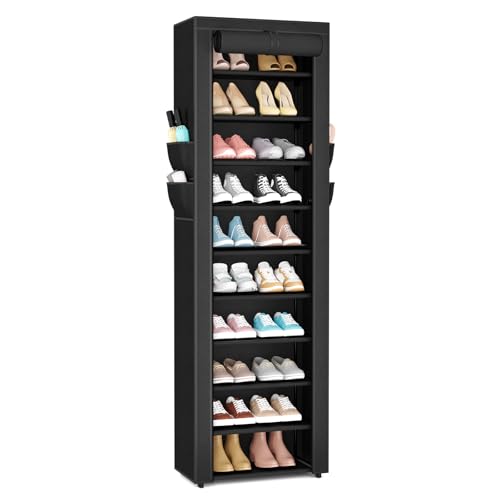
- Best true cabinet-style pick: VTRIN 10-Tier Narrow Shoe Rack with Dustproof Cover — Check on Amazon
- Prose-only: slimmest wooden tower: Furinno Compact Vertical Shoe Tower, 8-Tier (24142) — described in full below; no link in this guide (see the review for why)
- Whitmor 24-Pocket Over-the-Door Shoe Organizer (Clear) — Check on Amazon
- Kuject X-Large Clear Shoe Storage Boxes, 12-Pack — Check on Amazon
- HOMIDEC 8-Tier Cube Shoe Cabinet (2 by 8) — Check on Amazon
- Simple Houseware 3-Tier Stackable Shoe Rack, Bronze — Check on Amazon
Read the full guide ↓
Disclosure: As an Amazon Associate, dailyhomedecorating.com earns from qualifying purchases. Links to Amazon on this page are affiliate links; they cost you nothing extra. Listing details such as price and availability change often, so check the current Amazon listing before you buy.
In a small apartment, shoe storage is not a tidiness problem — it is a rent problem. Every square foot your shoes occupy is floor you are paying for monthly and cannot use for anything else, and the best shoe cabinet for small apartments under $50 is the one that stores the most pairs per square foot while asking for no drilling, no landlord permission and no permanent commitment to a layout you may change at the next lease. The typical small-apartment entry makes it harder: often there is no entry at all, just a front door opening into the living space, a sliver of wall, and a closet that is already negotiating with your entire wardrobe. Shoes that cannot find a vertical or hidden home end up as the famous apartment shoe puddle — the first thing you see, trip over and apologise for.
The budget tier is, for once, naturally suited to the problem. The closed storage that exists under $50 — fabric towers, cube grids, clear boxes — is light, flat-packed, tool-free and movable, which is precisely what rented life demands. Nothing here needs a wall fixing except the safety anchor we recommend for tall units, and even that has renter-friendly workarounds discussed below. What this tier will not give you is a solid wooden cabinet, and in a small apartment that is arguably a blessing: the day you move, a fabric tower folds into a bag and a cube grid flat-packs into a box, while a wooden cabinet becomes a two-person problem on a stairwell. Lightweight is not the compromise here. Lightweight is the feature.
Our short answer for most small apartments is the VTRIN covered tower: ten tiers in a footprint barely wider than a pair of shoes, hiding the whole collection behind one cover in the gap beside the door. The Furinno wooden tower, described prose-only, is the even narrower furniture-looking option for the one-foot gap nothing else fits. The Whitmor door organizer stores a dozen pairs in space that is currently doing nothing — the back of a door — and the Kuject boxes turn closet shelves and under-bed voids into shoe storage without touching your floor plan at all. The HOMIDEC grid is here for studio layouts with one usable wall, where it can be built low as a room-dividing block, and the Simple Houseware rack covers the small apartment whose door opens onto weather. Measure your gaps first — in a small apartment, the tape measure is the whole game.
One discipline runs through every recommendation below: in a small apartment, storage decisions are reversible or they are expensive. A tower can move to the next flat, a grid can rebuild in a new shape, boxes can redistribute across new voids, a door organizer can change doors in a minute. Nothing here asks you to commit the flat’s geometry to one product’s dimensions, and that reversibility is worth as much as capacity when your home is rented and your next home is unknown. Buy the system you can re-deploy, in the configuration this flat needs today, and the purchase stays correct across leases instead of expiring with this one.
In this guide
Quick Picks
Short on time? This table matches each design to the job it does best in this price tier. Every linked pick was checked against the under-$50 ceiling at the time of writing — confirm the current listing before you buy, because budget storage prices move often.
| Buyer type | Pick | Why it stands out | Link |
|---|---|---|---|
| Best true cabinet-style pick | VTRIN 10-Tier Narrow Shoe Rack with Dustproof Cover | Tall, narrow tower fully wrapped in a non-woven dust cover, so shoes disappear behind fabric instead of sitting on open display | Check on Amazon |
| Prose-only: slimmest wooden tower | Furinno Compact Vertical Shoe Tower, 8-Tier (24142) | An eight-tier composite-wood tower only about a foot square, the narrowest furniture-style footprint in this guide | No link — see review |
| Best zero-floor-space option | Whitmor 24-Pocket Over-the-Door Shoe Organizer (Clear) | Twenty-four clear pockets that hang on the back of a door, using space no floor-standing cabinet can touch | Check on Amazon |
| Best see-everything storage | Kuject X-Large Clear Shoe Storage Boxes, 12-Pack | Twelve individual clear stackable boxes with lids, so every pair stays visible, dust-free and separately grabbable | Check on Amazon |
| Best closed-door capacity | HOMIDEC 8-Tier Cube Shoe Cabinet (2 by 8) | A reconfigurable cube grid with a door on every cube, the closest thing in this tier to a real cabinet with doors | Check on Amazon |
| Best open metal rack | Simple Houseware 3-Tier Stackable Shoe Rack, Bronze | A sturdy bronze-finish wire-grid rack that stacks, so you start with three tiers and add height only if you need it | Check on Amazon |
How we chose the best shoe cabinet for small apartments under $50
Apartment judging starts with footprint efficiency: pairs stored per square foot of floor, with vertical designs scored on their true built footprint including the space their covers or doors need to open. Second came renter compatibility — tool-free or minimal assembly, nothing that requires wall drilling as a condition of use, and weight low enough for one person to move at lease-end. Third came the usual tests: how completely the design closes, verified real-world capacity, and a price we could sight inside the tier at the time of writing. The Furinno tower could not be price-verified in tier, so it appears prose-only with its dimensions stated, because for gap-fitting those dimensions are the useful part.
We also weighted flexibility, because small apartments rearrange constantly. Modular and box-based designs that can change shape when you move a sofa scored ahead of fixed frames, and anything that only works in one exact spot was marked down — in a one-room layout, storage that cannot adapt becomes storage you trip over in a new place.
We also tested each pick against the small apartment’s secret second brief: the guest test. When someone visits a one-room home, the entry storage becomes living-room furniture whether it wants to or not. Closed picks pass the guest test by disappearing; the open rack passes only in its disciplined, edited form; and the door organizer passes by not being in the room at all. Rankings below reflect that double life, because in a small apartment every object leads one.
A closing note on priorities for renters reading quickly. If you absorb nothing else, absorb the order of operations: audit the flat’s three volumes first, count pairs second, and only then look at products, because in a small apartment the products are the easy part. Every design in this guide is light, flat-packed, reversible and verified as buyable inside the tier during research — the companion sources file records the sightings — so the risk in this purchase was never really the object. The risk is a mismatch between object and flat, and that risk is entirely retired by twenty minutes with a tape measure before you order. Do the audit, and whichever pick your measurements select will feel less like a purchase and more like a discovery: the storage was always possible; it was just waiting to be measured.
Detailed reviews
Each pick below is judged on who it suits, what it does well, where it honestly falls short, and the simplest choose-or-skip test we can give you.
VTRIN 10-Tier Narrow Shoe Rack with Dustproof Cover
The VTRIN is a ten-tier vertical tower built from metal tubes, plastic connectors and non-woven fabric shelves, finished with a full dustproof cover that closes the front. The maker rates it for twenty to twenty-two pairs, which in practice means roughly two pairs of average shoes per tier if you angle them, or one pair of chunky trainers per tier with room to breathe. Because the footprint is narrow and the height does the work, it behaves like the budget end of a shoe cabinet: a closed, dust-shielded column rather than an open rack. Assembly is tool-free push-together work, and the cover lifts away so you can reach lower tiers without dismantling anything.
Who it suits: the classic small-apartment layout — a door, a sliver of wall beside it, and nowhere else. Ten tiers in a narrow covered column turns that sliver into the entire shoe system, hidden behind a cover so the living space it opens into stays calm.
Pros: the best pairs-per-square-foot of any floor-standing pick here; the cover matters doubly in studio layouts where the entry is the living room; it flat-packs to almost nothing on moving day. Honest limitation: tall and narrow means anchor it — a renter-friendly furniture strap or careful bottom-loading is part of the deal — and fabric shelves ask you to put boots low and light shoes high. Choose it if you have one narrow gap and a whole collection. Skip it if your only spot is wide and low — the grid uses that shape better.
Apartment life with the tower settles into a simple geography: the tower owns the entry, and nothing shoe-shaped lives anywhere else in the open. That single rule is what keeps a small living space calm, because visual clutter in a studio compounds — one pair on the floor licenses the next. The cover is the enforcement mechanism: pairs are either in the tower or on your feet. When guests come, the whole collection vanishes behind fabric in seconds, which in a one-room home is the difference between a living space and a hallway with a bed in it. Few objects this cheap change the feel of a small apartment this completely.
Furinno Compact Vertical Shoe Tower, 8-Tier (24142)
The Furinno 24142 is the outlier here: instead of tubes and fabric it is a vertical tower of CARB-grade composite wood panels, eight tiers tall, measuring roughly 12.1 by 12.6 by 46.8 inches — barely wider than a single pair of shoes. The maker positions it for around seven to eight pairs stored vertically, one per tier, with a forty-pound overall weight capacity and a one-year warranty against manufacturer defects. It looks more like furniture than any fabric tower, which is exactly its appeal in a visible hallway. We list it without a link because we could not confirm a current US Amazon price for this model inside the under-$50 tier at the time of writing; if you see it within budget, it is the pick for a narrow gap that no rack or cube grid can fit.
Who it suits: apartments with the famous impossible gap: roughly a foot of width between door frame and wall, or beside a wardrobe, where no rack, grid or standard tower fits. At about twelve inches square, this composite-wood tower is built for exactly that slot, and it looks like furniture when it gets there.
Pros: the narrowest footprint in this guide; rigid panels rather than fabric, so it suits visible living-space corners; one pair per tier keeps a daily rotation disciplined. Honest limitation: capacity is small — around seven to eight pairs — it is open storage with no dust cover, and we could not verify a current in-tier US price for this model, so it appears without a link. Choose it if you find it within budget and your gap is truly a foot wide. Skip it if it would be your only storage for a large collection.
In a small apartment the Furinno’s discipline is its charm: eight tiers force a decision about which pairs earn entry-level status, and the rest migrate to a closet or under-bed box where they belong. That forced edit is healthy in a small home, where the entry should hold the week’s rotation, not the archive. The wooden panels also survive apartment life gracefully — they wipe clean, they do not snag, and the tower reads as a small piece of furniture a landlord could mistake for yours-by-design rather than storage-by-necessity. If your lease is long and your gap is right, it is the pick that feels least like a compromise.
No Amazon link for this pick in this guide — see the sourcing note in the review above. Judge any listing you find against the same checks we applied to the linked picks.
Whitmor 24-Pocket Over-the-Door Shoe Organizer (Clear)
The Whitmor is the veteran of this list: twenty-four clear pockets on a hanging panel that hooks over a standard door, from a US storage brand that has sold this pattern for years (model 6046-13). Each pocket swallows one shoe, so a pair takes two pockets, and the clear fronts keep everything visible. It is not a cabinet and does not pretend to be — there are no doors, no frame and no floor footprint at all. What it offers instead is instant, tool-free capacity in the one place every home has spare volume: the back of a closet, bedroom or laundry door. The pockets suit flats, sandals, trainers and children’s shoes best; tall boots and very wide high-tops are the honest exception.
Who it suits: apartments where the floor plan has genuinely nothing left — and almost every small apartment has an unused door back. A dozen pairs in clear pockets on a closet or bedroom door costs zero floor, zero assembly and zero landlord conversations.
Pros: the only pick that adds storage without touching your layout; perfect for the shoes you wear less often, stored in the bedroom rather than crowding the entry; moves house by being taken off a hook. Honest limitation: pockets fit ordinary shoes, not tall boots; the host door gains weight, so hinges and gentle closing matter; and it organises pairs one shoe per pocket, which some people find fiddly for daily pairs. Choose it if floor space is truly exhausted. Skip it if your doors are glass-panelled or your collection is mostly boots.
The door organizer is the small apartment’s pressure valve: the pick that absorbs whatever the main system cannot. Overflow pairs, guest shoes, the seasonal swap in progress — the pockets take them all without a single new object entering the floor plan. In the smallest flats it can even be the main system, with a dozen pairs on a bedroom door and the entry kept surgically clear. Its apartment-specific virtue is reversibility: it installs in a minute, leaves in a minute, and makes no mark on a home you do not own, which is exactly the relationship rented storage should have with the building.
Kuject X-Large Clear Shoe Storage Boxes, 12-Pack
The Kuject set skips the shared frame entirely: you get twelve individual X-Large clear plastic boxes, each with its own lid, that stack into whatever wall of storage your space allows. The X-Large sizing is the point — these are the boxes in this price class aimed at bigger trainers and boots rather than only flats and sandals, and the clear walls mean you identify a pair at a glance instead of opening doors in sequence. There is no frame to wobble and no cover to lift; the trade-off is twelve separate lids to handle and a footprint that grows one box at a time. Stacked in a closet they read as a transparent shoe cabinet; spread under a bed they disappear completely.
Who it suits: closet-rich, floor-poor apartments — the ones with a deep wardrobe, high shelves or under-bed voids. Twelve clear boxes colonise those dead volumes one at a time, so shoe storage grows into space you were not using instead of competing for space you are.
Pros: no fixed footprint at all — the stack is whatever shape your void is; each pair is protected and visible; boxes split across locations, six in the closet and six under the bed, which no frame-based pick can do. Honest limitation: daily access is a lid at a time, and a tall stack in a small room must be kept stable and low if it is freestanding rather than shelved. Choose it if your storage problem is really a dead-space problem. Skip it if you want one unit by the door and nothing anywhere else.
Boxes change small-apartment maths because they monetise air. The top shelf of a wardrobe, the void above a closet rail, the space under a bed — in a small flat these volumes are significant, and twelve boxes convert them into organised, protected, retrievable storage without a single new piece of furniture. The retrieval matters: clear walls mean the box you want announces itself, so high storage stays usable rather than becoming a attic you dread. Split the set ruthlessly — four boxes high and distant for seasonal pairs, eight low and near for the rotation — and the system fits the apartment’s actual geography instead of a catalogue’s.
HOMIDEC 8-Tier Cube Shoe Cabinet (2 by 8)
The HOMIDEC is a modular cube system: polypropylene panels, a metal wire frame and ABS connectors that click together into a two-wide, eight-high grid measuring about 12.4 inches deep, 33.1 inches wide and 49.2 inches high. Each cube gets its own door, so this is the one design in this roundup that genuinely closes like a cabinet rather than hiding shoes behind a shared fabric flap. The maker rates the full grid for up to thirty-two pairs and each cube for about eleven pounds, and because it is modular you can build it as one tall block, two shorter blocks side by side, or an L-shape around a corner. At roughly seventeen pounds it is light enough to reposition after assembly, which matters when you inevitably build it in the wrong room first.
Who it suits: studio and open-plan small apartments with one honest wall. Built low and long rather than tall, the cube grid becomes a room-edge block — shoe cabinet, divider and surface in one — and its per-cube doors keep a visible living space looking composed.
Pros: the most capacity here, reconfigurable when the layout changes, and cubes take bags, hats and post as happily as shoes, which matters when one unit must do several jobs. Honest limitation: even built low it asks for a real wall run — measure honestly — and it is the longest assembly here, a consideration if you move yearly. Choose it if you have the wall and want one block that organises the whole entry zone. Skip it if your only space is a narrow gap — that is tower territory.
In a studio, the low grid does a job no other pick here attempts: it divides space. A two-cube-high run between the door zone and the living zone gives the flat a threshold it was built without, stores the shoes at the exact point of arrival, and offers a surface — kept disciplined and nearly empty — that reads as a console. That is three functions from one under-tier purchase, and in a small apartment multi-function is the whole game. Build it once, in the configuration the room asks for, and the flat gains a piece of architecture it was missing, with sixteen doors of storage hidden inside it.
Simple Houseware 3-Tier Stackable Shoe Rack, Bronze
The Simple Houseware is the traditionalist’s pick: a three-tier metal rack with wired-grid shelves in a bronze finish, rated by the maker for around nine pairs across its three levels. Its party trick is stacking — the frame is designed so a second unit locks on top, turning a low entryway rack into a six-tier tower without buying a different product. The open grid lets wet soles drip and dry instead of stewing inside a closed box, and the metal frame shrugs off the kicks and vacuum bumps that slowly destroy fabric shelves. There is no cover and no door, so what you gain in airflow and durability you give back in dust and visibility.
Who it suits: small apartments whose door opens straight onto the street or a wet stairwell, where shoes arrive soaked and the priority is drying, not hiding. Its low profile also slides under a coat rail or into a wide shallow closet where taller units waste the airspace above them.
Pros: metal grid shelves dry wet shoes, never sag, and the unit stacks if a second one joins it later; the bronze finish survives being visible in a living space better than most open racks. Honest limitation: open storage in a studio is on display to the whole room, dust included — if your entry is your living room and visual calm matters, a covered pick serves you better. Choose it if wet shoes are your daily reality. Skip it if concealment is the point of the purchase.
The rack’s apartment virtue is humility: it asks for a low, wide patch — under the coats, beneath a window, at the bed’s foot — and in return handles the shoes no closed system should, the wet and muddy arrivals. In a small flat without a utility space, that drying function protects everything else you own from damp smells. It also packs an underappreciated moving-day trick: it is the pick most likely to fit the next apartment too, because low wide space exists in every layout, while the perfect narrow gap may not. Renters who move often should weight that adaptability heavily — storage that survives three leases is cheaper than storage bought three times.
Comparison table
Use this table to shortlist by the one question that matters most at this price: how closed do you need the storage to be? Everything else — capacity, footprint, effort — flows from that answer.
| Pick | Closure | Capacity | Footprint | Main trade-off |
|---|---|---|---|---|
| VTRIN 10-Tier Narrow Shoe Rack with Dustproof Cover | Closed (fabric cover) | 20–22 pairs (maker rating) | Very narrow, tall | Fabric shelves can sag under heavy boots |
| Furinno Compact Vertical Shoe Tower, 8-Tier (24142) | Open tower | Around 7–8 pairs | About 12 in square | One pair per tier only |
| Whitmor 24-Pocket Over-the-Door Shoe Organizer (Clear) | Open pockets | 12 pairs (24 pockets) | Zero floor space | Not suited to tall boots |
| Kuject X-Large Clear Shoe Storage Boxes, 12-Pack | Closed (lid per box) | 12 pairs, one per box | Flexible — stack anywhere | Twelve lids to open and close |
| HOMIDEC 8-Tier Cube Shoe Cabinet (2 by 8) | Closed (door per cube) | Up to 32 pairs (maker rating) | 33 in wide, 49 in tall | Longest assembly in the group |
| Simple Houseware 3-Tier Stackable Shoe Rack, Bronze | Open rack | Around 9 pairs per unit | Low, wide, stackable | No dust protection at all |
The small-apartment shoe audit: finding capacity you already own
Before any purchase, run the audit. Most small apartments contain more shoe capacity than their owners believe — it is simply distributed across volumes nobody has assigned to shoes. This section is the audit, volume by volume.
Volume one: the door backs
Count your doors: entry, bedroom, bathroom, closet. Each interior door back is a vertical panel roughly the size of a wardrobe door, currently storing air. A pocket organizer claims one for about a dozen pairs; even reserving the entry door for coats, most flats have two or three candidate doors. Note which doors close against frames with enough clearance for hooks — most standard doors qualify — and which are glazed or hollow in ways that rule them out. This volume alone can hold a single person’s entire collection, which reframes the floor problem completely: the apartment may not need a cabinet at all, only a door and a decision.
Volume two: the voids
Under the bed, the wardrobe’s top shelf, the gap above the closet rail, the floor beneath hanging clothes: measure each void’s dimensions and treat them as a portfolio. Clear boxes are the instrument that converts voids into storage, one box per fragment, and the audit’s job is simply to count how many boxes your voids can hold. Six boxes under a bed and four on a top shelf is ten pairs stored without a centimetre of contested floor. Seasonal pairs belong in the highest, furthest voids; the audit should mark which volumes are daily-reachable and which are archive, because that distinction, made once, organises the whole system.
Volume three: the gap beside the door
Finally, the classic: the strip of wall beside the entry door, measured honestly — width between door frame and corner, depth to the skirting, height to the ceiling. This is tower country, and the audit’s output is a single set of dimensions to take shopping. Compare them against the towers in this guide, allow a finger’s width of tolerance, and remember the door’s own swing as part of the measurement. With the three volumes counted, most small-apartment owners discover the same pleasant fact: they need one modest floor unit at most, and often only the discipline of assigning the volumes they already had.
How to choose the best shoe cabinet for small apartments under $50
Inventory your gaps before your shoes
Small-apartment storage is a geometry problem. Walk the flat with a tape measure and list every candidate volume: the gap beside the door, the door backs, the closet floor and top shelf, the under-bed void, the wall run behind the sofa. Note each one’s width, depth and height. Then count pairs and match volumes to designs — towers for narrow gaps, boxes for voids, door pockets for door backs, a low grid for the one real wall. Buying the product first and hunting for its home afterwards is how small apartments end up with a cabinet in the middle of the room.
Renting rules: fixings, weight and moving day
Everything here assembles without wall drilling, but tall narrow units still need stabilising: use any included anti-tip kit where fixings are allowed, or a removable adhesive furniture strap where they are not, and always bottom-load heavy pairs. Prefer designs one person can carry — everything in this guide qualifies — and keep the original box or a note of the disassembly order if you move often. Flat-pack storage is a renter’s ally precisely because it leaves the way it arrived: quietly, and with your deposit intact.
One system, or two small ones?
Small apartments often do better with two small answers than one big one: daily pairs by the door in a tower, the rest distributed to a door organizer or under-bed boxes. Splitting the collection keeps the entry unit small enough for the space and stops the morning routine depending on a single crowded spot. Add up the split capacity before buying — it is frequently more than the single big unit you were considering, in less contested space.
Protect the one-room feeling
In a studio or one-room flat, judge every candidate by a single evening test: at 9pm, tired, looking across the room, will this object make the space feel smaller? Closed storage in a wall-matched colour passes; open racks pass only in their most edited form; anything with a cluttered top fails regardless of its footprint. The feeling is not vanity — a small home that feels calm is functionally larger, because you use all of it willingly. Choose the pick that disappears at 9pm, even at a small cost in capacity, and the apartment will repay the choice every single evening you live there.
Common mistakes
- Measuring the unit, not the gap. Skirting boards, door swing, radiators and plug sockets all steal inches. Measure the actual volume, including the swing of the door the unit will sit behind, and leave a finger’s width of honesty on every side.
- Blocking the door you need. In a small flat, storage that stops a door opening fully, or that you must squeeze past with shopping bags, will be resented daily. Live with the tape outline on the floor for a day before you commit.
- Forgetting the vertical dimension of the room. Tall towers need assembly headroom and can overwhelm a low-ceilinged room visually. In very small spaces, two low solutions often feel larger than one tall one, even at identical capacity.
- Storing everything at the entry. The entry of a small apartment is the worst place for your entire collection. Daily pairs at the door; occasion and seasonal pairs in the bedroom voids. The entry unit shrinks, and so does the visual pressure on the room.
- Buying for this flat only. If you move often, favour modular, box and flat-pack designs that reconfigure in the next place. A unit that fits exactly one alcove in this flat is a donation waiting to happen at the next lease.
- Storing the archive at the front door. Occasion shoes in the entry unit crowd out the daily pairs the unit exists for, in the most contested square foot of the home. Archive belongs in the voids — under-bed, top shelf — however good the entry unit is.
Moving day: the renter’s storage checklist
Small-apartment storage earns its final marks when you leave. This checklist keeps the system — and your deposit — intact through the move.
Photograph before you disassemble
Take three photos of every assembled unit: front, side and one close-up of a connector or joint. Reassembly in the new flat, possibly months later and certainly when tired, becomes a matching exercise instead of a puzzle. Store the photos with the instruction sheets, digitally, where a lost box cannot take them.
Bag the small parts, label the panels
Connectors, hooks and fixings go into one labelled bag per unit, taped to the unit’s largest panel or box. Panels and shelves flat-pack in build order, so the new assembly starts with the first piece on top. Ten minutes of labelling at this end saves an hour of sorting at the other, and prevents the classic renter’s loss: a complete cabinet minus one irreplaceable connector, discovered at midnight in a new home.
Re-audit the new flat before rebuilding
Resist rebuilding the old configuration by reflex. Run the three-volume audit on the new flat first — door backs, voids, the gap beside the door — because the new geometry may want the grid low instead of tall, or the boxes redistributed. Modular storage’s whole virtue is that it can answer a new set of questions; let it. The system that survives three leases is never the one rebuilt identically three times.
Final recommendation
Start with the VTRIN tower in the gap beside your door — for most small apartments it is the whole answer in about a square foot. If your gap is a true foot wide and you find the Furinno within budget, it is the furniture-grade fit for that slot. Then audit your dead space: a Whitmor on a door back and Kuject boxes in the closet and under-bed voids will quietly double your capacity without touching the floor plan. Studios with one good wall should build the HOMIDEC low and let it divide as well as store, and wet-climate doors deserve the Simple Houseware rack’s drying grid. In a small apartment, the best cabinet is the one you stop noticing — measure well, and it will disappear.
Small apartments reward owners who think like this about everything: measure the real space, use the dead volumes, keep every decision reversible, and let closed, quiet storage defend the feeling of room. Do that with shoes and the smallest room in the home — the entry that is also the living room — stops being the problem you apologise for and becomes the system you quietly show off. That transformation, for under fifty, is the best value in this entire guide. Run the audit this week — doors, voids and the gap beside the door, in that order — and you will likely find that the apartment was never too small. It was only unmeasured, which is the easiest problem in this entire guide to fix, and the cheapest.
FAQ
What is the smallest-footprint shoe cabinet that still holds a full collection?
A tall covered tower. Ten-tier fabric towers store around twenty pairs in a footprint barely wider than the shoes themselves by going vertical instead of wide. Load the heavy pairs at the bottom, anchor the unit, and it becomes the highest-capacity-per-square-foot option available in this tier.
Can I use these in a rental without drilling?
Yes — everything here assembles tool-free or with basic tools and stands on its own feet. Tall narrow units should still be stabilised: use the included anti-tip kit if your lease allows a small fixing, or a removable adhesive furniture strap if it does not, and keep heavy pairs low so the unit is inherently steady.
Where do shoes go in a studio with no entryway?
Create the entryway with the storage itself. A low cube grid or a covered tower beside the door defines a drop zone in an open room, and splitting the collection — daily pairs there, the rest on door backs and under the bed — keeps that zone small. A mat under the unit completes the illusion of a hallway you do not have.
Are over-door organizers worth it in small apartments?
For the right shoes, they are the best value in this guide: a dozen pairs stored in space that was doing nothing, at the lowest cost here, with no floor impact at all. They suit flats, trainers and children’s shoes; keep boots and your heaviest pairs in a floor unit and let the door carry the light rotation.
How do I stop a small entry looking cluttered even with storage?
Choose closed storage — a cover or doors — in a colour close to the wall behind it, keep the top surface empty, and cap the entry collection at daily pairs only. Visual clutter in small spaces is mostly contrast and overflow; remove both and even budget storage reads as calm.
What should I do with seasonal shoes in a small apartment?
Move them out of the entry entirely. Clear boxes under the bed or on a closet’s top shelf are ideal — protected, visible when you go looking, and out of the daily system. Rotating seasonally keeps the entry unit small, which in a small apartment is worth more than any single product feature.
What if my apartment has no closet either?
Then the system compresses to three elements: a covered tower by the door for the rotation, a door organizer for overflow, and under-bed boxes for the archive. That trio stores a full collection with no closet at all, and every element is closed or hidden, so the living space stays calm. It is the standard no-closet answer in this tier, and it works.
Can I take these apart and rebuild them in my next flat?
Yes — that reversibility is a core reason they suit renting. Towers collapse to tubes and fabric, grids to flat panels and a bag of connectors, boxes nest or stack for transport. Photograph assemblies before dismantling, bag the small parts per unit, and the same system answers the next flat’s different geometry without a new purchase.
Related guides
More storage and entryway guides from this site:


