Where to buy
Check the latest price, availability and delivery on Amazon. Orders are placed on Amazon. We may earn a commission from qualifying purchases.
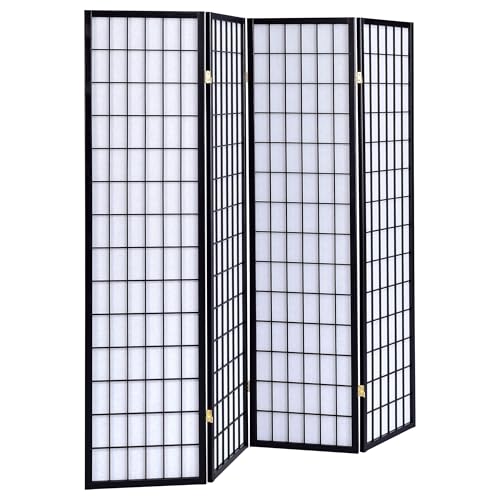
- Best for modern homes overall: Coaster Roberto 4-Panel Shoji Room Divider, Black, 4624 — Check on Amazon
- Aletheiawu 4-Panel Hand-Woven Rattan Room Divider, Natural — Check on Amazon
- VASAGLE 5-Tier Bookcase and Room Divider, White, ULBC62WT — Check on Amazon
- MyGift 6-Panel Artwork Room Divider, Black Wood Frame, 94.6 in Wide — Check on Amazon
- RANTILA 3-Panel Fabric Room Divider, Grey, 102 in Wide — Check on Amazon
- YATINEY 4-Panel Room Divider with Storage Shelves, Rustic Brown and Black — prose-only pick, see the review below for why
Read the full guide ↓
Disclosure: As an Amazon Associate, dailyhomedecorating.com earns from qualifying purchases. Links to Amazon on this page are affiliate links; they cost you nothing extra. Listing details such as price and availability change often, so check the current Amazon listing before you buy.
The best room divider for modern homes under $400 has to pass a test that other dividers never face: in a modern interior, there is nowhere to hide. Open plans, pale walls, uncluttered floors and large windows mean a divider stands in full view from several angles at once, and it will be judged — by you, every day — as a piece of design first and a piece of equipment second. That is actually good news for the shopper, because modern design and good dividing agree on the fundamentals: honest materials, clean geometry, nothing fussy, and light treated as a material in its own right. A divider that glows, casts a patterned shadow, or draws a calm grid across a room is not decorating the space despite dividing it; the division is the decoration.
This guide judges the under-$400 field by modern standards. We favoured solid timber over imitation finishes, woven and translucent panels that work with daylight, and silhouettes that read as architecture — a grid, a weave, a clean white shelf line — rather than as temporary kit. We were equally strict about the opposite failure: dividers that shout. A modern room can absorb one strong gesture, and a divider can be that gesture, but it cannot be a compromise covered in ornament. For most modern homes we would start with the Coaster Roberto below: its black pine grid and daylit panels are practically a diagram of Japandi design, and it folds away when the plan opens up. The rattan screen that follows it is the organic-modern counterpoint, and the white VASAGLE bookcase is the storage answer that keeps a modern room’s lines clean by giving its clutter somewhere designed to go. If your rooms are compact as well as modern, our companion guide to the Best Room Divider For Small Spaces Under $400 applies the same eye at a smaller scale.
In this guide
Quick Picks
Short on time, or comparing several options at once? Each row below names a modern-home need and the product that suits it, with a link to the listing where one is verified for this tier.
| Modern-home need | Pick | Why it stands out | Link |
|---|---|---|---|
| Best for modern homes overall | Coaster Roberto 4-Panel Shoji Room Divider, Black, 4624 | Black pine grid with daylit panels — a Japandi diagram in furniture form — check price on Amazon | Check on Amazon |
| Best organic modern | Aletheiawu 4-Panel Hand-Woven Rattan Room Divider, Natural | Hand-woven texture that warms minimal rooms without closing them — check price on Amazon | Check on Amazon |
| Best clean-line storage | VASAGLE 5-Tier Bookcase and Room Divider, White, ULBC62WT | Five white tiers that divide and declutter at once — check price on Amazon | Check on Amazon |
| Best statement piece | MyGift 6-Panel Artwork Room Divider, Black Wood Frame | 94.6 in of dual-sided artwork for wide, gallery-like plans — check price on Amazon | Check on Amazon |
| Best minimalist wall | RANTILA 3-Panel Fabric Room Divider, Grey | 102 in of flat, quiet grey that disappears into a calm scheme — check price on Amazon | Check on Amazon |
| Best industrial modern hybrid | YATINEY 4-Panel Room Divider with Storage Shelves, Rustic Brown and Black | Hinged panels plus shelving in black metal and wood tones — prose-only, see review | See review |
How These Picks Were Chosen
The budget filter came first: the divider, in the configuration reviewed, must sit at or under $400 and arrive complete and usable. Every linked pick is a real Amazon listing whose identity and specifications we verified against the listing and maker or retailer records — check the current price on Amazon before you buy, because prices move. One pick, the YATINEY shelf-screen, appears in prose only because we could not confirm a current price sighting for its exact configuration; it is fully described, with the reason stated in its review, rather than linked on a guess.
On top of the budget we applied a design filter with three parts. First, materials honesty: solid wood frames, genuine woven rattan, and clean manufactured board with a plain finish all pass; fake-distressed finishes and printed wood-effect panels pretending to be something they are not were marked down, because modern interiors expose imitation at a glance. Second, light behaviour: in glass-heavy modern homes a divider is a lighting object, so we recorded whether each pick transmits light, patterns it, or blocks it outright, and favoured the first two for main living spaces. Third, silhouette: the divider had to read as one calm gesture — a grid, a weave, a shelf line, a flat plane — from across an open plan, since that is how it will actually be seen. Construction and stability were checked as in every guide in this series: stance, weight, hinges, and for the bookcase, the included anti-tip kit.
We also kept a deliberate spread of modern dialects, because ‘modern’ is not one look. The shoji grid serves Japandi and Scandinavian calm; the rattan serves organic modern and warm minimalism; the white bookcase serves the gallery-clean end of the spectrum; the artwork screen serves modern rooms that want a single bold gesture; and the grey fabric wall serves the quiet, almost architectural end where the divider should disappear. What we excluded: listings with no verifiable specifications, models only available above this budget, and ornamented traditional screens whose carving and gloss fight the brief — however well made, they belong to a different guide.
The 6 Best Room Dividers for Modern Homes Under $400
Coaster Roberto 4-Panel Shoji Room Divider, Black, 4624
Who it suits: Most modern homes — Japandi, Scandinavian and calm contemporary rooms that need a boundary which keeps the light and reads as architecture.
The Roberto is what happens when a divider follows the same rules as the room around it. A solid pine frame in black carries a regular shoji grid over white translucent panels: nothing decorative is added, and nothing structural is hidden. Stood across an open plan — 69.5 inches wide by 70.25 inches tall — it does the most modern thing a divider can do, which is to change the light rather than merely block the view. The zone behind it stays daylit, the panels glow softly when the sun is on them, and the grid casts the room’s calmest shadow. Four panels on two-way hinges let you tune the gesture: a shallow zigzag for a graphic line across the floor, a wrap around a desk for a work bay, folded flat against the wall when the plan opens for guests. It arrives with no assembly required, so the object you unbox is the finished design, not a kit of intentions.
In modern use it excels at the divisions these homes actually need: a sleep zone in a studio that must not darken, a work corner in a living space that must not look like an office, a calm edge between dining and lounging in one long room. The black frame keys to the window frames, picture frames and hardware that modern rooms already use as their dark accents, while the white panels key to the walls — the divider is composed of the room’s own two tones, which is why it settles in so quickly. At 12.1 pounds it is light, and we flag the same honesty as in our other guides: it will shift if it is bumped hard, and its paper-style panels dislike rough contact. In a calm modern household that is a fair trade for the glow; in a household of toddlers and large dogs, read the RANTILA review instead.
Pros: Solid pine construction with a disciplined grid; transmits daylight so both zones stay bright; no assembly; folds flat; a long-established Coaster furniture model (4624), not a seasonal listing.
Honest limitation: Lightweight and panel-delicate — a divider for calm homes, not collision zones. The shoji language is also specific: in a room with no other black or Japanese note, it will be the room’s one accent, which you should intend rather than discover.
Choose it if your modern room wants a daylit, architectural boundary. Skip it if you need full blackout privacy or the divider will take daily knocks. Check on Amazon for the current listing. Full listing: Coaster Roberto on Amazon.
Aletheiawu 4-Panel Hand-Woven Rattan Room Divider, Natural
Who it suits: Organic-modern and warm-minimal homes — rooms of pale wood, linen, plants and plaster tones that need texture more than they need another hard line.
Minimal rooms fail in one of two ways: they feel serene, or they feel empty. The Aletheiawu is the divider for keeping a modern home on the right side of that line. Four panels of hand-woven rattan in a solid wood frame, 63.39 inches wide by 66.92 inches tall in the natural finish, bring a handmade, light-filtering texture that no manufactured panel can imitate — the weave is irregular in the way real weaving is, and modern rooms, which are built from regular things, are warmed by exactly that irregularity. Stood across a plan it patterns the daylight, softens the boundary between zones, and keeps air moving between them, so neither side feels sealed. Double hinges fold the panels in either direction, the folded stack is slim at about 19.86 inches wide and 4.52 inches thick, and at 19.4 pounds in the natural four-panel configuration it stands with a settled, furniture-like calm.
The maker’s honesty shapes the modern use case: Aletheiawu describes the weave as giving partial privacy, roughly a half-screening effect. In design terms that is not a flaw but a category — this is a zoning screen, for declaring where lounging ends and dining begins, for giving a reading chair a sense of enclosure, for screening a bed corner in a studio while keeping the room one breathing space. For a dressing zone or a guest conversion it is the wrong tool, and no styling will make it one. Dust, too, is a real consideration in a weave: it vacuums with a brush attachment and wipes with a dry cloth, but it will never be the wipe-and-done surface that flat panels are.
Pros: Genuine hand-woven rattan and solid wood; patterns daylight beautifully; keeps zones connected and aired; double hinges fold either way; natural finish is the organic-modern accent par excellence.
Honest limitation: Partial privacy only, by the maker’s own description; the weave collects dust and wants gentle cleaning; too soft a boundary for privacy jobs.
Choose it if your modern home leans warm and natural and your division is about atmosphere. Skip it if you need concealment or a stark, graphic line. Check on Amazon for colours and the current listing. Full listing: Aletheiawu rattan divider on Amazon.
VASAGLE 5-Tier Bookcase and Room Divider, White, ULBC62WT
Who it suits: Modern homes whose real enemy is visible clutter — open plans that stay calm only when everything has a designed place to be.
Every modern room has a storage problem it is too polite to mention: the books, chargers, baskets and objects that accumulate on every surface and quietly undo the calm. The VASAGLE turns the divider into the solution. It is a five-tier open bookcase — 27.6 inches wide, 9.4 inches deep, 62.6 inches tall, particleboard with a melamine finish — stood perpendicular to the wall to draw a clean white line across the room, with five shelves rated by the maker at 33 pounds each to absorb the life that would otherwise colonise the floor and the coffee table. The S-shaped shelf profile keeps the silhouette from reading as a plain slab, the white finish disappears against modern walls while the objects on the shelves become the room’s considered display, and because it is open, both zones borrow its contents visually: books and ceramics on one side are texture on the other.
Two disciplines come with it. Assembly is required, and once loaded it is a fixed piece, not a folding one — this is a divider for a settled plan. And VASAGLE includes an anti-tip kit and instructs that it be fitted; in a modern home, where the bookcase may stand free in the middle of a polished floor, that instruction is part of the design, not an optional extra. At 43.1 pounds it has the planted quality modern rooms reward: nothing about it looks temporary. If you like the logic but want the piece purely against a wall, our guide to the Best Bookcase Under $400 covers its siblings in depth.
Pros: Divides and declutters in one clean white gesture; five tiers with a real load rating; anti-tip kit included; substantial, permanent feel; display serves both sides.
Honest limitation: A zoning line, not a closure — 62.6 inches tall and 27.6 inches wide screens only as much as its contents do. Fixed once assembled and loaded.
Choose it if storage and calm are the same problem in your home. Skip it if your plan changes often or you need a full-height visual block. Check on Amazon for finishes and the current listing. Full listing: VASAGLE bookcase divider on Amazon.
MyGift 6-Panel Artwork Room Divider, Black Wood Frame, 94.6 in Wide
Who it suits: Wide, gallery-like modern plans that can take one bold gesture — and want the divider to be it.
Modern rooms are often advised to be quiet, but the best of them usually contain one confident move: a large artwork, a sculptural chair, a wall of colour. The MyGift offers that move in divider form. Six panels span 94.6 inches flat at 68.9 inches tall, framed in black wood, carrying a dual-sided printed design — a vintage Asian water-village scene in brushed ink on this version — so the screen reads as a folding artwork from both zones it creates. The width is functional as well as dramatic: six panels keep a stabilising zigzag across a broad opening where a four-panel screen would have to stand flat and fragile. When the plan opens up, the whole piece folds to a single stack 15.5 inches wide and 4.7 inches thick and leaves the room as empty as it found it.
The modern case for it is composition. In a long open plan with pale walls, a large ink-brushed screen gives the eye a destination and the floor plan a hinge; behind a sofa it works as the room’s artwork and its boundary at once, and on a video call it is a finished backdrop with nothing to tidy. The caution is the mirror of the virtue: a printed scene is a commitment, on both faces, at nearly eight feet wide. If your modern taste runs to empty walls and silent surfaces, this will feel like noise. If your room has been waiting for its one gesture, it may be exactly the gesture — judge it against your walls, not against a catalogue’s.
Pros: The widest wooden coverage in this guide; artwork on both faces; six panels keep a stable zigzag; folds to a slim stack; solid wood frame.
Honest limitation: A strong visual statement that will dominate quiet schemes and overwhelm small rooms; the imagery is fixed — if it does not suit your home, there is a lot of it.
Choose it if your plan is wide and wants a focal point that also divides. Skip it if your modern is minimalist-silent or your room is compact. Check on Amazon for design options. Full listing: MyGift 6-panel divider on Amazon.
RANTILA 3-Panel Fabric Room Divider, Grey, 102 in Wide
Who it suits: Modern homes that need a complete, temporary block with the quietest possible visual footprint — a guest conversion, a work wall, a media zone that appears and disappears.
There is a modern virtue the prettier screens cannot offer: disappearance. The RANTILA’s three wide panels span 102 inches by 71 inches tall in flat grey, high-density 180g polyethylene fabric on a steel frame — and flat grey, in a modern room, is camouflage. It does not glow, pattern or perform; it simply stands as a calm, light-swallowing plane, closer to a section of gallery wall than to a piece of furniture, and for some modern divisions that is exactly right: the guest bed that appears in the living room at night, the work wall that makes a video call professional, the media zone that keeps a projector screen’s surroundings dark. The fabric is waterproof and wipes clean, support feet steady the long run, and the whole wall folds flat in moments — the only pick here that can divide a room completely at breakfast and be behind a door by lunch.
Its honesty is about register. Judged as décor it is the plainest object in this guide, and a modern room built around beautiful materials may find its flatness a compromise too far for a permanent placement. Judged as architecture-on-demand it is superb: complete, gap-free, opaque screening at a width no wooden screen here matches. Modern homes with a genuinely temporary division to make — rather than a permanent one to furnish — should rank it far higher than its looks suggest.
Pros: Widest complete block here at 102 in; flat grey disappears into calm schemes; waterproof, wipe-clean fabric; steel frame with support feet; folds flat and vanishes.
Honest limitation: Utilitarian in close-up — a plane, not a piece of furniture — and it blocks light completely, darkening the far zone of a one-window room.
Choose it if your modern division is temporary and must be total. Skip it if the divider will stand permanently among beautiful materials — the Coaster or Aletheiawu will hold that company better. Check on Amazon for colours and sizes. Full listing: RANTILA 3-panel divider on Amazon.
YATINEY 4-Panel Room Divider with Storage Shelves, Rustic Brown and Black
Who it suits: Industrial-modern homes — black metal, warm wood tones, loft references — that want a hinged screen with working shelving attached.
The YATINEY speaks the industrial dialect of modern: four hinged panels in engineered wood with a black metal frame, rustic brown and black, with a five-shelf storage unit attached to the run. The span is 76.4 inches wide by 66.9 inches tall and the build is substantial at 34.6 pounds, so it stands like furniture while folding like a screen — the combination loft-style rooms ask for, where a boundary should look structural and earn its keep with storage. The wood-look panels screen more completely than open shelves, and the shelf face gives a work zone or reading corner a working edge of books and objects. In a modern scheme built on black steel and timber, it will look more native than any other pick in this guide.
We cover it in prose only, without a purchase link, and the reason is transparency: the listing is recent — first available in December 2025 per the listing — and while its specifications are published and verified, we could not confirm a current price sighting for the exact configuration when this guide was written. Rather than link on a guess, we describe it fully: search the model — YATINEY room divider with storage, model 01BR Storage Shelf — and judge the live listing yourself. One design note if you do: the rustic finish is a warmer, more textured note than the flat blacks and whites elsewhere in this guide, so it suits industrial and warm-modern rooms better than stark gallery ones.
Pros: Screen and shelving in one hinged unit; wide 76.4 in span; substantial build; black-metal and wood palette is native to industrial-modern rooms.
Honest limitation: Prose-only here because its current price could not be verified — check the live listing carefully. The shelf section also makes one part of the run fold less freely than a plain screen.
Choose it if you find it live under budget and your modern runs industrial. Skip it if you prefer a long-established listing — the Coaster or the VASAGLE.
Comparison Table
| Pick | Type | Flat width | Height | Modern strength |
|---|---|---|---|---|
| Coaster Roberto 4624 | Shoji screen, solid pine | 69.5 in | 70.25 in | Daylit grid; Japandi and Scandi calm |
| Aletheiawu Rattan | Hand-woven rattan screen | 63.39 in | 66.92 in | Organic texture for warm minimalism |
| VASAGLE ULBC62WT | 5-tier bookcase divider | 27.6 in | 62.6 in | Clean white storage line; declutters the plan |
| MyGift 6-Panel Artwork | Printed artwork screen, wood frame | 94.6 in | 68.9 in | One bold, gallery-scale gesture |
| RANTILA 3-Panel | Fabric screen, steel frame | 102 in | 71 in | Quiet grey plane; total, temporary block |
| YATINEY with Shelves | Hinged screen plus 5-shelf unit | 76.4 in | 66.9 in | Industrial-modern hybrid (prose-only) |
How to Choose the Best Room Divider for Modern Homes Under $400
Begin with your room’s dialect, not with the catalogue. Modern is a family of looks — Japandi calm, Scandinavian pale, organic warm, industrial dark, gallery minimal — and a divider that is native to one can be a foreign object in another. Name your dialect honestly, then shop inside it: grid and glow for Japandi, weave for organic, white shelving for gallery-clean, black metal and timber for industrial. A divider chosen inside the room’s language disappears into the design; a divider chosen against it becomes the thing every guest asks about, and not as a compliment.
Next, decide the divider’s relationship with light, because in a modern home that decision is aesthetic as much as practical. Transmitting screens — the shoji — keep an open plan feeling like one bright volume with zones; patterning screens — the rattan — turn daylight into texture and shadow play; blocking screens — the fabric wall — create true separation and true darkness on the far side. Walk your room at the hour you use it most and ask which of the three the space can afford. A north-facing studio rarely forgives a blocking screen; a sun-drenched loft can absorb one easily.
Then apply the ordinary disciplines with a modern eye. Measure the opening and subtract roughly a fifth of a hinged screen’s flat width for its stabilising zigzag — and notice that the zigzag itself is part of the design, a rhythm of angles your room will see every day, so choose a screen whose folded rhythm you like. Check the silhouette from the room’s main viewpoint, not from above the product photo. And decide permanence: folding screens keep a modern plan flexible, which is often the point of the plan; the bookcase commits, and repays commitment with calm. For the general ranking of this budget beyond the modern lens, see our main guide to the Best Room Divider Under $400.
Common Mistakes to Avoid
The first modern mistake is buying a divider as décor and forgetting it is also a wall: a beautiful screen stood across the only light path will darken a zone all day, and no amount of style repays a gloomy desk. The second is mixing dialects — a rustic, distressed or heavily carved screen in a calm modern room does not read as eclectic; it reads as unresolved. If your room is genuinely mixed, let the divider be the neutral party: flat grey, plain white shelving, or a quiet grid.
Third, shoppers underestimate scale in both directions: a four-panel screen lost across a wide loft opening, stood nearly flat and fragile, or an eight-foot artwork screen crammed into a compact room, folded so deep it becomes a thicket. Modern rooms punish wrong scale because there is no clutter to hide it in. Fourth, bookcase dividers get loaded untidily — a storage divider is a display, and chaotic shelves export chaos to both zones; edit what goes on it. Fifth, the anti-tip kit on a freestanding bookcase gets skipped because the unit ‘feels solid’ on a hard floor; fit it, exactly as the maker instructs. Finally, do not expect any divider here to block sound: modern open plans carry voices, and a screen divides sight and territory, not noise.
Design Notes: Placing a Divider in a Modern Room
Place the divider where it interrupts the sightline, which is rarely where it bisects the floor. Stand in the doorway and on the sofa; the screen belongs across the view you want to change. Align one panel with an existing line in the room — a window mullion, a rug edge, the end of a run of cabinets — and the division will look designed rather than parked. Leave air at both ends where you can: a screen that stops short of the walls reads as furniture in a plan, while one jammed wall-to-wall reads as a corridor. And light it deliberately: a translucent or woven screen with daylight behind it is the cheapest piece of lighting design in this entire guide, so if your room has one good window, consider giving the divider the job of sharing it.
Materials, Honestly: What This Budget Should Buy
Modern design’s first commandment is that materials should be what they appear to be, and the under-$400 tier is exactly where dividers start obeying it. Solid pine, as in the Coaster’s frame, ages the way timber ages — a knocked corner softens rather than chips to reveal a different substance underneath. Hand-woven rattan, as in the Aletheiawu, is a plant fibre doing a plant fibre’s job, and its slight irregularities are the signature of the making, not a defect to be explained away. Manufactured board with a plain melamine finish, as in the VASAGLE, is the honest industrial material of flat-pack furniture — it does not pretend to be oak, and in white it does not pretend to be anything but a clean surface, which is why it suits modern rooms better than the wood-effect prints that crowd the lower tiers.
What this budget should not buy is imitation wearing a premium price: printed grain that repeats if you look at two panels side by side, distressed finishes applied by machine to new board, gloss coatings standing in for lacquer. Modern rooms expose these economies mercilessly, because there is no visual noise for them to hide in — a fake finish in a spare room is the loudest thing in it. The test at this tier is simple: if a listing cannot name its frame material, its panel material and its weight, it has not earned modern money, whatever its photographs promise. Every linked pick in this guide names all three, and the two screens built from solid timber and real weave are ranked at the top for precisely that reason.
There is a longevity argument underneath the aesthetic one. Honest materials can be maintained honestly — timber can be re-oiled, rattan can be brushed and kept dry, melamine can be wiped — while imitation finishes, once damaged, can only be replaced. A modern home is usually furnished slowly and kept for years; a divider bought at this tier should be capable of the same lifespan, and construction, not styling, is what decides whether it gets one.
Light as a Material: The Modern Divider’s Real Job
Ask a designer what a divider does in a modern home and the honest answer is that it edits light. An open plan is one volume of daylight, and every object placed across it changes how that daylight is shared. A translucent shoji turns direct sun into a soft, even glow and gives the shadowed side of the room a luminous wall instead of a dark one — the effect, on a bright afternoon, is closer to a lighting installation than to furniture. A woven screen breaks light into pattern: the room gains moving texture as the sun crosses, which is why rattan screens photograph so well in modern interiors and why they suit rooms that otherwise risk feeling flat. An opaque plane does the opposite work, creating a zone of deliberate shade — valuable for a media corner or a nap space, costly for a desk that needs the window.
The practical method is simple. Before you buy, stand where the divider will stand at the brightest hour and look at what each side loses. If the far side is your workspace, protect its light with a transmitting or patterning screen. If the far side is your screen-watching or sleeping zone, shade is a gift and the fabric wall earns its place. Modern homes, with their large glass and pale surfaces, forgive almost any divider except one that makes a bright room feel dim — because dimness, in a modern interior, reads as failure faster than any style mismatch.
Two Worked Layouts
The studio that must stay one room. A single space, one window wall, bed at the far end. The answer is a transmitting screen — the Coaster — placed across the sightline from the door and the sofa, not across the window’s path: the bed gains a boundary, the living zone keeps its view of the glass, and daylight reaches both. Add the rattan instead if the scheme is warm and the boundary can be softer; the studio then reads as a room with a woven wall, which is a compliment studios rarely earn.
The long living room that works twice. One long space, lounging at one end, dining or working at the other, storage short. The answer is the VASAGLE stood perpendicular at the room’s waist, shelves edited to a few repeated tones, with the work side borrowing the bookcase as its backdrop and the lounge side borrowing it as its library. If the room is wide rather than long, swap the bookcase for the MyGift’s span and let the division be the room’s artwork; if the second use is occasional — guests, projects, parties — the RANTILA’s disappearing wall keeps the plan honest the rest of the year.
Final Recommendation
For most modern homes, the Coaster Roberto is the divider this budget was made for: a solid pine grid that divides the view and shares the light. Choose the Aletheiawu when your modern runs warm and organic, the VASAGLE when clutter is the enemy of your calm, the MyGift when a wide plan wants its one bold gesture, and the RANTILA when the division must be total, temporary and visually silent. Keep the YATINEY in view if its live listing sits under budget and your rooms run industrial. Whichever you choose, buy inside your room’s dialect, protect its light, and check the current listing before you buy.
Frequently Asked Questions
What divider style suits a Japandi or Scandinavian room best?
A shoji grid — black or pale timber framing translucent panels — is the native divider of both styles, which is why the Coaster leads this guide. Woven rattan is the close second where the room leans warmer and more organic. Both transmit light, which these styles treat as a building material.
Will a room divider make my modern open plan feel smaller?
A light-transmitting or partial screen will not — it zones the plan while the eye still reads one volume. A tall, opaque run can make the far zone feel like a separate, smaller room, which is sometimes the intention. Match the grade to the goal: zone with glow and weave, separate with fabric and shelving.
Can a bookcase really work as a divider in a minimalist room?
Yes, provided you edit it like a minimalist: few objects, repeated tones, breathing room on every shelf. An open bookcase divider is a display that both zones see, so its calm depends on its contents. Loaded chaotically, it exports clutter in two directions at once.
How do I keep a divider looking intentional, not temporary?
Align it with the room’s lines, give it a stable, confident zigzag rather than a tentative one, and let it stop short of the walls like furniture rather than a partition. Materials help: solid wood, real weave and clean shelving read as permanent at a glance, which is most of what this budget buys over the lower tiers — compare our Best Room Divider Under $300 guide for the step down.
How tall should a divider be in a modern open plan?
Tall enough to interrupt the sightline it exists to interrupt, and no taller. For zoning a seated area, a screen around 63 to 67 inches — the rattan and the bookcase sit in this band — divides without looming. For screening a bed or a standing figure, look to the 69 to 71 inch band of the shoji, artwork and fabric picks. In rooms with high ceilings, resist scaling the divider to the ceiling: a screen that stops well short of it reads as furniture in a volume, which is the modern effect, while one that strains toward the ceiling reads as a failed wall.
What colours work best for a divider in a modern home?
The room’s own colours, repeated. Black frames key to window frames and hardware; white shelving keys to walls; natural rattan keys to timber floors and furniture. A divider introduces no new colour family into a calm modern scheme unless it is deliberately the room’s single gesture — the artwork screen’s role — in which case let it be the only new note, and keep everything around it quieter in response.
How do I clean and care for a modern divider?
By material: timber frames wipe with a dry or barely damp cloth; shoji-style panels dust dry and are never soaked; rattan vacuums with a brush attachment; printed panels wipe gently, since solvents can lift the image; fabric walls wipe clean outright. Keep hinges grit-free and store screens folded flat and dry rather than leaning, which warps panels over a season.
How do I stop a divider looking temporary in a modern room?
Commit to its placement: align it with the room’s lines, give it a confident zigzag, style the zones it creates as if they were always rooms — a rug ending at the screen, a lamp placed for the new corner. Temporariness is mostly indecision made visible. A divider that the room’s other furniture acknowledges will read as part of the design within a day.
Is a divider better than a curtain in a modern home?
For most modern rooms, yes: a screen or bookcase holds a straight, architectural line that fabric rarely does, stands without fixings, and folds away to nothing. A curtain wins where the opening is very wide, the ceiling is the only anchor, or the division should feel soft rather than structured — and at lower budgets, where it is covered in our general guides. In a designed modern interior, the divider’s discipline is usually the point.
Can I use a divider in a modern rental?
Freestanding screens are among the most rental-friendly furniture there is: no drilling, no adhesive, no trace on moving out. Every folding pick in this guide stands on its own geometry. The one caution is the bookcase, whose anti-tip kit wants a wall fixing; if your lease forbids it outright, choose a folding screen instead and keep the shelving against a wall where it belongs.
Do modern room dividers block sound?
No. They divide sight and define territory; voices carry over and around them. In an open plan, treat sound with soft furnishings, rugs and layout, and let the divider do the visual work it is actually good at.
Working with a tighter footprint as well as a modern scheme? Our guide to the Best Room Divider For Small Apartments Under $400 combines both lenses — the same discipline of honest materials and protected light, applied where every folded inch has to earn its storage.


