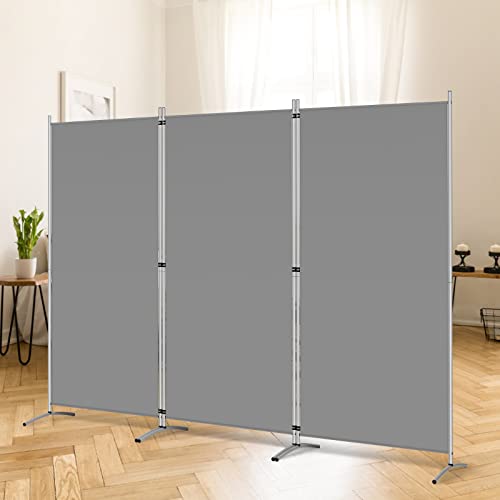
Where to buy
Check the latest price, availability and delivery on Amazon. Orders are placed on Amazon. We may earn a commission from qualifying purchases.
- Best for families overall: RANTILA 3-Panel Fabric Room Divider, Grey, 102 in Wide — Check on Amazon
- VASAGLE 5-Tier Bookcase and Room Divider, White, ULBC62WT — Check on Amazon
- Coaster Roberto 4-Panel Shoji Room Divider, Black, 4624 — Check on Amazon
- MyGift 6-Panel Artwork Room Divider, Black Wood Frame, 94.6 in Wide — Check on Amazon
- Aletheiawu 4-Panel Hand-Woven Rattan Room Divider, Natural — Check on Amazon
- YATINEY 4-Panel Room Divider with Storage Shelves, Rustic Brown and Black — prose-only pick, see the review below for why
Read the full guide ↓
Disclosure: As an Amazon Associate, dailyhomedecorating.com earns from qualifying purchases. Links to Amazon on this page are affiliate links; they cost you nothing extra. Listing details such as price and availability change often, so check the current Amazon listing before you buy.
Finding the best room divider for families under $400 means judging dividers by a harsher standard than style alone, because a family divider lives a harder life than any other kind. It will be bumped by ride-on toys, leaned on by teenagers, wiped down after sticky fingers, folded away for a birthday party and dragged back out for homework hour. It may need to give a parent a work corner that a toddler respects, split one bedroom between two siblings with very different bedtimes, or turn a living room into a guest room when grandparents visit — sometimes all three in the same month. A divider that delights a child-free household can be a daily frustration in a family one, and the difference is rarely visible in the product photographs. It is in the weight, the surface, the stance and the hardware.
So this guide re-judges the under-$400 field through family eyes. Stability comes first: how a divider stands, how it behaves when it is knocked, and whether safety hardware is in the box. Cleanability comes second, because a divider in a family room is a surface, and surfaces in family rooms get drawn on, splashed and sneezed at. Flexibility comes third, because family zoning changes by the hour, not the season. Only after those three do we weigh looks — and even then, we favour dividers whose looks survive contact with real life. For most families we would start with the RANTILA fabric wall below: it is wide, wipe-clean, quick to fold and honest about being equipment rather than décor. Families whose divider must also swallow toys, books and school clutter should look hard at the VASAGLE bookcase, and families with older children can consider the prettier screens further down — with their limitations stated plainly. If your household is smaller and calmer, our general guide to the Best Room Divider Under $400 ranks this same budget with looks and materials first.
In this guide
Quick Picks
Short on time, or comparing several options at once? Each row below names a family situation and the product that suits it, with a link to the listing where one is verified for this tier.
| Family situation | Pick | Why it stands out | Link |
|---|---|---|---|
| Best for families overall | RANTILA 3-Panel Fabric Room Divider, Grey | 102 in of waterproof, wipe-clean screening on a steel frame — check price on Amazon | Check on Amazon |
| Best for toys and clutter | VASAGLE 5-Tier Bookcase and Room Divider, White, ULBC62WT | Five shelves that divide the room and store family life, anti-tip kit included — check price on Amazon | Check on Amazon |
| Best for calmer households | Coaster Roberto 4-Panel Shoji Room Divider, Black, 4624 | Solid pine shoji that keeps daylight shared between zones — check price on Amazon | Check on Amazon |
| Best for wide family rooms | MyGift 6-Panel Artwork Room Divider, Black Wood Frame | Six panels spanning 94.6 in, artwork on both faces — check price on Amazon | Check on Amazon |
| Best natural look | Aletheiawu 4-Panel Hand-Woven Rattan Room Divider, Natural | Hand-woven rattan that zones softly without sealing the room — check price on Amazon | Check on Amazon |
| Best shelf-screen hybrid | YATINEY 4-Panel Room Divider with Storage Shelves, Rustic Brown and Black | Hinged panels plus an attached five-shelf unit — prose-only, see review | See review |
How These Picks Were Chosen
The budget filter came first, as it does in every guide in this series: the divider, in the configuration reviewed, must sit at or under $400 and arrive as a complete, usable product. Every linked pick is a real Amazon listing whose identity and specifications we verified against the listing and maker or retailer records — check the current price on Amazon before you buy, because prices move. One pick, the YATINEY shelf-screen, is covered in prose only because we could not confirm a current price sighting for its exact configuration; it is described fully, with the reason stated in its review, rather than linked on a guess.
On top of the budget, we applied three family filters. The stability filter asked how each divider stands and what happens when — not if — it gets knocked: support feet, zigzag depth, total weight, and, for the bookcase pick, whether an anti-tip kit is included and instructed by the maker. A divider that cannot be anchored or stood securely has no business dividing a play space, and where a pick is genuinely delicate we say so in its review rather than quietly dropping it, because families with older children may still choose it happily for a parents’ zone. The cleanability filter favoured surfaces that wipe down — waterproof fabric first, sealed finishes second, open weaves and paper-style panels last — because a family divider is a touch surface at exactly child height. The flexibility filter favoured dividers one adult can fold, carry and re-stand alone, since family zoning is usually rearranged by one parent, one-handed, at short notice.
We also kept the privacy grades honest. A divider between siblings needs a fuller block than a divider marking a reading corner, and the reviews grade each pick accordingly: complete block, view blocked with light shared, or soft zoning. What we excluded: dividers with no verifiable listing or published specifications, models whose only verified listings sat above this budget, and anything whose construction we judged too flimsy to survive family contact at a $400-tier price. The result is a shortlist where the first two picks are family-proof first and decorative second, and the prettier screens that follow carry clear guidance about the ages and zones they suit.
The 6 Best Room Dividers for Families Under $400
RANTILA 3-Panel Fabric Room Divider, Grey, 102 in Wide
Who it suits: Most families — anyone who needs a wide, complete visual block between zones that can be wiped clean, folded flat and re-stood by one adult in under a minute.
The RANTILA leads the family list because it is built like equipment, and family dividers are equipment. Three wide panels on a steel frame span 102 inches by 71 inches tall, in a high-density 180g polyethylene fabric with an anti-UV coating. That is over eight and a half feet of continuous, opaque screening — enough to split a shared kids’ bedroom properly, wall off a work corner in a family room, or give overnight guests a changing space that is genuinely private rather than symbolic. The hinges leave no gaps, so the block is complete: no slivers of sightline at the folds for siblings to peek through. Support feet keep the long run steady, and the whole thing folds flat when the division comes down for a party, a clear-out or a house move.
The family case rests on the surface. The fabric is waterproof and wipes clean, so the realities of life at child height — juice, felt-tip, muddy handprints, the occasional sneezed-at panel — come off with a damp cloth instead of becoming part of the décor. The steel frame shrugs off bumps that would rack a light timber screen, and because there are no shelves, ledges or climbable grids, it offers a toddler nothing to scale. It is also light enough for one parent to carry and reposition while the other parent holds the baby, which is how family furniture actually gets moved. Between uses it stores flat behind a door or under a bed, so it can be a weekday fixture and a weekend absence without a storage argument.
Pros: Widest complete block in this guide at 102 in; waterproof, wipe-clean fabric; steel frame with support feet; no climbable surfaces; folds flat and moves easily by one adult.
Honest limitation: It looks like what it is — a well-made partition, not furniture — and in a styled living room it will read as practical rather than pretty. The opaque fabric also blocks light completely, so the far side of a one-window room gets no daylight through it; families dividing a bright room for a nap zone may count that as a feature, and families dividing a study corner should count it as a cost.
Choose it if your divider must survive daily family contact and deliver real privacy between zones. Skip it if the divider will be a permanent visual feature of a carefully styled room and your children are old enough for a furniture-grade screen — the Coaster further down will sit happier there. Check on Amazon for colours and sizes. Full listing: RANTILA 3-panel divider on Amazon.
VASAGLE 5-Tier Bookcase and Room Divider, White, ULBC62WT
Who it suits: Families whose divider needs to earn its floor space twice — drawing a boundary across a room while swallowing the books, toys, games and school clutter that family life generates.
A family room rarely suffers from a shortage of sightlines; it suffers from a shortage of storage. The VASAGLE answers both problems with one footprint: a five-tier open bookcase, 27.6 inches wide, 9.4 inches deep and 62.6 inches tall, in particleboard with a melamine finish, stood perpendicular to the wall to draw a line across the room. Fill the shelves and the boundary becomes convincing — the eye reads a loaded bookcase as a wall’s beginning in a way it never reads a panel — while the room gains five tiers of storage rated by the maker at 33 pounds per shelf. Picture books and toy baskets on the play side, grown-up books and a plant on the seating side, and the divider is working for both zones at once. At 43.1 pounds assembled it stays where it is put, which in a family home is a safety feature as much as a convenience.
Safety needs a direct word here, because this is the one pick in the guide a child could try to climb. VASAGLE includes an anti-tip kit in the box and instructs plainly in its own notes that the unit be attached to the wall with it. Fit it. Loaded heaviest at the bottom, anchored as instructed, and with climbable temptation kept off the top shelves, a bookcase divider is a sound family choice; unanchored and top-heavy, it is not, and no review should pretend otherwise. Assembly is required, and once the shelves are loaded the divider is effectively fixed — this is a pick for a settled layout, not a weekly rearrangement. Families who love the storage logic but want it purely as shelving should also see our guide to the Best Bookcase Under $400.
Pros: Divides and stores in one footprint; five tiers with a real per-shelf load rating; anti-tip kit included; heavy, planted build; open shelves serve both sides of the division.
Honest limitation: It zones rather than closes — at 62.6 inches tall and 27.6 inches wide it will not give siblings full privacy — and open shelves only screen as much as the objects on them do. It must be anchored for family use, and it does not fold away.
Choose it if storage is half the problem and your layout is settled. Skip it if you cannot anchor it, rearrange often, or need a complete visual block. Check on Amazon for finishes and the current listing. Full listing: VASAGLE bookcase divider on Amazon.
Coaster Roberto 4-Panel Shoji Room Divider, Black, 4624
Who it suits: Families with older children, or a parents’ zone to protect — a work corner, a reading chair, a dressing area — where the divider will be respected rather than wrestled.
The Roberto is the prettiest serious divider in this guide: a solid pine frame with a black finish, shoji-style grid panels, standing 69.5 inches wide by 70.25 inches tall, arriving with no assembly required. Its family virtue is light. The translucent panels block the view while letting daylight pass, so a parent working behind it does not sit in a cave and the children’s side of the room keeps its window. For dividing a master bedroom corner, screening a study nook in a family room, or giving a teenager’s half of a shared room a boundary that still feels airy, it is the most graceful tool here. Four panels fold on two-way hinges, so it zigzags for stability, wraps a desk, or folds flat against the wall when the room opens up for family time.
The family limitation is equally clear, and it is about contact, not quality. At 12.1 pounds the screen is light — easy for a parent to move, easy for a running seven-year-old to shift — and the paper-style panels, while tougher than true rice paper, will not forgive being poked, kicked or used as a goalpost. In a household of toddlers this is the wrong divider for the play zone, full stop. In a household where the youngest child is past the collision years, or where the screen guards a calm zone rather than a busy one, it is a lovely, furniture-grade choice that children grow up alongside rather than through.
Pros: Solid pine frame; daylit privacy that keeps both zones bright; no assembly; folds flat; a long-established furniture model from Coaster (4624).
Honest limitation: Light and delicate for high-contact family zones — it will shift when bumped and its panels dislike hard knocks. Not a toddler-zone divider.
Choose it if your children are older or the divider guards a calm parents’ zone. Skip it if it will stand in a toddler’s traffic path — the RANTILA is built for that life. Check on Amazon for the current listing. Full listing: Coaster Roberto on Amazon.
MyGift 6-Panel Artwork Room Divider, Black Wood Frame, 94.6 in Wide
Who it suits: Families with a big, hard-working room — an open-plan living and dining space, a playroom end, a guest corner — where the divider must cover real width and still look like something.
Family rooms are often the widest rooms in the house, and width is where ordinary screens run out: a four-panel screen stretched flat across a broad opening is an unstable screen. The MyGift’s six panels span 94.6 inches laid flat at 68.9 inches tall, so you can keep a stabilising zigzag and still close off a generous zone — a play end that becomes a guest corner, a homework bay that becomes a television wall. The panels carry a dual-sided printed design, a vintage Asian water-village scene in brushed ink on the black-framed version, so the divider looks intentional from the children’s side and the grown-ups’ side alike; neither zone gets the back of the furniture. The wood frame and bamboo panel construction fold down to a single stack 15.5 inches wide and 4.7 inches thick, so the whole wall can disappear into a closet before a party.
For families, the artwork is a practical feature disguised as a decorative one: a printed, wipeable panel face hides the scuffs of family life better than plain white panels do, and a divider children see as a picture is a divider they treat as scenery rather than as a toy. The cautions are about scale and taste. Nearly eight feet of printed scene will dominate a small room, and if the imagery does not suit your home there is a lot of it, on both sides. It is also a screen, not a barrier — determined toddlers will go around, under or through the gap at the floor, as they will with every pick in this guide.
Pros: Widest wooden coverage here; artwork on both faces hides family scuffs and looks deliberate from both zones; six panels keep a stable zigzag; folds to a slim stack; solid wood frame.
Honest limitation: The printed scene is a strong visual commitment, and the size overwhelms compact rooms. Like all screens here, it divides sight, not determined small children or sound.
Choose it if your family room is wide and the divider should double as decoration. Skip it if your room is small or your taste runs plain and minimalist. Check on Amazon for design options. Full listing: MyGift 6-panel divider on Amazon.
Aletheiawu 4-Panel Hand-Woven Rattan Room Divider, Natural
Who it suits: Families who want a soft boundary rather than a wall — a calm corner for reading or feeding, a play zone that stays connected to the room, a divider for a parents’ retreat corner.
Not every family division should be a blockade. The Aletheiawu’s four panels of hand-woven rattan in a solid wood frame — 63.39 inches wide by 66.92 inches tall in the natural finish — zone a space while keeping it connected: light filters through, air moves, a parent can hear and half-see the children on the other side. The maker is honest that the weave gives partial privacy, roughly a half-screening effect, and in family use that honesty is a feature. A feeding chair, a reading nook or a toddler play corner bounded by rattan feels like a place, not an exile, and the natural texture warms rooms that family life has made purely practical. Double hinges fold the panels either way, the folded stack is slim at about 19.86 inches wide and 4.52 inches thick, and at 19.4 pounds in the natural four-panel configuration it stands with a little more authority than the lightest screens.
The limits follow from the weave. It will not give siblings privacy from each other, screen a changing guest, or block a determined peek — choose the RANTILA for those jobs. The open weave also collects dust at exactly the height small hands touch, and it cleans with a vacuum brush or dry cloth rather than a good wipe, so it is not the surface for the messiest zones of a family home. Place it where its softness is the point — calm corners, connected zones, grown-up retreats — and it will be loved; place it where a wall was needed and it will disappoint.
Pros: Genuine hand-woven rattan and solid wood; keeps family zones connected, lit and aired; double hinges fold either way; slim folded stack; warm, natural look.
Honest limitation: Partial privacy only, by the maker’s own description; weave traps dust and does not wipe clean like fabric; not a sibling-privacy or guest-changing solution.
Choose it if your family division is about calm zoning, not concealment. Skip it if you need a true visual block or a wipe-clean surface in a messy zone. Check on Amazon for colours and the current listing. Full listing: Aletheiawu rattan divider on Amazon.
YATINEY 4-Panel Room Divider with Storage Shelves, Rustic Brown and Black
Who it suits: Families who like the VASAGLE’s storage logic but want it hinged to a screen — a boundary for a living room or shared bedroom that also holds the children’s books and games.
The YATINEY is a hybrid: four hinged panels in engineered wood with a black metal frame, in a rustic brown and black industrial finish, with a five-shelf storage unit attached to the run. The full span is 76.4 inches wide by 66.9 inches tall and the unit weighs 34.6 pounds, so it stands with real authority while still folding and moving like a screen — a useful combination when the divider walls off a homework zone on weekdays and opens up for family film night at the weekend. The wood-look panels screen more completely than open shelves do, and the shelf section gives the family side of the boundary somewhere to put the things that otherwise colonise the floor.
We cover this pick in prose only, without a purchase link, for a stated reason: the listing is recent — the model first became available in December 2025 per its listing — and while its specifications are published and verified, we could not confirm a current price sighting for the exact configuration when this guide was written. Rather than link on a guess, we describe it fully so you can find the model — YATINEY room divider with storage, model 01BR Storage Shelf — and judge the live listing yourself. Two family notes if you do: the shelf section invites climbing in a way a flat screen does not, so treat placement and loading with the same respect you would give the VASAGLE, and remember that one section of the run does not fold as freely as a plain screen.
Pros: Screen and shelving in one hinged unit; wide 76.4 in span; substantial 34.6 lb build; industrial finish hides family wear well.
Honest limitation: Prose-only here because its current price could not be verified — check the live listing carefully. The attached shelves are a climbing temptation to manage, not ignore.
Choose it if you find it live under budget and want the hybrid. Skip it if you prefer a long-established listing — that is the RANTILA or the VASAGLE.
Comparison Table
| Pick | Type | Flat width | Height | Family strength |
|---|---|---|---|---|
| RANTILA 3-Panel | Fabric screen, steel frame | 102 in | 71 in | Wipe-clean, complete block, nothing to climb |
| VASAGLE ULBC62WT | 5-tier bookcase divider | 27.6 in | 62.6 in | Storage for family clutter; anti-tip kit included |
| Coaster Roberto 4624 | Shoji screen, solid pine | 69.5 in | 70.25 in | Daylit privacy for calmer, older-child zones |
| MyGift 6-Panel Artwork | Printed artwork screen, wood frame | 94.6 in | 68.9 in | Wide coverage; artwork hides scuffs |
| Aletheiawu Rattan | Hand-woven rattan screen | 63.39 in | 66.92 in | Soft, connected zoning for calm corners |
| YATINEY with Shelves | Hinged screen plus 5-shelf unit | 76.4 in | 66.9 in | Hybrid screening and storage (prose-only) |
How to Choose the Best Room Divider for Families Under $400
Start with the ages of your children, because they decide almost everything else. Under fives need a divider that is wipe-clean, unclimbable and unbothered by collisions — in this guide, that is the RANTILA, and it is not a close call. Primary-school children can live happily with a wider range, provided anything shelf-like is anchored and anything light stands out of the main traffic path. Teenagers, who mostly need privacy and a door-like sense of boundary, are best served by the fullest block you can fit, stood where it will be treated as a wall rather than a toy. Write the ages down before you shop; a divider bought for the family you had two years ago is a common and expensive mistake.
Next, match the divider to the job it will do most weeks, not the job it might do once. A sibling split needs complete, gap-free screening and as much height as the room allows. A work corner needs a boundary children learn to respect, which is about consistency of placement more than opacity — a divider that always stands in the same place becomes a rule, while one that wanders becomes a suggestion. A guest conversion needs privacy for changing, which rules out every partial screen in this guide. A play zone needs the opposite of privacy: a soft boundary, like the rattan, that keeps children in a defined place while parents keep sight and sound of them.
Then do the practical checks listings underplay. Measure the opening and subtract roughly a fifth of any hinged screen’s flat width for the stabilising zigzag. Check the weight against the adult who will actually move it. Run a hand over the product photos at child height and ask what a toddler would grab, climb or poke. And plan the divider’s day off: where does it fold to when the room opens up? Families who cannot answer that question end up resenting a good divider for being in the way. Households in tighter homes should also read our companion guide to the Best Room Divider For Small Spaces Under $400, where the same budget is judged on footprint first.
Common Mistakes to Avoid
The classic family mistake is buying the pretty screen for the busy zone. A shoji or rattan divider is a lovely object, and in a toddler’s traffic path it is a lovely object being steadily destroyed while its owners grow annoyed at the wrong target. Match delicacy to zone, not to taste. The second mistake is skipping the anti-tip kit on a bookcase divider because the shelf ‘feels solid’. It feels solid to an adult standing still; it behaves differently under a climbing child, and the kit takes minutes to fit. Fit it the day the bookcase is built, load the heavy things low, and keep the tempting things off the top.
Third, families overbuy opacity for connected zones and underbuy it for privacy zones — a blackout wall around a play corner isolates children you wanted in earshot, while a gauzy screen between siblings starts a nightly negotiation. Fourth, dividers get stood half on a rug and half on the floor, where they rock, creak and loosen; stand them fully on one surface. Fifth, nobody plans for the mess: a divider at child height is a surface, and surfaces that cannot be wiped will carry the evidence for years. Finally, do not expect any divider in this guide to block sound or contain a determined toddler. They divide sight and define territory — within a family, that is most of what ‘separate rooms’ ever really meant anyway.
Family Scenarios: Matching the Divider to the Moment
The work-from-home corner. A parent working in a family room needs a boundary that reads as a rule to children and as a backdrop to a camera. Stand the divider in the same place every working day — consistency is what teaches children that the screen means ‘not now’ — and choose the grade by the age of the audience: a fabric wall for toddlers who need a complete visual absence of the parent, a shoji or bookcase for school-age children who can honour a softer line. On camera, the bookcase and the artwork screen present best; the fabric wall presents plainest but tidiest, with nothing behind you to explain.
The shared children’s bedroom. Here the divider earns its money at bedtime. A full-height, gap-free run gives each child a darkened, private-feeling side, lets one read while the other sleeps, and turns ‘my side’ from an argument into a fact. Measure with the zigzag subtracted, leave a clear walking gap at one end rather than a squeeze past the panels, and keep the run out of the direct line between beds and door, so a half-asleep child is not navigating a screen in the dark. As children grow, the same divider becomes a changing screen and then a study boundary — one purchase, three childhoods.
The guest conversion. When grandparents or friends sleep in the living room, the divider’s job is dignity: a complete block for changing, tall enough to screen a standing adult from a seated sightline, quick to stand the evening they arrive and quick to vanish the morning they leave. That is the RANTILA’s finest hour, with the MyGift the choice when the room is wide and the hosts want the conversion to look deliberate rather than improvised. Test the sightlines from the sofa and the hallway before the guests arrive, not after.
The play zone that stays connected. For babies and toddlers, the wisest family divider often divides least. A rattan screen or a low, soft boundary marks the play territory, keeps toys from migrating across the whole floor, and lets a parent cook, work or rest within sight and sound. The mistake is sealing a play zone behind an opaque wall and losing the supervision that made the zone safe. Choose connection first; privacy earns its turn later, when the children are the ones asking for it.
Safety Checklist Before You Buy
Run every candidate through the same five checks. One: stance — can it stand in a deep, stable zigzag or on proper feet on your floor, not a showroom’s? Two: contact — what happens when a running child, a wagging dog or a carried laundry basket hits it at hip height? Three: climb — does it offer shelves, grids or ledges that read as a ladder to a three-year-old, and if so, can it be anchored and loaded to defeat the climb? Four: surface — can the marks of family life be wiped, brushed or vacuumed off it, at the height where those marks will land? Five: disappearance — where does it go, folded or emptied, on the days the room must be whole? A divider that passes all five is a family divider. A divider that fails one is a divider for a different household, or a different room — and this guide’s reviews are written to tell you which is which, pick by pick.
Care and Repair in a Family Home
Family dividers earn their keep by surviving, and survival is mostly maintenance. Keep hinges free of the grit that family floors generate — a weekly shake-out and a brush of the hinge line stops the grinding that loosens panels over a year. Never drag a folding screen sideways across carpet; lift, fold, carry, unfold — thirty seconds of patience that doubles a screen’s life. Wipe fabric panels little and often, because juice and felt-tip that sit for a month become permanent in a way that same-day marks do not. For the bookcase, add a termly ritual: check the anti-tip fixing is still tight, confirm the heavy load is still low, and re-edit the top shelves, which migrate upward in every family home as if by tide. Store any screen folded flat and dry, never leaning at an angle, which warps panels over a single season. None of this is skilled work; all of it is the difference between a divider that serves one childhood and one that serves three.
Final Recommendation
For most families, the RANTILA is the right first divider at this budget: wide, completely screening, wipe-clean and quick to disappear when family life needs the whole room. Add the VASAGLE logic when storage is half the problem — anchored, loaded low, and treated with respect. Choose the Coaster when your children are older or the zone is a calm one, the MyGift when the room is wide and wants decoration, and the Aletheiawu when the boundary should stay soft and connected. Keep the YATINEY in mind if its live listing sits under budget when you shop. Above all, buy for the ages and the traffic you have now, and check the current listing before you buy.
Frequently Asked Questions
What is the safest type of room divider for a home with toddlers?
A low, stable, wipe-clean fabric screen with no climbable parts — in this guide, the RANTILA pattern. Avoid unanchored shelving, light screens in traffic paths, and anything with a grid a small child can treat as a ladder. Whatever you choose, stand it out of the main running route and check its stance on your actual floor.
Can a room divider split one bedroom between two children?
Yes, visually — and for many families that is enough to give each child a territory, a reading light and a bedtime that survives the other’s. Choose the fullest, tallest block that fits, stood with a proper zigzag. It will not block sound, so staggered bedtimes still need a routine, not just a screen. Our Best Room Divider For Small Apartments Under $400 guide covers the same problem in tighter floor plans.
Are bookcase dividers safe around children?
They can be, with three non-negotiables: assemble them exactly as instructed, fit the included anti-tip kit to anchor them, and load the heaviest items on the lowest shelves. A bookcase divider that skips those steps should not stand in a child’s room, whatever its price.
How do I clean a family room divider?
Fabric panels like the RANTILA’s wipe down with a damp cloth — one reason it leads this guide. Wood frames and printed panels want a dry or barely damp cloth. Rattan vacuums with a brush attachment. Whatever the material, little and often beats a yearly deep clean, because family marks set if they are left.
What height divider do children actually respect?
Children respect consistency more than height: a boundary that always stands in the same place, at any sensible height, becomes a rule of the house, while a taller screen that wanders is treated as furniture to explore. That said, for a visual block between siblings you want the screen above a seated child’s sightline and ideally near a standing adult’s — the 69 to 71 inch band of the RANTILA, Coaster and MyGift — so the far side genuinely disappears rather than merely blurring.
How long will a family room divider last?
Judged by construction, years: a steel-framed fabric wall or a solid pine screen has no mechanism to wear out beyond its hinges, and a bookcase divider is ordinary furniture with an ordinary furniture lifespan. Judged by family fit, the honest answer is that children outgrow dividers faster than dividers wear out — the screen that bounded a play zone at three becomes a study boundary at nine and a changing screen at thirteen, which is an argument for buying a versatile, foldable design at this tier rather than a single-purpose one. Care helps: keep hinges grit-free, never drag panels sideways across carpet, and store screens folded flat and dry rather than leaning, which warps panels over a season.
Should I buy one wide divider or two smaller ones?
For most families, one wide divider wins: it stands as one boundary, folds as one object and stores in one place. Two smaller screens earn their keep only when the jobs genuinely differ — one permanent sibling split, one roaming guest screen — because two objects double the storage, the carrying and the number of things standing in traffic paths. If you do buy two, buy them for two named jobs, not as a spare.
Can I use one divider in different rooms across the year?
Yes, and families do it constantly — the same screen that splits the children’s bedroom in term time becomes the guest conversion at holidays and the work corner in between. That roaming life is the strongest argument for the folding picks in this guide over the bookcase: a screen that folds to a few inches thick and carries in one hand will actually get moved, while a loaded bookcase will not, however good the intention. If your divider will roam, weigh it before you buy it, literally — check the listed weight against the adult who will carry it up the stairs.
Will a divider give my teenager real privacy?
Visual privacy, yes, with an opaque, gap-free run stood at full height. Sound privacy, no — voices carry over any screen. For a teenager, the honest combination is a full-block divider plus household rules about the boundary it marks; the divider makes the rule visible, which is most of its power.
Dividing a smaller family home? Our guide to the Best Room Divider Under $300 covers the strongest options a step down in budget. And if the divider is only one piece of a room the whole family is refitting, plan the boundary first and the furniture around it — a divider chosen early shapes where sofas, desks and beds can honestly go, while one chosen last is forced to fit the gaps that are left.


