Where to buy
Check the latest price, availability and delivery on Amazon. Orders are placed on Amazon. We may earn a commission from qualifying purchases.
- Best overall for families: Furinno JAYA TV Stand for up to 55-Inch TV with Storage Bins — Check on Amazon
- Yaheetech Farmhouse TV Stand, 58-Inch with Sliding Barn Doors — Check on Amazon
- VASAGLE TV Stand for TV up to 70 Inches, 63-Inch 3-Tier Console — Check on Amazon
- Yaheetech TV Stand for TVs up to 65 Inch, 55-Inch Gray — Check on Amazon
See 2 more Amazon options
- Furinno Moretti 3-Tier Metal Frame TV Stand — Check on Amazon
- Furinno JAYA Simple Design Corner TV Stand — Check on Amazon
Read the full guide ↓
Disclosure: As an Amazon Associate, dailyhomedecorating.com earns from qualifying purchases. Links to Amazon on this page are affiliate links; they cost you nothing extra. Listing details such as price and availability change often, so check the current Amazon listing before you buy.
Shopping for the best media console for families under $150 is a different exercise from shopping for a console in a child-free home, because children change every variable the furniture has to survive. A console in a family living room is not just a television stand. It is a climbing temptation at toddler height, a hiding place during games, a surface that will host juice boxes, art projects and the occasional launched toy, and the guardian of a cable nest that small fingers find endlessly fascinating. It will be bumped by ride-on toys, leaned on during couch cushion forts, and asked to store not only the media stack but the board games, the coloring supplies and the console controllers that multiply across the floor every single evening. A family console therefore has to be judged on a stricter rubric than looks and width: stability first, then corners, then how completely it can swallow clutter and cables, and only then style.
The good news is that the under-$150 tier contains genuinely family-shaped options, if you know which specifications matter. Rounded corners — a feature one manufacturer in this guide builds into its designs explicitly to reduce injury risk — turn the most common furniture accident in a living room into a non-event. Closed cabinets with sliding doors put buttons, disc trays and power strips behind a barrier that toddlers cannot casually defeat, while fabric storage bins give children a place their own things belong, which is the only clutter system that has ever worked in a real household: one that a five-year-old can operate. Open consoles still have a family role, but it is a narrower one — older children, a console or receiver that runs hot, and a household disciplined enough to route cables where small hands cannot follow. This guide ranks six verified consoles by family criteria first, and it is blunt about the one rule that outranks every pick below: whatever you buy, anchor it to the wall. A television on a console is a tall, front-heavy arrangement, and the anti-tip strap is the most important accessory in this entire article.
Our short answer is this. For most families, start with the Furinno JAYA with storage bins: it is the least expensive pick here, its corners are rounded by design, its two bins give toys and controllers a home, and its tool-free build means a busy parent can assemble it during a nap window. If your children are at the grabbing age and the media gear itself needs protecting, step up to the Yaheetech farmhouse cabinet, whose sliding barn doors close the whole stack away. If your family room runs a large screen and older kids, the 63-inch VASAGLE brings the width and the steel frame to do the job properly. The reviews below judge each console the way a household will: by bumps, spills, storage and safety, not by showroom impressions. Families furnishing the whole room on this budget will also find the companion picks in Best Media Console Under $150 useful for comparing the same consoles on pure size and value.
In this guide
Quick Picks
In a hurry between school runs? This table matches each console to the family situation it handles best.
| Buyer type | Pick | Why it stands out | Link |
|---|---|---|---|
| Best overall for families | Furinno JAYA TV Stand for up to 55-Inch TV with Storage Bins | Rounded corners, two clutter bins and a nap-window assembly at the lowest price here | Check on Amazon |
| Best for toddlers in the house | Yaheetech Farmhouse TV Stand, 58-Inch with Sliding Barn Doors | Sliding doors close gear, cables and buttons away from small hands | Check on Amazon |
| Best for big screens and older kids | VASAGLE TV Stand for TV up to 70 Inches, 63-Inch 3-Tier Console | 63-inch steel-frame top for TVs up to 70 inches, with room for the whole family stack | Check on Amazon |
| Best viewing height | Yaheetech TV Stand for TVs up to 65 Inch, 55-Inch Gray | 24-inch height suits family sofas; gray finish forgives dust and fingerprints | Check on Amazon |
| Best for gaming households | Furinno Moretti 3-Tier Metal Frame TV Stand | Open metal frame keeps consoles cool through long family gaming sessions | Check on Amazon |
| Best for playroom corners | Furinno JAYA Simple Design Corner TV Stand | Corner shape and rounded shelves for a second TV in a playroom or bedroom | Check on Amazon |
How These Picks Were Chosen
We began with the same budget discipline as our main guide: every console below is a genuine Amazon listing chosen to fit the under-$150 budget — check the current price on Amazon before you buy, because prices move, and on the farmhouse cabinet in particular the street price drifts around this tier’s ceiling, so it earns its place only when the live listing sits under it. On top of the budget filter, we applied family filters that our general guide does not need. Stability and anchoring came first: we favored consoles with a low center of gravity, a frame or cabinet structure that resists racking when bumped, and a design that accepts a wall anchor strap cleanly. Corners came second — rounded or softened edges scored over sharp square ones wherever a pick offered them. Storage came third, judged by a household test: can this console absorb the controllers, games, remotes and charging cables a family generates daily, and can it hide them from a toddler or a tidy-up deadline?
We did not hands-on test these consoles. Instead we compared manufacturer specifications — dimensions, stated television sizes, load ratings, materials and assembly method — against the realities of family use. Shelf loads matter because family shelves accumulate: a game library, a stack of board games and a basket of toys weigh more than a streaming box. Surface behavior matters because family consoles get wiped, often, with whatever cloth is nearest; printed finishes and wood-tone laminates in this tier handle that routine fine, provided coasters mediate the juice boxes. Cable exposure mattered most of all in the open designs: an open console in a toddler’s home is only acceptable if its cables can be routed down the back, bundled, and kept behind the unit where small hands do not explore, and we say so in each open pick’s review rather than pretending the issue away.
Finally, we kept the honesty filter from our main guide on screen sizes. A console that claims a 65-inch television on a top narrower than the panel is a console whose feet may land at the edge, and in a family room — where the furniture gets leaned on — edge placement is not a risk worth taking. Where a pick’s claim and its width are in tension, the review says so and names the screen size we would stop at. Families planning the wider room around the console will find the matching storage piece in Best Bookshelf For Families Under $150, which applies the same anchoring and rounded-edge logic to book storage.
The 6 Best Media Consoles for Families Under $150
Furinno JAYA TV Stand for up to 55-Inch TV with Storage Bins
Who it suits: Most families with a TV up to 55 inches — especially households with toddlers and preschoolers, where rounded corners, fast assembly and a bin for every mess outrank furniture gravitas.
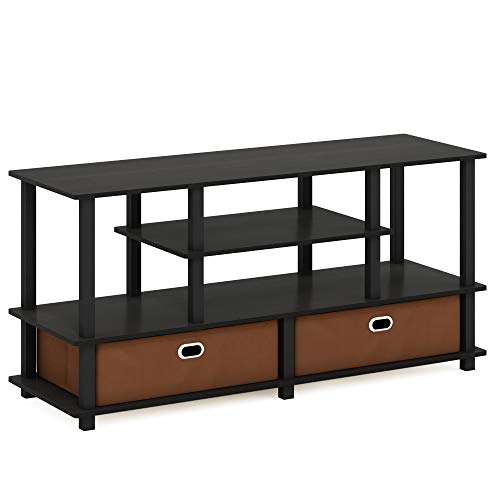
The JAYA leads this guide because it is the only pick designed, visibly and deliberately, around the way families actually live. Start with the corners: Furinno builds this stand with rounded corners specifically to reduce injury risk, and any parent who has watched a running toddler take a corner at forehead height knows that is not a styling detail — it is the feature. The frame is composite-wood panels on twist-together tubes, assembled by hand in about ten minutes with no tools, which in family terms means it can be built during a nap, repaired by re-seating a tube, and carried to another room by one adult while the other supervises bath time. The top is rated for televisions up to 55 inches, the large configuration measures 47.63 inches wide by 15.55 deep by 22.79 high, and beneath the screen the open tiers and two removable fabric bins divide the world the way a household needs it divided: gear on the shelves, everything else in the bins.
Those bins deserve their own paragraph, because they are the clutter system that survives contact with children. Controllers, remotes, charging cables, coloring books, the small plastic figures that migrate everywhere — all of it goes in a bin, and a child old enough to carry a toy is old enough to put it in one. Cleanup becomes a two-minute routine a five-year-old can genuinely do, which no amount of parental shelving discipline achieves. The bins are fabric, so they are silent when dropped, harmless when thrown, and replaceable when a juice incident writes one off. The open shelves above them keep the streaming box and console ventilated, and because the whole unit is light, it is the easiest console here to pull out for the twice-yearly retrieval of everything that has fallen behind it. It sits at the budget-friendly end of this guide — check the current price on Amazon — leaving most of the budget for the wall anchor, the cable box and the rest of the room.
The limits are real and we state them plainly. The load ratings are modest: this stand supports its stated television size, but per-shelf loads should be respected, and a heavy receiver stack belongs on a frame console instead. The open shelves do not lock a determined toddler away from the gear — if your child is in the button-pressing, tray-opening stage, the farmhouse cabinet below is the safer architecture, or place the JAYA’s gear shelf high and route every cable down the back, bundled and out of reach. And the printed finish wants coasters. Judged as family equipment rather than furniture fashion, though, this is the most thoughtfully matched pick in the guide, and the easiest recommendation we make in it.
- Rounded corners built in to reduce injury risk — the toddler-height feature that matters.
- Two fabric bins give toys, controllers and cables a home a child can manage.
- Tool-free assembly in about ten minutes; light enough to move for cleaning behind it.
Honest limitation: Modest load ratings, and open shelves cannot physically bar a determined toddler from the gear — anchor it to the wall and manage cables behind the unit.
Choose it if your TV is 55 inches or under and your household runs on bins and routines. Skip it if your gear is heavy or your toddler needs doors between small hands and the console.
Yaheetech Farmhouse TV Stand, 58-Inch with Sliding Barn Doors
Who it suits: Families with children at the grabbing age — households that need the media stack, the power strip and the game library physically closed away, without giving up a grown-up living room.
If the JAYA is the family pick for managing clutter, this cabinet is the family pick for managing access. Its sliding barn doors roll across a 58-inch front to close the entire media stack — console, receiver, power strip, cable nest — behind wood, and that single architectural fact solves a cluster of toddler problems at once: no buttons to press, no disc trays to open, no blinking lights to investigate, no cable ends to pull. The doors slide rather than swing, which matters in family rooms where a swing door would meet a toy bin, a play mat or a small person standing exactly where the door needs to go. Behind the doors, adjustable shelves take the family’s real inventory: the console and its games, the board-game stack, the basket of chargers. At 58 inches long, 16 deep and 28 high, rated for televisions up to 65 inches, it is the most substantial piece in this guide, and the dark walnut farmhouse front lets the family room look like a room adults chose, even on days when it is functioning as a soft-play annex.
Durability is the second family argument. A cabinet carcass resists the sideways bumps of ride-on toys and cushion-fort construction better than open tube frames, and the closed front means the inevitable juice and snack incidents land on wipeable doors rather than on the equipment. The 28-inch height raises the screen above toddler reach more effectively than the low stands here — small hands can still reach the TV’s lower edge on tiptoe in some setups, so measure your child’s reach honestly, but every inch of console height is an inch of deterrence. It sits at the top of this guide’s budget when the live price cooperates — check the current price on Amazon, because this model’s street price moves around the tier’s ceiling and it only belongs in an under-$150 guide while the listing sits under it.
The cautions are the ones closed storage always carries, plus one specific to families. Heat: a game console working through a long family gaming session needs air, so leave a door slid open while it runs hard, or position it on a shelf with space around it. Pinch awareness: sliding doors are gentle as doors go, but teach small children that the track is not a toy, as you would with any moving furniture part. And anchoring is non-negotiable — a 28-inch cabinet with a television on top is exactly the arrangement anti-tip straps exist for, and this guide’s position is that the strap goes on the day the cabinet goes in, before the first movie night. With those three habits in place, this is the most complete toddler-proof console under the ceiling.
- Sliding barn doors close gear, cables and power strips away from small hands — no swing clearance needed.
- Adjustable shelves behind the doors absorb games, consoles and family clutter.
- Substantial 58 x 16 x 28-inch cabinet that shrugs off bumps and wipes clean.
Honest limitation: Closed doors trap heat around hard-working consoles, the live price drifts around this tier’s ceiling, and a tall cabinet plus TV must be wall-anchored without exception.
Choose it if your children are at the grabbing age and the gear needs a door. Skip it if your console runs hot for hours daily or the live price has moved above budget.
VASAGLE TV Stand for TV up to 70 Inches, 63-Inch 3-Tier Console
Who it suits: Families with older children and a big screen — households whose console must carry a 55- to 70-inch TV, a gaming setup and a movie library, and whose kids are past the climbing stage.
Family rooms grow into big televisions, and big televisions punish undersized consoles. The VASAGLE’s 63-inch top, rated for TVs up to 70 inches, is the only surface in this guide that carries a 65-inch family screen with genuine margin — the panel is about 57 inches wide, so feet and panel both sit comfortably on the wood rather than at its edges, which matters in a room where the furniture gets leaned on, bumped and occasionally used as a ballet barre. The construction is the other family argument: particleboard shelves carried on a steel frame, three open tiers deep enough for the full household stack. Top tier for the soundbar, middle for the console the kids actually touch, bottom for the router, the strip and the game library. Everything visible, everything reachable, nothing overheating behind a door during a three-hour family gaming session.
That openness is also this pick’s family condition, and we state it as a condition rather than a flaw: this console belongs in homes where the children are old enough to leave cables alone, or where the adults commit to the cable discipline the design requires — every cord bundled, run down the back panel, and collected into a covered strip behind the unit, out of the exploration zone. With that done, the open design becomes a genuine family asset. Troubleshooting is instant because you can see every connection. A new device joins the stack in a minute. Airflow keeps the family console alive through years of service. The unit sits at the upper end of this guide’s budget — check the current price on Amazon — and in family terms that buys the one thing this tier usually lacks: headroom, in width, in frame strength and in shelf count, so the console survives the next television instead of being replaced by it.
Anchoring applies here with the same force as everywhere in this guide — a wide console is more stable than a narrow one, not immune to a determined climber — and the open shelves will show the family’s dust and cable runs to anyone who looks. If your household includes a toddler, read the farmhouse review above again before choosing this one. But for the family whose youngest is in school and whose screen is the room’s cinema, this is the strongest, roomiest and most future-proof console under the ceiling.
- 63-inch top rated for TVs up to 70 inches — real margin under a family-size screen.
- Steel frame and three open tiers carry and cool the whole household stack.
- Everything visible and reachable: the easiest console here to troubleshoot and expand.
Honest limitation: Fully open storage exposes cables and gear to young children; it suits older-kid households or strict cable discipline, and it must be wall-anchored like every pick here.
Choose it if your screen is 55 inches or more and your kids are past the grabbing stage. Skip it if toddlers share the room unsupervised with the gear.
Yaheetech TV Stand for TVs up to 65 Inch, 55-Inch Gray
Who it suits: Families who want a mid-size, mid-price console that raises the screen to a comfortable height for a room where children watch from the floor as often as from the sofa.
Family viewing geometry is different from showroom geometry. Adults watch from the sofa; children watch from the rug, from a beanbag, from a parent’s lap, sometimes from directly underneath the screen eating toast. The Yaheetech’s 24-inch height — taller than the low-profile stands in this guide — splits that difference well: the screen center lands near seated adult eye level while staying visible and comfortable from the floor, which makes it the natural family-room compromise. At 55 inches long and 14 deep, in a gray wood-and-metal industrial design, it fits the wall most family rooms actually have, and the gray finish performs a quiet family service: it is the most forgiving surface in this guide for the dust, fingerprints and faint crayon proximity that family furniture accumulates between cleanings.
The open shelving keeps the same ventilation and access advantages as the VASAGLE, in a smaller footprint and at the middle of this guide’s budget — check the current price on Amazon. For a family whose stack is a streaming box, one console and a soundbar, the shelves are sufficient without being cavernous, and the metal frame gives the unit a planted feel when the room gets boisterous. Parents of older children will appreciate that everything is reachable for the nightly controller roundup; parents of younger ones should apply the same cable discipline described in the VASAGLE review — bundled, behind, covered — because this design, like every open one, trusts the household to manage what it does not enclose.
One measurement matters more here than anywhere: the listing rates this console for TVs up to 65 inches, but a 65-inch panel is about 57 inches wide — wider than this 55-inch top. For a 55-inch television the fit is exact and ideal. For a 65-inch, the panel will overhang slightly and the feet may land near the edges, which in a family room, where furniture gets leaned on, is a margin we do not recommend. Measure your set’s foot span; if it lands close to the edges, step up to the 63-inch VASAGLE or wall-mount the panel above this console. That honesty aside, for the huge middle of family rooms running a 55-inch screen, this is the balanced buy: right height, right size, forgiving finish, sensible price.
- 24-inch height suits both sofa viewing and kids watching from the floor.
- Gray finish hides dust and fingerprints better than black or white rivals.
- Metal-frame build with open, ventilated shelves for the everyday family stack.
Honest limitation: A 65-inch TV is wider than the 55-inch top, so feet placement is a genuine concern in a bump-prone family room; open shelves also need household cable discipline.
Choose it if your TV is 55 inches and your viewers split between sofa and floor. Skip it if your 65-inch set’s feet land near the top’s edges.
Furinno Moretti 3-Tier Metal Frame TV Stand
Who it suits: Gaming families — households where a console runs for hours, where airflow is a safety and longevity issue, and where the children are old enough that an open frame is a feature rather than an invitation.
The Moretti’s family case is thermal. A game console in a family home does not run for twenty minutes; it runs through rainy Saturdays, school-holiday marathons and the evening session after homework, and it does so in the warmest room in the house surrounded by soft furnishings. Sealed in a cabinet, that machine breathes its own exhaust. On the Moretti’s open metal frame — three tiers of Columbia walnut-tone shelves on a steel skeleton, positioned by its maker for televisions up to 65 inches — every device sits in open air on its own shelf, with cable runs short, visible and easy to re-route when a new console or a karaoke machine joins the stack. For the household whose media gear works hardest, this is the kindest furniture in the guide to that gear.
The frame brings two more family virtues. It is easy to clean around and under — the open structure does not create the dust-trap caverns that closed cabinets and low stands hide, and a vacuum or a child with a duster can actually complete the job. And it disassembles into flat, light pieces, which matters to families more than to anyone: rooms get rearranged around new babies, new desks and new phases of childhood, and furniture that moves without a van and a plan gets to stay. It sits in the lower-middle of this guide’s budget — check the current price on Amazon — frequently discounted below its list price, which leaves room in the family budget for the anchor strap, the cable box and the second controller that peace treaties are made of.
The conditions are the open-design conditions, stated once more because families deserve them unvarnished: nothing here is hidden from a toddler, nothing is protected from a spilled drink placed on a lower shelf, and the printed walnut finish is handsome at a distance and ordinary under a fingertip. Households with children under five should treat this as a later-years purchase or pair it with rigorous cable covering and a house rule about drinks. For the school-age gaming household, though, it is the right tool: cool-running, movable, honest about what it is.
- Open metal frame gives consoles maximum airflow for long family gaming sessions.
- Easy to clean around and under; disassembles flat when family rooms get rearranged.
- Three tiers keep every device visible, reachable and simple to re-cable.
Honest limitation: Nothing is enclosed — toddlers, spills and dust all have free access, so it suits older-kid households best.
Choose it if gaming heat and rearrangement flexibility lead your list. Skip it if your youngest children still explore the furniture mouth-first.
Furinno JAYA Simple Design Corner TV Stand
Who it suits: Families setting up a second screen — a playroom, a kids’ bedroom or a den corner — with a television up to 46 inches and a premium on rounded edges and floor space returned to play.
Every family home has a room where the television is not the main event but still needs to exist: the playroom where a screen runs during craft time, the older child’s bedroom, the den where grandparents stay. Those rooms share two traits — the corner is usually the only free placement, and the floor belongs to play, not furniture. This JAYA variant is shaped for exactly that brief. Its angled sides push into a 90-degree corner, its curved-front shelves carry four tiers of modest gear, and at 42.04 inches wide by 15.55 deep by 22.75 high, rated for TVs up to 46 inches with a 35-pound top load, it converts dead corner footage into a working media spot while leaving the room’s center open for the forts, train sets and dance parties that are the room’s actual purpose. The rounded corners Furinno builds into the design matter most precisely here, in the room where children move fastest and look where they are going least.
Assembly is the family-standard JAYA experience: twist the tubes, stack the panels, done in about ten minutes, no tools to lose and no cam locks to swear at. At under 30 pounds the stand can be carried to a different corner by one adult when the room’s layout changes — and playroom layouts change with every developmental stage. The open tiers suit a simple stack: the TV, a streaming box, a small console, a basket of movies or games on the curved side shelves. It sits at the budget end of this guide — check the current price on Amazon — which is the right price for a second-screen room, leaving the serious money for the main living room’s console. Families comparing second-room options against the main-room list will find the overlap explained in Best Media Console Under $150.
Its limits are its brief: 46 inches is the screen ceiling, 35 pounds is the top’s honest load, and neither number should be negotiated with. Corner placement also puts the back of the unit in a wedge that small hands can reach around, so route the power strip to the side, keep cables bundled short, and anchor the stand — corner placement tempts people to skip the strap, and the strap matters as much in the playroom as anywhere. Within those lines, this is the playroom pick: safe-edged, space-returning, and priced like the secondary purchase it is.
- Corner shape returns the room’s center to play while hosting a TV up to 46 inches.
- Rounded corners and shelves, sized for the rooms where children move fastest.
- Tool-free, sub-30-pound build that one adult can relocate as the room evolves.
Honest limitation: The 46-inch screen ceiling and 35-pound top rating are hard limits, and corner placement still requires anchoring and side-routed cables.
Choose it if the second screen lives in a playroom or bedroom corner. Skip it if it would ever be asked to carry the family’s main television.
Comparison Table
| Product | Type | Best use | Link |
|---|---|---|---|
| Furinno JAYA 55-Inch with Bins | Open tool-free stand | Toddlers, bins for clutter, fastest assembly | Check on Amazon |
| Yaheetech 58-Inch Farmhouse Cabinet | Closed barn-door cabinet | Locking the stack away from grabbing-age children | Check on Amazon |
| VASAGLE 63-Inch 3-Tier Console | Open steel-frame console | Big family screens and older kids | Check on Amazon |
| Yaheetech 55-Inch Gray Console | Open industrial console | Sofa-plus-floor viewing at 55 inches | Check on Amazon |
| Furinno Moretti 3-Tier | Open metal-frame stand | Cool-running family gaming setups | Check on Amazon |
| Furinno JAYA Corner Stand | Corner stand | Playroom and bedroom second screens | Check on Amazon |
How to Choose the Best Media Console for Families Under $150
- Anchor first, shop second. Every console in this guide should be strapped or anchored to the wall, and the television secured as its maker directs. Choose a console whose back and height accept an anti-tip strap cleanly, buy the strap with the console if one is not included, and install it the same day. No other feature in this article matters as much.
- Prefer rounded corners at child height. Toddlers fall at furniture height, and living-room consoles sit exactly in the fall zone. Rounded or softened corners — built into the Furinno picks here by design — convert the most common bump from an injury into a story.
- Decide who the doors are for. If children under five share the room with the gear, closed cabinets protect both the children and the equipment. If the children are older, open shelves win on cooling, access and price. Be honest about your youngest child’s stage, not your oldest child’s behavior.
- Give children’s clutter a container, not a rule. Bins and baskets inside or under the console are the only storage young children reliably use. A console with a bin system — or shelf space sized for your own bins — will look tidy on ordinary days, not just on cleaning days.
- Route cables like a toddler will audit them. Because one will. Bundle every cord, run it down the back, collect power bricks in a covered strip behind the unit, and leave no loop at grabbing height. Open consoles demand this discipline; closed cabinets forgive its absence.
- Check height from the floor as well as the sofa. Children watch from rugs and beanbags. A console around 24 inches high splits the difference between adult eye level and floor viewing better than the lowest designs, while very tall cabinets can push the screen above comfortable floor angles.
- Respect load ratings with family math. Family shelves accumulate weight invisibly: games, books, a basket of toys, a sibling leaning during a fort build. Keep heavy items low and centered, and treat per-shelf ratings as ceilings with margin, not targets.
- Choose finishes that forgive. Mid-tone grays and wood effects hide the dust and fingerprints of family life between cleanings; gloss black and bright white advertise them. Every surface in this tier wants coasters under drinks — teach it as a house rule from day one.
- Plan for the room’s next phase. Playrooms become homework rooms; toddlers become gamers. A console that can be moved, re-shelved or promoted to another room — the light, tool-free picks here excel at this — will serve the family longer than a fixed showpiece. Households furnishing a compact family flat should also see Best Media Console For Small Apartments Under $150 for the same safety logic at apartment scale.
Family Safety Setup: The First-Evening Checklist
A console becomes family-safe in the setup, not in the shopping cart, so run this checklist on the first evening, before the first movie. One: anchor the console to a wall stud with its strap or bracket, then anchor or secure the television as its instructions direct, and test both with a firm pull — you are checking for the force of a climbing child, not a breeze. Two: load the shelves heaviest at the bottom. The receiver, the game library and the bin of toys go low; the light streaming box can live higher. A bottom-heavy console resists tipping in a way no strap should ever be asked to prove. Three: route every cable down the back, bundle it, and place the power strip behind the unit or inside a closed cabinet, with no cord visible from the front at toddler eye level and no loop hanging within reach of the floor.
Four: walk the room at child height — literally kneel — and look at the console the way a two-year-old does. What can be grabbed, opened, pulled or climbed? Move the tempting items, close the doors, adjust the bins. Five: set the house rules while the furniture is new, because rules attach to new things more easily than to old habits: drinks on coasters, controllers in the bin, no climbing the shelves, ever, with the reason explained once and enforced kindly. Six: schedule the re-check. Children grow, reach extends, and the setup that was safe in spring is audited by taller hands in autumn; a two-minute review each season — strap tight, cables still covered, loads still low — keeps the first evening’s work valid. Families applying the same thinking to the rest of the room will find it continued in Best Media Console For Small Spaces Under $150, where stability in tight quarters gets its own treatment.
Common Buying Mistakes
- Skipping the wall anchor because the console “feels heavy.” Heaviness is not stability: a tall, front-loaded unit with a television on top can tip under a climbing child regardless of how solid it feels to an adult pushing it.
- Buying sharp-cornered furniture for a toddler’s room. The corner is at forehead height for exactly the years when falling is a daily activity. Rounded designs exist at this price; choose them.
- Leaving cables as decoration. An open console with a visible cable nest teaches small children that cords are toys. Bundle, cover and route behind — or buy doors.
- Storing heavy items on top shelves. Books and game libraries belong low, both for the shelf’s load rating and for the console’s center of gravity.
- Choosing a console with no child-operable storage. If a five-year-old cannot put the controllers away, the controllers will live on the floor. Bins beat rules.
- Sealing the family console in a cabinet during marathon gaming. Closed doors plus hours of full-load gaming is how consoles overheat. Slide a door open for long sessions.
- Letting a 65-inch TV’s feet land at a 55-inch top’s edges. In a family room, where furniture gets leaned on daily, edge placement is an accident scheduling itself.
- Forgetting the floor viewers. A console chosen only for sofa eye level can leave children on the rug craning upward. Check the angle from the floor before you buy.
Final Recommendation
- Most families: Furinno JAYA TV Stand for up to 55-Inch TV with Storage Bins.
- Toddlers and grabbing-age children: Yaheetech Farmhouse TV Stand, 58-Inch with Sliding Barn Doors.
- Big screens, older kids: VASAGLE TV Stand for TV up to 70 Inches, 63-Inch 3-Tier Console.
- Sofa-and-floor viewing: Yaheetech TV Stand for TVs up to 65 Inch, 55-Inch Gray.
- Gaming households: Furinno Moretti 3-Tier Metal Frame TV Stand.
- Playrooms and second screens: Furinno JAYA Simple Design Corner TV Stand.
Our top two for family life are the Furinno JAYA with bins — rounded corners, a clutter system children can actually operate, and a price that leaves the budget room to do the safety extras properly — and the Yaheetech farmhouse cabinet for the toddler years, when a sliding door between small hands and the media stack is worth every dollar of its premium within this tier. The VASAGLE takes over when the screen grows and the children do; the gray Yaheetech balances the room’s two viewing heights; the Moretti keeps the gaming household’s gear cool; the corner JAYA gives the playroom its screen without taking its floor. Whichever you choose: anchor it the day it arrives, route the cables like a toddler will audit them — because one will — and check the live price on the listing before you buy.
Frequently Asked Questions
How do I make a media console safe for toddlers?
Anchor the console to a wall stud and secure the TV, load the heaviest items on the lowest shelves, route every cable down the back into a covered power strip, and choose rounded corners where you can. If your toddler is at the grabbing stage, a closed cabinet with doors adds a physical barrier between small hands and the equipment. Re-check the setup each season as your child’s reach grows.
Are open or closed consoles better for families?
It depends on your youngest child. Closed cabinets protect toddlers from gear and gear from toddlers, and they hide the cable nest entirely. Open consoles cool better, cost less and make cleanup and troubleshooting easier, but they require disciplined cable routing in a young household. Many families start closed and move open as the children grow — both styles appear in this guide for that reason.
What console height works when kids watch from the floor?
A console around 22 to 24 inches high is the family compromise: the screen center stays near adult seated eye level while remaining comfortable from a rug or beanbag. Very low consoles can feel cinematic from a sofa but strain floor viewers less, while tall cabinets above 28 inches can push the picture high for everyone. Check the angle from your actual floor spot before deciding.
Can children really tip a media console?
A console with a television on top is front-heavy, and a climbing child applies force exactly where the unit is weakest — at the top, pulling outward. That is why every recommendation in this guide assumes a wall anchor, heavy items stored low, and no exceptions for units that feel heavy. Weight resists sliding; anchoring resists tipping, and tipping is the hazard.
How do I keep controllers and games from taking over the room?
Give them a container at child height that a child can operate alone — the fabric bins on the JAYA pick in this guide are the model, and any low basket inside a cabinet does the same job. One bin for controllers and remotes, one for games and small toys, and a two-minute tidy routine beats any shelving system that requires adult precision.
Is a corner TV stand a good idea for a playroom?
Yes, when the television is 46 inches or under. A corner stand returns the room’s center to play, keeps the screen out of the main traffic path, and — in the rounded-corner design recommended here — suits the room where children move fastest. Anchor it like any other console, route its power strip to the side, and respect its stated load rating.