Where to buy
Check the latest price, availability and delivery on Amazon. Orders are placed on Amazon. We may earn a commission from qualifying purchases.
- Best overall: VASAGLE TV Stand for TV up to 70 Inches, 63-Inch 3-Tier Console — Check on Amazon
- Yaheetech TV Stand for TVs up to 65 Inch, 55-Inch Gray — Check on Amazon
- Yaheetech Farmhouse TV Stand, 58-Inch with Sliding Barn Doors — Check on Amazon
- Furinno JAYA TV Stand for up to 55-Inch TV with Storage Bins — Check on Amazon
See 2 more Amazon options
- Furinno Moretti 3-Tier Metal Frame TV Stand — Check on Amazon
- Furinno JAYA Simple Design Corner TV Stand — Check on Amazon
Read the full guide ↓
Disclosure: As an Amazon Associate, dailyhomedecorating.com earns from qualifying purchases. Links to Amazon on this page are affiliate links; they cost you nothing extra. Listing details such as price and availability change often, so check the current Amazon listing before you buy.
Finding the best media console under $150 starts with a simple truth about how living rooms actually work: the console is the hardest-working piece of furniture in the room, and it is also the one most people measure last. The television gets the research. The sofa gets the showroom visit. The console gets whatever wall space is left, and then it is expected to hold a screen that may weigh more than a child, swallow a game console, a soundbar, a streaming box and a router, hide a nest of cables, and still look like a deliberate piece of furniture rather than a plank on legs. Under $150, that job is absolutely doable — but only if you shop by width, load rating and shelf layout instead of by the photograph, because at this budget the difference between a console that serves you for years and one that sags by spring is written in the specification table, not in the styling.
The first thing to understand about this tier is what your money buys as you move through it. At the bottom of the under-$150 range sit open, tool-free stands from Furinno: light, quick to assemble, honest about their modest load limits, and well suited to screens up to about 55 inches. In the middle sit industrial wood-and-steel consoles from Yaheetech and VASAGLE, with deeper shelves, real cable management and tops long enough for 65-inch televisions. At the top of the tier, just under the ceiling, sit full farmhouse cabinets with sliding barn doors that hide everything behind a finished front. None of these is the right answer for everyone. A 42-inch corner stand is a brilliant purchase for a bedroom corner and a poor one under a 65-inch screen. A 63-inch three-tier console is the best all-rounder here and a waste of wall in a room that only has four feet to spare. This guide is organized around that reality: six verified consoles, each matched to the buyer it actually serves, with the trade-offs stated plainly.
Our short answer is this. For most living rooms, start with the 63-inch VASAGLE: it is the longest top in the guide, it is rated for televisions up to 70 inches, and its three open tiers handle the full modern stack — TV, soundbar, console, streaming gear — without anything disappearing behind doors you have to open every time you want to play a game. If closed storage matters more than open access, the Yaheetech farmhouse cabinet hides the same gear behind sliding barn doors. If your budget needs to land well under the ceiling rather than near it, the Furinno JAYA with its two storage bins is the value pick of the group, and its rounded corners are a genuine bonus in busy rooms. The reviews below explain each pick in detail, and the buying sections that follow cover the measurements — panel width versus diagonal, foot span, shelf height, load per shelf — that decide whether a console works in your room or merely fits in the photograph. Shoppers working with a smaller budget should also see Best Media Console Under $100, where several of these same brands field narrower models.
In this guide
Quick Picks
In a hurry? This table matches each console to the situation it handles best.
| Buyer type | Pick | Why it stands out | Link |
|---|---|---|---|
| Best overall | VASAGLE TV Stand for TV up to 70 Inches, 63-Inch 3-Tier Console | Longest top in the guide, three open tiers and a steel frame — the full-stack all-rounder | Check on Amazon |
| Best open industrial console | Yaheetech TV Stand for TVs up to 65 Inch, 55-Inch Gray | Wood-and-metal frame, generous shelving and a finish that hides dust well | Check on Amazon |
| Best closed storage | Yaheetech Farmhouse TV Stand, 58-Inch with Sliding Barn Doors | Barn doors hide the whole media stack behind a finished farmhouse front | Check on Amazon |
| Best value | Furinno JAYA TV Stand for up to 55-Inch TV with Storage Bins | Two fabric bins, rounded corners and tool-free assembly at the budget end of the tier | Check on Amazon |
| Best slim metal-frame design | Furinno Moretti 3-Tier Metal Frame TV Stand | Open metal frame keeps big-screen setups ventilated and visually light | Check on Amazon |
| Best for corners | Furinno JAYA Simple Design Corner TV Stand | Angled sides turn a dead corner into a media spot for TVs up to 46 inches | Check on Amazon |
How These Picks Were Chosen
We began with budget discipline. Every console below is a genuine Amazon listing chosen to fit this guide’s under-$150 budget — check the current price on Amazon before you buy, because listing prices change often, and on one pick in this guide, the farmhouse cabinet, the street price moves enough that we flag it explicitly in its review: only buy it when the live listing sits under the ceiling. Models that look inexpensive in a thumbnail but climb over the budget once you select the size that fits your television were excluded, as were well-known designer consoles positioned far above this tier.
We did not hands-on test these consoles. Instead we compared the specifications that decide whether a media console works in a real room: top width measured in inches rather than the television diagonal printed in the title, because a 65-inch TV is roughly 57 inches wide and needs a top at least that wide once its feet are accounted for; stated load capacity for the top and for each shelf, because a game console, an AV receiver and a stack of games add up faster than people expect; shelf height and depth, because a center-channel speaker or a taller console will not fit a shelf designed for a slim streaming box; cable management, because six devices mean six power bricks looking for somewhere to go; and construction — steel frames and thicker panels at this price resist the slow sag that thin, long spans of particleboard eventually show under a heavy screen. Assembly method counted too: tool-free designs genuinely help renters and first-time buyers, while cam-lock cabinets reward patience with a more furniture-like result.
Finally, we applied a honesty filter to screen-size claims. Several listings in this category advertise a television size that their top width barely supports, with the TV’s feet landing at the very edge of the surface. Where a pick’s claimed size and its measured width are in tension, we say so in its review and tell you the screen size we would actually stop at. A console should hold your television with margin, not with optimism, and that standard shaped this list from the first filter to the last. Readers who expect to step up to a much larger screen soon may want to compare the wider cabinets in Best Media Console Under $300 before committing to this tier.
The 6 Best Media Consoles Under $150
VASAGLE TV Stand for TV up to 70 Inches, 63-Inch 3-Tier Console
Who it suits: Most living rooms — anyone with a 55- to 70-inch television, an open-shelf preference, and a full stack of gear that needs air and easy access.
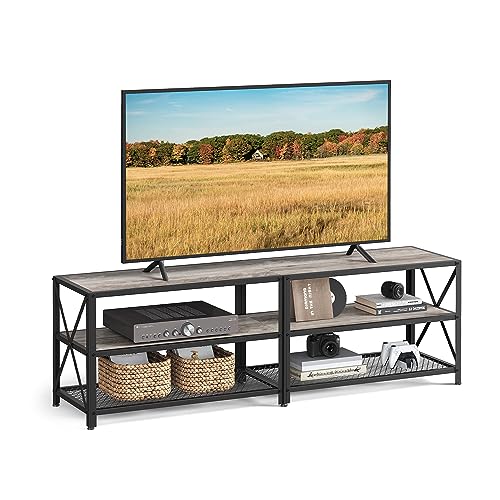
The VASAGLE earns the top spot in this guide by getting the fundamentals right at the size most living rooms now need. The top measures 63 inches long by 15.4 inches deep, which is the important number in this entire category: a 65-inch television is about 57 inches wide, so this top carries it with real margin on both sides, and the listing rates the stand for TVs up to 70 inches. Three open tiers run the full length beneath, built from particleboard panels on a steel frame, which is the construction we prefer at this price — the steel does the structural work, the panels do the storing, and the open design means a game console or receiver can breathe instead of baking behind a closed door. Heat is the quiet killer of media gear, and open shelving is the simplest insurance against it.
The layout suits how people actually stack equipment. The top tier under the television takes the soundbar or center speaker at ear-friendly height. The middle tier is the natural home for the devices you touch — the game console, the streaming box — where controller cables and disc trays stay reachable. The bottom tier absorbs the router, the power strip and the game library. Because nothing is hidden, nothing is forgotten: you can see at a glance which cable belongs to which box, which is worth more than it sounds the first time you troubleshoot a home theater at midnight. It sits at the upper end of this guide’s budget — check the current price on Amazon — with the money visibly spent on size and frame rather than ornament.
Two honest cautions. First, open shelving shows dust and cable runs; if your room’s look depends on a clean front, the farmhouse pick below hides what this one displays. Second, at 63 inches this is a wide piece of furniture that dominates a narrow wall — measure your wall run, including the space your speakers or a plant expect to occupy, before ordering. Within its brief, though, this is the console we would buy first with this budget: correctly sized, sensibly built, and flexible enough to survive your next television upgrade.
- 63-inch top rated for TVs up to 70 inches — real margin for a 65-inch screen and its feet.
- Three full-length open tiers keep consoles and receivers ventilated and reachable.
- Steel frame with particleboard shelves — the sturdier construction pattern at this price.
Honest limitation: Open tiers display dust, cables and blinking lights; there are no doors to hide a messy stack, and the 63-inch width overwhelms short walls.
Choose it if your TV is 55 inches or larger and your gear needs open air. Skip it if you need clutter hidden behind doors or your wall run is under about five and a half feet.
Yaheetech TV Stand for TVs up to 65 Inch, 55-Inch Gray
Who it suits: Buyers with a 55- to 65-inch TV who want the industrial wood-and-metal look, open storage, and a mid-tier price that leaves money for the rest of the room.
Yaheetech’s gray console is the VASAGLE’s closest rival and the better buy for a specific kind of room: one where the television is 65 inches at most and the wall cannot spare 63 inches of console. At 55 inches long, 14 inches deep and 24 inches high, it trims eight inches of width while keeping the same open, ventilated layout — a wood-effect top and shelves carried on a metal frame, with storage shelving below for consoles, speakers and media. The gray finish is a practical choice that deserves more credit than it gets: it sits comfortably between black metal and warm wood tones, works with both cool and warm room palettes, and shows dust less aggressively than a gloss black surface does.
The 24-inch height is the second reason to consider it. Many budget consoles sit low, which is fine for a bedroom but puts a living-room screen below comfortable viewing height from a sofa. This one raises the television closer to eye level when seated, which matters for long viewing sessions and for rooms where the TV doubles as a gaming display. The open shelves keep the same ventilation advantage as the VASAGLE, and the frame construction keeps the unit feeling planted rather than perched. It sits in the middle of this guide’s budget tier — check the current price on Amazon — which makes it the natural recommendation when the VASAGLE’s width or price is more than the room needs.
The trade-off is margin. A 65-inch television is about 57 inches wide, which is wider than this 55-inch top: the screen will overhang slightly on both sides, and depending on where your TV’s feet sit, they may land close to the edges. For a 55-inch TV the fit is perfect; for a 65-inch, check your set’s foot span against the top before ordering, and consider wall-mounting the panel above the console if the feet fall awkwardly. That single measurement decides whether this is the smartest buy in the guide or the wrong one, and we would rather flag it here than let a photograph decide for you.
- 55-inch top in a gray wood-and-metal industrial design that suits most palettes.
- 24-inch height raises the screen closer to seated eye level than low-profile rivals.
- Open shelving keeps game consoles and receivers cool and accessible.
Honest limitation: A 65-inch TV is wider than the 55-inch top, so feet placement needs checking; the open design also leaves cables and dust on display.
Choose it if your TV is 55 inches, or a 65-inch whose feet you have measured. Skip it if you want the screen fully supported with margin to spare — take the 63-inch VASAGLE instead.
Yaheetech Farmhouse TV Stand, 58-Inch with Sliding Barn Doors
Who it suits: Anyone whose living room has to look like a living room — buyers who want the media stack, the cables and the game library completely hidden behind a finished front, in a farmhouse or transitional scheme.
This is the only true cabinet in the guide, and it changes the character of the wall it stands against. At 58 inches long, 16 inches deep and 28 inches high, it is the tallest and deepest pick here, and its sliding barn doors roll across the front to reveal adjustable shelves behind — slide them one way to show a shelf of books or a soundbar, the other way to close the room down to a clean, furniture-only face. For households where the television wall is also the first thing guests see, that transformation is the entire point of the purchase. The dark walnut finish suits farmhouse, rustic and transitional rooms, and the listing rates it for televisions up to 65 inches, which the 58-inch top supports honestly: a 65-inch panel is about 57 inches wide, so the fit is exact rather than generous, and worth a foot-span check as with any cabinet at this width.
Closed storage has real functional advantages beyond looks. Doors keep dust off equipment, keep toddler hands and pet noses away from buttons and disc trays, and let a room switch from media center to calm living space in seconds. The adjustable shelves behind the doors adapt to taller items — a vinyl collection, board games, a subwoofer remote’s worth of accessories — in a way fixed open tiers cannot. It sits at the top of this guide’s budget when its live price cooperates — check the current price on Amazon before you buy, because this model’s street price moves around the ceiling of this tier, and it only belongs in an under-$150 guide on the days the listing sits under it.
The limitations are the mirror image of the strengths. Closed cabinets trap heat, so a hard-working game console or AV receiver needs the doors left ajar during long sessions or a shelf position with air around it. The barn-door hardware rewards level floors; on a noticeably sloped floor the doors can drift. And at 28 inches tall plus a television on top, check that your screen’s center lands near seated eye level rather than above it — in a low-slung sofa setup this cabinet can push the picture a touch high. None of that displaces it as the guide’s closed-storage recommendation; it simply defines the buyer: choose it for the hidden, finished look, and manage the heat honestly.
- Sliding barn doors hide the entire media stack behind a finished farmhouse front.
- Adjustable shelves behind the doors adapt to taller gear and collections.
- 58 x 16 x 28 inches — the deepest, tallest cabinet here, rated for TVs up to 65 inches.
Honest limitation: Closed doors trap heat around hard-working consoles, the sliding doors want a level floor, and the live price moves around this tier’s ceiling — verify it sits under $150 on the listing before buying.
Choose it if a clean, closed front matters more than open-air cooling. Skip it if your receiver runs hot, your floor slopes, or the live price has drifted above the budget.
Furinno JAYA TV Stand for up to 55-Inch TV with Storage Bins
Who it suits: Budget-first buyers, first apartments, and anyone who wants a competent console for a TV up to 55 inches at the lowest sensible price in the guide — with two fabric bins that swallow everyday clutter.
Furinno’s JAYA line is built on a disarmingly simple idea: composite-wood panels joined by tubes you twist together by hand, no tools, in about ten minutes. This 55-inch version stretches that idea about as far as it honestly goes. The top panel is rated for televisions up to 55 inches, the frame stands 47.63 inches wide by 15.55 deep by 22.79 high in its large configuration, and the open tiers below hold the usual stack — streaming box, console, a row of games — while two removable non-woven storage bins take the remotes, controllers, charging cables and general living-room debris that otherwise colonizes every flat surface. The manufacturer builds in rounded corners to reduce injury risk, a detail parents and anyone who has caught a hip on a furniture corner will appreciate, and the whole unit is light enough to move between rooms or homes without planning the day around it.
Value is the headline. This console sits at the budget-friendly end of this guide — check the current price on Amazon — typically leaving half the budget unspent for a soundbar, a wall mount or the next thing the room needs. That positioning changes how you should judge it: not against cabinets costing twice as much, but against the milk-crate and hand-me-down-table arrangements it replaces, against which it wins on looks, cable order and sheer tidiness by a wide margin. The open design keeps gear cool, the bins keep clutter invisible, and the tool-free build makes it the easiest assembly in this guide by a distance.
Honesty about limits matters more at this price than anywhere. The top panel’s rated load is modest — the JAYA design supports its stated TV size, but this is not the console for a heavy vintage receiver or a stack of stone bookends, and per-shelf loads should be respected rather than tested. The composite panels and tube joints will not feel like solid furniture when you lean on them, and the finish is a printed surface that asks for coasters. Buy it as what it is — the smartest cheap console in the guide — and it will not disappoint you. Buyers who like the concept but need a smaller footprint will find its sibling in Best Media Console For Small Spaces Under $150.
- Tool-free twist-together assembly in about ten minutes; the easiest build in the guide.
- Two removable fabric bins hide remotes, controllers and cables.
- Rounded corners and a lightweight frame that is easy to move between homes.
Honest limitation: Modest load ratings and composite panels — respect the stated TV size and shelf loads, and do not expect solid-wood solidity.
Choose it if budget leads and your TV is 55 inches or under. Skip it if your gear is heavy or you want a cabinet that feels like heirloom furniture.
Furinno Moretti 3-Tier Metal Frame TV Stand
Who it suits: Buyers who like an open, architectural look — a metal frame and wood-tone shelves that keep a big-screen setup feeling light — and gamers whose consoles need maximum airflow.
The Moretti takes Furinno’s formula and gives it a frame. Instead of tube joints, a metal skeleton carries three tiers of Columbia walnut-finish shelves, and the result reads as a deliberate piece of industrial-modern furniture rather than a budget stand that happens to hold a TV. The listing positions it for large screens — the Moretti line is sold for televisions up to 65 inches — and the open three-tier layout gives every device its own airy shelf, which is why this is the pick we point gaming households toward when a closed cabinet would cook their console. Nothing traps heat, nothing hides a status light you need to see, and the frame’s open sides make cable runs short and obvious rather than archaeological.
It is also one of the easiest consoles here to live around. The open frame is visually light, so a long console does not read as a long block of furniture — useful in rooms where the TV wall is also the dining wall or the office wall. The metal frame wipes clean, the shelves are wide enough for a soundbar on the top tier beneath the screen, and the whole unit sits comfortably in the lower-middle of this guide’s budget — check the current price on Amazon — frequently discounted well under its list price. For renters, the frame design disassembles into flat, carry-able pieces, which matters more than most furniture virtues on moving day.
The compromises are openness itself. There is nowhere to hide anything: the router’s lights, the power strip, the cable loop behind the streaming box are all part of the room’s scenery unless you add your own baskets or a cable box. The wood-tone finish is a printed surface over composite board, handsome at conversational distance and less convincing under a fingertip. And as with every wide-span budget console, respect the shelf loads and center heavy items over the frame’s uprights rather than mid-span. Judged as an open, ventilated, good-looking frame for a modern stack, it earns its place; judged as storage furniture, the farmhouse cabinet above is the honest alternative.
- Metal frame with three open tiers — maximum airflow for consoles and receivers.
- Visually light design that keeps long TV walls from feeling blocked in.
- Walnut-tone shelves and a frame that disassembles flat for moving.
Honest limitation: Fully open storage hides nothing, and the printed wood-tone finish is less convincing up close than real veneer.
Choose it if you run hot gear and like the industrial-modern look. Skip it if hiding clutter is the point of the purchase.
Furinno JAYA Simple Design Corner TV Stand
Who it suits: Anyone with a television up to 46 inches and a corner doing nothing — bedrooms, dens, kids’ rooms and small living rooms where the only honest placement is diagonal.
Every other console in this guide assumes a flat wall. This one assumes the opposite, and for a surprising number of rooms that assumption is the correct one. The JAYA corner stand’s angled sides and curved-front shelves are shaped to push into a 90-degree corner, turning the deadest square footage in most rooms into a working media spot. It measures 42.04 inches wide by 15.55 deep by 22.75 high, carries four tiers of open storage with rounded side shelves, and is rated for televisions up to 46 inches with a top load of 35 pounds — modest numbers, honestly stated, that match the second-TV and bedroom duties this stand is built for. Assembly is the same tool-free twist-and-stack as its JAYA sibling, and the rounded corners that Furinno builds into the design matter in the tight rooms where a corner stand usually lives.
The corner placement has advantages beyond using dead space. A diagonal television often solves glare in rooms where windows sit opposite the only flat wall, and it can open a better viewing angle for an L-shaped seating arrangement than any straight console in the room. The four open tiers give a bedroom setup — TV, streaming box, a small console, books — a shelf each, and the curved shelves at the sides take speakers or a plant without crowding the screen. It sits at the budget end of this guide — check the current price on Amazon — and weighs under 30 pounds, so repositioning it while you find the right corner is a one-person, one-minute job.
Its limits are written into its shape. Forty-six inches is the ceiling for the screen, the 35-pound top rating excludes heavy older sets, and a corner stand commits you to diagonal viewing — wonderful where the seating agrees, awkward where the sofa faces a wall flatly. The open shelves behind a corner placement also make cable access a reach-around exercise, so plan the power strip’s position before the stand goes in, not after. For the room it fits, nothing else in this guide does its job at all; for a main living room with a big screen, it was never a candidate, and the VASAGLE above is waiting.
- Corner-shaped design with curved side shelves uses dead corner space.
- Four open tiers for a TV up to 46 inches; tool-free assembly.
- Rounded corners and a sub-30-pound build that is easy to reposition.
Honest limitation: The 46-inch screen ceiling and 35-pound top rating confine it to second-TV and bedroom duty, and corner placement makes rear cable access awkward.
Choose it if a corner is your only — or best — placement. Skip it if your TV is larger than 46 inches or your seating faces a flat wall.
Comparison Table
| Product | Type | Best use | Link |
|---|---|---|---|
| VASAGLE 63-Inch 3-Tier Console | Open steel-frame console | TVs up to 70 inches and a full, ventilated media stack | Check on Amazon |
| Yaheetech 55-Inch Gray Console | Open industrial console | 55-inch TVs at comfortable viewing height | Check on Amazon |
| Yaheetech 58-Inch Farmhouse Cabinet | Closed barn-door cabinet | Hiding the whole stack behind a finished front | Check on Amazon |
| Furinno JAYA 55-Inch with Bins | Open tool-free stand | Budget value with clutter-swallowing bins | Check on Amazon |
| Furinno Moretti 3-Tier | Open metal-frame stand | Airflow for gaming gear in a modern room | Check on Amazon |
| Furinno JAYA Corner Stand | Corner stand | Bedrooms and corners with TVs up to 46 inches | Check on Amazon |
How to Choose the Best Media Console Under $150
- Measure your TV’s width and foot span, not its diagonal. Screen sizes are diagonals. A 55-inch TV is about 48 inches wide; a 65-inch is about 57; a 70-inch about 61. Your console’s top should be at least as wide as the panel, and the distance between the TV’s feet — which is narrower than the panel but varies by model — must land on the top with margin on both sides. This single check prevents most bad purchases in this category.
- Match console height to your sofa. Your eyes sit roughly 42 to 48 inches above the floor on a typical sofa, and the center of the screen should land near that line. Add the console’s height to roughly half the TV’s height and see where the center falls. Low consoles suit low platform sofas and bedrooms; taller cabinets suit higher seating — and can overshoot in a low-slung setup.
- Check load ratings per surface, not just the headline. A console may carry a television easily while its middle shelf is rated for far less. Add up what each shelf will hold — receiver, console, games, books — and compare against the stated per-shelf limit, keeping the heaviest items low and centered over supports.
- Decide open versus closed storage by heat and by household. Open shelves cool game consoles and receivers and keep remotes’ signals and disc trays accessible. Closed cabinets hide clutter, dust and small fingers. If you close hot gear behind doors, plan ventilation: a rear panel gap, a shelf position with air around the device, or doors left ajar during long sessions.
- Measure shelf height and depth against your tallest device. A center-channel speaker, a taller game console stood vertically, or an AV receiver with top vents needs clearance above it, not just a shelf it technically fits on. Depth matters too: receivers are deeper than streaming boxes, and a shallow console can leave connectors pressed against the back panel.
- Plan the cable path before the console arrives. Count your devices, place the power strip where every brick can reach it, and prefer consoles with rear cutouts or enough open back to route cables downward rather than sideways. Ten minutes of planning here saves the visible cable waterfall that ruins an otherwise tidy wall.
- Be honest about assembly. Tool-free tube designs assemble in about ten minutes and disassemble just as fast — ideal for renters and frequent movers. Cam-lock cabinets take longer and reward care with a more furniture-like result. Neither is better in the abstract; the right one is the one that matches your patience and your moving frequency.
- Anchor any console a child or pet can reach. Whatever you buy, use the anti-tip strap or wall anchor if one is included, and fit one if it is not. A loaded console with a television on top is a tall, front-heavy object, and anchoring is the cheapest safety measure in the room. Households shopping with children in mind should start with Best Media Console For Families Under $150, where stability and closed storage lead the criteria.
- Leave room for the next television. Screens grow. If you expect to move from 55 to 65 inches within the console’s life, buy the top width for the future set now — the 63-inch pick in this guide exists precisely for that buyer — rather than buying twice.
Will It Fit? A Five-Minute Measurement Routine
Before ordering any console in this guide, run five checks with a tape measure. First, the wall run: measure the full width available, then subtract what floor speakers, a subwoofer, a plant or a floor lamp expect to occupy, because the console gets what remains, not what the wall measures. Second, the panel check: measure your television’s actual width edge to edge, and the distance between the outside edges of its feet; both numbers must fit the console’s top, the foot span with at least an inch of margin per side. Third, the depth check: most consoles here are 14 to 16 inches deep, and most rooms can spare that, but a walkway behind a sofa or a door swing can turn two inches of depth into a daily annoyance — walk the path before you commit to it.
Fourth, the shelf audit: measure your tallest component — usually a receiver or a vertically stood console — including the clearance its vents need, and compare it with the shelf heights in the listing, not with the console’s total height divided by its shelf count, which is never how the space actually divides. Fifth, the outlet check: find the outlet the power strip will use, confirm the strip’s cord reaches it from inside the console, and confirm the console’s back design lets cables exit where the outlet actually is. Consoles placed in corners deserve one extra check — the diagonal. A corner stand pushes the television into the room along the corner’s bisector, so sight lines from your seating change; sit where you will sit and look at the corner before the furniture makes the decision permanent. Readers furnishing a compact room end-to-end will also want Best Media Console For Small Apartments Under $150, which applies this same routine at apartment scale.
Common Buying Mistakes
- Buying by diagonal. A console advertised for a 65-inch TV may have a top narrower than the television itself. Width and foot span are the real specifications; the diagonal is marketing shorthand.
- Ignoring per-shelf load limits. The top survives the TV while the middle shelf slowly bows under a receiver and a stack of hardback books. Read every rating, not just the biggest one.
- Sealing hot gear in a closed cabinet. Consoles and receivers shorten their own lives in still, heated air. Closed storage needs a ventilation plan, not just doors.
- Forgetting the soundbar. A soundbar needs width on the top or a shelf of its own, plus height clearance so it does not block the TV’s infrared receiver. Measure it into the layout before the console arrives.
- Skipping the anti-tip anchor. It takes five minutes and it is the difference between a stable wall and a front-heavy hazard in any home with children, pets or earthquakes on the list of possibilities.
- Choosing height by looks alone. A console that photographs beautifully can put the screen center a foot above seated eye level. Do the sofa arithmetic in the how-to-choose section first.
- Letting cables be an afterthought. Six devices, six bricks, one strip, no plan: the result is a visible tangle that makes a good console look cheap. Route first, admire after.
- Buying the exact width of today’s TV. Panels grow at upgrade time. A top with margin today is a console you keep; a top at the limit is a console you replace alongside the television.
Final Recommendation
- Most living rooms: VASAGLE TV Stand for TV up to 70 Inches, 63-Inch 3-Tier Console.
- Mid-size rooms and 55-inch TVs: Yaheetech TV Stand for TVs up to 65 Inch, 55-Inch Gray.
- Closed, finished storage: Yaheetech Farmhouse TV Stand, 58-Inch with Sliding Barn Doors.
- Tightest budgets: Furinno JAYA TV Stand for up to 55-Inch TV with Storage Bins.
- Gaming airflow and a modern frame: Furinno Moretti 3-Tier Metal Frame TV Stand.
- Corners and second TVs: Furinno JAYA Simple Design Corner TV Stand.
Our top two are the VASAGLE — the only pick here that sizes honestly for the 65- to 70-inch screens most living rooms now run, on a frame built the way we would specify at this price — and the Furinno JAYA with bins, which delivers a tidy, safe, tool-free console for a fraction of the budget and leaves real money for everything else the room needs. Between those poles, the Yaheetech gray console is the balanced middle, the farmhouse cabinet is the choice when the room must hide its machinery, the Moretti keeps hot gear cool in a modern frame, and the corner JAYA rescues rooms no straight console fits. Measure the panel, the feet, the shelves and the wall, check the live price on the listing, and buy the console your room actually describes.
Frequently Asked Questions
How wide should a media console be for a 65-inch TV?
A 65-inch television measures roughly 57 inches across, so look for a top at least 58 inches wide, and preferably a few inches more so the panel and its feet sit with margin. In this guide, the 63-inch VASAGLE gives that margin, and the 58-inch farmhouse cabinet fits exactly — check your set’s foot span against either before ordering, because feet placement varies by TV model.
Is an open or closed media console better?
Neither is universally better; they solve different problems. Open consoles ventilate game consoles and receivers, keep everything reachable, and usually cost less. Closed cabinets hide clutter and dust and present a finished front to the room, but they need a ventilation plan for hot gear. Choose by your equipment’s heat and your household’s tolerance for visible cables.
Can a console under $150 really hold a large TV safely?
Yes, within its stated ratings. The steel-frame and cabinet picks in this guide are rated for televisions up to 65 or 70 inches. Safety comes from respecting the numbers: keep the panel’s feet fully on the top, keep heavy items low and centered, and anchor the console to the wall, especially in homes with children or pets.
What height should a media console be?
Work backward from your sofa. Seated eye level is typically around 42 to 48 inches from the floor; the center of your screen should land near that height. Add half your TV’s height to the console’s height to find the screen center, and compare. Consoles in this guide range from about 20 to 28 inches tall, which covers most sofa and screen combinations.
Do I need cable management features, or can I improvise?
You can improvise with a power strip, velcro ties and a cable box, and many tidy setups do exactly that. Built-in cutouts and open backs simply make the improvisation easier and keep cables dropping straight down instead of spilling sideways. What you cannot skip is the plan itself: decide where the strip lives and how each cable reaches it before the gear goes in.
How long will a budget media console last?
Kept within its load ratings, away from standing moisture, and anchored rather than dragged, a steel-frame or cabinet console at this price should serve for years of ordinary use. The honest limits are surface wear on printed finishes and the slow sag that comes from overloading long shelf spans — both are avoidable with coasters, sensible loads and heavy items placed over supports.