Where to buy
Check the latest price, availability and delivery on Amazon. Orders are placed on Amazon. We may earn a commission from qualifying purchases.
- Best overall for small spaces: SAFAVIEH Adirondack Collection Rug, Ivory & Sage Modern Abstract, 8′ x 10′ — Check on Amazon
- Best for calm, camouflaged small rooms: Loloi II Layla Collection Rug, Olive/Charcoal, 7’6″ x 9’6″ — Check on Amazon
- Best flatweave for tight footprints: SAFAVIEH Natural Fiber Collection Seagrass Rug, Natural & Beige, 8′ x 10′ — Check on Amazon
- Best washable for hard-working small rooms: Ruggable Kamran Ivory Opal Washable Rug, 8′ x 10′, with Standard Pad — Check on Amazon
See 2 more Amazon options
- Best for multipurpose small rooms: Nourison Aloha Indoor/Outdoor Rug, Navy Multicolor, 7’10” x 10’6″ — Check on Amazon
- Best premium texture, small footprint: SAFAVIEH Trace Collection Rug, Ivory, 8′ x 10′ — Check on Amazon
Read the full guide ↓
Disclosure: As an Amazon Associate, dailyhomedecorating.com earns from qualifying purchases. Links to Amazon on this page are affiliate links; they cost you nothing extra. Listing details such as price and availability change often, so check the current Amazon listing before you buy.
The best living room rug for small spaces under $1000 succeeds by breaking the instinct most people bring to a small room: the instinct to buy a small rug. A small rug in a small room does not create breathing space — it creates a postage stamp that the furniture crowds around, and it makes the room’s proportions look meaner than they are. The rugs that transform compact living rooms are almost always bigger than their owners first dared, lighter in tone than they first considered, flatter in pile than they first wanted, and chosen with a geometrician’s eye for what a patterned field does to perceived space. This guide is about that geometry. Whether your small space is a cottage sitting room, the tight front room of a terraced house, a compact condo living area or the one usable rectangle in an awkward L-shaped plan, the physics are the same: the rug is the largest single visual field in the room, and it will either argue that the room is cramped or demonstrate that it is composed.
A healthy budget helps here in a specific way. Small spaces need fewer square feet of rug, so a given budget buys more quality per square foot than it ever could in a large room — real wool, handmade texture and engineered washable systems all come within reach at sizes a compact room can actually use, in a way they do not at 9′ x 12′. The smart small-space move is to spend the ceiling on construction and keep the footprint disciplined: the largest rug the seating geometry allows, in the best material your household’s traffic permits. Our general roundup at Best Living Room Rug Under $1000 ranks the wider field; this guide re-scores it purely for compact rooms, and renters in small spaces should also read the companion piece at Best Living Room Rug For Small Apartments Under $1000, which adds the lease, deposit and moving-day tests on top of the geometry covered here.
The short answer: for most small spaces, start with the pale abstract Adirondack ADR112W, whose borderless ivory-sage field is the closest thing to adding a window at floor level. If your small room works hard — children, dogs, a dining table in the same square metres — the washable Ruggable Kamran and the flat, camouflaging Layla are the workhorses. And if your small room is calm and you want it to feel jewel-like rather than merely efficient, the handmade wool Trace concentrates this entire budget into a few square feet of genuine luxury. The reviews and the geometry sections below explain the reasoning in full.
In this guide
Quick Picks
Each pick solves a different small-space problem. Sizes shown are the verified listings; most lines also come in smaller sizes — check price on Amazon for the dimensions your room needs.
| Buyer type | Pick | Why it stands out | Link |
|---|---|---|---|
| Best overall for small spaces | SAFAVIEH Adirondack ADR112W Abstract | Pale, borderless abstract field that visually expands the floor | Check on Amazon |
| Best calm camouflage | Loloi II Layla, Olive/Charcoal | Distressed tonal pattern hides everything and reads as quiet texture | Check on Amazon |
| Best flatweave for tight footprints | SAFAVIEH NF114A Seagrass | Basketweave flatweave: near-zero height, clean edges, layering-friendly | Check on Amazon |
| Best washable | Ruggable Kamran Ivory Opal | Machine-washable top on a fitted pad — small rooms concentrate spills | Check on Amazon |
| Best for multipurpose rooms | Nourison Aloha Indoor/Outdoor | Flatweave that zones living, dining and desk areas in one small plan | Check on Amazon |
| Best premium texture | SAFAVIEH Trace, Ivory | Handmade wool high-low pile — maximum quality per square foot | Check on Amazon |
How These Picks Were Chosen
Small-space scoring inverts several big-room rules, and we applied the inverted set deliberately. First, visual weight per square foot: in a compact room every inch of the rug is in the visual field, so pale grounds, borderless fields and tonal patterns scored up, while dark, bordered, high-contrast designs scored down regardless of their quality in larger rooms. Second, profile discipline: thick piles eat vertical space, catch on the doors that crowd small plans, and make light furniture rock — so flat and low constructions lead, and the one medium-pile pick earns its place through quality, not bulk. Third, edge behaviour: a small room puts the rug’s edges in the middle of sightlines, so picks had to lie flat, keep clean edges and tolerate being walked across at their borders without curling. Fourth, concentration tolerance: small living rooms concentrate a household’s whole life onto one surface — eating, working, playing, pets — so cleanability and camouflage were scored as heavily as in our family guide.
One exclusion deserves a sentence: round and novelty-shaped rugs are often marketed as small-space solutions, but the verified, quality lines in this category concentrate on rectangles, and a rectangle aligned with the seating group outperforms a shape that fights the room’s geometry in almost every real plan. We also refused to recommend any rug at a size the room cannot take: every pick is discussed at the largest size its geometry supports, with smaller sizes in the same lines noted where they are the honest order. Prices are not printed in this guide — they move by size and colourway — but every pick was selected inside the under-$1000 small-space frame; check price on Amazon for your size. Tighter budgets are covered by the same geometry at Best Living Room Rug For Small Spaces Under $700 and Best Living Room Rug For Small Spaces Under $400.
The Best Living Room Rug for Small Spaces Under $1000: 6 Picks in Detail
SAFAVIEH Adirondack Collection Rug, ADR112W — Ivory & Sage Modern Abstract, 8′ x 10′
Who it suits: The classic small-space brief — a compact living room that needs light, air and the illusion of floor area, in a house or flat of any style that leans contemporary.
The ADR112W’s design is a small-space instrument. Its modern abstract pattern drifts across an ivory and sage ground with no border and no repeating motif, which denies the eye any fixed points from which to measure the room — and a room the eye cannot measure reads as larger. The pale ground throws light back into the space instead of absorbing it, and the soft sage keeps the effect warm rather than clinical. Underneath the design is the Adirondack line’s practical construction: power-loomed polypropylene, non-shedding, easy to clean, in a low-to-medium pile that keeps the room’s vertical proportions honest and lets doors and robot vacuums pass. In practice this is the rug that makes visitors say the room feels bigger without knowing why. Use it at the largest size the seating allows — the expansion effect scales with coverage — and let its field run under the sofa’s front legs so the pale plane appears to continue beneath the furniture, borrowing depth the room does not have.
Pros: Borderless pale abstract design with a genuine space-expanding effect; light-reflecting ivory-sage palette; non-shedding, easy-care pile; low profile suits compact furniture. Honest limitation: A pale field in a small, hard-working room will show dark spills until they are cleaned — the pattern is tonal, not busy, so camouflage is limited — and the abstract contemporary look will not sit comfortably in a strongly traditional small room. Choose it if visual expansion is your first priority. Skip it if your small space is also a high-mess zone — the Layla below trades some expansion for a great deal of forgiveness.
Loloi II Layla Collection Rug — Olive/Charcoal, 7’6″ x 9’6″
Who it suits: Small spaces that live hard — compact family rooms, pet households, small rooms that double as dining rooms — where the rug must hide a concentrated life while keeping the room calm.
The Layla’s trick in a small room is that its busy, distressed vintage pattern behaves like texture at the distances a small room allows. You are never far enough away from a small room’s rug for its pattern to organise into “motif,” so what you perceive is tonal depth — olive, charcoal, warm neutrals — that gives the floor visual richness without visual noise. Meanwhile the pattern performs its famous camouflage exactly where camouflage matters most: in a compact room, all of life happens on one rug, and crumbs, hair and dust that would stripe a pale rug simply vanish into this design between vacuums. The 0.13-inch printed pile is the flattest here, which in small spaces is a cascade of small mercies — every door clears it, dining chairs glide, a robot vacuum maps it perfectly, and low furniture sits dead level. It does not shed, it spot-cleans in moments, and its 7’6″ x 9’6″ footprint is a genuinely useful in-between size for rooms where an 8′ x 10′ crowds the border but a 6′ x 9′ leaves the seating raft-like.
Pros: Pattern reads as calm texture at small-room distances; best camouflage in this guide; flattest profile for doors, chairs and robots; non-shedding and quick to clean. Honest limitation: No cushion — a good pad is essential, and in a small room you will feel its absence at floor level more than anywhere. Its mid-tone palette also expands a room less than the pale picks; it composes a small space rather than enlarging it. Choose it if your small room needs forgiveness first and composure second. Skip it if the room is calm and light-starved — take the ADR112W’s expansion instead.
SAFAVIEH Natural Fiber Collection Rug, NF114A — Natural & Beige Seagrass, 8′ x 10′
Who it suits: Very tight footprints, rooms with several doors, and layered schemes — anywhere the rug must be almost a floor finish: present, natural and dimensionally invisible.
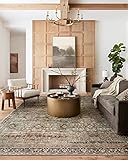
The NF114A is woven from 100% seagrass in a basketweave, and its small-space virtue is thinness with dignity. Where a piled rug in a tiny room becomes a platform that furniture climbs onto, the seagrass lies like a natural extension of the floor itself — doors clear it without thought, chair legs glide across the basketweave, and the rug can run closer to walls and thresholds than any pile could, which in a genuinely small room reclaims real square inches of usable coverage. The natural-and-beige colouring with its tailored border suits the pale, calm palettes small rooms favour, and the fine grid of the weave gives the surface just enough structure to register as a designed layer rather than a mat. It is also the layering base of this guide: put the seagrass down as the room’s full field, then float a smaller textured or vintage rug over the seating zone, and a small room gains the depth that larger rooms get from architecture. Seagrass releases dry dirt easily and resists staining well for a plant fibre, asking only to be kept dry.
Pros: Near-zero height suits the tightest footprints and every door; natural basketweave texture with tailored edges; excellent layering base; easy dry care. Honest limitation: It feels like a woven mat, not a carpet — firm underfoot, with cushion only from a pad — and it dislikes standing water and damp rooms. In a small room used barefoot all winter, that firmness is a real trade, not a footnote. Choose it if your footprint is tight, your doors are many or you plan to layer. Skip it if underfoot softness is the point of the purchase.
Ruggable Kamran Ivory Opal Washable Rug — 8′ x 10′, with Standard Pad
Who it suits: Small spaces with concentrated lives — the compact room that hosts meals, work, children and pets within the same few square metres, where the rug cannot be babied because there is nowhere else for life to go.
In a large house, a spill happens somewhere; in a small space, every spill happens on the rug. That concentration is the Kamran’s case. Its two-piece system — a non-slip pad fitted to the floor, and a stain-resistant vintage-patterned top that peels off for the washing machine — means the one surface your whole life crosses can be fully laundered back to clean, an ability no spot-cleaning regime in a small room can match over years. The Ivory Opal palette does small-space work too: warm, light and patterned enough to hide the interval between washes, brightening the interior rooms and low-light corners that compact homes specialise in. The fitted pad keeps the assembly dead flat — in a small room a creeping rug or a curled corner is not a detail, it is a daily obstacle in the only walkway — and the low profile respects the door swings that crowd small plans. Order the largest size your seating geometry allows that your laundry can also handle; in small spaces the right answer is often a mid size washed easily over a large size washed never.
Pros: Fully machine-washable surface for concentrated small-room life; fitted pad keeps edges flat in tight walkways; light vintage palette brightens low-light rooms; low profile for crowded door swings. Honest limitation: The biggest tops need a large-capacity machine, and refitting the top is a careful job in a room with little floor to spread it on — doable, but plan it. The feel is tailored, not plush. Choose it if your small room does everything and needs a reset button. Skip it if your laundry access is minimal and your life is dry-mess only — the Layla will serve you with less machinery.
Nourison Aloha Indoor/Outdoor Rug — Navy Multicolor, 7’10” x 10’6″
Who it suits: Multipurpose small rooms — the living room that is also the dining room, the home office and the guest overflow — where one rug must zone a plan and survive being crossed by every activity in the house.
The Aloha is a flatwoven indoor/outdoor rug whose high-low textured surface gives it more presence than most flat rugs, and in a multipurpose small room presence is zoning power. Lay it under the seating group and its navy botanical field declares the living zone inside an undifferentiated rectangle; the dining chairs at the room’s other end stay on bare floor, and the room suddenly has geography. The flat weave is the right tool for crossover traffic: desk-chair castors, dining chairs and daily crossings all pass without catching a pile, spills from the dining end wipe up instead of soaking in, and the whole rug can be taken out and washed down when a season of multipurpose life accumulates — then it dries fast enough to be back at work the same day. The navy ground is the boldest choice in this guide, and in a small white or pale room it is a deliberate one: a single strong floor field anchors a compact space the way a single strong wall colour does, and it hides the grey-brown evidence of a room that does everything.
Pros: Flatweave zoning strength for multipurpose plans; tolerates castors, dining chairs and crossings; wash-down-able and fast-drying; bold navy field anchors pale small rooms. Honest limitation: The flat outdoor weave feels functional, not luxurious, and the strong pattern will govern the room’s scheme — in a small space there is nowhere for a bold rug to be quiet. It also needs a pad indoors for grip. Choose it if your small room has three jobs and needs one tough, defining field. Skip it if your room is single-purpose and calm — subtler picks will flatter it more.
SAFAVIEH Trace Collection Rug — Ivory, 8′ x 10′
Who it suits: Small but calm rooms — the compact sitting room of a cottage, a small condo’s considered living space — where the floor area is limited and the owner would rather have a few square feet of the genuine article than a larger area of something lesser.
The Trace is handmade wool with a raised high-low pile, its contemporary design carved into the surface so that light draws the pattern anew across the day. In a small room that sculptural quality is magnified: you are always close to this rug, always seeing it at the intimate distance where carved texture and matte natural fibre separate themselves from every imitation. This is the quality-per-square-foot argument made physical. A small room needs perhaps half the rug area of a large one, so the same ceiling that buys a good synthetic at 9′ x 12′ buys handmade wool at a compact size — and the room feels correspondingly jewel-like, the rug reading as the one considered, permanent object in a space where everything must earn its place. Wool’s resilience suits small rooms too: in a compact plan the same few lanes carry all the traffic, and a fibre that recovers from compression and hides dry soil within its structure wears those lanes more gracefully than most synthetics. The medium pile stays within door clearances and keeps low furniture level.
Pros: Handmade wool with carved high-low texture, experienced up close in small rooms; resilient in concentrated traffic lanes; matte ivory warms compact spaces; maximum quality per square foot in this guide. Honest limitation: Wool care is real care — suction-only vacuuming, prompt blotting, light early shedding — and an ivory ground in a small, busy room will ask for it often. This pick assumes a calm household in a small footprint, not a busy one. Choose it if your small space is a sanctuary and you want its floor to feel like it. Skip it if the room is a thoroughfare with pets and projects — the Kamran or the Layla are the honest tools there.
Comparison Table
In small spaces, read “space effect” first — it is the column the room will actually feel — then check care against your household’s traffic.
| Pick | Construction | Size shown | Space effect | Care style | Link |
|---|---|---|---|---|---|
| SAFAVIEH Adirondack ADR112W | Power-loomed polypropylene, abstract | 8′ x 10′ | Expands — pale, borderless field | Vacuum & spot-clean | Check on Amazon |
| Loloi II Layla | Printed synthetic, flat woven | 7’6″ x 9’6″ | Composes — tonal texture, hides life | Vacuum & spot-clean | Check on Amazon |
| SAFAVIEH NF114A Seagrass | Seagrass basketweave flatweave | 8′ x 10′ | Recedes — becomes part of the floor | Sweep & vacuum, keep dry | Check on Amazon |
| Ruggable Kamran Ivory Opal | Washable top + fitted pad | 8′ x 10′ | Brightens — light vintage pattern | Machine wash the top | Check on Amazon |
| Nourison Aloha | Indoor/outdoor flatweave | 7’10” x 10’6″ | Defines — bold zoning field | Wipe, vacuum, wash down | Check on Amazon |
| SAFAVIEH Trace | Handmade wool, high-low | 8′ x 10′ | Enriches — sculptural texture up close | Gentle vacuum, blot spills | Check on Amazon |
How to Choose the Best Living Room Rug for Small Spaces Under $1000
Size up until the seating complains, then stop. The small-space sizing rule is the opposite of the timid one: choose the largest rug that keeps a visible floor border — even a few inches — and lets every door swing free. Front legs of the sofa and chairs on the rug is the minimum composition; a rug that ends before the chairs turns the group into a raft. Tape the outline, sit in the arrangement, and walk the room’s routes before ordering. If two sizes both pass, the larger one is almost always the right call in a small room, because coverage is what converts “rug in a room” into “room with a floor plan.”
Spend the budget on quality per square foot. Small rooms need less rug, so this ceiling stretches further here than anywhere else in our guides: handmade wool, engineered washable systems and natural flatweaves are all realistic at compact sizes. Decide which quality your room will actually feel daily — texture up close, washability under concentrated life, flatness under many doors — and concentrate the spend there rather than on extra area you cannot use.
Keep the profile honest. Measure door clearances with the pad included, check that low furniture sits level, and remember that in a small room a thick rug is also a trip edge in the main walkway. Flat and low picks are the default; a medium pile is a deliberate luxury for calm rooms, not a default. Design-led small spaces should also compare the modern edit at Best Living Room Rug For Modern Homes Under $1000, where texture is scored as a style feature in its own right.
Let one rug do one job. In a small plan, resist splitting the difference with a mid-sized rug that half-defines two zones. Either zone the room boldly with one field, as the Aloha does, or cover the seating completely and leave the rest as honest floor. Half-measures are what make small rooms look unresolved.
The Geometry of Bigger-Looking Small Rooms
Four visual mechanics do the expanding, and every pick in this guide uses at least two. Borderless fields deny the eye a frame to measure against; the ADR112W’s drifting abstract is the purest example, and it is why bordered traditional rugs — however lovely — shrink small rooms. Tonal continuity works in the opposite direction from contrast: a rug within a few tones of the floor makes the floor plane read as one continuous surface that happens to change texture, and the room’s footprint feels like the whole plane rather than the rug’s rectangle. The seagrass on pale boards and the Trace on light floors both exploit this. Pattern scale discipline matters because small rooms are viewed from inside the pattern: motifs should be either large and cropped boldly by the furniture, or small and dense enough to resolve into texture — the Layla’s distressed density — while the awkward middle, a medium motif repeated visibly, is what reads as “wallpaper on the floor” and closes a room in. Direction is the free one: run a rectangular rug’s long axis with the room’s long axis and the eye travels further; run it across and the room segments. None of these tricks requires a pale rug, a plain rug or a new room — they require choosing the rug’s geometry as deliberately as its colour, which is the entire discipline this guide exists to teach.
Where the Money Goes in a Small Room
A compact room rearranges rug economics, and it is worth seeing the rearrangement plainly before you spend. In a large room, most of a rug budget is consumed by area — the metres themselves — and construction quality is what remains after size is paid for. In a small room the order reverses: the area is modest, so the majority of this ceiling can go to what the rug is rather than how much of it there is. That is the arithmetic behind this guide’s shape — a handmade wool pick, an engineered washable system and a natural flatweave all sitting comfortably in one list. It also changes the pad decision: in a small room the pad is a larger share of the total spend and a larger share of the result, because at close quarters the difference between a rug that floats on felt and one that skitters on a thin grip sheet is felt at every step. Budget the pad as a first-class line, not a remainder. And it changes the replacement logic: a small, excellent rug that serves a decade costs less per year than a large, adequate one replaced twice — in small spaces, durability is not a luxury preference, it is the whole financial argument.
Small Rooms, Real Lives: Traffic Lanes and Furniture That Moves
Compact rooms concentrate wear in ways their owners underestimate. A large room spreads its crossings across several informal lanes; a small room has one lane — door to sofa, sofa to kitchen — and every crossing uses it, which is why small rugs develop a visible track while their edges stay new. Three defences work. Rotation, a half-turn twice a year, moves the lane to fresh pile; it costs ten minutes and matters more in small rooms than anywhere else in the house. Fibre choice is the second defence: wool’s structure hides dry soil and recovers from compression, dense synthetics tolerate the lane’s extra vacuuming, and flatweaves simply have less surface to crush. The third defence is furniture discipline: in small rooms furniture gets moved constantly — chairs pulled up, tables shifted for guests, the sofa dragged for cleaning — and every drag crosses the rug. Felt glides under every leg, and lifting rather than sliding, turn a rug’s worst enemy into a non-event. Small rooms also redecorate more often, because one changed object changes the whole picture; the neutral, structural picks in this guide — seagrass, ivory wool, tonal print — are chosen partly for their ability to survive those redecorations without becoming the one thing that no longer matches.
Three Small Rooms, Worked Through
The cottage sitting room. Low ceiling, one window, a wood stove, furniture inherited and mismatched, traffic moderate and mostly adult. The room’s problem is not space illusion — it is coherence. The Trace is the answer here: its carved ivory wool pulls the mismatched seating into one calm field, its texture suits the cottage’s material honesty, and its quality suits a room that will not be redecorated for a decade. Size it to the seating with a narrow border; in a cottage, a rug that nearly reaches the walls reads as warmth, not crowding, provided the doors clear it.
The compact family front room. A terraced house’s front room, sofa and two chairs, a toy box that lives permanently, the route to the kitchen crossing one corner. The room’s problem is concentration: everything happens here, on one surface, daily. The Kamran earns its place — washable against the concentrated life, flat against the crossing lane, pale against the north-facing light — with the Layla as the lower-maintenance alternative for a family that would rather vacuum daily than launder monthly. Size to the seating, keep the kitchen lane crossing the rug fully rather than clipping its corner, and let the pattern do the hiding between cleans.
The small condo living area. Open to the kitchen, pale floors, modern furniture, one resident and a cat, entertaining monthly. The room’s problem is definition: the living area must exist inside a larger open rectangle. The ADR112W draws it — a pale abstract field under the seating, borderless so the zone feels generous — with the seagrass as the layering upgrade when the room wants more texture: seagrass across the whole living zone, the abstract or a smaller vintage piece floated inside it. The cat rules out loops, the entertaining argues for easy cleaning, and the pale floors argue for a rug a few tones deeper than itself, which is exactly the register both picks occupy.
Common Buying Mistakes
The timid rug.
The number one small-space error, already named but worth repeating as a mistake in its own right: a rug bought small “so the room can breathe” achieves the opposite. Breathing room comes from border discipline and pale, flat fields at proper size — not from less rug.
Dark and bordered in a small, dim room. A dark, framed design in a compact low-light space pulls the walls inward visually. If you love a traditional pattern, take it faded and tonal — the Layla’s register — and keep the ground mid-tone or lighter.
Pile that fights the doors. Small plans have many doors per square metre, and a rug that one door scrapes will be cursed daily and lifted within a year. Measure once, with the pad, before the rug arrives.
Two competing rugs. In open small plans, a living rug and a dining rug in similar tones and different patterns create static. Either match the zoning boldly — clearly different fields — or use one rug and honest floor.
Judging from the doorway. Small rooms are experienced seated, at rug distance. A design that looks quiet from the door may be busy at the sofa, and a texture invisible from the door — the Trace’s carving — may be the room’s best feature at sitting height. Judge samples and listing photos at the distance you will actually live at.
Measuring a Small Room Properly: A Ten-Minute Method
Small rooms punish estimation, so measure like a surveyor for ten minutes and save yourself a return. Start with the room’s true rectangle, wall to wall, then subtract the intrusions: hearth, radiator pipes, the arc of every door swing drawn on the floor in tape. What remains is your working field. Inside it, tape the seating group first — the sofa and chairs where they actually live, not where the catalogue would put them — then tape the rug outline a hand’s width beyond the group’s front legs on the open sides. Now live with the tape for an evening: sit in every seat, walk every route, open every door. The tape will tell you things no measurement can — that the rug’s corner sits exactly where feet pivot toward the kitchen, that one chair leg straddles the outline, that the border vanishes entirely on the window side. Adjust once, photograph the final outline with the measurements written on the tape itself, and order against that photograph. In a large room a size error is a shrug; in a small room the same error is the difference between a floor plan and a compromise, and ten minutes of tape is the cheapest design consultation in this entire guide.
Final Recommendation
For most small spaces, buy the ADR112W and size it bravely
: its pale, borderless abstract field is the single most reliable way to make a compact living room feel larger, calmer and more finished — Check on Amazon. If your small room works as hard as it sits, take the Kamran’s washable reset or the Layla’s camouflage instead, and if your small room is a calm retreat, concentrate the budget in the Trace’s handmade wool — Check on Amazon. The small-space rules travel well beyond this guide: bigger than instinct, flatter than fashion, paler than fear, and always — always — measured against the doors. A small room with the right rug is not a compromise anyone has to apologise for. It is the most considered room in the house.
Frequently Asked Questions
What size rug makes a small living room look bigger?
The largest size that preserves a visible floor border and free door swings — commonly 6′ x 9′ or 8′ x 10′ even in compact rooms — with the seating’s front legs on it. Pale, borderless designs at that full size expand a room; a small rug at any colour contracts it. Tape the outline and judge from the sofa, not the doorway.
Should a small room’s rug be light or dark?
Light to mid-tone, as a rule: pale grounds return light and merge with the floor plane, while dark grounds absorb light and advance toward the viewer, shrinking the field. The exception is a deliberate anchor — one bold field like the Aloha’s navy in an otherwise pale room — used as a design decision rather than a default.
Are patterned rugs a mistake in small spaces?
No — the right patterns are tools. Dense, distressed patterns resolve into texture and hide life; large borderless abstracts deny the eye measuring points. The patterns to avoid are medium-scale, high-contrast and bordered, which read as busy at close range and frame the room smaller. Scale and contrast, not pattern itself, are the variables.
Can I layer rugs in a small room?
Yes, and it is one of the best small-space techniques: a flat natural base like the seagrass covering the full seating field, with a smaller textured or vintage rug floated over the inner zone. Keep the top rug clearly different in texture or tone, fully inside the base with an even margin, and never so small that chair legs straddle its edge.
What pile height suits a small living room?
Low, by default — flat to about a quarter inch — because it preserves door clearance, keeps light furniture level and avoids a platform edge in the walkway. A medium pile is a fine luxury in a calm, single-purpose small room, as the Trace shows; deep piles belong to larger lounge spaces where their bulk has room to read as comfort rather than obstruction.
How do I handle an L-shaped or awkward small room?
Rug the leg of the L that holds the seating, aligned with that leg’s axis, and let the other leg be honest floor or a clearly separate zone. One confident field in the main area composes an awkward plan far better than a rug bent, angled or split to follow the whole shape. Keep walkways between the zones bare so the plan reads as rooms, not as one difficult shape.
Should I choose a rug with or without a border for a small room?
Without, in most cases. A border draws a frame inside the room’s frame and gives the eye a second, smaller rectangle to judge the space by. Borderless fields and patterns that run off the rug’s edges let the floor feel continuous. The exception is a deliberate layering scheme, where a bordered base rug’s edge is part of the design — there, the border is architecture, not accident.
My small living room has a fireplace. How should the rug sit?
Centre the rug on the seating group, not on the fireplace, unless the two axes coincide. Keep the rug’s edge a safe, clear distance from the hearth — flat, natural-fibre and synthetic rugs alike should never sit where embers or intense radiant heat reach — and let the hearth end of the room be floor. A rug that respects the fireplace as a boundary reads as composed; one that crowds it reads as a hazard and a mistake.