Where to buy
Check the latest price, availability and delivery on Amazon. Orders are placed on Amazon. We may earn a commission from qualifying purchases.
- Best overall for modern homes: SAFAVIEH Adirondack Collection Rug, Ivory & Sage Modern Abstract, 8′ x 10′ — Check on Amazon
- Best sculptural wool texture: SAFAVIEH Trace Collection Rug, Ivory, 8′ x 10′ — Check on Amazon
- Best organic-modern texture: SAFAVIEH Natura Collection Rug, Ivory, 8′ x 10′ — Check on Amazon
- Best Scandi flatweave: SAFAVIEH Natural Fiber Collection Seagrass Rug, Natural & Beige, 8′ x 10′ — Check on Amazon
See 2 more Amazon options
- Best modern-vintage bridge: Loloi II Layla Collection Rug, Olive/Charcoal, 7’6″ x 9’6″ — Check on Amazon
- Best washable for modern-classic rooms: Ruggable Maral Heriz Creme Washable Rug, 8′ x 10′, with Standard Pad — Check on Amazon
Read the full guide ↓
Disclosure: As an Amazon Associate, dailyhomedecorating.com earns from qualifying purchases. Links to Amazon on this page are affiliate links; they cost you nothing extra. Listing details such as price and availability change often, so check the current Amazon listing before you buy.
The best living room rug for modern homes under $1000 has a harder job than a rug in a traditional room. A traditional rug can lean on pattern — medallions, borders, centuries of convention — to hold a seating arrangement together. A modern room strips most of that away. The sofa is plain, the coffee table is a slab or a sculptural object, the palette is restrained, and the rug is expected to supply the room’s texture, its softness and often its only real pattern, all without breaking the calm. Get it wrong and the room reads as either stark — a beautiful rug-less gallery nobody wants to sit in — or busy, where a loud rug fights the clean lines it was meant to ground. Get it right and the rug becomes the quiet architecture of the room: the thing that defines where living happens inside an open, minimal space.
Modern is also not one style, and this guide treats it as the family of styles it actually is. There is the soft minimalism of pale woods and ivory textiles, the organic modern of chunky weaves and natural fibre, the Scandi-Japandi axis of flatweaves and negative space, the mid-century-leaning room that wants a vintage note without a traditional rug’s formality, and the contemporary room built on abstract art and sculptural furniture. Each of those rooms needs a different rug, and the six picks below map to them deliberately: an abstract woven design, two kinds of sculptural wool texture, a seagrass flatweave, a printed vintage bridge piece, and a washable traditional-pattern rug for the large and growing group of modern rooms that mix eras on purpose. If your room is modern but your budget is smaller, the same mapping is applied at Best Living Room Rug For Modern Homes Under $700 and Best Living Room Rug For Modern Homes Under $400.
One principle runs through every review that follows: in a modern room, texture is pattern. A flat, single-tone rug under flat, single-tone furniture produces a room with no visual information at floor level, and the eye reads it as unfinished. The picks here all create interest through structure — high-low carving, chunky loops, basketweave, distressed printing, abstract tonal movement — rather than through loud colour, because structure survives trend cycles and colour statements often do not. The exception proves the rule: the one strongly patterned pick, the Layla, earns its place because its pattern is faded and tonal, behaving like texture at room distance. Our general roundup at Best Living Room Rug Under $1000 covers the wider field; this guide is the modern edit, scored on line, texture and restraint as much as on the usual questions of size and care.
In this guide
Quick Picks
Match your version of modern to its pick. Every rug here sits within the under-$1000 frame in the size shown — check price on Amazon for your size and colourway.
| Buyer type | Pick | Why it stands out | Link |
|---|---|---|---|
| Best overall for modern homes | SAFAVIEH Adirondack ADR112W, Ivory & Sage | Modern abstract design in soft neutrals — pattern as gentle movement, not noise | Check on Amazon |
| Best sculptural texture | SAFAVIEH Trace, Ivory | Handmade wool with a carved high-low pile that changes with the light | Check on Amazon |
| Best organic-modern texture | SAFAVIEH Natura, Ivory | Chunky hand-knotted wool-cotton loops; artisan surface, zero pattern risk | Check on Amazon |
| Best Scandi flatweave | SAFAVIEH Natural Fiber NF114A Seagrass | Basketweave seagrass: flat, natural, architectural under low furniture | Check on Amazon |
| Best modern-vintage bridge | Loloi II Layla, Olive/Charcoal | Faded printed vintage motif that reads as tonal texture in modern rooms | Check on Amazon |
| Best washable, modern-classic | Ruggable Maral Heriz Creme, 8′ x 10′ | Classic Heriz pattern in a creme palette, on a machine-washable system | Check on Amazon |
How These Picks Were Chosen
We filtered the modern field on design discipline first and housekeeping second — the reverse of our family guide, deliberately. The design tests were: does the rug create interest through structure or tonal movement rather than saturated colour? Does its pattern scale suit a room where most of the rug is visible, as it is under low modern furniture? And does it sit comfortably beside the materials modern rooms are built from — pale oak, walnut, boucle, linen, blackened steel, glass, concrete? Rugs that failed those tests, however excellent as rugs, were left to our other guides. The housekeeping tests then applied as usual: stated fibre and construction, a real living-room size, care instructions that match the claims, and a pad or profile story that works with low-slung modern furniture, whose legs and clearances punish thick, creeping rugs.
Two notes on what is not here. There is no flat single-colour rug, although they dominate modern mood boards, because in real rooms they show every crumb and footprint shadow and read as unfinished at floor level; texture is doing that job instead in every pick. And there is no high-gloss or visibly shiny synthetic: modern rooms are lit to show materials honestly, and a sheen that reads as plastic under daylight undermines the whole scheme. Prices are not printed in this guide — they move by size and colourway — but every pick was selected inside the under-$1000 modern frame at research time; use the links to check price on Amazon before ordering.
The Best Living Room Rug for Modern Homes Under $1000: 6 Picks in Detail
SAFAVIEH Adirondack Collection Rug, ADR112W — Ivory & Sage, 8′ x 10′
Who it suits: The contemporary modern room — abstract art on the walls, a sculptural coffee table, a sofa in a solid neutral — that needs the rug to contribute movement and softness without introducing a traditional motif or a competing colour.
Within SAFAVIEH’s long-running Adirondack line, the ADR112W is the modern entry: where its siblings do distressed florals, this one does a modern abstract design, soft tonal shapes drifting across an ivory and sage ground. The effect at room distance is closer to a large, quiet piece of abstract art lying flat than to a patterned rug — there is no border, no medallion, no repeat your eye can lock onto, which is exactly why it works under contemporary furniture. The sage is muted and greyed, a colour that cooperates with the pale woods, warm greys and off-whites of current modern interiors instead of shouting over them. Construction is the line’s proven formula: power-loomed polypropylene, non-shedding and easy to clean, with a low-to-medium pile that sits neatly under low modern sofa legs and lets a robot vacuum do its rounds. It is the pick that makes a modern room feel finished while asking the least visual negotiation from everything else in it.
Pros: Genuinely modern abstract design; soft ivory-sage palette built for current interiors; non-shedding, easy-care synthetic pile; low profile suits low-slung furniture and robot vacuums. Honest limitation: Abstract tonal designs are unforgiving of one thing — a single dark spill in the pale field will show until it is cleaned, because there is no busy pattern to absorb it visually. And buyers wanting the depth of a natural fibre will find a synthetic hand here, however good the design. Choose it if your modern room is contemporary in direction and needs calm movement at floor level. Skip it if your household’s spill rate is high and your palette is pale — the Layla’s busier camouflage or a washable pick will forgive more.
SAFAVIEH Trace Collection Rug — Ivory, 8′ x 10′
Who it suits: Soft-minimal and gallery-calm modern rooms, and buyers who want the rug to be a material experience — real wool, carved texture, changing light — rather than a picture on the floor.
The Trace is handmade from wool with a raised high-low pile, so its subtle contemporary design is sculpted into the surface rather than applied to it. Across a day, the room’s light rakes over the higher and lower areas and the pattern appears, softens and reappears; the rug is quietly different at breakfast and by lamplight, which is a quality no printed design can imitate. In an ivory palette it becomes the warm layer in rooms that risk sterility — the thing that makes a minimal scheme feel inhabited. Wool’s matte surface is part of the effect: it absorbs light instead of reflecting it, sitting calmly beside boucle, linen and pale timber, and its natural resilience means the pile recovers from the dents of low modern furniture better than synthetic equivalents. The medium pile gives barefoot comfort without disturbing the clean horizontal lines modern furniture depends on, and doors and robot vacuums cope with it in most homes.
Pros: Real handmade wool; carved high-low texture that shifts with light; matte, premium surface for minimal rooms; resilient pile that ages gracefully. Honest limitation: Wool care rules apply — light early shedding, suction-only vacuuming, prompt blotting, no soaking — and the ivory ground is a commitment in any household with mud or small children. This is a rug for rooms that are lived in gently. Choose it if your modern room is calm, your traffic is moderate and texture is the luxury you are buying. Skip it if the room doubles as a family free-for-all — our family guide’s washable picks exist for that house.
SAFAVIEH Natura Collection Rug — Ivory, 8′ x 10′
Who it suits: Organic-modern, warm-minimal and coastal-modern rooms — spaces built from natural materials, handmade-feeling objects and neutral layers — where the rug should feel crafted rather than manufactured.
The Natura is handcrafted from an 80% wool and 20% cotton blend, built with chunky knotted yarns, oversized loops and flat sections that form a mosaic of textures across an ivory ground. Where the Trace’s texture is carved and regular, the Natura’s is rustic and irregular, and that hand-made variation is the entire aesthetic proposition: in a room of smooth, precise modern surfaces — lacquer, glass, polished concrete, flat-front cabinetry — this rug is the counterweight, the evidence of the hand. It also performs. Loop construction resists the crushing that flattens cut piles in traffic lanes, the wool blend brings natural resilience and soil-hiding character, and the sheer textural busyness of the surface disguises the small debris of daily life surprisingly well for an ivory rug. Under a low platform sofa or a sculptural lounge chair it reads as a piece of woven architecture.
Pros: Distinctive chunky hand-knotted texture; natural wool-cotton blend; loops resist crushing; neutral ivory layers with any modern palette. Honest limitation: Loops and pet claws are enemies — a digging or scratching pet can pull one — and the textured surface wants gentle, suction-only vacuuming and prompt spill care like all wool. The rustic hand also has a direction: in a slick, high-gloss modern interior it can read as farmhouse rather than organic-modern. Choose it if your modern is warm, natural and texture-led. Skip it if your modern is glossy and precise — take the Trace or the abstract Adirondack instead.
SAFAVIEH Natural Fiber Collection Rug, NF114A — Natural & Beige Seagrass, 8′ x 10′
Who it suits: Scandi and Japandi rooms, and any modern interior built on the discipline of flat planes and natural materials — low platform furniture, paper-light colours, space left deliberately empty.
The NF114A is woven from 100% seagrass pile in a basketweave pattern, finished with a beige border that gives the field a tailored edge. Seagrass is the flatweave material modern purists reach for because it behaves like a natural floor finish rather than a textile: the surface is smooth, firm and slightly lustrous, the basketweave gives it a fine architectural grid, and the natural-and-beige colouring is the exact tone of the pale timber it usually sits beside. Under low furniture it is close to perfect — chair legs glide, the rug never bunches, doors clear it trivially, and its flatness keeps the horizontal calm that this style depends on. It is also quietly practical: seagrass releases dry dirt readily, resists staining better than most natural fibres, and does not shed fibres into the room. In a Japandi scheme, where every object must earn its place, a rug that is almost a material sample of the floor’s own palette earns it easily.
Pros: Authentic natural flatweave with a fine basketweave grid; firm, flat surface ideal under low modern furniture; natural stain resistance for a plant fibre; tailored bordered finish. Honest limitation: Seagrass is not soft — it feels like a woven mat underfoot, closer to flooring than to carpet, and it dislikes standing water and very high humidity, which rules it out for damp rooms. Cushion comes only from a pad, and even then the character stays firm. Choose it if your modern room prizes flatness, natural material honesty and visual quiet above barefoot plushness. Skip it if you want the rug to be the room’s comfort layer — that is the wool picks’ job.
Loloi II Layla Collection Rug — Olive/Charcoal, 7’6″ x 9’6″
Who it suits: Mid-century-leaning and eclectic-modern rooms — the ones mixing a modern sofa with vintage finds, warm woods and collected objects — plus modern households that need family-grade practicality without giving the room a “family rug.”
The Layla’s printed vintage design is heavily distressed and rendered in olive, charcoal and warm neutrals, and in a modern room that combination does something specific: it supplies the one aged, storied layer that stops a modern scheme feeling showroom-new, while its flatness keeps it compatible with modern furniture’s low lines. At standing distance the busy motif resolves into tonal texture — the modern eye reads it as depth, not as a traditional pattern — and up close it delivers the camouflage that makes it the easiest rug in this guide to live with: crumbs, pet hair and daily dust disappear into the design. The 0.13-inch pile is the thinnest here, so doors, dining chairs and robot vacuums are all unbothered, and it does not shed. For modern homes that are also busy homes — kids, dogs, entertaining — it is the pragmatic design choice, the rug that lets the room look composed on an ordinary Wednesday.
Pros: Vintage warmth that modern rooms often lack; elite camouflage for real life; thinnest profile here for doors and robots; non-shedding and easy to spot-clean. Honest limitation: There is no pile comfort — a pad is essential and even then the feel is tailored, not plush — and purist minimalists may find any motif, however faded, more pattern than they want. Choose it if your modern leans warm, collected or mid-century, or if practicality must wear a design disguise. Skip it if your scheme is strictly pattern-free — the Trace gives you interest with no motif at all.
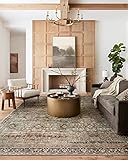
Ruggable Maral Heriz Creme Washable Rug — 8′ x 10′, with Standard Pad
Who it suits: Modern-classic and transitional-modern rooms — modern architecture softened with classic pieces, or a classic house being modernised — and anyone who wants a traditional pattern’s room-organising power with a thoroughly modern maintenance system underneath it.
The Maral Heriz takes one of the oldest rug patterns in the world — the Heriz medallion design — and renders it in a soft creme palette that behaves in a modern room the way a good vintage piece does: as history, toned down to a whisper. Then it does something no antique can: the rug top peels off its non-slip pad and goes in the washing machine. That pairing is why it closes this list. Plenty of modern homes are not minimalist at all in their living patterns — they host, they have dogs, they eat in front of films — and their owners choose classic patterns precisely because busy traditional motifs organise a room and hide life. The Ruggable system removes the traditional objection to a pale classic rug, which is that one bad spill owns it forever. The low profile keeps modern furniture lines clean, the pad keeps the whole assembly disciplined and flat, and the creme ground lifts darker modern schemes — charcoal sofas, black steel, walnut — without the starkness of white.
Pros: Classic pattern, modernised palette; fully machine-washable top on an integrated non-slip pad; pale ground brightens darker modern rooms; low profile under low furniture. Honest limitation: An 8′ x 10′ top needs a large-capacity machine, relaying it is a two-person alignment job, and committed minimalists will still find a medallion pattern a statement too far. The feel is tailored rather than cushioned. Choose it if your modern mixes eras and your household needs washability. Skip it if your room is pattern-free by principle — or your laundry cannot take the size.
Comparison Table
For modern rooms the “visual role” column matters as much as construction — decide what job the rug is doing in the scheme, then check the care column against your household.
| Pick | Construction | Size shown | Visual role | Care style | Link |
|---|---|---|---|---|---|
| SAFAVIEH Adirondack ADR112W | Power-loomed polypropylene, abstract | 8′ x 10′ | Gentle tonal movement | Vacuum & spot-clean | Check on Amazon |
| SAFAVIEH Trace | Handmade wool, high-low | 8′ x 10′ | Sculptural light-play | Gentle vacuum, blot spills | Check on Amazon |
| SAFAVIEH Natura | Hand-knotted wool/cotton loops | 8′ x 10′ | Chunky organic texture | Gentle vacuum, blot spills | Check on Amazon |
| SAFAVIEH NF114A Seagrass | Seagrass basketweave flatweave | 8′ x 10′ | Architectural natural plane | Sweep & vacuum, keep dry | Check on Amazon |
| Loloi II Layla | Printed synthetic, flat | 7’6″ x 9’6″ | Tonal vintage texture | Vacuum & spot-clean | Check on Amazon |
| Ruggable Maral Heriz Creme | Washable top + non-slip pad | 8′ x 10′ | Softened classic anchor | Machine wash the top | Check on Amazon |
How to Choose the Best Living Room Rug for Modern Homes Under $1000
Name your modern first. “Modern” covers at least five distinct rooms, and the rug that perfects one can genuinely damage another. Contemporary-abstract rooms want the ADR112W’s tonal drift. Soft minimalism wants the Trace’s carved calm. Organic modern wants the Natura’s hand-made loops. Scandi-Japandi discipline wants the seagrass flatweave. Eclectic and mid-century rooms want the Layla’s faded history, and modern-classic rooms want the Maral Heriz. Write your version down in three words before you shop; every later decision gets easier.
Let texture do pattern’s job. The most common modern-rug failure is the flat, single-tone rug that looked serene in a photograph and reads as a grey rectangle in a real room — showing every footprint, crumb and vacuum line. Structure is the fix: high-low carving, loops, basketweave, distressed printing. All six picks generate their interest structurally, which is also why they will outlast trend cycles that date bold colour statements within a few seasons.
Respect the low lines. Modern furniture sits low and light, and it exposes more of the rug than traditional furniture does — pattern scale and edge finish are on full display. It also means legs are often slim and hard: choose piles that will not be crushed into permanent dents by narrow feet (loops and wool recover best), keep total rug-plus-pad height within the room’s door clearances, and remember that a rug pad with real grip matters more, not less, when furniture is light enough to skate.
Size it like architecture. In open modern plans the rug is frequently the only definition of the living zone, so undersizing is doubly visible. Front legs of all seating on the rug is the minimum; in a true open plan, all-legs-on at 9′ x 12′ often looks more intentional. Compact modern rooms have their own geometry — see Best Living Room Rug For Small Apartments Under $1000 — and the wider budget context is in Best Living Room Rug Under $700.
How Modern Rooms Use Rugs: Colour, Line and Negative Space
Three design mechanics decide whether a rug completes a modern room. The first is tonal distance from the floor. A rug within one tone of the floorboards disappears, and the seating group appears to float on nothing; a rug several tones apart — in either direction — creates the platform effect modern rooms rely on. The ivory picks here are designed for mid and dark floors; on very pale floors, the Layla’s olive-charcoal or the seagrass’s natural warmth supplies the needed separation. The second mechanic is line. Bordered rugs (the seagrass, the Maral Heriz) draw a deliberate rectangle that suits symmetrical, architectural layouts. Borderless rugs (the abstract Adirondack, the Trace, the Natura, the Layla) let the seating zone bleed softly into the room, suiting asymmetrical and open layouts. Neither is more modern; matching the rug’s line logic to the room’s layout logic is what looks designed. The third is negative space: modern rooms need some emptiness at floor level to breathe, which is a sizing argument in disguise — a rug that covers wall to wall is carpet, and carpet is the one thing a modern rug must not imitate. Keep a visible floor border, keep it as even as the room allows, and the rug reads as a placed object in a composed space.
Modern Rug Materials, Decoded
Modern rooms expose materials honestly, so it pays to know what each construction on this list is really doing. Carved wool (the Trace) gets its pattern from pile height differences cut into a single colour — the most architectural technique here, and the one that ages best, because there is no surface print to wear away. Looped wool blends (the Natura) build pattern from yarn structure itself; the surface is essentially a textile sculpture, durable in traffic lanes and unforgiving only of claws and aggressive vacuum beaters. Plant-fibre flatweave (the seagrass NF114A) is not really a pile at all — it is a woven mat with the dimensional stability of flooring, which is why it suits rooms that treat the rug as a natural material plane. Printed synthetics (the Layla) put the design on the surface of a flat base; the trade is depth for precision and camouflage, and modern printing is good enough that at standing distance the eye reads tone and motif, not technique. Power-loomed abstract synthetics (the ADR112W) weave tonal shapes into a real but low pile — the middle path, with more substance than print and less care than wool. Washable systems (the Maral Heriz) separate the decorative surface from the gripping base entirely, an engineering answer rather than a weaving one. None of these is the “premium” choice in the abstract. The premium choice is the one whose technique produces the effect your room needs — light-play, sculpture, flatness, camouflage, movement or washability — because in a modern interior, the technique is visible in the result every single day.
Three Modern Rooms, Styled Rug-First
The pale, calm room. Light oak floor, off-white sofa, boucle chair, one piece of black steel for punctuation. The floor and sofa are close in tone, so the rug must create the platform: the Trace in ivory works when the floor is mid-oak, its carved shadows supplying the separation; on truly pale floors, step to the Layla, whose olive-charcoal depth draws the platform line the room needs. Keep the pad thin and the border wide — this room’s luxury is emptiness, and the rug should frame the furniture, not fill the floor.
The warm organic room. Walnut and rattan, a low linen sofa, handmade ceramics, plants doing real work. Here the Natura is the natural centre: its chunky loops echo the room’s crafted objects, and its ivory warms the walnut without competing. The seagrass is the alternative when the room already has texture everywhere else — then the rug should be the calm plane, and the basketweave’s quiet grid lets the objects speak. Either way, avoid printed vintage here; the room’s story is materials, and a print tells a different one.
The contemporary gallery room. Concrete or dark floors, a sculptural sofa in a solid colour, large abstract art, objects chosen like exhibits. The ADR112W was made for this floor: its own abstract field converses with the art without quoting it, and the sage softens concrete’s coldness. If the art is quiet and the furniture loud, reverse the emphasis — the Maral Heriz’s softened classic pattern becomes the room’s one historical note, a deliberate curatorial contrast. In both cases the rug is functioning as the fifth wall; size it generously, because a gallery room with a timid rug looks like the exhibition ran out of budget at the floor.
Common Buying Mistakes
The flat grey rectangle.
A single-tone, textureless rug bought to “not clash” ends up clashing with the idea of the room itself — it shows everything and contributes nothing. If your palette is monochrome, buy the monochrome texture: the Trace or the Natura in ivory.
Pattern at the wrong scale. A small, busy repeat under a large modern sofa reads as visual static; a huge motif cropped awkwardly by furniture reads as an accident. In modern rooms, err toward large-scale, abstract or textural designs whose cropping by furniture looks intentional from every angle.
Ignoring sheen. Some synthetic rugs carry a surface shine that daylight exposes mercilessly next to matte modern materials. If you choose a synthetic pick, favour the matte, printed or distressed finishes — the Layla and the abstract Adirondack behave well — and check listing photos taken in daylight rooms.
Matching the rug to the artwork. The rug and the art are the two largest visual fields in a modern room; making them compete in colour or pattern exhausts the space. Let one lead. If the art is bold, the rug should be structural and quiet — which describes five of our six picks.
Forgetting the room is also lived in. The purest modern choice that cannot survive your actual household is a slow-motion mistake. If the room hosts dogs and dinners, the washable Maral Heriz or the camouflaging Layla keeps the modern look honest on ordinary days, not just on photographed ones.
Light, Layering and the Modern Rug
Modern rooms are usually the most glazed rooms in the house, and light is a rug material whether you plan for it or not. In a south-facing room with hard sun, carved and looped textures perform a daily light show but also fade unevenly along the sun line; choose the picks whose colour is structural (wool, seagrass) and rotate them, and expect printed surfaces to soften fastest in the brightest band. In a north-facing room the light is cool and flat, textures lose their shadow play, and rugs need to contribute warmth deliberately — this is where the Natura’s chunky ivory and the Layla’s warm olive earn their keep, and where a blue-grey rug can push a cool room over the edge into cold. Under lamplight in the evening, high-low wool comes back to life while flat prints go quiet; rooms used mainly after dark should weight that behaviour.
Layering — a smaller rug over a larger flat one — is a legitimate modern technique when it is done with discipline: a flat, natural base (the seagrass is built for this role) with a smaller textured or vintage piece defining the inner seating zone. It adds the depth minimal rooms crave and lets a household own one washable or high-character piece at a smaller, easier size. The rules are contrast and proportion: the top rug should differ clearly in texture or tone from the base, sit fully within it with an even margin, and never be so small that chair legs straddle its edge. Done lazily it looks like two rugs that met by accident; done by these rules it looks like the most considered floor in the neighbourhood.
Placement Rules for Low, Light Modern Furniture
Modern furniture changes rug placement in ways traditional advice does not anticipate. Platform sofas and low lounge chairs sit close to the floor, which means the rug’s edge disappears under them sooner — push the rug further under the seating than you instinctively would, so the visible field in front of the sofa stays generous and the composition reads as layered rather than perched. Slim-legged pieces — steel, dowel and blade bases — concentrate their weight on tiny contact points; on cut pile they leave dents that wool and loops forgive, and on flatweaves they can catch and drag when furniture is moved, so lift, never slide, a modern chair across a seagrass or printed rug. Glass and open-frame coffee tables show the rug through themselves, which makes the centre of the rug a display surface: abstract and textural designs reward that visibility, while a centred medallion will be bisected by the table and should be placed — as with the Maral Heriz — only where the table is solid or the medallion can sit clear. Finally, modern rooms often run radiators, floor vents and full-height glazing along one wall; keep the rug’s edge clear of vents, and expect the sun line from that glazing to fade any rug unevenly over years — rotation, twice a year, is the modern room’s cheapest insurance, and it matters most for the wool picks whose colours are dyed into natural fibre.
Final Recommendation
For the broadest range of modern rooms, the abstract Adirondack ADR112W is the safest pair of hands
: genuinely modern design, a palette built for current interiors, and easy synthetic care — Check on Amazon. If your modern is soft, calm and material-led, spend the same budget on texture instead — the handmade wool Trace is the pick that makes minimal rooms feel warm rather than empty — Check on Amazon. Whichever direction your modern takes, hold the three rules: texture over flatness, a clear tonal step from the floor, and a floor border left visible. A modern rug is not the room’s decoration; it is the room’s ground plan, drawn in wool, weave or print.
Frequently Asked Questions
What rug style suits a modern living room best?
The style that matches your version of modern: abstract tonal designs for contemporary rooms, carved or looped texture for minimal and organic rooms, flat natural weaves for Scandi-Japandi schemes, and faded vintage or softened classic patterns for eclectic and transitional-modern rooms. The unifying rule is interest through structure rather than loud colour.
Can a patterned rug work in a minimalist room?
Yes, if the pattern behaves like texture — tonal, distressed or large-scale and borderless. The Layla’s faded print is the example in this guide: at room distance it reads as depth in the surface, not as ornament. What minimalism cannot absorb is high-contrast, small-scale, bordered pattern, which pulls the eye down and fragments the calm.
Are wool rugs worth it in a modern home?
When the room is calm enough to let the material show, yes. Wool’s matte surface, resilience and high-low carving give minimal rooms the warmth they otherwise lack, and wool ages gracefully beside quality furniture. In high-traffic or pet-heavy modern homes, a matte synthetic or a washable system usually serves the look better over time.
How big should a rug be in an open-plan modern space?
Big enough to hold the entire seating group with conviction — front legs on as a minimum, all legs on at 9′ x 12′ where the plan allows — with a visible, roughly even border of floor separating the living zone from the kitchen or dining zone. In open plans the rug is a room divider; an undersized one divides nothing.
Do modern rooms need rug pads?
Yes, and arguably more than traditional rooms: modern furniture is lighter, so it skates on an unpadded rug, and slim legs concentrate weight that a pad helps distribute. Choose a low-profile, high-grip pad so the rug’s clean lines and the doors’ clearances survive, and trim it just inside the rug’s edges so it never shows.
What colours are safest for a modern rug?
Ivory, warm grey, sage and other muted naturals — taken several tones away from your floor, and given interest through texture or tonal pattern rather than saturation. These palettes layer with the woods, stones and metals modern rooms are built from, and they outlast the colour trends that date bolder choices.
Should a modern rug have a border?
Only if the room’s layout is itself bordered — symmetrical seating, a defined rectangular zone, architecture with strong geometry. Borderless, field-only designs suit the asymmetrical, open layouts most modern rooms use, because the pattern can be cropped by furniture on any side and still look intentional. When in doubt, borderless is the more forgiving modern default.
How do I keep a modern rug from looking cold?
Warmth in a modern rug comes from material and texture, not from traditional pattern: wool’s matte depth, chunky loops, a warm ivory rather than a blue-white, and a pad that gives the surface some body. If the room still reads cold, the rug is rarely the whole problem — layer warmth at the sofa with textiles and let the rug stay calm.
Is a vintage rug in a modern room a mistake?
No — a faded, tonal vintage-look rug is one of the most reliable modern devices, supplying age and camouflage while its flatness respects modern lines. The Layla in this guide is chosen for exactly that role. The mistake is a crisp, high-contrast traditional rug, whose formality fights the room instead of grounding it.
Can I layer a modern rug over wall-to-wall carpet?
Yes, with a rug-on-carpet pad to stop creep, and with flat or low constructions only — the seagrass and the Layla behave best, because deep piles over carpet ripple and make light modern furniture wobble. In a rental, a well-chosen rug over tired carpet is often the single most effective modern refresh available without touching the lease.
How do I choose between the wool picks and the synthetics?
Decide by room temperature — literal and visual. Wool adds physical and visual warmth and suits calm, adult traffic; it is the connoisseur’s modern choice. Matte synthetics and washable systems suit modern rooms that work hard — pets, kids, entertaining — and keep the scheme intact on ordinary days. Both directions are genuinely modern; the honest variable is how the room lives, not which material is more fashionable this year.
How do I stop a modern rug looking lost under a large sectional?
Scale and anchoring. The rug must extend beyond the sectional’s footprint on the open sides — a visible margin of rug in front of and beside the seating — or it reads as an offcut. Choose a field design without a centred motif, since a sectional will cover any centre you choose, and let texture or tonal movement carry the visible areas. If the sectional is very large, this is the one modern case where the biggest standard size is not optional but structural.