Where to buy
Check the latest price, availability and delivery on Amazon. Orders are placed on Amazon. We may earn a commission from qualifying purchases.
- Best overall for small spaces: SUNMORY 32W/3000LM Torchiere Floor Lamp with Remote — Check on Amazon
- Ambimall 60-Inch Floor Lamp with 9W Bulb — Check on Amazon
- Brightech Sky LED Torchiere Floor Lamp, Black — Check on Amazon
- Simple Designs LF1014-BLK Etagere Shelf Floor Lamp — Check on Amazon
- SUNMORY Arc Floor Lamp with 9W 3 Color Temperature Bulb — Check on Amazon
See 1 more Amazon option
- LEPOWER Wood Tripod Floor Lamp — Check on Amazon
Read the full guide ↓
Disclosure: As an Amazon Associate, dailyhomedecorating.com earns from qualifying purchases. Links to Amazon on this page are affiliate links; they cost you nothing extra. Listing details such as price and availability change often, so check the current Amazon listing before you buy.
The best floor lamp for small spaces under $150 is not simply a smaller version of the best floor lamp — it is a different kind of tool, chosen by different rules. Small spaces are everywhere, not just in small homes: the reading corner carved out of a primary bedroom, the nook under the stairs, the landing that wants to be a library, the home-office corner of a spare room, the dorm room, the narrow gap between a sofa and a wall in an otherwise generous house. What unites them is not square footage on a lease but a local scarcity — a patch of floor perhaps eighteen inches wide, one reachable outlet, a ceiling or a sloped eave that limits height, and a pool of darkness that makes a loved corner unusable after sunset. A lamp for such a place is judged by how much light it delivers per inch of floor it claims, how gracefully it shares its footprint with the furniture it serves, and whether its light lands inside the small space or wastes itself outside it.
This guide applies those rules to six verified under-$150 lamps — the same pool ranked for general use in Best Floor Lamp Under $150, re-judged here entirely on small-space performance. We measured what matters: base diameter and whether the base can slide partly out of the footprint economy altogether (under a sofa, behind a chair), height against low ceilings and low furniture, whether the light aims into a nook or floods past it, and whether the lamp does a second job that a small space desperately needs, like storing the books the nook exists for. Style is not ignored — a lamp in a tiny space is always close to the eye — but it is ranked after fit, because in a small space a beautiful lamp in the wrong footprint is just an obstacle with good taste, while a plain lamp in the right footprint disappears into usefulness.
Our short answer: the SUNMORY 32W torchiere is the small-space champion for most readers, because it puts the highest output in this guide — 3000 lumens, fully adjustable — onto a 9.8-inch base that fits the corner every small space has, and bounces its light off the ceiling so a cramped nook feels larger rather than interrogated. The Ambimall 60-inch is the gentlest, shortest option for reading nooks and bedside corners. The Brightech Sky is the slimmest profile here for the gap beside furniture. The Simple Designs shelf lamp is the vertical-storage answer, stacking three shelves into a lamp’s footprint. The SUNMORY arc cheats footprint physics entirely by hiding its base under the sofa and delivering light from above. And the LEPOWER tripod closes the list as the one pick that asks for real floor — about 19 inches of it — in exchange for being the best-looking corner lamp here; small spaces with a true corner to give will love it, and the rest should measure honestly and choose otherwise.
In this guide
Quick Picks
Find your small space in the first column; the pick beside it was chosen for that exact geometry.
| Small-space situation | Pick | Why it stands out | Link |
|---|---|---|---|
| Best overall for small spaces | SUNMORY 32W/3000LM Torchiere Floor Lamp with Remote | 3000 lumens on a 9.8-inch base; ceiling bounce makes a tight room feel bigger | Check on Amazon |
| Best for reading nooks | Ambimall 60-Inch Floor Lamp with 9W Bulb | Short 60-inch height, warm shaded light, rotating shade, bulb included | Check on Amazon |
| Best slim gap-filler | Brightech Sky LED Torchiere Floor Lamp | Slim pole on a 10-inch weighted base slips beside sofas and into corners | Check on Amazon |
| Best vertical storage | Simple Designs LF1014-BLK Etagere Shelf Floor Lamp | Three shelves stacked in one lamp footprint — storage that grows up, not out | Check on Amazon |
| Best zero-footprint trick | SUNMORY Arc Floor Lamp with 9W Bulb | Base hides behind or under the sofa while light arrives over the seat | Check on Amazon |
| Best dedicated-corner style | LEPOWER Wood Tripod Floor Lamp | Real wood tripod and linen shade turn one spare corner into the room’s best seat | Check on Amazon |
How These Picks Were Chosen
Every lamp here was first verified against its manufacturer’s published specifications — dimensions, base size, height, output and controls — and had to sit honestly inside the under-$150 frame, bulb included in the accounting where a lamp needs one bought separately. Then came the small-space filter, which eliminated several otherwise good lamps. The filter has four tests. The footprint test: a lamp should claim no more than about one square foot of unshareable floor, or else prove its base can hide — under furniture, behind a chair, inside a corner’s dead angle. The direction test: the light must be aimable into the small space or bounced within it; lamps that spray light indiscriminately waste their output on the room beyond the nook. The proportion test: height and visual weight must suit low ceilings, eaves and close quarters — a lamp you sit beside at arm’s length is experienced at a scale a showroom never reveals. The second-job test: in a small space, a lamp that also stores, or replaces a ceiling light, or serves two seats at once, earns floor that a single-purpose lamp cannot.
We deliberately included one lamp that fails the footprint test — the LEPOWER tripod — because small spaces are not all the same shape. A nook that is small in area but has one true, dedicated corner can hold a tripod gloriously; a gap beside a sofa cannot. Rather than pretend one ranking fits every geometry, each review below states the space the lamp fits in plain measurements, so you can rule lamps in or out with a tape measure before you fall for any of them. Readers whose small space is an entire small apartment, with the renter’s questions that brings, will find the lease-and-moving treatment in Best Floor Lamp For Small Apartments Under $150; this guide stays with the geometry of tight spots in any home.
The 6 Best Floor Lamps for Small Spaces Under $150
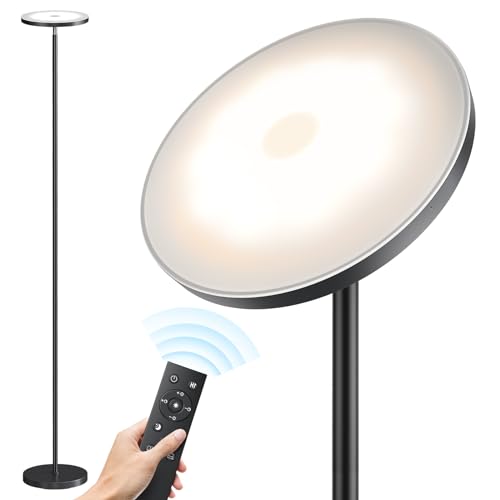
SUNMORY 32W/3000LM Torchiere Floor Lamp with Remote
Who it suits: Anyone whose small space is also a dark space — a corner office nook, a basement reading spot, a small bedroom doing double duty — and who needs one compact lamp to genuinely light it, not decorate it.
The small-space case for this lamp is arithmetic: up to 3000 lumens, adjustable from 3000K to 6000K and dimmable from 5 to 100 percent, delivered from a base 9.8 inches across — roughly half a square foot, the size of a dinner plate, in the corner. No other lamp in this guide comes close to that ratio of light to floor. And because it is a torchiere, the light goes up and bounces: in a small room, indirect ceiling light is the kind that makes walls recede, while a bright shaded lamp at close range can make the same room feel like a lit cupboard. The head rotates 350 degrees and tilts 180 degrees, so in a nook you can graze light down a wall or angle it over a desk surface; the remote means the lamp tucked into the far corner of a small room never requires a squeeze past furniture to adjust; and the memory function keeps your found settings. At 69 inches it is tall, but height is the one dimension small spaces usually have spare — floor is scarce, air is free — and a tall, slim column uses the free dimension to light the whole nook.
The cautions are about scale of output, not size of lamp. In a genuinely tiny space — a closet-sized nook, a bunk corner — 3000 lumens is a floodlight’s worth of power, and while the dimmer’s 5 percent floor tames it completely, buyers of very small nooks may be paying for headroom they never open. The integrated LED is not replaceable, so the purchase rests on its rated 30,000-hour life. And the remote, in a small space, is paradoxically easy to bury under the nook’s own books and blankets; the foot switch is the reliable backup.
Pros: Most light per square inch of floor in this guide; ceiling bounce enlarges small rooms visually; full dimming and color range from a remote; rotating head aims light into nooks and across desks; tall slim profile spends height, not floor.
Honest limitation: Output is oversized for the very tiniest nooks even if dimmable; integrated LED cannot be replaced; remote needs a designated spot in a space short on spots.
Choose this if your small space is dark and must be properly lit from one corner. Skip it if your nook needs only a gentle pool of reading light — the Ambimall does that for less, in less height. Check price on Amazon before you buy.

Ambimall 60-Inch Floor Lamp with 9W Bulb
Who it suits: Reading nooks, bedside corners, nursery chairs and any small space whose brief is a pool of warm light exactly where a person sits — nothing more, and nothing larger.
At 60 inches, the Ambimall is the shortest lamp in this guide, and in small spaces short is a discipline: under a sloped eave, beside a low bookcase, next to a daybed or a window seat, a 60-inch lamp keeps its shade below the visual clutter line and at the right height for a seated reader. The included 9W LED bulb gives three color temperatures, so the nook can be a crisp morning reading spot and a warm evening one with the same bulb, and the shade rotates to pour the light onto the page or soften it against the wall behind. Everything arrives in the box — bulb included — and assembly is the simplest here, which matters in spaces where there is literally no room to spread out parts on the floor.
Its honesty paragraph is short because its job is narrow. One shaded bulb makes a zone of light, not a lit room; the build is lightweight, so place it where it will not be knocked by passing traffic — inside the nook, not at its entrance; and beside very low furniture, check that the shade’s height still clears your book rather than your lap. Within its brief, though, it is the most proportionate lamp in this guide: the one that understands a small space wants light at human scale, delivered quietly, from the smallest possible claim on the floor.
Pros: Shortest, most proportionate lamp here for nooks and low ceilings; warm shaded light with three color temperatures; rotating shade; bulb included and simple assembly; smallest spend in this guide.
Honest limitation: A zone light only — will not lift a whole small room — and a lightweight build that belongs inside the nook, out of traffic.
Choose this if your small space is a seat and a corner. Skip it if the space must be lit wall to wall. Check price on Amazon before ordering.

Brightech Sky LED Torchiere Floor Lamp, Black
Who it suits: The gap. Every home has one — the ten inches between sofa and wall, the sliver beside a bookcase, the corner behind a door’s swing — and this is the lamp engineered to live in it while lighting the room around it.
The Sky is a slim metal pole on a weighted 10-inch base, 63 inches tall, and its small-space talent is disappearance: slide the base into the gap, and the room gains 2190 lumens of warm 3000K ceiling-bounced light with effectively zero visible furniture added. In tight rooms, that trade — light without an object — is often worth more than a prettier lamp that consumes the corner. The 3-way touch dimmer sits on the pole at hand height with a memory function, so the lamp is operable in the squeeze without a remote to drop behind the sofa, and the head tilts to throw its wash toward the seating rather than straight up when the gap is off to one side. Brightech rates the LED at 20,000 hours and supports the lamp with a 5-year limited warranty per its product page; the integrated head runs cool, a quiet virtue when a lamp lives inches from curtains, books or a wall.
The fixed warmth is the boundary: 3000K is evening light, and a small space that works as a daytime office corner may find it sleepy — that reader belongs with the SUNMORY above. Three dimming steps are also coarser than a stepless dial when the lamp is close enough to dominate a tiny room’s mood. But as the set-and-forget gap lamp — installed in ten minutes, invisible thereafter, lighting the whole small room from a dinner plate of floor — it has no rival in this guide except its brighter SUNMORY cousin, and it asks for far less management.
Pros: Slimmest profile here; weighted 10-inch base fits gaps and corners; bright warm uplight lifts the whole small room; touch dimmer with memory, no remote to lose; cool-running head safe near walls and curtains.
Honest limitation: Fixed 3000K color and 3-step dimming limit fine mood control; integrated LED is not replaceable.
Choose this if you have a gap, a corner and a wish for the lamp to vanish. Skip it if you need adjustable color or the lamp must be a visible feature. Check price on Amazon and confirm the finish on the listing.

Simple Designs LF1014-BLK Etagere Shelf Floor Lamp, Black
Who it suits: Small spaces that fail for lack of storage as much as lack of light — the nook with books in piles, the tiny bedroom with no nightstand room, the office corner where the printer lives on the floor.
The LF1014’s insight is that small spaces are three-dimensional and most lamps use only one of them. This 62.5-inch open frame stacks three shelves vertically inside roughly a square foot of floor, topped by a white linen shade on a standard E26 socket. The floor claim is a lamp’s; the yield is a lamp plus a bookcase plus a nightstand. In a small bedroom, it stands where a nightstand cannot, holding the book, the glass and the glasses under its own light. In a reading nook, the shelves are the library. The light itself is a soft shaded glow — local, warm with the right bulb, and exactly scaled to the seat beside it.
Count the costs honestly: the bulb is not included, so your first act is choosing one (a warm LED of decent output; the socket is a standard medium base). The frame is lightweight, and its shelves take display-weight loads — paperbacks, a plant, a basket — not a leaning tower of hardbacks. Open shelves in a small space are also always on display at close range, so they reward editing and expose hoarding at a glance. Assembly is a screw-together build that also disassembles, handy when the nook gets reimagined, as nooks do. For small spaces whose problem is stuff with nowhere to live, no other lamp in this guide solves two scarcities at once.
Pros: Three shelves of vertical storage inside a lamp’s footprint; replaces a nightstand in tiny bedrooms; soft local light at seat height; standard socket for your choice of bulb; low end of the budget.
Honest limitation: Bulb not included; light is local rather than room-filling; shelves suit light loads and show dust and clutter honestly.
Choose this if your small space needs storage as much as light. Skip it if you need brightness or a minimalist object. Check price on Amazon and plan a bulb purchase alongside it.
SUNMORY Arc Floor Lamp with 9W 3 Color Temperature Bulb
Who it suits: Compact living rooms and multi-use small rooms where the seating sits away from the walls and there is no floor to spare beside it — the arc’s base hides, and only its light takes up space.
The arc is the footprint cheat code. Its heavy base slides behind the sofa or partly beneath it — floor that was already dead — while the curved arm suspends the adjustable shade over the seat itself. In a small room, that geometry returns the corner a normal lamp would have eaten and still delivers the most useful light position of all: directly over the person reading, working or eating on the sofa. The included 9W bulb’s three color temperatures shift the seat from task to evening mode, the shade adjusts to aim the pool, and the bulb is a standard replaceable type. In a small multi-use room — sofa by day, guest bed by night, desk at the end — an arc over the sofa is often the only way to get ceiling-style light without a ceiling fixture or a sacrificed corner.
Geometry is the gatekeeper, as always with arcs. The reach is fixed, so measure from the base’s hiding place to the seat’s center; confirm the shade hangs over the seat, not over the room’s walkway, and that its height clears the head of whoever rises from the end seat. In a truly tiny room the arc’s sweep can feel like a presence — a beautiful one, but a presence — and a slim torchiere in the corner may be the calmer citizen. Our bedroom-focused arc selections in Best Arc Floor Lamp For Bedrooms Under $100 cover the over-bed version of this same trick for small bedrooms.
Pros: Effectively zero living footprint — base hides behind or under the sofa; light delivered over the seat in compact rooms; adjustable shade and three color temperatures; replaceable standard bulb; no installation.
Honest limitation: Fixed reach demands careful measuring; the arc’s visual sweep can crowd the smallest rooms; not a whole-room light source.
Choose this if your small room’s seating floats and its corners are full. Skip it if a simple corner is free — a pole lamp is the simpler tool. Check price on Amazon before ordering.
LEPOWER Wood Tripod Floor Lamp
Who it suits: The small space with one true corner to devote — a reading corner in a bedroom, the end of a hall, a bay window’s edge — where the lamp can be the place’s whole point, and look like it.
We end with the exception that proves the guide’s rule. The LEPOWER’s tripod spread is about 19 inches across — the largest unshareable footprint here — and in most small spaces that disqualifies it. But some small spaces are not gaps; they are destinations. A corner with an armchair, a side of books and a window is a room within a room, and for that corner the tripod is the finest lamp in this guide: natural rubber-wood legs, a flaxen linen shade glowing at 61 inches, light that falls sideways and down onto the reader like late afternoon. The standard E26 socket (maximum 60W; maker suggests a 10–12W LED, not included) takes the bulb of your choice, including a smart bulb that can schedule the corner to glow at reading hour. The foot switch rides a cord of about 10.6 feet — in awkward small spaces with distant outlets, that cord length is the difference between the lamp living in the corner and living wherever the outlet dictates.
Measure the corner before you commit: 19 inches of clear diameter, all three feet seated evenly (deep carpet asks for a moment’s care), and a traffic pattern that flows around the corner rather than through it. If the tape measure says yes, this lamp converts a small space from leftover to favorite. If it says no, believe it — the same money buys the Ambimall’s glow in a third of the footprint, and a small space respects honesty about inches more than it respects taste.
Pros: The most beautiful corner lamp here — real wood and linen at close range; warm, flattering shaded light for reading corners; standard socket accepts smart bulbs; longest cord solves distant-outlet nooks.
Honest limitation: Largest footprint in the guide at about 19 inches across; bulb not included; needs a dedicated corner, not a gap.
Choose this if your small space is a destination corner with the floor to prove it. Skip it if your space is a gap, a walkway edge or a squeeze. Check price on Amazon, and add a bulb if you need one.

Comparison Table
Specifications are the makers’ published figures. In small spaces the decisive columns are height and type — together they tell you how much floor a lamp claims and where its light goes.
| Pick | Type | Height | Light source | Controls | Link |
|---|---|---|---|---|---|
| SUNMORY 32W Torchiere | Torchiere uplight | 69 in | Integrated LED, 3000 lumens, 3000K–6000K | Remote + foot switch, stepless dimming, memory | Check on Amazon |
| Ambimall 60-Inch | Shaded pole lamp | 60 in | 9W LED bulb included, 3 color temperatures | Rotating shade; standard switch | Check on Amazon |
| Brightech Sky | Torchiere uplight | 63 in | Integrated LED, 2190 lumens, 3000K warm | 3-way touch dimmer, memory | Check on Amazon |
| Simple Designs LF1014 | Etagere shelf lamp | 62.5 in | E26 socket, bulb not included, 3 shelves | Standard switch; bulb-based control | Check on Amazon |
| SUNMORY Arc | Arc with hanging shade | Arc format | 9W LED bulb included, 3 color temperatures | Standard switch; bulb-based control | Check on Amazon |
| LEPOWER Tripod | Tripod with linen shade | 61 in | E26 socket, max 60W, bulb not included | Foot switch on 10.6 ft cord | Check on Amazon |
How to Choose a Floor Lamp for a Small Space
Measure the space in three dimensions, then shop. Width and depth give you the footprint budget — tape it on the floor and live with the tape for a day. Height gives you the ceiling budget, including slopes, beams and the top of the bookcase the lamp will stand beside. The third measurement everyone forgets is reach: the distance from the lamp’s only possible position to the seat, the desk or the page it must light. A lamp that fits the footprint but cannot reach its job is a sculpture, and small spaces cannot afford sculptures that do not work.
Spend height, save floor. In nearly every small space, vertical room is abundant and floor is rationed. Tall slim lamps — the torchieres here — convert free height into whole-nook light. Vertical storage does the same trick for objects: the shelf lamp grows upward instead of outward. The lamps to interrogate hardest are the wide ones; width is the currency small spaces are shortest on, and a wide lamp must pay for its spread with beauty or function, as the tripod does in a true corner and cannot do in a gap.
Decide whether the light should fill or pool. Fill light — a torchiere’s ceiling bounce — makes a small space feel bigger and serves every activity in it at once; it is the right default for small rooms that live multiple lives. Pooled light — a shaded lamp at a seat — makes a small space feel intentional, carving one warm destination out of a larger or darker room; it is the right choice for nooks, corners and bedside spots. Choosing wrong is the classic small-space error: a pool lamp asked to fill a room feels feeble, and a fill lamp at full power in a tiny nook feels like an interrogation — though a wide dimming range, like the SUNMORY’s 5-to-100 percent, forgives that mistake better than any other feature.
Hide the base, or honor it. There are two footprint strategies and no third. Hide the base: slide it under the sofa (the arc), behind the chair, into the gap beside the bookcase (the Sky) — the lamp becomes pure light with no visible claim. Or honor the base: give a beautiful lamp a real corner and let it be the space’s furniture, as with the tripod. The failure mode is the middle — a base neither hidden nor honored, standing in the walkway’s edge, collecting bumps and resentment.
Route the cord as part of the design. Small spaces put cords on display; there is nowhere for them to be casually lost. Measure the route along skirting from outlet to lamp, prefer long cords that reach without crossing the floor’s sightlines, and consider the switch’s position as carefully as the lamp’s — a foot switch you can reach from the chair is worth more in a nook than any decorative finish. Households furnishing a whole compact flat rather than one tight corner should also read the modern-scheme ranking in Best Floor Lamp For Modern Homes Under $150, where several of these same lamps are judged on style first.
Small Spaces Around the Home: Nooks, Landings and Odd Corners
Because “small space” describes a dozen different places, here is the short field guide to matching this guide’s lamps to the spots readers ask about most. The under-stairs nook — often a desk or a reading chair in newer homes — has a sloped ceiling that vetoes tall lamps at the low end and welcomes them at the high end; measure at the lamp’s exact position, and favor the Ambimall’s 60 inches or the Sky’s 63 where the slope falls, with the SUNMORY torchiere only where the full height survives. The landing library — a chair and shelves on a stair landing — wants pooled light that does not spill down the stairwell and dazzle people climbing at night: a shaded lamp, the Ambimall or the shelf lamp stocked with the landing’s own books, beats any uplight there. The dorm room is a small space with rules: no halogen anything in most residences, limited outlets, and a roommate whose sleep schedule is a diplomatic issue — the Ambimall’s warm low pool at one desk-chair, or a dimmable torchiere run at its lowest settings, respects both the rules and the diplomacy.
The home-office corner deserves its own paragraph because it is the small space most often lit badly. A desk wedged into a spare-room corner gets shadowed by the worker’s own body from any ceiling light behind them; the fix is light from the front-side, which a torchiere’s wall-and-ceiling bounce approximates well, or an arc reaching over the desk from behind the chair’s side. Color temperature matters here more than anywhere: the adjustable SUNMORY, or a socket lamp with a daylight-capable bulb, keeps screen work honest in a way fixed warm lamps cannot. The narrow hallway console spot — too thin for a table lamp’s table — is the shelf lamp’s strangest and best use: light and a landing strip for keys and post in a footprint a hallway can spare. And the small guest room, used ten nights a year, wants the lamp that asks nothing: bulb included, switch obvious, light warm — the Ambimall again, because guests should never need a tutorial, a remote hunt or a smart bulb’s app to read in bed.
Across all of these, the pattern is the same one this guide began with: name the space’s scarcest resource — floor, height, outlets, or darkness itself — and choose the lamp that spends a different one. Small spaces punish generic purchases and reward specific ones out of all proportion to their size, because in a small space there is no “somewhere else” for a mistake to be moved to. The lamp you choose is the lamp you will live beside, at arm’s length, every day. Measure like it matters, because at this scale, it does.
Common Buying Mistakes
Judging by the listing photo’s room. Product photos are shot in lofts. Your nook is not a loft. Buy from the specifications table — base diameter, height, spread — never from the pictured proportions.
Forgetting the door, the drawer and the swing. Small-space lamps die by inches: a base inside a door’s swing, a shade blocking a wardrobe door, a tripod foot where the storage ottoman slides. Walk the space’s moving parts before you place anything in it.
Buying light that cannot be aimed or dimmed. At close range, fixed full brightness is glare. In small spaces, dimming range and shade direction are not features; they are the difference between a lamp you use and a lamp you walk around.
Ignoring the outlet’s actual location. The perfect corner with no reachable outlet is a lamp museum. Cord length and route decide placement as surely as footprint does — measure both.
Splitting the budget into two weak lamps. Two dim lamps in one small room give you two obstacles and no well-lit spot. One right lamp, placed once, lights the space; add the second only when the first has proven where the darkness remains.
Choosing the wide lamp for the narrow reason. A tripod bought for a gap will be cursed daily. Wide lamps are for corners that can honor them; gaps want poles, arcs and disappearing acts.
A Tape-Measure Walkthrough Before You Order
Everything in this guide reduces to ten minutes with a tape measure, so here is the exact routine. First, mark the candidate footprint on the floor with painter’s tape at the true base size — 10 inches for the pole lamps, about 19 for the tripod, a square foot for the shelf lamp, and for the arc, the base’s hiding place behind the sofa. Live with the tape through one full day of the space’s real use: sit in the chair, open every door and drawer, walk the route you walk at night. Tape that gets stepped on, blocked or cursed is a veto no review can override. Second, measure upward: ceiling height at the lamp’s position — not the room’s center, because slopes and beams cheat — and the height of the furniture the lamp will stand beside, so the shade or head lands in proportion rather than by surprise. Third, walk the cord: from the lamp’s taped position, along the skirting, to the outlet it will actually use, and compare that distance with the cord lengths in the reviews above. If the walk crosses a doorway or a traffic line, the lamp’s position — or the lamp — is wrong, and it is far better to learn that from tape than from a return label.
Finish with the reach test: from the taped base position, measure to the center of the seat, desk or bed the light must serve. Shaded lamps serve about an arm’s length around themselves; arcs serve exactly as far as their arm reaches and not an inch further; torchieres serve the whole room but serve the nearest seat least dramatically. If the numbers say the light will land a foot short of the book, believe them. Small spaces are honest places — everything in them is close enough to touch, including your mistakes — and ten minutes of tape is the cheapest expertise in this entire guide.
Final Recommendation
For most small spaces, buy the SUNMORY 32W/3000LM Torchiere Floor Lamp. No other lamp here puts so much adjustable light on so little floor, and its ceiling bounce is the one kind of light that makes a small space feel larger instead of merely brighter. If your space is a reading nook or a bedside corner, the Ambimall’s low, warm pool is the more proportionate joy; if your space is literally a gap beside furniture, the Brightech Sky was designed for it. Take the Simple Designs when the space needs shelves as much as light, the SUNMORY arc when the base can hide under the sofa, and the LEPOWER when — and only when — the tape measure confirms a true corner with 19 inches to give. Measure first, buy once, and the smallest room in your home may become the best-lit seat in it. When you are ready, Check on Amazon for the current listing details of our top small-space pick.
Frequently Asked Questions
What type of floor lamp is best for a small space?
For lighting a whole small room, a slim torchiere: it claims about half a square foot and lights by ceiling bounce, which makes the room feel bigger. For a nook or reading corner, a short shaded lamp that pools light at the seat. The right answer follows the job — fill versus pool — more than any brand or style.
How much floor space does a floor lamp need?
Pole lamps on round bases need roughly a 10-inch circle — about half a square foot — and can often share that with a furniture gap. Shelf lamps need about a square foot. Tripod lamps need a clear circle of about 19 inches, nearly two square feet. An arc lamp’s base needs floor too, but it can be floor already hidden behind or under a sofa, which is why arcs are the small-space cheat code.
Can a bright lamp make a small room feel bigger?
Yes — indirect light does it. A torchiere bouncing light off a light-colored ceiling lifts the whole room evenly, removing the dark corners that make small spaces feel like closets. Bright direct light at close range does the opposite, creating glare and hard shadows. If the goal is spaciousness, bounce the light and keep the brightness dimmable.
Where should a floor lamp go in a small bedroom?
Beside the bed if it must serve as a nightstand light — a shelf lamp can replace the nightstand entirely in the tightest rooms — or in the corner by a reading chair if the room has one. Keep it out of the door swing and the wardrobe’s opening arc, and route the cord along the wall. Our family-focused guide, Best Floor Lamp For Families Under $150, covers the additional stability checks for small bedrooms children use.
Is a taller or shorter lamp better for low ceilings?
Shorter shaded lamps, around 60 inches, sit more calmly under low ceilings and beside low furniture. Torchieres are the exception: their height is functional, lifting light to the ceiling, and a 63- to 69-inch torchiere still works under an eight-foot ceiling. What low ceilings punish is the tall shaded lamp, whose shade crowds the ceiling plane without the uplight excuse.
How do I light a small space with no free outlet nearby?
Choose a lamp with a long cord and route it along the skirting to the nearest outlet — the LEPOWER in this guide carries about 10.6 feet of cord for exactly this problem. Avoid running cords across walkways or under rugs; a flat cord cover along the wall is the tidy last resort. If the space truly has no reachable outlet, no plug-in lamp solves it, and the honest answer is to light the space from an adjacent one with an arc or a tall torchiere at its edge. Small spaces reward that kind of lateral thinking: the lamp does not have to stand inside the nook to belong to it — it has to deliver its light there, by bounce, by reach or by a shade angled across the boundary, and several picks in this guide are shaped by exactly that possibility.