Where to buy
Check the latest price, availability and delivery on Amazon. Orders are placed on Amazon. We may earn a commission from qualifying purchases.
- Best overall for modern homes: LEPOWER Wood Tripod Floor Lamp — Check on Amazon
- Brightech Sky LED Torchiere Floor Lamp, Black — Check on Amazon
- SUNMORY Arc Floor Lamp with 9W 3 Color Temperature Bulb — Check on Amazon
- SUNMORY 32W/3000LM Torchiere Floor Lamp with Remote — Check on Amazon
- Ambimall 60-Inch Floor Lamp with 9W Bulb — Check on Amazon
See 1 more Amazon option
- Simple Designs LF1014-BLK Etagere Shelf Floor Lamp — Check on Amazon
Read the full guide ↓
Disclosure: As an Amazon Associate, dailyhomedecorating.com earns from qualifying purchases. Links to Amazon on this page are affiliate links; they cost you nothing extra. Listing details such as price and availability change often, so check the current Amazon listing before you buy.
The search for the best floor lamp for modern homes under $150 starts with an uncomfortable truth about modern interiors: they are unforgiving. A traditional room hides a mediocre lamp among patterns, wood tones and visual noise. A modern room — pale walls, clean lines, a edited handful of furniture pieces — puts every object on stage, and a floor lamp is a tall object. It will be seen against your emptiest wall, silhouetted in your largest window and reflected in your television screen. In a modern home, a lamp is not an appliance you tolerate; it is a vertical sculpture that also happens to produce light, and it has to succeed at both jobs or it quietly cheapens everything around it.
That is why this guide ranks the same verified under-$150 lamps as our general guide to Best Floor Lamp Under $150 in a completely different order, and judges them by different questions. Does the design come from a real tradition — mid-century tripod, minimalist torchiere, the Italian arc — or is it a shapeless pole with a shade borrowed from another decade? Are the materials honest at close range: real wood, metal, linen, or plastic pretending? Does the light itself behave the way modern rooms need — indirect and architectural where the room is open, warm and shaded where the room is a retreat? And does the lamp respect the modern room’s deepest rule, which is that nothing visible should look like clutter, including its own cord, its own remote and its own controls?
Our short answer: the LEPOWER wood tripod is the lamp that makes a modern room look finished. Its rubber-wood legs and flaxen linen shade descend directly from mid-century design, the one style vocabulary that has never left modern interiors, and its standard bulb socket makes it the most adaptable lamp here. If your modern is minimalist rather than mid-century, the Brightech Sky is the opposite and equal answer — a lamp that all but disappears, leaving only a wash of ceiling light. The SUNMORY arc is the statement piece for open-plan seating. The SUNMORY 32W torchiere is the technologist’s pick, with the output and adjustability to light a contemporary open space properly. The Ambimall brings the soft, low, Japandi note, and the Simple Designs shelf lamp — the least sculptural here, and we say so — earns its place in modern homes that need their objects to multitask. Each review below names the design language the lamp speaks, the rooms it flatters, and the rooms where it will fight the furniture.
In this guide
Quick Picks
Match the lamp to your version of modern — the word covers at least four different rooms.
| Modern style | Pick | Why it stands out | Link |
|---|---|---|---|
| Best overall for modern homes | LEPOWER Wood Tripod Floor Lamp | Natural rubber-wood tripod and flaxen linen shade — mid-century form in honest materials | Check on Amazon |
| Best minimalist | Brightech Sky LED Torchiere Floor Lamp | Slim metal pole and weighted base that vanish; only the ceiling wash of light is visible | Check on Amazon |
| Best statement piece | SUNMORY Arc Floor Lamp with 9W Bulb | Sculptural curved arm delivers light over a sofa from a tucked-away base | Check on Amazon |
| Best for open-plan tech homes | SUNMORY 32W/3000LM Torchiere Floor Lamp with Remote | 3000 lumens, 3000K–6000K adjustment, remote and rotating head for flexible modern layouts | Check on Amazon |
| Best soft / Japandi corner | Ambimall 60-Inch Floor Lamp with 9W Bulb | Lower 60-inch profile, beige shade and 3 color temperatures for calm, layered light | Check on Amazon |
| Best modern multitasker | Simple Designs LF1014-BLK Etagere Shelf Floor Lamp | Black open frame with three shelves — storage that keeps modern surfaces clear | Check on Amazon |
How These Picks Were Chosen
Every lamp here first cleared the practical bars from our main guide — verified manufacturer specifications, real output, a stable base, honest controls and a total cost inside the under-$150 frame including any bulb the lamp needs. Then we applied the modern-home filter, which is stricter and more subjective, so we will state it plainly. First, design lineage: each pick had to belong recognizably to a living design tradition — mid-century modern, minimalism, the arc tradition, contemporary tech, Japandi softness or functional modern storage — rather than being a generic lamp with a fashionable adjective in its title. Second, materials at close range: modern rooms show everything, so wood had to be wood, metal had to be metal and shades had to be fabric; lamps whose finishes imitate materials they are not were cut. Third, light quality as architecture: modern open spaces are lit in layers, and a lamp had to contribute a deliberate layer — a ceiling wash, a shaded glow, a delivered pool over seating — not just brightness. Fourth, visual quiet: slim profiles, controlled cords and controls that do not festoon the lamp with buttons and dongles scored ahead of feature piles.
We also weighted adaptability, because modern homes get rearranged and restyled more than most. A lamp that takes any standard bulb can change its color temperature, its brightness and its smart-home status for the price of a bulb; a lamp with a wide color-temperature range can follow a room from gallery-cool to evening-warm. Fixed lamps were not excluded — the Sky’s fixed warmth is a deliberate design decision — but their reviews say exactly what is fixed, so you can judge whether your room’s style can absorb it. Readers whose modern home is also a family home should cross-check the stability-first notes in Best Floor Lamp For Families Under $150; the prettiest lamp in this guide is not the one we would stand in a toddler’s racing line.
The 6 Best Floor Lamps for Modern Homes Under $150
LEPOWER Wood Tripod Floor Lamp
Who it suits: Mid-century modern, Scandinavian and warm-minimalist homes — and anyone whose room needs one object with enough presence and material warmth to stop the space feeling like a showroom.
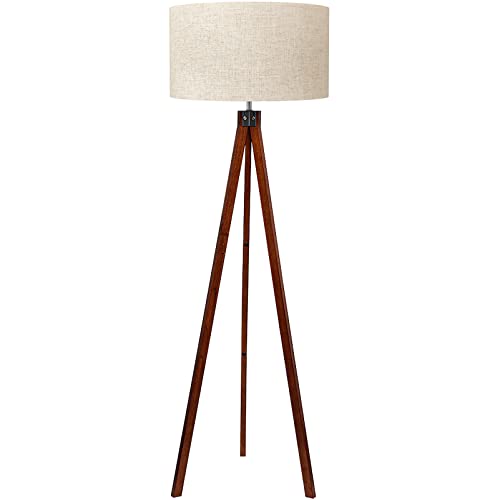
The tripod floor lamp is one of the few lighting designs that has been continuously fashionable for seventy years, and the LEPOWER shows why. Three legs of natural rubber wood splay beneath a flaxen linen drum shade, about 61 inches tall overall with a footprint around 19 inches across. There is no ornament and no imitation: the wood is wood, with visible grain, and the shade is cloth, which glows rather than shines when lit. In a modern room built from flat planes — a low sofa, a plain rug, an unadorned wall — that tripod silhouette provides the one sculptural note the composition needs, and its warmth corrects the coldness that all-white, all-grey modern schemes drift toward. It is the lamp in this guide most likely to be asked about by a guest, and the only one that improves a room while switched off.
The engineering under the styling is usefully old-fashioned. The socket is a standard E26 rated to 60 watts maximum, so the light character is yours to design: the maker suggests an LED in the 10–12W range, and your choice of bulb sets brightness and color temperature — a warm bulb for a lounge mood, a crisper one for a reading corner, or a smart bulb that folds the lamp into scenes and schedules without a single visible wire or hub on the lamp itself. A foot switch on a long cord, roughly 10.6 feet, keeps control discreet and lets you route power along a skirting board from a distant outlet, preserving the cordless illusion modern rooms depend on. No bulb is included, which we count as a styling feature with a cost attached: budget for the bulb, and choose it as deliberately as the lamp.
Pros: Authentic mid-century tripod form in real rubber wood and linen; standard socket takes any bulb, including smart bulbs, so the lamp evolves with the room; long cord and foot switch keep the look clean; shaded light is warm and flattering against modern surfaces.
Honest limitation: The wide tripod footprint needs real floor — about 19 inches of clear diameter — and reads wrong in ultra-minimal rooms where any visible structure is noise; in those rooms the Sky below is the better citizen. Bulb not included.
Choose this if your modern leans warm, wooden and mid-century. Skip it if your modern is stark minimalism or your floor space is measured in inches. Check price on Amazon, and choose a bulb with the same care as the lamp.

Brightech Sky LED Torchiere Floor Lamp, Black
Who it suits: Minimalists. If your ideal lamp is the one nobody notices — in a gallery-calm living room, a monochrome scheme or a small modern space where visual objects compete — this is your pick.
The Sky is modernism by subtraction. A slim metal pole rises 63 inches from a weighted 10-inch base to an integrated LED head that throws 2190 lumens of warm 3000K light at the ceiling and lets the room fill with the bounce. There is no shade to date, no ornament to clash and, in the black finish linked here, almost no silhouette at all against a shadowed corner: the lamp’s entire visual statement is the light itself and the brightened ceiling plane above it. That is a genuinely architectural way to light a modern room, because it emphasizes the volume of the space rather than the objects in it — the same reason recessed and cove lighting dominate modern interiors, achieved here with a plug.
Details respect the philosophy. The 3-way touch dimmer is a sensor on the pole, invisible until used, with memory so the lamp wakes at your chosen level. The head tilts to aim the wash. The integrated LED runs cool and is rated by the maker at 20,000 hours, and Brightech backs the lamp with a 5-year limited warranty per its product page — modern design that expects to be kept, which is the sustainable kind. The discipline required from the buyer is accepting what minimalism removes: the color temperature is fixed at warm 3000K, so if your modern scheme is a cool, daylight, gallery register, this lamp’s warmth will read as a deliberate contrast or a mistake, with nothing in between. In warm and neutral modern rooms, it simply disappears and glows.
Pros: Near-invisible profile suits strict minimalism; bright 2190-lumen ceiling wash lights the architecture, not the furniture; touch dimmer with memory, no visible controls or remote; weighted base; strong warranty support.
Honest limitation: Fixed warm 3000K cannot follow a cool-toned scheme or a daytime workspace mood, and three dimming steps are coarser than stepless control. The integrated LED is not replaceable.
Choose this if your modern room wants light without an object. Skip it if you need adjustable color temperature or a lamp with decorative presence. Check price on Amazon and confirm the finish — the model is made in several colors, and in a modern room the finish is half the decision.

SUNMORY Arc Floor Lamp with 9W 3 Color Temperature Bulb
Who it suits: Open-plan modern homes where the sofa floats or anchors a seating island, and design-conscious renters who want a statement silhouette with zero installation.
Every modern room needs one gesture, and the arc lamp is the lighting version: a heavy base held back at the room’s edge, a long curve of metal, and a shade suspended over the seating like punctuation. The form descends from the famous Italian Arco, and even in this budget interpretation it changes a seating arrangement from “furniture against walls” to “a place, composed.” The SUNMORY’s hanging shade is adjustable, so once the arc is placed you can tune exactly where the pool of light lands — over the reading end of the sofa, over a coffee table’s game, over the chair where someone works in the evening. The included 9W bulb offers three color temperatures, which matters more in modern rooms than most: the same arc can burn crisp over a workspace afternoon and warm over a dinner-party evening.
Practically, the arc solves the modern open-plan problem that the best-looking seating layout rarely coincides with outlet or ceiling-fixture locations. The base tucks beside or partly behind the sofa; no drilling, no wiring, no ceiling hook betrays the rental deposit. The bulb is a standard replaceable type, so the lamp’s light can be renewed or re-toned in minutes. The constraints are geometry, and they are real: the arm’s reach is fixed, so measure from your base position to your seat before ordering, and check that the shade’s hang height clears heads at the sofa’s end seat while staying low enough to feel intimate. Our arc-specific guide, Best Arc Floor Lamp For Modern Homes Under $100, works through those measurements in detail for design-led buyers comparing arcs alone.
Pros: The strongest silhouette in this guide; delivers composed, over-seating light in open plans; adjustable shade and three color temperatures; replaceable standard bulb; no installation.
Honest limitation: Fixed reach demands measuring, and the arc’s drama is wasted — even awkward — in small or traditional rooms; it is a one-gesture lamp, and a room that already has its gesture (a bold pendant, a sculptural chair) may find two statements competing.
Choose this if your seating needs a centerpiece of light. Skip it if your room is small, low-ceilinged or already visually busy. Check price on Amazon before ordering.
SUNMORY 32W/3000LM Torchiere Floor Lamp with Remote
Who it suits: Contemporary open-plan homes and tech-comfortable households that treat light as a setting, not a switch — one lamp that can run a large modern living space from work-bright to cinema-dim.
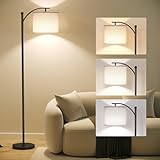
Where the Sky is minimalism, this SUNMORY is modern capability. At 69 inches it is the tallest lamp here, a straight black column with an integrated head that produces up to 3000 lumens — enough to genuinely light a large open-plan room by ceiling bounce — and rotates 350 degrees with a 180-degree tilt, so the same head can wash a ceiling, graze a wall or angle down over a work surface. Brightness dims steplessly from 5 to 100 percent and color temperature sweeps 3000K to 6000K, which in a modern interior is a design tool: cooler and brighter makes pale schemes feel like a gallery at noon; warmer and lower makes the same room feel like a boutique hotel at night. The remote, with preset modes and memory, means those scenes are one press from the sofa.
The modern-home cautions are about visual discipline. A remote is an object, and in a strict minimalist room it needs a home — a drawer, a tray — or it becomes the clutter the design exists to banish; the foot switch on the cord means the remote can live in that drawer full-time if you prefer. The lamp’s plain column styling is handsome in contemporary rooms but offers no mid-century warmth; in a warm-modern scheme it plays the cool counterpoint, which works only if something else in the room — wood, textile, art — supplies the warmth. And its output is scaled for real rooms: in a small modern flat it will live at the bottom of its dimming range, which it does gracefully, but a smaller lamp may be the more proportionate object.
Pros: Highest output here at 3000 lumens for open-plan spaces; full color-temperature and brightness range turns one lamp into several lighting scenes; rotating head adds wall-wash and task options; remote with memory and presets; tall, clean contemporary profile.
Honest limitation: Integrated LED is not replaceable; the design is cool and plain where some modern schemes want material warmth; the remote must be given a home to keep the look clean.
Choose this if your modern home is open-plan and you want lighting scenes, not just a lamp. Skip it if your rooms are small or your style needs wood and fabric in every piece. Check price on Amazon before you buy.

Ambimall 60-Inch Floor Lamp with 9W Bulb
Who it suits: Japandi, soft-modern and calm contemporary homes — bedrooms, reading corners and meditation-adjacent spaces where the lighting brief is “lower, warmer, quieter.”
Not every modern room wants architecture; some want atmosphere. The Ambimall stands 60 inches — noticeably lower than the torchieres — with a beige shade that glows rather than beams, and its proportions suit the low furniture of Japandi and soft-modern schemes: platform sofas, low shelving, floor cushions, negative space. The included 9W bulb’s three color temperatures let the corner shift from a clear morning reading light to a warm evening pool, and the rotating shade aims that pool at a page or softens it against the wall. In a layered modern lighting plan — and layering is the whole discipline — this is the lamp that provides the low, warm layer the ceiling wash cannot.
Its modesty is the point and also the boundary. A single shaded 9W bulb lights a seat and its surroundings, not a room; the build is lightweight and visually quiet to the edge of plain, which in a soft scheme is serenity and in a bold scheme is absence. Place it where the brief is calm — beside the reading chair, at the end of a low sofa, in the bedroom corner where a taller lamp would shout — and it completes the composition for the smallest spend in this guide. Everything needed, bulb included, arrives in the one box, with assembly simple enough to be part of an afternoon’s rearranging rather than a project.
Pros: Low, calm proportions suit Japandi and soft-modern rooms; warm shaded glow with three color temperatures; rotating shade; bulb included; smallest spend here.
Honest limitation: Modest output and lightweight build — a layer of light, not a room’s main source — and styling that may read plain in dramatic or luxury-leaning modern schemes.
Choose this if your modern is calm, low and warm. Skip it if you need a main light or a statement. Check price on Amazon before ordering.

Simple Designs LF1014-BLK Etagere Shelf Floor Lamp, Black
Who it suits: Modern homes where the discipline is “everything has a place” — studios, first apartments and spare-room offices where a lamp that also stores keeps the surfaces that define modern style clear.
We will be direct: of the six, this is the least sculptural lamp, and in a design gallery it would lose to the tripod and the arc. But modern living is not a gallery, and the LF1014 understands something the sculptures do not — clutter is the enemy of the modern look, and floor space that stores is floor space that keeps every other surface clean. The 62.5-inch black open frame carries three shelves under a white linen shade: styled with a plant, a small stack of art books and one beautiful object, it reads as a deliberate modern etagere; the shade at sofa height adds the warm layer. The socket is a standard E26 — bulb not included — so light quality is your choice of bulb away.
The styling burden is real and belongs to the owner: open shelves display whatever they hold, so this lamp rewards the edited shelf and punishes the dumping shelf, and its lightweight frame wants display-weight objects rather than a full library. Assembly is a screw-together build. In return, it is the only pick that gives a small modern home light and storage in a single square foot, at the low end of the budget — and in studio-scale modern living, that trade is not a compromise, it is the design. If your shelves will be styled rather than stuffed, this lamp earns its place in rooms the sculptures cannot help.
Pros: Three shelves protect the clear surfaces modern style depends on; black open frame suits contemporary schemes; soft shaded light at seating height; standard socket for your choice of bulb; low end of the budget.
Honest limitation: The least design-led object here; open shelves expose clutter and dust, and the lightweight frame suits display objects, not heavy storage. Bulb not included.
Choose this if storage scarcity, not light scarcity, is what threatens your modern room. Skip it if you want a sculptural object or whole-room brightness. Check price on Amazon and plan a bulb purchase alongside it.
Comparison Table
Specifications are the makers’ published figures. For modern homes, the “light source” and height columns tell you how each lamp will behave as an object in the room as much as how it will light it.
| Pick | Type | Height | Light source | Controls | Link |
|---|---|---|---|---|---|
| LEPOWER Tripod | Tripod with linen shade | 61 in | E26 socket, max 60W, bulb not included | Foot switch on 10.6 ft cord | Check on Amazon |
| Brightech Sky | Torchiere uplight | 63 in | Integrated LED, 2190 lumens, 3000K warm | 3-way touch dimmer, memory | Check on Amazon |
| SUNMORY Arc | Arc with hanging shade | Arc format | 9W LED bulb included, 3 color temperatures | Standard switch; bulb-based control | Check on Amazon |
| SUNMORY 32W Torchiere | Torchiere uplight | 69 in | Integrated LED, 3000 lumens, 3000K–6000K | Remote + foot switch, stepless dimming, memory | Check on Amazon |
| Ambimall 60-Inch | Shaded pole lamp | 60 in | 9W LED bulb included, 3 color temperatures | Rotating shade; standard switch | Check on Amazon |
| Simple Designs LF1014 | Etagere shelf lamp | 62.5 in | E26 socket, bulb not included, 3 shelves | Standard switch; bulb-based control | Check on Amazon |
How to Choose a Floor Lamp for a Modern Home
Name your modern before you shop. “Modern” on a listing title means nothing; your room’s specific dialect means everything. Mid-century modern wants wood, splay and cloth. Minimalism wants absence. Contemporary open-plan wants capability and clean geometry. Japandi wants low, natural and calm. Walk your room and list its three dominant materials and its temperature — warm or cool — then buy the lamp that speaks that language. A lamp from the wrong dialect is not a bad lamp; it is a foreign object, and modern rooms exile foreign objects to the corner by the door.
Plan light in layers, then assign the lamp one layer. Modern interiors are lit like stage sets: an ambient layer that sets the room’s base brightness, a task layer where people read and work, and accent light that gives walls and objects their evening modeling. A torchiere is an ambient layer. An arc or shaded lamp at a seat is a task layer. Asking one lamp to be all three produces the flat, over-lit look that makes modern rooms feel like offices. Decide which layer your room lacks — most often it is the warm task layer, because modern homes inherit plenty of cold ceiling light — and buy for that layer.
Treat color temperature as a design material. In a modern room, light color is as visible as paint color. Fixed 3000K warmth flatters wood, leather and warm whites; cooler temperatures flatter concrete, chrome and blue-greys, and make white schemes read gallery-clean. Adjustable lamps — the SUNMORY torchiere’s 3000K–6000K sweep, or any socket lamp with your choice of bulb — let the room change register between day and evening, which is the single most modern capability a lamp can have. If you buy fixed, buy the temperature your room wears at the hour you use it most.
Hide the evidence. Modern rooms are ruined by infrastructure: cords crossing floors, remotes on cushions, wall warts in view. Prefer long cords that route along skirting, foot switches that vanish under sofas, touch controls with no visible hardware, and give any remote a designed home. When you measure for a lamp, measure the cord’s route too. The difference between a room that looks styled and one that looks photographed-for-a-listing is usually nothing but cord discipline.
Scale the lamp to the furniture, not the ceiling alone. Low modern furniture wants lower lamps — the 60- and 61-inch picks here sit naturally beside platform sofas and low chairs, where a 72-inch pole would hover. Tall, spare rooms with high-back chairs can carry the 69-inch torchiere. And leave the lamp air: a sculptural lamp crowded by other objects loses its line, which in modern design is the same as losing the lamp.
Where Each Lamp Belongs: A Room-by-Room Placement Guide
Abstract advice about layers becomes useful when it is pinned to actual rooms, so here is how the six picks deploy across the modern homes we see most often. Take the classic open-plan loft first: kitchen at one end, seating island in the middle, glass along one side. That room’s problem is scale — it needs an ambient source with real output, which is the SUNMORY 32W torchiere’s whole argument, placed at the seating island’s quiet end where its column reads as part of the architecture. The arc is the alternative gesture for the same room if the island’s sofa is the social center: base behind the sofa, shade over the coffee table, and the room gains a center it was missing. What the loft does not need is a small shaded lamp as its main purchase; at that volume, a 9W shade is a candle at a banquet.
The warm-modern apartment living room — oak floors, a boucle or linen sofa, art on one wall, everything edited — is the LEPOWER’s natural habitat. Place the tripod at the art wall’s end of the sofa, where its wood echoes the floor and its shade’s glow models the artwork after dark, and fit it with a warm dimmable bulb so the corner can drop to gallery-evening levels. The same room with a cooler, greyer palette swaps the tripod for the Sky without changing anything else: the lamp disappears, the ceiling brightens, and the art keeps the stage. That swap is the cleanest illustration in this guide of why “modern” must be dialect-specific — two excellent lamps, two opposite answers, decided entirely by the room’s temperature.
The modern bedroom wants the opposite of the loft: less light, lower light, warmer light. This is the Ambimall’s room, at 60 inches beside a low bed or a reading chair, its shade at the height where a book is lit and a partner is not. Bedrooms also expose the weakness of bright torchieres — even dimmed, an uplight energizes the whole ceiling plane when the brief is retreat — so if a torchiere must serve a bedroom, the Sky’s fixed warmth at its lowest step is the gentlest of the uplights here. The modern home office, finally, is a color-temperature argument: daytime work wants the cooler register that fixed-3000K lamps cannot give, which points to the SUNMORY torchiere’s adjustable range or to a socket lamp — the LEPOWER or the Simple Designs — fitted with a daylight-capable smart bulb that warms itself as the workday ends. The shelf lamp in an office earns double credit, because office clutter is the one kind that grows faster than living-room clutter.
One placement rule survives every room above: the lamp’s cord route is decided before the lamp’s position is final. In modern interiors the eye travels along clean lines until it hits an interruption, and a cord crossing a floor is an interruption with a shadow. Walk the route from outlet to lamp position along the walls; if the walk is long, the long-cord picks in this guide exist for you; if the only route crosses the room’s main sightline, move the lamp, not the standard. Designers charge for this paragraph. It is, in practice, most of what they know about lamps.
Common Buying Mistakes
Buying “modern” by title. Listing titles use the word for anything with a straight pole. Judge the object: lineage, materials, proportions. If you cannot name the design tradition a lamp belongs to, it probably belongs to none.
Mixing temperatures across the room. A warm shaded lamp beside a cool torchiere makes both look wrong — one jaundiced, one clinical. Keep a room’s lamps within one temperature family, or use adjustable lamps set to match.
Over-lighting a calm scheme. Output is not virtue in a serene room. A 3000-lumen lamp at full power in a small white room is an interrogation; dimming range matters more than maximum brightness in design-led spaces.
Letting the cord cross the composition. One black cable across a pale floor undoes a room faster than any wrong lamp. Route along walls, choose long-cord models, and place lamps where the route is short.
Two statements in one room. An arc lamp and a sculptural chair and a dramatic pendant are three gestures competing. Modern rooms ration drama: pick the lamp as the gesture, or pick it to disappear — the Sky exists for rooms that already have their gesture.
Ignoring the off state. A lamp in a modern room is visible sixteen hours for every eight it is lit. If it does not please you switched off at noon, no evening glow will save it.
Final Recommendation
For the largest number of modern homes, buy the LEPOWER Wood Tripod Floor Lamp. Mid-century form is the lingua franca of modern interiors, the real wood and linen keep it honest at close range, and the standard socket means the lamp can be re-toned, re-brightened and made smart for the cost of a bulb as your room evolves — the only pick here that can follow a restyle indefinitely. Choose the Brightech Sky instead if your modern is minimalist and warm, the SUNMORY arc if your open-plan seating needs its gesture, and the SUNMORY 32W torchiere if your contemporary space needs real output and scene-level control. Take the Ambimall for the calm corner and the Simple Designs where storage discipline is the design problem. In every case, route the cord like you mean it and set the temperature to match the room; in modern homes, those two habits are half of lighting design. When you are ready, Check on Amazon for the current listing details of our top modern pick.
Keeping Modern Lamps Looking Modern
A modern lamp’s worst enemy is not time but neglect, because minimalist and mid-century designs have nowhere to hide dust, fingerprints or a tired shade. Build three small habits. First, dust shades and poles monthly with a dry microfiber cloth — linen and fabric shades like the LEPOWER’s and the Simple Designs’ gather a grey film that visibly dims their glow, and a lint roller restores them in seconds. Integrated LED heads, like the torchieres’, should be wiped only when cool and switched off. Second, treat the bulb as a replaceable design element on socket lamps: when a bulb’s color starts to drift or its brightness fades unevenly against its pair across the room, replace bulbs in a room together so temperatures match — mismatched bulbs are the invisible flaw guests feel without naming. Third, re-route and inspect cords twice a year; furniture migrates in lived-in homes, and a cord that began along a skirting board can end up pinched under a sofa leg, which is both a safety issue and the kind of slow visual disorder that makes a styled room feel tired.
Finally, resist the upgrade itch that modern rooms provoke. A well-chosen lamp from this guide — real materials, a clear design lineage, light matched to its layer — does not date the way novelty designs do. The tripod silhouette in this guide has been current for seventy years; the arc for sixty; the plain torchiere is less a style than an absence of one. If the room changes around your lamp, change the bulb’s temperature, move the lamp to a new layer, or restyle its shelf before you replace it. Modern design rewards the edited home, and editing includes knowing when an object has already earned its place. The lamp you keep for a decade is always the most modern object in the room.
Frequently Asked Questions
What floor lamp style suits a modern living room best?
The safest answer is mid-century modern — tripod and arc forms with natural materials — because it has blended with every modern dialect for decades. Strict minimalism is better served by a slim torchiere that disappears, and Japandi or soft-modern rooms by low shaded lamps in natural tones. Match the lamp’s tradition to your room’s dominant materials and you will rarely go wrong.
Should a modern floor lamp be warm or cool light?
Match the room’s materials and its main hour of use. Warm light around 3000K flatters wood, warm whites and evening living; cooler light flatters concrete, chrome and daytime work. Adjustable lamps remove the gamble by covering 3000K to 6000K in one fixture. Whatever you choose, keep all the lamps in one room in the same temperature family.
How do I hide a floor lamp cord in a modern room?
Choose a lamp with a long cord, place it near the wall it will plug into, and run the cord flat along the skirting board, behind furniture legs where possible. Foot switches can sit hidden under the sofa edge. The LEPOWER’s roughly 10.6-foot cord in this guide exists for exactly this routing. Avoid crossing open floor; if a crossing is unavoidable, a low-profile cord cover in a matching tone is the tidy solution.
Can a floor lamp work with a smart home setup?
Yes, by two routes. A socket lamp like the LEPOWER or Simple Designs can take a smart bulb directly, gaining app control, schedules and voice scenes. An integrated-LED lamp can go on a smart plug for on/off scheduling and voice control, though dimming should still be done by the lamp’s own control to avoid conflicts. Fully adjustable lamps with remotes, like the SUNMORY torchiere, offer scene control without any smart infrastructure at all. In design terms, the smart route you choose should leave no visible trace — no extra remotes on the sofa, no hubs blinking beside the lamp — because in a modern room the technology is supposed to be felt as atmosphere, never seen as equipment.
Is one floor lamp enough for a modern open-plan space?
Rarely, and the reason is layering rather than brightness. One high-output torchiere can supply the ambient layer for a large space, but modern rooms look their best with a second, warmer source at seating level to model faces and furniture. Budget-wise, one lamp from this guide now and a second layer later beats two mediocre lamps at once.
How tall should a floor lamp be in a modern room?
Proportion it to the furniture. Beside low platform seating, 60- to 63-inch lamps keep the shade near seated eye level and preserve the room’s horizontal calm. In taller, open schemes, a 69-inch torchiere carries light across the ceiling properly. The consistent mistake is a tall lamp beside low furniture, where it reads as a streetlight over a bench. A useful field test: sit in the room’s main chair and look across it — a shaded lamp’s shade should meet your eye near its lower third, and a torchiere’s head should be comfortably above your sightline, present in your peripheral vision as light rather than as an object competing with the art, the window and the people the room was designed around.


