Where to buy
Check the latest price, availability and delivery on Amazon. Orders are placed on Amazon. We may earn a commission from qualifying purchases.
- Best overall for small spaces: Yoobure C-Shaped End Table with Charging Station — Check on Amazon
- WELLAND Solid Teak Live Edge End Table — Check on Amazon
- Nathan James Amalia End Table with Faux Marble Top — Check on Amazon
- Christopher Knight Home Hoyt Wood End Table in Walnut — Check on Amazon
- Nathan James Jasper Mid-Century End Table with Fluted Drawer Doors — Check on Amazon
- FutureStone Luxury Marble Side Table in Calacatta Viola — Check on Amazon
Read the full guide ↓
Disclosure: As an Amazon Associate, dailyhomedecorating.com earns from qualifying purchases. Links to Amazon on this page are affiliate links; they cost you nothing extra. Listing details such as price and availability change often, so check the current Amazon listing before you buy.
The best end table for small spaces under $2000 is not really a furniture question; it is a geometry question with a budget attached. A small space — the studio corner, the narrow living room, the reading nook carved out of a bedroom — does not forgive a table that claims the wrong inches, faces the wrong way, or does only one job in a home where every object must do two. The generous ceiling matters here in a specific way: it buys compactness without cheapness. Down at the budget tier, small tables are small because they are flimsy. Up here, a table can be compact because it is engineered — a C-frame that borrows the space under your sofa, a solid teak square eighteen inches across that will outlast the building’s paint, a shaped top cut to fit the wedge of floor that square tables waste. You are not paying for size. You are paying for the absence of size, executed properly.
This guide applies that standard to six verified end tables, each small in a different way. The Yoobure C-table leads because its footprint is effectively zero: the base slides under the sofa, the top hovers over the seat, and a built-in charging station with two USB ports and two outlets deletes the power strip from your floor entirely. The WELLAND teak follows as the smallest permanent object — solid hardwood, 18 by 18 inches, 20 inches high, equally at home as end table, plant stand or bedside perch. The Nathan James Amalia is small the visual way: leggy and floating, so the room reads larger than its measurements. The Christopher Knight Home Hoyt is small the geometric way, its guitar-pick top shaped for corners. The Nathan James Jasper is small the organizational way — one cabinet footprint that removes clutter from every other surface. And the FutureStone marble pedestal closes the list as the paradox pick: a compact column of genuine stone for the small space that is finished shrinking and ready to be furnished for keeps.
All six fit the under-$2000 frame, most far below it — check price on Amazon for current figures — because compact quality rarely costs the whole ceiling, and the remainder belongs to the lamp, the rug and the seating that share your small space. Bring a tape measure to the reviews below; in a small room, two inches is not a detail, it is the decision.
In this guide
Quick Picks
In a hurry? This table matches each pick to the small-space problem it solves best.
| Buyer type | Pick | Why it stands out | Link |
|---|---|---|---|
| Best overall for small spaces | Yoobure C-Shaped End Table with Charging Station | Near-zero footprint — base under the sofa, surface over the seat, power built in | Check on Amazon |
| Best small and permanent | WELLAND Solid Teak Live Edge End Table | Solid teak in an 18 x 18 inch footprint; three jobs in one small object | Check on Amazon |
| Best visually light | Nathan James Amalia End Table | Floating top and splayed legs — the room reads bigger around it | Check on Amazon |
| Best for corners | Christopher Knight Home Hoyt End Table | Guitar-pick top converts dead corner wedges into working surface | Check on Amazon |
| Best clutter eraser | Nathan James Jasper End Table | One cabinet footprint that empties every other surface in the room | Check on Amazon |
| Best compact splurge | FutureStone Luxury Marble Side Table, Calacatta Viola | A small column of genuine marble for a finished, settled small room | Check on Amazon |
How These Picks Were Chosen
We did not hands-on test these tables. Each model was verified against its Amazon listing and maker information — dimensions, materials, construction and features — and then measured against a small-space rubric with four tests. Test one, true footprint: the floor a table actually removes from the room, counting door swing for cabinets and the borrowed under-sofa void as free for C-frames. Test two, function density: small spaces tax single-purpose objects, so charging, storage and multi-room versatility all counted as effective size reductions — a table that replaces two objects is smaller than its measurements. Test three, visual weight: a leggy table and a stone column can share a footprint while differing enormously in how much room they seem to take, and in small spaces seeming is half of living. Test four, proportion: height matched to compact seating, tops sized for a lamp, a book and a drink without the overhang that makes small rooms feel like furniture storage.
We also enforced the small-space honesty rule: no pick could be “small” only in its listing photo. Dimensions in the reviews are the makers’ published figures, and where a pick’s compactness has a condition — the C-table must stay tucked, the cabinet must be measured with its doors in mind — the condition is stated in the review, not buried. Every pick is a genuine Amazon listing within the under-$2000 frame at the time of writing; check price on Amazon before ordering. Readers whose small space is specifically a rental apartment will find the lease-focused version of this rubric in Best End Table For Small Apartments Under $2000, and the stricter-budget version in Best End Table For Small Spaces Under $1000.
Finally, we deliberately spanned the permanence spectrum. Small spaces change — a studio becomes a one-bedroom, a nook becomes a nursery — so the guide includes nomadic picks that slide and lift (Yoobure, Amalia), adaptable picks that change jobs (WELLAND, Hoyt), and two anchors (Jasper, FutureStone) for the small space that has stopped changing. A good small room usually wants one anchor and flexibility everywhere else; the reviews are written to help you choose which anchor, if any, yours has earned.
The 6 Best End Tables for Small Spaces Under $2000
Yoobure C-Shaped End Table with Charging Station
Who it suits: Studios, narrow living rooms and reading nooks where the floor beside the sofa is measured in single inches — and anyone whose small space currently loses a square foot to a power strip.
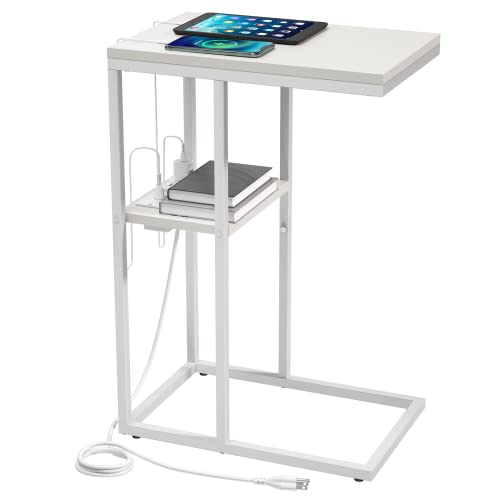
Start with the footprint, because the Yoobure barely has one. The C-shaped frame slides its base beneath the sofa — into space that was already furniture’s, already lost — and cantilevers the top out over the arm or the seat cushion. The result is a full working surface, for a laptop, a book, a drink or a dinner plate, that removes essentially nothing from the room’s usable floor. In a small space, that is not a convenience feature; it is the entire argument, and no conventional table at any price can match it, because conventional tables stand on the floor they serve.
Then the power, which in small spaces is a floor-space issue disguised as an electrical one. A small room has few outlets, and the traditional answer — a power strip with four cables — colonizes a visible patch of the scarcest resource in the home. The Yoobure’s station carries two USB ports and two three-prong outlets, four devices charging at once, mounted on the second tier where a spilled drink on top cannot reach them, on a 6.5-foot cord that finds the wall socket and disappears. Delete the power strip, delete the cable nest, and the small room gains back both floor and calm. The table itself slides between roles in seconds — work surface by day, bedside by night, drinks perch for guests — because in a small home, furniture that cannot migrate is furniture that is in the way half the time. Its price band is the joint-lowest in this guide, check price on Amazon, which fits its role: perfect the infrastructure cheaply, and let the room’s budget concentrate on the pieces that face the eye.
The conditions, stated plainly: the C-form is stable as designed, base tucked under the sofa, and is the least planted pick here if pulled into open floor; its construction is board-and-frame utility, not fine furniture; and the charging tier is a dry zone by household rule. None of these conditions is hard to live with, and all of them together still leave the Yoobure as the highest function-per-inch object in this guide — the first pick for small spaces, and the one most small-space owners would replace first if it vanished.
- Effectively zero footprint: base borrows the under-sofa void, top hovers over the seat.
- Built-in power for four devices deletes the floor power strip and its cable nest.
- Slides between sofa, bed and chair roles in seconds — migration as a feature.
Honest limitation: Stable by design only while tucked under furniture, with utility-grade construction — a brilliant servant, not a showpiece.
Choose it if floor inches and charging are your scarcest resources. Skip it if you need a freestanding table for the middle of open floor.
WELLAND Solid Teak Live Edge End Table
Who it suits: Small-space owners who buy once — the eighteen-inch square of solid hardwood that serves as end table today, plant stand tomorrow and bedside table in the next home.
The WELLAND’s dimensions deserve to lead its review: 18 inches long, 18 inches wide, 20 inches high. That is a genuinely small footprint — smaller than most budget tables — executed in the most permanent material in this guide after marble. It is solid teak throughout, frame, top and base, with the tree’s live edge preserved along the top’s rim. Small spaces are hard on furniture: pieces are bumped during every rearrangement, pressed into multiple roles, and moved between homes more often than house furniture ever is. Teak is the material that treats that life as normal. Its natural oils resist the moisture of daily use, its density shrugs off knocks that would dent softwood or chip laminate, and after years of service a light sanding and oiling returns the surface to beauty. Compact and permanent is a rare combination; this is the guide’s clearest example of it.
The versatility compounds the small-space value. Beside the sofa it is an end table with a lamp. In a studio’s sleeping corner it is a bedside table at a friendly height for low beds. Under a good plant it becomes a stand that raises greenery to window light — in small rooms, vertical gardening is the only gardening, and a teak stand does it handsomely. Its weight for its size keeps it planted in tight circulation paths where lighter small tables skitter. It sits in the accessible-premium band of this guide’s ceiling, check price on Amazon, which for solid hardwood with zero veneer is the quiet bargain of the lineup.
Honest notes: the 20-inch height suits the low seating small spaces favor, and pairs less perfectly with tall traditional sofa arms; the live edge is an organic contour, so a wide-based lamp should sit toward the top’s flatter center; and a matched pair will never match, because nature cuts each top individually. In a small space, where one table is usually the plan anyway, none of that argues against it. It argues for buying the one, well.
- True compact footprint — 18 x 18 inches — in solid, refinishable teak.
- Three-job versatility: end table, bedside table, plant stand, across any floor plan.
- Dense and planted for its size; stays put in tight circulation paths.
Honest limitation: The 20-inch height fits low seating best, and the live edge will not pair symmetrically or host a lamp at its very rim.
Choose it if you want the smallest possible permanent piece. Skip it if you need tall-table height or an identical matched pair.
Nathan James Amalia End Table with Faux Marble Top
Who it suits: Small spaces that feel smaller than they are — rooms needing a table that serves fully while seeming to take up almost nothing.
There are two kinds of small, and the Amalia masters the second: visual smallness. Its round white top — a marble-pattern laminate over engineered wood, model 32402, identified plainly as this guide always does — floats on three splayed solid wood legs, and because the eye passes under the top and between the legs to the floor and wall beyond, the room reads as one continuous space with a table in it, rather than a space interrupted by furniture. Beside a loveseat or an apartment sofa, that transparency is worth inches no tape measure can find. It remains, years after its debut, the silhouette small-space stylists reach for first, because it performs this trick in every decor from mid-century to Japandi to transitional.
The physical virtues serve small spaces too. It is light enough to lift one-handed when the room reconfigures — and small rooms reconfigure constantly, for guests, for workouts, for the Christmas tree’s annual negotiation. Pre-applied furniture pads protect floors from day one. The round top eliminates the hip-catching corner, a real consideration where walkways skim furniture. And its price band, check price on Amazon, is the guide’s joint-lowest, so a small-space buyer can pair it with the Yoobure — one floating table, one hovering surface — and solve both seats for a fraction of the ceiling.
Its limits are a laminate top that cannot be refinished after deep damage, and a light build meant for calm placements rather than a household’s roughest corner. In the small-space brief, those are acceptable trades for the roomiest feeling per dollar in this guide. If your space’s problem is that it feels cramped rather than that it is cramped, this is your pick.
- Floating, see-through silhouette — the room reads larger with it in place.
- Round top spares hips in the tight walkways small spaces impose.
- Featherweight to reposition; pads included; endlessly redeployable.
Honest limitation: Faux marble laminate is not stone and cannot be refinished; the light frame wants calm placements.
Choose it if your space feels cramped more than it measures cramped. Skip it if you need storage, power or a planted anchor.
Christopher Knight Home Hoyt Wood End Table in Walnut
Who it suits: Small spaces with corners — the angled armchair, the sofa that ends at a wall, the nook with one wedge of floor that no square or round table has ever used well.
Every small floor plan has a wedge: a triangular leftover where seating meets a wall at an angle, too small for a real table, too visible to ignore. The Hoyt was shaped for it. Its top is a softened triangle — the maker’s guitar-pick form — 20.08 inches at its widest and standing 22.05 inches high, presenting a broad, lamp-worthy curve to the room while its tapered point slides into the wedge. The space that round tables waste and square tables collide with becomes a working surface: lamp, drink, book, at full sofa-arm height. Christopher Knight Home, among Amazon’s most established furniture brands, backs it with precise published dimensions and light, minutes-long assembly — the support reality that matters when furniture must be right the first time because returning a table from a fourth-floor walk-up is nobody’s hobby.
In the room, the walnut finish and tapered legs give a small space a designed note without visual bulk — present enough to look intentional, light enough to keep the floor plan breathing. It is also the guide’s easiest pick to place asymmetrically: one Hoyt in the corner wedge, an Amalia or the C-table at the other seat, and the room looks curated rather than compromised, a distinction small spaces live and die by. Its price band leaves most of the ceiling unspent, check price on Amazon, funding the lighting that small rooms need in layers.
The honest trade-offs are a working surface smaller than a square cabinet’s — the classic lamp-book-drink trio fits; a laptop lifestyle does not — and a light frame for calm corners. Wedged into its intended geometry, neither matters. The Hoyt does not fight small spaces for room; it finds the room they were hiding.
- Shaped top converts dead corner wedges into full-height working surface.
- Classic 22.05-inch height matches standard sofa arms in compact rooms.
- Brand-backed, precisely dimensioned, light to assemble and move.
Honest limitation: Smaller top than square designs, and a light build suited to calm corners rather than high-traffic bumps.
Choose it if your floor plan has a wedge nothing else fits. Skip it if you need maximum surface, storage or power.
Nathan James Jasper Mid-Century End Table with Fluted Drawer Doors
Who it suits: Small spaces drowning in their own surfaces — rooms where every flat top is covered, because a small home has nowhere else for things to go.
The Jasper’s small-space logic is subtraction. It occupies one honest cabinet footprint — and behind its fluted doors, with their brass handles and natural brown finish, it removes objects from every other surface in the room. Remotes, chargers, notebooks, games, mail: the debris that makes a small room feel half its size lives behind the doors, and the room’s remaining surfaces return to their jobs. In a large home, storage furniture is a convenience. In a small space, it is the difference between a room and a warehouse with a sofa in it. Nathan James builds the Jasper as a planted cabinet — no legs interrupting the floor line, no wobble in tight paths — with a top that still performs full lamp-and-drink duty, so the footprint it claims is repaid twice: once in surface, once in everything it hides.
The fluting deserves its small-space mention: vertical grooves draw the eye upward and make a compact cabinet read as tall and tailored rather than boxy, a useful optical trick where ceiling height is the one dimension a small room sometimes has in surplus. As a current model from an established brand, it carries real support behind it. Its price band sits mid-guide, check price on Amazon — and for a small space, few spends return more visible room per dollar than a door that closes on the clutter.
Measure with the doors in mind: the cabinet claims its full rectangle, and its doors need swing clearance the leggy picks do not. In a gap too narrow, geometry vetoes it, and the C-table or Amalia should take the spot. The grooves also collect dust and ask for a soft brush in the weekly clean. Where it fits, though, the Jasper is the small room’s reset button — the pick for spaces whose problem was never size, but stuff.
- Enclosed storage empties the room’s other surfaces — space created, not consumed.
- Vertical fluting draws the eye up, making a compact cabinet read tall and tailored.
- Planted, legless stance suits tight circulation and stays put when bumped.
Honest limitation: Claims its full cabinet footprint plus door-swing clearance — the one pick that must be measured twice.
Choose it if clutter, not dimensions, is what makes your space feel small. Skip it if your gap is narrower than a cabinet or you want see-through lightness.
FutureStone Luxury Marble Side Table in Calacatta Viola
Who it suits: The finished small space — a compact room that has stopped changing and is ready for one permanent, genuine-material anchor at a modest footprint.
The paradox first: a solid marble pedestal is a compact table. The FutureStone’s square column claims roughly the floor of the guide’s compact picks, while being made of the most substantial material under this ceiling — natural Calacatta Viola marble, violet-veined and polished, shipped fully assembled because stone has nothing to assemble. For the small space that is done evolving — the owned studio, the settled reading room, the compact library corner — that combination answers the small-home dilemma in its final form: when a room can hold few things, each thing should be real. One stone table, holding the best lamp, beside the one good chair: that is not a compromise forced by square footage. It is an aesthetic large rooms imitate.
The stone’s weight, a liability in nomadic small spaces, becomes the anchor’s virtue in a settled one: total stability, a lamp in perfect safety, a surface cool and luminous in a way no substitute has matched. The maker’s care terms are marble’s eternal ones — it is not stain resistant, it etches under acids, it wants coasters — and in a finished, adult small room those terms are easily kept. Check price on Amazon, as stone colorways move through stock; the same pedestal family offers quieter stones if Viola’s drama exceeds your room’s register.
The vetoes, honestly: if your small space is a rental with a move on the horizon, stone’s weight taxes every relocation and its delivery needs two people and a plan; if the table must double as a dining and laptop surface under daily siege, marble’s care contract will chafe. The teak above offers permanence that travels. But for the compact room that has become a home, the FutureStone is the piece that declares it — small, and finished, and furnished in stone.
- Genuine natural marble in a compact pedestal footprint — permanence without sprawl.
- Absolute stability for the room’s best lamp; arrives fully assembled.
- Unique veining gives a small room a focal point no larger room can outbid.
Honest limitation: Heavy to deliver and move, with marble’s coaster discipline — wrong for nomadic or hard-siege small spaces.
Choose it if your small space is settled and ready for its anchor. Skip it if a move is coming or the table must serve as an everyday dining surface.
Comparison Table
| Product | Material | Best small-space use | Link |
|---|---|---|---|
| Yoobure C-Shaped Table with Charging Station | Board and frame with powered tier | Near-zero footprint plus charging — studios and nooks | Check on Amazon |
| WELLAND Live Edge End Table | Solid teak | The smallest permanent piece; three jobs in 18 inches | Check on Amazon |
| Nathan James Amalia | Faux marble laminate, solid wood legs | Making a cramped-feeling room read larger | Check on Amazon |
| Christopher Knight Home Hoyt | Wood, walnut finish | Corner wedges and angled seating layouts | Check on Amazon |
| Nathan James Jasper | Wood cabinet, fluted doors, brass handles | Erasing clutter from every other surface | Check on Amazon |
| FutureStone Marble Side Table, Calacatta Viola | Natural marble stone | The settled small room’s permanent anchor | Check on Amazon |
How to Choose an End Table for a Small Space
- Measure three numbers: gap width, sofa-arm height, walkway clearance. The gap decides the footprint, the arm decides the height (level to two inches below; this guide spans 20 to 22.05 inches), and the walkway decides the shape — round and tapered tops where hips pass close.
- Count the floor the table truly removes. A C-frame removes almost none, borrowing the under-sofa void. A leggy table removes its footprint but not the room’s sightlines. A cabinet removes its full rectangle plus door swing — and repays it in storage. Judge by net space, not by the listing’s footprint line.
- Demand a second job. In a small space, the best table also charges devices, hides clutter, stands a plant at window height, or migrates to the bedroom. A single-purpose table must be exceptionally good at its one job — the teak’s permanence is the guide’s example — to earn the same floor.
- Decide your permanence horizon. Moving within a year or two? Favor the sliders and lifters (Yoobure, Amalia, Hoyt). Settled for years? The anchors (teak, Jasper, marble) repay their weight in daily quality. Mismatching horizon and furniture is the classic small-space regret.
- Protect the sightlines. Small rooms feel larger when the eye travels far. Keep at least one side of the seating leggy or open, and place the solid anchor where it terminates a view rather than blocking one.
- Plan power before placement. Few outlets, all behind furniture: either choose the charging C-table or route the lamp cord along the sofa’s back in advance. A cable crossing a small room’s floor is proportionally enormous.
- Fund the ensemble, not the object. Compact quality is mostly mid-priced; the ceiling’s remainder buys the layered lighting and textiles that make small rooms feel rich rather than sparse.
Making a Small Space Live Larger
The end table’s contribution to a small room extends beyond its footprint, and three habits multiply any pick in this guide. First, light vertically: a taller lamp on a compact table draws the eye up and borrows the room’s one abundant dimension, its height — which is why table and lamp should be chosen together, their combined silhouette slim and tall rather than short and wide. Second, keep one surface sacred: whichever table you choose, hold its top to the lamp-book-drink discipline and let storage (the Jasper’s doors, a lidded basket beneath the Amalia) absorb everything else; a small room with one clear surface reads as calm, and a small room with none reads as storage. Third, let pieces migrate on purpose: the C-table that works by day and sleeps by the bed at night, the teak that stands a plant in spring and holds drinks at Christmas — a small home whose furniture rotates roles feels furnished at twice its inventory.
None of this requires the full ceiling, and that is the honest heart of this guide: small spaces reward judgment more than budget. The budget’s role is to remove the usual excuse — that compact means flimsy — by putting solid teak, real storage cabinetry, engineered C-frames and even genuine marble within reach of an eighteen-inch gap. What remains is measurement and intention, the same conclusion our apartment-focused companion reaches by a different road in Best End Table For Small Apartments Under $1000.
Common Buying Mistakes
- Shopping by photograph instead of by tape measure. Listing photos are shot in large rooms; a table that looks petite online can eat a studio’s only gap. Dimensions first, desire second.
- Paying for footprint you do not have. A cabinet whose doors cannot open, or a square top colliding with a wall wedge, is space spent twice for nothing. Measure swing and angles, not just width.
- Leaving the under-sofa void empty while claiming floor elsewhere. It is the one free footprint in a small home; a C-table is built on it, and ignoring it wastes the room’s best trick.
- Choosing two solid anchors for one small room. A stone pedestal and a cabinet table together can wall off a compact space. One anchor, lightness elsewhere.
- Forgetting the power strip’s footprint. Cables and strips occupy real, visible floor in small rooms. Powered furniture or a planned cord route belongs in the buying decision, not the aftermath.
- Buying nomadic furniture for a settled room — or the reverse. Featherweight pieces in a forever home feel provisional forever; stone in a yearly-move life is a recurring tax. Match the horizon.
- Overfilling the one surface. A small room’s end table styled with eight objects is a shelf with anxiety. Lamp, book, drink — and let the room breathe.
Final Recommendation
- Most small spaces: Yoobure C-Shaped Table with Charging Station.
- Smallest permanent piece: WELLAND Solid Teak Live Edge End Table.
- Best for cramped-feeling rooms: Nathan James Amalia.
- Best for corners and wedges: Christopher Knight Home Hoyt.
- Best for cluttered small rooms: Nathan James Jasper.
- Best settled anchor: FutureStone Luxury Marble Side Table in Calacatta Viola.
Our top two for small spaces are the Yoobure — a working surface and a charging station that together claim almost no floor, the purest small-space engineering in this guide — and the WELLAND teak, the smallest permanent object, eighteen inches of solid hardwood that will serve three roles across three homes. Between them they state the small-space philosophy: borrow space where you can, and where you must spend it, spend it on something real. The Amalia lightens, the Hoyt fits, the Jasper hides, and the marble anchors the room that has finished becoming. Measure the gap, count the jobs, check the live listing, and buy the table your square footage would choose for itself.
Small Spaces Beyond the Living Room
The small-space rubric in this guide — true footprint, function density, visual weight, proportion — was written for living rooms, but small spaces occur all over a home, and the same six tables solve them in instructive ways. The bedroom nook first: a bed pushed near a wall leaves a strip too narrow for most nightstands, and it is exactly the strip the C-table was born for, sliding its base under the bed frame and hovering a surface — book, water, phone on charge — over the mattress edge. Where the strip is wider, the teak’s eighteen inches make a bedside table of genuine material, its 20-inch height meeting a low platform bed at precisely pillow-reach level. The entryway is the second overlooked small space: most homes give it a wall, a door swing and nothing else. The Hoyt’s tapered point respects a door swing that defeats square tables, and the Amalia’s floating profile keeps a narrow hall feeling like a passage rather than a queue of furniture — keys and mail on top, and the space still breathes.
The home office corner — the desk’s overflow zone — is the third. A small workspace sheds paper, chargers and reference books onto whatever surface is nearest, and the Jasper beside a desk is the shedding solved: doors closed, desk clear, the corner reading as intentional. The bathroom and the plant corner make the fourth case, and they belong to the teak and the marble for opposite reasons: teak’s moisture-loving nature suits a plant stand in a bright bathroom or beside a humidifier in a way no laminate should be asked to, while a small marble pedestal in an entry or a dressing corner turns a pass-through patch of floor into the home’s one deliberate moment of luxury — a perfume tray, a watch, a small lamp, on stone. The lesson generalizes beyond this guide’s six products: in small spaces, the winning object is never the one that is merely small. It is the one whose shape, material and second job are all answers to the specific inches it will occupy. Measure those inches, name the job, and the table chooses itself — in every room, not just the one with the sofa.
Measuring a Small Space Like a Professional
Since every recommendation in this guide reduces to measurements, here is the method the measurements deserve. Work with painter’s tape before you work with a cart: mark the candidate table’s footprint on the floor, at full size, and live with the tape for a day. Walk the room’s real routes past it, open the cabinet doors it represents, sit in the seat it will serve and reach — actually reach — for where the drink and the book will be. Tape exposes what imagination hides: the door swing that clips the sofa, the walkway narrowed to a shuffle, the top that lands two inches too low for the arm it serves. Measure the sofa arm’s height from the floor, not from the cushion, and write it down; measure the gap’s width at its narrowest, which is usually at the skirting board, not at eye level. Photograph the taped layout from the doorway, because the doorway view is the room’s truth — it is what you and every guest actually see. Then shop the guide’s dimensions against your tape, in this order: footprint, height, shape, and only then material and style. Small spaces reward this pedantry disproportionately; a large room forgives a wrong table by absorbing it, while a small room presents it to you, at close range, every day. Ten minutes with tape is the cheapest premium upgrade available under any ceiling, and it is the step that turns this guide from reading into results.
A Note on Renting the Table’s Spot to the Future
One last small-space discipline: leave the layout one move of slack. The most common way a well-measured small room goes wrong is not the first arrangement but the second — the new chair, the larger sofa, the desk that arrives with a job change — arriving to find every inch already committed at full price. The picks in this guide were chosen partly for how gracefully they absorb that future: the C-table and the Amalia relocate in seconds, the teak and the Hoyt change rooms without changing character, and even the two anchors, the Jasper and the marble, were placed in their reviews at the spots — against walls, at sightlines — where a room’s plan is most stable. When you place your table, ask the unfashionable question: if the room changes next year, does this piece move, adapt, or obstruct? The small spaces that stay livable for a decade are the ones whose furniture answered that question on day one. Buy for today’s inches, certainly — but buy the piece that tomorrow’s inches will still welcome.
Frequently Asked Questions
What is the best end table shape for a small space?
It depends on the space’s geometry. C-shaped tables win beside sofas because they borrow under-sofa space. Round tables win in tight walkways because they have no corners. Shaped tops win in corner wedges. Compact squares win when the table must also be a plant stand or bedside piece. Measure your gap and let its shape choose the table’s.
How small is too small for an end table top?
A top needs to hold a lamp base, a book and a drink with a little air between them — in practice, about 16 inches across is the comfortable floor for a primary end table. Smaller drink tables work as secondary surfaces, especially C-tables whose top hovers over the seat, but below that range the lamp usually has to live elsewhere.
Can one end table serve a whole studio?
Yes, if it migrates or multitasks. A C-table slides from sofa to bedside; a compact solid table rotates between end table, nightstand and plant stand. Studios punish fixed, single-purpose furniture and reward pieces designed to move — choose mobility and a second job over a second table.
Is marble ever right for a small space?
Yes — in a settled small room, a marble pedestal’s footprint is genuinely compact and its permanence suits a home that has stopped changing. It is the wrong pick when moves are frequent or the surface must absorb daily dining and laptop duty, where its weight and care contract outweigh its beauty.
How do I hide clutter in a small living room?
Give the room one enclosed storage piece at the point of clutter — an end table with doors, like the Jasper in this guide, placed where remotes, chargers and paper actually accumulate. Open surfaces display clutter; doors delete it, and in a small room that single deletion changes how the whole space feels.