Where to buy
Check the latest price, availability and delivery on Amazon. Orders are placed on Amazon. We may earn a commission from qualifying purchases.
- Best overall: SIMPLIHOME Warm Shaker Solid Wood End Table — Check on Amazon
- VASAGLE Side End Table with Charging Station and 2 Drawers — Check on Amazon
- VASAGLE 3-Tier End Table with S-Shaped Steel Frame — Check on Amazon
- Walker Edison Maya Modern Oak Veneer Side Table with Storage — Check on Amazon
- Nathan James Amalia End Table with Solid Wood Legs — Check on Amazon
See 1 more Amazon option
- Kate and Laurel Celia Round Foldable Tray Accent Table — Check on Amazon
Read the full guide ↓
Disclosure: As an Amazon Associate, dailyhomedecorating.com earns from qualifying purchases. Links to Amazon on this page are affiliate links; they cost you nothing extra. Listing details such as price and availability change often, so check the current Amazon listing before you buy.
Finding the best end table under $400 sounds like a generous brief, and in one sense it is: four hundred dollars buys real materials, real joinery and finishes that do not apologize for themselves. But that budget also sits in the most confusing band of the furniture market. At the bottom of it you find flat-pack tables that cost a fraction of the ceiling and spend the difference on nothing at all. At the top you find solid wood, soft-close drawers, charging stations and metalwork that will outlast the sofa it stands beside. The hard part is not spending the money. The hard part is knowing which upgrades actually change daily life — a drawer that swallows the remote clutter, a height that matches your sofa arm, a top that survives a coffee ring — and which ones are just a prettier product photo. This guide sorts that out. We compared end tables across the full under-$400 range on the things that decide whether a table earns its square footage: footprint and height against typical sofa arms, storage layout, frame and top materials, stability on both hard floors and carpet, and how honestly each maker describes what you are getting.
An end table has a deceptively simple job description. It must hold a drink, a book, a lamp and a phone charger within arm’s reach of where you sit, at a height that does not make you reach up or stoop down, in a footprint that does not crowd the walkway or fight the sofa leg. Tables fail that job in predictable ways. They are two inches too short, so mugs perch below the armrest and get knocked by elbows. They are all top and no storage, so the surface disappears under remotes, coasters, chargers and mail within a week. They wobble because a light frame meets a heavy lamp. Or they arrive in a finish that matches nothing, because the listing photos were taken under lighting no living room has. Every pick below was chosen to avoid at least one of those failures outright, and the strongest of them avoid all four.
There is also a quieter reason to choose carefully at this budget: an end table is one of the most-touched objects in a home. You set a hand on it every time you sit down and stand up. You look at its top more often than you look at your coffee table, because it sits in your peripheral vision at reading distance for hours a week. A table that is slightly wrong — slightly wobbly, slightly low, slightly too small for the lamp it carries — does not announce itself as a bad purchase. It just adds a small, daily friction that you eventually stop noticing and never stop paying. The tables below were chosen to remove that friction, each in a different way, so the right way to use this guide is to identify your friction first: the clutter, the cables, the tight gap, the missing surface when guests come. The pick that removes your friction is your best table, even when it is not the most expensive one here.
Our short answer: if you want one table that does everything well for years, start with the solid-wood SIMPLIHOME Warm Shaker, whose drawer-and-shelf layout and honest timber construction make it the easiest recommendation in this guide. If your end table doubles as the family charging hub, the VASAGLE with a built-in charging station and two drawers solves a problem the others simply route around. If open shelving suits your habits better than drawers, the 3-tier VASAGLE puts three levels of storage in a compact square footprint. Modern rooms are served by the Walker Edison Maya and the Nathan James Amalia, and anyone who needs a table that folds away entirely should look at the Kate and Laurel Celia. Shoppers working with a tighter ceiling will find the same framework applied at a lower tier in Best End Table Under $300, while the pages below explain each pick in full.
In this guide
Quick Picks
No time to read the whole guide? This table matches each table to the household it serves best.
| Buyer type | Pick | Why it stands out | Link |
|---|---|---|---|
| Best overall | SIMPLIHOME Warm Shaker Solid Wood End Table | Solid wood build with a drawer and open shelf — the complete, long-lived package | Check on Amazon |
| Best for charging | VASAGLE Side End Table with Charging Station and 2 Drawers | Built-in outlets and USB ports plus two drawers for cable clutter | Check on Amazon |
| Best open storage | VASAGLE 3-Tier End Table with S-Shaped Steel Frame | Three tiers in a compact footprint for books, baskets and display | Check on Amazon |
| Best modern storage table | Walker Edison Maya Oak Veneer Side Table | Clean-lined oak veneer cabinet styling with enclosed storage | Check on Amazon |
| Best compact accent | Nathan James Amalia End Table | Small round profile, solid wood legs and a light footprint | Check on Amazon |
| Best fold-away option | Kate and Laurel Celia Round Foldable Tray Table | Tray top lifts off and the frame folds flat for storage | Check on Amazon |
How These Picks Were Chosen
We began with the budget itself. Every table in this guide is a genuine listing positioned under this guide’s $400 ceiling — check the current price on Amazon before you buy, because furniture pricing moves with sales and finish choices. Within that ceiling we deliberately included a spread: this is a guide about what an under-$400 budget can buy, so it includes honest budget-tier tables alongside the solid-wood and feature-rich models near the top of the band, and it tells you plainly what the extra money does and does not get you at each step.
We did not hands-on test these tables. Instead we compared manufacturer specifications and listing details on the measurements that matter. Height came first: most sofa arms sit roughly between 24 and 28 inches high, and an end table works best within about two inches of the arm height, so we recorded each table’s height and footprint and judged it against that standard. Storage came second — drawer count and depth, shelf spacing, whether storage is open or enclosed — because storage layout, more than style, decides whether a tabletop stays clear. Materials came third: solid wood versus veneer versus engineered board versus steel, and what each means for weight, stability and how the table ages. Finally we weighed assembly and care: how many parts, whether the finish wipes clean, and whether the maker publishes real dimensions rather than leaving you to guess from photographs.
We also scored each table on what might be called second-year satisfaction: the qualities that decide whether you still like a table after the newness fades. Drawers that still glide, finishes that have not yet shown every cup, frames that have not developed a creak — these are predicted by material honesty and construction simplicity, and they are why this guide consistently favors a well-made simple table over a complicated one with more features than its build quality can support. A table is a ten-year object bought in a ten-minute decision; the second-year test is how we tried to give the decision the weight of the decade.
Two filters removed more candidates than any others. The first was dimensional honesty: listings that hid their measurements or showed a table photographed to look substantially larger than its stated size were excluded. The second was stability. An end table holds drinks next to upholstery; a frame that flexes, a top that tips, or legs that splay under a lamp’s weight is not a cosmetic flaw but a functional failure, so spindly designs with no bracing, no lower shelf and no meaningful base weight did not make the cut. What remains is a short list of six tables that each do a defined job well — and the reviews below are candid about the job each one does badly.
The 6 Best End Tables Under $400
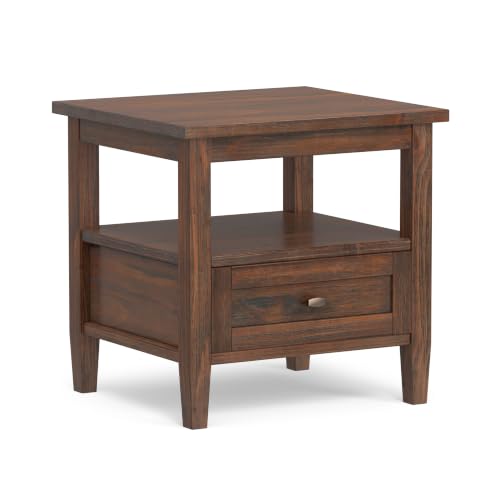
SIMPLIHOME Warm Shaker Solid Wood End Table
Who it suits: Anyone buying an end table once and expecting it to still look right in a decade — traditional, transitional and farmhouse living rooms, and households that want one drawer for the everyday clutter.
The Warm Shaker earns the top spot in this guide for a reason that has become rare in flat-pack furniture: it is made of solid wood. SIMPLIHOME builds the Warm Shaker line from solid pine, and at 20 inches wide it has the square, substantial proportions of a piece of furniture rather than an accessory. That material choice changes everything downstream. Solid wood carries weight without flexing, so a table lamp, a stack of hardbacks and a full mug all sit on a top that does not drum or bow. It takes knocks that would chip veneer into repairable dents. And its Shaker styling — clean lines, a framed drawer front, tapered legs — is deliberately neutral, the kind of design that survives a sofa change, a rug change and two repaintings without looking dated.
The storage layout is the classic done properly: one drawer above an open shelf. The drawer is sized for the objects that actually colonize end tables — remotes, a charger cable, coasters, reading glasses, the notebook you keep meaning to write in — and getting them behind a drawer front is what keeps the top usable for its real job. The open shelf below takes the oversize items a drawer cannot: a coffee-table book, a folded throw, a basket of knitting or games. It is a layout that has worked for a century because it maps onto how people actually use the space beside a sofa, and in this guide only the Warm Shaker offers it in solid wood at this size.
Assembly is the honest price of admission: this is a kit of solid timber parts, heavier than the engineered-board competition, and it rewards a slow, careful build on a soft surface with a second pair of hands for the drawer fitting. The result, though, is a table that feels categorically different from the moment you set a glass down on it. Within this guide’s budget it sits in the mid-to-upper tier — check the current price on Amazon — and we think it is the clearest case in the roundup of money visibly converted into material. If your living room leans modern rather than transitional, the Walker Edison Maya below makes the same storage argument in a cleaner dialect; the Warm Shaker is for rooms that want warmth and permanence.
- Solid pine construction — heavier, sturdier and more repairable than veneer or board.
- Drawer plus open shelf: concealed storage for clutter, open storage for books and throws.
- 20-inch-wide square top with Shaker styling that pairs with most sofa styles.
Honest limitation: Assembly takes longer than the metal-frame picks and the solid wood makes the box heavy to carry; the traditional styling also will not satisfy a strictly minimalist room.
Choose it if you want the buy-it-once table with real storage. Skip it if you need charging ports built in, or your room is committed to a modern, low-profile look.
VASAGLE Side End Table with Charging Station and 2 Drawers
Who it suits: Households whose end table is also the charging hub — phones, tablets, e-readers and a lamp all competing for one outlet — and anyone who wants two drawers of genuinely private storage.
Every living room has one outlet doing the work of four, and the usual solution — a power strip on the floor trailing cables up the table leg — is ugly and mildly chaotic. This VASAGLE attacks the problem at the furniture level: a built-in charging station with AC outlets and USB ports is integrated into the table, so the lamp plugs in at table height and phones charge inside a drawer-adjacent setup instead of dangling off the top. It sounds like a gadget feature until you live with the alternative; the first evening you sit down with a dying phone and simply plug it in where you sit, the feature justifies itself.
The storage is equally considered. Two drawers give you what one drawer cannot: separation. One drawer for the daily objects — remotes, coasters, chargers — and one for the things that need a home but not a display: medication, letters, the good scissors, game controllers. The table’s slim profile is deliberate; VASAGLE designs this line for the narrow gap beside a sofa or between a sofa and a wall, where a full-width table will not fit but a hand’s breadth of space is going to waste. The two-tone finish pairing — a warm greige-toned body with a darker frame in the listing we reviewed — reads more considered than the single-color flat-pack norm.
The trade-offs are the ones built into its category. It is engineered board and steel rather than solid timber, so it will not take a decade of moving-house abuse the way the Warm Shaker will, and the charging station ties the table to a wall outlet — placement is dictated by where your power is, and the cord run needs planning so it does not cross a walkway. It also needs assembly, like everything in this guide. But judged on the job it sets out to do — turning the dead space beside a sofa into a powered, organized station — nothing else in this roundup does it at all, let alone this completely. It sits in the middle of this guide’s budget tier; check the current price on Amazon.
- Built-in charging station with AC outlets and USB ports at table height.
- Two drawers for separated, concealed storage — more useful than one deep drawer.
- Slim profile designed for narrow gaps beside sofas and beds.
Honest limitation: Engineered-board construction is less durable than solid wood, and the charging feature fixes the table’s placement near an outlet.
Choose it if cable clutter and charging are your end table’s real problems. Skip it if you rearrange furniture often or want solid timber.
VASAGLE 3-Tier End Table with S-Shaped Steel Frame
Who it suits: Readers, display-minded decorators and anyone whose storage is books, baskets and objects rather than things that need hiding — in a compact footprint.
Some households do not need drawers because their clutter is not clutter: it is a current book, a backlist stack, a plant, a woven basket of throws. For them, open shelving beats concealed storage, and this VASAGLE is the open-storage specialist of the guide. Three tiers stack inside a footprint of about 15.7 by 15.7 inches, standing roughly 23.6 inches tall — squarely in the useful height band beside most sofa arms — and the S-shaped steel frame that gives the table its name wraps the shelves in a curved profile that looks designed rather than assembled. The rustic brown and black farmhouse finish pairing suits the industrial-farmhouse rooms that dominate current living room style.
The engineering logic is sound. Steel framing carries load without bulk, so each tier can hold a real stack of books rather than a decorative suggestion of one, and the three levels divide naturally: lamp and drink on top, current reading on the middle shelf, the heavy stack or a storage basket on the bottom where the weight helps stability. Because the frame is open on all sides, the table reads light in a room — it does not present a solid block to the eye — which makes it a smart choice where the space beside the sofa is tight but a full cabinet-style table would feel like a wall.
Its limits are the mirror image of its strengths. Open shelves show everything, so if your beside-sofa reality is cables, mail and medication, this table will display your chaos in three tidy rows — choose a drawer model instead. There are no drawers, no doors and no charging, and the open frame offers a drink on the top tier no protection from a passing elbow beyond the top’s own edges. But as a compact, sturdy, three-level storage table at the budget end of this guide — check the current price on Amazon — it is the easiest pick here to recommend to bookish households.
- Three open tiers in a compact roughly 15.7-inch-square footprint, about 23.6 inches tall.
- S-shaped steel frame with rustic farmhouse finish — sturdy and visually light.
- Bottom tier takes heavy book stacks or a basket, aiding stability.
Honest limitation: No concealed storage and no charging; open shelves display clutter rather than hiding it.
Choose it if your storage is books and display objects. Skip it if you need drawers, doors or a place to hide cables.
Walker Edison Maya Modern Oak Veneer Side Table with Storage
Who it suits: Modern and Scandinavian-leaning living rooms that want enclosed storage without the visual weight of traditional furniture.
The Maya is the design-led pick in this guide. Walker Edison finishes it in an oak veneer with a natural wood look, wraps the storage into a clean-lined cabinet form, and keeps the silhouette free of the framed panels and turned legs that make traditional tables look busy in a minimal room. At about 18.25 inches square and 20 inches tall, it is a touch lower and more compact than the Warm Shaker, which suits the low-slung sofas and low-profile sectionals that modern rooms favor — a tall table beside a low sofa arm looks like a stool that wandered in, while the Maya sits at the proportion modern seating actually wants. It weighs around 17 pounds, light enough to reposition when you rearrange, heavy enough not to feel hollow.
The enclosed storage is the functional half of the argument. Where the VASAGLE 3-tier displays and the Warm Shaker splits the difference, the Maya hides: the interior takes the visual noise of modern sitting — streaming remotes, game controllers, chargers, a tangle of earbuds — and closes it away behind a clean front. In a room whose entire aesthetic depends on uncluttered surfaces, that is not a minor feature; it is the feature. The top, meanwhile, is a smooth, uninterrupted square that styles well: lamp, drink, one object, done.
The honest caveats belong to veneer and scale. Oak veneer over a manufactured core looks convincingly like wood because the surface is wood, but it does not forgive damage the way solid timber does — a deep scratch or a long-standing water ring is a cosmetic problem you manage with coasters rather than repair with sandpaper. And at 20 inches tall, it will sit low beside a traditional high-armed sofa; measure your arm height before assuming any modern table fits it. It sits in the upper-middle of this guide’s budget — check the current price on Amazon — and what the money buys is design coherence: this is the table for the room where the end table is part of the look, not just beside it.
- Oak veneer finish with clean, modern cabinet styling.
- Enclosed storage keeps remotes and chargers out of sight.
- Compact roughly 18.25-inch square footprint, about 20 inches tall — proportioned for low modern sofas.
Honest limitation: Veneer cannot be sanded and repaired like solid wood, and the lower height suits low seating better than high-armed traditional sofas.
Choose it if your room is modern and your storage needs hiding. Skip it if your sofa arms are tall or you want solid timber’s repairability.
Nathan James Amalia End Table with Solid Wood Legs
Who it suits: Smaller living rooms and apartment seating areas that need a light, compact accent table — and anyone furnishing a first proper living room on a sensible budget.
The Amalia is the smallest full-time table in this guide: about 18 inches across and 18 inches tall, and under nine pounds, with solid wood legs under a round top in a faux marble-look finish paired with light brown wood tones. Those numbers describe a specific and useful kind of table. It is not trying to be a storage cabinet. It is a perch — for a drink, a book, a small lamp, a plant — that fits the gaps the bigger tables cannot: beside an accent chair, at the end of a loveseat, in the corner where a full-size end table would block the walkway. Its round top has no corners to catch hips in a tight circulation path, which in a compact room is a daily mercy.
Nathan James built its name on exactly this category — apartment-scale furniture with mid-century cues at accessible prices — and the Amalia shows the formula working: splayed solid wood legs that read as a design choice rather than a cost saving, a top finish that photographs and lives like a much more expensive material, and assembly that is a matter of minutes because there is barely anything to assemble. It sits at the budget-friendly end of this guide — check the current price on Amazon — which changes how you can use it: a pair of Amalias flanking a sofa costs less than one premium table, and matching pairs are how living rooms start to look intentional.
Its limits are defined by its size. Eighteen inches of height is low beside a standard sofa arm, so check it against your seating: beside a low lounge chair it is perfect, beside a tall rolled-arm sofa your drink will sit well below the armrest. There is no storage beyond the top itself, and at under nine pounds it is a table to place deliberately, not one that shrugs off a toddler hauling themselves up on it — that job belongs to the Warm Shaker. Judged as what it is — a light, handsome, inexpensive accent perch — it is excellent. Judged as a storage table, it was never in that contest.
- Compact round top, about 18 inches across, with solid wood legs.
- Under nine pounds — easy to move, easy to place in tight gaps.
- Budget-friendly enough to buy as a matched pair.
Honest limitation: Low height beside tall sofa arms, no storage, and too light for households needing a rock-solid anchor table.
Choose it if you need a compact accent beside a chair or loveseat. Skip it if you need drawers, height or heft.
Kate and Laurel Celia Round Foldable Tray Accent Table
Who it suits: Flexible living rooms — hosts who need an extra surface for guests, small homes where a permanent table crowds the room, and anyone who values a table that can disappear.
The Celia plays a different sport from the other five picks. It is a round metal tray table, about 14 inches across and 25.75 inches tall, whose tray top lifts off its base and whose frame folds flat. That folding party trick is the entire point: this is the table you deploy. Guests arrive and the drinks need somewhere to go — deploy it. Movie night needs a surface beside the accent chair — deploy it. Tuesday comes and the room needs its floor back — fold it, and it stores in the sliver of space behind a sofa or inside a closet, waiting. In homes where every permanent object must justify its footprint every single day, a table that justifies itself on demand is a genuinely different and valuable proposition.
The details are better than the folding-table category usually manages. The tray top has a raised lip, which contains the condensation ring and the sliding glass in a way flat tops do not, and the magnetic tabletop connection keeps the tray seated on the frame rather than skating on it. The tall, narrow profile — that 25.75-inch height on a 14-inch footprint — suits it to the bedside-adjacent and chair-side spots where a drink needs to arrive at arm height rather than table height. Kate and Laurel sell the Celia in a wide run of color pairings; the black finish in the listing we linked is the safe modern choice, and the line includes lighter and metallic pairings if your room wants the table to be an accent rather than a utility.
Be clear-eyed about what it is not. It is not storage — the tray is the whole product. It is not a lamp table for a heavy lamp, and a tray top, however well seated, will never feel as planted as a fixed top when you set down a full mug at its edge. It sits at the accessible end of this guide’s budget — check the current price on Amazon — and many households will sensibly own it alongside a permanent table rather than instead of one: the Warm Shaker does the daily work, the Celia appears when life needs an extra surface. As the flexible member of a furniture lineup, it has no real rival in this guide.
- Foldable frame and removable tray top — stores flat behind furniture or in a closet.
- Raised tray lip and magnetic top connection keep drinks contained and the tray seated.
- Tall, narrow profile, about 14 inches across and 25.75 inches tall, for chair-side use.
Honest limitation: No storage at all, and a tray top cannot match a fixed table’s planted feel under heavy items.
Choose it if you need an extra surface on demand. Skip it if you need an everyday anchor table with storage.
Comparison Table
| Product | Storage | Best use | Link |
|---|---|---|---|
| SIMPLIHOME Warm Shaker End Table | Drawer + open shelf, solid wood | The buy-it-once all-rounder | Check on Amazon |
| VASAGLE End Table with Charging Station | 2 drawers + outlets/USB | Charging hub beside the sofa | Check on Amazon |
| VASAGLE 3-Tier End Table | 3 open shelves | Books, baskets and display | Check on Amazon |
| Walker Edison Maya Side Table | Enclosed cabinet storage | Modern rooms, hidden clutter | Check on Amazon |
| Nathan James Amalia End Table | Top only | Compact accent beside chairs | Check on Amazon |
| Kate and Laurel Celia Tray Table | None — folds flat | Guest-ready extra surface | Check on Amazon |
How to Choose an End Table Under $400
Start with height, not style. Measure your sofa or chair arm from the floor. An end table works best within roughly two inches of that height: level with the arm is ideal for setting down drinks, slightly below is fine, and well below turns every mug into a stoop. Most sofa arms fall between about 24 and 28 inches, which is why the 23-to-26-inch band contains so many tables — and why a beautiful 20-inch modern table can be the wrong buy for a traditional sofa no matter how good it looks in the listing.
Decide what the table must swallow. List the objects that live beside your seat for one honest week. If the list is remotes, cables and small clutter, you need a drawer — the Warm Shaker’s single drawer or the VASAGLE charging model’s pair. If it is books and throws, open shelves like the 3-tier VASAGLE serve you better and cost less. If it is nothing but a drink and a lamp, a compact accent like the Amalia frees budget and floor space. Storage you do not need is footprint you did not have to give up.
Match the material to your household’s next decade. Solid wood costs more and shrugs off damage, refinishing and moves. Veneer delivers the modern look at a lower price and asks for coasters in return. Engineered board with steel framing delivers features — charging, tiers, drawers — at the friendliest prices, and asks for gentler handling when you move house. None of these is the wrong answer; the wrong answer is paying for one and expecting another.
Check the footprint against the real gap. Measure the space beside your sofa, then subtract honesty: baseboards, sofa legs that splay, the lamp cord’s path. A table that fits on paper but forces the sofa three inches off the wall has not fit. Round tops like the Amalia’s and the Celia’s forgive tight walkways; square tops like the Warm Shaker’s use corner space fully. If your gap is genuinely narrow, the slim VASAGLE charging table and the folding Celia exist precisely for it, and the small-space treatment in Best End Table For Small Apartments Under $400 goes deeper on measuring.
Think about the second table. Most living rooms need two end tables eventually. Buying one excellent table now and its match later is fine — but confirm the model is a continuing line rather than a one-season listing, or buy the pair together. Mismatched heights on either side of a sofa are the kind of small wrongness you will notice every day for years.
Weigh stability like it matters, because it does. An end table’s worst failure is not ugliness; it is a tipped drink across a light-colored sofa. Heavier tables with a low center of gravity — a solid-wood body, a lower shelf loaded with books, a steel frame with a wide stance — forgive bumps that a light, top-heavy accent table cannot. If your household includes large dogs, climbing toddlers or a sofa that doubles as a launchpad, stability should outrank almost every other criterion, and the wobble test matters more than the finish name: set the assembled table on a hard floor, press each corner, and expect silence. Any table in this guide can pass that test when assembled carefully; the lighter picks simply have less margin for a careless build.
Plan the surface, not just the table. Before you buy, lay out what the top must hold at its busiest: typically a lamp base, a drink on a coaster, a phone and the book you are actually reading. Sketch those footprints on paper at the size of the top you are considering. A 20-inch square top swallows that layout easily; an 18-inch round top holds it with choreography; a 14-inch tray holds the drink and the phone and asks the book to live elsewhere. None of those answers is wrong, but choosing the top after the layout — rather than discovering the layout after the top arrives — is the difference between a table that feels generous and one that feels like a negotiation every evening.
Common Mistakes When Buying an End Table
Buying by photograph instead of dimensions. Listing photos make small tables look grand and large tables look neat. The dimensions are the product; the photo is advertising. A 14-inch tray table and a 20-inch cabinet table solve different problems, and no amount of styling changes which one you received.
Ignoring the arm-height rule. A table dramatically lower than the sofa arm turns setting down a hot drink into a small daily hazard, and one dramatically higher crowds the seat and catches elbows. Two minutes with a tape measure prevents years of it.
Paying for the ceiling instead of the need. An under-$400 budget tempts shoppers to spend all of it. If your honest need is a perch beside a reading chair, the Amalia at the budget end of this guide is not a compromise — it is the correct purchase, and the saved money buys the lamp. Spend up when the upgrade is storage, material or a feature you will use weekly, not because the budget allowed it.
Forgetting the lamp. Most end tables carry a lamp, and lamps have bases, cords and weight. A table whose top is fully consumed by a lamp base has no room left for the drink it exists to hold. Add the lamp’s footprint to your own needs before choosing a top size — or pick a table, like the charging VASAGLE, that plans for powered objects from the start.
Skipping the wobble test after assembly. Flat-pack tables that wobble on day one were usually assembled on carpet, tightened in the wrong order, or are standing on an uneven floor. Re-tighten on a hard surface in sequence, check the floor, and only then conclude the table is at fault. Ten minutes of method beats a return.
Final Recommendation
For most living rooms, the answer is the SIMPLIHOME Warm Shaker: solid wood, the right drawer-and-shelf layout, proportions that suit the majority of sofas, and styling that will outlast your current decor. It is the table in this guide we would buy with our own money for a room we intended to keep. If your beside-sofa reality is defined by charging cables and devices, go straight to the VASAGLE charging table instead — it solves the problem the others leave on the floor. Round out the picture with the 3-tier VASAGLE for open book storage, the Walker Edison Maya for modern rooms, the Nathan James Amalia for compact accent duty, and the Kate and Laurel Celia as the fold-away extra every hosting household eventually wishes it owned.
Frequently Asked Questions
How tall should an end table be? Within about two inches of your sofa arm’s height — level is ideal. Most sofa arms measure roughly 24 to 28 inches from the floor, so tables in the 22-to-27-inch range fit most seating; lower modern tables suit lower modern sofas.
Is solid wood worth it in an end table under $400? If you will keep the table for years and your household is hard on furniture, yes: solid wood resists flexing, can be repaired, and ages gracefully. If your priority is features like charging or a modern veneer look, your money does more work elsewhere — see the VASAGLE and Walker Edison picks above.
End table vs side table — is there a difference? In practice, no. Retailers use the terms interchangeably for the small table placed beside seating. Shop by dimensions, storage and height rather than by which word the listing uses.
How many end tables does a living room need? One per primary seat is the comfortable standard — typically one at each end of a sofa, or one beside each armchair. A single table plus a flexible folding option like the Celia is a good pattern for smaller rooms.
Can an end table hold a TV or heavy equipment? These tables are designed for lamps, books and drinks, with tops sized accordingly. Check the maker’s stated weight capacity on the listing before placing anything heavy, and never use a light accent or tray table as equipment furniture.
What is the difference between a drawer table and an open-shelf table in daily life? Drawers hide visual clutter and keep small objects dust-free and contained, but everything inside is invisible until you open them — out of sight genuinely becomes out of mind. Open shelves keep books and objects visible and reachable, which suits readers and anyone who uses the same few items daily, but they show dust and disorder equally. Many households end up happiest with one of each at opposite ends of the sofa.
Should both end tables match? Matching pairs give a room its most finished, deliberate look, and they guarantee equal heights on both sides of the sofa. Deliberately mismatched tables can work when they share a height, a material family or a color, but accidental mismatch — two heights, two woods, two eras — reads as unfinished rather than eclectic. If you are buying one now and one later, photograph the first in daylight and keep its exact model name and finish saved.